


Titus 3:13
- ΖηνᾶνZēnanZenasG2211N-ASM-PNoun Accusative Singular Masculine Individual
- τὸνtontheG3588T-ASMDefinite article Accusative Singular Masculine
- νομικὸνnomikonlawyerG3544A-ASMAdjective Accusative Singular Masculine
- καὶkaiandG2532CONJConjunction
- ἈπολλῶνApollōnApollosG625N-ASM-PNoun Accusative Singular Masculine Individual
- σπουδαίωςspoudaiōsearnestlyG4709ADVAdverb
- πρόπεμψονpropempsondo equipG4311V-AAM-2SVerb Aorist Active Imperative 2nd Singular
- ἵναinaso thatG2443CONJConjunction
- μηδὲνmēdennothingG3367A-NSNAdjective Nominative Singular Neuter
- αὐτοῖςautoisto themG846P-DPMPersonal pronoun Dative Plural Masculine
- λείπῃleipēmay be lackingG3007V-PAS-3SVerb Present Active Subjunctive 3rd Singular
English is a literal word-by-word gloss of the Greek, not the KJV's wording. Why?
This is the original text the KJV's translators worked from — each Greek word with its own literal English meaning in this verse, prepared by scholars at Tyndale House, Cambridge. The KJV translates whole sentences, not word by word, so its wording differs: one Greek word can become several English words, and the KJV may choose “charity” where the gloss reads “love”. Both are faithful — they answer different questions. For the KJV's own rendering, switch to the KJV text.
Details
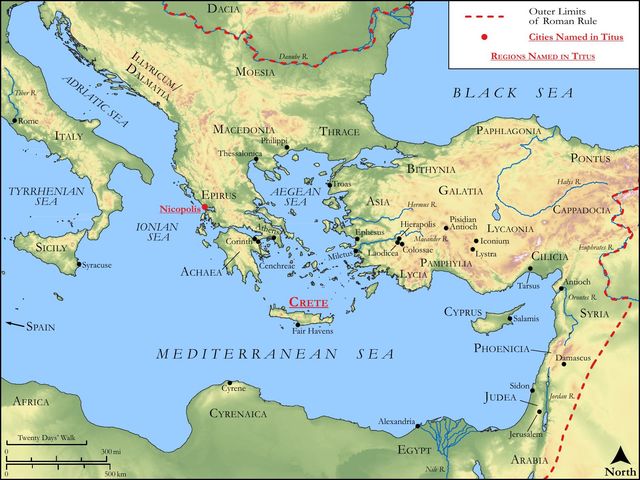
See on the biblical-era map

Study this verse
Public-domain commentary
Matthew Henry
From his Commentary on the Whole Bible. Henry comments on passages, not single verses — this entry covers Titus 3:9–15. His two-level outline is real structure in the source text, so it is rendered as structure.
Here is the fifth and last thing in the matter of the epistle: what Titus should avoid in teaching; how he should deal with a heretic; with some other directions. Observe,
I.That the apostle's meaning might be more clear and full, and especially fitted to the time and state of things in Crete, and the many judaizers among them, he tells Titus what, in teaching, he should shun, Tit 3:9. There are needful questions to be discussed and cleared, such as make for improvement in useful knowledge; but idle and foolish enquiries, tending neither to God's glory nor the edification of men, must be shunned. Some may have a show of wisdom, but are vain, as many among the Jewish doctors, as well as of later schoolmen, who abound with questions of no moment or use to faith or practice; avoid these. - And genealogies (of the gods, say some, that the heathen poets made such noise about; or rather those that the Jews were so curious in): some lawful and useful enquiries might be made into these things, to see the fulfilling of the scriptures in some cases, and especially in the descent of Christ the Messiah; but all that served to pomp only, and to feed vanity, in boasting of a long pedigree, and much more such as the Jewish teachers were ready to busy themselves in and trouble their hearers with, even since Christ had come, and that distinction of families and tribes had been taken away, as if they would build again that policy which now is abolished, these Titus must withstand as foolish and vain. - And contentious, and strivings about the law. There were those who were for the Mosaic rites and ceremonies, and would have them continued in the church, though by the gospel and the coming of Christ they were superseded and done away. Titus must give no countenance to these, but avoid and oppose them; for they are unprofitable and vain: this is to be referred to all those foolish questions and genealogies, as well as those strivings about the law. They are so far from instructing and building up in godliness, that they are hindrances of it rather: the Christian religion, and good works, which are to be maintained, will hereby be weakened and prejudiced, the peace of the church disturbed, and the progress of the gospel hindered. Observe, Ministers must not only teach things good and useful, but shun and oppose the contrary, what would corrupt the faith, and hinder godliness and good works; nor should people have itching ears, but love and embrace sound doctrine, which tends most to the use of edifying.
II.But because, after all, there will be heresies and heretics in the church, the apostle next directs Titus what to do in such a case, and how to deal with such, Tit 3:10. He who forsakes the truth as it is in Christ Jesus, who broaches false doctrines and propagates them to the corrupting of the faith in weighty and momentous points, and breaks the peace of the church about them, after due means used to reclaim him, must be rejected. "Admonish him once and again, that, if possible, he may be brought back, and thou mayest gain thy brother; but, if this will not reduce him, that others be not hurt, cast him out of the communion, and warn all Christians to avoid him." - Knowing that he that is such is subverted (turned off from the foundation) and sinneth grievously, being self-condemned. Those who will not be reclaimed by admonitions, but are obstinate in their sins and errors, are subverted and self-condemned; they inflict that punishment upon themselves which the governors of the church should inflict upon them: they throw themselves out of the church, and throw off its communion, and so are self-condemned. Observe, 1. How great an evil real heresy is, not lightly therefore to be charged upon any, though greatly to be taken heed of by all. Such a one is subverted or perverted - a metaphor from a building so ruined as to render it difficult if not impossible to repair and raise it up again. Real heretics have seldom been recovered to the true faith: not so much defect of judgment, as perverseness of the will, being in the case, through pride, or ambition, or self-willedness, or covetousness, or such like corruption, which therefore must be taken heed of: "Be humble, love the truth and practise it, and damning heresy will be escaped." 2. Pains and patience must be used about those that err most grievously. They are not easily and soon to be given up and cast off, but competent time and means must be tried for their recovery. 3. The church's means even with heretics are persuasive and rational. They must be admonished, instructed, and warned; so much nouthesia imports. 4. Upon continued obstinacy and irreclaimableness, the church has power, and is obliged, to preserve its own purity, by severing such a corrupt member which discipline may by God's blessing become effectual to reform the offender, or if not it will leave him the more inexcusable in his condemnation.
III.The apostle subjoins some further directions, Tit 3:12, Tit 3:13. Here are two personal things enjoined: -
1.That Titus should hold himself ready to come to Paul at Nicopolis (a city of Thrace, as is reckoned, on the borders of Macedonia), as soon as Artemas or Tychicus should be sent to Crete, to supply his place, and take care of the churches there when he should leave them. The apostle would not have them in their young and weak state be without one or other of chief sufficiency, to guide and help them. Titus, it seems, was not their ordinary fixed bishop or pastor, but an evangelist, otherwise Paul would not have called him so much from his charge. Of Artemas we read little, but Tychicus is mentioned on many occasions with respect. Paul calls him a beloved brother, and faithful minister, and fellow-servant in the Lord: one fit therefore for the service intimated. When Paul says to Titus, Be diligent to come to me to Nicopolis, for I have determined there to winter, it is plain that the epistle was not written from Nicopolis, as the postcript would have it, for then he would have said, I determined here, not there, to winter.
2.The other personal charge to Titus is that he would bring two of his friends on their journey diligently, and see them furnished, so that nothing should be wanting to them. This was to be done, not as a piece of common civility only, but of Christian piety, out of respect both to them and the work they were sent about, which probably was to preach the gospel, or to be in some way serviceable to the churches. Zenas is styled the lawyer, whether in reference to the Roman or the Mosaic law, as having some time been his profession, is doubtful. Apollos was an eminent and faithful minister. Accompanying such persons part of their way, and accommodating them for their work and journeys, was a pious and needful service; and to further this, and lay in for it, what the apostle had before exhorted Titus to teach (Tit 3:8) he repeats here: Let ours also learn to maintain good works for necessary uses, that they be not unfruitful, Tit 3:14. Let Christians, those who have believed in God, learn to maintain good works, especially such as these, supporting ministers in their work of preaching and spreading the gospel, hereby becoming fellow-helpers to the truth, Jo3 1:5-8. That they be not unfruitful. Christianity is not a fruitless profession; the professors of it must be filled with the fruits of righteousness, which are by Jesus Christ, to the glory and praise of God. It is not enough that they be harmless, but they must be profitable, doing good, as well as eschewing evil. - "Let ours set up and maintain some honest labour and employment, to provide for themselves and their families, that they be not unprofitable burdens on the earth;" so some understand it. Let them not think that Christianity gives them a writ of ease; no, it lays an obligation upon them to seek some honest work and calling, and therein to abide with God. This is of good report, will credit religion and be good to mankind; they will not be unprofitable members of the body, not burdensome and chargeable to others, but enabled to be helpful to those in want. To maintain good works for necessary uses; not living like drones on the labours of others, but themselves fruitful to the common benefit.
IV.The apostle concludes with salutations and benedictions, Tit 3:5.
Though perhaps not personally known (some of them at least), yet all by Paul testify their love and good wishes to Titus, owning him thereby in his work, and stimulating him to go on therein. Great comfort and encouragement it is to have the heart and prayers of other Christians with and for us. Greet those that love us in the faith, or for the faith, who are our loving fellow-christians. Holiness, or the image of God in any, is the great endearing thing that gives strength to all other bonds, and is itself the best. Grace be with you all. Amen. This is the closing benediction, not to Titus alone, but to all the faithful with him, which shows that though the epistle bears the single name of Titus in the inscription, yet it was for the use of the churches there, and they were in the eye, and upon the heart, of the apostle, in the writing of it. "Grace be with you all, the love and favour of God, with the fruits and effects thereof, according to need, spiritual ones especially, and the increase and feeling of them more and more in your souls." This is the apostle's wish and prayer, showing his affection to them, his desire of their good, and a means of obtaining for them, and bringing down upon them, the thing requested. Observe, Grace is the chief thing to be wished and begged for, with respect to ourselves or others; it is, summarily, all good. Amen shuts up the prayer, expressing desire and hope, that so it may, and so it shall be.
Historical interpretation
Six Centuries of Reception
4 surviving comments on this verse. Each one is dated, so this reads as a timeline rather than a list.
Select a marker to jump to its quote. Markers stagger vertically where authors wrote within a few decades of each other.
Ver. 14. "Bring Zenas the lawyer and Apollos on their journey diligently, that nothing be wanting unto them."
These were not of the number to whom Churches had been intrusted, but of the number of his companions. But Apollos was the more vehement, being "an eloquent man, and mighty in the Scriptures." (Acts xviii. 24.) But if Zenas was a lawyer, you say, he ought not to have been supported by others. But by a lawyer here is meant one versed in the laws of the Jews. And he seems to say, supply their wants abundantly, that nothing may be lacking to them.
Send Zenam, the learned in the law, and hasten to send Apollo, so that nothing may be lacking to them. This is the Apollo of whom mention is made in the epistle to the Corinthians: Every one of you saith: I indeed am of Paul; and I am of Apollo; and I am of Cephas (1 Cor. I, 12). He was an Alexandrian man, a Jew, very eloquent, and skilful in the scriptures; he was the bishop of the Corinthians; and he is supposed to have gone to the island of Crete with Zenas, the doctor of the law, and to have returned thence to Corinth, after having there regulated the Christian church by his preaching; as Paul too had done by his epistle. But we cannot say who the old testament lawyer was from another passage of scripture, except only this, that he himself, as an apostolic man, had the same work which Apollo exercised: to establish the churches of Christ. Therefore, Titus commands that since they were about to sail from Crete to Greece, he should not allow them to be in need of the bare necessities, but should have what is necessary for a journey.
Nevertheless, after the apostle had said in such instruction and advice: “Now such persons we charge and exhort in the Lord Jesus Christ that they work quietly and eat their own bread,” he was mindful of such needs of the holy persons who, although they would obey his commands to work quietly and eat their own bread, would, for many reasons, lack some provision of such necessary commodities. Hence, with foresight he added immediately: “But you, brothers, do not grow tired of well-doing,” so that those who had the means of furnishing sustenance to the servants of God would not grow careless in this respect. Furthermore, when in writing to Titus he said: “Help Zenas the lawyer and Apollos on their way, taking care that nothing be wanting to them.” He continued thus, in order to show why nothing should be lacking in their regard: “And let the people also learn to excel in good works, in order to meet cases of necessity, that they may not be unfruitful.”
I have earnestly sent Zenas the lawyer and Apollos, so that nothing may be lacking for them.
I have earnestly sent Zenas the lawyer. Experienced in the Jewish laws. Yet these had not yet been entrusted to the Church. But Apollos was a certain great man, both learned and mighty in the Scriptures.
so that nothing may be lacking for them. In every abundance, provide for them, perhaps with food and clothing.
Continue studying Titus 3:13 across the web’s major study libraries — every link below opens this exact verse, chapter, or book on the destination site.
Read & Compare
 BibleGatewayThis verse in more than 200 translations and 70 languages.
 Bible.comThe YouVersion reader — hundreds of translations, reading plans, and highlights.
 ESV.orgCrossway's official English Standard Version reader.
 NET BibleThe NET translation with 60,000+ translators' notes on every rendering decision.
 STEP BibleTyndale House's free study tool — original text, vocabulary, and scholarly resources.
 BibliaLogos Bible Software's free web reader.
 USCCBThe New American Bible (Revised Edition) with the U.S. bishops' study notes.
Commentaries
 BibleHub CommentariesDozens of classic commentaries on this verse, gathered on one page.
 StudyLightMore than 100 commentary sets — the largest collection on the web.
 BibleRefPlain-English commentary on what this verse means, verse by verse.
 Enduring WordDavid Guzik's free commentary on this chapter, widely used by Bible teachers.
 Bible Study ToolsVerse commentary alongside Greek and Hebrew study aids.
Original Language & Research
- BibleHub InterlinearThe verse word by word — original language, transliteration, and English.
- BibleHub LexiconEvery word's original-language definition and Strong's entry.
 Blue Letter BibleDeep-study tools — Strong's numbers, concordance, and word studies.
 CNTR CollationThe earliest Greek manuscripts of this verse, collated letter by letter.
Sermons, Hymns & Audio


TrulyRandomVerse is not affiliated with these sites and doesn’t control their content. They’re linked because they’re genuinely useful.
Summary
Titus 3:13 serves as a concise yet profound directive from the Apostle Paul to Titus, his apostolic delegate on Crete. This verse instructs Titus to provide diligent and thorough support for two traveling companions, Zenas the lawyer and Apollos, ensuring all their needs are met for their journey. It underscores the vital importance of Christian hospitality and practical care for those engaged in ministry, reflecting a foundational principle of mutual support within the early church and enabling the unhindered proclamation of the Gospel.
Context
ShowHideLiterary Context
This verse appears in the concluding section of Paul's letter to Titus, following a robust theological exposition on the grace of God and the transformative power of salvation. Paul has just exhorted Titus to remind the Cretan believers of their past sinful state and their present salvation "not by works of righteousness which we have done, but according to his mercy" Titus 3:3-7. This theological foundation is immediately followed by a call to practical godliness and "good works" Titus 3:8, which are beneficial and profitable for people. The instruction to care for Zenas and Apollos is a concrete example of such "good works," demonstrating the outworking of faith in tangible acts of love and support for fellow laborers in the Gospel. It transitions from general exhortations to specific, personal instructions, reflecting Paul's administrative and pastoral care for his co-workers.
Historical & Cultural Context
In the ancient world, travel was arduous and often dangerous. There were no organized systems of public accommodation comparable to modern hotels; inns were often disreputable and unsafe. Therefore, Christian travelers, especially those engaged in itinerant ministry, relied heavily on the hospitality of fellow believers. This practice was a hallmark of the early church, demonstrating the unity and mutual care within the body of Christ. Crete, where Titus was ministering, was a challenging environment, and the nascent churches there would have been learning these principles of Christian community. Zenas and Apollos were likely traveling on a mission related to the spread of the Gospel or the administration of the churches, making their safe passage and provision a matter of spiritual significance. The mention of Zenas as a "lawyer" (Greek: nomikos) is notable, suggesting he was an expert in either Jewish Mosaic Law or Roman civil law, indicating a person of education and perhaps influence who had converted to Christianity. Apollos, in contrast, was a well-known and influential figure in the early church, whose eloquent teaching had made a significant impact in places like Corinth 1 Corinthians 3:4-6.
Key Themes
ShowHideThis verse powerfully illustrates several key themes prevalent in the New Testament. Firstly, Christian hospitality is paramount, reflecting the love of God extended to fellow believers and strangers alike Romans 12:13, Hebrews 13:2. Secondly, the support for ministry is emphasized, highlighting the church's responsibility to provide for those who dedicate their lives to preaching and teaching the Gospel, enabling them to focus on their spiritual tasks without material hindrance 1 Corinthians 9:14. Paul himself often relied on the generosity of believers, as seen in his relationship with the Philippian church Philippians 4:16. Thirdly, the instruction to act "diligently" underscores the theme of earnestness and thoroughness in service, not just fulfilling an obligation but doing so with zeal and care, ensuring that all needs are truly met.
Exposition and Analysis
ShowHideKey Word Analysis
ShowHideProbably contracted from a poetic form of Zeus and dōron (gift); Jove-given; Zenas, a Christian. This name suggests a pagan origin, perhaps indicating his background before conversion. His designation as "the lawyer" (G3544 nomikós) further identifies him as an expert in law, either Jewish or Roman, making him a person of intellectual standing.
From nomos (law); according (or pertaining) to law, i.e., legal (ceremonially); as noun, an expert in the (Mosaic) law. This term indicates Zenas's professional background, suggesting he was a learned individual. His expertise could have been valuable in disputations or in understanding the Old Testament law in light of Christ.
From pro (before) and pempō (to send); to send forward, i.e., escort or aid in travel. This word implies more than just sending them off; it means to provide for their needs on the journey, to equip them, and potentially to accompany them for a portion of the way, ensuring their safe and well-supplied passage.
Adverb from spoudaios (earnest); earnestly, promptly. This adverb emphasizes the manner in which Titus is to assist Zenas and Apollos. It denotes zeal, eagerness, and thoroughness, ensuring that the task is not done grudgingly or minimally, but with full commitment and care.
A primary verb; to leave, i.e. (intransitively or passively) to fail or be absent; be destitute (wanting), lack. This word describes the desired outcome of Titus's diligence: that Zenas and Apollos should lack nothing essential for their journey and ministry. It highlights the practical goal of the support provided.
Verse Breakdown
ShowHide"Bring Zenas the lawyer and Apollos on their journey diligently,"
Paul issues a direct command to Titus to provide comprehensive support for Zenas and Apollos. "Bring... on their journey" (G4311 propémpō) signifies not merely sending them off, but actively assisting them with provisions, escort, and any necessary arrangements for their travel. The inclusion of Zenas, identified by his profession as "the lawyer," alongside the well-known Apollos, indicates that both individuals, regardless of their public prominence, were valued co-laborers in the Gospel deserving of the church's care. The adverb "diligently" (G4709 spoudaíōs) underscores the earnest, zealous, and thorough manner in which this assistance is to be rendered, implying a proactive and generous spirit.
"that nothing be wanting unto them."
This clause states the clear purpose and desired outcome of Titus's diligent efforts. The phrase "that nothing be wanting" (G3007 leípō) means that Zenas and Apollos should experience no lack or deficiency in their provisions, resources, or support. The aim is to ensure that their journey and their ongoing ministry are unhindered by material needs, allowing them to focus fully on their spiritual tasks and responsibilities without distraction or hardship. This reflects the principle of enabling and empowering God's servants for effective ministry.
Literary Devices
ShowHideThe verse employs several literary devices to convey its message effectively. The most prominent is the Imperative Mood of the verb "Bring" (propémpō), which functions as a direct command from Paul to Titus, highlighting Paul's apostolic authority and the urgency and importance of the task. This is further reinforced by the Purpose Clause, "that nothing be wanting unto them," which clearly articulates the intended outcome of Titus's actions, emphasizing the practical and pastoral aim of the directive. There is also a subtle Juxtaposition in mentioning Zenas, an otherwise unknown figure identified by his profession, alongside Apollos, a prominent and well-known leader in the early church. This serves to illustrate that Christian hospitality and support are to be extended to all fellow laborers, regardless of their public profile or level of fame. Finally, the phrase "on their journey" can be seen as a form of Synecdoche, where the journey itself stands for all the associated needs of travel, including food, lodging, safety, and financial provisions, underscoring the comprehensive nature of the required support.
Theological and Thematic Connections
ShowHideThis seemingly simple instruction carries profound theological weight, underscoring the interconnectedness and mutual responsibility within the body of Christ. It demonstrates that the practical outworking of faith is not merely about personal piety but extends to active, generous support for those who serve the Lord, especially itinerant ministers. The church's commitment to ensuring "nothing be wanting" for its workers reflects a deep understanding of stewardship, partnership in the Gospel, and the value of enabling unhindered ministry. It is a tangible expression of Christian love and fellowship, recognizing that when one part of the body is supported, the whole body benefits in its mission to proclaim the good news. This principle ensures that those who sow spiritual seed are sustained by those who reap material blessings, fostering a symbiotic relationship essential for the advancement of God's kingdom.
Reflection and Application
ShowHideTitus 3:13 offers a timeless blueprint for how believers and churches ought to support those engaged in Christian ministry. It challenges us to move beyond passive acknowledgment to active, diligent provision. In our contemporary context, this means actively identifying and meeting the needs of our pastors, missionaries, church staff, and Christian workers, whether through financial support, practical assistance, prayer, or hospitality. It calls for a generous and proactive spirit, ensuring that those who dedicate their lives to spreading the Gospel are not hindered by material lack or logistical burdens. Furthermore, the emphasis on "diligently" reminds us that our service should be marked by excellence, thoroughness, and genuine care, reflecting a heart that truly desires to see God's work flourish. This verse encourages us to view our resources—time, talent, and treasure—as tools for partnership in the Gospel, enabling others to fulfill their divine calling.
Questions for Reflection
ShowHideFAQ
ShowHideWho were Zenas and Apollos, and why were they traveling?
ShowHideZenas is mentioned only here in the New Testament. He is identified as "the lawyer" (nomikos), suggesting he was an expert in either Jewish Mosaic Law or Roman civil law, and was now a Christian. Apollos, in contrast, was a prominent and eloquent Christian teacher from Alexandria, well-known from Acts 18:24-28 and 1 Corinthians 1:12. The specific reason for their travel to or from Crete is not stated, but it is highly probable they were engaged in itinerant ministry, perhaps delivering Paul's letter to Titus, or serving other churches in the region, making their journey part of the broader apostolic mission.
What does "diligently" mean in this context?
ShowHideThe Greek word translated "diligently" is spoudaíōs (G4709), which means with earnestness, zeal, promptness, or thoroughness. It implies more than just providing minimal assistance; it denotes an active, eager, and careful effort to ensure that all the necessary provisions and arrangements for Zenas and Apollos's journey are fully and adequately met. It reflects a heart of genuine care and commitment to their well-being and the success of their ministry.
Why was it important that "nothing be wanting unto them"?
ShowHideIn the ancient world, traveling was difficult, and ministers often relied on the hospitality of local believers. Ensuring "nothing be wanting unto them" (G3007 leípō) was crucial for several reasons: it allowed Zenas and Apollos to focus fully on their spiritual work without being distracted or hindered by material needs or logistical concerns; it demonstrated the practical love and support of the Christian community; and it upheld the dignity of those serving the Gospel. By providing for their needs, the church was actively partnering in their ministry and enabling the unhindered proclamation of God's word.
Christ-Centered Fulfillment
ShowHideThe directive to diligently provide for Zenas and Apollos finds its ultimate fulfillment and motivation in the person and work of Jesus Christ. Our Lord Himself, though sovereign, often depended on the hospitality and support of others during His earthly ministry Luke 8:1-3. He taught His disciples about the importance of hospitality, equating acts of kindness to His followers with acts of kindness to Himself Matthew 25:35-40. Thus, when Paul instructs Titus to ensure "nothing be wanting" for these ministers, he is calling the church to embody the very care and provision that Christ demonstrated and commanded. The church, as the body of Christ, continues His mission in the world, and supporting His messengers is a direct extension of His ongoing work. Furthermore, the concept of "nothing wanting" points to Christ as the one who ultimately provides all things for His people, having left nothing wanting in His perfect redemptive work on the cross Philippians 4:19. His sacrifice was so complete that it leaves nothing more to be done for our salvation, perfectly fulfilling God's will Hebrews 10:14. Therefore, our diligence in serving others reflects the perfect diligence of Christ's finished work, and our provision for His servants echoes His boundless provision for us.