


Titus 3:14
Bible text: King James Version (1769 Blayney text) · Public domain
Bible text: Berean Standard Bible · Public domain
Bible text: American Standard Version (1901) · Public domain
Bible text: World English Bible, Messianic edition · Public domain
Bible text: Geneva Bible (1599) · Public domain
Bible text: Young's Literal Translation · Public domain
- μανθανέτωσανmanthanetōsanshould learnG3129V-PAM-3PVerb Present Active Imperative 3rd Plural
- δὲdenowG1161CONJConjunction
- καὶkaialsoG2532CONJConjunction
- οἱhoi<the>G3588T-NPMDefinite article Nominative Plural Masculine
- ἡμέτεροιhēmeteroiour own [people]G1473S-1PNPMPossessive pronoun Nominative 1st Person Plural Masculine
- καλῶνkalōnto goodG2570A-GPNAdjective Genitive Plural Neuter
- ἔργωνergōnworksG2041N-GPNNoun Genitive Plural Neuter
- προΐστασθαιproistasthaito devote themselvesG4291V-PMNVerb Present Middle Infinitive
- εἰςeisforG1519PREPPreposition
- τὰςtas<the>G3588T-APFDefinite article Accusative Plural Feminine
- ἀναγκαίαςanagkaiasnecessaryG316A-APFAdjective Accusative Plural Feminine
- χρείαςchreiasneedsG5532N-APFNoun Accusative Plural Feminine
- ἵναinaso thatG2443CONJConjunction
- μὴmēnotG3361PRT-NNegative Particle Negative
- ὦσινōsinthey may beG1510V-PAS-3PVerb Present Active Subjunctive 3rd Plural
- ἄκαρποιakarpoiunfruitfulG175A-NPMAdjective Nominative Plural Masculine
English is a literal word-by-word gloss of the Greek, not the KJV's wording. Why?
This is the original text the KJV's translators worked from — each Greek word with its own literal English meaning in this verse, prepared by scholars at Tyndale House, Cambridge. The KJV translates whole sentences, not word by word, so its wording differs: one Greek word can become several English words, and the KJV may choose “charity” where the gloss reads “love”. Both are faithful — they answer different questions. For the KJV's own rendering, switch to the KJV text.
Details
See on the biblical-era maps

Study this verse
Public-domain commentary
Matthew Henry
From his Commentary on the Whole Bible. Henry comments on passages, not single verses — this entry covers Titus 3:9–15. His two-level outline is real structure in the source text, so it is rendered as structure.
Here is the fifth and last thing in the matter of the epistle: what Titus should avoid in teaching; how he should deal with a heretic; with some other directions. Observe,
I.That the apostle's meaning might be more clear and full, and especially fitted to the time and state of things in Crete, and the many judaizers among them, he tells Titus what, in teaching, he should shun, Tit 3:9. There are needful questions to be discussed and cleared, such as make for improvement in useful knowledge; but idle and foolish enquiries, tending neither to God's glory nor the edification of men, must be shunned. Some may have a show of wisdom, but are vain, as many among the Jewish doctors, as well as of later schoolmen, who abound with questions of no moment or use to faith or practice; avoid these. - And genealogies (of the gods, say some, that the heathen poets made such noise about; or rather those that the Jews were so curious in): some lawful and useful enquiries might be made into these things, to see the fulfilling of the scriptures in some cases, and especially in the descent of Christ the Messiah; but all that served to pomp only, and to feed vanity, in boasting of a long pedigree, and much more such as the Jewish teachers were ready to busy themselves in and trouble their hearers with, even since Christ had come, and that distinction of families and tribes had been taken away, as if they would build again that policy which now is abolished, these Titus must withstand as foolish and vain. - And contentious, and strivings about the law. There were those who were for the Mosaic rites and ceremonies, and would have them continued in the church, though by the gospel and the coming of Christ they were superseded and done away. Titus must give no countenance to these, but avoid and oppose them; for they are unprofitable and vain: this is to be referred to all those foolish questions and genealogies, as well as those strivings about the law. They are so far from instructing and building up in godliness, that they are hindrances of it rather: the Christian religion, and good works, which are to be maintained, will hereby be weakened and prejudiced, the peace of the church disturbed, and the progress of the gospel hindered. Observe, Ministers must not only teach things good and useful, but shun and oppose the contrary, what would corrupt the faith, and hinder godliness and good works; nor should people have itching ears, but love and embrace sound doctrine, which tends most to the use of edifying.
II.But because, after all, there will be heresies and heretics in the church, the apostle next directs Titus what to do in such a case, and how to deal with such, Tit 3:10. He who forsakes the truth as it is in Christ Jesus, who broaches false doctrines and propagates them to the corrupting of the faith in weighty and momentous points, and breaks the peace of the church about them, after due means used to reclaim him, must be rejected. "Admonish him once and again, that, if possible, he may be brought back, and thou mayest gain thy brother; but, if this will not reduce him, that others be not hurt, cast him out of the communion, and warn all Christians to avoid him." - Knowing that he that is such is subverted (turned off from the foundation) and sinneth grievously, being self-condemned. Those who will not be reclaimed by admonitions, but are obstinate in their sins and errors, are subverted and self-condemned; they inflict that punishment upon themselves which the governors of the church should inflict upon them: they throw themselves out of the church, and throw off its communion, and so are self-condemned. Observe, 1. How great an evil real heresy is, not lightly therefore to be charged upon any, though greatly to be taken heed of by all. Such a one is subverted or perverted - a metaphor from a building so ruined as to render it difficult if not impossible to repair and raise it up again. Real heretics have seldom been recovered to the true faith: not so much defect of judgment, as perverseness of the will, being in the case, through pride, or ambition, or self-willedness, or covetousness, or such like corruption, which therefore must be taken heed of: "Be humble, love the truth and practise it, and damning heresy will be escaped." 2. Pains and patience must be used about those that err most grievously. They are not easily and soon to be given up and cast off, but competent time and means must be tried for their recovery. 3. The church's means even with heretics are persuasive and rational. They must be admonished, instructed, and warned; so much nouthesia imports. 4. Upon continued obstinacy and irreclaimableness, the church has power, and is obliged, to preserve its own purity, by severing such a corrupt member which discipline may by God's blessing become effectual to reform the offender, or if not it will leave him the more inexcusable in his condemnation.
III.The apostle subjoins some further directions, Tit 3:12, Tit 3:13. Here are two personal things enjoined: -
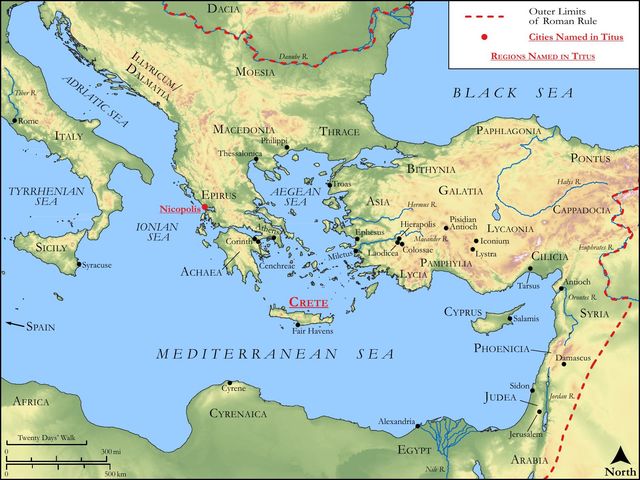
1.That Titus should hold himself ready to come to Paul at Nicopolis (a city of Thrace, as is reckoned, on the borders of Macedonia), as soon as Artemas or Tychicus should be sent to Crete, to supply his place, and take care of the churches there when he should leave them. The apostle would not have them in their young and weak state be without one or other of chief sufficiency, to guide and help them. Titus, it seems, was not their ordinary fixed bishop or pastor, but an evangelist, otherwise Paul would not have called him so much from his charge. Of Artemas we read little, but Tychicus is mentioned on many occasions with respect. Paul calls him a beloved brother, and faithful minister, and fellow-servant in the Lord: one fit therefore for the service intimated. When Paul says to Titus, Be diligent to come to me to Nicopolis, for I have determined there to winter, it is plain that the epistle was not written from Nicopolis, as the postcript would have it, for then he would have said, I determined here, not there, to winter.
2.The other personal charge to Titus is that he would bring two of his friends on their journey diligently, and see them furnished, so that nothing should be wanting to them. This was to be done, not as a piece of common civility only, but of Christian piety, out of respect both to them and the work they were sent about, which probably was to preach the gospel, or to be in some way serviceable to the churches. Zenas is styled the lawyer, whether in reference to the Roman or the Mosaic law, as having some time been his profession, is doubtful. Apollos was an eminent and faithful minister. Accompanying such persons part of their way, and accommodating them for their work and journeys, was a pious and needful service; and to further this, and lay in for it, what the apostle had before exhorted Titus to teach (Tit 3:8) he repeats here: Let ours also learn to maintain good works for necessary uses, that they be not unfruitful, Tit 3:14. Let Christians, those who have believed in God, learn to maintain good works, especially such as these, supporting ministers in their work of preaching and spreading the gospel, hereby becoming fellow-helpers to the truth, Jo3 1:5-8. That they be not unfruitful. Christianity is not a fruitless profession; the professors of it must be filled with the fruits of righteousness, which are by Jesus Christ, to the glory and praise of God. It is not enough that they be harmless, but they must be profitable, doing good, as well as eschewing evil. - "Let ours set up and maintain some honest labour and employment, to provide for themselves and their families, that they be not unprofitable burdens on the earth;" so some understand it. Let them not think that Christianity gives them a writ of ease; no, it lays an obligation upon them to seek some honest work and calling, and therein to abide with God. This is of good report, will credit religion and be good to mankind; they will not be unprofitable members of the body, not burdensome and chargeable to others, but enabled to be helpful to those in want. To maintain good works for necessary uses; not living like drones on the labours of others, but themselves fruitful to the common benefit.
IV.The apostle concludes with salutations and benedictions, Tit 3:5.
Though perhaps not personally known (some of them at least), yet all by Paul testify their love and good wishes to Titus, owning him thereby in his work, and stimulating him to go on therein. Great comfort and encouragement it is to have the heart and prayers of other Christians with and for us. Greet those that love us in the faith, or for the faith, who are our loving fellow-christians. Holiness, or the image of God in any, is the great endearing thing that gives strength to all other bonds, and is itself the best. Grace be with you all. Amen. This is the closing benediction, not to Titus alone, but to all the faithful with him, which shows that though the epistle bears the single name of Titus in the inscription, yet it was for the use of the churches there, and they were in the eye, and upon the heart, of the apostle, in the writing of it. "Grace be with you all, the love and favour of God, with the fruits and effects thereof, according to need, spiritual ones especially, and the increase and feeling of them more and more in your souls." This is the apostle's wish and prayer, showing his affection to them, his desire of their good, and a means of obtaining for them, and bringing down upon them, the thing requested. Observe, Grace is the chief thing to be wished and begged for, with respect to ourselves or others; it is, summarily, all good. Amen shuts up the prayer, expressing desire and hope, that so it may, and so it shall be.
Historical interpretation
Six Centuries of Reception
4 surviving comments on this verse. Each one is dated, so this reads as a timeline rather than a list.
Select a marker to jump to its quote. Markers stagger vertically where authors wrote within a few decades of each other.
Ver. 14, 15. "And let ours also learn to maintain good works for necessary uses, that they be not unfruitful. All that are with me salute thee. Greet them that love us in the faith."
That is, either those that love Paul himself, or those men that are faithful.
"Grace be with you all. Amen."
"And let ours," he says, "learn to maintain good works for necessary uses, that they be not unfruitful." You observe that he is more anxious for them than for those who are to receive their kindnesses. For they might probably have been brought on their way by many others, but I am concerned, he says, for our own friends. For what advantage would it be to them, if others should dig up treasures, and maintain their teachers? This would be no benefit to them, for they remained unfruitful. Could not Christ then, Who with five loaves fed five thousand men, and with seven loaves fed four thousand, could not He have supported Himself and His disciples?
For what reason then was He maintained by women? For women, it is said, followed Him, and ministered unto Him. (Mark xv. 41.) It was to teach us from the first that He is concerned for those who do good. Could not Paul, who supported others by his own hands, have maintained himself without assistance from others? But you see him receiving and requesting aid. And hear the reason for it. "Not because I desire a gift," he says, "but I desire fruit that may abound to your account." (Phil. iv. 17.)
But also let our people learn to lead in good works for necessary uses, that they may not be unfruitful. He had said above: Send Zenas, the teacher of the law, and Apollo and care for them that nothing be wanting to them. Since therefore a hidden answer might arise, so that anyone who reads this Epistle, not Titus only, might ask whence he should supply those who had no provision for their journey, he solved this difficulty and removed every obstacle by saying: But also let our people learn to lead in good works for necessary uses, that they may not be unfruitful. He calls our own those who had believed in Christ, who, because they were Christ's, deserved rightly to be called both Paul's and Titus's. You have, he says, the power over the disciples; teach them not to be unfruitful, but to serve as evangelists and apostolic men, who serve with good works, and to serve not in any causes, but in necessary uses, for having food and clothing ((or clothing)), let us be content with these (1 Timothy 6:8); and those who serve the altar should live by the altar; and those who have become participants in our spiritual things should share their carnal goods with us. And lest they easily despise either the letter of Paul or the instruction of Titus, he calls those who do not minister to the evangelists unfruitful. And Solomon himself says in Proverbs: But the fruit of charity (Prov. 3:12). And Paul himself first calls charity the fruit of the spirit (Gal. 5). But charity is especially proven in communication and in ministry. That they may not be unfruitful. For every tree that does not produce good fruit will be cut down and thrown into the fire (Mat. 5:10). But I say this: he who sows sparingly will also reap sparingly. To not give necessary support to apostolic men and evangelizers of Christ is to condemn oneself to sterility.
Nevertheless, after the apostle had said in such instruction and advice: “Now such persons we charge and exhort in the Lord Jesus Christ that they work quietly and eat their own bread,” he was mindful of such needs of the holy persons who, although they would obey his commands to work quietly and eat their own bread, would, for many reasons, lack some provision of such necessary commodities. Hence, with foresight he added immediately: “But you, brothers, do not grow tired of well-doing,” so that those who had the means of furnishing sustenance to the servants of God would not grow careless in this respect. Furthermore, when in writing to Titus he said: “Help Zenas the lawyer and Apollos on their way, taking care that nothing be wanting to them.” He continued thus, in order to show why nothing should be lacking in their regard: “And let the people also learn to excel in good works, in order to meet cases of necessity, that they may not be unfruitful.”
Let our own also learn to devote themselves to good works for necessary needs, so that they may not be unfruitful.
Let our own also learn. The statement concerning teaching, or concerning instruction, as if Paul said: They themselves showed themselves to be generous towards those in need, and let them draw them to themselves, whether they are in need of teaching or of necessities.
so that they may not be unfruitful. For Paul wishes to benefit those who give rather than those who receive.
Continue studying Titus 3:14 across the web’s major study libraries — every link below opens this exact verse, chapter, or book on the destination site.
Read & Compare
 BibleGatewayThis verse in more than 200 translations and 70 languages.
 Bible.comThe YouVersion reader — hundreds of translations, reading plans, and highlights.
 ESV.orgCrossway's official English Standard Version reader.
 NET BibleThe NET translation with 60,000+ translators' notes on every rendering decision.
 STEP BibleTyndale House's free study tool — original text, vocabulary, and scholarly resources.
 BibliaLogos Bible Software's free web reader.
 USCCBThe New American Bible (Revised Edition) with the U.S. bishops' study notes.
Commentaries
 BibleHub CommentariesDozens of classic commentaries on this verse, gathered on one page.
 StudyLightMore than 100 commentary sets — the largest collection on the web.
 BibleRefPlain-English commentary on what this verse means, verse by verse.
 Enduring WordDavid Guzik's free commentary on this chapter, widely used by Bible teachers.
 Bible Study ToolsVerse commentary alongside Greek and Hebrew study aids.
Original Language & Research
- BibleHub InterlinearThe verse word by word — original language, transliteration, and English.
- BibleHub LexiconEvery word's original-language definition and Strong's entry.
 Blue Letter BibleDeep-study tools — Strong's numbers, concordance, and word studies.
 CNTR CollationThe earliest Greek manuscripts of this verse, collated letter by letter.
Sermons, Hymns & Audio


TrulyRandomVerse is not affiliated with these sites and doesn’t control their content. They’re linked because they’re genuinely useful.
Summary
Titus 3:14 serves as a concluding exhortation in Paul's letter, urging believers in Crete to actively and intentionally engage in good works. This verse underscores that while salvation is by grace, a transformed life is characterized by practical, beneficial actions that address genuine needs within the community, thereby demonstrating the authenticity of their faith and ensuring that their lives are productive and spiritually fruitful, rather than barren or ineffective.
Context
ShowHideLiterary Context
This verse stands as the final practical instruction in Paul's letter to Titus, immediately preceding his personal closing remarks and greetings. It builds directly upon the profound theological foundation laid in Titus 3:4-7, which emphasizes salvation by God's mercy, not human works. Following this declaration, Paul instructs Titus to "affirm constantly" the necessity for believers to be "careful to maintain good works" (Titus 3:8). Verse 14, therefore, reinforces and summarizes this call, demonstrating that diligent engagement in good deeds is the natural and expected outflow of a life transformed by grace, essential for the church's witness and internal health, contrasting sharply with "foolish questions and genealogies" (Titus 3:9).
Historical & Cultural Context
Crete, the island where Titus was ministering, was known for its moral laxity and challenging cultural environment, as evidenced by the proverb "Cretans are always liars, evil beasts, lazy gluttons" (Titus 1:12). In such a setting, the conduct of believers was paramount for the credibility of the gospel. Paul's emphasis on "good works for necessary uses" would have been a stark contrast to the self-serving and often unproductive lifestyles prevalent in Cretan society. Furthermore, the early church often faced accusations of being anti-social or subversive. Demonstrating practical care for one another and for the wider community through "good works" would have served as a powerful apologetic, showcasing the transformative power of Christ in tangible ways that benefited society.
Key Themes
ShowHideTitus 3:14 contributes significantly to several key themes woven throughout the epistle. Foremost is the theme of Christian Conduct and Ethics, where Paul consistently links sound doctrine with righteous living, emphasizing that faith must be demonstrated through action (e.g., Titus 2:7-8). It also highlights the theme of Grace and Works, clarifying that good works are not a means to earn salvation but rather the evidence and fruit of it, a concept central to Paul's theology (e.g., Ephesians 2:8-10). Finally, the verse speaks to Spiritual Fruitfulness, contrasting a life of purpose and positive impact with one that is "unfruitful," echoing broader biblical teaching on the productivity of a life lived in Christ (e.g., John 15:5).
Exposition and Analysis
ShowHideKey Word Analysis
ShowHideThis verb means "to stand before," "to preside," or "to apply oneself diligently to." In this context, it conveys a sense of active engagement, leadership, and diligent practice. It's not merely about performing good works occasionally, but about taking initiative, being proactive, and consistently applying oneself to them, perhaps even overseeing or championing such efforts within the community.
This word describes something as "beautiful," "valuable," or "virtuous," often in terms of its appearance or usefulness, distinguishing it from agathos which denotes intrinsic goodness. Here, "good works" refers to actions that are morally upright, beneficial, honorable, and commendable in the eyes of both God and people, reflecting the beauty and excellence of Christ's character.
This term literally means "without fruit" and is used both literally (barren) and figuratively. In a spiritual sense, it signifies a lack of productivity, effectiveness, or positive spiritual outcome. Paul's warning implies that a failure to engage in "good works for necessary uses" results in a life that fails to glorify God, benefit others, or demonstrate the vitality of one's faith, becoming spiritually barren.
Verse Breakdown
ShowHide"And let ours also learn to maintain good works"
This opening phrase serves as a direct command and exhortation. "Ours" refers to the believers, those who have embraced the gospel and are part of the Christian community. The verb "learn" (G3129, manthánō) suggests that maintaining good works is not always innate but requires intentional instruction, practice, and cultivation. "Maintain" (G4291, proïstēmi) implies a proactive, diligent, and perhaps even leading role in these "good works" (G2570, kalós G2041, érgon), which are actions that are morally excellent, honorable, and beneficial. This clause emphasizes that Christian living is not passive but involves active, purposeful engagement in deeds that reflect God's character.
"for necessary uses"
This phrase (G1519, eis G316, anankaîos G5532, chreía) specifies the purpose and nature of these good works. They are not arbitrary acts or self-serving displays, but rather actions directed towards meeting genuine, practical needs. "Necessary uses" points to acts of charity, hospitality, support for the vulnerable, and contributions to the well-being of the community, both within and outside the church. It underscores the practical, compassionate, and purposeful dimension of Christian service, ensuring that faith translates into tangible help for those in need.
"that they be not unfruitful"
This concluding clause states the negative consequence of failing to maintain good works and, conversely, the positive outcome of doing so. The Greek "hína mḗ" (G3363) indicates a purpose clause, "in order that not." To be "unfruitful" (G175, ákarpos) means to be barren, unproductive, or lacking spiritual impact. By actively engaging in good works for necessary uses, believers avoid a life that is spiritually barren and instead demonstrate the vitality of their faith, produce spiritual fruit, and bring glory to God, thereby proving the authenticity and transformative power of the gospel in their lives.
Literary Devices
ShowHidePaul employs Purpose Clauses ("that they be not unfruitful") to clearly articulate the intended outcome and motivation behind the call to good works, emphasizing the importance of spiritual productivity. The phrase "good works" functions as a Metonymy or Synecdoche, where a specific type of action (works) stands for the broader concept of righteous, Christ-like living and the practical outworking of faith. The contrast between "maintaining good works" and being "unfruitful" creates a subtle Antithesis, highlighting the two opposing outcomes of a believer's life: one marked by productive service versus one characterized by spiritual barrenness. This reinforces the urgency and significance of the exhortation.
Theological and Thematic Connections
ShowHideTitus 3:14 profoundly connects the theological truth of salvation by grace with the practical reality of Christian living. It asserts that genuine faith, far from leading to passivity, compels believers to actively engage in good works. These works are not a means to earn salvation, but rather the natural, undeniable evidence of a transformed heart and the Spirit's indwelling. They serve as a vital witness to the world, demonstrating the gospel's power to renew individuals and communities, and ensure that the church is a force for good, meeting tangible needs and reflecting God's compassionate nature. The verse thus underscores the inseparable link between orthodoxy (right belief) and orthopraxy (right practice), ensuring that Christian discipleship is both deeply rooted in doctrine and visibly expressed in service.
Reflection and Application
ShowHideTitus 3:14 calls believers to a life of intentional and productive service, reminding us that our faith is not merely an intellectual assent or an emotional experience, but a dynamic force that should manifest in tangible acts of love and compassion. In a world often characterized by self-interest and apathy, this verse challenges us to proactively seek out opportunities to meet the "necessary uses" of those around us, whether within our immediate families, our church communities, or the broader society. It compels us to move beyond passive observation to active participation, ensuring that our lives are not spiritually barren but abundantly fruitful, bringing glory to God and demonstrating the transformative power of the gospel. This involves cultivating a mindset of generosity, empathy, and practical helpfulness, recognizing that every act of service, no matter how small, contributes to the flourishing of God's kingdom and the well-being of humanity.
Questions for Reflection
ShowHideFAQ
ShowHideDoes "maintain good works" imply that works are necessary for salvation?
ShowHideAbsolutely not. Paul consistently teaches that salvation is by grace through faith, not by works, as clearly stated in Titus 3:4-7. The "good works" mentioned in Titus 3:14 (and Titus 3:8) are the result and evidence of salvation, not its cause. They are the natural outflow of a transformed heart, empowered by the Holy Spirit, demonstrating the reality of one's faith and bringing glory to God. As Ephesians 2:10 states, believers are "created in Christ Jesus unto good works," meaning God has prepared these works for us to walk in, as a demonstration of our new life in Him.
What does it mean to be "unfruitful" in a spiritual sense?
ShowHideTo be "unfruitful" (Greek: ákarpos) in a spiritual sense means to live a life that lacks spiritual productivity, positive impact, or tangible evidence of the transformative power of the gospel. Just as a barren tree fails to produce expected fruit, an unfruitful believer fails to demonstrate the love, character, and righteous actions that should flow from a relationship with Christ. This can manifest as a lack of service to others, a failure to grow in Christlikeness, or an inability to contribute to the advancement of God's kingdom. Jesus Himself warned about the consequences of unfruitfulness in parables like the fig tree (Luke 13:6-9) and emphasized the importance of bearing "much fruit" by abiding in Him (John 15:5-8). Titus 3:14 encourages believers to actively pursue good works to avoid such spiritual barrenness.
Christ-Centered Fulfillment
ShowHideTitus 3:14, with its call to "maintain good works for necessary uses, that they be not unfruitful," finds its ultimate fulfillment and perfect example in the person and work of Jesus Christ. While the Old Testament Law prescribed good works, it was Jesus who perfectly embodied a life of selfless service and fruitful action, not to earn salvation, but to perfectly fulfill the Father's will and demonstrate divine love. His entire earthly ministry was characterized by "good works" – healing the sick, feeding the hungry, teaching the truth, and ultimately, offering Himself as the perfect sacrifice (Acts 10:38 describes Him as going about "doing good"). He taught His disciples to be fruitful, emphasizing that abiding in Him would lead to much fruit (John 15:5). Furthermore, Christ's work on the cross is the "necessary use" of ultimate redemption, providing the grace that enables believers to then live lives of good works, not out of compulsion but out of gratitude and transformation (Ephesians 2:10). Thus, believers are called to reflect Christ's own fruitful life of service, empowered by His Spirit, ensuring that their lives are productive and glorify the Father, just as His did.