


Titus 3:10
Bible text: King James Version (1769 Blayney text) · Public domain
Bible text: Berean Standard Bible · Public domain
Bible text: American Standard Version (1901) · Public domain
Bible text: World English Bible, Messianic edition · Public domain
Bible text: Geneva Bible (1599) · Public domain
Bible text: Young's Literal Translation · Public domain
- αἱρετικὸνhairetikonA factiousG141A-ASMAdjective Accusative Singular Masculine
- ἄνθρωπονanthrōponmanG444N-ASMNoun Accusative Singular Masculine
- μετὰmetaafterG3326PREPPreposition
- μίανmianoneG1520A-ASFAdjective Accusative Singular Feminine
- καὶkaiandG2532CONJConjunction
- δευτέρανdeuterana secondG1208A-ASFAdjective Accusative Singular Feminine
- νουθεσίανnouthesianadmonitionG3559N-ASFNoun Accusative Singular Feminine
- παραιτοῦparaitoudo rejectG3868V-PNM-2SVerb Present Middle Or Passive Deponent Imperative 2nd Singular
English is a literal word-by-word gloss of the Greek, not the KJV's wording. Why?
This is the original text the KJV's translators worked from — each Greek word with its own literal English meaning in this verse, prepared by scholars at Tyndale House, Cambridge. The KJV translates whole sentences, not word by word, so its wording differs: one Greek word can become several English words, and the KJV may choose “charity” where the gloss reads “love”. Both are faithful — they answer different questions. For the KJV's own rendering, switch to the KJV text.
Details
See on the biblical-era maps

Study this verse
Public-domain commentary
Matthew Henry
From his Commentary on the Whole Bible. Henry comments on passages, not single verses — this entry covers Titus 3:9–15. His two-level outline is real structure in the source text, so it is rendered as structure.
Here is the fifth and last thing in the matter of the epistle: what Titus should avoid in teaching; how he should deal with a heretic; with some other directions. Observe,
I.That the apostle's meaning might be more clear and full, and especially fitted to the time and state of things in Crete, and the many judaizers among them, he tells Titus what, in teaching, he should shun, Tit 3:9. There are needful questions to be discussed and cleared, such as make for improvement in useful knowledge; but idle and foolish enquiries, tending neither to God's glory nor the edification of men, must be shunned. Some may have a show of wisdom, but are vain, as many among the Jewish doctors, as well as of later schoolmen, who abound with questions of no moment or use to faith or practice; avoid these. - And genealogies (of the gods, say some, that the heathen poets made such noise about; or rather those that the Jews were so curious in): some lawful and useful enquiries might be made into these things, to see the fulfilling of the scriptures in some cases, and especially in the descent of Christ the Messiah; but all that served to pomp only, and to feed vanity, in boasting of a long pedigree, and much more such as the Jewish teachers were ready to busy themselves in and trouble their hearers with, even since Christ had come, and that distinction of families and tribes had been taken away, as if they would build again that policy which now is abolished, these Titus must withstand as foolish and vain. - And contentious, and strivings about the law. There were those who were for the Mosaic rites and ceremonies, and would have them continued in the church, though by the gospel and the coming of Christ they were superseded and done away. Titus must give no countenance to these, but avoid and oppose them; for they are unprofitable and vain: this is to be referred to all those foolish questions and genealogies, as well as those strivings about the law. They are so far from instructing and building up in godliness, that they are hindrances of it rather: the Christian religion, and good works, which are to be maintained, will hereby be weakened and prejudiced, the peace of the church disturbed, and the progress of the gospel hindered. Observe, Ministers must not only teach things good and useful, but shun and oppose the contrary, what would corrupt the faith, and hinder godliness and good works; nor should people have itching ears, but love and embrace sound doctrine, which tends most to the use of edifying.
II.But because, after all, there will be heresies and heretics in the church, the apostle next directs Titus what to do in such a case, and how to deal with such, Tit 3:10. He who forsakes the truth as it is in Christ Jesus, who broaches false doctrines and propagates them to the corrupting of the faith in weighty and momentous points, and breaks the peace of the church about them, after due means used to reclaim him, must be rejected. "Admonish him once and again, that, if possible, he may be brought back, and thou mayest gain thy brother; but, if this will not reduce him, that others be not hurt, cast him out of the communion, and warn all Christians to avoid him." - Knowing that he that is such is subverted (turned off from the foundation) and sinneth grievously, being self-condemned. Those who will not be reclaimed by admonitions, but are obstinate in their sins and errors, are subverted and self-condemned; they inflict that punishment upon themselves which the governors of the church should inflict upon them: they throw themselves out of the church, and throw off its communion, and so are self-condemned. Observe, 1. How great an evil real heresy is, not lightly therefore to be charged upon any, though greatly to be taken heed of by all. Such a one is subverted or perverted - a metaphor from a building so ruined as to render it difficult if not impossible to repair and raise it up again. Real heretics have seldom been recovered to the true faith: not so much defect of judgment, as perverseness of the will, being in the case, through pride, or ambition, or self-willedness, or covetousness, or such like corruption, which therefore must be taken heed of: "Be humble, love the truth and practise it, and damning heresy will be escaped." 2. Pains and patience must be used about those that err most grievously. They are not easily and soon to be given up and cast off, but competent time and means must be tried for their recovery. 3. The church's means even with heretics are persuasive and rational. They must be admonished, instructed, and warned; so much nouthesia imports. 4. Upon continued obstinacy and irreclaimableness, the church has power, and is obliged, to preserve its own purity, by severing such a corrupt member which discipline may by God's blessing become effectual to reform the offender, or if not it will leave him the more inexcusable in his condemnation.
III.The apostle subjoins some further directions, Tit 3:12, Tit 3:13. Here are two personal things enjoined: -
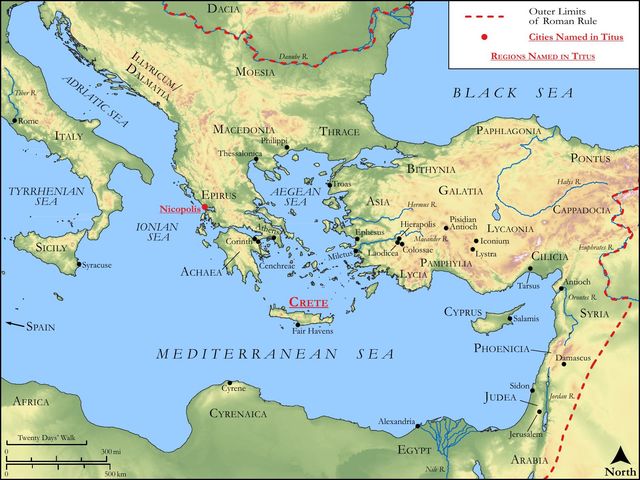
1.That Titus should hold himself ready to come to Paul at Nicopolis (a city of Thrace, as is reckoned, on the borders of Macedonia), as soon as Artemas or Tychicus should be sent to Crete, to supply his place, and take care of the churches there when he should leave them. The apostle would not have them in their young and weak state be without one or other of chief sufficiency, to guide and help them. Titus, it seems, was not their ordinary fixed bishop or pastor, but an evangelist, otherwise Paul would not have called him so much from his charge. Of Artemas we read little, but Tychicus is mentioned on many occasions with respect. Paul calls him a beloved brother, and faithful minister, and fellow-servant in the Lord: one fit therefore for the service intimated. When Paul says to Titus, Be diligent to come to me to Nicopolis, for I have determined there to winter, it is plain that the epistle was not written from Nicopolis, as the postcript would have it, for then he would have said, I determined here, not there, to winter.
2.The other personal charge to Titus is that he would bring two of his friends on their journey diligently, and see them furnished, so that nothing should be wanting to them. This was to be done, not as a piece of common civility only, but of Christian piety, out of respect both to them and the work they were sent about, which probably was to preach the gospel, or to be in some way serviceable to the churches. Zenas is styled the lawyer, whether in reference to the Roman or the Mosaic law, as having some time been his profession, is doubtful. Apollos was an eminent and faithful minister. Accompanying such persons part of their way, and accommodating them for their work and journeys, was a pious and needful service; and to further this, and lay in for it, what the apostle had before exhorted Titus to teach (Tit 3:8) he repeats here: Let ours also learn to maintain good works for necessary uses, that they be not unfruitful, Tit 3:14. Let Christians, those who have believed in God, learn to maintain good works, especially such as these, supporting ministers in their work of preaching and spreading the gospel, hereby becoming fellow-helpers to the truth, Jo3 1:5-8. That they be not unfruitful. Christianity is not a fruitless profession; the professors of it must be filled with the fruits of righteousness, which are by Jesus Christ, to the glory and praise of God. It is not enough that they be harmless, but they must be profitable, doing good, as well as eschewing evil. - "Let ours set up and maintain some honest labour and employment, to provide for themselves and their families, that they be not unprofitable burdens on the earth;" so some understand it. Let them not think that Christianity gives them a writ of ease; no, it lays an obligation upon them to seek some honest work and calling, and therein to abide with God. This is of good report, will credit religion and be good to mankind; they will not be unprofitable members of the body, not burdensome and chargeable to others, but enabled to be helpful to those in want. To maintain good works for necessary uses; not living like drones on the labours of others, but themselves fruitful to the common benefit.
IV.The apostle concludes with salutations and benedictions, Tit 3:5.
Though perhaps not personally known (some of them at least), yet all by Paul testify their love and good wishes to Titus, owning him thereby in his work, and stimulating him to go on therein. Great comfort and encouragement it is to have the heart and prayers of other Christians with and for us. Greet those that love us in the faith, or for the faith, who are our loving fellow-christians. Holiness, or the image of God in any, is the great endearing thing that gives strength to all other bonds, and is itself the best. Grace be with you all. Amen. This is the closing benediction, not to Titus alone, but to all the faithful with him, which shows that though the epistle bears the single name of Titus in the inscription, yet it was for the use of the churches there, and they were in the eye, and upon the heart, of the apostle, in the writing of it. "Grace be with you all, the love and favour of God, with the fruits and effects thereof, according to need, spiritual ones especially, and the increase and feeling of them more and more in your souls." This is the apostle's wish and prayer, showing his affection to them, his desire of their good, and a means of obtaining for them, and bringing down upon them, the thing requested. Observe, Grace is the chief thing to be wished and begged for, with respect to ourselves or others; it is, summarily, all good. Amen shuts up the prayer, expressing desire and hope, that so it may, and so it shall be.
Historical interpretation
Eight Centuries of Reception
10 surviving comments on this verse. Each one is dated, so this reads as a timeline rather than a list.
Select a marker to jump to its quote. Markers stagger vertically where authors wrote within a few decades of each other.
But as many as separate from the Church, and give heed to such old wives' fables as these, are truly self-condemned; and these men Paul commands us, "after a first and second admonition, to avoid.".
"Such was the horror which the apostles and their disciples had against holding even verbal communication with any corrupters of the truth; as Paul also says, "A man that is an heretic, after the first and second admonition, reject; knowing that he that is such is subverted, and sinneth, being condemned of himself."
On this point, however, we dwell no longer, since it is the same Paul who, in his Epistle to the Galatians, counts "heresies" among "the sins of the flesh," who also intimates to Titus, that "a man who is a heretic" must be "rejected after the first admonition," on the ground that "he that is such is perverted, and committeth sin, as a self-condemned man." Indeed, in almost every epistle, when enjoining on us (the duty) of avoiding false doctrines, he sharply condemns heresies.
That we must not speak with heretics. To Titus: "A man that is an heretic, after one rebuke avoid; knowing that one of such sort is perverted, and sinneth, and is by his own self condemned." Of this same thing in the Epistle of John: "They went out from among us, but they were not of us; for if they had been of us, they would doubtless have remained with us." Also in the second to Timothy: "Their word doth creep as a canker."
But for the rest, let our most beloved brethren firmly decline, and avoid the words and conversations of those whose word creeps onwards like a cancer; as the apostle says, "Evil communications corrupt good manners." And again: "A man that is an heretic, after one admonition, reject: knowing that he that is such is subverted, and sinneth, being condemned of himself." And the Holy Spirit speaks by Solomon, saying, "A perverse man carrieth perdition in his mouth; and in his lips he hideth a fire." Also again, he warneth us, and says, "Hedge in thy ears with thorns, and hearken not to a wicked tongue." And again: "A wicked doer giveth heed to the tongue of the unjust; but a righteous man does not listen to lying lips." And although I know that our brotherhood there, assuredly fortified by your foresight, and besides sufficiently cautious by their own vigilance, cannot be taken nor deceived by the poisons of heretics, and that the teachings and precepts of God prevail with them only in proportion as the fear of God is in them; yet, even although needlessly, either my solicitude or my love persuaded me to write these things to you, that no commerce should be entered into with such; that no banquets nor conferences be entertained with the wicked; but that we should be as much separated from them, as they are deserters from the Church; because it is written, "If he shall neglect to hear the Church, let him be unto thee as a heathen man and a publican." And the blessed apostle not only warns, but also commands us to withdraw from such. "We command you," he says, "in the name of Jesus Christ our Lord, that ye withdraw yourselves from every brother that walketh disorderly, and not after the tradition which he received of us." There can be no fellowship between faith and I faithlessness. He who is not with Christ, who is an adversary of Christ, who is hostile to His unity and peace, cannot be associated with us. If they come with prayers and atonements, let them be heard; if they heap together curses and threats, let them be rejected.
Perhaps even thus being put to shame by the bad odor of their names, they [the heretics] may be enabled to grasp the depth of impiety into which they have fallen. It would be within our rights not to answer them at all, according to the apostolic advice: “One who is heretical, after a first and a second admonition refuse, knowing that such a one is perverted and sins, being self-condemned.” This is even more the case, in that the prophet says about such men: “The fool shall utter foolishness, and his heart shall imagine vain things.” But since, like their leader, they too go about like lions seeking whom among the simple they shall devour, we are compelled to write in reply to your piety, that the brethren being once again instructed by your admonition may still further reprove the vain teaching of those men.
If he who has been corrected for his first sins and has been deemed worthy of pardon again falls, he prepares for himself a more wrathful judgment. He who after the first and second admonition remains in his fault should be reported to the superior, that perhaps he may be ashamed when further rebuked. But, if he does not even in this case correct himself, he must be cut off from the rest as a cause of scandal and be looked upon as a heathen and a publican.
This monster’s cavern [of heresies], your sacred Majesty, is thick laid (as seafaring men do say it is) with hidden lairs, and all the surrounding neighborhood, where the rocks of unbelief echo to the howling of her black dogs, we must pass by with ears stopped up. For it is written: “Hedge your ears about with thorns” and again: “Beware of dogs. Beware of evil workers"; and yet again: “One who is a heretic, avoid after the first reproof knowing that such a one is fallen and is in sin, being condemned of his own judgment.” So then, like prudent pilots, let us set the sails of our faith for the course wherein we may pass by most safely and again follow the coasts of the Scriptures.
How then does he elsewhere say, "If God peradventure will give them repentance" (2 Tim. ii. 25); but here, "A man that is an heretic after the first and second admonition reject, knowing that he that is such is subverted and sinneth, being condemned of himself"? In the former passage he speaks of the correction of those of whom he had hope, and who had simply made opposition. But when he is known and manifest to all, why dost thou contend in vain? why dost thou beat the air? What means, "being condemned of himself"? Because he cannot say that no one has told him, no one admonished him; since therefore after admonition he continues the same, he is self-condemned.
What then? dost thou command him to stop the mouths of gainsayers, if he must pass them by when they are doing everything to their own destruction? He means that he should not do it principally for their advantage, for being once perverted in their minds, they would not profit by it. But if they injured others, it behooved him to withstand and contend with them; and manfully await them, but if thou art reduced to necessity, seeing them destroying others, be not silent, but stop their mouths, from regard to those whom they would destroy. It is not indeed possible for a zealous man of upright life to abstain from contention, but so do as I have said. For the evil arises from idleness and a vain philosophy, that one should be occupied about words only. For it is a great injury to be uttering a superfluity of words, when one ought to be teaching, or praying, or giving thanks. For it is not right to be sparing of our money but not sparing of our words; we ought rather to spare words than our money, and not to give ourselves up to all sorts of persons.
What means, "that they be careful to maintain good works"? That they wait not for those who are in want to come to them, but that they seek out those who need their assistance. Thus the considerate man shows his concern, and with great zeal will he perform this duty. For in doing good actions, it is not those who receive the kindness that are benefited, so much as those who do it that make gain and profit, for it gives them confidence towards God. But in the other case, there is no end of contention: therefore he calls the heretic incorrigible. For as to neglect those for whom there is a hope of conversion is the part of slothfulness, so to bestow pains upon those who are diseased past remedy is the extreme of folly and madness; for we render them more bold.
Avoid a heretical man after one and a second admonition, knowing that such a one is subverted, and sins, being condemned by himself. The name of heresy is stated in the Epistle to the Corinthians: For there must be also heresies: that they also, which are approved, may be made manifest among you (1 Cor. 11:19). And among the works of the flesh, it is listed in the Epistle to the Galatians: Now the works of the flesh are manifest, which are these; Adultery, fornication, uncleanness, lasciviousness, Idolatry, witchcraft, hatred, variance, emulations, wrath, strife, seditions, heresies, Envyings, murders, drunkenness, revellings, and such like: of the which I tell you before, as I have also told you in time past, that they which do such things shall not inherit the kingdom of God. (Gal. 5:19-21). It should be carefully observed in these things, that just as the other vices, which are counted among the works of the flesh, exclude us ((Al. are excluded)) from the kingdom of God: so too heresies take away the kingdom of God from us; and it does not matter how someone is excluded from the kingdom. But what is even more remarkable seems to be that thing in the Acts of the Apostles, our faith in Christ, and Ecclesiastical discipline, already being labeled as heresy by perverse men at that time. For the Jews say to the Apostle Paul, "Neither have we received letters from you from Judea ((Al. from you... from Judea)), nor has anyone coming from the brethren reported or spoken any evil of you. But we ask to hear from you what your views are; for it is well known to us about this heresy, because everywhere it is contradicted (Acts 28:21,22)." And though the name of the heresy of Miletus is not mentioned, yet they are designated by the labours of Paul, in his address to the presbyters of the Church, 'I know that after my departure grievous wolves shall enter in among you, not sparing the flock; and of your own selves shall men arise speaking perverse things, to draw away disciples after them' (Acts 20:29-30). These remarks are made in passing, as it were, where elsewhere also heresy is spoken of. The name itself must now be fully examined. In Greek, heresy means an election, that is, everyone chooses for himself that which he thinks best. The philosophers, too, Stoics, Peripatetics, Academics, Epicureans, are called followers of this or that sect. It is needless to go through each one separately, and to enumerate the various dogmas of Marcion, Valentinus, Apelles, Ebion, Montanus, and Manichæus, seeing it is very easy for everyone to know what are the particular errors advocated by each individual. Arius and Eunomius, and the author of the new heresy, would that they were not so well known, perhaps they would have deceived fewer! Therefore, avoid a heretic after the first admonition, or as is better expressed in Greek, νουθεσία, which signifies warning or teaching rather than reproach; which is approved in Latin copies sometimes cited with approval by Pope Athanasius, to the effect that people who are wronged are not sufficient to be informed or warned once or twice, but that the second time they should be given instruction, and that every word should stay in the mouth of two or three witnesses. But why he should be avoided after the first and second admonitions, he gives the reasons, namely, that he is perverted and sins, being condemned by himself. For he who, having been corrected once or twice, does not wish to be corrected after hearing his mistake, is considered to be in error by the corrector: and on the contrary, when preparing for arguments and disputes with words, he wishes to make profit from the one from whom he learnt. Therefore, it is said to be condemned by oneself: because fornication, adultery, murder, and other vices are repelled by priests of the Church. But heretics bring judgment upon themselves, departing from the Church by their own choice: which departure seems to be a condemnation of their own conscience. They think that heresy differs from schism in that heresy has perverse doctrine, while schism separates from the Church due to episcopal dissension, which can be understood to some extent at the beginning. However, no schism does not invent some heresy for itself, so that it may appear to have departed from the Church correctly.
Warn a heretical man once or twice, and then reject him; knowing that such a person is perverted and sins, being self-condemned.
— [OECUMENIUS] And elsewhere Paul says, "May God not grant them repentance." (2 Tim. 2:25) How then does he here order to cease? There he speaks about correction for those who have hope; here, however, about those suffering incurable diseases. [end of the excerpt by Oecumenius R f. 300r] —
being self-condemned. For Paul has no defense to offer, saying, "No one told me; no one advised me." Being self-condemned means either being without defense or being condemned by oneself and one's own conscience.
Continue studying Titus 3:10 across the web’s major study libraries — every link below opens this exact verse, chapter, or book on the destination site.
Read & Compare
 BibleGatewayThis verse in more than 200 translations and 70 languages.
 Bible.comThe YouVersion reader — hundreds of translations, reading plans, and highlights.
 ESV.orgCrossway's official English Standard Version reader.
 NET BibleThe NET translation with 60,000+ translators' notes on every rendering decision.
 STEP BibleTyndale House's free study tool — original text, vocabulary, and scholarly resources.
 BibliaLogos Bible Software's free web reader.
 USCCBThe New American Bible (Revised Edition) with the U.S. bishops' study notes.
Commentaries
 BibleHub CommentariesDozens of classic commentaries on this verse, gathered on one page.
 StudyLightMore than 100 commentary sets — the largest collection on the web.
 BibleRefPlain-English commentary on what this verse means, verse by verse.
 Enduring WordDavid Guzik's free commentary on this chapter, widely used by Bible teachers.
 Bible Study ToolsVerse commentary alongside Greek and Hebrew study aids.
Original Language & Research
- BibleHub InterlinearThe verse word by word — original language, transliteration, and English.
- BibleHub LexiconEvery word's original-language definition and Strong's entry.
 Blue Letter BibleDeep-study tools — Strong's numbers, concordance, and word studies.
 CNTR CollationThe earliest Greek manuscripts of this verse, collated letter by letter.
Sermons, Hymns & Audio


TrulyRandomVerse is not affiliated with these sites and doesn’t control their content. They’re linked because they’re genuinely useful.
Summary
Titus 3:10 provides clear apostolic instruction regarding the handling of individuals who persistently cause division within the Christian community. Paul directs Titus to issue a "first and second admonition" to such a person, and if they remain unrepentant and continue their divisive behavior, they are to be rejected from fellowship. This directive underscores the church's responsibility to maintain doctrinal purity and communal harmony, prioritizing the spiritual health and unity of the body of Christ over the disruptive influence of an unyielding individual.
Context
ShowHideLiterary Context
Titus 3:10 stands as a crucial concluding instruction in Paul's letter to Titus, following a significant shift in focus from theological doctrine to practical Christian living. The preceding verses, Titus 3:1-2, call for believers to live peaceably, submitting to governing authorities and speaking evil of no one. This is immediately contrasted with the transformative power of God's grace, described in Titus 3:3-7, which reminds believers of their former sinful state and God's merciful salvation through the washing of regeneration. Titus 3:8 then emphasizes the importance of good works as a natural outflow of genuine faith. Critically, Titus 3:9 serves as the immediate precursor, warning against "foolish questions, and genealogies, and contentions, and strivings about the law; for they are unprofitable and vain." Thus, Titus 3:10 directly addresses the most severe form of the divisiveness warned against in verse 9, moving from a general caution against unprofitable disputes to a specific procedure for dealing with those who actively create factions.
Historical & Cultural Context
Paul wrote this epistle to Titus, his apostolic delegate, who was ministering on the island of Crete. Crete was known for its difficult and often immoral populace, as famously quoted by Paul himself in Titus 1:12. The nascent churches on Crete faced significant challenges, including internal strife, false teachers, and the need for established leadership. Paul had left Titus there to "set in order the things that are wanting, and ordain elders in every city" (Titus 1:5). In this environment, maintaining doctrinal purity and communal unity was paramount. Divisive individuals, whether motivated by pride, false doctrine, or personal ambition, posed a direct threat to the fragile stability and witness of these young congregations. Paul's instructions provided Titus with the necessary authority and method to address such threats decisively, ensuring the health and integrity of the church in a challenging cultural landscape.
Key Themes
ShowHideTitus 3:10 contributes significantly to several key themes within the epistle and broader Pauline theology. Firstly, it underscores the theme of Church Discipline, providing a practical framework for addressing persistent sin and division within the community, a principle echoed in Matthew 18:15-17 and 1 Corinthians 5:1-13. Secondly, the verse highlights the critical importance of Church Unity and Purity, emphasizing that the integrity of the body of Christ must be protected from internal strife and false teaching. Paul consistently champions unity throughout his letters, as seen in his pleas in Ephesians 4:1-3 and Philippians 2:1-4. Thirdly, it demonstrates the balance between Patience and Firmness in leadership, requiring multiple warnings before decisive action. This reflects the divine patience of God towards humanity, while also acknowledging the necessity of firm action when patience is exhausted and the community is at risk.
Exposition and Analysis
ShowHideKey Word Analysis
ShowHideThis term describes a "schismatic." While modern English often associates "heretic" with doctrinal error, in this context, the primary emphasis of hairetikós is on the divisive nature of the person's actions. It signifies one who chooses a faction or creates divisions within the community, often stemming from self-willed opinions or doctrines that lead to strife rather than unity. The individual is not merely mistaken but actively promotes partisan separation.
This word signifies "calling attention to," implying a "mild rebuke or warning." It denotes a gentle but firm verbal instruction or counsel, aimed at correcting behavior and restoring the individual to proper conduct and fellowship. It is a form of pastoral care designed to bring about repentance before more severe measures are necessary.
Meaning "to beg off, i.e. deprecate, decline, shun." In this context, it means to refuse, avoid, or decline fellowship with such a person. It indicates a deliberate separation from the church community, effectively excommunicating the individual to prevent further harm to the body of Christ and to impress upon the individual the seriousness of their unrepentant divisiveness.
Verse Breakdown
ShowHide"A man that is an heretick"
This identifies the subject of the instruction: an individual who is characterized by divisive behavior, one who causes factions or promotes partisan strife within the Christian community, often due to self-chosen opinions or doctrines that disrupt unity.
"after the first and second admonition"
This specifies the process and the required patience before severe action. It mandates that the divisive person must be given at least two opportunities to repent and correct their behavior through gentle but firm warnings or counsel from church leadership. This emphasizes due process and a desire for restoration.
"reject;"
This is the imperative command, indicating the necessary action if the individual remains unrepentant after the two warnings. To "reject" means to cease fellowship with, to avoid, or to remove from the community, signifying excommunication. This is a measure taken to protect the church from further harm and to underscore the gravity of unrepentant divisiveness.
Literary Devices
ShowHidePaul's instruction in Titus 3:10 employs the Imperative Mood, particularly in the command "reject," which conveys a direct, authoritative directive to Titus. This highlights the urgency and necessity of decisive action in maintaining church order. The phrase "first and second admonition" functions as a Numerical Parallelism, emphasizing a clear, structured process, not a rash decision. This also subtly employs Synecdoche, where "first and second" represents a complete and sufficient process of warning, implying that all reasonable attempts at reconciliation and correction have been exhausted. The term "heretick" itself, while a direct translation, carries a strong Connotative Meaning beyond mere doctrinal error, pointing to the active, destructive nature of schism and factionalism within the community.
Theological and Thematic Connections
ShowHideTitus 3:10 provides a crucial biblical basis for church discipline, emphasizing that the health and unity of the Christian community are paramount. It demonstrates a pastoral balance between patience and firmness: patience in providing multiple opportunities for repentance through "admonition," and firmness in the command to "reject" if the divisive behavior persists. This process is rooted in the understanding that unrepentant sin, particularly that which causes schism, can corrupt the entire body, much like a leaven (1 Corinthians 5:6). The goal is not punitive exclusion for its own sake, but the preservation of the church's peace, purity, and witness, and ideally, the ultimate repentance and restoration of the individual.
Reflection and Application
ShowHideTitus 3:10 offers profound practical wisdom for both church leaders and individual believers in navigating the complexities of communal life. It calls for a discerning and courageous approach to maintaining the integrity of the Christian fellowship. For leaders, it underscores the weighty responsibility of protecting the flock from internal threats, requiring a balance of grace and truth. The "first and second admonition" highlights the importance of patient, loving confrontation, providing ample opportunity for repentance and restoration, reflecting God's own patience with His people. However, it also mandates decisive action when an individual's persistent divisiveness threatens to unravel the unity and spiritual health of the community. For all believers, this verse serves as a sober reminder of the sanctity of church unity and the destructive nature of schism. It challenges us to examine our own attitudes and actions, ensuring that we are contributors to peace and edification, rather than sources of strife. Ultimately, the application of this verse is an act of love for the church, safeguarding its mission and witness in the world.
Questions for Reflection
ShowHideFAQ
ShowHideWhat is the difference between a "heretic" in Titus 3:10 and someone who simply holds a different theological opinion?
ShowHideIn Titus 3:10, the Greek word for "heretick" (hairetikós) primarily refers to someone who is a "schismatic" or one who causes factions and divisions within the church, rather than exclusively someone holding a specific doctrinal error. While doctrinal error can certainly be a root cause of division, the emphasis here is on the active creation of strife and partisan groups within the community. It's about behavior that disrupts unity, often stemming from self-willed opinions or a contentious spirit, even if those opinions aren't necessarily considered fundamental heresies in a creedal sense. Someone holding a different theological opinion, if they express it respectfully and do not actively promote division or undermine the church's peace and mission, would not fall under this category. The concern in Titus is for the practical impact on the church's harmony and stability, as seen in the warning against "foolish questions, and genealogies, and contentions" in Titus 3:9. The "heretick" is one who persists in such divisive behavior despite warnings.
Christ-Centered Fulfillment
ShowHideWhile Titus 3:10 directly addresses the practical administration of church discipline, its underlying principles find their ultimate fulfillment and motivation in Christ. Jesus Himself is the embodiment of unity and truth, praying for the unity of His followers in John 17:20-23. His ministry consistently exposed hypocrisy and challenged those who caused division through their self-righteousness or false teachings (Matthew 23:1-39). The church, as the body of Christ, is called to reflect His character, which includes both boundless grace and uncompromising truth. The "admonition" process mirrors Christ's patient pursuit of the lost and His desire for repentance, yet the command to "reject" an unrepentant, divisive individual echoes His cleansing of the temple (Matthew 21:12-13) and His warnings against those who would lead His flock astray (Matthew 7:15-20). Ultimately, the preservation of the church's unity and purity, as mandated in Titus 3:10, is for the glory of Christ, ensuring that His bride remains spotless and effective in bearing witness to His redemptive work in the world (Ephesians 5:25-27).