


Titus 3:9
Bible text: King James Version (1769 Blayney text) · Public domain
Bible text: King James Version with Strong's numbers · Public domain
Bible text: Berean Standard Bible · Public domain
Bible text: American Standard Version (1901) · Public domain
Bible text: World English Bible, Messianic edition · Public domain
Bible text: Geneva Bible (1599) · Public domain
Bible text: Young's Literal Translation · Public domain
- μωρὰςmōrasFoolishG3474A-APFAdjective Accusative Plural Feminine
- δὲdehoweverG1161CONJConjunction
- ζητήσειςzētēseiscontroversiesG2214N-APFNoun Accusative Plural Feminine
- καὶkaiandG2532CONJConjunction
- γενεαλογίαςgenealogiasgenealogiesG1076N-APFNoun Accusative Plural Feminine
- καὶkaiandG2532CONJConjunction
- ἔρειςereisargumentsG2054N-APFNoun Accusative Plural Feminine
- καὶkaiandG2532CONJConjunction
- μάχαςmachasquarrelsG3163N-APFNoun Accusative Plural Feminine
- νομικὰςnomikasabout [the] LawG3544A-APFAdjective Accusative Plural Feminine
- περιΐστασο·periistasodo yourself avoidG4026V-PMM-2SVerb Present Middle Imperative 2nd Singular
- εἰσὶνeisinthey areG1510V-PAI-3PVerb Present Active Indicative 3rd Plural
- γὰρgarforG1063CONJConjunction
- ἀνωφελεῖςanōpheleisunprofitableG512A-NPFAdjective Nominative Plural Feminine
- καὶkaiandG2532CONJConjunction
- μάταιοιmataioiworthlessG3152A-NPFAdjective Nominative Plural Feminine
English is a literal word-by-word gloss of the Greek, not the KJV's wording. Why?
This is the original text the KJV's translators worked from — each Greek word with its own literal English meaning in this verse, prepared by scholars at Tyndale House, Cambridge. The KJV translates whole sentences, not word by word, so its wording differs: one Greek word can become several English words, and the KJV may choose “charity” where the gloss reads “love”. Both are faithful — they answer different questions. For the KJV's own rendering, switch to the KJV text.
Details
See on the biblical-era maps

Study this verse
Public-domain commentary
Matthew Henry
From his Commentary on the Whole Bible. Henry comments on passages, not single verses — this entry covers Titus 3:9–15. His two-level outline is real structure in the source text, so it is rendered as structure.
Here is the fifth and last thing in the matter of the epistle: what Titus should avoid in teaching; how he should deal with a heretic; with some other directions. Observe,
I.That the apostle's meaning might be more clear and full, and especially fitted to the time and state of things in Crete, and the many judaizers among them, he tells Titus what, in teaching, he should shun, Tit 3:9. There are needful questions to be discussed and cleared, such as make for improvement in useful knowledge; but idle and foolish enquiries, tending neither to God's glory nor the edification of men, must be shunned. Some may have a show of wisdom, but are vain, as many among the Jewish doctors, as well as of later schoolmen, who abound with questions of no moment or use to faith or practice; avoid these. - And genealogies (of the gods, say some, that the heathen poets made such noise about; or rather those that the Jews were so curious in): some lawful and useful enquiries might be made into these things, to see the fulfilling of the scriptures in some cases, and especially in the descent of Christ the Messiah; but all that served to pomp only, and to feed vanity, in boasting of a long pedigree, and much more such as the Jewish teachers were ready to busy themselves in and trouble their hearers with, even since Christ had come, and that distinction of families and tribes had been taken away, as if they would build again that policy which now is abolished, these Titus must withstand as foolish and vain. - And contentious, and strivings about the law. There were those who were for the Mosaic rites and ceremonies, and would have them continued in the church, though by the gospel and the coming of Christ they were superseded and done away. Titus must give no countenance to these, but avoid and oppose them; for they are unprofitable and vain: this is to be referred to all those foolish questions and genealogies, as well as those strivings about the law. They are so far from instructing and building up in godliness, that they are hindrances of it rather: the Christian religion, and good works, which are to be maintained, will hereby be weakened and prejudiced, the peace of the church disturbed, and the progress of the gospel hindered. Observe, Ministers must not only teach things good and useful, but shun and oppose the contrary, what would corrupt the faith, and hinder godliness and good works; nor should people have itching ears, but love and embrace sound doctrine, which tends most to the use of edifying.
II.But because, after all, there will be heresies and heretics in the church, the apostle next directs Titus what to do in such a case, and how to deal with such, Tit 3:10. He who forsakes the truth as it is in Christ Jesus, who broaches false doctrines and propagates them to the corrupting of the faith in weighty and momentous points, and breaks the peace of the church about them, after due means used to reclaim him, must be rejected. "Admonish him once and again, that, if possible, he may be brought back, and thou mayest gain thy brother; but, if this will not reduce him, that others be not hurt, cast him out of the communion, and warn all Christians to avoid him." - Knowing that he that is such is subverted (turned off from the foundation) and sinneth grievously, being self-condemned. Those who will not be reclaimed by admonitions, but are obstinate in their sins and errors, are subverted and self-condemned; they inflict that punishment upon themselves which the governors of the church should inflict upon them: they throw themselves out of the church, and throw off its communion, and so are self-condemned. Observe, 1. How great an evil real heresy is, not lightly therefore to be charged upon any, though greatly to be taken heed of by all. Such a one is subverted or perverted - a metaphor from a building so ruined as to render it difficult if not impossible to repair and raise it up again. Real heretics have seldom been recovered to the true faith: not so much defect of judgment, as perverseness of the will, being in the case, through pride, or ambition, or self-willedness, or covetousness, or such like corruption, which therefore must be taken heed of: "Be humble, love the truth and practise it, and damning heresy will be escaped." 2. Pains and patience must be used about those that err most grievously. They are not easily and soon to be given up and cast off, but competent time and means must be tried for their recovery. 3. The church's means even with heretics are persuasive and rational. They must be admonished, instructed, and warned; so much nouthesia imports. 4. Upon continued obstinacy and irreclaimableness, the church has power, and is obliged, to preserve its own purity, by severing such a corrupt member which discipline may by God's blessing become effectual to reform the offender, or if not it will leave him the more inexcusable in his condemnation.
III.The apostle subjoins some further directions, Tit 3:12, Tit 3:13. Here are two personal things enjoined: -
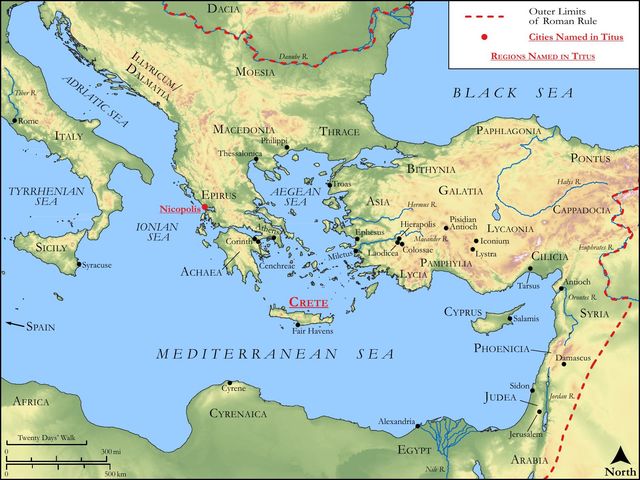
1.That Titus should hold himself ready to come to Paul at Nicopolis (a city of Thrace, as is reckoned, on the borders of Macedonia), as soon as Artemas or Tychicus should be sent to Crete, to supply his place, and take care of the churches there when he should leave them. The apostle would not have them in their young and weak state be without one or other of chief sufficiency, to guide and help them. Titus, it seems, was not their ordinary fixed bishop or pastor, but an evangelist, otherwise Paul would not have called him so much from his charge. Of Artemas we read little, but Tychicus is mentioned on many occasions with respect. Paul calls him a beloved brother, and faithful minister, and fellow-servant in the Lord: one fit therefore for the service intimated. When Paul says to Titus, Be diligent to come to me to Nicopolis, for I have determined there to winter, it is plain that the epistle was not written from Nicopolis, as the postcript would have it, for then he would have said, I determined here, not there, to winter.
2.The other personal charge to Titus is that he would bring two of his friends on their journey diligently, and see them furnished, so that nothing should be wanting to them. This was to be done, not as a piece of common civility only, but of Christian piety, out of respect both to them and the work they were sent about, which probably was to preach the gospel, or to be in some way serviceable to the churches. Zenas is styled the lawyer, whether in reference to the Roman or the Mosaic law, as having some time been his profession, is doubtful. Apollos was an eminent and faithful minister. Accompanying such persons part of their way, and accommodating them for their work and journeys, was a pious and needful service; and to further this, and lay in for it, what the apostle had before exhorted Titus to teach (Tit 3:8) he repeats here: Let ours also learn to maintain good works for necessary uses, that they be not unfruitful, Tit 3:14. Let Christians, those who have believed in God, learn to maintain good works, especially such as these, supporting ministers in their work of preaching and spreading the gospel, hereby becoming fellow-helpers to the truth, Jo3 1:5-8. That they be not unfruitful. Christianity is not a fruitless profession; the professors of it must be filled with the fruits of righteousness, which are by Jesus Christ, to the glory and praise of God. It is not enough that they be harmless, but they must be profitable, doing good, as well as eschewing evil. - "Let ours set up and maintain some honest labour and employment, to provide for themselves and their families, that they be not unprofitable burdens on the earth;" so some understand it. Let them not think that Christianity gives them a writ of ease; no, it lays an obligation upon them to seek some honest work and calling, and therein to abide with God. This is of good report, will credit religion and be good to mankind; they will not be unprofitable members of the body, not burdensome and chargeable to others, but enabled to be helpful to those in want. To maintain good works for necessary uses; not living like drones on the labours of others, but themselves fruitful to the common benefit.
IV.The apostle concludes with salutations and benedictions, Tit 3:5.
Though perhaps not personally known (some of them at least), yet all by Paul testify their love and good wishes to Titus, owning him thereby in his work, and stimulating him to go on therein. Great comfort and encouragement it is to have the heart and prayers of other Christians with and for us. Greet those that love us in the faith, or for the faith, who are our loving fellow-christians. Holiness, or the image of God in any, is the great endearing thing that gives strength to all other bonds, and is itself the best. Grace be with you all. Amen. This is the closing benediction, not to Titus alone, but to all the faithful with him, which shows that though the epistle bears the single name of Titus in the inscription, yet it was for the use of the churches there, and they were in the eye, and upon the heart, of the apostle, in the writing of it. "Grace be with you all, the love and favour of God, with the fruits and effects thereof, according to need, spiritual ones especially, and the increase and feeling of them more and more in your souls." This is the apostle's wish and prayer, showing his affection to them, his desire of their good, and a means of obtaining for them, and bringing down upon them, the thing requested. Observe, Grace is the chief thing to be wished and begged for, with respect to ourselves or others; it is, summarily, all good. Amen shuts up the prayer, expressing desire and hope, that so it may, and so it shall be.
Historical interpretation
Eight Centuries of Reception
5 surviving comments on this verse. Each one is dated, so this reads as a timeline rather than a list.
Select a marker to jump to its quote. Markers stagger vertically where authors wrote within a few decades of each other.
Unhappy Aristotle! who invented for these men dialectics, the art of building up and pulling down; an art so evasive in its propositions, so far-fetched in its conjectures, so harsh, in its arguments, so productive of contentions-embarrassing even to itself, retracting everything, and really treating of nothing! Whence spring those "fables and endless genealogies," and "unprofitable questions," and "words which spread like a cancer? " From all these, when the apostle would restrain us, he expressly names philosophy as that which he would have us be on our guard against.
Blessed is that servant [Paul] who can say: “I have fed you with milk and not with meat; for until now you were not able to bear it.” … Yet he—being so great a man and chosen by Christ for the care of his flock in order to strengthen the weak and to heal the sick—rejects immediately after a single admonition a heretic from the fold entrusted to him. This he does for fear that the taint of one erring sheep might infect the whole flock with a spreading sore. He further bids that foolish questions and contentions be avoided.
"But avoid foolish questions, and genealogies, and contentions, and strivings about the law, for they are unprofitable and vain." What do these "genealogies" mean? For in his Epistle to Timothy he mentions "fables and endless genealogies." (1 Tim. i. 4.) Perhaps both here and there glancing at the Jews, who, priding themselves on having Abraham for their forefather, neglected their own part. On this account he calls them both "foolish and unprofitable"; for it is the part of folly to confide in things unprofitable. "Contentions," he means, with heretics, in which he would not have us labor to no purpose, where nothing is to be gained, for they end in nothing. For when a man is perverted and predetermined not to change his mind, whatever may happen, why shouldest thou labor in vain, sowing upon a rock, when thou shouldest spend thy honorable toil upon thy own people, in discoursing with them upon almsgiving and every other virtue?
But avoid foolish questions, and genealogies, and contentions, and strivings about the law; for they are unprofitable and vain. For there are many questions and divers contentions, wherefore Solomon said: "Those who seek God in the right way, find peace" (Proverbs 8:35). Therefore, those who do not seek God in the right way cannot find peace. There are many examples of those who seek God in the wrong way. The Jews seek God wrongly, hoping to find Him without Christ. Heretics, making a noise with vain words, seek that which they cannot find. Philosophers and barbarians, having different opinions about God, seek God. But because they do not seek in the right way, their questions are foolish, thinking that God may be comprehended by human senses. Therefore, Paul calls us away from these questions. Moreover, to the wise, and those things which are supported by the authority of the Scriptures, it is urged and provoked more, being knowledgeable of the precepts of the Savior, in which he says: Seek and you shall find, knock and it shall be opened to you, ask and it shall be given to you. For everyone who seeks finds, and who asks receives, and who knocks, it shall be opened to him (Luke 11); provided our body is not subject to sins, and wisdom will enter us. Let our understanding be exercised, let our mind be nourished daily by divine reading: and our foolish questions will not be questions. But he who said: Avoid genealogies and contentions and quarrels, which come from the Law, properly rebukes the Jews, who boast in it and think they have knowledge of the Law, if they hold the names of each one: which because they are barbaric, and we do not know their etymology, they are often uttered incorrectly by us. And if by chance we err in accentuation, in the length or brevity of a syllable, whether lengthening the short or shortening the long, our ignorance is wont to be ridiculed, especially in the case of aspirations and certain letters pronounced with throaty constriction. Now this happens because the Seventy Interpreters by whom the Divine Utterance was translated into the Greek language, have rendered the Heth and Ain and other similar letters, because they could not transfer them into the Greek language with the double aspiration, by adding other letters. For example they said 'Rahel' for Rachel, and 'Jeriho' for Jericho, and 'Hebron' for Chebron, and 'Seor' for Segor; but in other instances this method failed them. For we and the Greeks have only one letter s, but they three, Samech, Sade, and Sin, which have different sounds. Isaac and Sion are spelled with Sade, Israel with Sin, and do not sound as they are written. Seon, king of the Amorites, is spelled and pronounced with the letter Samech. Therefore, if we have not expressed these names and idioms of language, namely barbarian, in the way Hebrews express them, they are accustomed to laugh and swear that they completely do not understand what we are saying. Hence, it was our concern to correct all the books of the Old Law, arranged in six columns by the learned man Adamantius, written in the Caesarean library, from the authentic ones, in which the Hebrew itself is written in its own characters, and are expressed in the Greek letters on the margin. Aquila and Symmachus, as well as the Septuagint and Theodotion, follow their order. But some books and especially those written in verses among the Hebrews have three other variations added, which they call the fifth, the sixth, and the seventh translations, having gained authority without the names of interpreters. This immortal talent has given us, through his own efforts, the ability not to greatly fear the arrogance of the Jews; those who are happy with loose lips, a twisted tongue, a hissing spittle, and a hoarse throat. And there is another source of their pride, because just as we who are Latins, having Latin names and origins from our language, [that we learn] with greater ease from memory; so they, from a young age, have deeply absorbed the words of their own language [with] the most exact senses [possible]. From the beginning with Adam to the end with Zerubbabel, they run through all the generations from memory so quickly that you might think it is their own name that they are relating. We who have either learned other languages or have only later believed in Christ or even if we are infants made over to the Church, rely more on the sense of the Scriptures than their wording. If perhaps we do not know [the Latin] text so well, they believe themselves better [than us] in reciting names, in computing years, in [knowledge of] their children’s children to the third and fourth generation, of their ancestors, grandfathers, and great-grandfathers. I heard from certain Hebrews in Rome who pretended to have believed in Christ, on the genealogies of our Lord Jesus Christ, which are written in Matthew and Luke; specifically that they do not agree with each other in number or in the equality of words, from Solomon to Joseph. This person disturbed the hearts of simple people as if he was bringing forth responses from some sacred inner-sanctums and oracles, despite the fact that he should have been seeking justice, mercy, and love of God instead, and after this, if it happened to arise, disputing names and numbers. We have perhaps said enough about the haughtiness of the Hebrews, more than was necessary, but we were given an opportunity to speak of the genealogies and the contentions and disputes that arise from the Law. The dialecticians, of whom Aristotle is the foremost, are accustomed to weaving nets of argumentation, and to attaching the loose freedom of rhetoric to the threads of syllogisms. Those who spend all their days and nights in questioning, answering, giving and accepting propositions and confirming and concluding them are thus called contentious, who argue not based on reason, but through their gut. If they do this, whose proper art is contention, then what should a Christian do other than completely shun contention? Even legal disputes should be completely discarded and the foolishness of the Jews abandoned. For they are useless and vain, which have only the appearance of knowledge: besides, they are not of advantage either to those who speak them, or to those who hear them. For what is it to me to know how many years Methuselah lived, or in what year of his age Solomon obtained a wife, lest perhaps it should be believed that Rehoboam was born in his eleventh year? and many things of this kind, which either are difficult to find on account of the variety of books, and (while they are gradually written faultily) unwonted errors: or even if we find them with great study and labour, we have known that they are of no value. It frequently happens that we have disputes about the Law, not for the sake of the desire of truth; but for the sake of the love of glory, while we wish to be respected as learned among those who hear us: or certainly we pursue base profits from this little rumour: For what profit is it to babble with foaming lips, and to bark like dogs: since a simple and moderate answer either can appease you, if it is true, or if it is false, can be corrected gently and quietly?
but avoid foolish disputes, genealogies, contentions, and strivings about the law, for they are unprofitable and vain.
but avoid foolish disputes, genealogies. Genealogies or concerning the Greeks, who were recounting the lineage of their gods. They say, 'such a one begot such a one'. Concerning the Jews, who do not assert anything, but resort to genealogies and from them hold great esteem. Abraham, they say, Isaac and Jacob are our ancestors. But they bring foolish things, that is, nothing beneficial. For what benefit is there to a sinner if Abraham is his father? Indeed, rather it will bring harm if, having come from these, they were made reprobate. Flee, and beware. How then does Paul elsewhere command that he should stop the mouths of those who contradict, if it is absolutely necessary to believe and to forsake? And we say: That it is necessary to stop the mouths of those who teach to the destruction of others: but when they contend against you not about dogma, yield and forsake.
for they are unprofitable. For, Paul says, they will have no good end.
Exhortations concerning the avoidance of heretical seekers.
Continue studying Titus 3:9 across the web’s major study libraries — every link below opens this exact verse, chapter, or book on the destination site.
Read & Compare
 BibleGatewayThis verse in more than 200 translations and 70 languages.
 Bible.comThe YouVersion reader — hundreds of translations, reading plans, and highlights.
 ESV.orgCrossway's official English Standard Version reader.
 NET BibleThe NET translation with 60,000+ translators' notes on every rendering decision.
 STEP BibleTyndale House's free study tool — original text, vocabulary, and scholarly resources.
 BibliaLogos Bible Software's free web reader.
 USCCBThe New American Bible (Revised Edition) with the U.S. bishops' study notes.
Commentaries
 BibleHub CommentariesDozens of classic commentaries on this verse, gathered on one page.
 StudyLightMore than 100 commentary sets — the largest collection on the web.
 BibleRefPlain-English commentary on what this verse means, verse by verse.
 Enduring WordDavid Guzik's free commentary on this chapter, widely used by Bible teachers.
 Bible Study ToolsVerse commentary alongside Greek and Hebrew study aids.
Original Language & Research
- BibleHub InterlinearThe verse word by word — original language, transliteration, and English.
- BibleHub LexiconEvery word's original-language definition and Strong's entry.
 Blue Letter BibleDeep-study tools — Strong's numbers, concordance, and word studies.
 CNTR CollationThe earliest Greek manuscripts of this verse, collated letter by letter.
Sermons, Hymns & Audio


TrulyRandomVerse is not affiliated with these sites and doesn’t control their content. They’re linked because they’re genuinely useful.
Summary
Titus 3:9 issues a direct command from the Apostle Paul to Titus, instructing him to actively steer clear of unproductive and divisive discussions within the Christian community on Crete. This verse identifies "foolish questions," "genealogies," "contentions," and "strivings about the law" as pursuits that are ultimately "unprofitable and vain," serving only to distract from the core truths of the gospel and undermine the unity and spiritual health of believers.
Context
ShowHideLiterary Context
This verse serves as a sharp contrast to the preceding exhortations in Titus 3:1-8. Paul has just outlined the positive behaviors expected of believers: submission to authorities, kindness, gentleness, and readiness for good works, all rooted in the transformative grace of God. He describes the profound change from a past life of foolishness and disobedience to one of righteousness through the washing of regeneration and renewal by the Holy Spirit. Verse 9 then pivots, using the adversative "But," to warn against specific negative behaviors that would counteract the positive impact of the gospel and hinder the spiritual growth and unity that Paul desires for the Cretan churches. It functions as a practical application of the sound doctrine Paul has been emphasizing throughout the letter.
Historical & Cultural Context
The island of Crete, where Titus was ministering, was known for its challenging cultural environment, often characterized by moral laxity and a propensity for deception, as noted in Titus 1:12. Within this context, the early Christian communities faced internal threats from false teachers, particularly those of Jewish background who insisted on the necessity of Mosaic Law observance and endless debates about Jewish traditions and genealogies (Titus 1:10-11). These individuals often engaged in speculative arguments and legalistic disputes, which fostered division rather than genuine faith and love. Paul's directive reflects a broader concern seen in his other pastoral letters to combat such influences that threatened to corrupt the simplicity of the gospel and distract believers from lives of practical godliness.
Key Themes
ShowHideTitus 3:9 contributes significantly to several key themes in the letter to Titus and Paul's broader theology. Foremost is the theme of sound doctrine and practical godliness, emphasizing that true faith is not merely intellectual assent or engagement in endless debates, but a life transformed by grace, leading to good works (Titus 2:11-14). It also highlights the theme of church unity and avoiding division, as these "foolish questions" and "strivings" inevitably lead to discord and undermine the peace of the community (Titus 3:10-11). Furthermore, the verse underscores the profitability of truth versus the futility of error, contrasting activities that are "unprofitable and vain" with the "good works" that are "profitable unto men" (Titus 3:8).
Exposition and Analysis
ShowHideKey Word Analysis
ShowHideThis term means "to stand all around," but in this context, it carries the sense of keeping away from, shunning, or avoiding. It implies a deliberate and active withdrawal from engagement with these specified activities, rather than merely passive disinterest. Paul is not just suggesting indifference but a conscious decision to distance oneself from these unproductive discussions.
Derived from a root meaning "dull" or "stupid," this adjective describes something as absurd, senseless, or lacking spiritual wisdom. When applied to "questions," it indicates inquiries that are not only trivial but also spiritually barren, leading nowhere productive and often stemming from a lack of true understanding or a misplaced focus.
This word is formed from a negative particle ("a-") and the root for "useful" or "beneficial." It literally means "useless" or "without profit." Paul uses it to emphasize that the specified activities yield no spiritual benefit, contribute nothing to godliness, and do not advance the kingdom of God or the spiritual well-being of individuals or the community.
Verse Breakdown
ShowHide"But avoid foolish questions"
Paul begins with a strong injunction to actively turn away from inquiries or debates that are senseless, absurd, or lack any spiritual substance. These are not questions that seek genuine understanding or edification, but rather those that are trivial, speculative, or designed to stir up controversy.
"and genealogies"
This refers to discussions or disputes concerning ancestral lines, particularly common in Jewish contexts. While historical lineage could be important, obsessive or prideful preoccupation with genealogies, especially when used to establish spiritual superiority or to engage in endless, unedifying debates, is deemed unproductive by Paul.
"and contentions"
This term signifies quarrels, wrangling, or strife. It points to the argumentative spirit itself, where individuals are more interested in winning a debate or asserting their own viewpoint than in fostering unity or seeking truth in love.
"and strivings about the law"
This phrase specifically targets legalistic disputes or controversies over the interpretation and application of the Mosaic Law. Such arguments often led to bitter divisions, as factions within the early church debated the necessity of circumcision, dietary laws, or other aspects of the Law for salvation or sanctification, rather than focusing on the sufficiency of Christ's grace.
"for they are unprofitable and vain"
This concluding clause provides the rationale for Paul's directive. The activities listed are to be avoided precisely because they yield no spiritual fruit ("unprofitable") and are ultimately empty, useless, or futile ("vain"). They do not build up faith, promote love, or contribute to the growth of the church, but rather drain energy and foster division.
Literary Devices
ShowHidePaul employs several literary devices in Titus 3:9 to convey his urgent message. The verse begins with an Adversative Conjunction ("But"), clearly signaling a sharp contrast with the preceding positive exhortations. This creates a rhetorical tension, highlighting the divergence between godly conduct and the unproductive behaviors being warned against. Paul uses Enumeration by listing four distinct categories of things to avoid: "foolish questions, and genealogies, and contentions, and strivings about the law." This list provides specific examples, making the instruction concrete and actionable. The repetition of "and" (polysyndeton) emphasizes the cumulative nature of these destructive practices. Finally, the verse concludes with a powerful Justification or Reasoning Clause ("for they are unprofitable and vain"), which functions as a concise summary of why these activities must be shunned. This rhetorical move provides the theological and practical basis for the command, appealing to the reader's understanding of spiritual utility.
Theological and Thematic Connections
ShowHideTitus 3:9 underscores a vital theological principle: genuine Christian faith is not characterized by intellectual gymnastics, speculative debates, or legalistic wrangling, but by a life transformed by grace that expresses itself in good works and unity. Paul consistently warns against activities that distract from the core message of the gospel and undermine the peace of the church. The emphasis is on spiritual profitability and the pursuit of what truly builds up the body of Christ, rather than engaging in discussions that are empty and lead to division. This aligns with the broader New Testament emphasis on practical godliness and the importance of love and unity within the community of believers, contrasting the fruit of the Spirit with the works of the flesh.
Reflection and Application
ShowHidePaul's directive in Titus 3:9 remains profoundly relevant for believers today, serving as a timeless guide for healthy Christian discourse and community life. In an age saturated with information and diverse opinions, the temptation to engage in "foolish questions" or "vain" debates is ever-present, whether in theological discussions, social media interactions, or even within church contexts. This verse calls us to spiritual discernment, urging us to evaluate the purpose and outcome of our conversations. Are they building up, or tearing down? Do they lead to greater godliness and unity, or to division and distraction? Applying this verse means prioritizing what is spiritually profitable, focusing on the core truths of the gospel, and actively cultivating peace and edification within our relationships and communities. It encourages us to invest our time and energy in pursuits that yield genuine spiritual fruit, rather than wasting them on arguments that are ultimately empty and unproductive.
Questions for Reflection
ShowHideFAQ
ShowHideWhat exactly are "foolish questions" and "genealogies" that Paul warns against?
ShowHideThe "foolish questions" (Greek, mōras zētēseis) Paul refers to are not genuine inquiries seeking truth, but rather senseless, absurd, or spiritually unproductive debates that lead nowhere. They are often speculative, trivial, or designed to stir up controversy rather than build up faith. "Genealogies" (Greek, genealogias) specifically refer to tracing family lines. While lineage could be important in certain contexts, Paul is warning against an obsessive preoccupation with ancestry, particularly within Jewish circles, where it might have been used to establish spiritual superiority or engage in endless, unedifying discussions that distracted from the gospel. Both were likely issues within the early church, especially among those with a strong Jewish background, that led to division and wasted time. Paul also warns against similar issues in 1 Timothy 1:4.
Why does Paul say these activities are "unprofitable and vain"?
ShowHidePaul states that these activities are "unprofitable" (Greek, anōphelḗs) because they yield no spiritual benefit or advantage; they do not contribute to godliness, spiritual growth, or the advancement of the gospel. They are "vain" (Greek, mátaios) in the sense that they are empty, useless, or futile. They consume time, energy, and attention without producing any lasting positive outcome. Instead of building up the church or individual believers, these debates often lead to division, bitterness, and a distraction from the essential truths and practical applications of the Christian faith, as highlighted in Titus 3:8.
Christ-Centered Fulfillment
ShowHideWhile Titus 3:9 directly addresses the avoidance of specific unproductive debates, its underlying principle points profoundly to Christ as the ultimate fulfillment of all profitable truth and the end of all vain striving. The "strivings about the law" that Paul condemns find their resolution in Christ, who is the "end of the law for righteousness to everyone who believes" (Romans 10:4). Legalistic debates become obsolete in light of God's grace revealed in Jesus, who fulfilled the Law perfectly, rendering human attempts to achieve righteousness through its minute observance as "unprofitable and vain." Furthermore, the "foolish questions" and "genealogies" that distract from the gospel are superseded by the singular, saving truth of Christ. Our identity and worth are no longer found in earthly lineage or speculative knowledge, but solely in our union with Christ, through whom we become "new creation[s]" (2 Corinthians 5:17). All true wisdom and knowledge are "hidden in Christ" (Colossians 2:3), making any pursuit outside of Him ultimately empty. Thus, avoiding these futile discussions is not merely a negative command, but a positive call to fix our gaze upon Jesus, the source of all spiritual profit and the substance of our faith, in whom all things hold together and find their true meaning (Colossians 1:17).