


2 Peter 1:8
Bible text: King James Version (1769 Blayney text) · Public domain
Bible text: King James Version with Strong's numbers · Public domain
Bible text: Berean Standard Bible · Public domain
Bible text: American Standard Version (1901) · Public domain
Bible text: World English Bible, Messianic edition · Public domain
Bible text: Geneva Bible (1599) · Public domain
Bible text: Young's Literal Translation · Public domain
- ταῦταtautaThese thingsG3778D-NPNDemonstrative pronoun Nominative Plural Neuter
- γὰρgarforG1063CONJConjunction
- ὑμῖνhuminin youG4771P-2DPPersonal pronoun Dative 2nd Plural
- ὑπάρχονταhuparchontabeingG5225V-PAP-NPNVerb Present Active Participle Nominative Plural Neuter
- καὶkaiandG2532CONJConjunction
- πλεονάζονταpleonazontaaboundingG4121V-PAP-NPNVerb Present Active Participle Nominative Plural Neuter
- οὐκoukneitherG3756PRT-NNegative Particle Negative
- ἀργοὺςargousidleG692A-APMAdjective Accusative Plural Masculine
- οὐδὲoudenorG3761CONJ-NConjunction Negative
- ἀκάρπουςakarpousunfruitfulG175A-APMAdjective Accusative Plural Masculine
- καθίστησινkathistēsinmake [you]G2525V-PAI-3SVerb Present Active Indicative 3rd Singular
- εἰςeisas toG1519PREPPreposition
- τὴνtēntheG3588T-ASFDefinite article Accusative Singular Feminine
- τοῦtouof theG3588T-GSMDefinite article Genitive Singular Masculine
- κυρίουkuriouLordG2962N-GSM-TNoun Genitive Singular Masculine Title
- ἡμῶνhēmōnof usG3165P-1GPPersonal pronoun Genitive 1st Plural
- ἸησοῦIēsouJesusG2424N-GSM-PNoun Genitive Singular Masculine Individual
- ΧριστοῦChristouChristG5547N-GSM-TNoun Genitive Singular Masculine Title
- ἐπίγνωσινepignōsinknowledgeG1922N-ASFNoun Accusative Singular Feminine
English is a literal word-by-word gloss of the Greek, not the KJV's wording. Why?
This is the original text the KJV's translators worked from — each Greek word with its own literal English meaning in this verse, prepared by scholars at Tyndale House, Cambridge. The KJV translates whole sentences, not word by word, so its wording differs: one Greek word can become several English words, and the KJV may choose “charity” where the gloss reads “love”. Both are faithful — they answer different questions. For the KJV's own rendering, switch to the KJV text.
Details
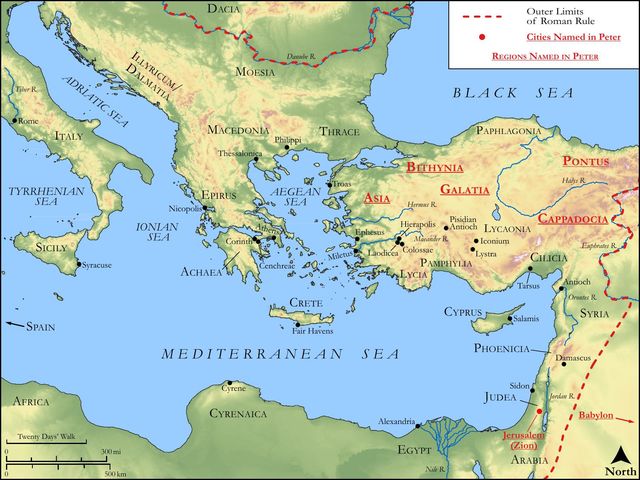
See on the biblical-era maps

Study this verse
Public-domain commentary
Matthew Henry
From his Commentary on the Whole Bible. Henry comments on passages, not single verses — this entry covers 2 Peter 1:5–11. His three-level outline is real structure in the source text, so it is rendered as structure.
In these words the apostle comes to the chief thing intended in this epistle - to excite and engage them to advance in grace and holiness, they having already obtained precious faith, and been made partakers of the divine nature. This is a very good beginning, but it is not to be rested in, as if we were already perfect. The apostle had prayed that grace and peace might be multiplied to them, and now he exhorts them to press forward for the obtaining of more grace. We should, as we have opportunity, exhort those we pray for, and excite them to the use of all proper means to obtain what we desire God to bestow upon them; and those who will make any progress in religion must be very diligent and industrious in their endeavours. Without giving all diligence, there is no gaining any ground in the work of holiness; those who are slothful in the business of religion will make nothing of it; we must strive if we will enter in at the strait gate, Luk 13:24.
I.Here we cannot but observe how the believer's way is marked out step by step.
1.He must get virtue, by which some understand justice; and then the knowledge, temperance, and patience that follow, being joined with it, the apostle may be supposed to put them upon pressing after the four cardinal virtues, or the four elements that go to the making up of every virtue or virtuous action. But seeing it is a faithful saying, and constantly to be asserted, that those who have faith be careful to maintain good works (Tit 3:8), by virtue here we may understand strength and courage, without which the believer cannot stand up for good works, by abounding and excelling in them. The righteous must be bold as a lion (Pro 28:1); a cowardly Christian, who is afraid to profess the doctrines or practise the duties of the gospel, must expect that Christ will be ashamed of him another day. "Let not your hearts fail you in the evil day, but show yourselves valiant in standing against all opposition, and resisting every enemy, world, flesh, devil, yea, and death too." We have need of virtue while we live, and it will be of excellent use when we come to die.
2.The believer must add knowledge to his virtue, prudence to his courage; there is a knowledge of God's name which must go before our faith (Psa 9:10), and we cannot approve of the good, and acceptable, and perfect will of God, till we know it; but there are proper circumstances for duty, which must be known and observed; we must use the appointed means, and observe the accepted time. Christian prudence regards the persons we have to do with and the place and company we are in. Every believer must labour after the knowledge and wisdom that are profitable to direct, both as to the proper method and order wherein all Christian duties are to be performed and as to the way and manner of performing them.
3.We must add temperance to our knowledge. We must be sober and moderate in our love to, and use of, the good things of this life; and, if we have a right understanding and knowledge of outward comforts, we shall see that their worth and usefulness are vastly inferior to those of spiritual mercies. Bodily exercises and bodily privileges profit but little, and therefore are to be esteemed and used accordingly; the gospel teaches sobriety as well as honesty, Tit 2:12. We must be moderate in desiring and using the good things of natural life, such as meat, drink, clothes, sleep, recreations, and credit; an inordinate desire after these is inconsistent with an earnest desire after God and Christ; and those who take more of these than is due can render to neither God nor man what is due to them.
4.Add to temperance patience, which must have its perfect work, or we cannot be perfect and entire, wanting nothing (Jam 1:4), for we are born to trouble, and must through many tribulations enter into the kingdom of heaven; and it is this tribulation (Rom 5:3) which worketh patience, that is, requires the exercise and occasions the increase of this grace, whereby we bear all calamities and crosses with silence and submission, without murmuring against God or complaining of him, but justifying him who lays all affliction upon us, owning that our sufferings are less than our sins deserve, and believing they are no more than we ourselves need.
5.To patience we must add godliness, and this is the very thing which is produced by patience, for that works experience, Rom 5:4. When Christians bear afflictions patiently, they get an experimental knowledge of the loving-kindness of their heavenly Father, which he will not take from his children, even when he visits their iniquity with the rod and their transgression with stripes (Psa 89:32, Psa 89:33), and hereby they are brought to the child-like fear and reverential love wherein true godliness consists: to this,
6.We must add brotherly-kindness, a tender affection to all our fellow-christians, who are children of the same Father, servants of the same Master, members of the same family, travellers to the same country, and heirs of the same inheritance, and therefore are to be loved with a pure heart fervently, with a love of complacency, as those who are peculiarly near and dear to us, in whom we take particular delight, Psa 16:3.
7.Charity, or a love of good-will to all mankind, must be added to the love of delight which we have for those who are the children of God. God has made of one blood all nations, and all the children of men are partakers of the same human nature, are all capable of the same mercies, and liable to the same afflictions, and therefore, though upon a spiritual account Christians are distinguished and dignified above those who are without Christ, yet are they to sympathize with others in their calamities, and relieve their necessities, and promote their welfare both in body and soul, as they have opportunity: thus must all believers in Christ evidence that they are the children of God, who is good to all, but is especially good to Israel.
II.All the forementioned graces must be had, or we shall not be thoroughly furnished for all good works - for the duties of the first and second table, for active and passive obedience, and for those services wherein we are to imitate God as well as for those wherein we only obey him - and therefore to engage us to an industrious and unwearied pursuit of them, the apostle sets forth the advantages that redound to all who successfully labour so as to get these things to be and abound in them, Pe2 1:8-11. These are proposed,
1.More generally, Pe2 1:8. The having these things make not barren (or slothful) nor unfruitful, where, according to the style of the Holy Ghost, we must understand a great deal more than is expressed; for when it is said concerning Ahaz, the vilest and most provoking of all the kings of Judah, that he did not right in the sight of the Lord (Kg2 16:2), we are to understand as much as if it had been said, He did what was most offensive and abominable, as the following account of his life shows; so, when it is here said that the being and abounding of all Christian graces in us will make us neither inactive nor unfruitful, we are thereby to understand that it will make us very zealous and lively, vigorous and active, in all practical Christianity, and eminently fruitful in the works of righteousness. these will bring much glory to God, by bringing forth much fruit among men, being fruitful in knowledge, or the acknowledging of our Lord Jesus Christ, owning him to be their Lord, and evidencing themselves to be his servants by their abounding in the work that he has given them to do. This is the necessary consequence of adding one grace to another; for, where all Christian graces are in the heart, they improve and strengthen, encourage and cherish, one another; so they all thrive and grow (as the apostle intimates in the beginning of Pe2 1:8), and wherever grace abounds there will be an abounding in good works. How desirable it is to be in such a case the apostle evidences, Pe2 1:9. There he sets forth how miserable it is to be without those quickening fructifying graces; for he who has not the forementioned graces, or, though he pretends or seems to have them, does not exercise and improve them, is blind, that is, as to spiritual and heavenly things, as the next words explain it: He cannot see far off. This present evil world he can see, and dotes upon, but has no discerning at all of the world to come, so as to be affected with the spiritual privileges and heavenly blessings thereof. He who sees the excellences of Christianity must needs be diligent in endeavours after all those graces that are absolutely necessary for obtaining glory, honour, and immortality; but, where these graces are not obtained nor endeavoured after, men are not able to look forward to the things that are but a very little way off in reality, though in appearance, or in their apprehension, they are at a great distance, because they put them far away from them; and how wretched is their condition who are thus blind as to the awfully great things of the other world, who cannot see any thing of the reality and certainty, the greatness and nearness, of the glorious rewards God will bestow on the righteous, and the dreadful punishment he will inflict on the ungodly! But this is not all the misery of those who do not add to their faith virtue, knowledge, etc. They are as unable to look backward as forward, their memories are slippery and unable to retain what is past, as their sight is short and unable to discern what is future; they forget that they have been baptized, and had the means, and been laid under the obligations to holiness of heart and life. By baptism we are engaged in a holy war against sin, and are solemnly bound to fight against the flesh, the world, and the devil. Often call to mind, and seriously meditate on, your solemn engagement to be the Lord's, and your peculiar advantages and encouragements to lay aside all filthiness of flesh and spirit.
2.The apostle proposes two particular advantages that will attend or follow upon diligence in the work of a Christian: stability in grace, and a triumphant entrance into glory. These he brings in by resuming his former exhortation, and laying it down in other words; for what in Pe2 1:5 is expressed by giving diligence to add to faith virtue, etc., is expressed in Pe2 1:10 by giving diligence to make our calling and election sure. Here we may observe,
(1.)It is the duty of believers to make their election sure, to clear it up to themselves that they are the chosen of God.
(2.)The way to make sure their eternal election is to make out their effectual calling: none can look into the book of God's eternal counsels and decrees; but, inasmuch as whom God did predestinate those he also called, if we can find we are effectually called, we may conclude we are chosen to salvation.
(3.)It requires a great deal of diligence and labour to make sure our calling and election; there must be a very close examination of ourselves, a very narrow search and strict enquiry, whether we are thoroughly converted, our minds enlightened, our wills renewed, and our whole souls changed as to the bent and inclination thereof; and to come to a fixed certainty in this requires the utmost diligence, and cannot be attained and kept without divine assistance, as we may learn from Psa 139:23; Rom 8:16. "But, how great soever the labour is, do not think much of it, for great is the advantage you gain by it; for," [1.] "By this you will be kept from falling, and that at all times and seasons, even in those hours of temptation that shall be on the earth." When others shall fall into heinous and scandalous sin, those who are thus diligent shall be enabled to walk circumspectly and keep on in the way of their duty; and, when many fall into errors, they shall be preserved sound in the faith, and stand perfect and complete in all the will of God. [2.] Those who are diligent in the work of religion shall have a triumphant entrance into glory; while of those few who get to heaven some are scarcely saved (Pe1 4:18), with a great deal of difficulty, even as by fire (Co1 3:15), those who are growing in grace, and abounding in the work of the Lord, shall have an abundant entrance into the joy of their Lord, even that everlasting kingdom where Christ reigns, and they shall reign with him for ever and ever.
Historical interpretation
Six Centuries of Reception
4 surviving comments on this verse. Each one is dated, so this reads as a timeline rather than a list.
Select a marker to jump to its quote. Markers stagger vertically where authors wrote within a few decades of each other.
These things, as well as those already mentioned, namely, virtue, knowledge, continence, patience, godliness, brotherly love and charity, must not only be present in us, they must be present to overflowing. For if their presence is a good thing, how much more their abundance! What advantage do these things have, and what will it mean to have assurance on the day of our Lord Jesus Christ? Peter is speaking here of his second coming, when Christ will come to judge the living and the dead. Before the great and terrible judgment seat of God, what a good and wonderful thing it will be to have assurance of being acquitted!
Those who have chosen to live the glorious and beloved way of life devised by Christ must first be adorned with simple and unblemished faith, and then add virtue to their faith. When this has been done, they must strive to enrich their knowledge of the mystery of Christ and ascend to the most complete understanding of him.
For if all these things are present with you and abound, not empty, etc. He said if they abound, if with superior virtue they prevail against the wars of vices.
For if these things are with you and abound, you will be neither idle nor unfruitful in the knowledge of our Lord Jesus Christ.
"For if these things are with you and abound." What are these? Faith, virtue, knowledge, self-control, patience, godliness, brotherly kindness, love, which must not only be present but also abound. For if presence is beneficial, much more is abundance or wealth. What, then, is the benefit that follows from these? To have security for the second coming of the Lord. For indeed, to those to whom these are not present, in the glory of the coming Judge, and in the manner of the shining sun, blindness follows. Where, even if it is strong in appearance, it cannot be gazed upon without injury by the exaggeration of those who are weak-eyed, since it was born shining in its own light in such a way that it blinds those who rely on it with feeble sight. But the word Μυωπάζειν is used to mean, ἀπὸ τῶν μυῶν, that is, from the moles living underground, who remain blind to everything.
Continue studying 2 Peter 1:8 across the web’s major study libraries — every link below opens this exact verse, chapter, or book on the destination site.
Read & Compare
 BibleGatewayThis verse in more than 200 translations and 70 languages.
 Bible.comThe YouVersion reader — hundreds of translations, reading plans, and highlights.
 ESV.orgCrossway's official English Standard Version reader.
 NET BibleThe NET translation with 60,000+ translators' notes on every rendering decision.
 STEP BibleTyndale House's free study tool — original text, vocabulary, and scholarly resources.
 BibliaLogos Bible Software's free web reader.
 USCCBThe New American Bible (Revised Edition) with the U.S. bishops' study notes.
Commentaries
 BibleHub CommentariesDozens of classic commentaries on this verse, gathered on one page.
 StudyLightMore than 100 commentary sets — the largest collection on the web.
 BibleRefPlain-English commentary on what this verse means, verse by verse.
 Enduring WordDavid Guzik's free commentary on this chapter, widely used by Bible teachers.
 Bible Study ToolsVerse commentary alongside Greek and Hebrew study aids.
Original Language & Research
- BibleHub InterlinearThe verse word by word — original language, transliteration, and English.
- BibleHub LexiconEvery word's original-language definition and Strong's entry.
 Blue Letter BibleDeep-study tools — Strong's numbers, concordance, and word studies.
 CNTR CollationThe earliest Greek manuscripts of this verse, collated letter by letter.
Sermons, Hymns & Audio


TrulyRandomVerse is not affiliated with these sites and doesn’t control their content. They’re linked because they’re genuinely useful.
Summary
Second Peter 1:8 serves as a pivotal summary and promise within Peter's exhortation to spiritual diligence, asserting that the active cultivation and abounding presence of specific Christian virtues—faith, virtue, knowledge, temperance, patience, godliness, brotherly kindness, and love—will prevent believers from being unproductive or ineffective in their experiential understanding of Jesus Christ. This verse underscores the dynamic relationship between spiritual growth, character development, and a fruitful life that honors the Lord.
Context
ShowHideLiterary Context
This verse directly follows Peter's "spiritual ladder" in 2 Peter 1:5-7, where he outlines a progressive list of virtues believers are exhorted to "add" to their faith with diligence. The phrase "these things" in verse 8 explicitly refers to this preceding list of qualities. Peter has just laid the foundation for salvation by grace through faith in 2 Peter 1:3-4, emphasizing God's divine power granting everything necessary for life and godliness through the knowledge of Christ. Verse 8 then functions as a promise and a consequence: if believers actively pursue and possess these virtues in abundance, their knowledge of Christ will be vibrant and productive, not stagnant or barren. The subsequent verses, 2 Peter 1:9-11, further elaborate on the negative consequences of lacking these virtues, portraying such a person as spiritually short-sighted and ineffective.
Historical & Cultural Context
Peter's second epistle is written to a scattered Christian audience facing internal challenges from false teachers and external pressures from a hostile world. The historical context includes the nascent church's struggle to maintain doctrinal purity and moral integrity against the infiltration of Gnostic-like heresies that often promoted antinomianism (the idea that moral laws are not binding for Christians) or a detached, intellectualized "knowledge" without corresponding ethical living. Culturally, the Roman world was characterized by various philosophical schools and religious practices, some of which emphasized esoteric knowledge over practical righteousness. Peter's emphasis on "knowledge" (epígnōsis) that leads to practical fruitfulness directly counters any notion that faith or knowledge is merely intellectual assent devoid of moral transformation. The agricultural imagery of "barren" and "unfruitful" would have resonated deeply with an ancient audience familiar with the importance of a productive harvest, applying this metaphor to spiritual life.
Key Themes
ShowHideThe passage contributes significantly to several major themes within 2 Peter and the broader biblical narrative. Spiritual Growth and Diligence is paramount, as Peter repeatedly calls believers to active participation in their sanctification, urging them to "give diligence" (2 Peter 1:10). This isn't passive reception but an energetic pursuit of Christ-likeness. Another key theme is Experiential Knowledge of Christ, highlighted by the term epígnōsis. This is not mere intellectual acquaintance (gnosis) but a deep, transformative, and relational understanding of Jesus that profoundly impacts one's character and conduct. Finally, Spiritual Fruitfulness is a central outcome. The contrast between being "barren nor unfruitful" and a life abounding in virtues points to a productive Christian life that bears the fruit of righteousness, impacting the world and glorifying God. This fruitfulness is a natural, necessary outflow of a genuine and growing relationship with Christ, echoing the teachings on bearing fruit found in John 15.
Exposition and Analysis
ShowHideKey Word Analysis
ShowHideFrom the Greek word G692, meaning "inactive, i.e., unemployed; (by implication) lazy, useless." In this context, it describes a spiritual state of idleness or ineffectiveness, a lack of purposeful activity or contribution within the Christian life. It implies a failure to apply one's faith and virtues in a way that yields positive results.
From the Greek word G175, literally meaning "without fruit" or "unproductive." This term directly relates to the metaphor of a plant that fails to produce the expected harvest. Spiritually, it signifies a life that does not yield the expected outcomes of Christian character, good works, or influence for the Kingdom of God, despite having the potential.
From the Greek word G1922, meaning "recognition, i.e., (by implication) full discernment, acknowledgement." This is a profound, complete, or experiential knowledge, distinct from mere intellectual acquaintance (gnosis). It implies an intimate, transformative understanding of Jesus Christ that deeply influences one's actions, character, and worldview, leading to practical godliness.
Verse Breakdown
ShowHide"For if these things be in you, and abound"
This clause establishes a conditional premise. "These things" refers to the list of virtues from 2 Peter 1:5-7 (faith, virtue, knowledge, temperance, patience, godliness, brotherly kindness, and charity). The phrase "be in you" indicates their presence as internal qualities, while "abound" (from G4121, pleonázō) signifies not just their existence but their increasing, overflowing, and superabundant presence. This emphasizes active cultivation and growth, not static possession.
"they make you that ye shall neither be barren nor unfruitful"
This is the promised outcome of the preceding condition. The active presence and increase of these virtues "make" (from G2525, kathístēmi, meaning "to constitute" or "to render") believers productive. The double negative "neither...nor" strongly emphasizes the complete absence of spiritual idleness or lack of fruit. "Barren" (G692, argós) suggests inactivity or uselessness, while "unfruitful" (G175, ákarpos) implies a lack of spiritual produce or impact. Together, they paint a picture of a vibrant, purposeful, and productive Christian life.
"in the knowledge of our Lord Jesus Christ"
This phrase defines the sphere or context in which this fruitfulness occurs. It is not fruitfulness in general, but specifically "in the knowledge" (G1922, epígnōsis) of Jesus Christ. This deep, experiential knowledge is both the environment for and the object of spiritual growth and fruitfulness. It implies that genuine spiritual productivity is inextricably linked to a deepening, transformative relationship with Christ Himself, who is the source and goal of all true Christian living.
Literary Devices
ShowHidePeter employs several effective Literary Devices to convey his message. The primary device is Metaphor, specifically the agricultural imagery of "barren" and "unfruitful." This vivid language draws on the common experience of farming to illustrate spiritual productivity, contrasting a spiritually unproductive life with one that yields a rich harvest of character and good works. This is further enhanced by Contrast, as the verse presents a clear dichotomy between the negative state of being barren and unfruitful and the positive state of abounding in virtues, which leads to spiritual productivity. The structure of the verse itself forms a Conditional Statement ("For if... then they make"), clearly outlining the cause-and-effect relationship between diligent spiritual growth and a fruitful Christian life. This rhetorical structure underscores the believer's responsibility in cultivating these virtues.
Theological and Thematic Connections
ShowHideThis verse profoundly connects the internal state of a believer's character with their external impact and spiritual vitality. It posits that genuine, transformative knowledge of Jesus Christ is not merely intellectual but is intrinsically linked to the active cultivation of Christ-like virtues. When these virtues are present and growing, they prevent spiritual stagnation and ensure a life that actively participates in God's purposes, bearing fruit that glorifies Him. This fruitfulness is a tangible evidence of a living and dynamic faith, demonstrating the reality of one's relationship with the Lord and contributing to the advancement of His Kingdom. It underscores the biblical truth that faith without works is dead, and true knowledge of God always leads to practical righteousness.
Reflection and Application
ShowHideSecond Peter 1:8 serves as a powerful diagnostic tool and an inspiring challenge for every believer. It prompts us to honestly assess the presence and abundance of the virtues Peter lists in our own lives. Are we actively cultivating faith, virtue, knowledge, self-control, perseverance, godliness, brotherly kindness, and love? Do these qualities not just exist, but are they growing and overflowing? The promise is clear: a life rich in these virtues will be neither idle nor unproductive, but vibrant, impactful, and ever-deepening in its experiential knowledge of Jesus Christ. This verse reminds us that spiritual growth is not passive; it requires intentional diligence and active participation. Our fruitfulness is a direct reflection of our abiding in Christ and our commitment to His transforming work within us. It assures us that a diligent pursuit of Christ-likeness leads to a life of purpose and effectiveness for God's glory.
Questions for Reflection
ShowHideFAQ
ShowHideWhat does Peter mean by "these things" that should "be in you, and abound"?
ShowHide"These things" refers directly to the list of Christian virtues Peter outlines in the preceding verses, 2 Peter 1:5-7. This list includes faith, virtue (moral excellence), knowledge (spiritual discernment), temperance (self-control), patience (perseverance), godliness (reverence for God expressed in life), brotherly kindness (love for fellow believers), and charity (agape love, unconditional love). The phrase "be in you" means these qualities must be genuinely present as part of your character. "Abound" (Greek: pleonázō) means they should not just be present, but increasing, overflowing, and superabundant. It implies a dynamic and progressive growth in these Christ-like attributes, not a static possession.
Is it possible for a true believer to be "barren" or "unfruitful" in the knowledge of Christ?
ShowHidePeter's language suggests that while a true believer possesses the divine nature and the promises of God (2 Peter 1:3-4), the expression of that spiritual life can indeed be barren or unfruitful if diligence is not applied to cultivating these virtues. The consequence of neglecting this growth is described in 2 Peter 1:9, where such a person is called "blind, and cannot see afar off, and hath forgotten that he was purged from his old sins." This implies a lack of spiritual perception and effectiveness, even if salvation is secure. The call is to move from mere existence to active, productive living in Christ.
What is the difference between "barren" and "unfruitful" in this verse?
ShowHideWhile closely related, "barren" (Greek: argós) and "unfruitful" (Greek: ákarpos) offer slightly different nuances. "Barren" suggests a state of inactivity, idleness, or uselessness. It implies a lack of purposeful engagement or energy in one's faith that would lead to spiritual output. "Unfruitful" literally means "without fruit" or "unproductive," directly relating to the metaphor of a plant that does not yield its expected produce. Together, they paint a comprehensive picture of a Christian life that fails to produce the expected spiritual harvest of character, good works, and influence for God's Kingdom. The double negative "neither barren nor unfruitful" strongly emphasizes that a life abounding in these virtues will be productive in every sense.
Christ-Centered Fulfillment
ShowHideSecond Peter 1:8 finds its ultimate fulfillment and meaning in Jesus Christ, who is the very source and embodiment of the virtues Peter exhorts believers to cultivate. He is the perfect example of faith, virtue, knowledge, temperance, patience, godliness, brotherly kindness, and charity. Our "knowledge of our Lord Jesus Christ" is not merely intellectual assent but a transformative, experiential relationship that flows from and leads us deeper into Him. As the True Vine, Jesus declares in John 15:5, "I am the vine, ye are the branches: He that abideth in me, and I in him, the same bringeth forth much fruit: for without me ye can do nothing." Our fruitfulness, therefore, is not a product of our own striving in isolation, but a natural outflow of abiding in Him and allowing His life to flow through us. He is the "wisdom of God" (1 Corinthians 1:24) and in Him "are hid all the treasures of wisdom and knowledge" (Colossians 2:3). Thus, to abound in these virtues and to be fruitful in the knowledge of Christ is to increasingly reflect and participate in the very life and character of Jesus Himself, becoming more like Him and bearing witness to His transformative power in the world.