


Acts 18:24
- ἸουδαῖοςIoudaiosA JewG2453N-NSM-PGNoun Nominative Singular Masculine Person Gentilic
- δέdenowG1161CONJConjunction
- τιςtiscertainG5100X-NSMIndefinite pronoun Nominative Singular Masculine
- ἈπολλῶςApollōsApollosG625N-NSM-PNoun Nominative Singular Masculine Individual
- ὀνόματιonomatinamedG3686N-DSNNoun Dative Singular Neuter
- ἈλεξανδρεὺςAlexandreusof AlexandriaG221N-NSM-LGNoun Nominative Singular Masculine Location Gentilic
- τῷtō<the>G3588T-DSNDefinite article Dative Singular Neuter
- γένειgeneia nativeG1085N-DSNNoun Dative Singular Neuter
- ἀνὴρanēra manG435N-NSMNoun Nominative Singular Masculine
- λόγιοςlogioseloquentG3052A-NSMAdjective Nominative Singular Masculine
- κατήντησενkatēntēsencameG2658V-AAI-3SVerb Aorist Active Indicative 3rd Singular
- εἰςeistoG1519PREPPreposition
- ἜφεσονEphesonEphesusG2181N-ASF-LNoun Accusative Singular Feminine Location
- δυνατὸςdunatosmightyG1415A-NSMAdjective Nominative Singular Masculine
- ὢνōnbeingG1510V-PAP-NSMVerb Present Active Participle Nominative Singular Masculine
- ἐνeninG1722PREPPreposition
- ταῖςtaistheG3588T-DPFDefinite article Dative Plural Feminine
- γραφαῖςgraphaisScripturesG1124N-DPFNoun Dative Plural Feminine
English is a literal word-by-word gloss of the Greek, not the KJV's wording. Why?
This is the original text the KJV's translators worked from — each Greek word with its own literal English meaning in this verse, prepared by scholars at Tyndale House, Cambridge. The KJV translates whole sentences, not word by word, so its wording differs: one Greek word can become several English words, and the KJV may choose “charity” where the gloss reads “love”. Both are faithful — they answer different questions. For the KJV's own rendering, switch to the KJV text.
Details
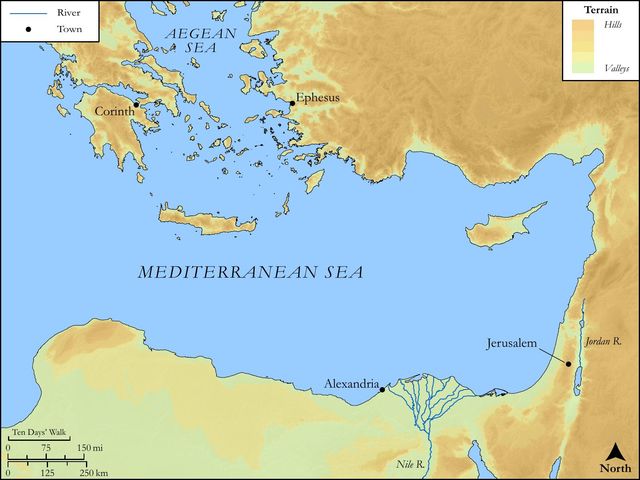
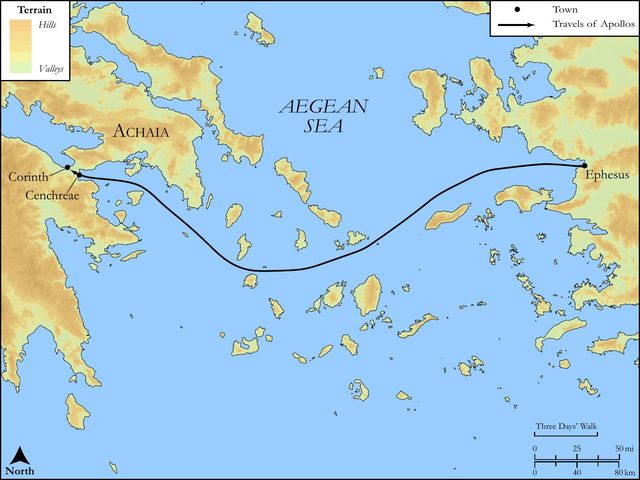
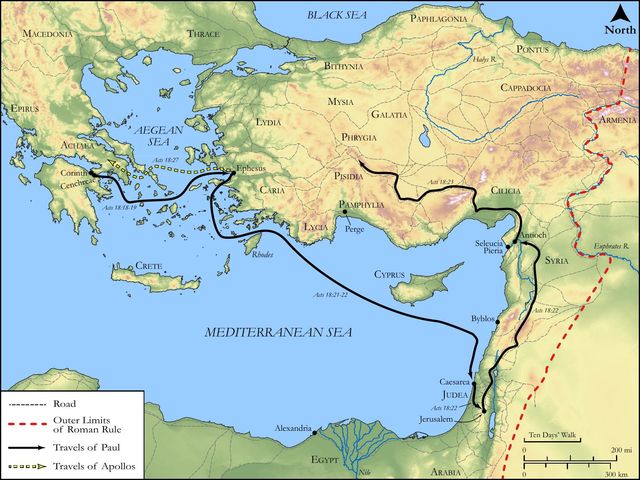
See on the biblical-era map
Study this verse
Public-domain commentary
Matthew Henry
From his Commentary on the Whole Bible. Henry comments on passages, not single verses — this entry covers Acts 18:24–28. His four-level outline is real structure in the source text, so it is rendered as structure.
The sacred history leaves Paul upon his travels, and goes here to meet Apollos at Ephesus, and to give us some account of him, which was necessary to our understanding some passages in Paul's epistles.
I.Here is an account of his character, when he came to Ephesus.
1.He was a Jew, born at Alexandria in Egypt, but of Jewish parents; for there were abundance of Jews in that city, since the dispersion of the people, as it was foretold (Deu 28:68): The Lord shall bring thee into Egypt again. His name was not Apollo, the name of one of the heathen gods, but Apollos, some think the same with Apelles, Rom 16:10.
2.He was a man of excellent good parts, and well fitted for public service. He was an eloquent man, and mighty in the scriptures of the Old Testament, in the knowledge of which he was, as a Jew, brought up.
(1.)He had a great command of language: he was an eloquent man; he was anēr logios - a prudent man, so some; a learned man, so others; historiarum peritus - a good historian, which is an excellent qualification for the ministry: he was one that could speak well, so it properly signifies; he was an oracle of a man; he was famous for speaking pertinently and closely, fully and fluently, upon any subject.
(2.)He had a great command of scripture-language, and this was the eloquence he was remarkable for. He came to Ephesus, being mighty in the scriptures, so the words are placed; having an excellent faculty of expounding scripture, he came to Ephesus, which was a public place, to trade with that talent, for the honour of God and the good of many. He was not only ready in the scriptures, able to quote texts off-hand, and repeat them, and tell you where to find them (many of the carnal Jews were so, who were therefore said to have the form of knowledge, and the letter of the law); but he was mighty in the scriptures. He understood the sense and meaning of them, he knew how to make use of them and to apply them, how to reason out of the scriptures, and to reason strongly; a convincing, commanding, confirming power went along with all his expositions and applications of the scripture. It is probable he had given proof of his knowledge of the scriptures, and his abilities in them, in many synagogues of the Jews.
3.He was instructed in the way of the Lord; that is, he had some acquaintance with the doctrine of Christ, had obtained some general notions of the gospel and the principles of Christianity, that Jesus is the Christ, and that prophet that should come into the world; the first notice of this would be readily embraced by one that was so mighty in the scripture as Apollos was, and therefore understood the signs of the times. He was instructed, katēchēmenos - he was catechised (so the word is), either by his parents or by ministers; he was taught something of Christ and the way of salvation by him. Those that are to teach others must first be themselves taught the word of the Lord, not only to talk of it, but to walk in it. It is not enough to have our tongues tuned to the word of the Lord, but we must have our feet directed into the way of the Lord.
4.Yet he knew only the baptism of John; he was instructed in the gospel of Christ as far as John's ministry would carry him, and no further; he knew the preparing of the way of the Lord by that voice crying in the wilderness, rather than the way of the Lord itself. We cannot but think he had heard of Christ's death and resurrection, but he was not let into the mystery of them, had not had opportunity of conversing with any of the apostles since the pouring out of the Spirit; or he had himself been baptized only with the baptism of John, but was not baptized with the Holy Ghost, as the disciples were at the day of pentecost.
II.We have here the employment and improvement of his gifts at Ephesus; he came thither, seeking opportunities of doing and getting good, and he found both.
1.He there made a very good use of his gifts in public. He came, probably, recommended to the synagogue of the Jews as a fit man to be a teacher there, and according to the light he had, and the measure of the gift given to him, he was willing to be employed (Act 18:25): Being fervent in the Spirit, he spoke and taught diligently the things of the Lord. Though he had not the miraculous gifts of the Spirit, as the apostles had, he made use of the gifts he had; for the dispensation of the Spirit, whatever the measure of it is, is given to every man to profit withal. And our Savior, by a parable, designed to teach his ministers that though they had but one talent they must not bury that. We have seen how Apollos was qualified with a good head and a good tongue: he was an eloquent man, and mighty in the scriptures; he had laid in a good stock of useful knowledge, and had an excellent faculty of communicating it. Let us now see what he had further to recommend him as a preacher; and his example is recommended to the intimation of all preachers.
(1.)He was a lively affectionate preacher; as he had a good head, so he had a good heart; he was fervent in Spirit. He had in him a great deal of divine fire as well as divine light, was burning as well as shining. He was full of zeal for the glory of God, and the salvation of precious souls. This appeared both in his forwardness to preach when he was called to it by the rulers of the synagogue, and in his fervency in his preaching. He preached as one in earnest, and that had his heart in his work. What a happy composition was here! Many are fervent in spirit, but are weak in knowledge, in scripture-knowledge - have far to seek for proper words and are full of improper ones; and, on the other hand, many are eloquent enough, and mighty in the scriptures, and learned, and judicious, but they have no life or fervency. Here was a complete man of God, thoroughly furnished for his work; both eloquent and fervent, full both of divine knowledge and of divine affections.
(2.)He was an industrious laborious preacher. He spoke and taught diligently. He took pains in his preaching, what he delivered was elaborate; and he did not offer that to God, or to the synagogue, that either cost nothing or cost him nothing. He first worked it upon his own heart, and then laboured to impress it on those he preached to: he taught diligently, akribōs - accurately, exactly; every thing he said was well-weighed.
(3.)He was an evangelical preacher. Though he knew only the baptism of John, yet that was the beginning of the gospel of Christ, and to that he kept close; for he taught the things of the Lord, of the Lord Christ, the things that tended to make way for him, and to set him up. The things pertaining to the kingdom of the Messiah were the subjects he chose to insist upon; not the things of the ceremonial law, though those would be pleasing to his Jewish auditors; not the things of the Gentile philosophy, though he could have discoursed very well on those things; but the things of the Lord.
(4.)He was a courageous preacher: He began to speak boldly in the synagogue, as one who, having put confidence in God, did not fear the face of man; he spoke as one that knew the truth of what he said, and had no doubt of it, and that knew the worth of what he said and was not afraid to suffer for it; in the synagogue, where the Jews not only were present, but had power, there he preached the things of God, which he knew they were prejudiced against.
2.He there made a good increase of his gifts in private, not so much in study, as in conversation with Aquila and Priscilla. If Paul or some other apostle or evangelist had been at Ephesus, he would have instructed him; but, for want of better help, Aquila and Priscilla (who were tent-makers) expounded to him the way of God more perfectly. Observe,
(1.)Aquila and Priscilla heard him preach in the synagogue. Though in knowledge he was much inferior to them, yet, having excellent gifts for public service, they encouraged his ministry, by a diligent and constant attendance upon it. Thus young ministers, that are hopeful, should be countenanced by grown Christians, for it becomes them to fulfil all righteousness.
(2.)Finding him defective in his knowledge of Christianity, they took him to them, to lodge in the same house with them, and expounded to him the way of God, the way of salvation by Jesus Christ, more perfectly. They did not take occasion from what they observed of his deficiency either to despise him themselves, or to disparage him to others; did not call him a young raw preacher, not fit to come into a pulpit, but considered the disadvantages he had laboured under, as knowing only the baptism of John; and, having themselves got great knowledge in the truths of the gospel by their long intimate conversation with Paul, they communicated what they knew to him, and gave him a clear, distinct, and methodical account of those things which before he had but confused notions of.
[1.]See here an instance of that which Christ has promised, that to him that hath shall be given; he that has, and uses what he has, shall have more. He that diligently traded with the talent he had doubled it quickly.
[2.]See an instance of truly Christian charity in Aquila and Priscilla; they did good according to their ability. Aquila, though a man of great knowledge, yet did no undertake to speak in the synagogue, because he had not such gifts for public work as Apollos had; but he furnished Apollos with matter, and then left him to clothe it with acceptable words. Instructing young Christians and young ministers privately in conversation, who mean well, and perform well, as far as they go, is a piece of very good service, both to them and to the church.
[3.]See an instance of great humility in Apollos. He was a very bright young man, of great parts and learning, newly come from the university, a popular preacher, and one mightily cried up and followed; and yet, finding that Aquila and Priscilla were judicious serious Christians, that could speak intelligently and experimentally of the things of God, though they were but mechanics, poor tent-makers, he was glad to receive instructions from them, to be shown by them his defects and mistakes, and to have his mistakes rectified by them, and his deficiencies made up. Young scholars may gain a great deal by converse with old Christians, as young students in the law may by old practitioners. Apollos, though he was instructed in the way of the Lord, did not rest in the knowledge he had attained, nor thought he understood Christianity as well as any man (which proud conceited young men are apt to do), but was willing to have it expounded to him more perfectly. Those that know much should covet to know more, and what they know to know it better, pressing forward towards perfection.
[4.]Here is an instance of a good woman, though not permitted to speak in the church or in the synagogue, yet doing good with the knowledge God had given her in private converse. Paul will have the aged women to be teachers of good things Tit 2:3, Tit 2:4.
III.Here is his preferment to the service of the church of Corinth, which was a larger sphere of usefulness than Ephesus at present was.
Paul had set wheels a-going in Achaia and particularly at Corinth, the county-town. Many were stirred up by his preaching to receive the gospel, and they needed to be confirmed; and many were likewise irritated to oppose the gospel, and they needed to be confuted. Paul was gone, was called away to other work, and now there was a fair occasion in this vacancy for Apollos to set in, who was fitted rather to water than to plant, to build up those that were within than to bring in those that were without. Now here we have,
1.His call to this service, not by a vision, as Paul was called to Macedonia, no, nor so much as by the invitation of those he was to go to; but,
(1.)He himself inclined to go: He was disposed to pass into Achaia; having heard of the state of the churches there, he had a mind to try what good he could do among them. Though there were those there who were eminent for spiritual gifts, yet Apollos thought there might be some work for him, and God disposed his mind that way.
(2.)His friends encouraged him to go, and approved of his purpose; and, he being a perfect stranger there, they gave him a testimonial or letters of recommendation, exhorting the disciples in Achaia to entertain him and employ him. In this way, among others, the communion of churches is kept up, by the recommending of members and ministers to each other, when ministers, as Apollos here, are disposed to remove. Though those at Ephesus had a great loss of his labours, they did not grudge those in Achaia the benefit of them; but, on the contrary, used their interest in them to introduce him; for the churches of Christ, though they are many, yet they are one.
2.His success in this service, which both ways answered his intention and expectation; for,
(1.)Believers were greatly edified, and those that had received the gospel were very much confirmed: He helped those much who had believed through grace. Note,
[1.]Those who believe in Christ, it is through grace that they believe; it is not of themselves, it is God's gift to them; it is his work in them.
[2.]Those who through grace do believe, yet still have need of help; as long as they are here in this world there are remainders of unbelief, and something lacking in their faith to be perfected, and the work of faith to be fulfilled.
[3.]Faithful ministers are capable of being in many ways helpful to those who through grace do believe, and it is their business to help them, to help them much; and, when a divine power goes along with them, they will be helpful to them.
(2.)Unbelievers were greatly mortified. Their objections were fully answered, the folly and sophistry of their arguments were discovered, so that they had nothing to say in defence of the opposition they made to the gospel; their mouths were stopped, and their faces filled with shame (Act 18:28): He mightily convinced the Jews, and that publicly, before the people; he did it, eutonōs - earnestly, and with a great deal of vehemence; he took pains to do it; his heart was upon it, as one that was truly desirous both to serve the cause of Christ and to save the souls of men. He did it effectually and to universal satisfaction. He did it levi negotio - with facility. The case was so plain, and the arguments were so strong on Christ's side, that it was an easy matter to baffle all that the Jews could say against it. Though they were so fierce, yet their cause was so weak that he made nothing of their opposition. Now that which he aimed to convince them of was that Jesus is the Christ, that he is the Messiah promised to the fathers, who should come, and they were to look for not other. If the Jews were but convinced of this - that Jesus is Christ, even their own law would teach them to hear him. Note, The business of ministers is to preach Christ: We preach not ourselves, but Christ Jesus the Lord. The way he took to convince them was by the scriptures; thence he fetched his arguments; for the Jews owned the scriptures to be of divine authority, and it was easy for him, who was mighty in the scriptures, from them to show that Jesus is the Christ. Note, Ministers must be able not only to preach the truth, but to prove it and defend it, and to convince gainsayers with meekness and yet with power, instructing those that oppose themselves; and this is real service to the church.
Historical interpretation
Historical reception
2 surviving comments on this verse. Each one is dated, so this reads as a timeline rather than a list.
Select a marker to jump to its quote. Markers stagger vertically where authors wrote within a few decades of each other.
He was learned in the Scriptures, able to dispute with those who questioned him and able to demonstrate that the recent events were in agreement with the Old Testament.
"And a certain Jew named Apollos, born at Alexandria, an eloquent man, and mighty in the Scriptures, came to Ephesus." Lo, even learned men are now urgent, and the disciples henceforth go abroad. Do you mark the spread of the preaching? For he was an awakened man, travelling in foreign parts for this very purpose. Writing of him the Apostle said, "Now concerning Apollos our brother."
Continue studying Acts 18:24 across the web’s major study libraries — every link below opens this exact verse, chapter, or book on the destination site.
Read & Compare
 BibleGatewayThis verse in more than 200 translations and 70 languages.
 Bible.comThe YouVersion reader — hundreds of translations, reading plans, and highlights.
 ESV.orgCrossway's official English Standard Version reader.
 NET BibleThe NET translation with 60,000+ translators' notes on every rendering decision.
 STEP BibleTyndale House's free study tool — original text, vocabulary, and scholarly resources.
 BibliaLogos Bible Software's free web reader.
 USCCBThe New American Bible (Revised Edition) with the U.S. bishops' study notes.
Commentaries
 BibleHub CommentariesDozens of classic commentaries on this verse, gathered on one page.
 StudyLightMore than 100 commentary sets — the largest collection on the web.
 BibleRefPlain-English commentary on what this verse means, verse by verse.
 Enduring WordDavid Guzik's free commentary on this chapter, widely used by Bible teachers.
 Bible Study ToolsVerse commentary alongside Greek and Hebrew study aids.
Original Language & Research
- BibleHub InterlinearThe verse word by word — original language, transliteration, and English.
- BibleHub LexiconEvery word's original-language definition and Strong's entry.
 Blue Letter BibleDeep-study tools — Strong's numbers, concordance, and word studies.
 CNTR CollationThe earliest Greek manuscripts of this verse, collated letter by letter.
Sermons, Hymns & Audio


TrulyRandomVerse is not affiliated with these sites and doesn’t control their content. They’re linked because they’re genuinely useful.
Summary
Acts 18:24 introduces Apollos, a Jewish believer from Alexandria, Egypt, who arrives in Ephesus. The verse highlights his remarkable intellectual and spiritual gifts: he was an eloquent speaker and possessed a profound, authoritative knowledge of the Old Testament Scriptures. This initial description sets the stage for his significant role in the burgeoning early Christian movement, particularly his subsequent encounter with Priscilla and Aquila, who would further refine his understanding of the Christian faith.
Context
ShowHideLiterary Context
This verse marks a significant transition in the narrative of Acts. Paul has just departed from Corinth, leaving Priscilla and Aquila in Ephesus before continuing his journey to Antioch. The introduction of Apollos immediately after Paul's departure underscores the ongoing, divinely orchestrated expansion of the Gospel, demonstrating that God is continually raising up and deploying gifted individuals for His purposes. Apollos's arrival in Ephesus, a key city for early Christian missions, signals a new phase of ministry in that region, setting the stage for his impactful work there and later in Corinth, as detailed in the subsequent verses of Acts 18 and 1 Corinthians.
Historical & Cultural Context
Apollos's origin in Alexandria, Egypt, is crucial to understanding his character. Alexandria was one of the ancient world's most prominent intellectual and cultural centers, second only to Rome. It boasted a vast library, a vibrant philosophical tradition, and a large, influential Jewish community that had deeply engaged with Hellenistic thought. The Septuagint, the Greek translation of the Old Testament, originated there, indicating a strong tradition of scriptural study and interpretation in Greek. This environment would have fostered Apollos's eloquence and deep knowledge of the Scriptures. His arrival in Ephesus, a major Roman port city and the capital of the Roman province of Asia, further highlights the strategic spread of the Gospel. Ephesus was a hub of trade, culture, and pagan worship (most notably the Temple of Artemis), making it a vital center for Christian evangelism and church planting.
Key Themes
ShowHideThe introduction of Apollos immediately brings forth several key themes. First, it emphasizes Divine Provision and Strategic Placement, showing how God raises up and positions gifted individuals like Apollos to advance His kingdom, even as other key figures like Paul move on. Second, the verse highlights the Power of Eloquence and Scriptural Mastery in ministry. Apollos's gifts of speech and deep understanding of the Old Testament Scriptures made him a formidable and effective communicator of truth. Third, it subtly introduces the theme of Preparation and Further Instruction, as subsequent verses will reveal that despite his impressive gifts, Apollos's understanding of the Christian message was initially incomplete, necessitating the further teaching he received from Priscilla and Aquila, demonstrating the ongoing need for discipleship and theological refinement even for highly gifted individuals, as seen in Acts 18:25-26.
Exposition and Analysis
ShowHideKey Word Analysis
ShowHideThis term describes someone who is "fluent," an "orator," or "learned." It suggests not merely a natural gift for speaking, but a cultivated skill in rhetoric and discourse, likely honed in the intellectual environment of Alexandria. Apollos was not just a good talker; he was a master of words, capable of persuasive and compelling communication.
This word means "powerful" or "capable," indicating strength or ability. When applied to Apollos "in the scriptures," it signifies that his grasp of the Old Testament was not superficial but profound, authoritative, and effective. He possessed a powerful ability to wield the Scriptures, likely for argumentation, teaching, and proclamation.
This term refers to "a document," specifically "holy Writ" or its contents. In the context of the New Testament, it almost exclusively refers to the Old Testament. Apollos's might in the Scriptures meant he had a deep, comprehensive, and authoritative knowledge of the Hebrew Bible, which was foundational for understanding the coming of the Messiah.
Verse Breakdown
ShowHide"And a certain Jew named Apollos"
This clause introduces the subject, Apollos, identifying him as a Jew. The use of "certain" (G5100, tìs) suggests he was a particular individual of note, though perhaps not yet widely known to the immediate audience of Acts. His Jewish background is significant, as it implies his familiarity with the Old Testament and the Jewish traditions.
"born at Alexandria"
This specifies Apollos's place of origin, Alexandria (G221, Alexandreús), a city renowned for its intellectual and cultural vibrancy, especially within the Jewish diaspora. This detail provides crucial context for understanding his intellectual prowess and rhetorical skill.
"an eloquent man"
This phrase describes Apollos's rhetorical ability (G3052, lógios). He possessed a natural or cultivated skill in speaking, making him a compelling communicator. This gift would have been invaluable for preaching and teaching.
"and mighty in the scriptures"
This highlights Apollos's profound knowledge and authoritative grasp of the Old Testament (G1124, graphḗ). The term "mighty" (G1415, dynatós) indicates that he was powerful and effective in his use and interpretation of the Scriptures, able to expound them with force and conviction.
"came to Ephesus"
This final clause states Apollos's destination (G2181, Éphesos), a strategically important city in Asia Minor. His arrival there signifies the providential movement of gifted individuals to key centers for the spread of the Gospel.
Literary Devices
ShowHideLuke's introduction of Apollos in Acts 18:24 employs several effective literary devices. The most prominent is Character Introduction, where Apollos is presented with a concise yet impactful summary of his key attributes: his origin, his eloquence, and his scriptural mastery. This serves to immediately establish his significance and prepare the reader for his subsequent actions. There is also an element of Foreshadowing, as these impressive qualities hint at the substantial role he is about to play in the unfolding narrative of the early church, particularly in Ephesus and Corinth. The mention of his specific geographical origins and destination (Alexandria and Ephesus) utilizes Setting to provide crucial historical and cultural context, grounding Apollos's gifts within the intellectual currents of his time and highlighting the strategic locations for the Gospel's spread. Finally, the succinct description of his dual gifts—"eloquent" and "mighty in the scriptures"—creates a sense of Apposition or complementary attributes, emphasizing the powerful combination of rhetorical skill and theological depth that defined Apollos.
Theological and Thematic Connections
ShowHideApollos's introduction underscores the divine orchestration of ministry and the diverse ways God equips His servants. His natural gifts of eloquence, coupled with a diligent study and profound understanding of the Old Testament Scriptures, demonstrate that God uses both inherent talents and cultivated knowledge for His kingdom purposes. This passage illustrates the principle that God raises up leaders with specific aptitudes to meet the needs of a growing church, ensuring the continuous proclamation of the Gospel. It also implicitly highlights the foundational importance of the Old Testament as the bedrock upon which the New Testament revelation of Christ is built, showing how a deep grasp of the former is essential for effectively communicating the latter.
Reflection and Application
ShowHideApollos's story in Acts 18:24 offers profound lessons for believers today. First, it reminds us that God sovereignly raises up and uses individuals with diverse gifts and backgrounds. We are encouraged to identify and cultivate our own natural talents and spiritual gifts, recognizing that they are not merely for personal benefit but for the advancement of God's kingdom. Just as Apollos diligently studied the Scriptures, we are called to be students of God's Word, seeking a deep and authoritative understanding that can be powerfully applied and communicated. His initial incomplete understanding, later refined by Priscilla and Aquila, also serves as a humble reminder that even the most gifted among us can benefit from mentorship, correction, and ongoing theological growth within the community of faith. This passage challenges us to embrace both personal excellence in our gifts and a humble posture of lifelong learning, always ready to be taught and to teach others with both skill and spiritual insight. Our aim should be to effectively communicate the truth of the Gospel, rooted in a robust understanding of Scripture.
Questions for Reflection
ShowHideFAQ
ShowHideWho was Apollos and why was he important?
ShowHideApollos was a Jewish Christian from Alexandria, Egypt, introduced in Acts 18:24. He was significant because he was an eloquent speaker and had a profound knowledge of the Old Testament Scriptures, which he used to powerfully preach about Jesus. He played a crucial role in the early church, particularly in Ephesus and Corinth, where he built upon Paul's work, "watering" the seeds that Paul had planted (1 Corinthians 3:6).
What does it mean that Apollos was "mighty in the scriptures"?
ShowHideBeing "mighty in the scriptures" (Greek: dynatós en tais graphaîs) means Apollos possessed a powerful, authoritative, and deep understanding of the Old Testament. He wasn't just familiar with the texts; he could effectively interpret, explain, and apply them, especially in demonstrating how they pointed to Jesus as the Messiah. This skill made him a formidable debater and teacher, capable of convincing both Jews and Greeks through scriptural argumentation (Acts 18:28).
How did Apollos's background in Alexandria influence his ministry?
ShowHideAlexandria was a major intellectual and cultural center in the Roman Empire, known for its vast library and a large, influential Jewish community that engaged deeply with Hellenistic thought. This environment fostered rhetorical skill and a scholarly approach to the Scriptures, as evidenced by the Septuagint (the Greek translation of the Old Testament) originating there. Apollos's Alexandrian background likely contributed to his eloquence and his profound, systematic understanding of the Scriptures, preparing him for his effective ministry.
Christ-Centered Fulfillment
ShowHideApollos, though a powerful and gifted individual in his own right, ultimately points beyond himself to Christ. His "might in the scriptures" and his eloquence were not ends in themselves but served to magnify the One who is the fulfillment of all Scripture. The Old Testament, which Apollos so masterfully expounded, is not merely a collection of historical accounts or moral laws, but a grand narrative consistently pointing to the coming Messiah. Apollos's ministry, especially after being taught "the way of God more accurately" by Priscilla and Aquila (Acts 18:26), became a powerful demonstration of how the Law and the Prophets testify to Jesus. He would "powerfully refute the Jews in public, demonstrating by the Scriptures that Jesus was the Christ" (Acts 18:28). Thus, Apollos's intellectual prowess and scriptural depth were ultimately channeled into proclaiming the Gospel of Jesus Christ, who is the living Word and the ultimate revelation of God (John 1:1-14). His story reminds us that all true eloquence and biblical knowledge find their highest purpose in exalting the Lord Jesus, who is the Alpha and the Omega, the beginning and the end of God's redemptive story (Revelation 22:13).