


Acts 18:23
- καὶkaiAndG2532CONJConjunction
- ποιήσαςpoiēsashaving stayedG4160V-AAP-NSMVerb Aorist Active Participle Nominative Singular Masculine
- χρόνονchronontimeG5550N-ASMNoun Accusative Singular Masculine
- τινὰtinasomeG5100X-ASMIndefinite pronoun Accusative Singular Masculine
- ἐξῆλθενexēlthenhe went forthG1831V-2AAI-3SVerb 2nd Aorist Active Indicative 3rd Singular
- διερχόμενοςdierchomenospassing throughG1330V-PNP-NSMVerb Present Middle Or Passive Deponent Participle Nominative Singular Masculine
- καθεξῆςkathexēssuccessivelyG2517ADVAdverb
- τὴνtēntheG3588T-ASFDefinite article Accusative Singular Feminine
- ΓαλατικὴνGalatikēnGalatianG1054A-ASF-LGAdjective Accusative Singular Feminine Location Gentilic
- χώρανchōranregionG5561N-ASFNoun Accusative Singular Feminine
- καὶkaiandG2532CONJConjunction
- ΦρυγίανPhrugianPhrygiaG5435N-ASF-LNoun Accusative Singular Feminine Location
- ἐπιστηρίζωνepistērizōnstrengtheningG1991V-PAP-NSMVerb Present Active Participle Nominative Singular Masculine
- πάνταςpantasallG3956A-APMAdjective Accusative Plural Masculine
- τοὺςtoustheG3588T-APMDefinite article Accusative Plural Masculine
- μαθητάςmathētasdisciplesG3101N-APMNoun Accusative Plural Masculine
English is a literal word-by-word gloss of the Greek, not the KJV's wording. Why?
This is the original text the KJV's translators worked from — each Greek word with its own literal English meaning in this verse, prepared by scholars at Tyndale House, Cambridge. The KJV translates whole sentences, not word by word, so its wording differs: one Greek word can become several English words, and the KJV may choose “charity” where the gloss reads “love”. Both are faithful — they answer different questions. For the KJV's own rendering, switch to the KJV text.
Details
See on the biblical-era map
Study this verse
Public-domain commentary
Matthew Henry
From his Commentary on the Whole Bible. Henry comments on passages, not single verses — this entry covers Acts 18:18–23. His three-level outline is real structure in the source text, so it is rendered as structure.
We have here Paul in motion, as we have had him at Corinth for some time at rest, but in both busy, very busy, in the service of Christ; if he sat still, if he went about, still it was to do good. Here is,
I.Paul's departure from Corinth, Act 18:18.
1.He did not go away till some time after the trouble he met with there; from other places he had departed when the storm arose, but not from Corinth, because there it had no sooner risen than it fell again. Some tell us that Gallio did privately countenance Paul, and took him into his favour, and that this occasioned a correspondence between Paul and Seneca, Gallio's brother, which some of the ancients speak of. After this he tarried there yet a good while, some think, beyond the year and a half mentioned, Act 18:11. While he found he laboured not in vain, he continued labouring.
2.When he went, he took leave of the brethren solemnly, and with much affection, with suitable comforts and counsels, and prayers at parting, commending what was good, reproving what was otherwise, and giving them necessary cautions against the wiles of the false apostles; and his farewell sermon would leave impressions upon them.
3.He took with him Priscilla and Aquila, because they had a mind to accompany him; for they seemed disposed to remove, and not inclined to stay long at a place, a disposition which may arise from a good principle, and have good effects, and therefore ought not to be condemned in others, though it ought to be suspected in ourselves. There was a great friendship contracted between them and Paul, and therefore, when he went, they begged to go along with him.
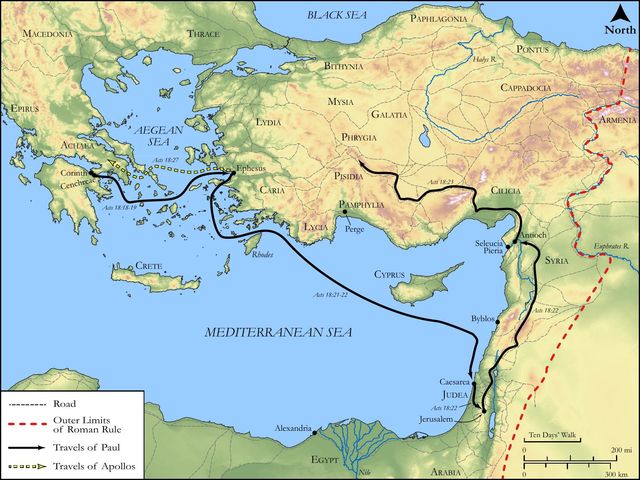
4.At Cenchrea, which was hard by Corinth, the port where those that went to sea from Corinth took ship, either Paul or Aquila (for the original does not determine which) had his head shaved, to discharge himself from the vow of a Nazarite: Having shorn his head at Cenchrea; for he had a vow. Those that lived in Judea were, in such a case, bound to do it at the temple: but those who lived in other countries might do it in other places. The Nazarite's head was to be shaved when either his consecration was accidentally polluted, in which case he must begin again, or when the days of his separation were fulfilled (Num 6:9; Num 13:18), which, we suppose, was the case here. Some throw it upon Aquila, who was a Jew (Act 18:2), and retained perhaps more of his Judaism than was convenient; but I see no harm in admitting it concerning Paul, for concerning him we must admit the same thing (Act 21:24, Act 21:26), not only in compliance for a time with the Jews, to whom he became as a Jew (Co1 9:20), that he might win upon them, but because the vow of the Nazarites, though ceremonial, and as such ready to vanish away, had yet a great deal of moral and very pious significance, and therefore was fit to die the last of all the Jewish ceremonies. The Nazarites are joined with the prophets (Amo 2:11), and were very much the glory of Israel (Lam 4:7), and therefore it is not strange if Paul bound himself for some time with the vow of a Nazarite from wine and strong drink, and from being trimmed, to recommend himself to the Jews; and from this he now discharged himself.
II.Paul's calling at Ephesus, which was the metropolis of the Lesser Asia, and a sea-port.
1.There he left Aquila and Priscilla; not only because they would be but burdensome to him in his journey, but because they might be serviceable to the interests of the gospel at Ephesus. Paul intended shortly to settle there for some time, and he left Aquila and Priscilla there in the mean time, for the same end as Christ sent his disciple before to every place where he himself would come, to prepare his way. Aquila and Priscilla might, by private conversation, being very intelligent judicious Christians, dispose the minds of many to give Paul, when he should come among them, a favourable reception, and to understand his preaching; therefore he calls them his helpers in Christ Jesus, Rom 16:3.
2.There he preached to the Jews in their synagogue; though he did but call there in his journey, yet he would not go without giving them a sermon. He entered into the synagogue, not as a hearer, but as a preacher, for there he reasoned with the Jews. Though he had abandoned the Jews at Corinth, who opposed themselves, and blasphemed, yet he did not, for their sakes, decline the synagogues of the Jews in other places, but still made the first offer of the gospel to them. We must not condemn a whole body or denomination of men, for the sake of some that conduct themselves ill.
3.The Jews at Ephesus were so far from driving Paul away that they courted his stay with them (Act 18:20): They desired him to tarry longer with them, to instruct them, in the gospel of Christ. These were more noble, and better bred, than those Jews at Corinth, and other places, and it was a sign that God had not quite cast away his people, but had a remnant among them.
4.Paul would not stay with them now: He consented not; but bade them farewell. He had further to go; he must by all means keep this feast at Jerusalem; not that he thought himself bound in duty to it (he knew the laws of the feasts were no longer binding), but he had business t Jerusalem (whatever it was) which would be best done at the time of the feast, when there was a general rendezvous of all the Jews from all parts; which of the feasts it was we are not told, probably it was the passover, which was the most eminent.
5.He intimated his purpose, after this journey, to come and spend some time at Ephesus, being encouraged by their kind invitation to hope that he should do good among them. It is good to have opportunities in reserve, when one good work is over to have another to apply ourselves to: I will return again to you, but he inserts that necessary proviso, if God will. Our times are in God's hand; we purpose, but he disposes; and therefore we must make all our promises with submission to the will of God. If the Lord will, we shall live, and do this or that. I will return again to you, if the Spirit suffer me (Act 16:7); this was included in Paul's case; not only if providence permit, but if God do not otherwise direct my motions.
III.Paul's visit to Jerusalem; a short visit it was, but it served as a token of respect to that truly mother-church.
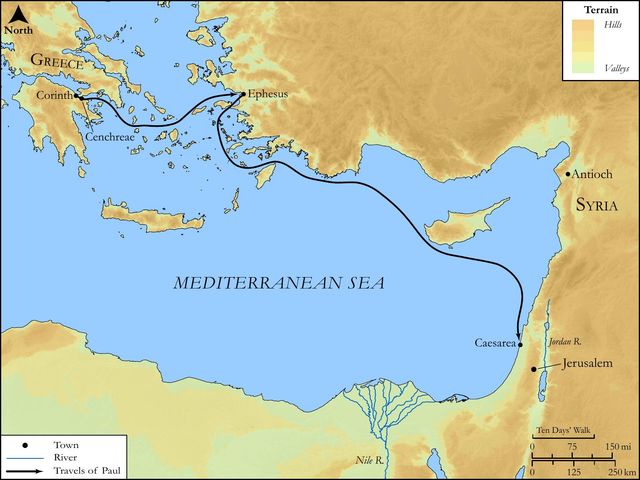
1.He came by sea to the port that lay next to Jerusalem. He sailed from Ephesus (Act 18:21), and landed at Caesarea, Act 18:22. He chose to go by sea, for expedition and for safety, and that he might see the works of the Lord, and his wonders in the deep. Joppa had been the port for Jerusalem, but Herod having improved Caesarea, and the port at Joppa being dangerous, that was generally made use of.
2.He went up, and saluted the church, by which, I think, is plainly meant the church at Jerusalem, which is emphatically called the church, because there the Christian church began, Act 15:4. Paul thought it requisite to show himself among them, that they might not think his success among them, that they might not think his success among the Gentiles had made him think himself either above them or estranged from them, or that the honour God had put upon him made him unmindful of the honour he owed to them. His going to salute the church at Jerusalem intimates,
(1.)That it was a very friendly visit that he made them, in pure kindness, to enquire into their state, and to testify his hearty good-will to them. Note, The increase of our new friends should not make us forget our old ones, but it should be a pleasure to good men, and good ministers, to revive former acquaintance. The ministers at Jerusalem were constant residents, Paul was a constant itinerant; but he took care to keep up a good correspondence with them, that they might rejoice with him in his going out, and he might rejoice with them in their tents, and they might both congratulate and wish well to one another's comfort and success.
(2.)That it was but a short visit. He went up, and saluted them, perhaps with the holy kiss, and made no stay among them. It was designed but for a transient interview, and yet Paul undertook this long journey for that. This is not the world we are to be together in. God's people are the salt of the earth, dispersed and scattered; yet it is good to see one another sometimes, if it be but to see one another, that we may confirm mutual love, may the better keep up our spiritual communion with one another at a distance, and may long the more for that heavenly Jerusalem in which we hope to be together for ever.
IV.His return through those countries where he had formerly preached the gospel.
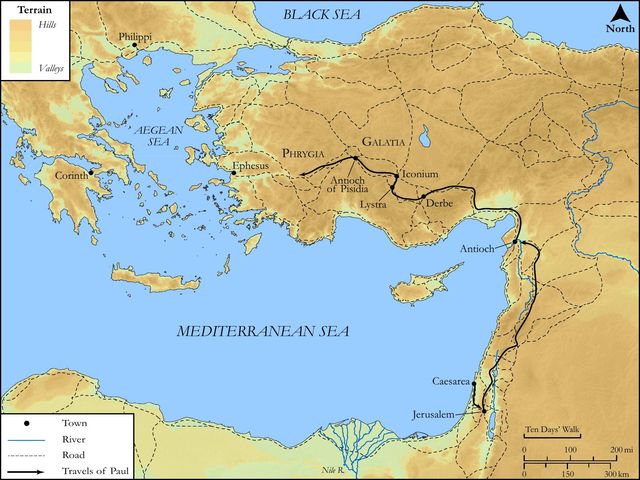
1.He went and spent some time in Antioch, among his old friends there, whence he was first sent out to preach among the Gentiles, Act 13:1. He went down to Antioch, to refresh himself with the sight and conversation of the ministers there; and a very good refreshment it is to a faithful minister to have for awhile the society of his brethren; for, as iron sharpeneth iron, so doth a man the countenance of his friend. Paul's coming to Antioch would bring to remembrance the former days, which would furnish him with matter for fresh thanksgiving.
2.Thence he went over the country of Galatia and Phrygia in order, where he had preached the gospel, and planted churches, which, though very briefly mentioned (Act 16:6), was yet a glorious work, as appears by Gal 4:14, Gal 4:15, where Paul speaks of his preaching the gospel to the Galatians at the first, and their receiving him as an angel of God. These country churches (for such they were [Gal 1:2], and we read not of any city in Galatia where a church was) Paul visited in order as they lay, watering what he had been instrumental to plant, and strengthening all the disciples. His very coming among them, and owning them, were a great strengthening to them and their ministers. Paul's countenancing them was encouraging them; but that was not all: he preached that to them which strengthened them, which confirmed their faith in Christ, their resolutions for Christ, and their pious affections to him. Disciples need to be strengthened, for they are compassed about with infirmity; ministers must do what they can to strengthen them, to strengthen them all, by directing them to Christ, and bringing them to live upon him, whose strength is perfected in their weakness, and who is himself their strength and song.
Historical interpretation
Historical reception
1 surviving comment on this verse from the historical church.
"And when he had landed at Caesarea, and gone up, and saluted the Church, he went down to Antioch. And after he had spent some time there, he departed, and went over all the country of Galatia and Phrygia in order, strengthening all the disciples." He came again to those places which he had previously visited. Through these regions also he merely passes again, just enough to establish them by his presence.
Continue studying Acts 18:23 across the web’s major study libraries — every link below opens this exact verse, chapter, or book on the destination site.
Read & Compare
 BibleGatewayThis verse in more than 200 translations and 70 languages.
 Bible.comThe YouVersion reader — hundreds of translations, reading plans, and highlights.
 ESV.orgCrossway's official English Standard Version reader.
 NET BibleThe NET translation with 60,000+ translators' notes on every rendering decision.
 STEP BibleTyndale House's free study tool — original text, vocabulary, and scholarly resources.
 BibliaLogos Bible Software's free web reader.
 USCCBThe New American Bible (Revised Edition) with the U.S. bishops' study notes.
Commentaries
 BibleHub CommentariesDozens of classic commentaries on this verse, gathered on one page.
 StudyLightMore than 100 commentary sets — the largest collection on the web.
 BibleRefPlain-English commentary on what this verse means, verse by verse.
 Enduring WordDavid Guzik's free commentary on this chapter, widely used by Bible teachers.
 Bible Study ToolsVerse commentary alongside Greek and Hebrew study aids.
Original Language & Research
- BibleHub InterlinearThe verse word by word — original language, transliteration, and English.
- BibleHub LexiconEvery word's original-language definition and Strong's entry.
 Blue Letter BibleDeep-study tools — Strong's numbers, concordance, and word studies.
 CNTR CollationThe earliest Greek manuscripts of this verse, collated letter by letter.
Sermons, Hymns & Audio


TrulyRandomVerse is not affiliated with these sites and doesn’t control their content. They’re linked because they’re genuinely useful.
Summary
Acts 18:23 marks the commencement of Paul's third missionary journey, following a period of rest in Antioch. This verse describes his systematic and purposeful tour through the regions of Galatia and Phrygia, areas he had previously evangelized. His primary objective was not to plant new churches but to revisit and spiritually fortify the existing communities of believers, ensuring their continued growth and stability in the faith.
Context
ShowHideLiterary Context
Acts 18:23 follows Paul's return to Antioch (likely Syrian Antioch), his missionary home base, at the conclusion of his second missionary journey (Acts 18:22). This brief mention of his return and subsequent departure signals a transition point, preparing the reader for the extensive narrative of his third journey. The preceding verses detail the end of his second journey, including his brief stop in Ephesus and his interaction with Aquila and Priscilla, setting the stage for his future work in that significant city. The verse itself acts as a concise summary of the initiation and purpose of this new phase of ministry, which will eventually lead him back to Ephesus for an extended period.
Historical & Cultural Context
The regions of Galatia and Phrygia were located in central Asia Minor, part of the Roman province of Galatia. Paul had previously evangelized these areas during his first (e.g., Iconium, Lystra, Derbe in southern Galatia, as seen in Acts 14) and second missionary journeys (e.g., Acts 16:6). By the time of this third journey, Christian communities had been established in these areas for several years. The Roman Empire provided a relatively stable environment for travel, though dangers from bandits and local opposition were ever-present. Paul's methodical approach, described as "in order," reflects a common Roman administrative and travel practice, but here it is applied to a strategic pastoral itinerary, emphasizing deliberate and organized oversight of the burgeoning Christian movement in a diverse Greco-Roman world.
Key Themes
ShowHideThis verse highlights several crucial themes. Firstly, it underscores the theme of Pastoral Care and Discipleship, demonstrating Paul's commitment to nurturing and consolidating the faith of new converts rather than solely focusing on initial evangelism. His journey was an act of dedicated follow-up, emphasizing the importance of ongoing spiritual growth after initial conversion, a theme echoed in his epistles, such as when he speaks of presenting believers "mature in Christ" in Colossians 1:28. Secondly, the verse emphasizes the Strengthening of Believers, indicating that the young churches needed continued instruction, encouragement, and grounding in truth to withstand challenges and doctrinal errors. This aligns with Paul's broader ministry of building up the body of Christ, as described in Ephesians 4:11-12. Finally, the phrase "in order" points to Systematic and Intentional Ministry, revealing Paul's strategic and organized approach to church planting and development, ensuring that his efforts were not haphazard but purposeful and effective.
Exposition and Analysis
ShowHideKey Word Analysis
ShowHideFrom ἐπί and στηρίζω, meaning "to support further, i.e. reestablish." This term signifies more than a casual visit; it implies a deep work of confirming, establishing, and making firm the believers in their faith. It speaks to solidifying their spiritual foundation, grounding them in truth, and helping them to stand resilient against external pressures and internal doubts.
From κατά and ἑξῆς, meaning "thereafter, i.e. consecutively; by (in) order." This word highlights Paul's methodical and systematic approach to his journey. It suggests a planned itinerary, moving from one location to the next in a sequential and organized manner, rather than random or impulsive travel. This intentionality underscores the strategic nature of his pastoral oversight.
From μανθάνω, meaning "a learner, i.e. pupil." This term identifies the recipients of Paul's ministry as those who are committed followers of Christ, actively learning and growing in their faith. It emphasizes the ongoing process of spiritual formation and the importance of continued instruction for all who profess belief.
Verse Breakdown
ShowHide"And after he had spent some time [there]"
This clause indicates a period of rest and perhaps strategic planning for Paul in Antioch, his sending church, following the arduous second missionary journey. It suggests a necessary pause for spiritual and physical refreshment before embarking on another demanding phase of ministry.
"he departed, and went over [all] the country of Galatia and Phrygia in order"
This describes the initiation and scope of Paul's third journey. "Departed" signifies the resumption of his itinerant ministry. "Went over" (Greek, diérchomai) implies traversing or passing through these regions thoroughly. The phrase "in order" emphasizes the deliberate, systematic, and planned nature of his itinerary, reflecting a strategic pastoral approach rather than random visitation. Galatia and Phrygia were areas where churches had already been established.
"strengthening all the disciples"
This final clause articulates the primary purpose and outcome of Paul's journey. His aim was not primarily to evangelize new territories but to fortify, confirm, and build up the existing believers in these regions. This "strengthening" involved teaching, encouragement, pastoral care, and addressing any challenges or doctrinal issues within the nascent Christian communities.
Literary Devices
ShowHideThe verse employs Purposeful Action through verbs like "departed," "went over," and "strengthening," which convey Paul's intentional and directed ministry. The phrase "in order" further emphasizes this deliberate approach, suggesting a methodical and strategic plan. There is also an element of Continuity and Reiteration, as Paul revisits regions where he had previously sown the seeds of the gospel. This highlights the ongoing nature of discipleship and church development, moving beyond initial evangelism to sustained pastoral care. The overall tone is one of Pastoral Nurturing, portraying Paul not merely as an evangelist but as a spiritual shepherd tending to his flock, ensuring their spiritual health and stability.
Theological and Thematic Connections
ShowHideActs 18:23 deeply enriches our understanding of the ongoing nature of Christian discipleship and the vital role of pastoral care in the life of the church. It underscores that conversion is merely the beginning of the journey; sustained spiritual growth requires intentional nurturing, teaching, and encouragement. Paul's commitment to revisiting and strengthening established communities reveals a foundational principle of church health: that believers need to be continually grounded in truth and equipped to live out their faith amidst challenges. This verse highlights the holistic nature of apostolic ministry, encompassing both evangelism and diligent follow-up, ensuring the endurance and maturity of the body of Christ.
Reflection and Application
ShowHideActs 18:23 serves as a powerful reminder that the Christian life is not a one-time event but a continuous journey of growth and maturation. Just as Paul diligently revisited and strengthened the early disciples, so too must contemporary believers and church leaders prioritize ongoing discipleship, teaching, and mutual encouragement. This verse challenges us to move beyond superficial engagement with faith to a deeper, more robust commitment to spiritual formation. It calls us to be intentional in our own growth, seeking out opportunities for learning and accountability, and to actively participate in the strengthening of our local church communities. For those in ministry, it underscores the profound importance of follow-up, pastoral care, and systematic teaching, recognizing that true spiritual health comes from consistent nourishment and support. We are all called to be both disciples who are strengthened and, in turn, those who strengthen others, building up the body of Christ in love and truth.
Questions for Reflection
ShowHideFAQ
ShowHideWhat is the significance of Paul revisiting Galatia and Phrygia instead of going to new territories?
ShowHideThe significance lies in Paul's commitment to holistic church planting and pastoral care. While initial evangelism is crucial, the long-term health and stability of nascent Christian communities depend on ongoing support, teaching, and encouragement. By revisiting Galatia and Phrygia, Paul was demonstrating the importance of discipleship and consolidation of faith. These churches, though established, were still young and vulnerable to internal challenges (like doctrinal errors, as seen in the book of Galatians) and external pressures. His systematic visitation ensured that the foundations laid were firm and that believers were equipped to stand strong in their faith, reflecting a mature understanding of ministry that extends beyond initial conversion.
Christ-Centered Fulfillment
ShowHidePaul's methodical journey to "strengthen all the disciples" in Galatia and Phrygia is a profound reflection of Christ's own enduring commitment to His followers. Just as Paul sought to confirm and establish the early believers, Jesus continually nurtured and prepared His disciples for their mission, promising the Holy Spirit as their Helper and Strengthener (see John 14:26 and John 16:13). Paul's pastoral care mirrors the Good Shepherd's unwavering dedication to His flock, who lays down His life for them and then continues to sustain them (as depicted in John 10:11). The ultimate "strengthening" that Paul imparted was a deeper rooting in the person and work of Christ, who is the foundation upon which the church is built (Ephesians 2:20). Thus, Paul's ministry serves as an earthly outworking of the heavenly Christ's ongoing work of building up His body, ensuring its spiritual vitality and equipping His people for every good work until His glorious return (Ephesians 4:15-16).