


Acts 18:2
- καὶkaiAndG2532CONJConjunction
- εὑρώνheurōnhaving foundG2147V-2AAP-NSMVerb 2nd Aorist Active Participle Nominative Singular Masculine
- τιναtinaa certainG5100X-ASMIndefinite pronoun Accusative Singular Masculine
- ἸουδαῖονIoudaionJewG2453N-ASM-PGNoun Accusative Singular Masculine Individual Gentilic
- ὀνόματιonomatinamedG3686N-DSNNoun Dative Singular Neuter
- ἈκύλανAkulanAquilaG207N-ASM-PNoun Accusative Singular Masculine Individual
- ΠοντικὸνPontikonof PontusG4193A-ASM-LAdjective Accusative Singular Masculine Location
- τῷtō<the>G3588T-DSNDefinite article Dative Singular Neuter
- γένειgeneia nativeG1085N-DSNNoun Dative Singular Neuter
- προσφάτωςprosphatōsrecentlyG4373ADVAdverb
- ἐληλυθόταelēluthotahaving comeG2064V-2RAP-ASMVerb 2nd Perfect Active Participle Accusative Singular Masculine
- ἀπὸapofromG575PREPPreposition
- τῆςtēs<the>G3588T-GSFDefinite article Genitive Singular Feminine
- ἸταλίαςItaliasItalyG2482N-GSF-LNoun Genitive Singular Feminine Location
- καὶkaiandG2532CONJConjunction
- ΠρίσκιλλανPriskillanPriscillaG4252N-ASF-PNoun Accusative Singular Feminine Individual
- γυναῖκαgunaikawifeG1135N-ASFNoun Accusative Singular Feminine
- αὐτοῦautouof himG846P-GSMPersonal pronoun Genitive Singular Masculine
- διὰdiabecause ofG1223PREPPreposition
- τὸto<the>G3588T-ASNDefinite article Accusative Singular Neuter
- διατεταχέναιdiatetachenaito have commandedG1299V-RANVerb Perfect Active Infinitive
- ΚλαύδιονKlaudionClaudiusG2804N-ASM-PNoun Accusative Singular Masculine Individual
- χωρίζεσθαιchōrizesthaito departG5563V-PPNVerb Present Passive Infinitive
- πάνταςpantasallG3956A-APMAdjective Accusative Plural Masculine
- τοὺςtoustheG3588T-APMDefinite article Accusative Plural Masculine
- ἸουδαίουςIoudaiousJewsG2453N-APM-PGNoun Accusative Plural Masculine Person Gentilic
- ἀπὸapoout ofG575PREPPreposition
- τῆςtēs<the>G3588T-GSFDefinite article Genitive Singular Feminine
- ῬώμηςRhōmēsRomeG4516N-GSF-LNoun Genitive Singular Feminine Location
- προσῆλθενprosēlthenhe cameG4334V-2AAI-3SVerb 2nd Aorist Active Indicative 3rd Singular
- αὐτοῖς·autoisto themG846P-DPMPersonal pronoun Dative Plural Masculine
English is a literal word-by-word gloss of the Greek, not the KJV's wording. Why?
This is the original text the KJV's translators worked from — each Greek word with its own literal English meaning in this verse, prepared by scholars at Tyndale House, Cambridge. The KJV translates whole sentences, not word by word, so its wording differs: one Greek word can become several English words, and the KJV may choose “charity” where the gloss reads “love”. Both are faithful — they answer different questions. For the KJV's own rendering, switch to the KJV text.
Details
See on the biblical-era map
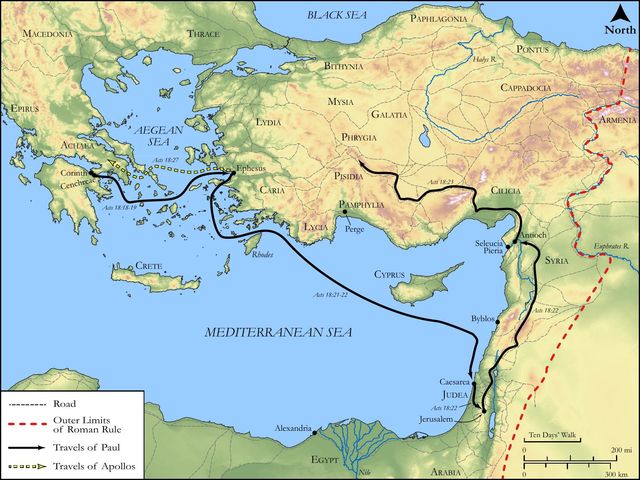
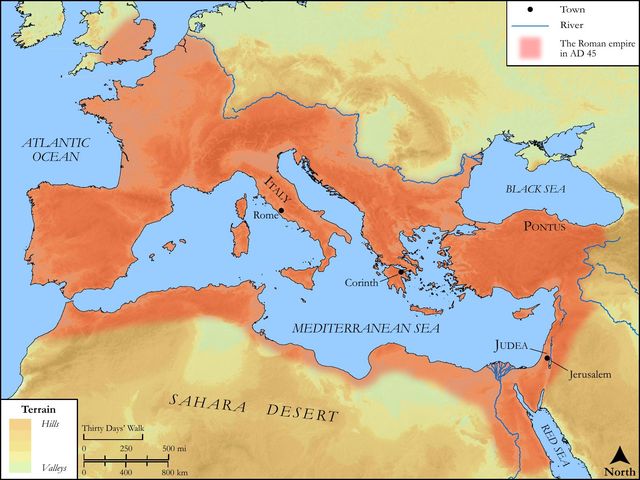
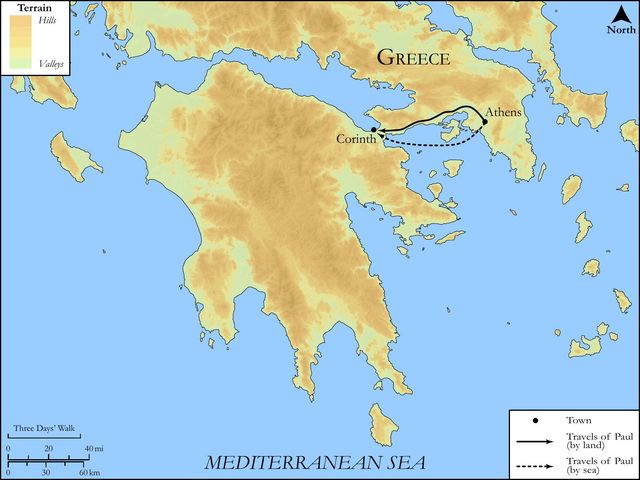
Study this verse
Public-domain commentary
Matthew Henry
From his Commentary on the Whole Bible. Henry comments on passages, not single verses — this entry covers Acts 18:1–6. His three-level outline is real structure in the source text, so it is rendered as structure.
We do not find that Paul was much persecuted at Athens, nor that he was driven thence by any ill usage, as he was from those places where the Jews had or could make any interest; but this reception at Athens being cold, and little prospect of doing good there, he departed from Athens, leaving the care of those there who believed with Dionysius; and thence he came to Corinth, where he was now instrumental in planting a church that became on many accounts considerable. Corinth was the chief city of Achaia, now a province of the empire, a rich and splendid city. Non cuivis homini contingit adire Corinthum - It is not permitted every man to see Corinth. The country thereabouts at this day is called the Morea. Now here we have,
I.Paul working for his living, Act 18:2, Act 18:3.
1.Though he was bred a scholar, yet he was master of a handicraft trade. He was a tent-maker, an upholsterer; he made tents for the use of soldiers and shepherds, of cloth or stuff, or (as some say tents were then generally made) of leather or skins, as the outer covering of the tabernacle. Hence to live in tents was to live sub pellibus - under skins. Dr. Lightfoot shows that it was the custom of the Jews to bring up their children to some trade, yea, though they gave them learning or estates. Rabbi Judah says, "He that teaches not his son a trade is as if he taught him to be a thief." And another says, "He that has a trade in his hand is as a vineyard that is fenced." An honest trade, by which a man may get his bread, is not to be looked upon by any with contempt. Paul, though a Pharisee, and bred up at the feet of Gamaliel, yet, having in his youth learned to make tents, did not by disuse lose the art.
2.Though he was entitled to a maintenance from the churches he had planted, and from the people to whom he preached, yet he worked at his calling to get bread, which is more to his praise who did not ask for supplies than to theirs who did not supply him unasked, knowing what straits he was reduced to. See how humble Paul was, and wonder that so great a man could stoop so low; but he had learned condescension of his Master, who came not to be ministered to, but to minister. See how industrious he was, and how willing to take pains. He that had so much excellent work to do with his mind, yet, when there was occasion, did not think it below him to work with his hands. Even those that are redeemed from the curse of the law are not exempt from that sentence, In the sweat of thy face thou shalt eat bread. See how careful Paul was to recommend his ministry, and to prevent prejudices against it, even the most unjust and unreasonable; he therefore maintained himself with his own labour that he might not make the gospel of Christ burdensome, Co2 11:7, etc.; Th2 3:8, Th2 3:9.
3.Though we may suppose he was master of his trade, yet he did not disdain to work at journey-work: He wrought with Aquila and Priscilla, who were of that calling, so that he got no more than day-wages, a bare subsistence. Poor tradesmen must be thankful if their callings bring them in a maintenance for themselves and their families, though they cannot do as the rich merchants that raise estates by their callings.
4.Though he was himself a great apostle, yet he chose to work with Aquila and Priscilla, because he found them to be very intelligent in the things of God, as appears afterwards (Act 18:26), and he owns that they had been his helpers in Christ Jesus, Rom 16:3. This is an example to those who are going to service to seek for those services in which they may have the best help for their souls. Choose to work with those that are likely to be helpers in Christ Jesus. It is good to be in company and to have conversation with those that will further us in the knowledge of Christ, and to put ourselves under the influence of such as are resolved that they will serve the Lord. Concerning this Aquila we are here told,
(1.)That he was a Jew, but born in Pontus, Act 18:2. Many of the Jews of the dispersion were seated in that country, as appears Pe1 1:1.
(2.)That he was lately come from Italy to Corinth. It seems he often changed his habitation; this is not the world we can propose ourselves a settlement in.
(3.)That the reason of his leaving Italy was because by a late edict of the emperor Claudius Caesar all Jews were banished from Rome; for the Jews were generally hated, and every occasion was taken to put hardship and disgrace upon them. God's heritage was as a speckled bird, the birds round about were against her, Jer 12:9. Aquila, though a Christian, was banished because he had been a Jew; and the Gentiles had such confused notions of the thing that they could not distinguish between a Jew and a Christian. Suetonius, in the life of Claudius, speaks of this decree in the ninth year of his reign, and says, The reason was because the Jews were a turbulent people - assiduo tumultuantes; and that it was impulsore Christo - upon the account of Christ; some zealous for him, others bitter against him, which occasioned great heats, such as gave umbrage to the government, and provoked the emperor, who was a timorous jealous man, to order them all to be gone. If Jews persecute Christians, it is not strange if heathens persecute them both.
II.We have here Paul preaching to the Jews, and dealing with them to bring them to the faith of Christ, both the native Jews and the Greeks, that is, those that were more or less proselyted to the Jewish religion, and frequented their meetings.
1.He reasoned with them in the synagogue publicly every sabbath. See in what way the apostles propagated the gospel, not by force and violence, by fire and sword, not by demanding an implicit consent, but by fair arguing; they drew with the cords of a man, gave a reason for what they said, and gave a liberty to object against it, having satisfactory answers ready. God invites us to come and reason with him (Isa 1:18), and challenges sinners to produce their cause, and bring forth their strong reasons, Isa 41:21. Paul was a rational as well as a scriptural preacher.
2.He persuaded them - epeithe. It denotes,
(1.)The urgency of his preaching. He did not only dispute argumentatively with them, but he followed his arguments with affectionate persuasions, begging of them for God's sake, for their own soul's sake, for their children's sake, not to refuse the offer of salvation made to them. Or,
(2.)The good effect of his preaching. He persuaded them, that is, he prevailed with them; so some understand it. In sententiam suam adducebat - He brought them over to his own opinion. Some of them were convinced by his reasonings, and yielded to Christ.
3.He was yet more earnest in this matter when his fellow-labourers, his seconds, came up with him (Act 18:5): When Silas and Timothy had come from Macedonia, and had brought him good tidings from the churches there, and were ready to assist him here, and strengthened his hands, then Paul was more than before pressed in spirit, which made him more than ever pressing in his preaching. He was grieved for the obstinacy and infidelity of his countrymen the Jews, was more intent than ever upon their conversion, and the love of Christ constrained him to it (Co2 5:14): it is the word that is used here, it pressed him in spirit to it. And, being thus pressed, he testified to the Jews with all possible solemnity and seriousness, as that which he was perfectly well assured of himself, and attested to them as a faithful saying, and worthy of all acceptation, that Jesus is the Christ, the Messiah promised to the fathers and expected by them.
III.We have him here abandoning the unbelieving Jews, and turning from them to the Gentiles, as he had done in other places, Act 18:6.
1.Many of the Jews, and indeed the most of them, persisted in their contradiction to the gospel of Christ, and would not yield to the strongest reasonings nor the most winning persuasions; they opposed themselves and blasphemed; they set themselves in battle array (so the word signifies) against the gospel; they joined hand in hand to stop the progress of it. They resolved they would not believe it themselves, and would do all they could to keep others from believing it. They could not argue against it, but what was wanting in reason they made up in ill language: they blasphemed, spoke reproachfully of Christ, and in him of God himself, as Rev 13:5, Rev 13:6. To justify their infidelity, they broke out into downright blasphemy.
2.Paul hereupon declared himself discharged from them, and left them to perish in their unbelief. He that was pressed in spirit to testify to them (Act 18:5), when they opposed that testimony, and persisted in their opposition, was pressed in spirit to testify against them (Act 18:6), and his zeal herein also he showed by a sign: he shook his raiment, shaking off the dust from it (as before they shook off the dust from their feet, Act 13:51), for a testimony against them. thus he cleared himself from them, but threatened the judgments of God against them. As Pilate by washing his hands signified the devolving of the guilt of Christ's blood from himself upon the Jews, so Paul by shaking his raiment signified what he said, if possible to affect them with it.
(1.)He had done his part, and was clean from the blood of their souls; he had, like a faithful watchman, given them warning, and thereby had delivered his soul, though he could not prevail to deliver theirs. He had tried all methods to work upon them, but all in vain, so that if they perish in their unbelief their blood is not to be required at his hands; here, and Act 20:26, he plainly refers to Eze 33:8, Eze 33:9. It is very comfortable to a minister to have the testimony of his conscience for him, that he has faithfully discharged his trust by warning sinners.
(2.)They would certainly perish if they persisted in their unbelief, and the blame would lie wholly upon themselves: "Your blood be upon your own heads, you will be your own destroyers, your nation will be ruined in this world, and particular persons will be ruined in the other world, and you alone shall bear it." If any thing would frighten them at last into a compliance with the gospel, surely this would.
3.Having given them over, yet he does not give over his work. Though Israel be not gathered, Christ and his gospel shall be glorious: Henceforth I will go unto the Gentiles; and the Jews cannot complain, for they had the first offer, and a fair one, made to them. The guests that were first invited will not come, and the provision must not be lost; guests must be had therefore from the highways and the hedges. "We would have gathered the Jews (Mat 23:37), would have healed them (Jer 51:9), and they would not; but Christ must not be a head without a body, nor a foundation without a building, and therefore, if they will not, we must try whether others will." Thus the fall and diminishing of the Jews became the riches of the Gentiles; and Paul said this to their faces, not only because it was what he could justify, but to provoke them to jealousy, Rom 11:12, Rom 11:14.
Historical interpretation
Three Centuries of Reception
2 surviving comments on this verse. Each one is dated, so this reads as a timeline rather than a list.
Select a marker to jump to its quote. Markers stagger vertically where authors wrote within a few decades of each other.
"And having found a certain Jew named Aquila, of Pontus by birth, lately come from Italy"--for the greater part of his life had been passed there--"and Priscilla his wife, because that Claudius had commanded all the Jews to depart from Rome." For though it was in the reign of Nero that the war against the Jews was consummated, yet from the time of Claudius and thenceforward it was fanning up, at a distance indeed, so that, were it but so, they might come to their senses, and from Rome they were now driven as common pests. This is why it is so ordered by Providence that Paul was led thither as a prisoner, that he might not as a Jew be driven away, but as acting under military custody might even be guarded there.
Because Claudius had commanded all Jews to depart from Rome. Josephus narrates that this happened in the ninth year of Claudius. Suetonius the historian reports it in this way: Claudius expelled the Jews from Rome, as they were continually making disturbances at the instigation of Chrestus. Whether he meant to restrain and suppress the Jews making disturbances against Christ, or also wished to expel the Christians as related religious members, it is not at all clear.
Continue studying Acts 18:2 across the web’s major study libraries — every link below opens this exact verse, chapter, or book on the destination site.
Read & Compare
 BibleGatewayThis verse in more than 200 translations and 70 languages.
 Bible.comThe YouVersion reader — hundreds of translations, reading plans, and highlights.
 ESV.orgCrossway's official English Standard Version reader.
 NET BibleThe NET translation with 60,000+ translators' notes on every rendering decision.
 STEP BibleTyndale House's free study tool — original text, vocabulary, and scholarly resources.
 BibliaLogos Bible Software's free web reader.
 USCCBThe New American Bible (Revised Edition) with the U.S. bishops' study notes.
Commentaries
 BibleHub CommentariesDozens of classic commentaries on this verse, gathered on one page.
 StudyLightMore than 100 commentary sets — the largest collection on the web.
 BibleRefPlain-English commentary on what this verse means, verse by verse.
 Enduring WordDavid Guzik's free commentary on this chapter, widely used by Bible teachers.
 Bible Study ToolsVerse commentary alongside Greek and Hebrew study aids.
Original Language & Research
- BibleHub InterlinearThe verse word by word — original language, transliteration, and English.
- BibleHub LexiconEvery word's original-language definition and Strong's entry.
 Blue Letter BibleDeep-study tools — Strong's numbers, concordance, and word studies.
 CNTR CollationThe earliest Greek manuscripts of this verse, collated letter by letter.
Sermons, Hymns & Audio


TrulyRandomVerse is not affiliated with these sites and doesn’t control their content. They’re linked because they’re genuinely useful.
Summary
Acts 18:2 introduces Aquila and Priscilla, a Jewish couple whom Paul encounters in Corinth. Their arrival in the city is presented as a direct consequence of Emperor Claudius's decree expelling all Jews from Rome. This verse not only sets the stage for a pivotal partnership in Paul's ministry but also highlights the broader historical context of Jewish dispersion and the early spread of Christianity within the Roman Empire, demonstrating God's sovereign hand in orchestrating seemingly disparate events for His redemptive purposes.
Context
ShowHideLiterary Context
This verse immediately follows Paul's arrival in Corinth, as detailed in Acts 18:1. Having just left Athens, where his philosophical discourse on Mars Hill yielded limited conversions, Paul enters Corinth, a bustling and notoriously immoral port city. The encounter with Aquila and Priscilla is the very first interaction recorded for Paul in Corinth, establishing his initial support network and living arrangements. This meeting is crucial as it provides Paul with both a place to stay and a means of livelihood through their shared trade of tentmaking, as explicitly stated in Acts 18:3. Their partnership quickly evolves beyond shared labor into a deep spiritual and ministerial collaboration, setting a precedent for Paul's modus operandi in subsequent cities.
Historical & Cultural Context
The historical backdrop of Acts 18:2 is the "Edict of Claudius," issued around A.D. 49-50. This decree commanded "all Jews to depart from Rome." Roman historians like Suetonius corroborate this event, noting that Claudius expelled Jews from Rome because they were causing continuous disturbances "at the instigation of Chrestus" (Suetonius, Life of Claudius, 25.4). This reference to "Chrestus" is widely understood to refer to Christ, indicating that the early spread of Christianity within the Jewish community in Rome was already causing significant internal strife and external friction with Roman authorities. This edict led to a forced diaspora of Jewish residents, including Jewish Christians, from the capital, scattering them across the empire. Aquila and Priscilla's presence in Corinth thus exemplifies the broader displacement experienced by many Jewish believers during this period, highlighting the volatile environment in which the early church operated.
Key Themes
ShowHideActs 18:2 contributes significantly to several key themes within the book of Acts and the broader New Testament. Divine Providence is profoundly evident, as God uses a seemingly adverse political decree (the expulsion of Jews from Rome) to strategically position key individuals like Aquila and Priscilla in Corinth, where they could meet Paul and become instrumental in the spread of the Gospel. This illustrates God's ability to work through human decrees and societal disruptions for His redemptive purposes, a theme echoed in passages like Romans 8:28. The verse also introduces the theme of Fellowship and Partnership in Ministry, foreshadowing the deep and enduring collaboration between Paul, Aquila, and Priscilla. Their shared Jewish heritage and common trade provided an immediate bond, which blossomed into a powerful ministry team, demonstrating the importance of synergistic relationships in advancing God's kingdom. Finally, the narrative touches upon the theme of Persecution and Displacement, underscoring the challenges faced by early Christians, particularly Jewish believers, who often experienced hostility and forced relocation from both Roman authorities and sometimes from their own countrymen, as seen in other instances of opposition to the Gospel in Acts, such as the persecution in Jerusalem in Acts 8:1.
Exposition and Analysis
ShowHideKey Word Analysis
ShowHideFrom Iouda (in the sense of Ioudas as a country), referring to one belonging to Jehudah. In this context, it identifies Aquila as ethnically and religiously Jewish, a crucial detail for understanding his background and the context of his expulsion from Rome. This designation highlights the Jewish roots of early Christianity and the initial focus of Paul's ministry, often beginning in synagogues.
From dia and tasso, meaning "to arrange thoroughly, i.e. (specially) institute, prescribe, etc." This word emphasizes the authoritative nature of Claudius's decree. It was not a suggestion but an official, binding order from the highest Roman authority, underscoring the involuntary nature of Aquila and Priscilla's relocation and the widespread impact of imperial policy on the lives of ordinary citizens.
From chora, meaning "to place room between, i.e. part; reflexively, to go away." This term vividly describes the forced separation and expulsion of the Jews from Rome. It conveys the sense of being uprooted and displaced, highlighting the hardship and disruption caused by the imperial edict, yet also setting the stage for God's providential redirection of their lives.
Verse Breakdown
ShowHide"And found a certain Jew named Aquila, born in Pontus, lately come from Italy, with his wife Priscilla;"
This clause introduces the key figures, Aquila and Priscilla, providing essential biographical details. Aquila is identified as a Jew, emphasizing his ethnic and religious identity. His birthplace, Pontus (a region in Asia Minor), indicates the widespread diaspora of Jewish communities throughout the Roman Empire. The phrase "lately come from Italy" establishes their recent arrival in Corinth, setting up the subsequent explanation for their relocation. Priscilla is introduced as his wife, immediately establishing their marital unit and joint presence.
"(because that Claudius had commanded all Jews to depart from Rome:)"
This parenthetical clause provides the crucial historical and causal explanation for Aquila and Priscilla's presence in Corinth. It explicitly names Emperor Claudius and his edict, which mandated the expulsion of "all Jews" from the imperial capital, Rome. This detail is vital for understanding the circumstances of their displacement and highlights the impact of Roman imperial policy on the early Christian community, particularly its Jewish members.
"and came unto them."
This final, concise clause describes Paul's action upon finding Aquila and Priscilla. The verb "came unto them" implies not just a physical approach but an intentional seeking out and engagement, setting the stage for their immediate connection and the subsequent development of their profound partnership in ministry. It signifies the beginning of a divinely orchestrated relationship.
Literary Devices
ShowHideThe verse employs Concise Narration to efficiently convey significant historical and personal details. Luke, the author of Acts, masterfully weaves together biographical information, a major imperial decree, and the immediate consequence for key individuals into a single, flowing sentence. The use of a Parenthetical Explanation ("because that Claudius had commanded all Jews to depart from Rome") is a powerful technique. It provides essential Historical Context without interrupting the main narrative flow, serving as a crucial explanatory aside that clarifies the circumstances of Aquila and Priscilla's arrival. This parenthetical statement also functions as a form of Foreshadowing, hinting at the broader challenges and movements within the early church that will continue to shape Paul's ministry. The verse also subtly uses Juxtaposition by placing the imperial decree (a human act of power and control) directly alongside God's providential arrangement (Paul finding these specific individuals), implicitly highlighting God's ultimate sovereignty over human affairs.
Theological and Thematic Connections
ShowHideActs 18:2 serves as a powerful testament to God's sovereign providence, demonstrating how seemingly disruptive political and social events can be precisely orchestrated by divine will to advance His kingdom purposes. The forced displacement of Aquila and Priscilla from Rome, intended by Claudius to quell unrest, inadvertently positioned them to meet Paul in Corinth, initiating one of the most fruitful partnerships in early Christian history. This highlights a recurring biblical theme: God's ability to transform adversity into opportunity, using human decisions, even those driven by hostility or political expediency, to fulfill His redemptive plan. It underscores that God is not limited by human decrees or geographical boundaries, but rather works through them to gather His people and spread His Gospel.
Reflection and Application
ShowHideActs 18:2 offers profound insights for contemporary believers, reminding us that God's hand is at work even in the midst of global upheaval and personal disruption. Just as Aquila and Priscilla were displaced by a political decree, many today face forced migration, economic hardship, or unexpected changes that uproot their lives. This verse encourages us to look for God's purpose in such circumstances, recognizing that He often uses our "detours" to connect us with new people, open new opportunities for ministry, and deepen our reliance on Him. It challenges us to remain open to divine appointments, understanding that the people God brings into our lives, even strangers, can become vital partners in our spiritual journey and service. Furthermore, it underscores the importance of Christian hospitality and fellowship, as the immediate connection between Paul, Aquila, and Priscilla provided a foundation for mutual support, shared labor, and collaborative ministry. We are called to be attentive to the needs of those who are displaced or new to our communities, extending grace and practical help, just as Aquila and Priscilla found a new home and purpose in Corinth.
Questions for Reflection
ShowHideFAQ
ShowHideWhat was the "Edict of Claudius" and why was it issued?
ShowHideThe "Edict of Claudius" was an imperial decree issued by the Roman Emperor Claudius, likely around A.D. 49-50, which commanded the expulsion of "all Jews to depart from Rome." Roman historians like Suetonius confirm this event, stating that Claudius expelled the Jews because they were causing continuous disturbances "at the instigation of Chrestus" (Suetonius, Life of Claudius, 25.4). This indicates that the early spread of Christianity within the Jewish community in Rome was leading to significant internal strife and unrest, prompting the emperor to remove the perceived source of the disturbance. The edict resulted in a widespread diaspora of Jewish residents, including Jewish Christians like Aquila and Priscilla, from the capital city, scattering them across various parts of the Roman Empire, including Corinth, where they encountered the Apostle Paul, as noted in Acts 18:2.
Christ-Centered Fulfillment
ShowHideActs 18:2, while primarily a historical account, points to Christ's ongoing work through His body, the church, and His sovereign control over all earthly affairs. The forced displacement of Aquila and Priscilla by a Roman emperor's decree serves as a powerful illustration of how God orchestrates human history, even its chaotic and oppressive elements, to advance His redemptive plan centered on Christ. Just as Joseph's brothers intended evil, but God used it for good (as seen in Genesis 50:20), so too Claudius's edict, intended to quell unrest, inadvertently positioned key individuals to further the Gospel of Christ. This highlights the ultimate authority of Christ, who is "head over every rule and authority" (Colossians 2:10), and whose kingdom is not bound by earthly decrees or geographical limitations. The meeting of Paul with Aquila and Priscilla, facilitated by this edict, foreshadows the global spread of the Gospel, not by human might or power, but by the Spirit of Christ working through His obedient followers (Zechariah 4:6). Their subsequent partnership in ministry, risking their lives for Paul (Romans 16:4), exemplifies the self-sacrificial love and unity that characterize those who follow Christ, reflecting His own ultimate sacrifice on the cross for the redemption of humanity (John 15:13). Thus, this historical moment in Acts ultimately testifies to the unwavering sovereignty of Christ, who builds His church even amidst persecution and displacement, ensuring that the gates of hell will not prevail against it (Matthew 16:18).