


Galatians 1:2
Bible text: King James Version (1769 Blayney text) · Public domain
Bible text: Berean Standard Bible · Public domain
Bible text: American Standard Version (1901) · Public domain
Bible text: World English Bible, Messianic edition · Public domain
Bible text: Geneva Bible (1599) · Public domain
Bible text: Young's Literal Translation · Public domain
- καὶkaiandG2532CONJConjunction
- οἱhoitheG3588T-NPMDefinite article Nominative Plural Masculine
- σὺνsunwithG4862PREPPreposition
- ἐμοὶemoime myselfG1473P-1DSPersonal pronoun Dative 1st Singular
- πάντεςpantesallG3956A-NPMAdjective Nominative Plural Masculine
- ἀδελφοὶadelphoibrothersG80N-NPMNoun Nominative Plural Masculine
- ταῖςtaisTo theG3588T-DPFDefinite article Dative Plural Feminine
- ἐκκλησίαιςekklēsiaischurchesG1577N-DPFNoun Dative Plural Feminine
- τῆςtēs<the>G3588T-GSFDefinite article Genitive Singular Feminine
- Γαλατίας·Galatiasof GalatiaG1053N-GSF-LNoun Genitive Singular Feminine Location
English is a literal word-by-word gloss of the Greek, not the KJV's wording. Why?
This is the original text the KJV's translators worked from — each Greek word with its own literal English meaning in this verse, prepared by scholars at Tyndale House, Cambridge. The KJV translates whole sentences, not word by word, so its wording differs: one Greek word can become several English words, and the KJV may choose “charity” where the gloss reads “love”. Both are faithful — they answer different questions. For the KJV's own rendering, switch to the KJV text.
Details
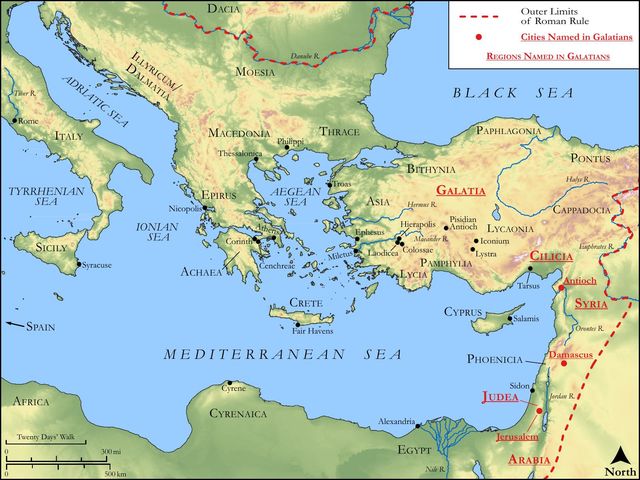
See on the biblical-era maps

Study this verse
Public-domain commentary
Matthew Henry
From his Commentary on the Whole Bible. Henry comments on passages, not single verses — this entry covers Galatians 1:1–5. His two-level outline is real structure in the source text, so it is rendered as structure.
In these verses we have the preface or introduction to the epistle, where observe,
I.The person or persons from whom this epistle is sent - from Paul an apostle, etc., and all the brethren that were with him.
1.The epistle is sent from Paul; he only was the penman of it. And, because there were some among the Galatians who endeavoured to lessen his character and authority, in the front of it he gives a general account both of his office and of the manner in which he was called to it, which afterwards, in this and the following chapter, he enlarges more upon. As to his office, he was an apostle. He is not afraid to style himself so, though his enemies would scarcely allow him this title: and, to let them see that he did not assume this character without just ground, he acquaints them how he was called to this dignity and office, and assures them that his commission to it was wholly divine, for he was an apostle, not of man, neither by man; he had not the common call of an ordinary minister, but an extraordinary call from heaven to this office. He neither received his qualification for it, nor his designation to it, by the mediation of men, but had both the one and the other directly from above; for he was an apostle by Jesus Christ, he had his instructions and commission immediately from him, and consequently from God the Father, who was one with him in respect of his divine nature, and who had appointed him, as Mediator, to be the apostle and high priest of our profession, and as such to authorize others to this office. He adds, Who raised him from the dead, both to acquaint us that herein God the Father gave a public testimony to Christ's being his Son and the promised Messiah, and also that, as his call to the apostleship was immediately from Christ, so it was after his resurrection from the dead, and when he had entered upon his exalted state; so that he had reason to look upon himself, not only as standing upon a level with the other apostles, but as in some sort preferred above them; for, whereas they were called by him when on earth, he had his call from him when in heaven. Thus does the apostle, being constrained to it by his adversaries, magnify his office, which shows that though men should by no means be proud of any authority they are possessed of, yet at certain times and upon certain occasions it may become needful to assert it. But,
2.He joins all the brethren that were with him in the inscription of the epistle, and writes in their name as well as his own. By the brethren that were with him may be understood either the Christians in common of that place where he now was, or such as were employed as ministers of the gospel. These, notwithstanding his own superior character and attainments, he is ready to own as his brethren; and, though he alone wrote the epistle, yet he joins them with himself in the inscription of it. Herein, as he shows his own great modesty and humility, and how remote he was from an assuming temper, so he might do this to dispose these churches to a greater regard to what he wrote, since hereby it would appear that he had their concurrence with him in the doctrine which he had preached, and was now about to confirm, and that it was no other than what was both published and professed by others as well as himself.
II.To whom this epistle is sent - to the churches of Galatia.
There were several churches at that time in this country, and it should seem that all of them were more or less corrupted through the arts of those seducers who had crept in among them; and therefore Paul, on whom came daily the care of all the churches, being deeply affected with their state, and concerned for their recovery to the faith and establishment in it, writes this epistle to them. He directs it to all of them, as being all more or less concerned in the matter of it; and he gives them the name of churches, though they had done enough to forfeit it, for corrupt churches are never allowed to be churches: no doubt there were some among them who still continued in the faith, and he was not without hope that others might be recovered to it.
III.The apostolical benediction, Gal 1:3.
Herein the apostle, and the brethren who were with him, wish these churches grace and peace from God the Father, and from the Lord Jesus Christ. This is the usual blessing wherewith he blesses the churches in the name of the Lord - grace and peace. Grace includes God's good-will towards us and his good work upon us; and peace implies in it all that inward comfort, or outward prosperity, which is really needful for us; and they come from God the Father as the fountain, through Jesus Christ as the channel of conveyance. Both these the apostle wishes for these Christians. But we may observe, First grace, and then peace, for there can be no true peace without grace. Having mentioned the Lord Jesus Christ, he cannot pass without enlarging upon his love; and therefore adds (Gal 1:4), Who gave himself for our sins, that he might deliver, etc. Jesus Christ gave himself for our sins, as a great sacrifice to make atonement for us; this the justice of God required, and to this he freely submitted for our sakes. One great end hereof was to deliver us from this present evil world; not only to redeem us from the wrath of God, and the curse of the law, but also to recover us from the corruption that is in the world through lust, and to rescue us from the vicious practices and customs of it, unto which we are naturally enslaved; and possibly also to set us free from the Mosaic constitution, for so aiōn houtos is used, Co1 2:6, Co1 2:8. From this we may note,
1.This present world is an evil world: it has become so by the sin of man, and it is so on account of the sin and sorrow with which it abounds and the many snares and temptations to which we are exposed as long as we continue in it. But,
2.Jesus Christ has died to deliver us from this present evil world, not presently to remove his people out of it, but to rescue them from the power of it, to keep them from the evil of it, and in due time to possess them of another and better world. This, the apostle informs us, he has done according to the will of God and our Father. In offering up himself a sacrifice for this end and purpose, he acted by the appointment of the Father, as well as with his own free consent; and therefore we have the greatest reason to depend upon the efficacy and acceptableness of what he has done and suffered for us; yea, hence we have encouragement to look upon God as our Father, for thus the apostle here represents him: as he is the Father of our Lord Jesus, so in and through him he is also the Father of all true believers, as our blessed Saviour himself acquaints us (Joh 20:17), when he tells his disciples that he was ascending to his Father and their Father.
The apostle, having thus taken notice of the great love wherewith Christ hath loved us, concludes this preface with a solemn ascription of praise and glory to him (Gal 1:5): To whom be glory for ever and ever. Amen. Intimating that on this account he is justly entitled to our highest esteem and regard. Or this doxology may be considered as referring both to God the Father and our Lord Jesus Christ, from whom he had just before been wishing grace and peace. They are both the proper objects of our worship and adoration, and all honour and glory are perpetually due to them, both on account of their own infinite excellences, and also on account of the blessings we receive from them.
Historical interpretation
Four Centuries of Reception
8 surviving comments on this verse. Each one is dated, so this reads as a timeline rather than a list.
Select a marker to jump to its quote. Markers stagger vertically where authors wrote within a few decades of each other.
Whereas he was accustomed to call himself simply Paul the apostle to the Romans and Corinthians, in order to startle the Galatians and reprove them for a grave error he has joined with himself all the brothers who were with him, saying that they themselves were writing to the Galatians, making them feel the shame of thinking contrary to everyone, so as to give more weight to his own injunctions and the gospel that he preaches.
"And all the brethren which are with me."
Why is it that he has on no other occasion in sending an epistle added this phrase? For either he puts his own name only or that of two or three others, but here has mentioned the whole number and so has mentioned no one by name.
On what account then does he this?
They made the slanderous charge that he was singular in his preaching, and desired to introduce novelty in Christian teaching. Wishing therefore to remove their suspicion, and to show he had many to support him in his doctrine, he has associated with himself "the brethren," to show that what he wrote he wrote with their accord.
"Unto the Churches of Galatia."
Thus it appears, that the flame of error had spread over not one or two cities merely, but the whole Galatian people. Consider too the grave indignation contained in the phrase, "unto the Churches of Galatia:" he does not say, "to the beloved" or "to the sanctified," and this omission of all names of affection or respect, and this speaking of them as a society merely, without the addition "Churches of God," for it is simply "Churches of Galatia," is strongly expressive of deep concern and sorrow. Here at the outset, as well as elsewhere, he attacks their irregularities, and therefore gives them the name of "Churches," in order to shame them, and reduce them to unity. For persons split into many parties cannot properly claim this appellation, for the name of "Church" is a name of harmony and concord.
The exordium is full of a vehement and lofty spirit, and not the exordium only, but also, so to speak, the whole Epistle. For always to address one's disciples with mildness, even when they need severity is not the part of a teacher but it would be the part of a corrupter and enemy. Wherefore our Lord too, though He generally spoke gently to His disciples, here and there uses sterner language, and at one time pronounces a blessing, at another a rebuke. Thus, having said to Peter, "Blessed art thou, Simon Barjona," and having promised to lay the foundation of the Church upon his confession, shortly afterwards He says, "Get thee behind Me, Satan: thou art a stumbling block unto Me." Again, on another occasion, "Are ye also even yet without understanding?" And what awe He inspired them with appears from John's saying, that, when they beheld Him conversing with the Samaritan woman, though they reminded Him to take food, no one ventured to say, "What seekest Thou, or why speakest thou with her?" Thus taught, and walking in the steps of his Master, Paul hath varied his discourse according to the need of his disciples, at one time using knife and cautery, at another, applying mild remedies.
Now that this Epistle breathes an indignant spirit, is obvious to every one even on the first perusal; but I must explain the cause of his anger against the disciples. Slight and unimportant it could not be, or he would not have used such vehemence. For to be exasperated by common matters is the part of the little-minded, morose, and peevish; just as it is that of the more redolent and sluggish to lose heart in weighty ones. Such a one was not Paul. What then was the offence which roused him? it was grave and momentous, one which was estranging them all from Christ, as he himself says further on, "Behold, I Paul say unto you, that if ye receive circumcision, Christ will profit you nothing;" and again, "Ye who would be justified by the Law, ye are fallen away from Grace."
(Vers. 2.) And all the brothers who are with me, to the churches of Galatia. In other Epistles, Sosthenes and Silvanus, and sometimes even Timothy, are mentioned at the beginning. In this one, however, because the authority of many was necessary, the name of all the brothers is assumed. They themselves perhaps were also of the circumcision, and were not held in contempt by the Galatians. For it is of great importance to correct the people, to have the agreement and consensus of many in one matter. But when he says 'to the churches of Galatia,' it should be noted that here he writes not only to one church of one city, but to the churches of the whole province, and he calls them churches, which he later accuses of being corrupt by error. From this it is to be understood that the Church can be said in two ways: the one which has no spot or wrinkle and truly is the body of Christ, and the one which gathers in the name of Christ without full and perfect virtues (Ephesians 5). The wise are called in two ways, both those who are full of perfect virtue and those who are just beginning and are in progress. Concerning the perfect, it is said: 'I will send to you wise men' (Luke 11:49). Concerning the foolish: 'Reprove a wise man, and he will love thee' (Proverbs 8:9). For he who is full and complete in virtue does not need correction. This sense can be understood in regard to the other virtues as well, namely that the courageous and prudent, pious, chaste, just, and temperate are sometimes understood correctly, sometimes incorrectly.
The epistle to the Galatians was written from Rome. The divine apostle had already seen and taught them.
He indicates by this the necessity of the Letter; for it was not only one Church that prompted him to such a diligent action, but a multitude of Churches.
Again he takes up the point they made, namely, that Paul is one, and the Apostles, many. Thus he brought in with him a whole multitude, and not as in other Letters, only Paul, or Paul and Timothy, or Silvanus as well.
Continue studying Galatians 1:2 across the web’s major study libraries — every link below opens this exact verse, chapter, or book on the destination site.
Read & Compare
 BibleGatewayThis verse in more than 200 translations and 70 languages.
 Bible.comThe YouVersion reader — hundreds of translations, reading plans, and highlights.
 ESV.orgCrossway's official English Standard Version reader.
 NET BibleThe NET translation with 60,000+ translators' notes on every rendering decision.
 STEP BibleTyndale House's free study tool — original text, vocabulary, and scholarly resources.
 BibliaLogos Bible Software's free web reader.
 USCCBThe New American Bible (Revised Edition) with the U.S. bishops' study notes.
Commentaries
 BibleHub CommentariesDozens of classic commentaries on this verse, gathered on one page.
 StudyLightMore than 100 commentary sets — the largest collection on the web.
 BibleRefPlain-English commentary on what this verse means, verse by verse.
 Enduring WordDavid Guzik's free commentary on this chapter, widely used by Bible teachers.
 Bible Study ToolsVerse commentary alongside Greek and Hebrew study aids.
Original Language & Research
- BibleHub InterlinearThe verse word by word — original language, transliteration, and English.
- BibleHub LexiconEvery word's original-language definition and Strong's entry.
 Blue Letter BibleDeep-study tools — Strong's numbers, concordance, and word studies.
 CNTR CollationThe earliest Greek manuscripts of this verse, collated letter by letter.
Sermons, Hymns & Audio


TrulyRandomVerse is not affiliated with these sites and doesn’t control their content. They’re linked because they’re genuinely useful.
Summary
Galatians 1:2, part of Paul's opening salutation, expands upon the letter's origin and destination established in the preceding verse. It indicates that the urgent message to follow is not solely from Paul but is collectively endorsed by "all the brethren" who are with him, lending significant weight to its content. The letter is addressed to "the churches of Galatia," signifying that the critical issues Paul addresses were widespread across multiple congregations within the Roman province, necessitating a unified and authoritative apostolic response.
Context
ShowHideLiterary Context
This verse immediately follows Galatians 1:1, where Paul asserts his unique apostolic authority, emphasizing that his commission came "not from men nor through man, but through Jesus Christ and God the Father." Galatians 1:2 then broadens the scope of the senders, including "all the brethren" with him, and specifies the recipients as "the churches of Galatia." This structured opening, typical of ancient letters, serves to establish the legitimacy and collective backing of the message, preparing the readers for the severe rebuke and theological exposition that dominates the rest of the epistle. The inclusion of companions adds a communal weight to Paul's individual apostolic authority, underscoring the unity of purpose among the early Christian leaders in confronting the doctrinal crisis.
Historical & Cultural Context
The Roman province of Galatia, located in Asia Minor, was a region where Paul had established numerous churches during his first missionary journey, as recounted in Acts 13-14. These churches, likely including those in Iconium, Lystra, and Derbe, were predominantly Gentile converts. However, after Paul's departure, a group of Jewish Christians, often referred to as Judaizers, infiltrated these congregations. They taught that Gentile converts must be circumcised and observe other aspects of the Mosaic Law in addition to faith in Christ to be truly saved, thereby undermining the Gospel of grace. Paul's address to "the churches of Galatia" (plural) highlights that this false teaching was not an isolated incident but a widespread problem affecting multiple communities across the province, demanding a comprehensive and unified response. The "brethren" with Paul likely refer to his missionary companions (e.g., Silas, Timothy, or others present at the time of writing), whose presence would have been understood by the recipients as an endorsement of the letter's content.
Key Themes
ShowHideGalatians 1:2 contributes to several overarching themes within the epistle. Firstly, it emphasizes Collective Authority and Support, demonstrating that Paul's message is not a solitary opinion but carries the backing of his immediate Christian community, strengthening the letter's impact in addressing the significant doctrinal challenges. Secondly, the address to "the churches of Galatia" underscores the Widespread Nature of Doctrinal Error, indicating that the infiltration of false teachings regarding justification by faith was affecting the Christian movement across an entire region, not just an isolated community. This sets the stage for Paul's urgent and comprehensive defense of the true Gospel. Finally, the verse subtly highlights the theme of Early Church Unity, implying a sense of shared concern and solidarity among early Christian communities, both among the senders and the various recipient churches. This unity, despite geographical separation, is foundational to the concept of the body of Christ, where believers are bound together by a common faith and purpose.
Exposition and Analysis
ShowHideKey Word Analysis
ShowHideDerived from a word signifying "from the same womb," this term literally means "brother" but is consistently used in the New Testament to denote fellow believers, encompassing both men and women in the spiritual family of God. In this context, it emphasizes the familial bond and shared spiritual identity among Paul and his companions, signifying a collective and unified front in their message.
This preposition denotes a close union, association, or companionship, indicating a much deeper connection than merely being "beside" someone. Its use here highlights that the "brethren" are not just physically present but are united with Paul in purpose, conviction, and the endorsement of the letter's content, adding significant weight to the message.
From a compound meaning "a calling out," this term refers to a popular meeting or, specifically, a religious congregation. In the New Testament, it denotes a Christian community or assembly. The plural form here signifies distinct, separate congregations within the province of Galatia, yet all united under the broader spiritual umbrella of the Christian faith, facing a common challenge.
Verse Breakdown
ShowHide"And all the brethren which are with me"
This phrase immediately follows Paul's assertion of his unique apostolic authority in Galatians 1:1. By including "all the brethren," Paul broadens the source of the letter's authority beyond himself, indicating a collective endorsement of the message. This suggests that his companions, likely fellow missionaries or leaders present with him, were in full agreement with the content of the letter, adding a communal weight and solidarity to the urgent theological arguments that follow. It underscores that the defense of the Gospel is a shared responsibility of the Christian community.
"unto the churches of Galatia"
This identifies the recipients of the letter. The plural "churches" is crucial, signifying that the letter was a circular epistle intended for multiple distinct congregations scattered throughout the Roman province of Galatia. This highlights the widespread nature of the false teaching (Judaizing) that Paul was about to address, indicating that the problem was not isolated to a single city but was affecting the Christian movement across an entire region. It also implies a recognition of these separate communities as part of a larger, unified body of believers.
Literary Devices
ShowHideGalatians 1:2, while seemingly a straightforward salutation, employs several subtle literary devices. The most prominent is Epistolary Convention, as it adheres to the standard opening format of ancient letters by clearly identifying the senders and recipients. However, Paul's specific phrasing elevates this convention. The inclusion of "all the brethren which are with me" creates a powerful sense of Collective Voice and Corporate Authority. This is not merely Paul's personal opinion but a shared conviction, lending greater weight and legitimacy to the severe theological arguments he is about to present against the false teachers. Furthermore, addressing "the churches of Galatia" (plural) rather than a single church emphasizes the Widespread Impact of the doctrinal crisis, setting the stage for a comprehensive and urgent rebuke that applies to an entire region, not just an isolated congregation. This broad address also subtly reinforces the Unity of the early Christian communities, despite their geographical dispersion.
Theological and Thematic Connections
ShowHideGalatians 1:2 powerfully underscores the communal nature of the Christian faith and the importance of collective witness in upholding biblical truth. Paul's inclusion of "all the brethren" demonstrates that the defense of the Gospel is not a solitary endeavor but a shared responsibility of the Christian community. This collective endorsement lends significant weight to the letter's message, particularly given the severe doctrinal challenges it addresses. The fact that the letter is sent to multiple "churches of Galatia" highlights that theological errors can spread widely, necessitating a unified and robust response from the body of Christ. This verse thus serves as a foundational statement about the interconnectedness of believers and the corporate dimension of Christian ministry and theological integrity.
Reflection and Application
ShowHideGalatians 1:2 offers profound insights for contemporary believers and church communities. The collective endorsement by "all the brethren" reminds us that Christian ministry and the proclamation of truth are often strengthened by the support and agreement of fellow believers. It encourages us to cultivate a spirit of unity and shared purpose within our own church communities, recognizing that we are part of a larger, interconnected body of Christ. When doctrinal challenges or ethical dilemmas arise, a unified front, grounded in biblical truth, carries greater authority and impact. This verse also highlights the reality that spiritual challenges, like the false teachings faced by the Galatian churches, can spread rapidly and affect multiple congregations. Therefore, it calls us to be vigilant, discerning, and prepared to stand together in upholding the purity of the Gospel. Our individual faith is deeply intertwined with the corporate witness of the church, compelling us to seek fellowship, mutual encouragement, and collective action in defending and advancing the truth of Christ in our world.
Questions for Reflection
ShowHideFAQ
ShowHideWhy does Paul include "all the brethren" in his greeting, rather than just sending the letter from himself?
ShowHidePaul's inclusion of "all the brethren which are with me" serves to add significant weight and collective authority to his message. While Galatians 1:1 establishes his individual apostolic authority directly from Christ, this verse shows that the urgent message he is about to deliver is not merely his personal opinion but has the full backing and agreement of his companions and the wider Christian community present with him. This collective endorsement was particularly important given the controversial and severe nature of the doctrines he was about to address, as it underscored the unity of purpose among the early Christian leaders in confronting the false teachings spreading in Galatia.
What does addressing the letter to "the churches of Galatia" imply about the recipients and the issues at hand?
ShowHideAddressing the letter to "the churches of Galatia" (plural) indicates that it was a circular letter intended for multiple distinct congregations scattered throughout the Roman province of Galatia. This implies that the issues Paul addresses—primarily the infiltration of false teachings by Judaizers who insisted on circumcision and adherence to the Mosaic Law for salvation—were widespread in the region, not confined to a single city or church. It highlights the pervasive nature of the doctrinal error and underscores the need for a comprehensive, unified response that would reach all affected communities.
Christ-Centered Fulfillment
ShowHideThe communal greeting in Galatians 1:2, where Paul is joined by "all the brethren" in addressing "the churches of Galatia," profoundly points to the Christ-centered nature of the church and its mission. The unity and collective witness expressed here are not merely a human organizational strategy but are rooted in the very person and work of Jesus Christ. The "brethren" are united because they are all "in Christ," members of His body, which He purchased with His own blood (Acts 20:28). Similarly, the diverse "churches of Galatia," though geographically distinct, are recognized as a singular entity under the headship of Christ, who is the cornerstone and builder of His church (Matthew 16:18). The ultimate purpose of this collective address and the subsequent letter is to defend the true Gospel—the good news of salvation by grace through faith in Christ alone, apart from works of the Law (Ephesians 2:8-9). Thus, Galatians 1:2, by establishing the unified voice of the messengers and the unified nature of the recipients, foreshadows the ultimate gathering of all believers from every nation, tribe, and tongue into one glorious body, united in their worship of the Lamb who was slain (Revelation 5:9-10). This verse, therefore, is not just a polite opening but a foundational statement about the universal scope and singular focus of the Gospel, centered entirely on the person and redemptive work of Jesus Christ.