


Acts 24:17
Bible text: King James Version (1769 Blayney text) · Public domain
Bible text: Berean Standard Bible · Public domain
Bible text: American Standard Version (1901) · Public domain
Bible text: World English Bible, Messianic edition · Public domain
Bible text: Geneva Bible (1599) · Public domain
Bible text: Young's Literal Translation · Public domain
- δι᾽di᾽AfterG1223PREPPreposition
- ἐτῶνetōnyearsG2094N-GPNNoun Genitive Plural Neuter
- δὲdenowG1161CONJConjunction
- πλειόνωνpleionōnmanyG4119A-GPN-CAdjective Genitive Plural Neuter Comparative
- ἐλεημοσύναςeleēmosunasalmsG1654N-APFNoun Accusative Plural Feminine
- ποιήσωνpoiēsōnto then bringG4160V-FAP-NSMVerb Future Active Participle Nominative Singular Masculine
- εἰςeistoG1519PREPPreposition
- τὸtotheG3588T-ASNDefinite article Accusative Singular Neuter
- ἔθνοςethnosnationG1484N-ASNNoun Accusative Singular Neuter
- μουmouof mineG3165P-1GSPersonal pronoun Genitive 1st Singular
- παρεγενόμηνparegenomēnI cameG3854V-2ADI-1SVerb 2nd Aorist Middle Deponent Indicative 1st Singular
- καὶkaiandG2532CONJConjunction
- προσφοράςprosphorasofferingsG4376N-APFNoun Accusative Plural Feminine
English is a literal word-by-word gloss of the Greek, not the KJV's wording. Why?
This is the original text the KJV's translators worked from — each Greek word with its own literal English meaning in this verse, prepared by scholars at Tyndale House, Cambridge. The KJV translates whole sentences, not word by word, so its wording differs: one Greek word can become several English words, and the KJV may choose “charity” where the gloss reads “love”. Both are faithful — they answer different questions. For the KJV's own rendering, switch to the KJV text.
Details
See on the biblical-era maps
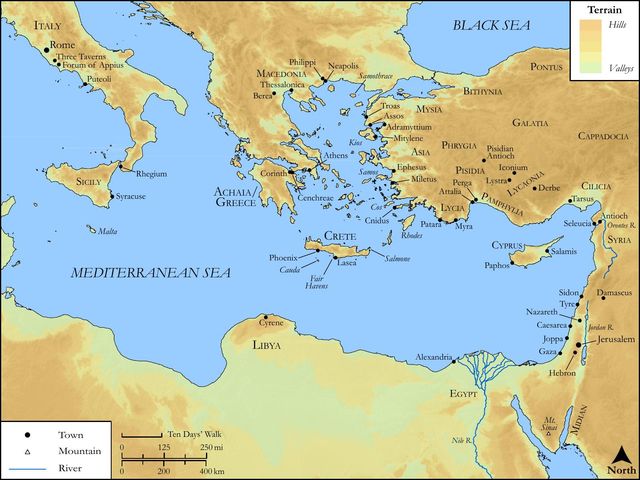
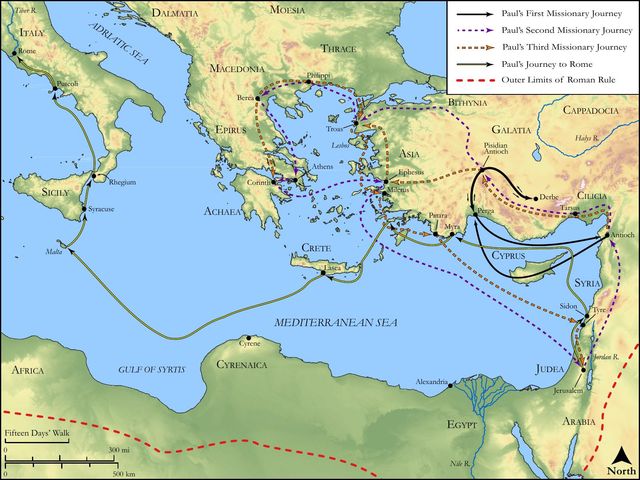
Study this verse
Public-domain commentary
Matthew Henry
From his Commentary on the Whole Bible. Henry comments on passages, not single verses — this entry covers Acts 24:10–21. His four-level outline is real structure in the source text, so it is rendered as structure.
We have here Paul's defence of himself, in answer to Tertullus's charge, and there appears in it a great deal of the spirit of wisdom and holiness, and an accomplishment of Christ's promise to his followers that when they were before governors and kings, for his sake, it should be given them in that same hour what they should speak. Though Tertullus had said a great many provoking things, yet Paul did not interrupt him, but let him go on to the end of his speech, according to the rules of decency and the method in courts of justice, that the plaintiff be allowed to finish his evidence before the defendant begins his plea. And when he had done, he did not presently fly out into passionate exclamations against the iniquity of the times and the men (O tempora! O mores! - Oh the degeneracy of the times!) but he waited for a permission from the judge to speak in his turn, and had it. The governor beckoned to him to speak, Act 24:10. And now he also may have leave to speak out, under the protection of the governor, which was more than he could hitherto obtain. And, when he did speak, he made no reflections at all upon Tertullus, who he knew spoke for his fee, and therefore despised what he said, and levelled his defence against those that employed him. And here,
I.He addressed himself very respectfully to the governor, and with a confidence that he would do him justice.
Here are not such flattering compliments as Tertullus soothed him up with, but, which was more truly respectful, a profession that he answered for himself cheerfully, and with good assurance before him, looking upon him, though not as one that was his friend, yet as one that would be fair and impartial. He thus expresses his expectation that he would be so, to engage him to be so. It was likewise the language of one that was conscious to himself of his own integrity, and whose heart did not reproach him, whoever did. He did not stand trembling at the bar; on the contrary, he was very cheerful when he had one to be his judge that was not a party, but an indifferent person. Nay, when he considers who his judge is, he answers the more cheerfully; and why so? He does not say, "Because I know thee to be a judge of inflexible justice and integrity, that hatest bribes, and in giving judgment fearest God, and regardest not man;" for he could not justly say this of him, and therefore would not say it, though it were to gain his favour ever so much; but, I the more cheerfully answer from myself, because I know thou hast been many years a judge to this nation, and this was very true, and being so,
1.He could say of his own knowledge that there had not formerly been any complaints against Paul. Such clamours as they raised are generally against old offenders; but, though he had long say judge there, he never had Paul brought before him till now; and therefore he was not so dangerous a criminal as he was represented to be.
2.He was well acquainted with the Jewish nation, and with their temper and spirit. He knew how bigoted they were to their own way, what furious zealots they were against all that did not comply with them, how peevish and perverse they generally were, and therefore would make allowances for that in their accusation of him, and not regard that which he had reason to think came so much from part-malice. Though he did not know him, he knew his prosecutors, and by this might guess what manner of man he was.
II.He denies the facts that he was charged with, upon which their character of him was grounded.
Moving sedition, and profaning the temple, were the crimes for which he stood indicted, crimes which they knew the Roman governors were not accustomed to enquire into, and therefore they hoped that the governor would return him back to them to be judged by their law, and this was all they wished for. But Paul desires that though he would not enquire into the crimes he would protect one that was unjustly charged with them from those whom he knew to be spiteful and ill-natured enough. Now he would have him to understand (and what he said he was ready, if required, to make out by witnesses),
1.That he came up to Jerusalem on purpose to worship God in peace and holiness, so far was he from any design to move sedition among the people or to profane the temple. He came to keep up his communion with the Jews, not to put any affront upon them.
2.That it was but twelve days since he came up to Jerusalem, and he came up to Jerusalem, and he had been six days a prisoner; he was alone, and it could not be supposed that in so short a time he could do the mischief they charged upon him. And, as for what he had done in other countries, they knew nothing of it but by uncertain report, by which the matter was very unfairly represented.
3.That he had demeaned himself at Jerusalem very quietly and peaceably, and had made no manner of stir. If it had been true (as they alleged) that he was a mover of sedition among all the Jews, surely he would have been industrious to make a party at Jerusalem: but he did not do so. He was in the temple, attending the public service there. He was in the synagogues where the law was read and opened. He went about in the city among his relations and friends, and conversed freely in the places of concourse; and he was a man of a great genius and an active spirit, and yet they could not charge him with offering any thing either against the faith or against the peace of the Jewish church.
(1.)He had nothing in him of a contradicting spirit, as the movers of sedition have; he had no disposition to quarrel or oppose. They never found him disputing with any man, either affronting the learned with captious cavils or perplexing the weak and simple with curious subtleties. He was ready, if asked, to give a reason of his own hope, and to give instruction to others; but he never picked a quarrel with any man about his religion, nor made that the subject of debate, and controversy, and perverse dispute, which ought always to be treated of with humility and reverence, with meekness and love.
(2.)He had nothing in him of a turbulent spirit: "They never found me raising up the people, by incensing them against their governors in church or state or suggesting to them fears and jealousies concerning public affairs, nor by setting them at variance one with another or sowing discord among them." He behaved as became a Christian and minister, with love and quietness, and due subjection to lawful authority. The weapons of his warfare were not carnal, not did he ever mention or think of such a thing as taking up arms for the propagating of the gospel or the defence of the preachers of it; though he could have made, perhaps, as strong a party among the common people as his adversaries, yet he never attempted it.
4.That as to what they had charged him with, of moving sedition in other countries, he was wholly innocent, and they could not make good the charge (Act 24:13): Neither can the prove the things whereof the now accuse me. Hereby,
(1.)He maintains his own innocency; for when he says, They cannot prove it, he means, The matter is not so. He was no enemy to the public peace; he had done no real prejudice, but a great deal of real service, and would gladly have done more, to the nation of the Jews. He was so far from having any antipathy to them that he had the strongest affection imaginable for them, and a most passionate desire for their welfare, Rom 9:1-3.
(2.)He bemoans his own calamity, that he was accused of those things which could not be proved against him. And it has often been the lot of very worthy good men to be thus injured, to have things laid to their charge which they are the greatest distance from and abhor the though of. But, while they are lamenting this calamity, this may be their rejoicing, even the testimony of their consciences concerning their integrity.
(3.)He shows the iniquity of his prosecutors, who said that which they knew they could not prove, and thereby did him wrong in his name, liberty, and life, and did the judge wrong too, in imposing upon him, and doing what in them lay to pervert his judgment.
(4.)He appeals to the equity of his judge, and awakens him to look about him, that he might not be drawn into a snare by the violence of the prosecution. The judge must give sentence secundum allegata et probata - according to that which is not only alleged but proved, and therefore must enquire, and search, and ask diligently, whether the thing be true and certain (Deu 13:14); he cannot otherwise give a right judgment.
III.He gives a fair and just account of himself, which does at once both clear him from crime and likewise intimate what was the true reason of their violence in prosecuting him.
1.He acknowledges himself to be one whom they looked upon as a heretic, and that was the reason of their spleen against him. The chief captain had observed, and the governor now cannot but observe, an uncommon violence and fury in his prosecutors, which they know not what to make of, but, guessing at the crime by the cry, conclude he must needs have been a very bad man only for that reason. Now Paul here unriddles the matter: I confess that in the way which they call heresy - or a sect, so worship I the God of my fathers. The controversy is in a matter of religion, and such controversies are commonly managed with most fury and violence. Note, It is no new thing for the right way of worshipping God to be called heresy; and for the best of God's servants to be stigmatized and run down as sectaries. The reformed churches are called heretical ones by those who themselves hate to be reformed, and are themselves heretics. Let us therefore never be driven off from any good way by its being put into an ill name; for true and pure Christianity is never the worse, nor to be the worse thought of, for its being called heresy; no, not though it be called so by the high priest and the elders.
2.He vindicates himself from this imputation. They call Paul a heretic, but he is not so; for,
(1.)He worships the God of his fathers, and therefore is right in the object of his worship. He does not say, Let us go after other gods, which we have not known, and let us serve them, as the false prophet is supposed to do, Deu 13:2. If so, they might justly call his way heresy, a drawing of them aside into a by-path, and a dangerous one; but he worships the God of Abraham, Isaac, and Jacob, not only the God whom they worshipped, but the God who took them into covenant with himself, and was and would be called their God. Paul adheres to that covenant, and sets up no other in opposition to it. The promise made unto the fathers Paul preached as fulfilled to the children (Act 13:32, Act 13:33), and so directed both his own devotions and those of others to God, as the God of their fathers. He also refers to the practice of all his pious ancestors: I worship the same God that all my fathers worshipped. His religion was so far from being chargeable with novelty that it gloried in its antiquity, and in an uninterrupted succession of its professors. Note, It is very comfortable in our worshipping God to have an eye to him as the God of our fathers. Our fathers trusted in him, and were owned by him, and he engaged to be their God, and the God of their seed. He approved himself theirs, and therefore, if we serve him as they did, he will be ours; what an emphasis is laid upon this, He is my father's God, and I will exalt him! Exo 15:2.
(2.)He believes all things which are written in the law and the prophets, and therefore is right in the rule of his worship. His religion is grounded upon, and governed by, the holy scriptures; they are his oracle and touchstone, and he speaks and acts according to them. He receives the scriptures entire, and believes all things that are there written; and he receives them pure, for he says no other things than what are contained in them, as he explains himself, Act 26:22. He sets not up any other rule of faith, or practice but the scriptures - not tradition, nor the authority of the church, nor the infallibility of any man or company of men on earth, nor the light within, nor human reason; but divine revelation, as it is in the scripture, is that which he resolves to live and die by, and therefore he is not a heretic.
(3.)He has his eye upon a future state, and is a believing expectant of that, and therefore is right in the end of his worship. Those that turn aside to heresy have a regard to this world, and some secular interest, but Paul aims to make heaven of his religion, and neither more nor less (Act 24:15): "I have hope towards God, all my expectation is from him, and therefore all my desire is towards him and all my dependence upon him; my hope is towards God and not towards the world, towards another world and not towards this. I depend upon God and upon his power, that there shall be a resurrection of the dead at the end of time, of all, both the just and unjust; and the great thing I aim at in my religion is to obtain a joyful and happy resurrection, a share in the resurrection of the just." Observe here,
[1.]That there shall be a resurrection of the dead, the dead bodies of men, of all men from the beginning to the end of time. It is certain, not only that the soul does not die with the body, but that the body itself shall live again; we have not only another life to live when our present life is at an end, but there is to be another world, which shall commence when this world is at an end, into which all the children of men must enter at once by a resurrection from the dead, as they entered into this, one after another, by their birth.
[2.]It shall be a resurrection both of the just and of the unjust, the sanctified and the unsanctified, of those that did well, and to them our Saviour has told us that it will be a resurrection of life; and of those that did evil, and to them that it will be a resurrection of condemnation, Joh 5:29. See Dan 12:2. This implies that it will be a resurrection to a final judgment, by which all the children of men will be determined to everlasting happiness or misery in a world of retribution, according to what they were and what they did in this state of probation and preparation. The just shall rise by virtue of their union with Christ as their head; the unjust shall rise by virtue of Christ's dominion over them as their Judge.
[3.]God is to be depended upon for the resurrection of the dead: I have hope towards God, and in God, that there shall be a resurrection; it shall be effected by the almighty power of God, in performance of the word which God hath spoken; so that those who doubt of it betray their ignorance both of the scriptures and of the power of God, Mat 22:29.
[4.]The resurrection of the dead is a fundamental article of our creed, as it was also of that of the Jewish church. It is what they themselves also allow; nay, it was the expectation of the ancient patriarchs, witness Job's confession of his faith; but it is more clearly revealed and more fully confirmed by the gospel, and therefore those who believed it should have been thankful to the preachers of the gospel for their explications and proofs of it, instead of opposing them.
[5.]In all our religion we ought to have an eye to the other world, and to serve God in all instances with a confidence in him that there will be a resurrection of the dead, doing all in preparation for that, and expecting our recompence in that.
(4.)His conversation is of a piece with his devotion (Act 24:16): And herein do I exercise myself, to have always a conscience void of offence towards God and towards men. Prophets and their doctrine were to be tried by their fruits. Paul was far from having made shipwreck of a good conscience, and therefore it is not likely he has made shipwreck of the faith, the mystery of which is best held in a pure conscience. This protestation of Paul's is to the same purport with that which he made before the high priest (Act 23:1): I have lived in all good conscience; and this was his rejoicing. Observe, [1.] What was Paul's aim and desire: To have a conscience void of offence. Either, First, "A conscience not offending; not informing me wrong, nor flattering me, nor dealing deceitfully with me, nor in any thing misleading me." Or, Secondly, A conscience not offended; it is like Job's resolution, "My heart shall not reproach me, that is, I will never give it any occasion to do so. This is what I am ambitious of, to keep upon good terms with my own conscience, that it may have no cause either to question the goodness of my spiritual state or to quarrel with me for any particular action. I am as careful not to offend my conscience as I am not to offend a friend with whom I daily converse; nay, as I am not to offend a magistrate whose authority I am under, and to whom I am accountable; for conscience is God's deputy in my soul." [2.] What was his care and endeavour, in pursuance of this: "I exercise myself - askō. I make it my constant business, and govern myself by this intention; I discipline myself, and live by rule" (those that did so were called ascetics, from the word here used), "abstain from many a thing which my inclination leads me to, and abound in all the exercises of religion that are most spiritual, with this in my eye, that I may keep peace with my own conscience." [3.] The extent of this care: First, To all times: To have always a conscience void of offence, always void of gross offence; for though Paul was conscious to himself that he had not yet attained perfection, and the evil that he would not do yet he did, yet he was innocent from the great transgression. Sins of infirmity are uneasy to conscience, but they do not wound it, and waste it, as presumptuous sins do; and, though offence may be given to conscience, yet care must be taken that it be not an abiding offence, but that by the renewed acts of faith and repentance the matter may be taken up again quickly. This however we must always exercise ourselves in, and, though we come short, we must follow after. Secondly, To all things: Both towards God, and towards man. His conscientious care extended itself to the whole of his duty, and he was afraid of breaking the law of love either to God or his neighbour. Conscience, like the magistrate, is custos utriusque tabulae - the guardian of each table. We must be very cautious that we do not think, or speak, or do any thing amiss, either against God or man, Co2 8:21. [4.] The inducement to it: Herein, en toutō, for this cause; so it may be read. "Because I look for the resurrection of the dead and the life of the world to come, therefore I thus exercise myself." The consideration of the future state should engage us to be universally conscientious in our present state.
IV.Having made confession of his faith, he gives a plain and faithful account of his case, and of the wrong done him by his persecutors.
Twice he had been rescued by the chief captain out of the hands of the Jews, when they were ready to pull him to pieces, and he challenges them to prove him guilty of any crime either time.
1.In the temple. Here they fell furiously upon him as an enemy to their nation and the temple, Act 21:28. But was there any colour for the charge? No, but evidence sufficient against it,
(1.)It was very hard to accuse him as an enemy to their nation, when after long absence from Jerusalem he came to bring alms to his nation, money which (though he had need enough himself of it) he had collected among his friends, for the relief of the poor at Jerusalem. He not only had no malice to that people, but he had a very charitable concern for them, and was ready to do them all good offices; and were they his adversaries for his love? Psa 109:4.
(2.)It was very hard to accuse him of having profaned the temple when he brought offerings to the temple, and was himself at charges therein (Act 21:24), and was found purifying himself in the temple, according to the law (Act 24:18), and that in a very quiet decent manner, neither with multitude nor with tumult. Though he was a man so much talked of, he was far from coveting to show himself when he came to Jerusalem, or to be crowded after, but went to the temple, as much as was possible, incognito. They were Jews from Asia, his enemies, that caused him to be taken notice of; they had not pretence to make a tumult and raise a multitude against him, for he had neither multitude nor tumult for him. And as to what was perhaps suggested to Felix that he had brought Greeks into the temple, contrary to their law, and the governor ought to reckon with him for that, the Romans having stipulated with the nations that submitted to them to preserve them in their religion, he challenges them to prove it (Act 24:19): "Those Jews of Asia ought to have been here before thee, that they might have been examined, whether they had aught against me, that they would stand by and swear to;" for some that will not scruple to tell a lie have such heavings of conscience that they scruple confirming it with an oath.
2.In the council: "Since the Jews of Asia are not here to prove any thing upon me done amiss in the temple, let these same that are here, the high priest and the elders, say whether they have found any evil doing in me, or whether I was guilty of any misdemeanor when I stood before the council, when also they were ready to pull me in pieces, Act 24:20. When I was there, they could not take offence at any thing I said; for all I said was, Touching the resurrection of the dead I am called in question by you this day (Act 24:21), which gave no offence to any one but the Sadducees. This I hope was no crime, that I stuck to that which is the faith of the whole Jewish church, excepting those whom they themselves call heretics."
Historical interpretation
Three Centuries of Reception
2 surviving comments on this verse. Each one is dated, so this reads as a timeline rather than a list.
Select a marker to jump to its quote. Markers stagger vertically where authors wrote within a few decades of each other.
Now after many years I came to bring alms to my nation, and offerings. In which they found me purified in the temple, not with multitude, neither with tumult. Why then camest thou up? What brought thee hither? To worship, says he; to do alms. This was not the act of a factious person. And for the cause of his going up, I came, he says, to bring alms to my nation and offerings. How then should I have troubled those, for the bringing offerings to whom I had come so long a journey? Neither with multitude, nor with tumult. Everywhere he does away the charge of sedition.
However, after many years, I came to my nation to give alms and make offerings and vows. Alms pertain to those things which he had brought for the use of the saints, of which he makes frequent mention in his Epistles; offerings and vows, however, to those things which, at the urging of James and the elders, he offered to God in the temple. Although in Greek, vows are not added. Even though Luke in the order of the history did not say that Paul came to Jerusalem from Greece with the alms for the poor of Christ, from the words, however, which he reports Paul said, he shows that he had done this.
Continue studying Acts 24:17 across the web’s major study libraries — every link below opens this exact verse, chapter, or book on the destination site.
Read & Compare
 BibleGatewayThis verse in more than 200 translations and 70 languages.
 Bible.comThe YouVersion reader — hundreds of translations, reading plans, and highlights.
 ESV.orgCrossway's official English Standard Version reader.
 NET BibleThe NET translation with 60,000+ translators' notes on every rendering decision.
 STEP BibleTyndale House's free study tool — original text, vocabulary, and scholarly resources.
 BibliaLogos Bible Software's free web reader.
 USCCBThe New American Bible (Revised Edition) with the U.S. bishops' study notes.
Commentaries
 BibleHub CommentariesDozens of classic commentaries on this verse, gathered on one page.
 StudyLightMore than 100 commentary sets — the largest collection on the web.
 BibleRefPlain-English commentary on what this verse means, verse by verse.
 Enduring WordDavid Guzik's free commentary on this chapter, widely used by Bible teachers.
 Bible Study ToolsVerse commentary alongside Greek and Hebrew study aids.
Original Language & Research
- BibleHub InterlinearThe verse word by word — original language, transliteration, and English.
- BibleHub LexiconEvery word's original-language definition and Strong's entry.
 Blue Letter BibleDeep-study tools — Strong's numbers, concordance, and word studies.
 CNTR CollationThe earliest Greek manuscripts of this verse, collated letter by letter.
Sermons, Hymns & Audio


TrulyRandomVerse is not affiliated with these sites and doesn’t control their content. They’re linked because they’re genuinely useful.
Summary
In Acts 24:17, during his defense before Governor Felix in Caesarea, the Apostle Paul articulates the true, benevolent purpose of his return to Jerusalem after a significant absence. He clarifies that his visit was not driven by sedition or a desire to desecrate the Temple, as his accusers claimed, but rather by a compassionate intention to bring charitable aid ("alms") to his Jewish brethren and to present religious "offerings," thereby demonstrating his continued piety and deep concern for his people.
Context
ShowHideLiterary Context
This verse is a pivotal statement within Paul's formal defense (apologia) before Governor Felix, as recorded in Acts 24. Paul had been arrested in Jerusalem following a riot instigated by Jews from Asia who falsely accused him of defiling the Temple and inciting unrest (Acts 21:27-28). After being transferred to Caesarea for his safety, he systematically refutes the charges brought by the high priest Ananias and the orator Tertullus. In Acts 24:10-21, Paul presents himself not as a revolutionary or a Temple defiler, but as a devout Jew who consistently worships God, adheres to the Law, and maintains a good conscience. Verse 17 specifically addresses his motives for returning to Jerusalem, directly countering the narrative of his accusers by offering a charitable and pious explanation for his presence.
Historical & Cultural Context
Paul's trial takes place under the Roman provincial administration, with Felix serving as procurator of Judea. The legal proceedings reflect Roman judicial practice, where accusations were formally presented, and the accused was given an opportunity for defense. Within Jewish society, "alms" (charity) and "offerings" (religious contributions, often to the Temple) were deeply ingrained practices of piety and righteousness. Giving to the poor was a highly esteemed religious duty, and participating in Temple rituals, including bringing offerings, was central to Jewish identity and worship. Paul's statement about bringing "alms to my nation" would resonate with Jewish cultural values, emphasizing his continued connection to his people and their welfare, despite his primary ministry to Gentiles. His mention of "offerings" also aligns with the purification rites he undertook in the Temple, as detailed in Acts 21:26, which would have involved specific sacrifices.
Key Themes
ShowHideActs 24:17 contributes significantly to several key themes within Acts and Paul's broader ministry. Firstly, it underscores the theme of Benevolence and Charity, revealing Paul's deep concern for the material well-being of his Jewish brethren, even as he served as the "apostle to the Gentiles" (Romans 11:13). This act of bringing alms, likely collected from Gentile churches, also speaks to the theme of Christian Unity and Reconciliation, demonstrating a tangible expression of love and support between Jewish and Gentile believers. Secondly, the mention of "offerings" highlights Paul's continued Religious Devotion and Piety within his Jewish heritage. Despite his revolutionary theological insights regarding Christ and the new covenant, Paul did not abandon his Jewish identity or its pious practices, especially those that honored God and the Temple. This directly refutes the accusation that he was abandoning or blaspheming the Law and the Temple. Finally, the verse powerfully conveys the theme of Integrity of Motive, as Paul presents a clear, honorable, and verifiable reason for his return, directly countering the false charges of sedition and profanation leveled against him. His defense showcases the importance of living a life whose actions are consistent with one's stated intentions, even under intense scrutiny.
Exposition and Analysis
ShowHideKey Word Analysis
ShowHideMeaning "compassionateness," specifically as exercised towards the poor, referring to beneficence or a concrete benefaction. Paul's use of this term indicates a practical, tangible act of charity, likely financial aid collected from the Gentile churches for the impoverished believers in Jerusalem. This was not a casual visit but a mission of mercy.
Meaning "a race (as of the same habit), i.e., a tribe." While often used for foreign, non-Jewish, or pagan peoples (Gentiles), here Paul uses it to refer to his own Jewish people, emphasizing his enduring ethnic and familial connection to them. This highlights that despite his primary calling to the Gentiles, his heart remained with his Jewish kinsmen.
Meaning "presentation; concretely, an oblation (bloodless) or sacrifice." This term denotes gifts or contributions made to God, particularly in a religious or Temple context. It could refer to general Temple contributions or specific sacrifices associated with vows, such as the purification rites Paul undertook in Acts 21:26. This demonstrates Paul's continued adherence to Jewish religious customs and his respect for the Temple as a place of worship.
Verse Breakdown
ShowHide"Now after many years"
This phrase emphasizes the significant duration of Paul's absence from Jerusalem and Judea, during which he had been extensively engaged in his missionary journeys to the Gentile world. His return was not a hasty or opportunistic act but a deliberate and long-planned visit, adding weight to the sincerity of his stated intentions. It implicitly counters any suggestion that he had returned to stir up immediate trouble.
"I came to bring alms to my nation"
This is the primary stated purpose of Paul's return. "Alms" refers to charitable contributions, likely gathered from the Gentile churches, intended for the poor Jewish believers in Jerusalem. This act of benevolence served multiple purposes: alleviating poverty among the saints, fostering unity between Jewish and Gentile Christians, and demonstrating the practical outworking of Christian love. By referring to the recipients as "my nation," Paul underscores his enduring solidarity with his Jewish heritage and people.
"and offerings"
In addition to charitable aid, Paul also brought religious "offerings." These were likely contributions to the Temple, possibly related to the vow he had taken or general support for the Temple's operations. This detail is crucial for Paul's defense, as it directly refutes the accusation that he had defiled the Temple or abandoned Jewish religious practice. It portrays him as a devout Jew fulfilling his religious duties, not as a renegade.
Literary Devices
ShowHidePaul's statement in Acts 24:17 is a masterful example of Apologia, a formal defense speech. Throughout his address to Felix, Paul employs a clear Rhetorical Strategy to dismantle the accusations against him. He presents himself not as a dangerous agitator, but as a pious and benevolent individual. This verse, in particular, utilizes Juxtaposition, contrasting the malicious accusations of his enemies with his genuinely charitable and devout intentions. The simplicity and directness of his statement serve as a form of Understatement regarding the immense effort and risk involved in his journey and the collection of funds, making his motives appear even more pure and undeniable. His appeal to common Jewish practices of almsgiving and offerings also serves as an Ethos appeal, establishing his credibility and shared values with his Jewish audience and, by extension, the Roman court, who would understand the cultural significance of such acts.
Theological and Thematic Connections
ShowHidePaul's declaration in Acts 24:17 profoundly connects to the broader biblical themes of practical love, reconciliation, and the continuity of God's redemptive plan. His act of bringing "alms" underscores the New Testament emphasis on tangible expressions of faith, where love is not merely a sentiment but translates into concrete acts of generosity towards those in need (James 2:15-16). This collection, often referred to in his epistles, was a significant effort to foster unity between Jewish and Gentile believers, demonstrating that the gospel breaks down dividing walls (Ephesians 2:14). Furthermore, his mention of "offerings" highlights that Paul, despite his profound understanding of the New Covenant's fulfillment in Christ, did not abandon the legitimate and God-ordained practices of his Jewish heritage. He recognized the value of continuity and respect for cultural and religious expressions that honored God, demonstrating a nuanced approach to Christian freedom that did not negate all aspects of the Law.
Reflection and Application
ShowHidePaul's defense in Acts 24:17 offers a powerful model for believers today, particularly in how we navigate accusations, demonstrate our faith, and engage in acts of compassion. Paul, despite being falsely accused and facing severe personal risk, maintains his integrity and clearly articulates his benevolent motives. This reminds us that our actions, especially those born out of love and piety, can be misunderstood or even maliciously misrepresented. Yet, our call is to persist in good works, allowing our character and genuine intentions to speak for themselves. His commitment to bringing "alms to my nation" underscores the importance of compassionate giving, not only to those within our immediate spiritual family but also to those with whom we share a common heritage or humanity, bridging divides with tangible expressions of care. Furthermore, Paul's continued participation in "offerings" demonstrates that Christian freedom does not necessitate abandoning all cultural or religious practices, but rather transforming them through a Christ-centered lens, honoring God in every sphere of life.
Questions for Reflection
ShowHideFAQ
ShowHideWhat "many years" is Paul referring to in Acts 24:17?
ShowHideThe "many years" refers to the significant period that had passed since Paul's last visit to Jerusalem. Following the Jerusalem Council (Acts 15), Paul embarked on his second and third missionary journeys, which spanned several years and covered vast regions of the Gentile world. His return to Jerusalem in Acts 21 was his first visit after these extensive travels, marking a considerable absence during which his primary focus had been on establishing and strengthening Gentile churches.
Why was Paul bringing "alms" to his nation?
ShowHidePaul was bringing "alms" (charitable contributions) to his nation, specifically to the poor Jewish believers in Jerusalem. This collection was a significant undertaking, often mentioned in his epistles (Romans 15:25-27; 1 Corinthians 16:1-4; 2 Corinthians 8-9). It served multiple purposes: to alleviate the poverty of the Jerusalem church, to demonstrate the practical love and solidarity of the Gentile churches towards their Jewish brethren, and to foster unity within the nascent Christian community, bridging the divide between Jewish and Gentile believers.
What "offerings" did Paul bring, and why were they significant?
ShowHideThe "offerings" Paul brought likely refer to religious contributions to the Temple, possibly general Temple taxes or specific sacrifices related to vows. This is significant because it directly counters the accusations that Paul was an enemy of the Temple or had defiled it. In fact, Acts 21:26 records Paul participating in purification rites in the Temple, which would have involved bringing specific offerings. His statement here underscores his continued adherence to Jewish religious customs and his respect for the Temple, demonstrating that he was not an apostate but a devout Jew who believed in Jesus as the Messiah.
Christ-Centered Fulfillment
ShowHidePaul's actions in Acts 24:17, though rooted in Jewish piety and practical charity, find their ultimate fulfillment and deepest meaning in Christ. Paul's selfless commitment to bringing "alms to my nation" echoes the very heart of Christ, who, "though he was rich, yet for your sakes he became poor, so that you through his poverty might become rich" (2 Corinthians 8:9). Jesus consistently demonstrated compassion for the poor and overlooked, embodying the very beneficence Paul sought to extend. Furthermore, Paul's mention of "offerings" points to the ultimate and perfect offering made by Christ Himself. While Paul brought temporal sacrifices and gifts, Jesus Christ is the Lamb of God, whose single, perfect sacrifice on the cross forever atoned for sin, rendering all other offerings obsolete in terms of propitiation (Hebrews 10:10-14). Through Christ, believers are now called to offer spiritual sacrifices of worship, praise, and good deeds (Hebrews 13:15-16). Paul's mission of reconciliation and unity between Jews and Gentiles through these acts of charity also reflects Christ's own work of breaking down the dividing wall of hostility (Ephesians 2:14-16), creating one new humanity in Himself. Thus, Paul's journey to Jerusalem, with its dual purpose of charity and piety, ultimately serves as a tangible expression of the gospel's power to transform hearts and unite diverse peoples in the love and truth of Christ.