


Acts 13:1
Bible text: King James Version (1769 Blayney text) · Public domain
Bible text: King James Version with Strong's numbers · Public domain
Bible text: Berean Standard Bible · Public domain
Bible text: American Standard Version (1901) · Public domain
Bible text: World English Bible, Messianic edition · Public domain
Bible text: Geneva Bible (1599) · Public domain
Bible text: Young's Literal Translation · Public domain
- ἮσανĒsanThere wereG1510V-IAI-3PVerb Imperfect Active Indicative 3rd Plural
- δὲdenowG1161CONJConjunction
- τινεςtinessomeG5100X-NPMIndefinite pronoun Nominative Plural Masculine
- ἐνeninG1722PREPPreposition
- ἈντιοχείᾳAntiocheiaAntiochG490N-DSF-LNoun Dative Singular Feminine Location
- κατὰkatainG2596PREPPreposition
- τὴνtēnwhatG3588T-ASFDefinite article Accusative Singular Feminine
- οὖσανousanisG1510V-PAP-ASFVerb Present Active Participle Accusative Singular Feminine
- ἐκκλησίανekklēsian[the] churchG1577N-ASFNoun Accusative Singular Feminine
- προφῆταιprophētaiprophetsG4396N-NPMNoun Nominative Plural Masculine
- καὶkaiandG2532CONJConjunction
- διδάσκαλοιdidaskaloiteachersG1320N-NPMNoun Nominative Plural Masculine
- ὅho<the>G3588T-NSMDefinite article Nominative Singular Masculine
- τεtebothG5037CONJConjunction
- ΒαρναβᾶςBarnabasBarnabasG921N-NSM-PNoun Nominative Singular Masculine Individual
- καὶkaiandG2532CONJConjunction
- ΣυμεὼνSumeōnSimeonG4826N-NSM-PNoun Nominative Singular Masculine Individual
- ὁhowhoG3588T-NSMDefinite article Nominative Singular Masculine
- καλούμενοςkaloumenosis being calledG2564V-PPP-NSMVerb Present Passive Participle Nominative Singular Masculine
- ΝίγερNigerNigerG3526N-NSM-PNoun Nominative Singular Masculine Individual
- καὶkaiandG2532CONJConjunction
- ΛούκιοςLoukiosLuciusG3066N-NSM-PNoun Nominative Singular Masculine Individual
- ὁhotheG3588T-NSMDefinite article Nominative Singular Masculine
- ΚυρηναῖοςKurēnaiosCyrenianG2956N-NSM-LGNoun Nominative Singular Masculine Location Gentilic
- ΜαναήνManaēnManaenG3127N-NSM-PNoun Nominative Singular Masculine Individual
- τεtealso —G5037CONJConjunction
- ἩρῴδουHērōdouwith HerodG2264N-GSM-PNoun Genitive Singular Masculine Individual
- τοῦtoutheG3588T-GSMDefinite article Genitive Singular Masculine
- τετραάρχουtetraarchoutetrarchG5076N-GSMNoun Genitive Singular Masculine
- σύντροφοςsuntrophosbrought up —G4939A-NSMAdjective Nominative Singular Masculine
- καὶkaiandG2532CONJConjunction
- ΣαῦλοςSaulosSaulG4569N-NSM-PNoun Nominative Singular Masculine Individual
English is a literal word-by-word gloss of the Greek, not the KJV's wording. Why?
This is the original text the KJV's translators worked from — each Greek word with its own literal English meaning in this verse, prepared by scholars at Tyndale House, Cambridge. The KJV translates whole sentences, not word by word, so its wording differs: one Greek word can become several English words, and the KJV may choose “charity” where the gloss reads “love”. Both are faithful — they answer different questions. For the KJV's own rendering, switch to the KJV text.
Details
See on the biblical-era maps
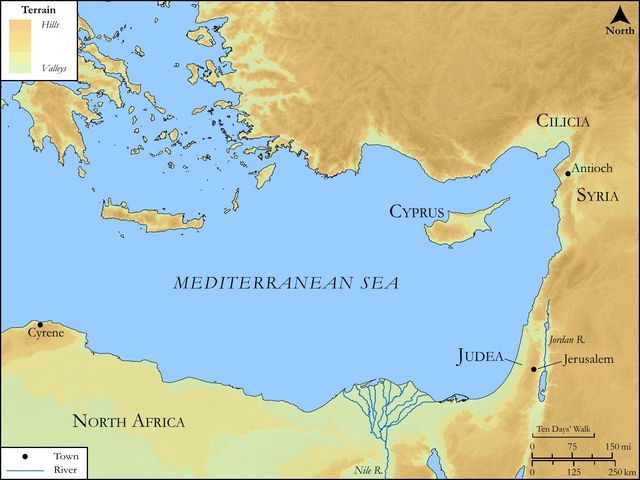
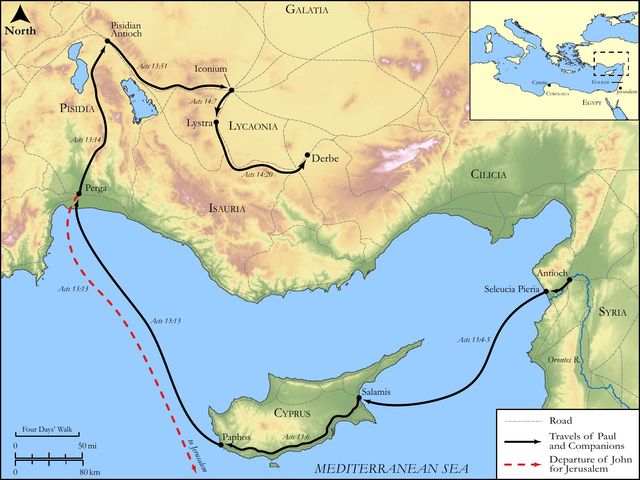
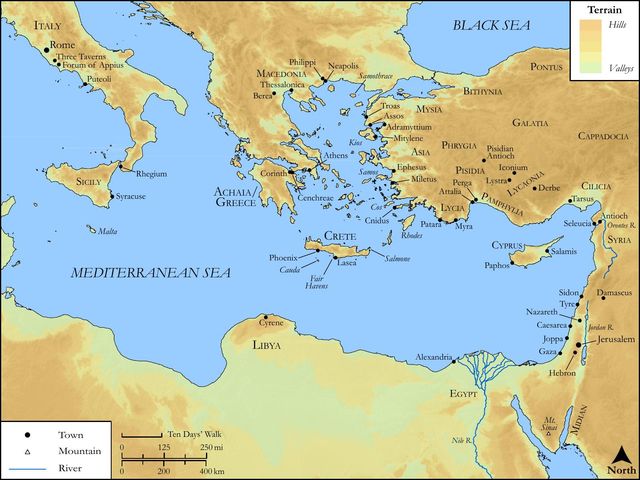
Study this verse
Public-domain commentary
Matthew Henry
From his Commentary on the Whole Bible. Henry comments on passages, not single verses — this entry covers Acts 13:1–3. His three-level outline is real structure in the source text, so it is rendered as structure.
We have here a divine warrant and commission to Barnabas and Saul to go and preach the gospel among the Gentiles, and their ordination to that service by the imposition of hands, with fasting and prayer.
I.Here is an account of the present state of the church at Antioch, which was planted, Act 11:20.
1.How well furnished it was with good ministers; there were there certain prophets and teachers (Act 13:1), men that were eminent for gifts, graces, and usefulness. Christ, when he ascended on high, gave some prophets and some teachers (Eph 4:11); these were both. Agabus seems to have been a prophet and not a teacher, and many were teachers who were not prophets; but those here mentioned were at times divinely inspired, and had instructions immediately from heaven upon special occasions, which gave them the title of prophets; and withal they were stated teachers of the church in their religious assemblies, expounded the scriptures, and opened the doctrine of Christ with suitable applications. These were the prophets, and scribes, or teachers, which Christ promised to send (Mat 23:34), such as were every way qualified for the service of the Christian church. Antioch was a great city, and the Christians there were many, so that they could not all meet in one place; it was therefore requisite they should have many teachers, to preside in their respective assemblies, and to deliver God's mind to them. Barnabas is first named, probably because he was the eldest, and Saul last, probably because he was the youngest; but afterwards the last became first, and Saul more eminent in the church. Three others are mentioned.
(1.)Simeon, or Simon, who for distinction-sake was called Niger, Simon the Black, from the color of his hair; like him that with us was surnamed the Black Prince.
(2.)Lucius of Cyrene, who some think (and Dr. Lightfoot inclines to it) was the same with this Luke that wrote the Acts, originally a Cyrenian, and educated in the Cyrenian college or synagogue at Jerusalem, and there first receiving the gospel.
(3.)Manaen, a person of some quality, as it should seem, for he was brought up with Herod the tetrarch, either nursed of the same milk, or bred at the same school, or pupil to the same tutor, or rather one that was his constant colleague and companion - that in every part of his education was his comrade and intimate, which gave him a fair prospect of preferment at court, and yet for Christ's sake he quitted all the hopes of it; like Moses, who, when he had come to years, refused to be called the son of Pharaoh's daughter. Had he joined in with Herod, with whom he was brought up, he might have had Blastus's place, and have been his chamberlain; but it is better to be fellow-sufferer with a saint than fellow-persecutor with a tetrarch.
2.How well employed they were (Act 13:2): They ministered to the Lord, and fasted. Observe,
(1.)Diligent faithful teachers do truly minister unto the Lord. Those that instruct Christians serve Christ; they really do him honour, and carry on the interest of his kingdom. Those that minister to the church in praying and preaching (both which are included here), minister unto the Lord, for they are the church's servants for Christ's sake; to him they must have an eye in their ministrations, and from him they shall have their recompence.
(2.)Ministering to the Lord, in one way or other, ought to be the stated business of churches and their teachers; to this work time ought to be set apart, nay, it is set apart, and in this work we ought to spend some part of every day. What have we to do as Christians and ministers but to serve the Lord Christ? Col 3:24; Rom 14:18.
(3.)Religious fasting is of use in our ministering to the Lord, both as a sign of our humiliation and a means of our mortification. Though it was not so much practised by the disciples of Christ, while the bridegroom was with them, as it was by the disciples of John and of the Pharisees; yet, after the bridegroom was taken away, they abounded in it, as those that had well learned to deny themselves and to endure hardness.
II.The orders given by the Holy Ghost for the setting apart of Barnabas and Saul, while they were engaged in public exercises, the ministers of the several congregations in the city joining in one solemn fast or day of prayer: The Holy Ghost said, either by a voice from heaven, or by a strong impulse on the minds of those of them that were prophets, Separate me Barnabas and Saul for the work whereunto I have called them. He does not specify the work, but refers to a former call of which they themselves knew the meaning, whether others did or no: as for Saul, he was particularly told that he must bear Christ's name to the Gentiles (Act 9:15), that he must be sent to the Gentiles (Act 22:21); the matter was settled between them at Jerusalem before this, that as Peter, James, and John laid out themselves among those of the circumcision, so Paul and Barnabas should go to the heathen, Gal 2:7-9. Barnabas, it is likely, knew himself designed for this service as well as Paul. Yet they would not thrust themselves into this harvest, though it appeared plenteous, till they received their orders from the Lord of the harvest: Thrust in thy sickle for the harvest is ripe, Rev 14:15. The orders were, Separate me Barnabas and Saul. Observe here,
1.Christ by his Spirit has the nomination of his ministers; for it is by the Spirit of Christ that they are qualified in some measure for his services, inclined to it, and taken off from other cares inconsistent with it. There are some whom the Holy Ghost has separated for the service of Christ, has distinguished from others as men that are offered and that willingly offer themselves to the temple service; and concerning them directions are given to those who are competent judges of the sufficiency of the abilities and the sincerity of the inclination: Separate them.
2.Christ's ministers are separated to him and to the Holy Ghost: Separate them to me; they are to be employed in Christ's work and under the Spirit's guidance, to the glory of God the Father.
3.All that are separated to Christ as his ministers are separated to work; Christ keeps no servants to be idle. If any man desires the office of a bishop, he desires a good work; that is what he is separated to, to labour in the word and doctrine. They are separated to take pains, not to take state.
4.The work of Christ's ministers, to which they are to be separated, is work that is already settled, and that which all Christ's ministers hitherto have been called to, and which they themselves have first been, by an external call, directed to and have chosen.
III.Their ordination, pursuant to these orders:
not to the ministry in general (Barnabas and Saul had both of them been ministers long before this), but to a particular service in the ministry, which had something peculiar in it, and which required a fresh commission, which commission God saw fit at this time to transmit by the hands of these prophets and teachers, for the giving of this direction to the church, that teachers should ordain teachers (for prophets we are not now any longer to expect), and that those who have the dispensing of the oracles of Christ committed to them should, for the benefit of posterity, commit the same to faithful men, who shall be able also to teach others, Ti2 2:2. So here, Simeon, and Lucius, and Manaen, faithful teachers at this time in the church of Antioch, when they had fasted and prayed, laid their hands on Barnabas and Saul, and sent them away (Act 13:3), according to the directions received. Observe,
1.They prayed for them. When good men are going forth about good work, they ought to be solemnly and particularly prayed for, especially by their brethren that are their fellow-labourers and fellow-soldiers.
2.They joined fasting with their prayers, as they did in their other ministrations, Act 13:3. Christ has taught us this by his abstaining from sleep (a night-fast, if I may so call it) the night before he sent forth his apostles, that he might spend it in prayer.
3.They laid their hands on them. Hereby,
(1.)They gave them their manumission, dismission, or discharge from the present service they were engaged in, in the church of Antioch, acknowledging that they went off not only fairly and with consent, but honourably and with a good report.
(2.)They implored a blessing upon them in their present undertaking, begged that God would be with them, and give them success; and, in order to this, that they might be filled with the Holy Ghost in their work. This very thing is explained Act 14:26, where it is said, concerning Paul and Barnabas, that from Antioch they had been recommended to the grace of God for the work which they fulfilled. As it was an instance of the humility of Barnabas and Saul that they submitted to the imposition of the hands of those that were their equals, or rather their inferiors; so it was of the good disposition of the other teachers that they did not envy Barnabas and Saul the honour to which they were preferred, but cheerfully committed it to them, with hearty prayers for them; and they sent them away with all expedition, out of a concern for those countries where they were to break up fallow ground.
Historical interpretation
Historical reception
2 surviving comments on this verse. Each one is dated, so this reads as a timeline rather than a list.
Select a marker to jump to its quote. Markers stagger vertically where authors wrote within a few decades of each other.
“And Manaean, who had been brought up with Herod the tetrarch.” Behold the customs of each of them: not even the fact of being brought up together saves them both. See how absolutely evil Herod was, for he did not want to be converted. But his foster brother Manaean certainly changed a great deal, because he was considered worthy of the gift of prophecy.
"Now there were in the Church that was at Antioch, certain prophets and teachers; as Barnabas, and Simeon that was called Niger, and Lucius of Cyrene, and Manaen, which had been brought up with Herod the tetrarch, and Saul." He still mentions Barnabas first: for Paul was not yet famous, he had not yet wrought any sign.
Continue studying Acts 13:1 across the web’s major study libraries — every link below opens this exact verse, chapter, or book on the destination site.
Read & Compare
 BibleGatewayThis verse in more than 200 translations and 70 languages.
 Bible.comThe YouVersion reader — hundreds of translations, reading plans, and highlights.
 ESV.orgCrossway's official English Standard Version reader.
 NET BibleThe NET translation with 60,000+ translators' notes on every rendering decision.
 STEP BibleTyndale House's free study tool — original text, vocabulary, and scholarly resources.
 BibliaLogos Bible Software's free web reader.
 USCCBThe New American Bible (Revised Edition) with the U.S. bishops' study notes.
Commentaries
 BibleHub CommentariesDozens of classic commentaries on this verse, gathered on one page.
 StudyLightMore than 100 commentary sets — the largest collection on the web.
 BibleRefPlain-English commentary on what this verse means, verse by verse.
 Enduring WordDavid Guzik's free commentary on this chapter, widely used by Bible teachers.
 Bible Study ToolsVerse commentary alongside Greek and Hebrew study aids.
Original Language & Research
- BibleHub InterlinearThe verse word by word — original language, transliteration, and English.
- BibleHub LexiconEvery word's original-language definition and Strong's entry.
 Blue Letter BibleDeep-study tools — Strong's numbers, concordance, and word studies.
 CNTR CollationThe earliest Greek manuscripts of this verse, collated letter by letter.
Sermons, Hymns & Audio


TrulyRandomVerse is not affiliated with these sites and doesn’t control their content. They’re linked because they’re genuinely useful.
Summary
Acts 13:1 introduces the diverse and gifted leadership of the church in Antioch, a pivotal early Christian center. This verse lists key figures—Barnabas, Simeon called Niger, Lucius of Cyrene, Manaen (who was raised with Herod the tetrarch), and Saul—who served as prophets and teachers. It sets the stage for the church's burgeoning missionary endeavors, highlighting the spiritual maturity and multicultural composition that would enable it to become a launching pad for the Gospel's expansion to the Gentile world.
Context
ShowHideLiterary Context
Acts 13:1 marks a significant transition within the book of Acts. Chapters 1-12 primarily focused on the Gospel's spread from Jerusalem to Judea and Samaria, with Peter as a central figure and the initial outreach to Gentiles exemplified by Cornelius's conversion in Acts 10. Chapter 12 concludes with Herod Agrippa I's persecution of the church and his subsequent death, underscoring divine protection and judgment. Acts 13 then shifts the narrative focus to Antioch, a thriving Gentile-inclusive church that becomes the new center for missionary activity, with Paul (Saul) emerging as the primary apostle to the Gentiles. This verse serves as an introduction to the key individuals whom the Holy Spirit will soon commission for the first missionary journey, effectively launching the church's global mission.
Historical & Cultural Context
Antioch in Syria was one of the largest cities in the Roman Empire, a major commercial and cultural hub. Its diverse population, including significant Jewish and Greek communities, made it fertile ground for the Gospel. After Stephen's martyrdom, believers scattered from Jerusalem and established a vibrant Christian community in Antioch, where both Jews and Gentiles were welcomed into the church, leading to the designation of followers as "Christians" for the first time (Acts 11:19-26). The presence of leaders from various backgrounds—Barnabas (Cypriot Jew), Simeon (possibly African), Lucius (Cyrenian), Manaen (from the Herodian court), and Saul (a Jew from Tarsus)—reflects Antioch's cosmopolitan nature and the Gospel's power to transcend ethnic and social barriers. The mention of Manaen's connection to Herod the tetrarch is particularly striking, demonstrating the Gospel's reach into unexpected and influential spheres.
Key Themes
ShowHideThis verse powerfully introduces several foundational themes that will unfold throughout the remainder of Acts. Firstly, Diverse Leadership is paramount, illustrating that God uses individuals from all walks of life—Jew and Gentile, rich and poor, educated and uneducated—to advance His kingdom. This diversity is not merely incidental but foundational to the church's universal mission. Secondly, the identification of these leaders as "prophets and teachers" underscores the importance of Spiritual Authority and Gifts in the early church. These roles were crucial for receiving divine revelation, instructing believers, and guiding the community's direction, as seen when the Holy Spirit speaks through them in Acts 13:2. Thirdly, the entire verse functions as a setup for Preparation for Mission. The strength, spiritual maturity, and varied backgrounds of these leaders were essential for the significant missionary thrust that was about to begin, signifying Antioch's role as the strategic launchpad for the evangelization of the wider Roman world, fulfilling the mandate of Acts 1:8.
Exposition and Analysis
ShowHideKey Word Analysis
ShowHideFrom a compound of ἐκ (out) and a derivative of καλέω (to call), meaning "a calling out." This term refers to a popular meeting or, more specifically in the New Testament, a religious congregation. In the context of Acts 13:1, it signifies the Christian community in Antioch, emphasizing its identity as a group of people "called out" by God for His purposes. It highlights their distinctiveness as God's gathered assembly.
From a compound of πρό (before, forth) and φημί (to speak), meaning "a foreteller" or "an inspired speaker." In the early church, prophets were individuals who received and communicated divine revelation, often speaking God's direct message to the community, providing guidance, encouragement, or warning. Their role was crucial for the spiritual health and direction of the church, complementing the teachers.
From σύν (with) and τροφός (nursling/nourisher), meaning "a fellow-nursling" or "comrade." This term indicates a close relationship, often implying someone raised or educated together, like a foster-brother or childhood companion. The detail that Manaen was sýntrophos with Herod the tetrarch is significant, showing the Gospel's penetration into high social strata and highlighting the diverse backgrounds united within the Antioch church.
Verse Breakdown
ShowHide"Now there were in the church that was at Antioch certain prophets and teachers;"
This opening clause immediately establishes the setting as the church in Antioch and identifies the primary roles of its leaders. The phrase "prophets and teachers" indicates a dual function: some individuals possessed the gift of prophecy (receiving and speaking God's direct word), while others excelled in teaching (systematically instructing believers in Christian doctrine and ethics). This combination underscores the spiritual vitality and instructional depth present in this early Christian community, setting the stage for their significant role in the expansion of the Gospel.
"as Barnabas, and Simeon that was called Niger, and Lucius of Cyrene, and Manaen, which had been brought up with Herod the tetrarch, and Saul."
This second clause provides a specific enumeration of five key leaders within the Antioch church. The list is notable for its diversity: Barnabas (a Levite from Cyprus, known for his encouragement), Simeon (whose Latin name "Niger" suggests African descent, possibly from Cyrene or North Africa), Lucius (from Cyrene, North Africa), Manaen (whose intimate connection to Herod's royal court highlights the Gospel's reach across social classes), and Saul (the former persecutor, now a prominent apostle). This roster vividly illustrates the multicultural and socio-economically varied composition of the early church's leadership, emphasizing the unifying power of the Gospel.
Literary Devices
ShowHideThe verse employs several significant literary devices. Enumeration is prominently used, as Luke meticulously lists the five key leaders, providing a clear roster of the individuals central to the upcoming missionary endeavors. This list serves not only to identify but also to emphasize the collective strength and diversity of the leadership. The careful naming of each individual, often with a brief descriptive tag (e.g., "Simeon that was called Niger," "Manaen, which had been brought up with Herod the tetrarch"), functions as Character Introduction. These brief biographical notes add depth and intrigue, hinting at their unique backgrounds and the breadth of the Gospel's reach. Furthermore, the verse employs Foreshadowing by introducing these specific individuals just before the Holy Spirit's direct command to send Barnabas and Saul on their first missionary journey. This detailed introduction prepares the reader for the monumental work these men are about to undertake, building anticipation for the global expansion of the Christian faith.
Theological and Thematic Connections
ShowHideActs 13:1 profoundly illustrates the Holy Spirit's sovereign orchestration in preparing and commissioning the church for its global mission. The Spirit not only calls individuals to faith but also gifts them for specific roles within the body of Christ, such as prophets and teachers, to build up and guide the community. The diverse composition of Antioch's leadership underscores the universal nature of God's call, demonstrating that the Gospel transcends all human-made barriers—ethnic, social, and economic—uniting a diverse people under Christ. This verse highlights that a healthy, Spirit-led church, characterized by sound teaching and prophetic guidance, is the divine instrument for advancing God's kingdom, serving as a launchpad for evangelism and discipleship to the ends of the earth.
Reflection and Application
ShowHideActs 13:1 offers a powerful blueprint for the contemporary church, emphasizing the critical importance of Spirit-led, diverse leadership for effective ministry and mission. Just as the church in Antioch flourished under the guidance of prophets and teachers from varied backgrounds, so too should modern congregations strive to identify, affirm, and empower leaders who reflect the rich tapestry of their communities and the global body of Christ. This verse challenges us to look beyond conventional qualifications and embrace the unique gifts and experiences that individuals from all walks of life bring to the table. It reminds us that the church's health and missional effectiveness are deeply tied to its willingness to be led by the Holy Spirit, to value spiritual gifts, and to cultivate an environment where diverse voices can contribute to the collective wisdom and direction. Ultimately, Acts 13:1 calls us to be a church that is not only spiritually mature but also outwardly focused, ready to be sent by God to share the transformative power of the Gospel with a world in need, just as Antioch became a sending church for Barnabas and Saul.
Questions for Reflection
ShowHideFAQ
ShowHideWhy was the church in Antioch so important for early Christian missions?
ShowHideThe church in Antioch was strategically important for several reasons. Geographically, it was a major Roman city, a hub of trade and culture, making it an ideal base for outward expansion. Theologically, it was the first major church outside Jerusalem to embrace a significant number of Gentiles, fostering a truly multicultural community where Jewish and Gentile believers worshipped together. This inclusive environment, coupled with strong spiritual leadership (prophets and teachers), allowed it to become the "launchpad" for the first missionary journeys, particularly those of Paul and Barnabas, shifting the focus of the Gospel's spread from primarily Jewish audiences to the wider Gentile world, as seen in Acts 13:2-3.
Who were the specific leaders mentioned in Acts 13:1, and what do their backgrounds tell us about the early church?
ShowHideThe verse names five leaders: Barnabas, Simeon (called Niger), Lucius of Cyrene, Manaen, and Saul. Their backgrounds are remarkably diverse: Barnabas was a Levite from Cyprus; Simeon's name "Niger" (Latin for "black") suggests African descent; Lucius was from Cyrene (North Africa); Manaen had a unique connection, having been "brought up with Herod the tetrarch," indicating a background in the royal court; and Saul (Paul) was a highly educated Jew from Tarsus, formerly a persecutor of Christians. This diverse group—spanning different ethnicities, social classes, and previous affiliations—powerfully illustrates the unifying and transformative power of the Gospel, demonstrating that Christ breaks down all barriers (Ephesians 2:14) and calls people from every walk of life into His service.
Christ-Centered Fulfillment
ShowHideActs 13:1, though not directly prophesying Christ, profoundly illustrates the outworking of His universal mission through His body, the church. The diverse leadership at Antioch—comprising individuals from various ethnic and social backgrounds—is a tangible manifestation of Christ's reconciling work, breaking down the dividing wall of hostility between Jew and Gentile, as described in Ephesians 2:14-16. These "prophets and teachers" were empowered by the same Holy Spirit that Christ promised would come to guide His disciples into all truth and empower them for witness (John 16:13 and Acts 1:8). The very existence and function of this multicultural, Spirit-filled church at Antioch, serving as the launchpad for global missions, directly fulfills Christ's Great Commission to make disciples of all nations (Matthew 28:19-20). In sending Barnabas and Saul, the church was participating in Christ's ongoing work of gathering His elect from every tribe, tongue, people, and nation, ultimately pointing to the Lamb of God who is worthy to receive glory and honor from all creation (Revelation 5:9-10).