


Acts 4:36
- ἸωσὴφIōsēphJosephG2501N-NSM-PNoun Nominative Singular Masculine Individual
- δὲdenowG1161CONJConjunction
- ὁhowhoG3588T-NSMDefinite article Nominative Singular Masculine
- ἐπικληθεὶςepiklētheishaving been calledG1941V-APP-NSMVerb Aorist Passive Participle Nominative Singular Masculine
- ΒαρναβᾶςBarnabasBarnabasG921N-NSM-PNoun Nominative Singular Masculine Individual
- ἀπὸapobyG575PREPPreposition
- τῶνtōntheG3588T-GPMDefinite article Genitive Plural Masculine
- ἀποστόλωνapostolōnapostlesG652N-GPMNoun Genitive Plural Masculine
- ὅhowhichG3739R-NSNRelative pronoun Nominative Singular Neuter
- ἐστινestinisG1510V-PAI-3SVerb Present Active Indicative 3rd Singular
- μεθερμηνευόμενονmethermēneuomenonbeing translatedG3177V-PPP-NSNVerb Present Passive Participle Nominative Singular Neuter
- υἱὸςhuiosSonG5207N-NSMNoun Nominative Singular Masculine
- παρακλήσεωςparaklēseōsof encouragementG3874N-GSFNoun Genitive Singular Feminine
- ΛευίτηςLeuitēsa LeviteG3019N-NSM-PGNoun Nominative Singular Masculine Person Gentilic
- ΚύπριοςKupriosa CypriotG2953N-NSM-LGNoun Nominative Singular Masculine Location Gentilic
- τῷtōat theG3588T-DSNDefinite article Dative Singular Neuter
- γένειgeneibirthG1085N-DSNNoun Dative Singular Neuter
English is a literal word-by-word gloss of the Greek, not the KJV's wording. Why?
This is the original text the KJV's translators worked from — each Greek word with its own literal English meaning in this verse, prepared by scholars at Tyndale House, Cambridge. The KJV translates whole sentences, not word by word, so its wording differs: one Greek word can become several English words, and the KJV may choose “charity” where the gloss reads “love”. Both are faithful — they answer different questions. For the KJV's own rendering, switch to the KJV text.
Details
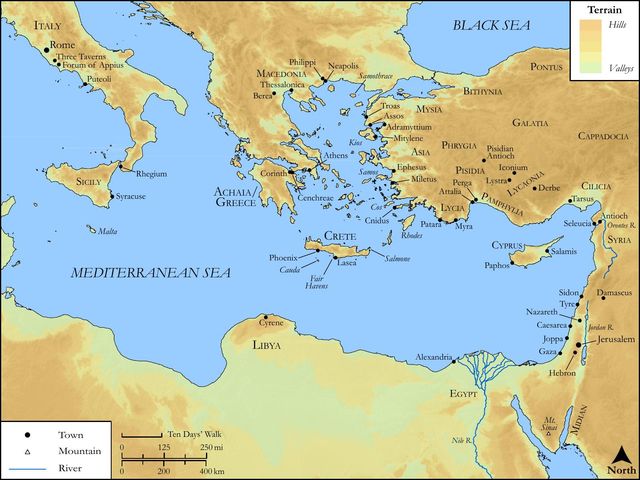
See on the biblical-era map
Study this verse
Public-domain commentary
Matthew Henry
From his Commentary on the Whole Bible. Henry comments on passages, not single verses — this entry covers Acts 4:32–37. His four-level outline is real structure in the source text, so it is rendered as structure.
We have a general idea given us in these verses, and it is a very beautiful one, of the spirit and state of this truly primitive church; it is conspectus saeculi - a view of that age of infancy and innocence.
I.The disciples loved one another dearly.
Behold, how good and how pleasant it was to see how the multitude of those that believed were of one heart, and of one soul (Act 4:32), and there was no such thing as discord nor division among them. Observe here,
1.There were multitudes that believed; even in Jerusalem, where the malignant influence of the chief priests was most strong, there were three thousand converted on one day, and five thousand on another, and, besides these, there were added to the church daily; and no doubt they were all baptized, and made profession of the faith; for the same Spirit that endued the apostles with courage to preach the faith of Christ endued them with courage to confess it. Note, The increase of the church is the glory of it, and the multitude of those that believe, more than their quality. Now the church shines, and her light is come, when souls thus fly like a cloud into her bosom, and like doves to their windows, Isa 60:1, Isa 60:8.
2.They were all of one heart, and of one soul. Though there were many, very many, of different ages, tempers, and conditions, in the world, who perhaps, before they believed, were perfect strangers to one another, yet, when they met in Christ, they were as intimately acquainted as if they had known one another many years. Perhaps they had been of different sects among the Jews, before their conversion, or had had discords upon civil accounts; but now these were all forgotten and laid aside, and they were unanimous in the faith of Christ, and, being all joined to the Lord, they were joined to one another in holy love. This was the blessed fruit of Christ's dying precept to his disciples, to love one another, and his dying prayer for them, that they all might be one. We have reason to think they divided themselves into several congregations, or worshipping assemblies, according as their dwellings were, under their respective ministers; and yet this occasioned no jealousy or uneasiness; for they were all of one heart, and one soul, notwithstanding; and loved those of other congregations as truly as those of their own. Thus it was then, and we may not despair of seeing it so again, when the Spirit shall be poured out upon us from on high.
II.The ministers went on in their work with great vigour and success (Act 4:33):
With great power gave the apostles witness of the resurrection of the Lord Jesus. The doctrine they preached was, the resurrection of Christ: a matter of fact, which served not only for the confirmation of the truth of Christ's holy religion, but being duly explained and illustrated, with the proper inferences from it, served for a summary of all the duties, privileges, and comforts of Christians. The resurrection of Christ, rightly understood and improved, will let us into the great mysteries of religion. By the great power wherewith the apostles attested the resurrection may be meant,
1.The great vigour, spirit, and courage, with which they published and avowed this doctrine; they did it not softly and diffidently, but with liveliness and resolution, as those that were themselves abundantly satisfied of the truth of it, and earnestly desired that others should be so too. Or,
2.The miracles which they wrought to confirm their doctrine. With works of great power, they gave witness to the resurrection of Christ, God himself, in them, bearing witness too.
III.The beauty of the Lord our God shone upon them, and all their performances:
Great grace was upon them all, not only all the apostles, but all the believers, charis megalē - grace that had something great in it (magnificent and very extraordinary) was upon them all.
1.Christ poured out abundance of grace upon them, such as qualified them for great services, by enduing them with great power; it came upon them from on high, from above.
2.There were evident fruits of this grace in all they said and did, such as put an honour upon them, and recommended them to the favour of God, as being in his sight of great price.
3.Some think it includes the favour they were in with the people. Every one saw a beauty and excellency in them, and respected them.
IV.They were very liberal to the poor, and dead to this world.
This was as great an evidence of the grace of God in them as any other, and recommended them as much to the esteem of the people.
1.They insisted not upon property, which even children seem to have a sense of and a jealousy for, and which worldly people triumph in, as Laban (Gen 31:43): All that thou seest is mine; and Nabal (Sa1 25:11): My bread and my water. These believers were so taken up with the hopes of an inheritance in the other world that this was as nothing to them. No man said that aught of the things which he possessed was his own, Act 4:32. They did not take away property, but they were indifferent to it. They did not call what they had their own, in a way of pride and vainglory, boasting of it, or trusting in it. They did not call it their own, because they had, in affection, forsaken all for Christ, and were continually expecting to be stripped of all for their adherence to him. They did not say that aught was their own; for we can call nothing our own but sin. What we have in the world is more God's than our own; we have it from him, must use it for him, and are accountable for it to him. No man said that what he had was his own, idion - his peculiar; for he was ready to distribute, willing to communicate, and desired not to eat his morsel alone, but what he had to spare from himself and family his poor neighbours were welcome to. Those that had estates were not solicitous to lay up, but very willing to lay out, and would straiten themselves to help their brethren. No marvel that they were of one heart and soul, when they sat so loose to the wealth of this world; for meum - mine, and tuum - thine, are the great makebates. Men's holding their own, and grasping at more than their own, are the rise of wars and fightings.
2.They abounded in charity, so that, in effect, they had all things common; for (Act 4:34) there was not any among them that lacked, but care was taken for their supply. Those that had been maintained upon the public charity were probably excluded when they turned Christians, and therefore it was fit that the church should take care of them. As there were many poor that received the gospel, so there were some rich that were able to maintain them, and the grace of God made them willing. Those that gather much have nothing over, because what they have over they have for those who gather little, that they may have no lack, Co2 8:14, Co2 8:15. The gospel hath laid all things common, not so that the poor are allowed to rob the rich, but so that the rich are appointed to relieve the poor.
3.They did many of them sell their estates, to raise a fund for charity: As many as had possession of lands or houses sold them, Act 4:34. Dr. Lightfoot computes that this was the year of jubilee in the Jewish nation, the fiftieth year (the twenty-eighth since they settled in Canaan fourteen hundred years ago), so that, what was sold that year being not to return till the next jubilee, lands then took a good price, and so the sale of those lands would raise the more money. Now,
(1.)We are here told what they did with the money that was so raised: They laid it at the apostles' feet - the left it to them to be disposed of as they thought fit; probably they had their support from it; for whence else could they have it? Observe, The apostles would have it laid at their feet, in token of their holy contempt of the wealth of the world; they thought it fitter it should be laid at their feet than lodged in their hands or in their bosoms. Being laid there, it was not hoarded up, but distribution was made, by proper persons, unto every man according as he had need. Great care ought to be taken in the distribution of public charity,
[1.]That it be given to such as have need; such as are not able to procure a competent maintenance of themselves, through age, infancy, sickness, or bodily disability, or incapacity of mind, want either of ingenuity or activity, cross providences, losses, oppressions, or a numerous charge. Those who upon any of these accounts, or any other, have real need, and have not relations of their own to help them - but, above all, those that are reduced to want for well doing, and for the testimony of a good conscience, ought to be taken care of, and provided for, and, with such a prudent application of what is given, as may be most for their benefit.
[2.]That it be given to every man for whom it is intended, according as he has need, without partiality or respect of persons. It is a rule in dispensing charity, as well as in administering justice, ut parium par sit ratio - that those who are equally needy and equally deserving should be equally helped, and that the charity should be suited and adapted to the necessity, as the word is.
(2.)Here is one particular person mentioned that was remarkable for this generous charity: it was Barnabas, afterwards Paul's colleague. Observe,
[1.]The account here given concerning him, Act 4:36. His name was Joses; he was of the tribe of Levi, for there were Levites among the Jews of the dispersion, who, it is probable, presided in their synagogue - worship, and, according to the duty of that tribe, taught them the good knowledge of the Lord. He was born in Cyprus, a great way off from Jerusalem, his parents, though Jews, having a settlement there. Notice is taken of the apostles' changing his name after he associated with them. It is probable that he was one of the seventy disciples, and, as he increased in gifts and graces, grew eminent, and was respected by the apostles, who, in token of their value for him, gave him a name, Barnabas - the son of prophecy (so it properly signifies), he being endued with extraordinary gifts of prophecy. But the Hellenist Jews (saith Grotius) called praying paraklēsis, and therefore by that word it is rendered here: A son of exhortation (so some), one that had an excellent faculty of healing and persuading; we have an instance of it, Act 11:22-24. A son of consolation (so we read it); one that did himself walk very much in the comforts of the Holy Ghost - a cheerful Christian, and this enlarged his heart in charity to the poor; or one that was eminent for comforting the Lord's people, and speaking peace to wounded troubled consciences; he had an admirable facility that way. There were two among the apostles that were called Boanerges - sons of thunder (Mar 3:17); but here was a son of consolation with them. Each had his several gift. Neither must censure the other, but both case one another; let the one search the wound, and then let the other heal it and bind it up.
[2.]Here is an account of his charity, and great generosity to the public fund. This is particularly taken notice of, because of the eminency of his services afterwards in the church of God, especially in carrying the gospel to the Gentiles; and, that this might not appear to come from any ill-will to his own nation, we have here his benevolence to the Jewish converts. Or perhaps this is mentioned because it was a leading card, and an example to others: He having land, whether in Cyprus, where he was born, or in Judea, where he now lived, or elsewhere, is not certain, but he sold it, not to buy elsewhere to advantage, but, as a Levite indeed, who knew he had the Lord God of Israel for his inheritance, he despised earthly inheritances, would be encumbered no more with them, but brought the money, and laid it at the apostles' feet, to be given in charity. Thus, as one that was designed to be a preacher of the gospel, he disentangled himself from the affairs of this life: and he lost nothing upon the balance of the account, by laying the purchase-money at the apostles' feet, when he himself was, in effect, numbered among the apostles, by that word of the Holy Ghost, Separate me Barnabas and Saul for the work whereunto I have called them, Act 13:2. Thus, for the respect he showed to the apostles as apostles, he had an apostle's reward.
Historical interpretation
Thirteen Centuries of Reception
9 surviving comments on this verse. Each one is dated, so this reads as a timeline rather than a list.
Select a marker to jump to its quote. Markers stagger vertically where authors wrote within a few decades of each other.
This he says regarding the conspiracy into which they were to enter against the Lord. And that he means this conspiracy, is evident to us. For the blessed David sings, "Rulers have taken counsel together against the Lord," and so forth. And of this conspiracy the Spirit prophesied, saying, "Let not my soul contend," desiring to draw them off, if possible, so that that future crime might not happen through them. "They slew men, and houghed the bull; "by the "strong bull" he means Christ. And "they houghed," since, when He was suspended on the tree, they pierced through His sinews. Again, "in their anger they houghed a bull." And mark the nicety of the expression: for "they slew men, and houghed a bull." For they killed the saints, and they remain dead, awaiting the time of the resurrection. But as a young bull, so to speak, when houghed, sinks down to the ground, such was Christ in submitting voluntarily to the death of the flesh; but He was not overcome of death. But though as man He became one of the dead, He remained alive in the nature of divinity. For Christ is the bull,-an animal, above all, strong and neat and devoted to sacred use. And the Son is Lord of all power, who did no sin, but rather offered Himself for us, a savour of a sweet smell to His God and Father. Therefore let those hear who houghed this august bull: "Cursed be their anger, for it was stubborn; and their wrath, for it was hardened." But this people of the Jews dared to boast of houghing the bull: "Our hands shed this." For this is nothing different, I think, from the word of folly: "His blood" (be upon us), and so forth. Moses recalls the curse against Levi, or, rather converts it into a blessing, on account of the subsequent zeal of the tribe, and of Phinehas in particular, in behalf of God. But that against Simeon he did not recall. Wherefore it also was fulfilled in deed. For Simeon did not obtain an inheritance like the other tribes, for he dwelt in the midst of Judah. Yet his tribe was preserved, although it was small in numbers.
"And Joses, who by the Apostles was surnamed Barnabas, which is, being interpreted, The son of consolation." I do not think that this is the same with the companion of Matthias; for that person was also called Justus and Barsabas, but this, Joses and "Barnabas" ["son of consolation"]. I suppose he also received the name from his virtue, as being qualified and suited for this duty. "A Levite, and of the country of Cyprus by birth." Observe on all occasions how the writer indicates the breaking up of the Law. But how was he also a "Cyprian by birth?" Because they then even removed to other countries, and still were called Levites. "Having land, sold it, and brought the price, and laid it at the Apostles' feet."
The writer is now about to relate the affair of Ananias and Sapphira, and in order to show that the man's sin was of the worst description, he first mentions him who performed the virtuous deed; that, there being so great a multitude all doing the same, so great grace, so great miracles, he, taught by none of these, but blinded by covetousness, brought destruction upon his own head. "Having land," meaning that this was all he possessed, "sold it, and brought the money, and laid it at the Apostles' feet."
Barnabas means, 'Son of a prophet', or 'son of one coming', or, as many think, son of consolation. All the derivations, as 'Bar' (son of) either 'Nabi' (a prophet), or a derivative from 'Bo' (to come) or from 'Bee' (to console), as by the Syriac interpreter it is also rendered, 'Son of consolation.'
"And Joseph, who, by the apostles, was surnamed Barnabas," etc. Here are given examples of faithful and of deceitful people: Joseph, who was surnamed Barnabas, went away unhurt, because he brought the entire price; Ananias, on the other hand, and his wife Saphira, who kept back by fraud the price of the land they had sold, were cursed, and gave up their unfortunate souls in front of everyone; and the same people carried out the husband and later his lifeless wife. After this event, everyone's fear and faith increased, and the apostles' preaching kept intensifying. None of their opponents dared to join them, since the people's favor towards them kept growing, when sick people were cured by a word from the apostles and by Peter's shadow as he passed by. Not only the people of that city, but also people from neighboring cities would try this with growing faith.
Joseph, who was also called Barnabas by the apostles. I think this Barnabas is the same who later is read to be ordained as an apostle to the Gentiles with Paul. Hence, because he was a Cypriot by birth, after separating from Paul, he returned to his native island. Although some think he was a companion of Paul rather than the one who was established by lot with Matthias in the apostleship, they overlook the fact that, according to the more correct manuscripts, this Barnabas should be called Barsabas with a changed letter, and in the Book of Hebrew Names, this Barnabas is interpreted as the son of consolation, but the other as the son of quiet.
Which means the Son of Consolation. Wherever the sacred Scriptures place the names of things or persons together with an interpretation, it undoubtedly signifies a more sacred meaning in those. He is rightly called the son of consolation, who, despising present things, is consoled by the hope of future things. For the Holy Spirit is therefore also called Paraclete because He grants consolation, that is, the joy of heavenly things, through the inner infusion of His gift to those who have pressure in the world. Similarly, blessed Peter is called Bar Jona, that is, the son of the dove, because of the same grace of the Spirit.
Joseph, who was surnamed Barnabas by the apostles, which is interpreted as the son of consolation, a Levite of Cyprian origin, having land, sold it, etc. It is remarkable how this Barnabas, who was later ordained an apostle of the Gentiles with Paul, and after a long companionship with him, returned to Cyprus, where he was born, to preach again, Eusebius, in the Ecclesiastical History, considers him to be among the seventy disciples of the Lord Savior, while it is clearly written by blessed Luke that he came to the discipleship of the apostles after the Lord's ascension; unless perhaps it is to be thought that he first followed the discipleship of Christ in such a way that he had not yet renounced all that he possessed. Whether this was in keeping with evangelical doctrine, anyone can easily see.
Joseph, to whom the apostles gave the surname Barnabas, which in Aramaic means 'son of consolation
Continue studying Acts 4:36 across the web’s major study libraries — every link below opens this exact verse, chapter, or book on the destination site.
Read & Compare
 BibleGatewayThis verse in more than 200 translations and 70 languages.
 Bible.comThe YouVersion reader — hundreds of translations, reading plans, and highlights.
 ESV.orgCrossway's official English Standard Version reader.
 NET BibleThe NET translation with 60,000+ translators' notes on every rendering decision.
 STEP BibleTyndale House's free study tool — original text, vocabulary, and scholarly resources.
 BibliaLogos Bible Software's free web reader.
 USCCBThe New American Bible (Revised Edition) with the U.S. bishops' study notes.
Commentaries
 BibleHub CommentariesDozens of classic commentaries on this verse, gathered on one page.
 StudyLightMore than 100 commentary sets — the largest collection on the web.
 BibleRefPlain-English commentary on what this verse means, verse by verse.
 Enduring WordDavid Guzik's free commentary on this chapter, widely used by Bible teachers.
 Bible Study ToolsVerse commentary alongside Greek and Hebrew study aids.
Original Language & Research
- BibleHub InterlinearThe verse word by word — original language, transliteration, and English.
- BibleHub LexiconEvery word's original-language definition and Strong's entry.
 Blue Letter BibleDeep-study tools — Strong's numbers, concordance, and word studies.
 CNTR CollationThe earliest Greek manuscripts of this verse, collated letter by letter.
Sermons, Hymns & Audio


TrulyRandomVerse is not affiliated with these sites and doesn’t control their content. They’re linked because they’re genuinely useful.
Summary
Acts 4:36 introduces Joses, a Levite from Cyprus, who was given the surname Barnabas by the apostles, a name interpreted as "The son of consolation." This verse highlights his background and the defining characteristic recognized by the early church leadership, setting the stage for his significant role as an encourager and generous contributor within the burgeoning Christian community in Jerusalem.
Context
ShowHideLiterary Context
This verse immediately follows a vivid description of the early Christian community's radical unity and shared resources in Acts 4:32-35. The preceding verses emphasize that "no one claimed that any of their possessions was their own, but they shared everything they had" (Acts 4:32). Barnabas is presented as a concrete, exemplary illustration of this communal generosity, specifically noted for selling a field and laying the proceeds at the apostles' feet. His introduction here serves to personify the ideal of selflessness and mutual support that characterized the early church, making him a model for the believers and foreshadowing his later prominence.
Historical & Cultural Context
The early church in Jerusalem, following Pentecost, was experiencing rapid growth and a unique communal dynamic. The practice of selling property and sharing resources was a voluntary expression of radical devotion, not a mandatory economic system, as later clarified in Acts 5:4. Barnabas's identity as a Levite is significant; traditionally, Levites were dedicated to temple service and often did not own land within Israel, though they could own property outside of it, like in Cyprus. His Cypriot origin indicates the diverse geographical and ethnic makeup of the early church, drawing believers from across the Jewish diaspora. This context underscores a community deeply committed to caring for its members, reflecting a profound shift in values from individual accumulation to collective welfare, driven by the Holy Spirit.
Key Themes
ShowHideBarnabas's introduction contributes to several key themes prevalent in the Book of Acts. His act of selling land exemplifies the theme of radical generosity and communal living, showcasing how believers sacrificially supported one another, echoing the descriptions in Acts 2:44-45. The apostles' act of bestowing the surname "Barnabas" highlights the theme of apostolic authority and discernment, as they recognized and affirmed his character and spiritual gift, signaling their leadership in guiding the nascent church. Most notably, his interpreted name, "The son of consolation," introduces the vital theme of encouragement and exhortation, which would become his defining characteristic and a crucial ministry within the early church. This trait is seen later when he champions Paul (Acts 9:27) and plays a pivotal role in the growth of the church in Antioch (Acts 11:22-26). Finally, his background as a Levite from Cyprus underscores the diversity and universal reach of the early Christian movement, drawing people from various backgrounds into a unified body.
Exposition and Analysis
ShowHideKey Word Analysis
ShowHideThis verb means "to entitle" or "to invoke." In this context, it signifies that the apostles formally bestowed a descriptive name upon Joses. This act highlights their authority and discernment in recognizing a distinctive character trait or spiritual gift within an individual, thereby affirming their role and identity within the burgeoning Christian community. It was not a mere nickname but an official designation reflecting his essence.
This noun encompasses a rich range of meanings, including "imploration," "hortation," "solace," "comfort," and "exhortation." When applied to Barnabas, it indicates that his primary characteristic and ministry were to provide comfort, encouragement, and spiritual strengthening to others. This word is deeply significant, pointing to his role as one who comes alongside others to uplift, support, and urge them forward in their faith.
Derived from a root meaning "to be born," this word refers to "kin," "kindred," "nation," or "offspring." Here, it specifies Barnabas's origin or nationality, indicating that he was "of the country of Cyprus." This detail provides important geographical and cultural context for his identity, showing the diverse background of believers joining the early church.
Verse Breakdown
ShowHide"And Joses, who by the apostles was surnamed Barnabas,"
This clause introduces the individual by his birth name, Joses, but immediately qualifies it by stating that the apostles gave him a new, descriptive surname: Barnabas. This act of naming by the apostles signifies their recognition of his character and spiritual gifting, establishing his identity within the Christian community.
"(which is, being interpreted, The son of consolation,)"
This parenthetical explanation provides the profound meaning behind the surname "Barnabas." It reveals that the name is an Aramaic term interpreted into Greek, signifying that Joses was characterized by his ability to bring comfort, encouragement, and exhortation to others. This interpretation highlights the core of his ministry and personality.
"a Levite, [and] of the country of Cyprus,"
This final phrase details Barnabas's background. He was a Levite, indicating his tribal lineage and traditional priestly association, though now serving in a new covenant context. His origin from Cyprus further broadens his identity, showing the diverse geographical reach of the early church and the varied backgrounds of its members.
Literary Devices
ShowHideActs 4:36 employs several literary devices to introduce and define Barnabas. The most prominent is Appellation or Epithet, as the apostles bestow the surname "Barnabas," which is then immediately interpreted as "The son of consolation." This epithet is not merely a label but a profound descriptor of his character and future ministry, effectively summarizing his essence. There is also an element of Juxtaposition between his birth name, Joses, and his new, Spirit-inspired name, Barnabas. This contrast emphasizes the transformative power of God's call and the recognition of spiritual gifts within the new community, where one's identity is shaped by their service and character in Christ. Finally, the phrase "son of consolation" functions as a Metonymy, where "son of" does not denote literal parentage but rather a strong association or embodiment of a quality. Barnabas is so characterized by consolation that he is called its "son," indicating that this quality is intrinsic to his being and ministry.
Theological and Thematic Connections
ShowHideBarnabas's introduction in Acts 4:36 serves as a powerful theological statement about the nature of the early church and the Spirit's work within it. His radical act of generosity, selling his land and giving the proceeds to the apostles, embodies the communal ideal of the Spirit-filled community, where material possessions were held loosely for the benefit of all. This selfless act is not presented as a legalistic requirement but as a spontaneous overflow of love and devotion, demonstrating a profound trust in God and a deep commitment to the body of Christ. Furthermore, his surname, "Son of Consolation," underscores the vital importance of encouragement, comfort, and exhortation within the Christian fellowship. In a nascent church facing internal challenges and external persecution, individuals like Barnabas, gifted with the ability to uplift and strengthen others, were indispensable. His life exemplifies how spiritual gifts are not merely for personal edification but are given for the building up of the entire body of Christ, fostering unity, resilience, and growth.
Reflection and Application
ShowHideBarnabas stands as an enduring model for believers today, challenging us to embody the principles of radical generosity and profound encouragement. His willingness to divest himself of personal assets for the common good calls us to examine our own relationship with material possessions and to consider how we might more fully share our resources—whether financial, time, or talent—to meet the needs of our community and advance God's kingdom. Beyond material giving, Barnabas's very name, "Son of Consolation," beckons us to cultivate a spirit of encouragement. In a world often marked by despair, criticism, and division, the church is called to be a beacon of hope and affirmation. We are invited to actively seek opportunities to uplift, comfort, and exhort those around us, speaking words of life and faith into weary souls. Like Barnabas, we are to be people who come alongside others, offering strength and support, helping them to persevere in their faith journey. Our unique backgrounds, like Barnabas's as a Levite from Cyprus, are not hindrances but divinely appointed aspects of our identity that God can use to serve His purposes and edify the body of Christ.
Questions for Reflection
ShowHideFAQ
ShowHideWhy did the apostles rename Joses to Barnabas?
ShowHideThe apostles did not formally "rename" Joses in the sense of changing his legal identity, but rather bestowed upon him a descriptive surname, "Barnabas." This act was a recognition of his outstanding character and spiritual gift, specifically his profound ability to bring comfort, encouragement, and exhortation to others. It was a prophetic and affirming act, highlighting his defining quality and signaling his significant role within the burgeoning Christian community. This practice aligns with other instances in Scripture where individuals receive new names or titles that reflect their transformed character or divine calling, such as Abram becoming Abraham or Simon becoming Peter.
What does Barnabas being a "Levite" signify in this context?
ShowHideBarnabas's identity as a Levite is significant because Levites were traditionally the priestly tribe, responsible for temple service, teaching the Law, and maintaining the tabernacle/temple. In the context of the early Christian church, his Levite background highlights a profound shift: a Levite, whose former life was tied to the Old Covenant temple system, is now serving God in the New Covenant community through radical generosity and encouragement. This demonstrates the continuity of service to God but also the transformation of that service under Christ, moving from ritualistic duties to Spirit-empowered acts of love and community building. It underscores that all believers, regardless of their past roles, are now part of a "royal priesthood" (1 Peter 2:9).
Was selling property mandatory for early Christians, or was Barnabas's act unique?
ShowHideBarnabas's act of selling his field and giving the proceeds to the apostles was a voluntary and extraordinary expression of faith and communal commitment, not a mandatory requirement for all early Christians. The apostle Peter explicitly clarifies this point later in Acts 5:4 when confronting Ananias, stating that the property remained his to keep or sell, and the money was his to use as he wished. Barnabas's generosity was an exemplary demonstration of the Spirit's work in producing radical selflessness among believers, reflecting the deep unity and care within the early church, rather than a universal command for all to liquidate their assets.
Christ-Centered Fulfillment
ShowHideBarnabas, the "Son of Consolation," serves as a beautiful human reflection of the ultimate Comforter and Exhorter, Jesus Christ. While Barnabas generously gave his earthly possessions, Christ gave infinitely more, divesting Himself of divine glory and ultimately His life on the cross to secure humanity's salvation (Philippians 2:5-8). His self-sacrificial act is the supreme example of the radical generosity that Barnabas's actions foreshadow. Furthermore, the very essence of Barnabas's name, "consolation" or "encouragement," points directly to Christ as the Paraclete, the one who comes alongside us as Advocate, Counselor, and Comforter. Jesus promised His disciples that He would send another Helper, the Holy Spirit, who would continue His work of comforting and guiding them (John 14:26). Thus, Barnabas's ministry of encouragement within the early church is a tangible manifestation of Christ's ongoing work through His Spirit to comfort His people and to build up the body of Christ for His glory. Barnabas, in his character and actions, embodies the very heart of Christ's self-giving love and comforting presence.