


2 Corinthians 8:15
Bible text: King James Version (1769 Blayney text) · Public domain
Bible text: Berean Standard Bible · Public domain
Bible text: American Standard Version (1901) · Public domain
Bible text: World English Bible, Messianic edition · Public domain
Bible text: Geneva Bible (1599) · Public domain
Bible text: Young's Literal Translation · Public domain
- καθὼςkathōsEven asG2531CONJConjunction
- γέγραπται·gegraptaiit has been writtenG1125V-RPI-3SVerb Perfect Passive Indicative 3rd Singular
- ὁhoHeG3588T-NSMDefinite article Nominative Singular Masculine
- τὸtotheG3588T-ASNDefinite article Accusative Singular Neuter
- πολὺpolumuchG4183A-ASNAdjective Accusative Singular Neuter
- οὐκouknotG3756PRT-NNegative Particle Negative
- ἐπλεόνασενepleonasendid aboundG4121V-AAI-3SVerb Aorist Active Indicative 3rd Singular
- καὶkaiandG2532CONJConjunction
- ὁhoheG3588T-NSMDefinite article Nominative Singular Masculine
- τὸtotheG3588T-ASNDefinite article Accusative Singular Neuter
- ὀλίγονoligonlittleG3641A-ASNAdjective Accusative Singular Neuter
- οὐκouknotG3756PRT-NNegative Particle Negative
- ἠλαττόνησενēlattonēsenlackedG1641V-AAI-3SVerb Aorist Active Indicative 3rd Singular
English is a literal word-by-word gloss of the Greek, not the KJV's wording. Why?
This is the original text the KJV's translators worked from — each Greek word with its own literal English meaning in this verse, prepared by scholars at Tyndale House, Cambridge. The KJV translates whole sentences, not word by word, so its wording differs: one Greek word can become several English words, and the KJV may choose “charity” where the gloss reads “love”. Both are faithful — they answer different questions. For the KJV's own rendering, switch to the KJV text.
Details
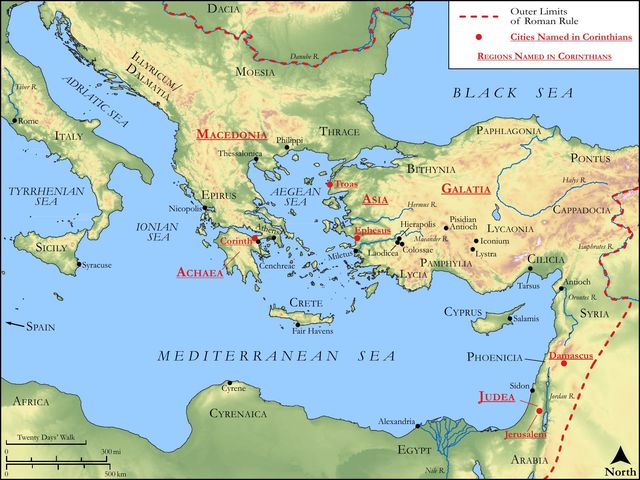
See on the biblical-era maps

Study this verse
Public-domain commentary
Matthew Henry
From his Commentary on the Whole Bible. Henry comments on passages, not single verses — this entry covers 2 Corinthians 8:7–15. His two-level outline is real structure in the source text, so it is rendered as structure.
In these verses the apostle uses several cogent arguments to stir up the Corinthians to this good work of charity.
I.He urges upon them the consideration of their eminence in other gifts and graces, and would have them excel in this of charity also, Co2 8:7. Great address and much holy art are here used by the apostle. When he would persuade the Corinthians to this good thing, he commends them for other good things that were found in them. Most people love to be complimented, especially when we ask a gift of them for ourselves or others; and it is a justice we owe to those in whom God's grace shines to give them their due commendation. Observe here, What it was that the Corinthians abounded in. Faith is mentioned first, for that is the root; and, as without faith it is impossible to please God (Heb 11:6), so those who abound in faith will abound in other graces and good works also; and this will work and show itself by love. To their faith was added utterance, which is an excellent gift, and redounds much to the glory of God and the good of the church. Many have faith who want utterance. But these Corinthians excelled most churches in spiritual gifts, and particularly in utterance; and yet this was not in them, as in too many, both the effect and evidence of ignorance; for with their utterance there appeared knowledge, abundance of knowledge. They had a treasury of things new and old, and in their utterance they brought out of this treasury. They abounded also in all diligence. Those who have great knowledge and ready utterance are not always the most diligent Christians. Great talkers are not always the best doers; but these Corinthians were diligent to do, as well as know and talk, well. And further, they had abundant love to their minister; and were not like too many, who, having gifts of their own, are but too apt to slight their ministers, and neglect them. Now to all these good things the apostle desires them to add this grace also, to abound in charity to the poor; that, where so much good was found, there should be found yet more good. Before the apostle proceeds to another argument he takes care to prevent any misapprehensions of his design to impose on them, or to bind heavy burdens upon them by his authority; and tells them (Co2 8:8) he does not speak by commandment, or in a way of authority. I give my advice, Co2 8:10. He took occasion from the forwardness of others to propose what would be expedient for them, and would prove the sincerity of their love, or be the genuine effect and evidence thereof. Note, A great difference should be made between plain and positive duty, and the improvement of a present opportunity of doing or getting good. Many a thing which is good for us to do, yet can not be said to be, by express and indispensable commandment, our duty at this or that time.
II.Another argument is taken from the consideration of the grace of our Lord Jesus Christ.
The best arguments for Christian duties are those that are taken from the love of Christ, that constraineth us. The example of the churches of Macedonia was such as the Corinthians should imitate; but the example of our Lord Jesus Christ should have much greater influence. And you know, saith the apostle, the grace of our Lord Jesus Christ (Co2 8:9), that though he was rich, as being God, equal in power and glory with the Father, rich in all the glory and blessedness of the upper world, yet for your sakes he became poor; not only did become man for us, but he became poor also. He was born in poor circumstances, lived a poor life, and died in poverty; and this was for our sakes, that we thereby might be made rich, rich in the love and favour of God, rich in the blessings and promises of the new covenant, rich in the hopes of eternal life, being heirs of the kingdom. This is a good reason why we should be charitable to the poor out of what we have, because we ourselves live upon the charity of the Lord Jesus Christ.
III.Another argument is taken from their good purposes, and their forwardness to begin this good work. As to this he tells them,
1.It was expedient for them to perform what they purposed, and finish what they had begun, Co2 8:10, Co2 8:11. What else did their good purposes and good beginnings signify? Good purposes, indeed, are good things; they are like buds and blossoms, pleasant to behold, and give hopes of good fruit; but they are lost, and signify nothing, without performances. So good beginnings are amiable; but we shall lose the benefit unless there be perseverance, and we bring forth fruit to perfection. Seeing therefore the Corinthians had shown a readiness to will, he would have them be careful also in the performance, according to their ability. For,
2.This would be acceptable to God. This willing mind is accepted (Co2 8:12), when accompanied with sincere endeavours. When men purpose that which is good, and endeavour, according to their ability, to perform also, God will accept of what they have, or can do, and not reject them for what they have not, and what is not in their power to do: and this is true as to other things besides the work of charity. But let us note here that this scripture will by no means justify those who think good meanings are enough, or that good purposes, and the profession of a willing mind, are sufficient to save them. It is accepted, indeed, where there is a performance as far as we are able, and when Providence hinders the performance, as in David's case concerning building a house for the Lord, 2 Sa. 7.
IV.Another argument is taken from the discrimination which the divine Providence makes in the distribution of the things of this world, and the mutability of human affairs, Co2 8:13-15. The force of the arguing seems to be this: - Providence gives to some more of the good things of this world, and to some less, and that with this design, that those who have a greater abundance may supply those who are in want, that there may be room for charity. And further, considering the mutability of human affairs, and how soon there may be an alteration, so that those who now have an abundance may stand in need of being supplied themselves in their wants, this should induce them to be charitable while they are able. It is the will of God that, by our mutually supplying one another, there should be some sort of equality; not an absolute equality indeed, or such a levelling as would destroy property, for in such a case there could be no exercise of charity. But as in works of charity there should be an equitable proportion observed, that the burden should not lie too heavy on some, while others are wholly eased, so all should think themselves concerned to supply those who are in want. This is illustrated by the instance of gathering and distributing manna in the wilderness, concerning which (as we may read, Ex. 16) it was the duty of every family, and all in the family, to gather what they could, which, when it was gathered, was put into some common receptacle for each family, whence the master of the family distributed to every one as he had occasion, to some more than they were able, through age and infirmity, to gather up; to others less than they gathered, because they did not need so much: and thus he that had gathered much (more than he had occasion for) had nothing over, when a communication was made to him that had gathered little, who by this method had no lack. Note, Such is the condition of men in this world that we mutually depend on one another, and should help one another. Those who have ever so much of this world have no more than food and raiment; and those who have but a little of this world seldom want these; nor, indeed, should those who have abundance suffer others to want, but be ready to afford supply.
Historical interpretation
Historical reception
2 surviving comments on this verse. Each one is dated, so this reads as a timeline rather than a list.
Select a marker to jump to its quote. Markers stagger vertically where authors wrote within a few decades of each other.
The saints, with their hope in the world to come, have more than those who appear to be rich in this world. But both will be made equal, because those who give of their wealth to help the saints now will be helped by them at some future time, when they are in need.
Now this happened in the case of the manna. For both they that gathered more, and they that gathered less, were found to have the same quantity, God in this way punishing insatiableness. And this he said at once both to alarm them by what then happened, and to persuade them never to desire to have more nor to grieve at having less. And this one may see happening now in things of this life not in the manna only. For if we all fill but one belly, and live the same length of time, and clothe one body; neither will the rich gain aught by his abundance nor the poor lose aught by his poverty.
Continue studying 2 Corinthians 8:15 across the web’s major study libraries — every link below opens this exact verse, chapter, or book on the destination site.
Read & Compare
 BibleGatewayThis verse in more than 200 translations and 70 languages.
 Bible.comThe YouVersion reader — hundreds of translations, reading plans, and highlights.
 ESV.orgCrossway's official English Standard Version reader.
 NET BibleThe NET translation with 60,000+ translators' notes on every rendering decision.
 STEP BibleTyndale House's free study tool — original text, vocabulary, and scholarly resources.
 BibliaLogos Bible Software's free web reader.
 USCCBThe New American Bible (Revised Edition) with the U.S. bishops' study notes.
Commentaries
 BibleHub CommentariesDozens of classic commentaries on this verse, gathered on one page.
 StudyLightMore than 100 commentary sets — the largest collection on the web.
 BibleRefPlain-English commentary on what this verse means, verse by verse.
 Enduring WordDavid Guzik's free commentary on this chapter, widely used by Bible teachers.
 Bible Study ToolsVerse commentary alongside Greek and Hebrew study aids.
Original Language & Research
- BibleHub InterlinearThe verse word by word — original language, transliteration, and English.
- BibleHub LexiconEvery word's original-language definition and Strong's entry.
 Blue Letter BibleDeep-study tools — Strong's numbers, concordance, and word studies.
 CNTR CollationThe earliest Greek manuscripts of this verse, collated letter by letter.
Sermons, Hymns & Audio


TrulyRandomVerse is not affiliated with these sites and doesn’t control their content. They’re linked because they’re genuinely useful.
Summary
Second Corinthians 8:15 encapsulates a profound principle of divine provision and communal equity, asserting that in God's economy, both abundance and scarcity are balanced to ensure universal sufficiency. Paul quotes from the Old Testament account of the manna in the wilderness to illustrate that when resources are shared according to God's design, those with much will not have surplus, and those with little will not experience want, thereby fostering a spirit of mutual care and trust in God's unfailing supply within the community of believers.
Context
ShowHideLiterary Context
This verse is strategically placed within Paul's extensive discourse on Christian giving in 2 Corinthians 8 and 2 Corinthians 9. Following his commendation of the Macedonian churches' exemplary generosity despite their poverty (2 Corinthians 8:1-5), and his profound theological grounding for giving in Christ's self-impoverishment (2 Corinthians 8:9), Paul then addresses the Corinthians directly. He encourages them to complete their promised contribution for the impoverished saints in Jerusalem, not as a burden, but as a matter of fairness and mutual support. 2 Corinthians 8:13-14 establishes the principle of "equality"—that their present abundance should meet the needs of others, with the expectation that in time, others' abundance might meet their needs. Verse 15 then serves as the scriptural proof and illustration of this principle, drawing directly from the Old Testament narrative of the manna.
Historical & Cultural Context
The immediate historical context is the collection Paul was organizing among Gentile churches for the Jewish Christians in Jerusalem who were suffering from famine and poverty. This collection was not merely an act of charity but a tangible expression of the unity between Jewish and Gentile believers, demonstrating the practical outworking of the gospel. The cultural backdrop involved a strong emphasis on hospitality and care for the poor within both Jewish and early Christian communities. The specific reference to the manna in Exodus 16 would have resonated deeply with a Jewish audience and was a familiar story to early Christians. The manna incident describes God's miraculous provision in the wilderness, where each Israelite was to gather an omer of manna daily. Crucially, regardless of how much one physically collected, when measured, everyone had exactly what they needed—no more, no less—highlighting God's equitable distribution and sufficiency for all His people.
Key Themes
ShowHideThe verse powerfully contributes to several overarching themes in 2 Corinthians and broader biblical theology. Foremost is the theme of Equality and Equity within the body of Christ, emphasizing that Christian giving is not about creating burdens or making everyone equally wealthy, but ensuring that basic needs are met and extreme disparities are alleviated. This ties into the theme of Divine Provision and Sufficiency, illustrating God's faithfulness to supply for His people's needs, often through the generosity of others. It underscores that when believers participate in God's economy of sharing, He ensures that both givers and receivers experience sufficiency, echoing the truth that God will supply all needs according to His riches in glory by Christ Jesus (Philippians 4:19). Finally, it reinforces the theme of Mutual Support and Interdependence within the church, portraying the community of believers as a unified body where members care for one another, fostering strong communal bonds and reflecting the unity found in Christ. This principle of sharing and community is also evident in the early church's practice in Acts 4:32-35.
Exposition and Analysis
ShowHideKey Word Analysis
ShowHideThis verb, G1125, signifies "to grave," particularly "to write," and figuratively, "to describe." Its use here, "As it is written," is a standard formula in the New Testament to introduce a direct quotation from the Old Testament, lending divine authority and historical precedent to Paul's argument. It grounds the principle of equitable distribution in God's established pattern of provision for His people.
Derived from a word meaning "more," G4121 means "to do, make or be more," "to increase," or "to superabound." In this context, "had nothing over" means there was no surplus, no excess, no more than was needed. It speaks to the precise and sufficient nature of God's provision and the ideal outcome of equitable sharing—that abundance is distributed rather than accumulated beyond need.
This word, G1641, comes from a root meaning "less" and means "to diminish" or "to fall short." "Had no lack" signifies that there was no deficiency, no shortage, no want. This highlights the miraculous and comprehensive nature of God's provision, ensuring that even those who gathered little were fully supplied, reinforcing the principle that in God's economy, everyone's needs are met.
Verse Breakdown
ShowHide"As it is written,"
This introductory phrase serves as a direct citation marker, signaling that Paul is quoting Scripture. It immediately establishes the divine authority and biblical precedent for the principle he is about to articulate, drawing from the historical account of God's miraculous provision for Israel.
"He that had gathered much had nothing over;"
This clause refers to the Israelites' experience with the manna. Despite some individuals gathering a large quantity, when it was measured, they found they had precisely an omer, the prescribed amount for each person. This illustrates that God's provision is not for hoarding or excessive accumulation, but for sufficiency and equitable distribution among the community.
"and he that had gathered little had no lack."
Conversely, this clause highlights that those who gathered only a small amount of manna miraculously found that when measured, they also had exactly an omer. This demonstrates God's care for the vulnerable and His ability to ensure that even the least capable or fortunate among His people are fully provided for, underscoring the principle of universal sufficiency.
Literary Devices
ShowHideThe verse employs several significant literary devices. The most prominent is Quotation or Allusion, as "As it is written" introduces a direct verbatim quote from Exodus 16:18. This not only lends scriptural authority to Paul's argument but also creates a powerful Analogy or Type where the physical provision of manna in the wilderness serves as a historical and theological type for the spiritual and material provision within the New Covenant community. The structure of the verse itself exhibits strong Parallelism and Antithesis. The two clauses—"He that had gathered much had nothing over" and "he that had gathered little had no lack"—are syntactically parallel, presenting contrasting situations (gathering much vs. gathering little) that lead to the same equitable outcome (no surplus, no deficiency). This Antithesis effectively highlights the divine principle of balance and sufficiency, regardless of individual effort or initial circumstance.
Theological and Thematic Connections
ShowHideThis verse profoundly illustrates God's economy of grace, where His desire is for sufficiency and equity among His people, not for extreme wealth or poverty. It teaches that true abundance in the Kingdom of God is found not in personal accumulation, but in shared resources and mutual provision. The manna account, to which Paul refers, is a powerful demonstration of God's ability to provide for His entire community, ensuring that no one is left in want when His principles are followed. This divine pattern calls believers to trust in God's ability to sustain them even as they generously share their resources, understanding that their giving participates in a larger divine plan to meet the needs of the whole body of Christ. It challenges the human tendency towards self-preservation and hoarding, instead promoting a counter-cultural ethos of communal responsibility and reliance on God's unfailing supply.
Reflection and Application
ShowHideSecond Corinthians 8:15 challenges contemporary believers to re-evaluate their understanding of wealth, poverty, and stewardship in light of God's communal economy. It calls us away from an individualistic mindset that seeks only personal gain and security, towards a corporate vision where the well-being of the entire body of Christ is paramount. This verse encourages us to view our resources—whether abundant or limited—as part of God's provision intended for the flourishing of His people. It fosters a spirit of generosity rooted in trust, knowing that when we share, God ensures sufficiency for all. Practically, this means actively seeking opportunities to alleviate the burdens of others, contributing to initiatives that support the needy within our churches and communities, and cultivating a lifestyle that prioritizes mutual care over excessive accumulation. It reminds us that our "much" is meant to supply another's "want," and in doing so, God ensures that our "little" will never truly "lack."
Questions for Reflection
ShowHideFAQ
ShowHideWhat is the significance of Paul quoting from the Old Testament in 2 Corinthians 8:15?
ShowHidePaul's quotation of Exodus 16:18 is highly significant because it grounds his teaching on Christian giving in a historical and divinely ordained precedent. By referencing the miraculous provision of manna in the wilderness, Paul demonstrates that the principle of equitable distribution and sufficiency for all is not a new idea but a consistent pattern of God's care for His people. It shows that God's desire for His community to live without extreme surplus or extreme lack is deeply embedded in His character and His covenant relationship with Israel, now extended and fulfilled in the church. This Old Testament example provides a powerful, tangible illustration of how God ensures that everyone has enough when His people participate in His economy of sharing.
Christ-Centered Fulfillment
ShowHideSecond Corinthians 8:15 finds its ultimate Christ-centered fulfillment in the person and work of Jesus, who perfectly embodies the principle of divine sufficiency through self-emptying. While the manna provided physical sustenance and demonstrated God's equitable provision, Christ is the true "bread of life" (John 6:35), who descended from heaven to give spiritual life to the world. Paul explicitly links Christian giving to Christ's example in 2 Corinthians 8:9: "For you know the grace of our Lord Jesus Christ, that though he was rich, yet for your sake he became poor, so that you through his poverty might become rich." Jesus, who had infinite spiritual and divine "much," emptied Himself (Philippians 2:5-8), having "nothing over" in terms of His divine prerogatives, taking on the form of a servant. Through His ultimate sacrifice on the cross, He ensured that humanity, which had "gathered little" and was in utter spiritual "lack" due to sin, would have "no lack" of righteousness, forgiveness, and eternal life. His perfect obedience and atoning death provide an inexhaustible spiritual supply, guaranteeing that all who believe in Him receive spiritual abundance and sufficiency, fulfilling the principle of 2 Corinthians 8:15 in the most profound and eternal sense.