


Acts 17:17
Bible text: King James Version (1769 Blayney text) · Public domain
Bible text: King James Version with Strong's numbers · Public domain
Bible text: Berean Standard Bible · Public domain
Bible text: American Standard Version (1901) · Public domain
Bible text: World English Bible, Messianic edition · Public domain
Bible text: Geneva Bible (1599) · Public domain
Bible text: Young's Literal Translation · Public domain
- διελέγετοdielegetoHe was reasoningG1256V-INI-3SVerb Imperfect Middle Or Passive Deponent Indicative 3rd Singular
- μὲνmenindeedG3303PRTParticle or Disjunctive
- οὖνounthereforeG3767CONJConjunction
- ἐνeninG1722PREPPreposition
- τῇtēatheG3588T-DSFDefinite article Dative Singular Feminine
- συναγωγῇsunagōgēasynagogueG4864N-DSFNoun Dative Singular Feminine
- τοῖςtoiswith theG3588T-DPMDefinite article Dative Plural Masculine
- ἸουδαίοιςIoudaioisJewsG2453N-DPM-PGNoun Dative Plural Masculine Individual Gentilic
- καὶkaiandG2532CONJConjunction
- τοῖςtoiswith thoseG3588T-DPMDefinite article Dative Plural Masculine
- σεβομένοιςsebomenoisworshipingG4576V-PNP-DPMVerb Present Middle Or Passive Deponent Participle Dative Plural Masculine
- καὶkaiandG2532CONJConjunction
- ἐνeninG1722PREPPreposition
- τῇtēatheG3588T-DSFDefinite article Dative Singular Feminine
- ἀγορᾷagoramarketplaceG58N-DSFNoun Dative Singular Feminine
- κατὰkataonG2596PREPPreposition
- πᾶσανpasaneveryG3956A-ASFAdjective Accusative Singular Feminine
- ἡμέρανhēmerandayG2250N-ASFNoun Accusative Singular Feminine
- πρὸςproswithG4314PREPPreposition
- τοὺςtousthoseG3588T-APMDefinite article Accusative Plural Masculine
- παρατυγχάνοντας·paratugchanontasmeeting [him]G3909V-PAP-APMVerb Present Active Participle Accusative Plural Masculine
English is a literal word-by-word gloss of the Greek, not the KJV's wording. Why?
This is the original text the KJV's translators worked from — each Greek word with its own literal English meaning in this verse, prepared by scholars at Tyndale House, Cambridge. The KJV translates whole sentences, not word by word, so its wording differs: one Greek word can become several English words, and the KJV may choose “charity” where the gloss reads “love”. Both are faithful — they answer different questions. For the KJV's own rendering, switch to the KJV text.
Details
See on the biblical-era maps
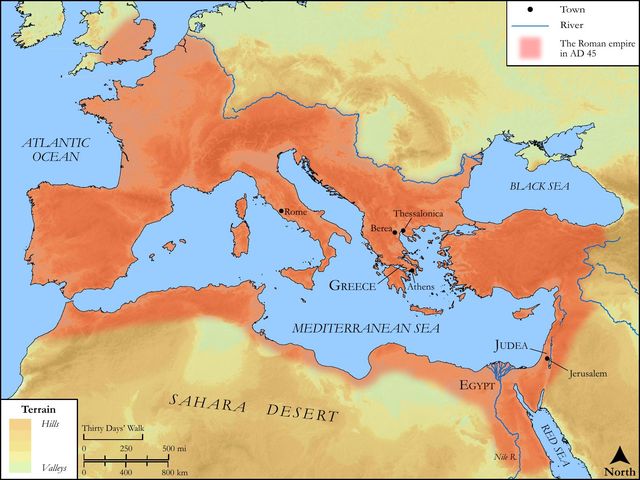
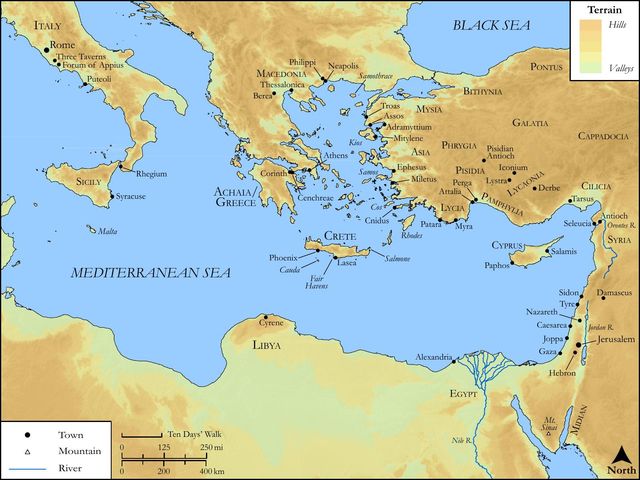
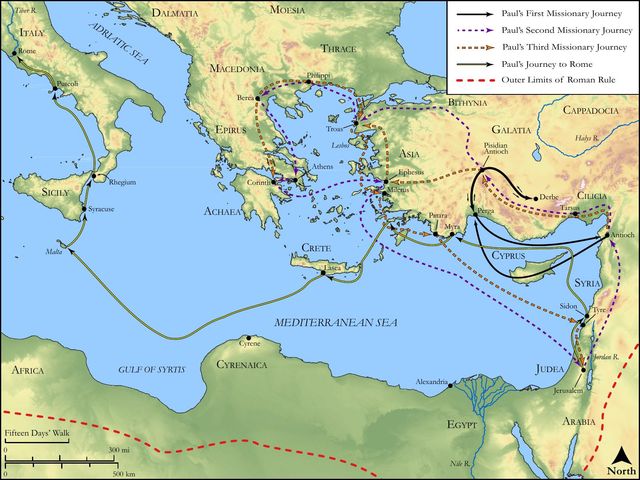
Study this verse
Public-domain commentary
Matthew Henry
From his Commentary on the Whole Bible. Henry comments on passages, not single verses — this entry covers Acts 17:16–21. His three-level outline is real structure in the source text, so it is rendered as structure.
A scholar that has acquaintance, and is in love, with the learning of the ancients, would think he should be very happy if he were where Paul now was, at Athens, in the midst of the various sects of philosophers, and would have a great many curious questions to ask them, for the explication of the remains we have of the Athenian learning; but Paul, though bred a scholar, and an ingenious active man, does not make this any of his business at Athens. He has other work to mind: it is not the improving of himself in their philosophy that he aims at, he has learned to call it a vain thing, and is above it (Col 2:8); his business is, in God's name, to correct their disorders in religion, and to turn them from the service of idols, and of Satan in them, to the service of the true and living God in Christ.
I.Here is the impression which the abominable ignorance and superstition of the Athenians made upon Paul's spirit, Act 17:16. Observe,
1.The account here given of that city: it was wholly given to idolatry. This agrees with the account which the heathen writers give of it, that there were more idols in Athens than there were in all Greece besides put together, and that they had twice as many sacred feasts as others had. Whatever strange gods were recommended to them, they admitted them, and allowed them a temple and an altar, so that they had almost as many gods as men - facilius possis deum quam hominem invenire. And this city, after the empire became Christian, continued incurably addicted to idolatry, and all the pious edicts of the Christian emperors could not root it out, till, by the irruption of the Goths, that city was in so particular a manner laid waste that there are now scarcely any remains of it. It is observable that there, where human learning most flourished, idolatry most abounded, and the most absurd and ridiculous idolatry, which confirms that of the apostle, that when they professed themselves to be wise they became fools (Rom 1:22), and, in the business of religion, were of all other the most vain in their imaginations. The world by wisdom knew not God, Co1 1:21. They might have reasoned against polytheism and idolatry; but, it seems, the greatest pretenders to reason were the greatest slaves to idols: so necessary was it to the re-establishing even of natural religion that there should be a divine revelation, and that centering in Christ.
2.The disturbance which the sight of this gave to Paul. Paul was not willing to appear publicly till Silas and Timothy came to him, that out of the mouth of two or three witnesses the word might be established; but in the mean time his spirit was stirred within him. He was filled with concern for the glory of God, which he saw given to idols, and with compassion to the souls of men, which he saw thus enslaved to Satan, and led captive by him at his will. He beheld these transgressors, and was grieved; and horror took hold of him. He had a holy indignation at the heathen priests, that led the people such an endless trace of idolatry, and at their philosophers, that knew better, and yet never said a word against it, but themselves went down the stream.
II.The testimony that he bore against their idolatry, and his endeavours to bring them to the knowledge of the truth.
He did not, as Witsius observes, in the heat of his zeal break into the temples, pull down their images, demolish their altars, or fly in the face of their priests; nor did he run about the streets crying, "You are all the bond-slaves of the devil," though it was too true; but he observed decorum, and kept himself within due bounds, doing that only which became a prudent man.
1.He went to the synagogue of the Jews, who, though enemies to Christianity, were free from idolatry, and joined with them in that among them which was good, and took the opportunity given him there of disputing for Christ, Act 17:17. He discoursed with the Jews, reasoned fairly with them, and put it to them what reason they could give why, since they expected the Messiah, they would not receive Jesus. There he met with the devout persons that had forsaken the idol temples, but rested in the Jews' synagogue, and he talked with these to lead them on to the Christian church, to which the Jews' synagogue was but as a porch.
2.He entered into conversation with all that came in his way about matters of religion: In the market - en tē agora, in the exchange, or place of commerce, he disputed daily, as he had occasion, with those that met with him, or that he happened to fall into company with, that were heathen, and never came to the Jews' synagogue. The zealous advocates for the cause of Christ will be ready to plead it in all companies, as occasion offers. The ministers of Christ must not think it enough to speak a good word for Christ once a week, but should be daily speaking honourably of him to such as meet with them.
III.The enquiries which some of the philosophers made concerning Paul's doctrine. Observe,
1.Who they were that encountered him, that entered into discourse with him, and opposed him: He disputed with all that met him, in the places of concourse, or rather of discourse. Most took no notice of him, slighted him, and never minded a word he said; but there were some of the philosophers that thought him worth making remarks upon, an they were those whose principles were most directly contrary to Christianity.
(1.)The Epicureans, who thought God altogether such a one as themselves, an idle inactive being, that minded nothing, nor put any difference between good and evil. They would not own, either that God made the world or that he governs it; nor that man needs to make any conscience of what he says or does, having no punishment to fear nor rewards to hope for, all which loose atheistical notions Christianity is levelled against. The Epicureans indulged themselves in all the pleasures of sense, and placed their happiness in them, in what Christ has taught us in the first place to deny ourselves.
(2.)The Stoics, who thought themselves altogether as good as God, and indulged themselves as much in the pride of life as the Epicureans did in the lusts of the flesh and of the eye; they made their virtuous man to be no way inferior to God himself, nay to be superior. Esse aliquid quo sapiens antecedat Deum - There is that in which a wise man excels God, so Seneca: to which Christianity is directly opposite, as it teaches us to deny ourselves and abase ourselves, and to come off from all confidence in ourselves, that Christ may be all in all.
2.What their different sentiments were of him; such there were as there were of Christ, Act 17:18.
(1.)Some called him a babbler, and thought he spoke, without any design, whatever came uppermost, as men of crazed imaginations do: What will this babbler say? ho spermologos houtos - this scatterer of words, that goes about, throwing here one idle word or story and there another, without any intendment or signification; or, this picker up of seeds. Some of the critics tell us that the term is used for a little sort of bird, that is worth nothing at all, either for the spit or for the cage, that picks up the seeds that lie uncovered, either in the field or by the way-side, and hops here and there for that purpose - Avicula parva quae semina in triviis dispersa colligere solet; such a pitiful contemptible animal they took Paul to be, or supposed he went from place to place venting his notions to get money, a penny here and another there, as that bird picks up here and there a grain. They looked upon him as an idle fellow, and regarded him, as we say, no more than a ballad-singer.
(2.)Others called him a setter forth of strange gods, and thought he spoke with design to make himself considerable by that means. And, if he had strange gods to set forth, he could not bring them to a better market than to Athens. He did not, as many did, directly set forth new gods, nor avowedly; but they thought he seemed to do so, because he preached unto then Jesus, and the resurrection. From his first coming among them he ever and anon harped upon these two strings, which are indeed the principal doctrines of Christianity - Christ and a future state - Christ our way, and heaven our end; and, though he did not call these gods, yet they thought he meant to make them so. Ton Iēsoun kai tēn anastasin̂ "Jesus they took for a new god, and anastasis, the resurrection, for a new goddess." Thus they lost the benefit of the Christian doctrine by dressing it up in a pagan dialect, as if believing in Jesus, and looking for the resurrection, were the worshipping of new demons.
3.The proposal they made to give him a free, full, fair, and public hearing, Act 17:19, Act 17:20. They had heard some broken pieces of his doctrine, and are willing to have a more perfect knowledge of it.
(1.)They look upon it as strange and surprising, and very different from the philosophy that had for many ages been taught and professed at Athens. "It is a new doctrine, which we do not understand the drift and design of. Thou bringest certain strange things to our ears, which we never heard of before, and know not what to make of now." By this it should seem that, among all the learned books they had, they either had not, or heeded not, the books of Moses and the prophets, else the doctrine of Christ would not have been so perfectly new and strange to them. There was but one book in the world that was of divine inspiration, and that was the only book they were strangers to, which, if they would have given a due regard to it, would, in its very first page, have determined that great controversy among them about the origin of the universe.
(2.)They desired to know more of it, only because it was new and strange: "May we know what this new doctrine is? Or, is it (like the mysteries of the gods) to be kept as a profound secret? If it may be, we would gladly know, and desire thee to tell us, what these things mean, that we may be able to pass a judgment upon them." This was a fair proposal; it was fit they should know what this doctrine was before they embraced it; and they were so fair as not to condemn it till they had had some account of it.
(3.)The place they brought him to, in order to this public declaration of his doctrine; it was to Areopagus, the same word that is translated (Act 17:22) Mars' Hill; it was the town-house, or guildhall of their city, where the magistrates met upon public business, and the courts of justice were kept; and it was as the theatre in the university, or the schools, where learned men met to communicate their notions. The court of justice which sat here was famous for its equity, which drew appeals to it from all parts; if any denied a God, he was liable to the censure of this court. Diagoras was by them put to death, as a contemner of the gods; nor might any new God be admitted without their approbation. Hither they brought Paul to be tried, not as a criminal but as a candidate.
4.The general character of the people of that city given upon this occasion (Act 17:21): All the Athenians, that is natives of the place, and strangers who sojourned there for their improvement, spent their time in nothing else but either to tell or to hear some new thing, which comes in as the reason why they were inquisitive concerning Paul's doctrine, not because it was good, but because it was new. It is a very sorry character which is here given of these people, yet many transcribe it.
(1.)They were all for conversation. St. Paul exhorts his pupil to give attendance to reading and meditation (Ti1 4:13, Ti1 4:15), but these people despised those old-fashioned ways of getting knowledge, and preferred that of telling and hearing. It is true that good company is of great use to a man, and will polish one that has laid a good foundation in study; but that knowledge will be very flashy and superficial which is got by conversation only.
(2.)They affected novelty; they were for telling and hearing some new thing. They were for new schemes and new notions in philosophy, new forms and plans of government in politics, and, in religion, for new gods that came newly up (Deu 32:17), new demons, new-fashioned images and altars (Kg2 16:10); they were given to change. Demosthenes, an orator of their own, had charged this upon them long before, in one of his Philippics, that their common question in the markets, or wherever they met, was ei ti le etai neōteron - whether there was any news.
(3.)They meddled in other people's business, and were inquisitive concerning that, and never minded their own. Tattlers are always busy bodies, Ti1 5:13.
(4.)They spent their time in nothing else, and a very uncomfortable account those must needs have to make of their time who thus spend it. Time is precious, and we are concerned to be good husbands of it, because eternity depends upon it, and it is hastening apace into eternity, but abundance of it is wasted in unprofitable converse. To tell or hear the new occurrences of providence concerning the public in our own or other nations, and concerning our neighbours and friends, is of good use now and then; but to set up for newsmongers, and to spend our time in nothing else, is to lose that which is very precious for the gain of that which is worth little.
Historical interpretation
Historical reception
1 surviving comment on this verse from the historical church.
"He reasoned therefore in the synagogue," etc. Observe him again reasoning with Jews. By "devout persons" he means the proselytes. For the Jews were dispersed everywhere before Christ's coming, the Law indeed being henceforth, so to say, in process of dissolution, but at the same time the dispersed Jews teaching men religion. But those prevailed nothing, save only that they got witnesses of their own calamities.
Continue studying Acts 17:17 across the web’s major study libraries — every link below opens this exact verse, chapter, or book on the destination site.
Read & Compare
 BibleGatewayThis verse in more than 200 translations and 70 languages.
 Bible.comThe YouVersion reader — hundreds of translations, reading plans, and highlights.
 ESV.orgCrossway's official English Standard Version reader.
 NET BibleThe NET translation with 60,000+ translators' notes on every rendering decision.
 STEP BibleTyndale House's free study tool — original text, vocabulary, and scholarly resources.
 BibliaLogos Bible Software's free web reader.
 USCCBThe New American Bible (Revised Edition) with the U.S. bishops' study notes.
Commentaries
 BibleHub CommentariesDozens of classic commentaries on this verse, gathered on one page.
 StudyLightMore than 100 commentary sets — the largest collection on the web.
 BibleRefPlain-English commentary on what this verse means, verse by verse.
 Enduring WordDavid Guzik's free commentary on this chapter, widely used by Bible teachers.
 Bible Study ToolsVerse commentary alongside Greek and Hebrew study aids.
Original Language & Research
- BibleHub InterlinearThe verse word by word — original language, transliteration, and English.
- BibleHub LexiconEvery word's original-language definition and Strong's entry.
 Blue Letter BibleDeep-study tools — Strong's numbers, concordance, and word studies.
 CNTR CollationThe earliest Greek manuscripts of this verse, collated letter by letter.
Sermons, Hymns & Audio


TrulyRandomVerse is not affiliated with these sites and doesn’t control their content. They’re linked because they’re genuinely useful.
Summary
Acts 17:17 vividly portrays the Apostle Paul's dynamic and strategic evangelistic approach in Athens. Upon observing the city's pervasive idolatry, Paul's spirit was deeply provoked, compelling him to engage actively with its inhabitants. This verse details his dual-pronged method of outreach: reasoning in the Jewish synagogue with both Jews and God-fearing Gentiles, and daily engaging with a broader, diverse audience in the bustling public marketplace, demonstrating a comprehensive and persistent model of gospel proclamation.
Context
ShowHideLiterary Context
This verse is situated immediately after Paul's arrival in Athens, following his ministry in Thessalonica and Berea. Acts 17:16 sets the stage, describing Paul's deep distress ("his spirit was stirred in him") at the sight of a city "wholly given to idolatry." Acts 17:17 then details his immediate and proactive response to this spiritual challenge, outlining the specific venues and audiences he targeted. This public discourse and daily engagement in the market directly precede and lay the groundwork for his renowned address on Mars' Hill, where he would articulate the Christian message to Epicurean and Stoic philosophers, as recorded in Acts 17:18-34.
Historical & Cultural Context
Ancient Athens was not merely a city but a vibrant intellectual and cultural hub, renowned for its philosophical schools (like the Epicureans and Stoics mentioned in Acts 17:18), its democratic traditions, and its overwhelming devotion to numerous gods, evident in its countless idols and altars. The "synagogue" served as the primary gathering place for the Jewish community and "devout persons" (Gentile God-fearers) who were drawn to monotheism and Jewish scripture. The "market" (Greek: agora) was the heart of Athenian public life—a bustling town square where commerce, political debate, philosophical discourse, and social interaction converged. Paul's choice of these two distinct venues reflects a keen understanding of the city's social fabric and a strategic adaptation of his missionary efforts to reach both religious and secular minds.
Key Themes
ShowHideActs 17:17 highlights several crucial themes. Firstly, Strategic Evangelism is paramount, as Paul intentionally targets both those familiar with monotheistic traditions in the synagogue (a common starting point for his missions, as seen in Acts 9:20) and the broader, diverse populace in the public square. This adaptability underscores the principle Paul later articulated about becoming "all things to all people" for the sake of the gospel (1 Corinthians 9:22). Secondly, the verse emphasizes Public Discourse and Reasoning, indicated by the term "disputed." This was not merely proclamation but an active engagement in thoughtful dialogue, debate, and the presentation of logical arguments for the Christian faith, inviting interaction and challenge. Thirdly, the phrase "daily" underscores Persistent Witness, revealing Paul's unwavering commitment to consistent, ongoing engagement in sharing the Gospel, not as a one-off event but as an integral part of his daily life and ministry.
Exposition and Analysis
ShowHideKey Word Analysis
ShowHideThis term, derived from dia (through) and legō (to speak), signifies "to say thoroughly," implying a process of discussing, reasoning, or lecturing. It suggests an intellectual exchange, often in a debating or conversational style, rather than a mere argumentative quarrel. Paul engaged in a thoughtful dialogue, presenting coherent arguments for the Christian faith, inviting questions and counter-arguments.
Properly referring to the town-square, the agora was the central public space in ancient Greek cities. It served as a hub for commerce, political assembly, and crucially, philosophical discussion. For Paul, it was an ideal venue to reach a wide and diverse audience, including philosophers, merchants, and ordinary citizens, allowing for spontaneous and widespread dissemination of the Gospel.
This phrase literally means "according to every day" or "throughout every day." The combination of katá (down, through), pâs (all, every), and hēméra (day) strongly emphasizes the regularity, consistency, and persistence of Paul's evangelistic efforts. His witness was not sporadic but a continuous, integrated part of his presence in Athens.
Verse Breakdown
ShowHide"Therefore disputed he in the synagogue with the Jews"
This clause indicates Paul's initial and customary approach upon entering a new city. His spirit was provoked by the idolatry (Acts 17:16), leading him to immediately engage. The synagogue was the logical starting point, providing a ready audience of his own countrymen who were familiar with the Old Testament scriptures, which prophesied of the Messiah.
"and with the devout persons"
This addition highlights Paul's broader reach within the synagogue setting. "Devout persons" refers to God-fearers, Gentiles who, while not fully converting to Judaism, attended synagogue services and adhered to certain Jewish practices, having rejected polytheism for monotheism. They were often spiritually receptive and a fertile ground for the Gospel message.
"and in the market daily"
This marks a significant expansion of Paul's ministry beyond the confines of the synagogue. The "market" (agora) was the public square, a bustling center of Athenian life. Paul's willingness to engage here demonstrates his commitment to reaching all segments of society, including those with no prior exposure to Jewish monotheism. The term "daily" underscores the consistent and persistent nature of his evangelism.
"with them that met with him"
This phrase implies an open, accessible, and responsive form of engagement. Paul did not merely preach at people but engaged with those who were willing to encounter him, whether out of curiosity, philosophical interest, or genuine spiritual hunger. It suggests interactive dialogue and a readiness to address individual questions and concerns.
Literary Devices
ShowHideThe verse employs Juxtaposition by contrasting the "synagogue" with the "market," highlighting Paul's strategic adaptation to different audiences and settings—one a structured religious environment, the other a chaotic public forum. This shows his versatility in ministry. The use of the word "daily" serves as Emphasis and Hyperbole, underscoring the relentless and persistent nature of Paul's evangelistic efforts, implying a constant, almost non-stop commitment to sharing the Gospel. The active verb "disputed" (KJV) or "reasoned" (ESV) signifies Action and Engagement, portraying Paul not as a passive observer but as an active participant in the intellectual and spiritual life of Athens, directly confronting its prevailing ideologies.
Theological and Thematic Connections
ShowHideActs 17:17 provides a profound theological blueprint for Christian engagement with the world. It underscores the importance of a Spirit-stirred passion for the lost, a strategic approach to evangelism that adapts to diverse audiences, and a commitment to intellectual and relational discourse. Paul's example teaches that the Gospel is to be proclaimed not only in sacred spaces but also in the public square, engaging with the prevailing philosophies and cultural norms of the day. His method of "disputing" or "reasoning" highlights the apologetic nature of Christian witness, where truth is presented with clarity, logic, and grace, inviting thoughtful consideration and response. This verse calls believers to be both bold in proclamation and wise in engagement, reflecting God's desire for all people to hear and understand the good news.
Reflection and Application
ShowHideActs 17:17 serves as a powerful mandate for contemporary believers, urging us to move beyond the comfort of our faith communities and actively engage the world around us with the Gospel. Paul's example challenges us to cultivate a heart that is deeply moved by the spiritual lostness and idolatry of our culture, prompting us to action rather than passive observation. We are called to be discerning in our approach, understanding the unique contexts and worldviews of those we seek to reach, whether in established religious settings or the bustling "marketplaces" of modern society—our workplaces, schools, social media, and public forums. True evangelism, as modeled by Paul, involves not just proclamation but also thoughtful dialogue, patient reasoning, and a willingness to listen and respond to questions and objections. It demands a consistent, "daily" commitment, integrating our witness into the fabric of our everyday lives, demonstrating the transformative power of Christ through both our words and our actions.
Questions for Reflection
ShowHideFAQ
ShowHideWhy did Paul choose to engage in both the synagogue and the market in Athens?
ShowHidePaul's dual engagement in the synagogue and the market was a strategic and comprehensive approach to evangelism. The synagogue provided a natural starting point, as it was a gathering place for Jews and "devout persons" (Gentile God-fearers) who already shared a monotheistic worldview and familiarity with the Old Testament scriptures, which provided a foundation for understanding the Messiah. This allowed Paul to build upon existing theological concepts. The market (agora), on the other hand, was the public square—a vibrant hub of Athenian life where philosophers, merchants, and ordinary citizens congregated. Engaging here allowed Paul to reach a much broader and more diverse audience, including those with no prior knowledge of Judaism or the God of Israel. This two-pronged approach demonstrates his commitment to reaching all people by adapting his message and method to the specific context and audience, a principle he articulates in 1 Corinthians 9:22.
What does the word "disputed" imply about Paul's method of evangelism?
ShowHideThe King James Version's translation "disputed" (from the Greek dialégomai) might suggest mere argument, but in this context, it implies a much richer and more nuanced form of engagement. It means Paul "reasoned," "discussed," or "lectured," engaging in thoughtful dialogue and intellectual exchange. This was not a quarrel but a presentation of logical arguments for the Christian faith, inviting questions, objections, and counter-arguments. Paul was not simply proclaiming a message but was actively interacting with his audience, seeking to persuade them through rational discourse and clear explanation of the Scriptures and the person of Christ. This method is evident in his subsequent address on Mars' Hill, where he skillfully adapted his message to the philosophical framework of his listeners.
Christ-Centered Fulfillment
ShowHidePaul's ministry in Acts 17:17, characterized by passionate engagement, strategic outreach, and intellectual reasoning, profoundly reflects the very nature and mission of Christ. Just as Paul was "stirred" by the idolatry of Athens, Jesus himself was moved with compassion for the lost and the spiritually blind (Matthew 9:36). Christ's earthly ministry was not confined to synagogues; He taught in the temple courts, on hillsides, by the sea, and in homes, engaging with all who would listen, from religious leaders to the common people (Matthew 4:23). Paul's "disputing" or "reasoning" mirrors Jesus' own authoritative teaching and debates with the religious authorities, where He consistently presented truth with both wisdom and power (Luke 20:1-8). Ultimately, Paul's message in Athens, as everywhere, was centered on the resurrected Christ—the true God who calls all people to repentance (Acts 17:30-31). Paul's willingness to cross cultural and intellectual divides to bring the Gospel to the Athenians is a continuation of Christ's incarnational mission, where the Word became flesh to dwell among us and make God known (John 1:14). Thus, Paul's evangelistic zeal and methodology in Athens serve as a powerful Christ-centered example for all who seek to make Him known in a diverse and often idolatrous world.