


Acts 17:16
“Paul in Athens: Confronting Idolatry”Acts 17:16–21
Bible text: King James Version (1769 Blayney text) · Public domain
Bible text: Berean Standard Bible · Public domain
Bible text: American Standard Version (1901) · Public domain
Bible text: World English Bible, Messianic edition · Public domain
Bible text: Geneva Bible (1599) · Public domain
Bible text: Young's Literal Translation · Public domain
- ἘνEnInG1722PREPPreposition
- δὲdenowG1161CONJConjunction
- ταῖςtais[the]G3588T-DPFDefinite article Dative Plural Feminine
- ἈθήναιςAthēnaisAthensG116N-DPF-LNoun Dative Plural Feminine Location
- ἐκδεχομένουekdechomenouis waiting forG1551V-PNP-GSMVerb Present Middle Or Passive Deponent Participle Genitive Singular Masculine
- αὐτοὺςautousthemG846P-APMPersonal pronoun Accusative Plural Masculine
- τοῦtou[the]G3588T-GSMDefinite article Genitive Singular Masculine
- ΠαύλουPaulouPaulG3972N-GSM-PNoun Genitive Singular Masculine Individual
- παρωξύνετοparōxunetowas provokedG3947V-IPI-3SVerb Imperfect Passive Indicative 3rd Singular
- τὸtotheG3588T-NSNDefinite article Nominative Singular Neuter
- πνεῦμαpneumaspiritG4151N-NSNNoun Nominative Singular Neuter
- αὐτοῦautouof himG846P-GSMPersonal pronoun Genitive Singular Masculine
- ἐνeninG1722PREPPreposition
- αὐτῷautōhimG846P-DSMPersonal pronoun Dative Singular Masculine
- θεωροῦντοςtheōrountosseeingG2334V-PAP-GSMVerb Present Active Participle Genitive Singular Masculine
- κατείδωλονkateidōlonutterly idolatrousG2712A-ASFAdjective Accusative Singular Feminine
- οὖσανousanto beG1510V-PAP-ASFVerb Present Active Participle Accusative Singular Feminine
- τὴνtēntheG3588T-ASFDefinite article Accusative Singular Feminine
- πόλινpolincityG4172N-ASFNoun Accusative Singular Feminine
English is a literal word-by-word gloss of the Greek, not the KJV's wording. Why?
This is the Greek text the KJV’s translators worked from, with each word given its own literal English meaning in this verse. The word-by-word meanings were prepared by scholars at Tyndale House, Cambridge. The KJV translates whole sentences rather than single words, so its wording often differs: one Greek word can become several English words, and the KJV may say “charity” where the word-by-word meaning reads “love”. The two are made for different purposes, and both are faithful to the Greek. To read the KJV’s own wording, switch to the KJV text.
Words in [ ] are added by the English.
Details
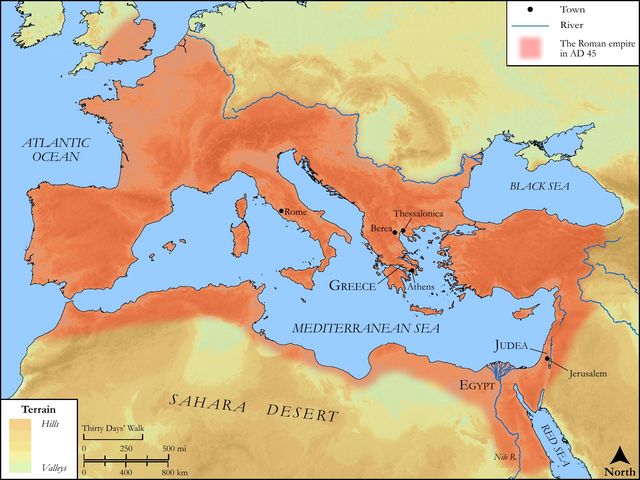
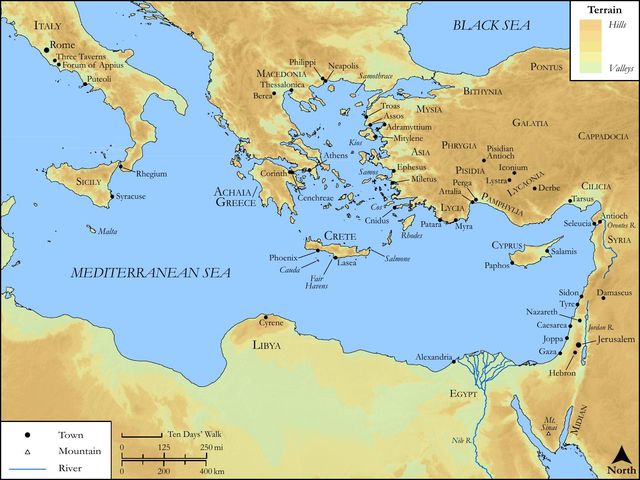
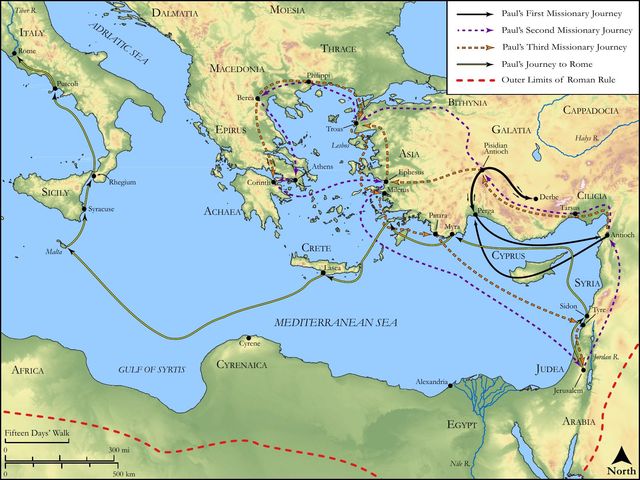
See on the biblical-era maps
Study this verse
Public-domain commentary
Matthew Henry
From his Commentary on the Whole Bible. Henry wrote on whole passages, and this entry covers Acts 17:16–21. He set out his notes in a three-level outline, kept here as he numbered it.
A scholar that has acquaintance, and is in love, with the learning of the ancients, would think he should be very happy if he were where Paul now was, at Athens, in the midst of the various sects of philosophers, and would have a great many curious questions to ask them, for the explication of the remains we have of the Athenian learning; but Paul, though bred a scholar, and an ingenious active man, does not make this any of his business at Athens. He has other work to mind: it is not the improving of himself in their philosophy that he aims at, he has learned to call it a vain thing, and is above it (Colossians 2:8); his business is, in God's name, to correct their disorders in religion, and to turn them from the service of idols, and of Satan in them, to the service of the true and living God in Christ.
I.Here is the impression which the abominable ignorance and superstition of the Athenians made upon Paul's spirit, Acts 17:16. Observe,
1.The account here given of that city: it was wholly given to idolatry. This agrees with the account which the heathen writers give of it, that there were more idols in Athens than there were in all Greece besides put together, and that they had twice as many sacred feasts as others had. Whatever strange gods were recommended to them, they admitted them, and allowed them a temple and an altar, so that they had almost as many gods as men - facilius possis deum quam hominem invenire. And this city, after the empire became Christian, continued incurably addicted to idolatry, and all the pious edicts of the Christian emperors could not root it out, till, by the irruption of the Goths, that city was in so particular a manner laid waste that there are now scarcely any remains of it. It is observable that there, where human learning most flourished, idolatry most abounded, and the most absurd and ridiculous idolatry, which confirms that of the apostle, that when they professed themselves to be wise they became fools (Romans 1:22), and, in the business of religion, were of all other the most vain in their imaginations. The world by wisdom knew not God, 1 Corinthians 1:21. They might have reasoned against polytheism and idolatry; but, it seems, the greatest pretenders to reason were the greatest slaves to idols: so necessary was it to the re-establishing even of natural religion that there should be a divine revelation, and that centering in Christ.
2.The disturbance which the sight of this gave to Paul. Paul was not willing to appear publicly till Silas and Timothy came to him, that out of the mouth of two or three witnesses the word might be established; but in the mean time his spirit was stirred within him. He was filled with concern for the glory of God, which he saw given to idols, and with compassion to the souls of men, which he saw thus enslaved to Satan, and led captive by him at his will. He beheld these transgressors, and was grieved; and horror took hold of him. He had a holy indignation at the heathen priests, that led the people such an endless trace of idolatry, and at their philosophers, that knew better, and yet never said a word against it, but themselves went down the stream.
II.The testimony that he bore against their idolatry, and his endeavours to bring them to the knowledge of the truth.
He did not, as Witsius observes, in the heat of his zeal break into the temples, pull down their images, demolish their altars, or fly in the face of their priests; nor did he run about the streets crying, "You are all the bond-slaves of the devil," though it was too true; but he observed decorum, and kept himself within due bounds, doing that only which became a prudent man.
1.He went to the synagogue of the Jews, who, though enemies to Christianity, were free from idolatry, and joined with them in that among them which was good, and took the opportunity given him there of disputing for Christ, Acts 17:17. He discoursed with the Jews, reasoned fairly with them, and put it to them what reason they could give why, since they expected the Messiah, they would not receive Jesus. There he met with the devout persons that had forsaken the idol temples, but rested in the Jews' synagogue, and he talked with these to lead them on to the Christian church, to which the Jews' synagogue was but as a porch.
2.He entered into conversation with all that came in his way about matters of religion: In the market - en tē agora, in the exchange, or place of commerce, he disputed daily, as he had occasion, with those that met with him, or that he happened to fall into company with, that were heathen, and never came to the Jews' synagogue. The zealous advocates for the cause of Christ will be ready to plead it in all companies, as occasion offers. The ministers of Christ must not think it enough to speak a good word for Christ once a week, but should be daily speaking honourably of him to such as meet with them.
III.The enquiries which some of the philosophers made concerning Paul's doctrine. Observe,
1.Who they were that encountered him, that entered into discourse with him, and opposed him: He disputed with all that met him, in the places of concourse, or rather of discourse. Most took no notice of him, slighted him, and never minded a word he said; but there were some of the philosophers that thought him worth making remarks upon, an they were those whose principles were most directly contrary to Christianity.
(1.)The Epicureans, who thought God altogether such a one as themselves, an idle inactive being, that minded nothing, nor put any difference between good and evil. They would not own, either that God made the world or that he governs it; nor that man needs to make any conscience of what he says or does, having no punishment to fear nor rewards to hope for, all which loose atheistical notions Christianity is levelled against. The Epicureans indulged themselves in all the pleasures of sense, and placed their happiness in them, in what Christ has taught us in the first place to deny ourselves.
(2.)The Stoics, who thought themselves altogether as good as God, and indulged themselves as much in the pride of life as the Epicureans did in the lusts of the flesh and of the eye; they made their virtuous man to be no way inferior to God himself, nay to be superior. Esse aliquid quo sapiens antecedat Deum - There is that in which a wise man excels God, so Seneca: to which Christianity is directly opposite, as it teaches us to deny ourselves and abase ourselves, and to come off from all confidence in ourselves, that Christ may be all in all.
2.What their different sentiments were of him; such there were as there were of Christ, Acts 17:18.
(1.)Some called him a babbler, and thought he spoke, without any design, whatever came uppermost, as men of crazed imaginations do: What will this babbler say? ho spermologos houtos - this scatterer of words, that goes about, throwing here one idle word or story and there another, without any intendment or signification; or, this picker up of seeds. Some of the critics tell us that the term is used for a little sort of bird, that is worth nothing at all, either for the spit or for the cage, that picks up the seeds that lie uncovered, either in the field or by the way-side, and hops here and there for that purpose - Avicula parva quae semina in triviis dispersa colligere solet; such a pitiful contemptible animal they took Paul to be, or supposed he went from place to place venting his notions to get money, a penny here and another there, as that bird picks up here and there a grain. They looked upon him as an idle fellow, and regarded him, as we say, no more than a ballad-singer.
(2.)Others called him a setter forth of strange gods, and thought he spoke with design to make himself considerable by that means. And, if he had strange gods to set forth, he could not bring them to a better market than to Athens. He did not, as many did, directly set forth new gods, nor avowedly; but they thought he seemed to do so, because he preached unto then Jesus, and the resurrection. From his first coming among them he ever and anon harped upon these two strings, which are indeed the principal doctrines of Christianity - Christ and a future state - Christ our way, and heaven our end; and, though he did not call these gods, yet they thought he meant to make them so. Ton Iēsoun kai tēn anastasin̂ "Jesus they took for a new god, and anastasis, the resurrection, for a new goddess." Thus they lost the benefit of the Christian doctrine by dressing it up in a pagan dialect, as if believing in Jesus, and looking for the resurrection, were the worshipping of new demons.
3.The proposal they made to give him a free, full, fair, and public hearing, Acts 17:19, Acts 17:20. They had heard some broken pieces of his doctrine, and are willing to have a more perfect knowledge of it.
(1.)They look upon it as strange and surprising, and very different from the philosophy that had for many ages been taught and professed at Athens. "It is a new doctrine, which we do not understand the drift and design of. Thou bringest certain strange things to our ears, which we never heard of before, and know not what to make of now." By this it should seem that, among all the learned books they had, they either had not, or heeded not, the books of Moses and the prophets, else the doctrine of Christ would not have been so perfectly new and strange to them. There was but one book in the world that was of divine inspiration, and that was the only book they were strangers to, which, if they would have given a due regard to it, would, in its very first page, have determined that great controversy among them about the origin of the universe.
(2.)They desired to know more of it, only because it was new and strange: "May we know what this new doctrine is? Or, is it (like the mysteries of the gods) to be kept as a profound secret? If it may be, we would gladly know, and desire thee to tell us, what these things mean, that we may be able to pass a judgment upon them." This was a fair proposal; it was fit they should know what this doctrine was before they embraced it; and they were so fair as not to condemn it till they had had some account of it.
(3.)The place they brought him to, in order to this public declaration of his doctrine; it was to Areopagus, the same word that is translated (Acts 17:22) Mars' Hill; it was the town-house, or guildhall of their city, where the magistrates met upon public business, and the courts of justice were kept; and it was as the theatre in the university, or the schools, where learned men met to communicate their notions. The court of justice which sat here was famous for its equity, which drew appeals to it from all parts; if any denied a God, he was liable to the censure of this court. Diagoras was by them put to death, as a contemner of the gods; nor might any new God be admitted without their approbation. Hither they brought Paul to be tried, not as a criminal but as a candidate.
4.The general character of the people of that city given upon this occasion (Acts 17:21): All the Athenians, that is natives of the place, and strangers who sojourned there for their improvement, spent their time in nothing else but either to tell or to hear some new thing, which comes in as the reason why they were inquisitive concerning Paul's doctrine, not because it was good, but because it was new. It is a very sorry character which is here given of these people, yet many transcribe it.
(1.)They were all for conversation. St. Paul exhorts his pupil to give attendance to reading and meditation (1 Timothy 4:13, 1 Timothy 4:15), but these people despised those old-fashioned ways of getting knowledge, and preferred that of telling and hearing. It is true that good company is of great use to a man, and will polish one that has laid a good foundation in study; but that knowledge will be very flashy and superficial which is got by conversation only.
(2.)They affected novelty; they were for telling and hearing some new thing. They were for new schemes and new notions in philosophy, new forms and plans of government in politics, and, in religion, for new gods that came newly up (Deuteronomy 32:17), new demons, new-fashioned images and altars (2 Kings 16:10); they were given to change. Demosthenes, an orator of their own, had charged this upon them long before, in one of his Philippics, that their common question in the markets, or wherever they met, was ei ti le etai neōteron - whether there was any news.
(3.)They meddled in other people's business, and were inquisitive concerning that, and never minded their own. Tattlers are always busy bodies, 1 Timothy 5:13.
(4.)They spent their time in nothing else, and a very uncomfortable account those must needs have to make of their time who thus spend it. Time is precious, and we are concerned to be good husbands of it, because eternity depends upon it, and it is hastening apace into eternity, but abundance of it is wasted in unprofitable converse. To tell or hear the new occurrences of providence concerning the public in our own or other nations, and concerning our neighbours and friends, is of good use now and then; but to set up for newsmongers, and to spend our time in nothing else, is to lose that which is very precious for the gain of that which is worth little.
Historical interpretation
Historical reception
2 surviving comments on this verse. Each one is dated, so this reads as a timeline rather than a list.
"And while Paul waited," etc. It is providentially ordered that against his will he stays there, while waiting for those others. "His spirit," it says, "within him was roused." It does not mean there anger or exasperation: just as elsewhere it says, "There was sharp contention between them." Then what does "was roused" mean? Was roused: for the gift is far removed from anger and exasperation. He could not bear it, but pined away.
Observe how he meets with greater trials among the Jews than among the Gentiles. Thus in Athens he undergoes nothing of this kind; the thing goes as far as ridicule, and there an end: and yet he did make some converts: whereas among the Jews he underwent many perils; so much greater was their hostility against him. "His spirit," it says, "was roused within him when he saw the city all full of idols." Nowhere else were so many objects of worship to be seen.
Continue studying Acts 17:16 across the web’s major study libraries — every link below opens this exact verse, chapter, or book on the destination site.
Read & Compare
 BibleGatewayThis verse in more than 200 translations and 70 languages.
 Bible.comThe YouVersion reader — hundreds of translations, reading plans, and highlights.
 ESV.orgCrossway's official English Standard Version reader.
 NET BibleThe NET translation with 60,000+ translators' notes on every rendering decision.
 STEP BibleTyndale House's free study tool — original text, vocabulary, and scholarly resources.
 BibliaLogos Bible Software's free web reader.
 USCCBThe New American Bible (Revised Edition) with the U.S. bishops' study notes.
Commentaries
 BibleHub CommentariesDozens of classic commentaries on this verse, gathered on one page.
 StudyLightMore than 100 commentary sets — the largest collection on the web.
 BibleRefPlain-English commentary on what this verse means, verse by verse.
 Enduring WordDavid Guzik's free commentary on this chapter, widely used by Bible teachers.
 Bible Study ToolsVerse commentary alongside Greek and Hebrew study aids.
Original Language & Research
- BibleHub InterlinearThe verse word by word — original language, transliteration, and English.
- BibleHub LexiconEvery word's original-language definition and Strong's entry.
 Blue Letter BibleDeep-study tools — Strong's numbers, concordance, and word studies.
 CNTR CollationThe earliest Greek manuscripts of this verse, collated letter by letter.
Sermons, Hymns & Audio


TrulyRandomVerse is not affiliated with these sites and does not control their content.
Written with AI assistance. Always check it against Scripture.
This verse
While Paul waits in Athens for his companions, his spirit is stirred within him at the sight of a city given over to idols.
“Now while Paul waited for them at Athens,”
“Them” are Silas and Timothy, whom Paul had asked to come quickly from Berea. Athens was a stop on the way, and God used the time of waiting.
“his spirit was stirred in him,”
A deep inner distress, felt within him, which moved him to speak in the very next verse.
“when he saw the city wholly given to idolatry.”
The idols themselves were the cause. Paul looked at the city carefully, and he saw its devotion for what it was, false worship that robbed God of his glory.
Passage studyActs 17:16–21
Paul in Athens, a City Full of Idols
Summary
Paul has come to Athens ahead of Silas and Timothy, and while he waits he walks through a city crowded with idols. What he sees stirs his spirit, and he begins to reason with anyone who will listen, in the synagogue with Jews and God-fearing Gentiles and every day in the market with whoever comes by. Philosophers of the Epicurean and Stoic schools take him on. Some scorn him as a “babbler”, and others think he is bringing in foreign gods, because he preaches Jesus and the resurrection. They bring him to the Areopagus and ask what his new teaching means, and Luke adds that Athenians and visitors alike spent their time on nothing else but telling or hearing some new thing.
These six verses set the scene for Paul’s sermon on Mars’ hill (Acts 17:22–31). They show us a servant of God grieved for God’s glory, and the good news of the risen Christ brought into the most learned city of its day.
A City Wholly Given to Idolatry
Paul came to Athens after trouble in Thessalonica and Berea. Believers from Berea escorted him there, and he sent word for Silas and Timothy to join him as soon as they could (Acts 17:10–15). The verb for waiting, ekdéchomai, simply means to wait for or expect someone. The time of waiting became a time of looking. The KJV’s “saw” is theōréō, to look on as a spectator and to discern, and Paul took a long, clear look at the city around him.
Athens in the first century had lost its old political power, but it was still the great centre of learning and the arts in the Greek world. Its name, Athēnai, comes from the goddess of wisdom who was said to have founded it. Plato’s Academy, Aristotle’s Lyceum, the Stoa of Zeno and the Garden of Epicurus had made it famous for philosophy. It was also a city of temples, altars and statues to gods, heroes and ideas, and their worship ran through daily life. Luke’s word for the city is kateídōlos, “utterly idolatrous”, which the KJV renders “wholly given to idolatry”. Idols stood on every corner, and there was even an altar “TO THE UNKNOWN GOD” (Acts 17:23). The wisest city of its age was full of false worship, and all its learning had left it ignorant of the one true God.
Why Paul’s spirit was stirred
“His spirit was stirred in him” uses paroxýnō, which means to sharpen alongside and so, figuratively, to provoke or exasperate. The word for his spirit, pneûma, means breath or wind and also a person’s spirit, and here it is Paul’s own inner self. What he saw provoked him to the depths.
This was grief and zeal for the glory of God. The LORD commanded Israel to have no other gods before him and to make no graven image to bow down to (Exodus 20:3–5), and he says through Isaiah that he will give his glory to no other (Isaiah 42:8). Paul later wrote of people who knew God and yet exchanged the glory of the Creator for images of created things (Romans 1:21–23). In Athens he saw that exchange everywhere he turned.
Paul’s distress moved him to act. It sent him into the synagogue and the market, and it carried forward the witness Christ had promised would reach to the uttermost part of the earth (Acts 1:8). His stirred spirit belongs with the heart of his Lord, who wept over Jerusalem because the city was blind to the day of its visitation (Luke 19:41–44), and who was moved with compassion for the crowds, scattered like shepherdless sheep (Matthew 9:36).
Reasoning in the Synagogue and the Market
“Therefore” ties verse 17 to verse 16, because what Paul saw sent him out to speak. He began, as he usually did, in the synagogue, where he had gone first ever since his days in Damascus (Acts 9:20). There he found Jews, who knew the Scriptures that foretold the Messiah, and “devout persons”. That word, sébomai, means to revere or worship, and here it names Gentiles who had turned from many gods to the God of Israel and attended the synagogue without becoming full converts to Judaism. They already believed in one God, and they were often ready to hear of Christ.
Then Paul went into the market, the agorá, the town square at the heart of public life in a Greek city. Trade, politics and philosophy all met there, and so did merchants, thinkers and ordinary citizens who knew little of Israel’s God. He was there “daily”, in Greek katá pâs hēméra, “according to every day”, and he spoke “with them that met with him”. That verb, paratynchánō, means to chance upon or fall in with someone. Paul’s witness was steady, part of every day he spent in the city, and open to whoever happened to pass by.
Disputing and reasoning
The KJV says Paul “disputed”. The verb, dialégomai, means to discuss in argument or exhortation, and it is also rendered “reasoned” and “preached”. Paul talked with people, gave reasons, heard their objections and answered them, and that is how he went on to speak at the Areopagus, starting from what his hearers already knew. Peter tells believers to be ready always to give an answer to everyone who asks a reason of the hope in them (1 Peter 3:15). Paul asks that we walk in wisdom toward those outside and that our speech be gracious (Colossians 4:5–6), and he says he became all things to all men so that he might save some (1 Corinthians 9:22). Behind all his reasoning stood his confidence that the gospel is the power of God unto salvation to everyone who believes (Romans 1:16).
In this too Paul followed his Lord. Jesus taught in the synagogues and went about among the people (Matthew 4:23), and he answered the leaders who questioned his authority (Luke 20:1–8).
Epicureans and Stoics Meet Paul
“Philosophers” is philósophos, one who is fond of wise things. Those who “encountered” Paul came from two schools, and the verb, symbállō, means to put together, and in speech to converse or dispute. They engaged him in argument, and the meeting that begins here runs on to the end of the chapter (Acts 17:18–34).
The Epicureans, Epikoúreios, followed Epicurus (c. 341–270 BC). They held that the highest good was pleasure, understood as calm of mind (ataraxia) and freedom from pain, reached by living simply and keeping out of public life. They believed the gods existed but stood apart from human affairs, and that the soul dissolved at death. The Stoics, Stōïkós, took their name from a porch in Athens where their school met, and their founder was Zeno of Citium (c. 334–262 BC). They prized virtue, reason (logos) and a life in harmony with nature and providence, and they saw the divine as an impersonal reason running through the whole universe.
Paul’s message clashed with both. He preached a personal God who acts in history, who will judge the world, and who raised Jesus bodily from the dead. To an Epicurean, for whom the soul ends at death, a resurrection of the body was foreign to everything he believed. To a Stoic it was a strange claim about one man in history who called for allegiance. Much Greek thought counted the body a hindrance to the soul, and later in this chapter some of Paul’s hearers mocked when he spoke of the resurrection of the dead (Acts 17:32). Paul wrote afterward that the preaching of Christ crucified is foolishness to the Greeks, while to those who are called it is the power of God and the wisdom of God (1 Corinthians 1:18–25).
“What will this babbler say?”
The first group’s word for Paul was spermológos, a “seed-picker”, the name for a bird such as the crow that picks up seeds. Said of a man, it meant a gossip or trifler who gathers scraps of ideas here and there and repeats them. In a city proud of its rhetoric and philosophy, it was a scornful dismissal of Paul as an unlearned talker with borrowed notions. There is irony in it, because the men who prided themselves on wisdom were writing off the one who carried the wisdom of God.
“A setter forth of strange gods”
The second group thought Paul was “a setter forth of strange gods”. A katangeleús is a proclaimer or herald, a word used outside the New Testament for the herald of the games. Xénos means foreign, alien or novel, and daimónion means a spirit being and by extension a deity, which the KJV renders “gods”. So they heard Paul as the herald of foreign gods.
This charge was more serious than scorn. Athens had long guarded its religion against new gods, and centuries earlier Socrates had been condemned and put to death, partly on a charge of bringing in new divinities. To be called a setter forth of strange gods could put Paul in danger.
Luke gives the reason for both reactions: Paul “preached unto them Jesus, and the resurrection”. “Preached” is euangelízō, to announce good news, and resurrection is anástasis, a standing up again from death. Since they speak of “gods” in the plural, they may have taken anástasis for a second deity, a goddess called Resurrection standing beside Jesus. Whatever they made of it, Paul’s message was the risen Christ. His resurrection declared him to be the Son of God with power (Romans 1:4), he is the firstfruits whose rising is the pledge that all who belong to him will rise (1 Corinthians 15:20–23), and salvation is found in his name alone (Acts 4:12). Paul kept that at the centre whether his hearers scorned him or accused him.
Brought to the Areopagus
They “took him, and brought him unto Areopagus”. Áreios Págos means “the rock of Ares”, named for the Greek god of war, whom the Romans called Mars, which is why the KJV calls the place “Mars’ hill” (Acts 17:22). It was a rocky hill near the Acropolis and the seat of the city’s ancient high court, the Council of the Areopagus, which had oversight of religious, moral and educational matters. Its power as a court was less in Paul’s day, but it remained a respected place where new teachings were heard and weighed. Luke tells the whole scene there in Acts 17:19–34.
Was Paul put on trial?
The Athenians took Paul to the Areopagus to hear him out. The verb for “took”, epilambánomai, means to take hold of someone, whether to help, to harm or for some other purpose, and “brought”, ágō, is the ordinary word for leading someone. Their own words are a request, “May we know?”, and verse 21 explains that they loved to hear new things, so the scene is a hearing of Paul’s teaching in the city’s most respected forum. The charge of “strange gods” still hung over him, and those who heard him there would weigh whether his teaching threatened the city’s religion and order. In God’s providence, this opened a door for the gospel before the leading thinkers of Athens, in a place Paul himself could hardly have reached.
“What this new doctrine … is”
“May we know” pairs dýnamai, to be able, with ginṓskō, to know or come to understand, so their question is, “Can we know?” They call Paul’s message a “new doctrine”. Kainós means new, fresh or novel, and didachḗ means teaching, both the act of teaching and what is taught. To them this was a fresh teaching unlike anything their schools held, and they wanted it set out plainly. Its newness was real, though in a way they had yet to learn, as the section on Christ below shows.
Strange Things to Their Ears
“For thou bringest certain strange things to our ears.” Eisphérō means to carry in, and the Athenians felt that Paul was carrying his ideas into their city from outside. “Strange things” is xenízō, a verb that means to be a host or a guest and so to be or appear strange. It belongs to the same family as xénos, the “strange” of verse 18. What Paul brought was foreign to them, above all the resurrection of Jesus and the call to repent before the one God who will judge the world by the man he has raised from the dead (Acts 17:30–31).
“We would know therefore what these things mean” joins boúlomai, to will or be minded, with ginṓskō, the verb of verse 19. They had heard Paul’s words and wanted to understand them. Here they speak as people curious to learn, and their question gave Paul the opening for his sermon.
Some New Thing
Verse 21 is Luke’s own aside, set in brackets in the KJV, explaining why the Athenians were so eager to hear Paul. “All the Athenians and strangers which were there” takes in the citizens, Athēnaîos, and the foreigners living in the city. “Strangers” is xénos, the same word as the “strange” of verse 18, and “which were there” is epidēméō, to make oneself at home or to reside in a foreign country. Athens drew people from many lands, and they shared the city’s habits.
“Spent their time” is eukairéō, to have leisure or opportunity. They had time to spare, and they spent it “in nothing else, but either to tell, or to hear some new thing”. Luke’s “nothing else” is a strong way of saying that this filled their spare hours, and telling and hearing cover both sides of the talk, speaking and listening. “New” is kainós, the same word the Athenians had used for Paul’s “new doctrine” in verse 19.
Was the Athenian love of new things good or bad?
The Athenians’ curiosity was a real opening for the gospel. They were willing to hear different ideas, even of “strange gods”, and that gave Paul his hearing. Luke’s words also show its weakness. A people who live for the next new idea can hear the truth as one more novelty to talk over and set aside, with more interest in the newness of a teaching or the skill of its speaker than in whether it is true. Proverbs says that a fool has no delight in understanding, only in showing what is in his own heart (Proverbs 18:2), and the Preacher says that there is nothing new under the sun (Ecclesiastes 1:9–10). Restless curiosity of this kind never comes to rest until it finds the truth.
How Paul spoke to such a city
Paul met this audience where it was. He began from common ground, their altar to an unknown god (Acts 17:22–23). From there he spoke of the Creator, the one true God, who does not dwell in temples made with hands, of God’s rule over the nations and their dependence on him, quoting their own poets along the way, and at last of the call to repent and the man God raised from the dead, by whom he will judge the world (Acts 17:24–31). The resurrection, the “new thing” that most challenged them, came at the end, after the ground had been laid.
The Risen Christ, the Truly New Thing
The Athenians wanted to hear something new, and the news Paul brought was the newest thing the world has heard. Jesus is the Word made flesh, who dwelt among us and made God known (John 1:14). In him was life, and the life was the light of men, shining in the darkness (John 1:4–5). That light has come into the world, and men loved darkness (John 3:19), which is why the gospel sounded so strange in Athens.
He is the way, the truth and the life, and no one comes to the Father but by him (John 14:6). The Father seeks those who worship him in spirit and in truth (John 4:23–24), the very worship that Athens, for all its altars, lacked. Christ is the resurrection and the life (John 11:25), and whoever believes in him has everlasting life (John 3:16). Anyone who is in Christ is a new creature (2 Corinthians 5:17). He is the mediator of a better covenant, the new covenant God promised (Hebrews 8:6–13), and his blood has opened a new and living way into God’s presence (Hebrews 10:19–20). In him “are hid all the treasures of wisdom and knowledge” (Colossians 2:3), the wisdom the philosophers of Athens were seeking and missed. This newness never grows old.
Good News for a City Full of Idols
These verses show us a God whose glory belongs to him alone, so that a servant who loves him grieves to see it given to idols. They also show his mercy. The same God sends his servant into the synagogue, into the busy square and up to the city’s council with good news, and he opens doors even through scorn and suspicion.
Our own age has its idols too, whether wealth, power, self or pride of learning, and its own appetite for whatever is newest. Paul’s answer to Athens is God’s answer still: Jesus, and the resurrection. The message that sounded like a babbler’s scraps to the philosophers is the power and wisdom of God, and it meets the restless search for something new with the one who makes all things new.
Acts 17:16 This verse
“Now while Paul waited for them at Athens,”
“Them” are Silas and Timothy, whom Paul had asked to come quickly from Berea. Athens was a stop on the way, and God used the time of waiting.
“his spirit was stirred in him,”
A deep inner distress, felt within him, which moved him to speak in the very next verse.
“when he saw the city wholly given to idolatry.”
The idols themselves were the cause. Paul looked at the city carefully, and he saw its devotion for what it was, false worship that robbed God of his glory.
Acts 17:17
“Therefore disputed he in the synagogue with the Jews,”
He started with those who had the Scriptures, as was his custom.
“and with the devout persons,”
Gentiles who worshipped the God of Israel at the synagogue, already turned from idols to the one God.
“and in the market daily”
The public square, every day, where the whole city came and went.
“with them that met with him.”
Anyone he happened to meet, whether curious, learned or searching.
Acts 17:18
“Then certain philosophers of the Epicureans, and of the Stoicks, encountered him.”
Paul’s daily talk in the market drew the attention of thinkers from the two best-known schools of the day.
“And some said, What will this babbler say?”
Scorn mixed with curiosity. They still wanted to hear what he would say.
“other some, He seemeth to be a setter forth of strange gods:”
A weightier judgement, carrying the danger of a charge of bringing in new gods.
“because he preached unto them Jesus, and the resurrection.”
The cause of both reactions, and the heart of Paul’s message in every city.
Acts 17:19
“And they took him, and brought him unto Areopagus,”
From the open market to the hill and council where new teachings were examined.
“saying, May we know what this new doctrine,”
A polite request to understand the teaching they had heard in pieces.
“whereof thou speakest, is?”
The Greek speaks of the teaching as spoken by Paul. Hypó marks the one who does something, soû is “of thee”, and laléō is the ordinary verb for talking. They had heard him in the market and now wanted him to set it out in full.
Acts 17:20
“For thou bringest certain strange things to our ears:”
“Ears” renders a word for hearing, akoḗ. These things had reached their hearing and were still unfamiliar to them.
“we would know therefore what these things mean.”
“Therefore” links their wish to what they had heard. They want the meaning, and Paul’s sermon is his answer.
Acts 17:21
“(For all the Athenians and strangers which were there”
Luke’s own explanation, taking in citizens and foreign residents alike.
“spent their time in nothing else,”
Their leisure went to one pursuit above all.
“but either to tell, or to hear some new thing.)”
Talking and listening, always about the latest idea. This is why they gave Paul a hearing.
Last revised