


1 Corinthians 16:12
- ΠερὶPeriConcerningG4012PREPPreposition
- δὲdenowG1161CONJConjunction
- ἈπολλῶApollōApollosG625N-GSM-PNoun Genitive Singular Masculine Individual
- τοῦtoutheG3588T-GSMDefinite article Genitive Singular Masculine
- ἀδελφοῦadelphoubrotherG80N-GSMNoun Genitive Singular Masculine
- πολλὰpollagreatlyG4183A-APNAdjective Accusative Plural Neuter
- παρεκάλεσαparekalesaI exhortedG3870V-AAI-1SVerb Aorist Active Indicative 1st Singular
- αὐτὸνautonhimG846P-ASMPersonal pronoun Accusative Singular Masculine
- ἵναinathatG2443CONJConjunction
- ἔλθῃelthēhe may goG2064V-2AAS-3SVerb 2nd Aorist Active Subjunctive 3rd Singular
- πρὸςprostoG4314PREPPreposition
- ὑμᾶςhumasyouG4771P-2APPersonal pronoun Accusative 2nd Plural
- μετὰmetawithG3326PREPPreposition
- τῶνtōntheG3588T-GPMDefinite article Genitive Plural Masculine
- ἀδελφῶν·adelphōnbrothersG80N-GPMNoun Genitive Plural Masculine
- καὶkaiandG2532CONJConjunction
- πάντωςpantōsat allG3843ADVAdverb
- οὐκouknotG3756PRT-NNegative Particle Negative
- ἦνēnwasG1510V-IAI-3SVerb Imperfect Active Indicative 3rd Singular
- θέλημαthelēma[his] willG2307N-NSNNoun Nominative Singular Neuter
- ἵναinathatG2443CONJConjunction
- νῦνnunnowG3568ADVAdverb
- ἔλθῃelthēhe may comeG2064V-2AAS-3SVerb 2nd Aorist Active Subjunctive 3rd Singular
- ἐλεύσεταιeleusetaihe will comeG2064V-FDI-3SVerb Future Middle Deponent Indicative 3rd Singular
- δὲdehoweverG1161CONJConjunction
- ὅτανhotanwhenG3752CONJConjunction
- εὐκαιρήσῃeukairēsēhe may have opportunityG2119V-AAS-3SVerb Aorist Active Subjunctive 3rd Singular
English is a literal word-by-word gloss of the Greek, not the KJV's wording. Why?
This is the original text the KJV's translators worked from — each Greek word with its own literal English meaning in this verse, prepared by scholars at Tyndale House, Cambridge. The KJV translates whole sentences, not word by word, so its wording differs: one Greek word can become several English words, and the KJV may choose “charity” where the gloss reads “love”. Both are faithful — they answer different questions. For the KJV's own rendering, switch to the KJV text.
Details
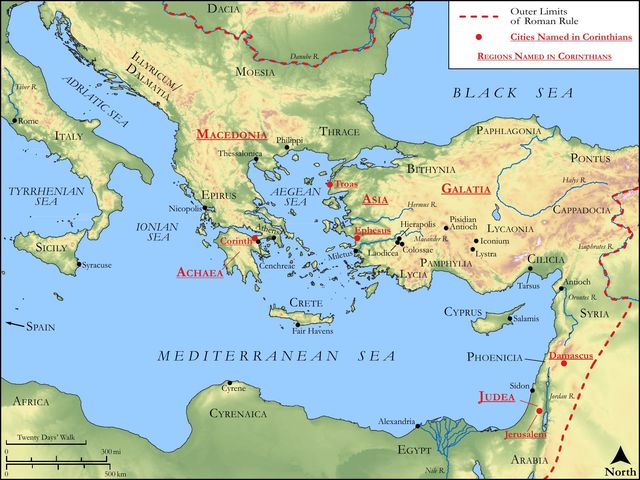
See on the biblical-era map

Study this verse
Public-domain commentary
Matthew Henry
From his Commentary on the Whole Bible. Henry comments on passages, not single verses — this entry covers 1 Corinthians 16:10–12. His two-level outline is real structure in the source text, so it is rendered as structure.
In this passage,
I.He recommends Timothy to them, in several particulars. As,
1.He bids them take care that he should be among them without feat, Co1 16:10. Timothy was sent by the apostle to correct the abuses which had crept in among them; and not only to direct, but to blame, and censure, and reprove, those who were culpable. They were all in factions, and no doubt the mutual strife and hatred ran very high among them. There were some very rich, as it is probable; and many very proud, upon account both of their outward wealth and spiritual gifts. Proud spirits cannot easily bear reproof. It was reasonable therefore to think young Timothy might be roughly used; hence the apostle warns them against using him ill. Not but that he was prepared for the worst; but, whatever his firmness and prudence might be, it was their duty to behave themselves well towards him, and not discourage and dishearten him in his Lord's work. They should not fly out into resentment at his reproof. Note, Christians should bear faithful reproofs from their ministers, and not terrify and discourage them from doing their duty.
2.He warns them against despising him, Co1 16:11. He was but a young man, and alone, as Ecumenius observes. He had no one to back him, and his own youthful face and years commanded but little reverence; and therefore the great pretenders to wisdom among them might be apt to entertain contemptuous thoughts of him. "Now," says the apostle, "guard against this." Not that he distrusted Timothy; he knew that Timothy would do nothing to bring contempt on his character, nothing to make his youth despicable. But pride was a reigning sin among the Corinthians, and such a caution was but too necessary. Note, Christians should be very careful not to pour contempt on any, but especially on ministers, the faithful ministers of Christ. These, whether young or old, are to be had in high esteem for their works sake.
3.He tells them they should give him all due encouragement, use him well while he was with them; and, as an evidence of this, they should send him away in friendship, and well prepared for his journey back again to Paul. This, as I have before observed, is the meaning of bringing him on his journey in peace, Co1 16:11. Note, Faithful ministers are not only to be well received by a people among whom they may for a season minister, but are to be sent away with due respect.
II.He assigns the reasons why they should behave thus towards Timothy.
1.Because he was employed in the same work as Paul, and acted in it by the same authority, Co1 16:10. He did not come on Paul's errand among them, nor to do his work, but the work of the Lord. Though he was not an apostle, he was assistant to one, and was sent upon this very business by a divine commission. And therefore to vex his spirit would be to grieve the Holy Spirit; to despise him would be to despise him that sent him, not Paul, but Paul's Lord and theirs. Note, Those who work the work of the Lord should be neither terrified nor despised, but treated with all tenderness and respect. Such are all the faithful ministers of the word, though not all in the same rank and degree. Pastors and teachers, as well as apostles and evangelists, while they are doing their duty, are to be treated with honour and respect.
2.Another reason is implied; as they were to esteem him for his work's sake, so also for Paul's sake, who had sent him to Corinth; not of his own errand indeed, but to work the work of the Lord: Conduct him forth in peace, that he may come to me, for I look for him with the brethren (Co1 16:11); or I with the brethren look for him (the original will bear either), ekdechomai gar auton meta tōn adelphōn - "I am expecting his return, and his report concerning you; and shall judge by your conduct towards him what your regard and respect for me will be. Look to it that you send him back with no evil report." Paul might expect from the Corinthians, that a messenger from him, upon such an errand, should be regarded, and well treated. His services and success among them, his authority with them as an apostle, would challenge this at their hands. They would hardly dare to send back Timothy with a report that would grieve or provoke the apostle. "I and the brethren expect his return, wait for the report he is to make; and therefore do not use him ill, but respect him, regard his message, and let him return in peace."
III.He informs them of Apollos's purpose to see them.
1.He himself had greatly desired him to come to them, Co1 16:12. Though one party among them had declared for Apollos against Paul (if that passage is to be understood literally, vide Co1 4:6), yet Paul did not hinder Apollos from going to Corinth in his own absence, nay, he pressed him to go thither. He had no suspicions of Apollos, as if he would lessen Paul's interest and respect among them, to the advancement of his own. Note, Faithful ministers are not apt to entertain jealousies of each other, nor suspect of such selfish designs. True charity and brotherly love think no evil. And where should these reign, if not in the breasts of the ministers of Christ?
2.Apollos could not be prevailed on for the present to come, but would at a more convenient season. Perhaps their feuds and factions might render the present season improper. He would not go to be set at the head of a party and countenance the dividing and contentious humour. When this had subsided, through Paul's epistle to them and Timothy's ministry among them, he might conclude a visit would be more proper. Apostles did not vie with each other, but consulted each other's comfort and usefulness. Paul intimates his great regard to the church of Corinth, when they had used him ill, by entreating Apollos to go to them; and Apollos shows his respect to Paul, and his concern to keep up his character and authority, by declining the journey till the Corinthians were in better temper. Note, It is very becoming the ministers of the gospel to have and manifest a concern for each other's reputation and usefulness.
Historical interpretation
Historical reception
3 surviving comments on this verse. Each one is dated, so this reads as a timeline rather than a list.
Select a marker to jump to its quote. Markers stagger vertically where authors wrote within a few decades of each other.
Paul is hinting that Apollos did not want to go to Corinth because the church there was divided, in the hope that when they heard this they would be eager to make peace. Apollos would come when the church reached agreement.
Apollos was the bishop of Corinth, but he had left the church on account of its divisions and gone to be with Paul. He would not go back with the letter, because he did not want to return until the divisions were healed.
This man appears to have been both well-educated and also older than Timothy. Lest they should say then, "For what possible reason did he not send the man grown, but the youth instead of him?" observe how he softens down this point also, both calling him a brother, and saying that he had besought him much. For lest he should seem to have held Timothy in higher honor than him and to have exalted him more, and on this account not to have sent him, and cause their envy to burst out more abundantly, he adds, "I besought him much to come." What then: did not the other yield nor consent? did he resist and show himself contentious? He saith not this, but that he might not excite prejudice against him, and also might make excuse for himself, he saith, "and it was not at all his will to come now." Then to prevent their saying that all this was an excuse and pretence, he added, "but he will come to you when he shall have opportunity." This was both an excuse for him, and a refreshment to them who desired to see him, by the hope which it gave of his coming.
Continue studying 1 Corinthians 16:12 across the web’s major study libraries — every link below opens this exact verse, chapter, or book on the destination site.
Read & Compare
 BibleGatewayThis verse in more than 200 translations and 70 languages.
 Bible.comThe YouVersion reader — hundreds of translations, reading plans, and highlights.
 ESV.orgCrossway's official English Standard Version reader.
 NET BibleThe NET translation with 60,000+ translators' notes on every rendering decision.
 STEP BibleTyndale House's free study tool — original text, vocabulary, and scholarly resources.
 BibliaLogos Bible Software's free web reader.
 USCCBThe New American Bible (Revised Edition) with the U.S. bishops' study notes.
Commentaries
 BibleHub CommentariesDozens of classic commentaries on this verse, gathered on one page.
 StudyLightMore than 100 commentary sets — the largest collection on the web.
 BibleRefPlain-English commentary on what this verse means, verse by verse.
 Enduring WordDavid Guzik's free commentary on this chapter, widely used by Bible teachers.
 Bible Study ToolsVerse commentary alongside Greek and Hebrew study aids.
Original Language & Research
- BibleHub InterlinearThe verse word by word — original language, transliteration, and English.
- BibleHub LexiconEvery word's original-language definition and Strong's entry.
 Blue Letter BibleDeep-study tools — Strong's numbers, concordance, and word studies.
 CNTR CollationThe earliest Greek manuscripts of this verse, collated letter by letter.
Sermons, Hymns & Audio


TrulyRandomVerse is not affiliated with these sites and doesn’t control their content. They’re linked because they’re genuinely useful.
Summary
In 1 Corinthians 16:12, the Apostle Paul provides an update regarding Apollos, a prominent fellow minister. Paul expresses his strong desire for Apollos to visit the Corinthian church alongside other brethren. However, he respectfully acknowledges Apollos's personal decision not to come at that specific time, indicating that Apollos would visit when he found a more opportune or "convenient" moment. This verse offers a profound glimpse into the collaborative yet autonomous nature of early Christian leadership, highlighting mutual respect, discernment, and the practical realities of ministry travel.
Context
ShowHideLiterary Context
This verse appears in the concluding section of Paul's First Epistle to the Corinthians, following extensive discussions addressing various issues within the Corinthian church, including divisions, immorality, legal disputes, marriage, spiritual gifts, and the resurrection. Chapter 16 shifts to practical matters such as the collection for the saints in Jerusalem, Paul's own travel plans, and final greetings and exhortations. The mention of Apollos here is significant because Apollos was a figure around whom some factions in Corinth had rallied, leading to divisions (as seen in 1 Corinthians 1:12). Paul had previously emphasized that both he and Apollos were merely servants through whom the Corinthians believed, with God giving the increase (1 Corinthians 3:5-9). Thus, this concluding remark about Apollos's travel plans serves to reinforce the unity and mutual respect between these leaders, dispelling any notion of rivalry and demonstrating a healthy, collaborative spirit in ministry. It shows Paul's transparency and his desire to keep the Corinthians informed about key figures in their spiritual lives.
Historical & Cultural Context
The early church operated within a Roman world where travel was often arduous and dependent on favorable conditions, including weather, available shipping, and personal safety. Communication relied on letters delivered by trusted individuals, who often also served as emissaries or representatives. Corinth itself was a major Roman colony and a bustling port city, making it a significant hub for trade and travel. The cultural norms of patronage and loyalty were strong, and some Corinthians might have viewed their spiritual leaders through this lens, leading to the factionalism Paul addressed. However, Paul consistently challenged these worldly paradigms, promoting a kingdom culture of humility, unity, and service. The dynamic between Paul and Apollos, as depicted in this verse, reflects a mature understanding of leadership that transcends personal preference or perceived rivalry, prioritizing the Spirit's leading and the needs of the church. Leaders like Paul and Apollos were itinerant, traveling extensively to plant and nurture churches, making their travel plans a constant feature of their ministry.
Key Themes
ShowHideThis verse contributes to several overarching themes in 1 Corinthians and Pauline theology. Firstly, it powerfully illustrates the theme of Unity and Mutual Respect Among Leaders. Despite the earlier divisions in Corinth that had used Paul and Apollos as rallying points, this passage reveals a deep, genuine respect and collaborative spirit between the two apostles. Paul's desire for Apollos to come "with the brethren" underscores a unified front, contrasting sharply with the factions Paul condemned in 1 Corinthians 1:10-13. Secondly, it highlights Respect for Individual Will and Divine Timing. Paul's acceptance of Apollos's decision, even though it differed from his own "greatly desired" outcome, demonstrates a healthy leadership dynamic that honors personal conviction and God-given discernment regarding opportune timing. This reflects a broader theological principle of God working through individuals according to His perfect plan and season, as seen in passages like Ecclesiastes 3:1. Lastly, the verse touches upon the Practicalities and Flexibility of Early Ministry. It offers a realistic glimpse into the logistical challenges and fluid nature of missionary work, where plans were not rigid but subject to various factors, including individual availability, spiritual leading, and practical circumstances.
Exposition and Analysis
ShowHideKey Word Analysis
ShowHideThis word means "to call near, i.e., invite, invoke (by imploration, hortation or consolation)." Paul's use of "greatly desired" (combining parakaléō with polýs, "much" or "greatly") indicates a strong, earnest appeal or invitation, not a command. It conveys a sense of urging or beseeching, demonstrating Paul's genuine longing for Apollos's presence and ministry in Corinth. This highlights Paul's pastoral heart and his collaborative approach to ministry, seeking partnership rather than dictating terms.
thélēma refers to "a determination (properly, the thing), i.e., (actively) choice (specially, purpose, decree; abstractly, volition) or (passively) inclination." In this context, "his will" (G2307 + G846 autós) signifies Apollos's deliberate, personal choice or settled intention. It underscores his autonomy and discernment, indicating that his decision was not arbitrary but a considered one, likely based on his own sense of divine leading or practical considerations for his ministry. Paul's respect for Apollos's thélēma is a powerful lesson in leadership.
eukairéō means "to have good time, i.e., opportunity or leisure." This word implies an opportune moment, a favorable season, or the right circumstances for action. Apollos's decision to wait for a "convenient time" suggests that he was discerning the most effective or appropriate moment for his visit, rather than simply being unwilling. It speaks to the importance of timing in ministry and the wisdom of waiting for God's kairos (opportune time) rather than acting prematurely.
Verse Breakdown
ShowHide"As touching [our] brother Apollos"
Paul transitions to a specific topic, signaling an update or instruction regarding Apollos. The term "brother" (G80, adelphós) emphasizes the familial bond and spiritual kinship between Paul and Apollos, reinforcing their unity despite any perceived rivalry among their followers in Corinth.
"I greatly desired him to come unto you with the brethren"
Paul openly expresses his strong personal wish for Apollos to join him or other traveling companions in visiting the Corinthian church. This reveals Paul's collaborative spirit and his belief in the value of Apollos's ministry to the Corinthians, perhaps to further establish them or to help address ongoing issues. The phrase "with the brethren" (G3326, metá + G80, adelphós) suggests a coordinated effort, not a solo mission, emphasizing teamwork.
"but his will was not at all to come at this time;"
This clause presents the counterpoint to Paul's desire. The Greek "not at all" (G3756, ou + G3843, pántōs) emphasizes the definitive nature of Apollos's decision. His "will" (G2307, thélēma) indicates a personal and deliberate choice, not merely a lack of availability. This shows Paul's respect for Apollos's autonomy and discernment, even when it differed from his own preference.
"but he will come when he shall have convenient time."
This final clause provides the resolution and future expectation. Apollos's refusal was not absolute but conditional on timing. The phrase "convenient time" (G2119, eukairéō) implies an opportune or favorable moment, suggesting that Apollos was waiting for the right circumstances or divine leading for his visit, rather than being permanently unwilling. This demonstrates a shared understanding of ministry that prioritizes divine timing and strategic effectiveness.
Literary Devices
ShowHidePaul employs several Epistolary Conventions in this verse, typical of his letter-writing style, such as transitioning to specific individuals or matters ("As touching..."). The verse also showcases Personal Rapport and Diplomacy between Paul and Apollos. Paul's open expression of his "great desire" for Apollos to come, followed by his respectful acknowledgment of Apollos's "will" not to come at that specific time, demonstrates a mature and healthy relationship built on mutual respect rather than hierarchical command. This creates an Antithesis between Paul's desire and Apollos's will, which is then resolved by the shared understanding of "convenient time." The language itself is straightforward, reflecting Paul's direct communication style while subtly conveying the nuanced dynamics of their collaborative ministry.
Theological and Thematic Connections
ShowHide1 Corinthians 16:12 offers significant theological insights into the nature of Christian leadership, divine sovereignty, and human agency. It illustrates that effective ministry is not always about immediate compliance with human desires, even well-intentioned ones, but often about discerning God's perfect timing and respecting the individual leading of the Holy Spirit in others. Paul's attitude models a profound humility and trust in his fellow workers, recognizing that God works through diverse wills and circumstances to accomplish His purposes. This passage implicitly teaches that unity in the body of Christ does not demand uniformity of action or immediate agreement on all logistical matters, but rather a shared commitment to Christ and His kingdom, allowing for individual discernment and timing. It underscores the importance of servant leadership, where leaders empower and respect one another, fostering an environment of collaboration rather than control.
Reflection and Application
ShowHideThe interaction between Paul and Apollos in this verse provides a timeless blueprint for healthy relationships and effective ministry within the body of Christ. It reminds us that even among highly gifted and Spirit-led individuals, there can be differences in timing and approach, and that true spiritual maturity involves respecting these distinctions. For believers today, this means cultivating a spirit of humility and trust, both in our own discernment and in the discernment of others. We are called to be patient, understanding that God's timing is perfect, and that His plans often unfold in ways that require flexibility and waiting. In our churches, this verse encourages collaborative leadership, where leaders empower and honor one another's unique callings and seasons of ministry, rather than imposing their own preferences. It challenges us to prioritize unity and the common good of the church over personal agendas or perceived rivalries, fostering an environment where every member's "will" in discerning God's leading is respected, provided it aligns with biblical principles.
Questions for Reflection
ShowHideFAQ
ShowHideWhy did Apollos not want to come at that time?
ShowHideThe text does not explicitly state Apollos's reasons, but it does say "his will was not at all to come at this time; but he will come when he shall have convenient time." The phrase "convenient time" (Greek: eukairéō) implies an opportune or favorable moment. This suggests Apollos had valid reasons, perhaps related to his current ministry commitments, a sense of divine timing, or a discernment that his presence in Corinth at that specific moment would not be most beneficial, given the past divisions associated with his name (see 1 Corinthians 1:12 and 1 Corinthians 3:4-6). Paul's respect for Apollos's decision indicates that these reasons were understood and accepted.
What does this verse tell us about the relationship between Paul and Apollos?
ShowHideThis verse demonstrates a strong relationship of mutual respect, trust, and collaboration between Paul and Apollos. Despite the fact that some factions in Corinth had tried to create division by aligning themselves with either Paul or Apollos (as seen in 1 Corinthians 1:12), this passage clearly shows that Paul held Apollos in high regard and respected his autonomy and discernment. Paul "greatly desired" Apollos's visit, indicating his value for Apollos's ministry, and he fully accepted Apollos's decision regarding his timing. This exemplifies healthy, Christ-centered leadership, where personal preferences are submitted to the leading of the Spirit and the well-being of the church, fostering unity rather than competition.
Christ-Centered Fulfillment
ShowHideWhile 1 Corinthians 16:12 directly concerns the practicalities of early church ministry and the relationship between Paul and Apollos, its underlying principles find profound Christ-centered fulfillment. Jesus Christ Himself perfectly exemplified the submission to the Father's will and the discernment of divine timing. He consistently declared, "My time has not yet come" (John 2:4) or "My hour has come" (John 12:23), demonstrating that His entire earthly ministry, including His ultimate sacrifice, unfolded according to the Father's perfect schedule. Just as Paul respected Apollos's "will" and "convenient time," so too did Christ perfectly align His will with the Father's, even to the point of death on the cross (Philippians 2:8). Furthermore, Christ is the ultimate source of unity for His body, the Church (Ephesians 4:4-6). The harmonious relationship between Paul and Apollos, characterized by mutual respect and shared purpose despite differing immediate plans, reflects the unity that Christ prayed for among His followers (John 17:20-23). In Christ, we find the model for servant leadership, where individual gifts and callings are honored within a unified mission, all working together for the building up of His kingdom according to God's perfect and sovereign timing.