


Colossians 2:17
Bible text: King James Version (1769 Blayney text) · Public domain
Bible text: Berean Standard Bible · Public domain
Bible text: American Standard Version (1901) · Public domain
Bible text: World English Bible, Messianic edition · Public domain
Bible text: Geneva Bible (1599) · Public domain
Bible text: Young's Literal Translation · Public domain
- ἅhawhichG3739R-NPNRelative pronoun Nominative Plural Neuter
- ἐστινestinareG1510V-PAI-3SVerb Present Active Indicative 3rd Singular
- σκιὰskiaa shadowG4639N-NSFNoun Nominative Singular Feminine
- τῶνtōnof the [things]G3588T-GPNDefinite article Genitive Plural Neuter
- μελλόντωνmellontōncomingG3195V-PAP-GPNVerb Present Active Participle Genitive Plural Neuter
- τὸtotheG3588T-NSNDefinite article Nominative Singular Neuter
- δὲdehoweverG1161CONJConjunction
- σῶμαsōmabody [is]G4983N-NSNNoun Nominative Singular Neuter
- τοῦtou<the>G3588T-GSMDefinite article Genitive Singular Masculine
- ΧριστοῦChristouof ChristG5547N-GSM-TNoun Genitive Singular Masculine Title
English is a literal word-by-word gloss of the Greek, not the KJV's wording. Why?
This is the original text the KJV's translators worked from — each Greek word with its own literal English meaning in this verse, prepared by scholars at Tyndale House, Cambridge. The KJV translates whole sentences, not word by word, so its wording differs: one Greek word can become several English words, and the KJV may choose “charity” where the gloss reads “love”. Both are faithful — they answer different questions. For the KJV's own rendering, switch to the KJV text.
Details
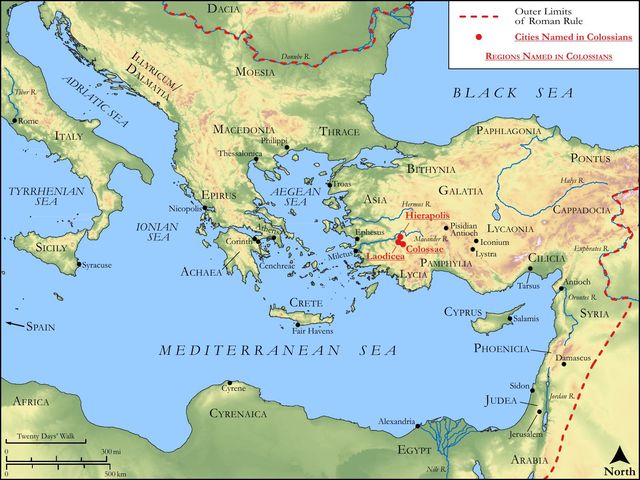
See on the biblical-era maps

Study this verse
Public-domain commentary
Matthew Henry
From his Commentary on the Whole Bible. Henry comments on passages, not single verses — this entry covers Colossians 2:16–23. His two-level outline is real structure in the source text, so it is rendered as structure.
The apostle concludes the chapter with exhortations to proper duty, which he infers from the foregoing discourse.
I.Here is a caution to take heed of judaizing teachers, or those who would impose upon Christians the yoke of the ceremonial law:
Let no man therefore judge you in meat nor drink, etc., Col 2:16. Much of the ceremonies of the law of Moses consisted in the distinction of meats and days. It appears by Rom. 14 that there were those who were for keeping up those distinctions: but here the apostle shows that since Christ has come, and has cancelled the ceremonial law, we ought not to keep it up. "Let no man impose those things upon you, for God has not imposed them: if God has made you free, be not you again entangled in that yoke of bondage." And this the rather because these things were shadows of things to come (Col 2:17), intimating that they had no intrinsic worth in them and that they are now done away. But the body is of Christ: the body, of which they were shadows, has come; and to continue the ceremonial observances, which were only types and shadows of Christ and the gospel, carries an intimation that Christ has not yet come and the gospel state has not yet commenced. Observe the advantages we have under the gospel, above what they had under the law: they had the shadows, we have the substance.
II.He cautions them to take heed of those who would introduce the worship of angels as mediators between God and them, as the Gentile philosophers did: Let no man beguile you of your reward, in a voluntary humility and worshipping of angels, Col 2:18. It looked like a piece of modesty to make use of the mediation of angels, as conscious to ourselves of our unworthiness to speak immediately to God; but, though it has a show of humility, it is a voluntary, not a commanded humility; and therefore it is not acceptable, yea, it is not warrantable: it is taking that honour which is due to Christ only and giving it to a creature. Besides, the notions upon which this practice was grounded were merely the inventions of men and not by divine revelation, - the proud conceits of human reason, which make a man presume to dive into things, and determine them, without sufficient knowledge and warrant: Intruding into those things which he hath not seen, vainly puffed up by his fleshly mind - pretending to describe the order of angels, and their respective ministries, which God has hidden from us; and therefore, though there was a show of humility in the practice, there was a real pride in the principle. They advanced those notions to gratify their own carnal fancy, and were fond of being thought wiser than other people. Pride is at the bottom of a great many errors and corruptions, and even of many evil practices, which have great show and appearance of humility. Those who do so do not hold the head, Col 2:19. They do in effect disclaim Christ, who is the only Mediator between God and man. It is the highest disparagement to Christ, who is the head of the church, for any of the members of it to make use of any intercessors with God but him. When men let go their hold of Christ, they catch at that which is next them and will stand them in no stead. - From which all the body, by joints and bands, having nourishment ministered, and knit together, increaseth with the increase of God. Observe,
1.Jesus Christ is not only a head of government over the church, but a head of vital influence to it. They are knit to him by joints and bands, as the several members of the body are united to the head, and receive life and nourishment from him.
2.The body of Christ is a growing body: it increaseth with the increase of God. The new man is increasing, and the nature of grace is to grow, where there is not an accidental hindrance. - With the increase of God, with an increase of grace which is from God as its author; or, in a usual Hebraism, with a large and abundant increase. - That you may be filled with all the fulness of God, Eph 3:19. See a parallel expression, Which is the head, even Christ, from whom the whole body, fitly joined together, maketh increase of the body, Eph 4:15, Eph 4:16.
III.He takes occasion hence to warn them again:
"Wherefore, if you be dead with Christ from the rudiments of the world, why, as though living in the world, are you subject to ordinances? Col 2:20. If as Christians you are dead to the observances of the ceremonial law, why are you subject to them? Such observances as, Touch not, taste not, handle not," Col 2:21, Col 2:22. Under the law there was a ceremonial pollution contracted by touching a dead body, or any thing offered to an idol; or by tasting any forbidden meats, etc., which all are to perish with the using, having no intrinsic worth in themselves to support them, and those who used them saw them perishing and passing away; or, which tend to corrupt the Christian faith, having no other authority than the traditions and injunctions of men. - Which things have indeed a show of wisdom in will-worship and humility. They thought themselves wiser than their neighbours, in observing the law of Moses together with the gospel of Christ, that they might be sure in the one, at least, to be in the right; but, alas! it was but a show of wisdom, a mere invention and pretence. So they seem to neglect the body, by abstaining from such and such meats, and mortifying their bodily pleasures and appetites; but there is nothing of true devotion in these things, for the gospel teaches us to worship God in spirit and truth and not by ritual observances, and through the mediation of Christ alone and not of any angels. Observe,
1.Christians are freed by Christ from the ritual observances of Moses's law, and delivered from that yoke of bondage which God himself had laid upon them.
2.Subjection to ordinances, or human appointments in the worship of God, is highly blamable, and contrary to the freedom and liberty of the gospel. The apostle requires Christians to stand fast in the liberty with which Christ hath made them free, and not to be entangled again with the yoke of bondage, Gal 5:1. And the imposition of them is invading the authority of Christ, the head of the church, and introducing another law of commandments contained in ordinances, when Christ has abolished the old one, Eph 2:15.
3.Such things have only a show of wisdom, but are really folly. It is true wisdom to keep close to the appointments of the gospel, and an entire subjection to Christ, the only head of the church.
Historical interpretation
Sixteen Centuries of Reception
2 surviving comments on this verse. Each one is dated, so this reads as a timeline rather than a list.
Select a marker to jump to its quote. Markers stagger vertically where authors wrote within a few decades of each other.
"Which are a shadow of the things to come"; he means, of the New Covenant; "but the body" is "Christ's." Some persons here punctuate thus "but the body" is "of Christ," i.e. the truth is come in with Christ: others thus; "The Body of Christ let no man adjudge away from you," that is, thwart you of it. The term katabrabeuthenai, is employed when the victory is with one party, and the prize with another, when though a victor thou art thwarted. Thou standest above the devil and sin; why dost thou again subject thyself to sin?
As to the fabulous element in the Old Testament, I very much doubt if you would be wise to chuck it out. What you get is something coming gradually into focus. First you get, scattered through the heathen religions all over the world— but still quite vague and mythical—the idea of a god who is killed and broken and then comes to life again. No one knows where he is supposed to have lived and died; he's not historical. Then you get the Old Testament. Religious ideas get a bit more focused. Everything is now connected with a particular nation. And it comes still more into focus as it goes on. Jonah and the Whale, Noah and his Ark, are fabulous; but the court history of King David is probably as reliable as the court history of Louis XIV. Then, in the New Testament the thing really happens. The dying god really appears—as an historical person, living in a definite place and time. It we could sort out all the fabulous elements in the earlier stages and separate them from the historical ones, I think we might lose an essential part of the whole process.
Continue studying Colossians 2:17 across the web’s major study libraries — every link below opens this exact verse, chapter, or book on the destination site.
Read & Compare
 BibleGatewayThis verse in more than 200 translations and 70 languages.
 Bible.comThe YouVersion reader — hundreds of translations, reading plans, and highlights.
 ESV.orgCrossway's official English Standard Version reader.
 NET BibleThe NET translation with 60,000+ translators' notes on every rendering decision.
 STEP BibleTyndale House's free study tool — original text, vocabulary, and scholarly resources.
 BibliaLogos Bible Software's free web reader.
 USCCBThe New American Bible (Revised Edition) with the U.S. bishops' study notes.
Commentaries
 BibleHub CommentariesDozens of classic commentaries on this verse, gathered on one page.
 StudyLightMore than 100 commentary sets — the largest collection on the web.
 BibleRefPlain-English commentary on what this verse means, verse by verse.
 Enduring WordDavid Guzik's free commentary on this chapter, widely used by Bible teachers.
 Bible Study ToolsVerse commentary alongside Greek and Hebrew study aids.
Original Language & Research
- BibleHub InterlinearThe verse word by word — original language, transliteration, and English.
- BibleHub LexiconEvery word's original-language definition and Strong's entry.
 Blue Letter BibleDeep-study tools — Strong's numbers, concordance, and word studies.
 CNTR CollationThe earliest Greek manuscripts of this verse, collated letter by letter.
Sermons, Hymns & Audio


TrulyRandomVerse is not affiliated with these sites and doesn’t control their content. They’re linked because they’re genuinely useful.
Summary
Colossians 2:17 serves as a pivotal theological statement, clarifying the relationship between Old Testament ceremonial practices and the person of Jesus Christ. Paul asserts that the dietary laws, festivals, and Sabbaths of the Mosaic Law were not ends in themselves but rather served as prophetic "shadows," prefiguring the ultimate spiritual realities found in Christ. He is the "body" or substance, embodying the fullness and truth to which these Old Covenant observances pointed, thereby liberating believers from legalistic adherence to practices that have found their complete fulfillment in Him.
Context
ShowHideLiterary Context
This verse is a direct explanation of the preceding verse, Colossians 2:16, where Paul instructs believers not to allow anyone to judge them concerning food, drink, religious festivals, New Moons, or Sabbath days. The flow of Paul's argument in Colossians 2 is a strong warning against false teaching that threatened the Colossian church. These teachings likely combined elements of Jewish legalism (emphasizing ceremonial law), asceticism, and a form of mystical philosophy that diminished the unique supremacy and sufficiency of Christ. Paul has already established that believers are "complete in Him" (Colossians 2:10), having been "buried with Him in baptism, in which you also were raised with Him through faith" (Colossians 2:12). The ceremonial laws, therefore, are presented as obsolete in light of Christ's finished work, particularly His triumph over spiritual powers (Colossians 2:15).
Historical & Cultural Context
The city of Colossae was situated in Phrygia, a region known for its syncretistic religious environment, where various philosophical and religious ideas mingled. The specific false teaching confronting the Colossian church appears to have been a blend of Jewish legalism (insisting on adherence to Mosaic ceremonial laws like dietary restrictions and Sabbath observance), Hellenistic philosophical asceticism (self-denial for spiritual purity), and possibly elements of Gnosticism or a nascent form of angel worship (as hinted at in Colossians 2:18). These teachers likely presented their practices as a higher form of spirituality or a necessary means to attain a deeper relationship with God, thereby undermining the all-sufficiency of Christ's work on the cross. Paul's letter vigorously counters these influences by reasserting the absolute supremacy and completeness found in Christ alone.
Key Themes
ShowHideColossians 2:17 powerfully contributes to several major themes within Paul's letter and the broader New Testament. The most prominent is the Shadow vs. Substance distinction, where the Old Testament ceremonial law is presented as merely a temporary, illustrative "shadow" pointing to the ultimate, enduring "body" or reality found in Christ. This theme highlights the Supremacy and Sufficiency of Christ, asserting that He is the culmination and fulfillment of all God's redemptive purposes and promises. He did not abolish the law but brought it to its intended completion, revealing its true purpose and meaning, as He Himself stated in Matthew 5:17. Consequently, this verse also underscores Christian Freedom from Legalism, liberating believers from the burden of rigidly adhering to ceremonial laws that have been fulfilled. True spiritual growth and righteousness are found in a living relationship with Christ, not in external observances or human-made rules, a concept also strongly articulated in Galatians 5:1. Implicitly, it points to the Superiority of the New Covenant established by Christ over the Old Covenant, where the Old served its preparatory purpose, but the New brings the full reality of God's grace and salvation, as extensively developed in Hebrews 8.
Exposition and Analysis
ShowHideKey Word Analysis
ShowHideThis word denotes an outline, a faint resemblance, or a mere image. It implies something that lacks substance and is an imperfect representation of the real thing. In the context of the Old Testament law, it signifies that the ceremonial observances were not the ultimate reality but merely a preliminary sketch or prefigurement.
This verb, often translated as "to be about to be" or "to intend," carries the idea of expectation and future realization. It emphasizes that the "shadows" were forward-looking, anticipating a future reality that had not yet fully arrived. This highlights the prophetic nature of the Old Covenant rituals, pointing to a future fulfillment.
In this context, "body" stands in direct contrast to "shadow" and signifies the substance, reality, or complete form. Paul uses it to convey that Christ is the tangible, solid, and ultimate reality to which the Old Testament types and rituals pointed. He is the full, three-dimensional embodiment of all that the shadows depicted.
Verse Breakdown
ShowHide"Which are a shadow of things to come;"
The antecedent of "Which" refers to the ceremonial observances mentioned in Colossians 2:16—food and drink regulations, festivals, New Moons, and Sabbaths. These elements of the Mosaic Law are declared to be a "shadow" (skiá), an outline or a prefigurement, not the full reality. They were temporary, illustrative pointers to "things to come" (méllō), indicating that their purpose was to anticipate future spiritual realities that would be inaugurated by the Messiah. They were preparatory and symbolic, designed to instruct and guide God's people toward the ultimate fulfillment.
"but the body [is] of Christ."
The conjunction "but" (dé) introduces a strong contrast, emphasizing the distinction between the temporary shadow and the enduring reality. The "body" (sōma) here signifies the substance, the reality, the full and complete embodiment. This clause asserts that Christ Himself is the ultimate reality to which all the Old Testament shadows pointed. His person, His life, His atoning death, and His resurrection are the tangible, complete, and perfect fulfillment of all the types, prophecies, and rituals of the Old Covenant. He is the substance, rendering the shadows obsolete as means of salvation or spiritual perfection.
Literary Devices
ShowHidePaul employs several powerful literary devices in this concise verse. The most prominent is Metaphor, specifically the contrasting metaphors of "shadow" (skiá) and "body" (sōma). The Old Testament ceremonial law is metaphorically described as a "shadow," an insubstantial outline that lacks the full reality of the object casting it. In stark contrast, Christ is presented as the "body," signifying the complete, tangible, and ultimate reality. This creates a strong Antithesis or contrast, highlighting the qualitative difference between the temporary, preparatory nature of the Old Covenant rituals and the permanent, fulfilling nature of Christ's work. Furthermore, the verse functions within a broader biblical Typology, where elements, persons, or events in the Old Testament (the "types" or "shadows") are divinely designed to prefigure and anticipate greater realities in the New Testament (the "anti-types" or "body"), culminating in the person and work of Jesus Christ.
Theological and Thematic Connections
ShowHideColossians 2:17 is a cornerstone for understanding the relationship between the Old and New Covenants, asserting Christ's ultimate supremacy as the fulfillment of God's redemptive plan. Theologically, it teaches that the ceremonial law was never intended to be an end in itself, but a divinely ordained pedagogical tool, guiding humanity towards the Messiah. The sacrifices, feasts, and rituals were not arbitrary rules but prophetic symbols, each pointing to a facet of Christ's person or work. With Christ's advent, these shadows have met their substance, and their preparatory function has been completed. This means that righteousness and salvation are found not in adherence to these now-fulfilled rituals, but solely through faith in Christ, who is the full and final revelation of God's grace.
Reflection and Application
ShowHideColossians 2:17 offers profound insights for contemporary Christian living. It calls us to fix our gaze on Christ as the ultimate reality and substance of our faith, rather than becoming entangled in external observances or human-made traditions that detract from His finished work. This verse serves as a timeless warning against legalism in all its forms, reminding us that true spirituality is not about what we eat or drink, or which days we observe, but about a living, transformative relationship with Jesus. While the Old Testament ceremonial law no longer binds us, this passage encourages a deeper appreciation for its prophetic value, recognizing how beautifully it foreshadowed Christ. Living in the freedom Christ provides means understanding that our righteousness comes through faith in Him, not through works of the law, allowing us to serve God out of love and gratitude, not out of fear or obligation to shadows.
Questions for Reflection
ShowHideFAQ
ShowHideWhat specific "things to come" does Colossians 2:17 refer to as being shadowed by the Old Testament?
ShowHideThe "things to come" primarily refer to the spiritual realities and blessings of the New Covenant inaugurated by Jesus Christ, which were prefigured by the ceremonial aspects of the Mosaic Law. These include the new way of salvation through faith in Christ, the indwelling of the Holy Spirit, direct access to God, and the new spiritual identity of believers in Christ. The specific "shadows" mentioned in Colossians 2:16—food and drink regulations, religious festivals, New Moons, and Sabbath days—were all symbolic. For example, the sacrificial system pointed to Christ's ultimate sacrifice, the Passover to His atoning death, and the Sabbath rest to the spiritual rest found in Him.
Does Colossians 2:17 mean the Old Testament is irrelevant or abolished for Christians?
ShowHideNo, Colossians 2:17 does not mean the Old Testament is irrelevant or abolished. Instead, it clarifies its purpose and fulfillment. The verse specifically addresses the ceremonial aspects of the law (like dietary rules and festival observances), stating that their prophetic function has been fulfilled in Christ. The Old Testament remains divinely inspired and incredibly valuable for Christians. It provides the historical context for God's redemptive plan, reveals God's character, contains moral principles (like the Ten Commandments, which are reiterated in the New Testament), and is rich with prophecies and types that beautifully illustrate the coming of Christ. It is the "shadow" that helps us understand and appreciate the "body," Jesus Christ. As 2 Timothy 3:16 states, "All Scripture is God-breathed and is useful for teaching, rebuking, correcting and training in righteousness."
Christ-Centered Fulfillment
ShowHideColossians 2:17 is a profound declaration of Christ's centrality and supremacy, revealing Him as the ultimate fulfillment of all that the Old Testament system anticipated. Every sacrifice, every feast, every ritual, and every temple ordinance was a divinely orchestrated "shadow," pointing forward to the perfect "body" of Christ. He is the true Passover Lamb whose blood secures our redemption, the Great High Priest who offered Himself as the perfect and final sacrifice for sins once for all. The physical temple, with its holy of holies, was a shadow of Christ's own body, through which we now have direct access to God. The Sabbath rest, which pointed to a spiritual cessation from works, finds its ultimate reality in the spiritual rest and peace that believers find in Him. In Christ, the new covenant has been established, rendering the old system of shadows obsolete because the substance has arrived. He is the complete and final revelation of God, in whom "all the fullness of the Deity lives in bodily form" (Colossians 2:9), and in Him, we are made complete (Colossians 2:10).