


Acts 15:2
- γενομένηςgenomenēsWhen was hapeningG1096V-2ADP-GSFVerb 2nd Aorist Middle Deponent Participle Genitive Singular Feminine
- δὲdethenG1161CONJConjunction
- στάσεωςstaseōscommotionG4714N-GSFNoun Genitive Singular Feminine
- καὶkaiandG2532CONJConjunction
- ζητήσεωςzētēseōscontroversyG2214N-GSFNoun Genitive Singular Feminine
- οὐκouknoG3756PRT-NNegative Particle Negative
- ὀλίγηςoligēssmallG3641A-GSFAdjective Genitive Singular Feminine
- τῷtō<the>G3588T-DSMDefinite article Dative Singular Masculine
- ΠαύλῳPaulōby PaulG3972N-DSM-PNoun Dative Singular Masculine Individual
- καὶkaiandG2532CONJConjunction
- τῷtō<the>G3588T-DSMDefinite article Dative Singular Masculine
- ΒαρναβᾷBarnabaBarnabasG921N-DSM-PNoun Dative Singular Masculine Individual
- πρὸςproswithG4314PREPPreposition
- αὐτοὺςautousthemG846P-APMPersonal pronoun Accusative Plural Masculine
- ἔταξανetaxanthey appointedG5021V-AAI-3PVerb Aorist Active Indicative 3rd Plural
- ἀναβαίνεινanabaineinto go upG305V-PANVerb Present Active Infinitive
- ΠαῦλονPaulonPaulG3972N-ASM-PNoun Accusative Singular Masculine Individual
- καὶkaiandG2532CONJConjunction
- ΒαρναβᾶνBarnabanBarnabasG921N-ASM-PNoun Accusative Singular Masculine Individual
- καίkaiandG2532CONJConjunction
- τιναςtinascertainG5100X-APMIndefinite pronoun Accusative Plural Masculine
- ἄλλουςallousothersG243A-APMAdjective Accusative Plural Masculine
- ἐξexout fromG1537PREPPreposition
- αὐτῶνautōnthemG846P-GPMPersonal pronoun Genitive Plural Masculine
- πρὸςprostoG4314PREPPreposition
- τοὺςtoustheG3588T-APMDefinite article Accusative Plural Masculine
- ἀποστόλουςapostolousapostlesG652N-APMNoun Accusative Plural Masculine
- καὶkaiandG2532CONJConjunction
- πρεσβυτέρουςpresbuterouseldersG4245N-APMNoun Accusative Plural Masculine
- εἰςeistoG1519PREPPreposition
- ἸερουσαλὴμIerousalēmJerusalemG2419N-ASF-LNoun Accusative Singular Feminine Location
- περὶperiaboutG4012PREPPreposition
- τοῦtou<the>G3588T-GSNDefinite article Genitive Singular Neuter
- ζητήματοςzētēmatosquestionG2213N-GSNNoun Genitive Singular Neuter
- τούτουtoutouthisG3778D-GSNDemonstrative pronoun Genitive Singular Neuter
English is a literal word-by-word gloss of the Greek, not the KJV's wording. Why?
This is the original text the KJV's translators worked from — each Greek word with its own literal English meaning in this verse, prepared by scholars at Tyndale House, Cambridge. The KJV translates whole sentences, not word by word, so its wording differs: one Greek word can become several English words, and the KJV may choose “charity” where the gloss reads “love”. Both are faithful — they answer different questions. For the KJV's own rendering, switch to the KJV text.
Details
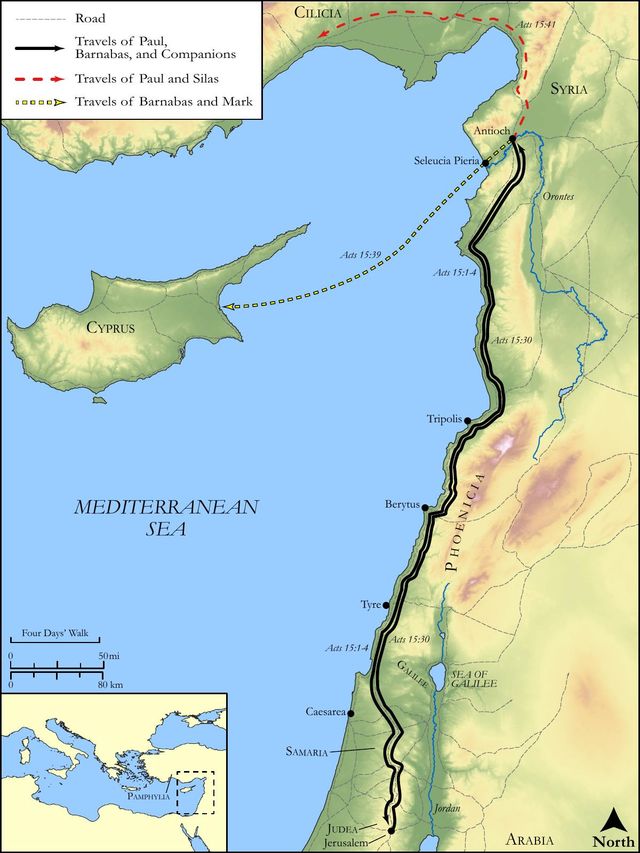
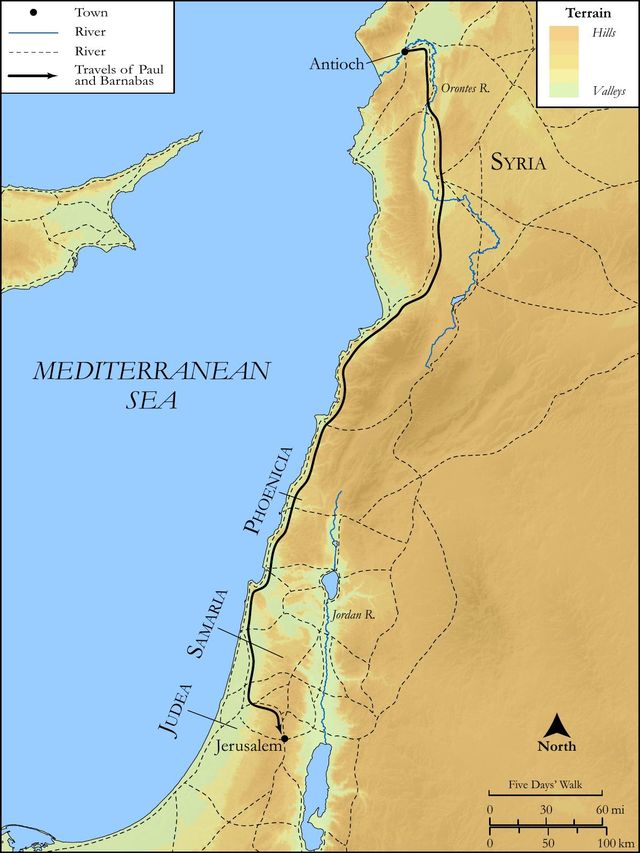
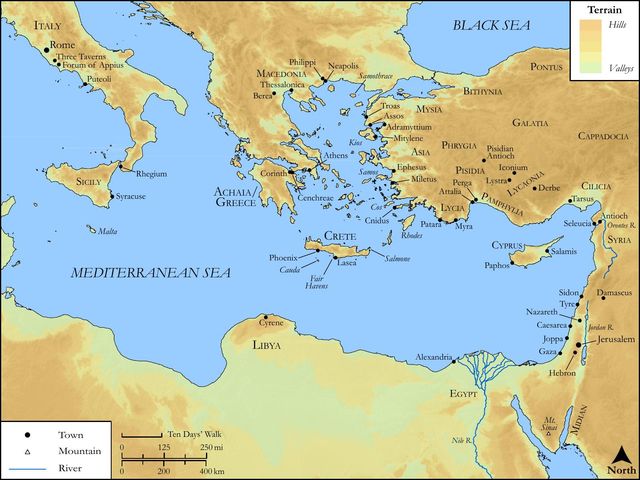
See on the biblical-era map
Study this verse
Public-domain commentary
Matthew Henry
From his Commentary on the Whole Bible. Henry comments on passages, not single verses — this entry covers Acts 15:1–5. His three-level outline is real structure in the source text, so it is rendered as structure.
Even when things go on very smoothly and pleasantly in a state or in a church, it is folly to be secure, and to think the mountain stands strong and cannot be moved; some uneasiness or other will arise, which is not foreseen, cannot be prevented, but must be prepared for. If ever there was a heaven upon earth, surely it was in the church at Antioch at this time, when there were so many excellent ministers there, and blessed Paul among them, building up that church in her most holy faith. But here we have their peace disturbed, and differences arising. Here is,
I.A new doctrine started among them, which occasioned this division, obliging the Gentile converts to submit to circumcision and the ceremonial law, Act 15:1. Many that had been proselytes to the Jewish religion became Christians; and they would have such as were proselyted to the Christian religion to become Jews.
1.The persons that urged this were certain men who came down from Judea; some think such as had been of the Pharisees (Act 15:5), or perhaps of those priests who were obedient to the faith, Act 6:7. They came from Judea, pretending perhaps to be sent by the apostles at Jerusalem, at least to be countenanced by them. Having a design to spread their notions, they came to Antioch, because that was the head-quarters of those that preached to the Gentiles, and the rendezvous of the Gentile converts; and, if they could but make an interest there, this leaven would soon be diffused to all the churches of the Gentiles. They insinuated themselves into an acquaintance with the brethren, pretended to be very glad that they had embraced the Christian faith, and congratulated them on their conversion; but tell them that yet one thing they lack, they must be circumcised. Note, Those that are ever so well taught have need to stand upon their guard that they be not untaught again, or ill taught.
2.The position they laid down, the thesis they gave, was this, that except the Gentiles who turned Christians were circumcised after the manner of Moses, and thereby bound themselves to all the observances of the ceremonial law, they could not be saved. As to this,
(1.)Many of the Jews who embraced the faith of Christ, yet continued very zealous for the law, Act 21:20. They knew it was from God and its authority was sacred, valued it for its antiquity, had been bred up in the observance of it, and it is probable had been often devoutly affected in their attendance on these observances; they therefore kept them up after they were by baptism admitted into the Christian church, kept up the distinction of meats, and used the ceremonial purifyings from ceremonial pollutions, attend the temple service, and celebrated the feasts of the Jews. Herein they were connived at, because the prejudices of education are not to be overcome all at once, and in a few years the mistake would be effectually rectified by the destruction of the temple and the total dissolution of the Jewish church, by which the observance of the Mosaic ritual would become utterly impracticable. But it did not suffice them that they were herein indulged themselves, they must have the Gentile converts brought under the same obligations. Note, There is a strange proneness in us to make our opinion and practice a rule and a law to every body else, to judge of all about us by our standard, and to conclude that because we do well all do wrong that do not just as we do.
(2.)Those Jews who believed that Christ was the Messiah, as they could not get clear of their affection to the law, so they could not get clear of the notions they had of the Messiah, that he should set up a temporal kingdom in favour of the Jewish nation, should make this illustrious and victorious; it was a disappointment to them that there was as yet nothing done towards this in the way they expected. But now that they hear the doctrine of Christ is received among the Gentiles, and his kingdom begins to be set up in the midst of them, if they can but persuade those that embrace Christ to embrace the law of Moses too they hope their point will be gained, the Jewish nation will be made as considerable as they can wish, though in another way; and "Therefore by all means let the brethren be pressed to be circumcised and keep the law, and then with our religion our dominion will be extended, and we shall in a little time be able to shake off the Roman yoke; and not only so, but to put it on the necks of our neighbours, and so shall have such a kingdom of the Messiah as we promised ourselves." Note, It is no wonder if those who have wrong notions of the kingdom of Christ take wrong measures for the advancement of it, and such as really tend to the destruction of it, as these do.
(3.)The controversy about the circumcising of the Gentile proselytes had been on foot among the Jews long before this. This is observed by Dr. Whitby out of Josephus - Antiq. 20.38-45: "That when Izates, the son of Helen queen of Adiabene, embraced the Jews' religion, Ananias declared he might do it without circumcision; but Eleazar maintained that it was a great impiety to remain uncircumcised." And when two eminent Gentiles fled to Josephus (as he relates in the history of his own life) "the zealots among the Jews were urgent for their circumcision; but Josephus dissuaded them from insisting upon it." Such has been the difference in all ages between bigotry and moderation.
(4.)It is observable what a mighty stress they laid upon it; they do not only say, "You ought to be circumcised after the manner of Moses, and it will be good service to the kingdom of the Messiah if you be; it will best accommodate matters between you and the Jewish converts, and we shall take it very kindly if you will, and shall converse the more familiarly with you;" but, "Except you be circumcised you cannot be saved. If you be not herein of our mind and way, you will never go to heaven, and therefore of course you must go to hell." Note, it is common for proud impostors to enforce their own inventions under pain of damnation; and to tell people that unless they believe just as they would have them believe, and do just as they would have them do, they cannot be saved, it is impossible they should; not only their case is hazardous, but it is desperate. Thus the Jews tell their brethren that except they be of their church, and come into their communion, and conform to the ceremonies of their worship, though otherwise good men and believers in Christ, yet they cannot be saved; salvation itself cannot save them. None are in Christ but those that are within their pale. We ought to see ourselves well warranted by the word of God before we say, "Except you do so and so, you cannot be saved."
II.The opposition which Paul and Barnabas gave to this schismatical notion, which engrossed salvation to the Jews, now that Christ has opened the door of salvation to the Gentiles (Act 15:2): They had no small dissension and disputation with them. They would by no means yield to this doctrine, but appeared and argued publicly against it.
1.As faithful servants of Christ, they would not see his truths betrayed. They knew that Christ came to free us from the yoke of the ceremonial law, and to take down that wall of partition between Jews and Gentiles and unite them both in himself; and therefore could not bear to hear of circumcising the Gentile converts, when their instructions were only to baptize them. The Jews would unite with the Gentiles, that is, they would have them to conform in every thing to their rites, and then, and not till then they will look upon them as their brethren; and no thanks to them. But, this not being the way in which Christ designed to unite them, it is not to be admitted.
2.As spiritual fathers to the Gentile converts, they would not see their liberties encroached upon. They had told the Gentiles that if they believed in Jesus Christ they should be saved; and now to be told that this was not enough to save them, except they were circumcised and kept the law of Moses, this was such a discouragement to them at setting out, and would be such a stumbling-block in their way, as might almost tempt them to think of returning into Egypt again; and therefore the apostles set themselves against it.
III.The expedient pitched upon for preventing the mischief of this dangerous notion, and silencing those that vented it, as well as quieting the minds of the people with reference to it. They determined that Paul and Barnabas, and some others of their number, should go to Jerusalem to the apostles and elders, concerning this doubt. Not that the church at Antioch had any doubt concerning it: they knew the liberty wherewith Christ had made them free; but they sent the case to Jerusalem,
1.Because those who taught this doctrine came from Jerusalem, and pretended to have directions from the apostles there to urge circumcision upon the Gentile converts; it was therefore very proper to send to Jerusalem about it, to know if they had any such direction from the church there. And it was soon found to be all wrong, which yet pretended to be of apostolical right. It was true that these went out from them (Act 15:24), but they never had any such orders from them.
2.Because those who were taught this doctrine would be the better confirmed in their opposition to it, and in the less danger of being shocked and disturbed by it, if they were sure that the apostles and elders at Jerusalem (which was the Christian church that of all others retained the most affection to the law of Moses) were against it; and, if they could but have this under their hands, it would be the likeliest means to silence and shame these incendiaries, who had pretended to have it from them.
3.Because the apostles at Jerusalem were fittest to be consulted in a point not yet fully settled; and being most eminent for an infallible spirit, peculiar to them as apostles, their decision would be likely to end the controversy. It was owing to the subtlety and malice of the great enemy of the church's peace (as it appears by Paul's frequent complaints of these judaizing teachers, these false apostles, these deceitful workers, these enemies of the cross of Christ), that it had not this effect.
IV.Their journey to Jerusalem upon this errand, Act 15:3. Where we find,
1.That they were honoured at parting: They were brought on their way by the church, which was then much used as a token of respect to useful men, and is directed to be done after a godly sort, Jo3 1:6. Thus the church showed their favour to those who witnessed against these encroachments on the liberties of the Gentile converts, and stood up for them.
2.That they did good as they went along. They were men that would not lose time, and therefore visited the churches by the way; they passed through Phenice and Samaria, and as they went declared the conversion of the Gentiles, and what wonderful success the gospel had had among them, which caused great joy to all the brethren. Note, The progress of the gospel is and ought to be a matter of great joy. All the brethren, the faithful brethren in Christ's family, rejoice when more are born into the family; for the family will be never the poorer for the multitude of its children. In Christ and heaven there is portion enough, and inheritance enough for them all.
V.Their hearty welcome at Jerusalem, Act 15:4.
1.The good entertainment their friends gave them: They were received of the church, and of the apostles and elders, were embraced as brethren, and had audience as messengers of the church at Antioch; they received them with all possible expressions of love and friendship.
2.The good entertainment they gave their friends: They declared all things that God had done with them, gave them an account of the success of their ministry among the Gentiles, not what they had done, but what God had done with them, what he had by his grace in them enabled them to do, and what he had by his grace in their hearers enabled them to receive. As they went they had planted, as they came back they had watered; but in both they were ready to own it was God that gave the increase. Note, It is a great honour to be employed for God, to be workers for him; for those that are so have him a worker with them, and he must have all the glory.
VI.The opposition they met with from the same party at Jerusalem, Act 15:5.
When Barnabas and Paul gave an account of the multitude of the Gentiles, and of the great harvest of souls gathered in to Christ there, and all about them congratulated them upon it, there rose up certain of the sect of the Pharisees, who received the tidings very coldly, and, though they believed in Christ, yet were not satisfied in the admission of these converts, but thought it was needful to circumcise them. Observe here,
1.That those who have been most prejudiced against the gospel yet have been captivated by it; so mighty has it been through God to the pulling down of strong-holds. When Christ was here upon earth, few or none of the rulers and of the Pharisees believed on him; but now there are those of the sect of the Pharisees who believed, and many of them, we hope, in sincerity.
2.That it is very hard for men suddenly to get clear of their prejudices: those that had been Pharisees, even after they became Christians, retained some of the old leaven. All did not so, witness Paul, but some did; and they had such a jealousy for the ceremonial law, and such a dislike of the Gentiles, that they could not admit the Gentiles into communion with them, unless they would be circumcised, and thereby engage themselves to keep the law of Moses. This was, in their opinion, needful; and for their parts they would not converse with them unless they submitted to it.
Historical interpretation
Four Centuries of Reception
4 surviving comments on this verse. Each one is dated, so this reads as a timeline rather than a list.
Select a marker to jump to its quote. Markers stagger vertically where authors wrote within a few decades of each other.
It is to be noted that the early believers, with much searching and great eagerness, discussed dogmas, and that they benefited to such an extent through their discussions and that the Antiochians did not hesitate to send [someone] to Jerusalem to inquire about the controversy. And yet their inquiry was not, in the first place, about the Godhead, or the providential incarnation of the Son, or the Holy Spirit, or angels, or powers, or heaven, or anything like this, but about circumcision, about the least part of a man’s genitals. They were aware of the fact that the words “a single iota and a single point of the law” were full of a great spiritual meaning. The Antiochian disciples were afraid to take authority, but they took so much thought even for questions that seemed to be trifling, seeing that those from Antioch sent Paul and Barnabas to consult those in Jerusalem, while the disciples from Jerusalem sent Judah and Silas back to Antioch with their letters.
How can he say in his letter to the Galatians, “I did not go up to Jerusalem to see those who were apostles before me, nor did I move”? We suggest this: in the first place because he had not gone up spontaneously but had been sent by others; and in the second place because he did not come in order to learn something but to persuade others. Indeed, from the beginning he held that opinion that the apostles approved later, namely, that it was not necessary to circumcise. Until that day, however, it had seemed to them that [Paul] was not worthy of faith, but they rather listened more to those who lived in Jerusalem. So [Paul] went up, not in order to gain what he had been ignorant of before but in order to persuade his opponents because those who were in Jerusalem agreed with them. He had recognized from the start what had to be done and needed no teacher. And he had a clear and sure idea, beyond any discussion, of what the apostles would have decreed after a long discussion. Since it had seemed opportune to the brothers that he might learn something about them, he went up not for himself but for them. Even though he says, “I did not go up,” we can explain that. He did not go up at the beginning of his preaching or in order to learn. And he means both these things when he says, “I did not go immediately in flesh and blood.” He did not simply say, “I did not go” but “I did not go immediately.”
And Paul does not say, What? Have I not a right to be believed after so many signs? but he complied for their sakes. But when he returned from thence, the doctrine also became more exact. For if they at Jerusalem enjoin no such thing, much more these have no right to do so.
They decided that Paul and Barnabas and some others from them should go up to the apostles and elders in Jerusalem, etc. About this ascension of his, Paul himself writes to the Galatians: Then, after fourteen years, I went up to Jerusalem with Barnabas, taking Titus along also, and I communicated to them the Gospel which I preach among the Gentiles (Galatians II); where the very number that he mentioned must be reckoned in years. For we know that the apostles Peter and Paul suffered martyrdom in the thirty-eighth year after the passion of the Lord, that is, in the last year of Nero, and that the blessed Peter sat upon the episcopal throne in Rome for twenty-five years. Now, twenty-five and fourteen make not thirty-eight but thirty-nine. Therefore, it follows that we believe the blessed Peter came to Rome in the same fourteenth year after the passion of the Lord, in which Paul conversed with him at Jerusalem, in the fourth year of Claudius Caesar; and likewise, unless I am mistaken, from this position it is proven that the blessed Apostle Paul came to faith in the same year in which the Lord suffered and rose again.
Continue studying Acts 15:2 across the web’s major study libraries — every link below opens this exact verse, chapter, or book on the destination site.
Read & Compare
 BibleGatewayThis verse in more than 200 translations and 70 languages.
 Bible.comThe YouVersion reader — hundreds of translations, reading plans, and highlights.
 ESV.orgCrossway's official English Standard Version reader.
 NET BibleThe NET translation with 60,000+ translators' notes on every rendering decision.
 STEP BibleTyndale House's free study tool — original text, vocabulary, and scholarly resources.
 BibliaLogos Bible Software's free web reader.
 USCCBThe New American Bible (Revised Edition) with the U.S. bishops' study notes.
Commentaries
 BibleHub CommentariesDozens of classic commentaries on this verse, gathered on one page.
 StudyLightMore than 100 commentary sets — the largest collection on the web.
 BibleRefPlain-English commentary on what this verse means, verse by verse.
 Enduring WordDavid Guzik's free commentary on this chapter, widely used by Bible teachers.
 Bible Study ToolsVerse commentary alongside Greek and Hebrew study aids.
Original Language & Research
- BibleHub InterlinearThe verse word by word — original language, transliteration, and English.
- BibleHub LexiconEvery word's original-language definition and Strong's entry.
 Blue Letter BibleDeep-study tools — Strong's numbers, concordance, and word studies.
 CNTR CollationThe earliest Greek manuscripts of this verse, collated letter by letter.
Sermons, Hymns & Audio


TrulyRandomVerse is not affiliated with these sites and doesn’t control their content. They’re linked because they’re genuinely useful.
Summary
Acts 15:2 details the intense conflict that arose in the church at Antioch concerning the necessity of circumcision for Gentile believers, a dispute that directly challenged the gospel message preached by Paul and Barnabas. Recognizing the gravity of this theological disagreement, the church leaders, including Paul and Barnabas, resolved to travel to Jerusalem to consult with the apostles and elders, seeking a definitive resolution to this foundational question regarding salvation and the inclusion of Gentiles into the Christian community.
Context
ShowHideLiterary Context
Acts 15:2 stands at the precipice of a monumental theological crisis within the early church. The preceding verse, Acts 15:1, introduces the agitators: "certain men which came down from Judaea" who began teaching Gentile converts in Antioch that "Except ye be circumcised after the manner of Moses, ye cannot be saved." This doctrine directly contradicted the message of grace and faith that Paul and Barnabas had been proclaiming during their first missionary journey, particularly in places like Pisidian Antioch (Acts 13:38-39). The "dissension and disputation" mentioned in verse 2 is the immediate consequence of this clash, necessitating a formal resolution to preserve the unity and doctrinal purity of the nascent Christian movement. This verse sets the stage for the Jerusalem Council, a pivotal event that would shape the future trajectory of Christianity.
Historical & Cultural Context
The early church was predominantly Jewish in its origins, and adherence to the Mosaic Law, particularly circumcision, was a deeply ingrained aspect of Jewish identity and covenant relationship with God. For centuries, circumcision had marked God's people, as established in Genesis 17:9-14. As the gospel expanded beyond Jewish communities to include Gentiles, a fundamental question arose: must Gentiles become Jews (i.e., observe the Law, including circumcision) to become Christians? This was not merely a cultural preference but a theological debate with eternal implications, touching upon the very nature of salvation, the role of the Law, and the identity of the new covenant community. Jerusalem, as the birthplace of the church and the seat of the original apostles, was the natural and authoritative place to address such a weighty matter.
Key Themes
ShowHideThis verse powerfully contributes to several key themes within the book of Acts and the broader New Testament. Firstly, it highlights the theme of Doctrinal Purity and Conflict, demonstrating the early church's commitment to safeguarding the true gospel from false teachings that threatened to undermine salvation by grace through faith. The "no small dissension" underscores the seriousness with which foundational truths were defended. Secondly, it exemplifies the theme of Church Authority and Unity, as the decision to "go up to Jerusalem unto the apostles and elders" reveals a recognition of the need for collective apostolic and pastoral wisdom to resolve disputes and maintain cohesion across diverse congregations. This established a precedent for communal discernment in matters of faith, as seen in the subsequent council's decision in Acts 15:28. Lastly, it showcases the Inclusion of the Gentiles, as the entire conflict revolves around the terms of their reception into the body of Christ, a central narrative thread throughout Acts, culminating in the council's affirmation of their unburdened inclusion.
Exposition and Analysis
ShowHideKey Word Analysis
ShowHideThis term denotes a "standing apart," implying a division, conflict, or even an uprising. In the context of Acts 15:2, it describes a significant theological and relational rift that developed within the Antioch church, far beyond a minor disagreement, suggesting a serious internal challenge to unity and doctrine.
This word refers to "mutual questioning" or "discussion," often implying a debate or argument. Paired with "dissension," it emphasizes the verbal and intellectual struggle involved in the theological conflict, indicating that the disagreement was not merely passive but involved active, perhaps heated, dialogue and argument over the core issue of Gentile salvation.
This term literally means "a search" but is used concretely to mean "a debate" or "a matter of inquiry." Here, it encapsulates the specific doctrinal issue at hand – whether circumcision and adherence to the Mosaic Law were prerequisites for salvation for Gentile believers. It signifies the core subject that required authoritative resolution.
Verse Breakdown
ShowHide"When therefore Paul and Barnabas had no small dissension and disputation with them"
This clause highlights the intensity and significance of the conflict. The phrase "no small" is a litotes, an understatement used for emphasis, meaning the dissension was very great, serious, and substantial. Paul and Barnabas, as the primary evangelists to the Gentiles, found themselves in direct opposition to the Judaizers who insisted on circumcision for salvation. This indicates a profound theological clash that could not be easily dismissed or ignored.
"they determined that Paul and Barnabas, and certain other of them, should go up to Jerusalem unto the apostles and elders about this question"
This part of the verse reveals the church's strategic and wise decision to seek a higher, authoritative resolution. "They determined" (from G5021, tássō, meaning "to arrange in an orderly manner" or "assign") implies a formal decision made by the Antioch church, recognizing the need for collective wisdom. Sending Paul and Barnabas, key figures in the Gentile mission, along with other representatives, to Jerusalem, the center of apostolic authority, demonstrates a commitment to unity and doctrinal clarity, acknowledging that this "question" (G2213, zḗtēma) was too weighty for a local congregation alone to settle.
Literary Devices
ShowHideThe phrase "no small dissension and disputation" is a prime example of Litotes, a rhetorical device where an affirmative is expressed by negating its opposite. Instead of simply stating "they had great dissension," the text uses "no small dissension," which effectively emphasizes the severity and magnitude of the disagreement. This understatement powerfully conveys the depth of the theological conflict. The repetition of "and" (Polysyndeton) between "dissension and disputation" serves to highlight both the nature of the conflict (a division) and the process of the conflict (an argument), reinforcing the idea that this was a multi-faceted and intense struggle. The narrative also employs Foreshadowing, as this verse directly sets the stage for the pivotal Jerusalem Council described later in the chapter, an event of immense theological and historical significance for the early church.
Theological and Thematic Connections
ShowHideActs 15:2 stands as a foundational text for understanding how the early church navigated profound theological challenges, particularly those concerning the nature of salvation and the inclusion of diverse peoples into the covenant community. It underscores the vital importance of contending for the truth of the gospel while simultaneously demonstrating a commitment to unity and order through established ecclesiastical structures. The dispute over circumcision was not merely a procedural matter but a direct assault on the sufficiency of Christ's work, threatening to revert the new covenant community to an old covenant framework. The decision to appeal to Jerusalem highlights the early church's recognition of a collective apostolic authority guided by the Holy Spirit to preserve the integrity of the faith. This process became a paradigm for resolving future doctrinal disputes, emphasizing communal discernment over individual interpretation in matters of core belief.
Reflection and Application
ShowHideActs 15:2 offers profound insights for contemporary believers and the church, particularly in an era marked by diverse interpretations and theological disagreements. It teaches us that serious doctrinal conflicts are not new to the church, and when they arise, they must be addressed with both conviction and a commitment to unity. Paul and Barnabas, despite their strong convictions, did not allow the dispute to fracture the local church but sought resolution through communal discernment and appeal to recognized spiritual authority. This models a healthy approach to conflict: standing firm on biblical truth while pursuing unity through dialogue, prayer, and submission to the wisdom of godly leaders. It reminds us that the purity of the gospel—salvation by grace through faith in Christ alone—is a truth worth contending for, and that the church, in its collective wisdom, guided by the Holy Spirit, is called to safeguard this message for future generations.
Questions for Reflection
ShowHideFAQ
ShowHideWhat was the core "question" that led to the dispute in Acts 15:2?
ShowHideThe core "question" (Greek, zḗtēma, G2213) was whether Gentile converts to Christianity needed to be circumcised and adhere to the Mosaic Law in order to be saved. Certain men from Judea were teaching in Antioch that salvation was contingent upon these Old Covenant practices, directly contradicting the message of salvation by grace through faith in Jesus Christ that Paul and Barnabas were proclaiming, as exemplified in Acts 13:38-39. This was a fundamental theological issue that threatened the very nature of the gospel and the unity of the nascent Christian movement.
Christ-Centered Fulfillment
ShowHideActs 15:2, with its depiction of intense debate over the necessity of circumcision for salvation, profoundly points to the Christ-centered fulfillment of God's redemptive plan. The "question" at the heart of the dispute was ultimately about whether salvation was achieved through human effort and adherence to the Law, or solely through the finished work of Jesus Christ. The resolution, found later in Acts 15:11, affirms Peter's declaration: "But we believe that through the grace of the Lord Jesus Christ we shall be saved, even as they." This echoes Paul's consistent teaching that Christ is the end of the Law for righteousness to everyone who believes (Romans 10:4). The Mosaic Law, including circumcision, served as a tutor to lead humanity to Christ (Galatians 3:24), but with His advent, the old covenant shadows gave way to the substance found in Him. Jesus' perfect life, atoning death, and glorious resurrection provide complete salvation, making ceremonial observances obsolete as a means of justification. Thus, the debate in Acts 15:2, and its resolution, powerfully underscore the sufficiency and exclusivity of Christ's work as the sole basis for salvation and the inclusion of all, Jew and Gentile alike, into God's family through faith in Him, fulfilling the Abrahamic promise that all nations would be blessed through his Seed, who is Christ (Galatians 3:16).