


Galatians 6:15
Bible text: King James Version (1769 Blayney text) · Public domain
Bible text: Berean Standard Bible · Public domain
Bible text: American Standard Version (1901) · Public domain
Bible text: World English Bible, Messianic edition · Public domain
Bible text: Geneva Bible (1599) · Public domain
Bible text: Young's Literal Translation · Public domain
- ἐνeninG1722PREPPreposition
- ΧριστῷChristōChristG5547N-DSM-TNoun Dative Singular Masculine Title
- ἸησοῦIēsouJesusG2424N-DSM-PNoun Dative Singular Masculine Individual
- οὔτεouteNeitherG3777CONJ-NConjunction Negative
- γὰρgarforG1063CONJConjunction
- περιτομήperitomēcircumcisionG4061N-NSFNoun Nominative Singular Feminine
- τίtianythingG5101I-NSNInterrogative pronoun Nominative Singular Neuter
- ἐστινestinisG1510V-PAI-3SVerb Present Active Indicative 3rd Singular
- οὔτεoutenorG3777CONJ-NConjunction Negative
- ἀκροβυστίαakrobustiauncircumcisionG203N-NSFNoun Nominative Singular Feminine
- ἀλλὰallainsteadG235CONJConjunction
- καινὴkainēa newG2537A-NSFAdjective Nominative Singular Feminine
- κτίσιςktisiscreationG2937N-NSFNoun Nominative Singular Feminine
English is a literal word-by-word gloss of the Greek, not the KJV's wording. Why?
This is the original text the KJV's translators worked from — each Greek word with its own literal English meaning in this verse, prepared by scholars at Tyndale House, Cambridge. The KJV translates whole sentences, not word by word, so its wording differs: one Greek word can become several English words, and the KJV may choose “charity” where the gloss reads “love”. Both are faithful — they answer different questions. For the KJV's own rendering, switch to the KJV text.
Details
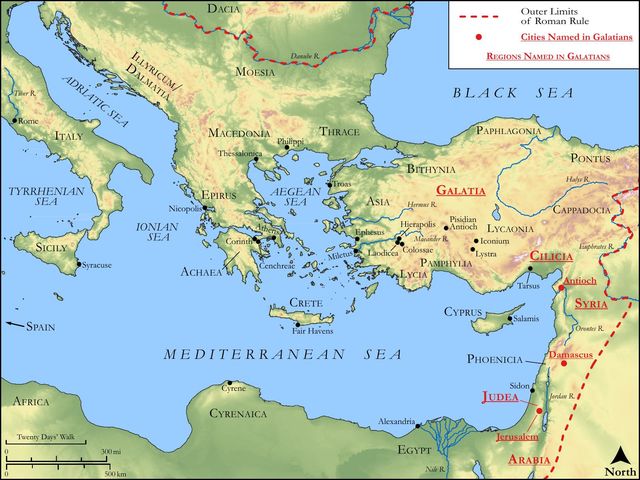
See on the biblical-era maps

Study this verse
Public-domain commentary
Matthew Henry
From his Commentary on the Whole Bible. Henry comments on passages, not single verses — this entry covers Galatians 6:11–18. His three-level outline is real structure in the source text, so it is rendered as structure.
The apostle, having at large established the doctrine of the gospel, and endeavoured to persuade these Christians to a behaviour agreeable to it, seems as if he intended here to have put an end to the epistle, especially when he had acquainted them that, as a particular mark of his respect for them, he had written this large letter with his own hand, and had not made use of another as his amanuensis, and only subscribed his name to it, as he was wont to do in his other epistles: but such is his affection to them such his concern to recover them from the bad impressions made upon them by their false teachers, that he cannot break off till he has once again given them the true character of those teachers, and an account of his own contrary temper and behaviour, that by comparing these together they might the more easily see how little reason they had to depart from the doctrine he had taught them and to comply with theirs.
I.He gives them the true character of those teachers who were industrious to seduce them, in several particulars. As,
1.They were men who desired to make a fair show in the flesh, Gal 6:12. They were very zealous for the externals of religion, forward to observe, and to oblige others to observe, the rites of the ceremonial law, though at the same time they had little or no regard to real piety; for, as the apostle says of them in the following verse, neither do they themselves keep the law. Proud, vain, and carnal hearts desire nothing more than to make a fair show in the flesh, and they can easily be content with so much religion as will help them to keep up such a fair show; but frequently those have least of the substance of religion who are most solicitous to make a show of it.
2.They were men who were afraid of suffering, for they constrained the Gentile Christians to be circumcised, only lest they should suffer persecution for the cross of Christ. It was not so much out of a regard to the law as to themselves; they were willing to sleep in a whole skin, and to save their worldly cargo, and cared not though they made shipwreck of faith and a good conscience. That which they chiefly aimed at was to please the Jews, and to keep up their reputation among them, and so to prevent the trouble that Paul, and other faithful professors of the doctrine of Christ, lay open to. And,
3.Another part of their character was that they were men of a party spirit, and who had no further zeal for the law than as it subserved their carnal and selfish designs; for they desired to have these Christians circumcised, that they might glory in their flesh (Gal 6:13), that they might say they had gained them over to their side, and made proselytes of them, of which they carried the mark in their flesh. And thus, while they pretended to promote religion, they were the greatest enemies of it; for nothing has been more destructive to the interest of religion than men-siding and party-making.
II.He acquaints us, on the other hand, with his own temper and behaviour, or makes profession of his own faith, hope, and joy; particularly,
1.That his principle glory was in the cross of Christ: God forbid, says he, that I should glory, save in the cross of our Lord Jesus Christ, Gal 6:14. By the cross of Christ is here meant his sufferings and death on the cross, or the doctrine of salvation by a crucified Redeemer. This was what the Jews stumbled at and the Greeks accounted foolishness; and the judaizing teachers themselves, though they had embraced Christianity, yet were so far ashamed of it that in compliance with the Jews, and to avoid persecution from them, they were for mixing the observance of the law of Moses with faith in Christ, as necessary to salvation. But Paul had a very different opinion of it; he was so far from being offended at the cross of Christ, or ashamed of it, or afraid to own it, that he gloried in it; yea, he desired to glory in nothing else, and rejected the thought of setting up anything in competition with it, as the object of his esteem, with the utmost abhorrence; God forbid, etc. This was the ground of all his hope as a Christian: this was the doctrine which, as an apostle, he was resolved to preach; and, whatever trials his firm adherence to it might bring upon him, he was ready, not only to submit to them, but to rejoice in them. Note, The cross of Christ is a good Christian's chief glory, and there is the greatest reason why we should glory in it, for to it we owe all our joys and hopes.
2.That he was dead to the world. By Christ, or by the cross of Christ, the world was crucified to him, and he to the world; he had experienced the power and virtue of it in weaning him from the world, and this was one great reason of his glorying in it. The false teachers were men of a worldly temper, their chief concern was about their secular interests, and therefore they accommodated their religion thereunto. But Paul was a man of another spirit; as the world had no kindness for him, so neither had he any great regard to it; he had got above both the smiles and the frowns of it, and had become as indifferent to it as one who is dying out of it. This is a temper of mind that all Christians should be labouring after; and the best way to attain it is to converse much with the cross of Christ. The higher esteem we have of him the meaner opinion shall we have of the world, and the more we contemplate the sufferings our dear Redeemer met with from the world the less likely shall we be to be in love with it.
3.That he did not lay the stress of his religion on one side or the other of the contesting interests, but on sound Christianity, Gal 6:15. There was at that time an unhappy division among Christians; circumcision and uncircumcision had become names by which they were distinguished from each other; for (Gal 2:9, Gal 2:12) the Jewish Christians are called the circumcision, and those of the circumcision. The false teachers were very zealous for circumcision; yea, to such a degree as to represent it as necessary to salvation, and therefore they did all they could to constrain the Gentile Christians to submit to it. In this they had carried the matter much further than others did; for, though the apostles connived at the use of it among the Jewish converts, yet they were by no means for imposing it upon the Gentiles. But what they laid so great a stress upon Paul made very little account of. It was indeed of great importance to the interest of Christianity that circumcision should not be imposed on the Gentile converts, and therefore this he had set himself with the utmost vigour to oppose; but as for mere circumcision or uncircumcision, whether those who embraced the Christian religion had been Jews or Gentiles, and whether they were for or against continuing the use of circumcision, so that they did not place their religion in it - this was comparatively a matter of little moment with him; for he very well knew that in Jesus Christ, that is, in his account, or under the Christian dispensation, neither circumcision availed any thing nor uncircumcision, as to men's acceptance with God, but a new creature. Here he instructs us both wherein real religion does not and wherein it does consist. It does not consist in circumcision or uncircumcision, in our being in this or the other denomination of Christians; but it consists in our being new creatures; not in having a new name, or putting on a new face, but in our being renewed in the spirit of our minds and having Christ formed in us: this is of the greatest account with God, and so it was with the apostle. If we compare this text with some others, we may more fully see what it is that renders us most acceptable to God, and about which we should therefore be chiefly concerned. Here we are told that it is a new creature, and in Gal 5:6 that it is faith which worketh by love, and in Co1 7:19 that it is the keeping of the commandments of God, from all which it appears that it is a change of mind and heart, whereby we are disposed and enabled to believe in the Lord Jesus and to live a life of devotedness to God; and that where this inward, vital, practical religion is wanting, no outward professions, nor particular names, will ever stand us in any stead, or be sufficient to recommend us to him. Were Christians duly concerned to experience this in themselves, and to promote it in others, if it did not make them lay aside their distinguishing names, yet it would at least take them off from laying so great a stress upon them as they too often do. Note, Christians should take care to lay the stress of their religion where God has laid it, namely, on those things which are available to our acceptance with him; so we see the apostle did, and it is our wisdom and interest herein to follow his example. The apostle having shown what was of chief consideration in religion, and what he laid the greatest stress upon, namely, not a mere empty name or profession, but a sound and saving change, in Gal 6:16 he pronounces a blessing upon all those who walk according to this rule: And as many as walk according to this rule peace be upon them, and mercy upon the Israel of God. The rule which he here speaks of may signify more generally the whole word of God, which is the complete and perfect rule of faith and life, or that doctrine of the gospel, or way of justification and salvation, which he had laid down in this epistle, namely, by faith in Christ without the works of the law; or it may be considered as more immediately referring to the new creature, of which he had just before been speaking. The blessings which he desires for those who walk according to this rule, or which he gives them the hope and prospect of (for the words may be taken either as a prayer or a promise), are peace and mercy - peace with God and conscience, and all the comforts of this life as far as they are needful for them, and mercy, or an interest in the free love and favour of God in Christ, which are the spring and fountain of all other blessings. A foundation is laid for these in that gracious change which is wrought in them; and while they behave themselves as new creatures, and govern their lives and hopes by the rule of the gospel, they may most assuredly depend upon them. These, he declares, shall be the portion of all the Israel of God, by whom he means all sincere Christians, whether Jews or Gentiles, all who are Israelites indeed, who, though they may not be the natural, yet are become the spiritual seed of Abraham; these, being heirs of his faith, are also heirs together with him of the same promise, and consequently entitled to the peace and mercy here spoken of. The Jews and judaizing teachers were for confining these blessings to such as were circumcised and kept the law of Moses; but, on the contrary, the apostle declares that they belong to all who walk according to the rule of the gospel, or of the new creature, even to all the Israel of God, intimating that those only are the true Israel of God who walk according to this rule, and not that of circumcision, which they insisted so much upon, and therefore that this was the true way to obtain peace and mercy. Note,
(1.)Real Christians are such as walk by rule; not a rule of their own devising, but that which God himself has prescribed to them.
(2.)Even those who walk according to this rule do yet stand in need of the mercy of God. But,
(3.)All who sincerely endeavour to walk according to this rule may be assured that peace and mercy will be upon them: this is the best way to have peace with God, ourselves, and others; and hereupon, as we may be sure of the favour of God now, so we may be sure that we shall find mercy with him hereafter.
4.That he had cheerfully suffered persecution for the sake of Christ and Christianity, Gal 6:17. As the cross of Christ, or the doctrine of salvation by a crucified Redeemer, was what he chiefly gloried in, so he had been willing to run all hazards rather than he would betray this truth, or suffer it to be corrupted. The false teachers were afraid of persecution, and this was the great reason why they were zealous for circumcision, as we see, Gal 6:12. But this was the least of Paul's concern; he was not moved at any of the afflictions he met with, nor did he count his life dear to him, so that he might finish his course with joy, and the ministry which he had received of the Lord Jesus, to testify the gospel of the grace of God, Act 20:24. He had already suffered much in the cause of Christ, for he bore in his body the marks of the Lord Jesus, the scars of those wounds which he had sustained from persecuting enemies, for his steady adherence to him, and that doctrine of the gospel which he had received from him. As from this it appeared that he was firmly persuaded of the truth and importance of it, and that he was far from being a favourer of circumcision, as they had falsely reported him to be, so hereupon, with a becoming warmth and vehemence, suitable to his authority as an apostle and to the deep concern of mind he was under, he insists upon it that no man should henceforth trouble him, namely by opposing his doctrine or authority, or by any such calumnies and reproaches as had been cast upon him; for as, both from what he had said and what he had suffered, they appeared to be highly unjust and injurious, so also those were very unreasonable who either raised or received them. Note, (1.) It may justly be presumed that men are fully persuaded of those truths in the defence of which they are willing to suffer. And (2.) It is very unjust to charge those things upon others which are contrary not only to their profession, but their sufferings too.
III.The apostle, having now finished what he intended to write for the conviction and recovery of the churches of Galatia, concludes the epistle with his apostolical benediction, Gal 6:18. He calls them his brethren, wherein he shows his great humility, and the tender affection he had for them, notwithstanding the ill treatment he had met with from them; and takes his leave of them with this very serious and affectionate prayer, that the grace of our Lord Jesus Christ may be with their spirit. This was a usual farewell wish of the apostle's, as we see, Rom 16:20, Rom 16:24, and Co1 16:23. And herein he prays that they might enjoy the favour of Christ, both in its special effects and its sensible evidences, that they might receive from him all that grace which was needful to guide them in their way, to strengthen them in their work, to establish them in their Christian course, and to encourage and comfort them under all the trials of life and the prospect of death itself. This is fitly called the grace of our Lord Jesus Christ, as he is both the sole purchaser and the appointed dispenser of it; and though these churches had done enough to forfeit it, by suffering themselves to be drawn into an opinion and practice highly dishonourable to Christ, as well as dangerous to them, yet, out of his great concern for them, and knowing of what importance it was to them, he earnestly desires it on their behalf; yea, that it might be with their spirit, that they might continually experience the influences of it upon their souls, disposing and enabling them to act with sincerity and uprightness in religion. We need desire no more to make us happy than the grace of our Lord Jesus Christ. This the apostle begs for these Christians, and therein shows us what we are chiefly concerned to obtain; and, both for their and our encouragement to hope for it, he adds his Amen.
Historical interpretation
Historical reception
3 surviving comments on this verse. Each one is dated, so this reads as a timeline rather than a list.
Select a marker to jump to its quote. Markers stagger vertically where authors wrote within a few decades of each other.
"For neither is circumcision any thing, nor uncircumcision, but a new creature. And as many as shall walk by this rule, peace be upon them, and mercy, and upon the Israel of God."
Observe the power of the Cross, to what a pitch it hath raised him! not only hath it put to death for him all mundane affairs, but hath set him far above the Old Dispensation. What can be comparable to this power? for the Cross hath persuaded him, who was willing to be slain and to slay others for the sake of circumcision, to leave it on a level with uncircumcision, and to seek for things strange and marvellous and above the heavens. This our rule of life he calls "a new creature," both on account of what is past, and of what is to come; of what is past, because our soul, which had grown old with the oldness of sin, hath been all at once renewed by baptism, as if it had been created again. Wherefore we require a new and heavenly rule of life. And of things to come, because both the heaven and the earth, and all the creation, shall with our bodies be translated into incorruption. Tell me not then, he says, of circumcision, which now availeth nothing; (for how shall it appear, when all things have undergone such a change?) but seek the new things of grace. For they who pursue these things shall enjoy peace and amity, and may properly be called by the name of "Israel." While they who hold contrary sentiments, although they be descended from him (Israel) and bear his appellation, have yet fallen away from all these things, both the relationship and the name itself. But it is in their power to be true Israelites, who keep this rule, who desist from the old ways, and follow after grace.
(v. 15) For neither circumcision is anything, nor uncircumcision, but a new creature. As faithful and unfaithful, when there is one in substance, are divided into two according to the diversity of understanding, the Apostle saying: Stripping yourselves of the old man with his works, and putting on the new, who is renewed unto knowledge according to the image of the Creator (Colossians 3:9-10): in the same way, the world, although it is one in substance, is made different according to the understanding. Sinners, the old world is: holy, new. For when the world has been crucified with the holy, neither circumcision nor uncircumcision is to it: not Jew, nor Gentile: but a new creature, into which the body of our humility is transformed, conformed to the body of the glory of Christ: For the old things have passed away, behold all things have become new (II Cor. V). And as the glory of the sun is different from the glory of the moon, and the glory of the stars: for star differs from star in glory: so also is the resurrection of the dead (I Cor. XV, 41, 42). About this, Daniel agrees with the same voice, saying: Many of those who sleep in the dust of the earth shall awake: some to everlasting life, and some to shame and everlasting contempt (Dan. XII, 2); and: Those who are wise shall shine like the brightness of the sky. And concerning the righteous: Many shall be like the stars forever. For neither circumcision counts for anything, nor uncircumcision, but a new creation without these parts of the body, which can be cut. So we also who love God, and the things that are prepared for us, which eye hath not seen, nor ear heard, neither hath it entered into the heart of man, what things God hath prepared for them that love him (1 Corinthians 2), when we shall be transformed in the body of the humility of Christ, into the body of the glory of the Lord Jesus Christ, shall have that kind of body that neither a Jew can oppose nor a Gentile preserve with circumcision. Not that it is anything else in substance, but that it is different in glory. For it is necessary for this mortal to put on immortality, and for this corruptible body to be clothed with incorruption (I Cor. XV, 53). This is similar to what the blessed evangelist John said: Beloved, we are now children of God, and it has not yet been revealed what we shall be. We know that when it is revealed, we shall be like Him, for we shall see Him as He is (I John III, 2). Therefore, since that body of the glory of Jesus Christ, which had the marks of the nails after the resurrection and entered through closed doors, has not yet been revealed, let us who have already been raised up with Christ in baptism, as new-born men, not serve circumcision or uncircumcision, but believe that we are already what we shall be in the future.
Paul also mentions a new creation in his letter to the Corinthians. … The strict meaning of new creation is the transformation of all things which will occur after the resurrection from the dead. For then the creation will be freed from sin’s burden and redeemed. Paul demonstrates that saving baptism is an image of things to come. In it we put off the old nature and put on the new. And we, ridding ourselves of sin’s burden, receive the grace of the Spirit. Yet neither the most holy baptism nor the life to come recognizes any difference between circumcision and uncircumcision. By world he means the affairs of life—honor, glory and wealth. To these he declares himself dead.
Continue studying Galatians 6:15 across the web’s major study libraries — every link below opens this exact verse, chapter, or book on the destination site.
Read & Compare
 BibleGatewayThis verse in more than 200 translations and 70 languages.
 Bible.comThe YouVersion reader — hundreds of translations, reading plans, and highlights.
 ESV.orgCrossway's official English Standard Version reader.
 NET BibleThe NET translation with 60,000+ translators' notes on every rendering decision.
 STEP BibleTyndale House's free study tool — original text, vocabulary, and scholarly resources.
 BibliaLogos Bible Software's free web reader.
 USCCBThe New American Bible (Revised Edition) with the U.S. bishops' study notes.
Commentaries
 BibleHub CommentariesDozens of classic commentaries on this verse, gathered on one page.
 StudyLightMore than 100 commentary sets — the largest collection on the web.
 BibleRefPlain-English commentary on what this verse means, verse by verse.
 Enduring WordDavid Guzik's free commentary on this chapter, widely used by Bible teachers.
 Bible Study ToolsVerse commentary alongside Greek and Hebrew study aids.
Original Language & Research
- BibleHub InterlinearThe verse word by word — original language, transliteration, and English.
- BibleHub LexiconEvery word's original-language definition and Strong's entry.
 Blue Letter BibleDeep-study tools — Strong's numbers, concordance, and word studies.
 CNTR CollationThe earliest Greek manuscripts of this verse, collated letter by letter.
Sermons, Hymns & Audio


TrulyRandomVerse is not affiliated with these sites and doesn’t control their content. They’re linked because they’re genuinely useful.
Summary
Galatians 6:15 encapsulates a foundational truth of the New Covenant: spiritual standing and acceptance before God are not determined by external religious markers or ethnic distinctions, such as circumcision or uncircumcision. Instead, the sole criterion for genuine belonging and spiritual efficacy in Christ Jesus is the radical, divine transformation into a "new creature," signifying an inward, qualitative renewal of one's entire being by the power of God.
Context
ShowHideLiterary Context
This verse serves as a powerful summary statement near the conclusion of Paul's letter to the Galatian churches. It immediately follows Paul's profound declaration in Galatians 6:14, where he asserts that his only boast is in the cross of Jesus Christ, through which he has been crucified to the world and the world to him. This preceding verse establishes the radical reorientation of values and identity that occurs in Christ, setting the stage for the irrelevance of external distinctions like circumcision. The broader context of Galatians is Paul's fervent defense of justification by faith alone against the "Judaizers," who insisted that Gentile converts must adopt Jewish customs, particularly circumcision, to be truly saved. Galatians 6:15 thus functions as a climactic theological pronouncement, distilling the core message of the entire epistle.
Historical & Cultural Context
Circumcision was the covenant sign given to Abraham and his descendants, marking them as God's chosen people (Genesis 17:9-14). By the time of the New Testament, it had become a deeply ingrained and highly revered symbol of Jewish identity, righteousness, and separation from the Gentiles. The "Judaizers" were Jewish Christians who believed that Gentile converts needed to be circumcised and observe the Mosaic Law to be full members of God's people and to truly inherit salvation. This teaching directly contradicted Paul's gospel of grace through faith. For Gentiles, "uncircumcision" represented their outsider status, their lack of covenant relationship with God according to Jewish understanding. Paul's statement in Galatians 6:15 directly challenges these deeply held cultural and religious assumptions, asserting that in the new era inaugurated by Christ, these physical markers are utterly devoid of spiritual value.
Key Themes
ShowHideGalatians 6:15 powerfully contributes to several overarching themes in Paul's theology and the book of Galatians. Primarily, it underscores the theme of Justification by Faith Alone, emphasizing that salvation is not earned through human works or adherence to ritual law, but is a gift received through faith in Christ. It highlights the Irrelevance of External Rituals for salvation and spiritual standing, dismantling the notion that physical acts or ethnic identity could commend one to God. Most significantly, it introduces and champions the theme of New Creation (or New Creature), positing that true transformation in Christ involves a radical, internal, spiritual rebirth that transcends all previous human distinctions. This "new creature" concept is central to understanding the nature of Christian identity and the transformative power of the Gospel, as seen in passages like 2 Corinthians 5:17. The verse also implicitly reinforces the theme of Grace Over Law, demonstrating that God's redemptive plan operates on the basis of His unmerited favor rather than human achievement.
Exposition and Analysis
ShowHideKey Word Analysis
ShowHideThis word means "to have (or exercise) force," "to be able," "to be of strength," or "to prevail." In this context, Paul uses it to emphatically declare that neither circumcision nor uncircumcision possesses any spiritual efficacy, power, or advantage in the context of salvation or one's standing before God in Christ. They are utterly powerless to contribute to or detract from one's spiritual condition.
This adjective signifies "new" in a qualitative sense, referring to something fresh, unprecedented, or of a different kind, rather than merely new in terms of time (for which the Greek word néos would be used). When applied to "creature," it implies a radical, qualitative renovation and spiritual transformation, indicating a fundamental change in nature and character, not just a chronological update.
Derived from the verb "to create," this noun refers to "original formation," "the act of creation," or "the thing created." In conjunction with kainós, it powerfully conveys the idea of a completely new creation, a being fundamentally re-formed and transformed by divine power. It speaks to a radical re-genesis of the individual, not merely a modification of the old self.
Verse Breakdown
ShowHide"For in Christ Jesus"
This opening phrase establishes the sphere or realm in which the subsequent truth operates. It signifies that this principle is true only within the context of a saving relationship with Jesus Christ, where His finished work is the foundation. It is a statement about the reality of the New Covenant inaugurated by Christ.
"neither circumcision availeth any thing, nor uncircumcision"
This clause directly addresses the core controversy in Galatia. Paul asserts that the physical act of circumcision, so central to Jewish identity and the Judaizers' message, holds no spiritual value or advantage for salvation. Likewise, the state of uncircumcision (being a Gentile) offers no disadvantage. Both external statuses are rendered spiritually null and void in the economy of Christ's salvation.
"but a new creature"
This is the emphatic contrast and the positive declaration of what truly matters. Instead of external markers, what "availeth" is a radical, internal transformation. To be a "new creature" signifies a spiritual rebirth, a fundamental re-creation of one's inner being by God's Spirit. This new identity, characterized by a renewed heart, mind, and purpose, is the sole distinguishing mark of those who truly belong to Christ.
Literary Devices
ShowHidePaul employs several potent literary devices in Galatians 6:15 to convey his message with clarity and force. The most prominent is Antithesis, where he sets up a direct opposition between "circumcision" and "uncircumcision" as things that "avail nothing," contrasting them sharply with "a new creature" as the sole thing that truly matters. This stark contrast highlights the radical shift from external, human-made distinctions to internal, divinely-wrought transformation. Furthermore, the phrase "a new creature" functions as a powerful Metaphor for spiritual regeneration. It's not a literal new biological entity, but a profound spiritual reality that likens the believer's transformation to an act of divine creation, akin to God's original work in Genesis. This metaphor emphasizes the comprehensive and supernatural nature of the change. Finally, the concise and declarative nature of the verse, especially with the use of "but" (allá), lends it an air of Emphasis, drawing the reader's attention directly to the pivotal truth of the new creation as the ultimate criterion.
Theological and Thematic Connections
ShowHideGalatians 6:15 is a theological cornerstone, underscoring the radical discontinuity between the Old Covenant's emphasis on external markers and the New Covenant's focus on internal, spiritual transformation. It declares that God's saving work in Christ transcends all human distinctions—ethnic, social, or religious—and establishes a new basis for belonging: a spiritual rebirth that re-creates the individual at their core. This "new creature" is not merely an improved version of the old self but a fundamentally re-oriented being, living under the reign of grace rather than the law. This concept profoundly shapes our understanding of Christian identity, unity, and the nature of true righteousness, shifting the focus from human effort and lineage to divine initiative and radical spiritual renewal.
Reflection and Application
ShowHideGalatians 6:15 provides a timeless and profoundly liberating truth for believers today, urging us to look beyond superficial religious practices and external affiliations to the heart of what truly defines a follower of Christ. In a world often preoccupied with outward appearances, denominational labels, or cultural traditions, this verse calls us back to the essential: a genuine, Spirit-wrought transformation of our inner being. It challenges us to examine whether our faith is merely a set of rules we adhere to or a vibrant, living relationship with Christ that has fundamentally reshaped who we are. The call to be a "new creature" means that our desires, motivations, values, and actions should increasingly reflect the character of Christ, demonstrating that we are indeed "born again" not of human will, but of God (John 1:13). This transformation fosters unity within the body of Christ, reminding us that our shared identity in Him transcends all earthly distinctions, whether they be race, gender, socio-economic status, or even our specific church traditions.
Questions for Reflection
ShowHideFAQ
ShowHideWhat does Paul mean by "availeth any thing" in Galatians 6:15?
ShowHideWhen Paul states that "neither circumcision availeth any thing, nor uncircumcision," he is asserting that these external conditions or religious practices have no spiritual power, efficacy, or advantage whatsoever in the context of salvation or one's standing before God. The Greek word translated "availeth" (ischýō) means to "have force" or "be strong." Paul's point is that in the new covenant reality established by Christ, God no longer evaluates individuals based on their adherence to ritual law or their ethnic background. These things are spiritually null and void; they cannot contribute to or detract from one's righteousness or acceptance with God. The only thing that truly "avails" or has spiritual force is the internal transformation into a "new creature," which is a work of God's grace through faith in Jesus Christ (Galatians 5:6 also makes a similar point, emphasizing "faith which worketh by love").
What is a "new creature" and how does one become one?
ShowHideA "new creature" (kainē ktísis in Greek) refers to a radical, spiritual transformation of an individual, akin to a new act of creation by God. It signifies a complete renewal of one's inner being, where old ways of thinking, desiring, and living are replaced by new ones aligned with God's will. This is not merely an improvement of the old self but a fundamental re-genesis, a spiritual rebirth. One becomes a "new creature" through faith in Jesus Christ, as the Holy Spirit regenerates the heart and mind. This concept is beautifully articulated in 2 Corinthians 5:17: "Therefore if any man be in Christ, he is a new creature: old things are passed away; behold, all things are become new." It is a work of divine grace, not human effort, and it marks the true beginning of a life lived in union with Christ.
Christ-Centered Fulfillment
ShowHideGalatians 6:15 finds its profound Christ-centered fulfillment in the person and work of Jesus, for it is "in Christ Jesus" that the old distinctions lose their power and the new creation becomes a reality. Christ's perfect life, atoning death on the cross, and glorious resurrection are the very means by which this radical transformation is made possible. He is the template for this "new creature," the firstborn of a new humanity (Colossians 1:15). Through His sacrifice, Christ has rendered the Old Covenant system, with its emphasis on external rituals like circumcision, obsolete as a means of righteousness, ushering in a New Covenant based on grace and an internal work of the Spirit (Hebrews 8:6-13). When we are united with Christ by faith, we participate in His death to the old self and His resurrection to a new life (Romans 6:3-11). Thus, the "new creature" is not merely a theological concept but a living reality forged in union with the resurrected Christ, whose Spirit indwells believers, empowering them to walk in newness of life and bear the fruit of righteousness (Galatians 5:22-23). The ultimate "avail" is found not in human performance, but in Christ's finished work, which creates a people transformed from within, reflecting His glory.