


1 Thessalonians 5:26
Bible text: King James Version (1769 Blayney text) · Public domain
Bible text: Berean Standard Bible · Public domain
Bible text: American Standard Version (1901) · Public domain
Bible text: World English Bible, Messianic edition · Public domain
Bible text: Geneva Bible (1599) · Public domain
Bible text: Young's Literal Translation · Public domain
- ἈσπάσασθεAspasasthedo greetG782V-ADM-2PVerb Aorist Middle Deponent Imperative 2nd Plural
- τοὺςtoustheG3588T-APMDefinite article Accusative Plural Masculine
- ἀδελφοὺςadelphousbrothersG80N-APMNoun Accusative Plural Masculine
- πάνταςpantasallG3956A-APMAdjective Accusative Plural Masculine
- ἐνenwithG1722PREPPreposition
- φιλήματιphilēmatia kissG5370N-DSNNoun Dative Singular Neuter
- ἁγίῳhagiōholyG40A-DSNAdjective Dative Singular Neuter
English is a literal word-by-word gloss of the Greek, not the KJV's wording. Why?
This is the original text the KJV's translators worked from — each Greek word with its own literal English meaning in this verse, prepared by scholars at Tyndale House, Cambridge. The KJV translates whole sentences, not word by word, so its wording differs: one Greek word can become several English words, and the KJV may choose “charity” where the gloss reads “love”. Both are faithful — they answer different questions. For the KJV's own rendering, switch to the KJV text.
Details
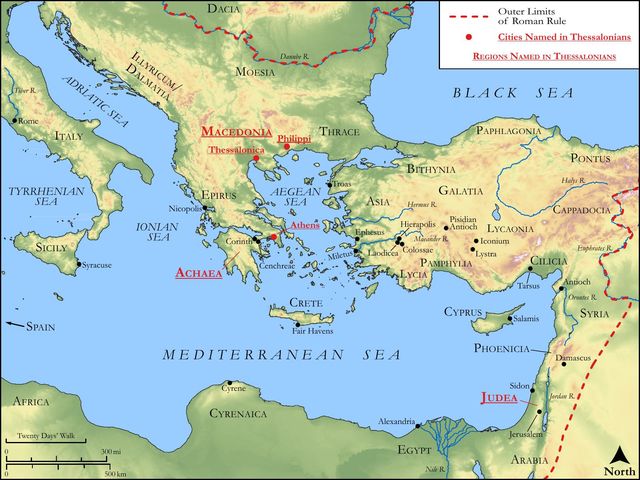
See on the biblical-era maps

Study this verse
Public-domain commentary
Matthew Henry
From his Commentary on the Whole Bible. Henry comments on passages, not single verses — this entry covers 1 Thessalonians 5:23–28. His two-level outline is real structure in the source text, so it is rendered as structure.
In these words, which conclude this epistle, observe,
I.Paul's prayer for them, Th1 5:23.
He had told them, in the beginning of this epistle, that he always made mention of them in his prayers; and, now that he is writing to them, he lifts up his heart to God in prayer for them. Take notice,
1.To whom the apostle prays, namely, The very God of peace. He is the God of grace, and the God of peace and love. He is the author of peace and lover of concord; and by their peaceableness and unity, from God as the author, those things would best be obtained which he prays for.
2.The things he prays for on behalf of the Thessalonians are their sanctification, that God would sanctify them wholly; and their preservation, that they might be preserved blameless. He prays that they may be wholly sanctified, that the whole man may be sanctified, and then that the whole man, spirit, soul, and body, may be preserved: or, he prays that they may be wholly sanctified, that is, more perfectly, for the best are sanctified but in part while in this world; and therefore we should pray for and press towards complete sanctification. Where the good work of grace is begun, it shall be carried on, be protected and preserved; and all those who are sanctified in Christ Jesus shall be preserved to the coming of our Lord Jesus Christ. And because, if God did not carry on his good work in the soul, it would miscarry, we should pray to God to perfect his work, and preserve us blameless, free from sin and impurity, till at length we are presented faultless before the throne of his glory with exceeding joy.
II.His comfortable assurance that God would hear his prayer:
Faithful is he who calleth you, who will also do it, Th1 5:24. The kindness and love of God had appeared to them in calling them to the knowledge of his truth, and the faithfulness of God was their security that they should persevere to the end; and therefore, the apostle assures them, God would do what he desired; he would effect what he had promised; he would accomplish all the good pleasure of his goodness towards them. Note, Our fidelity to God depends upon his faithfulness to us.
III.His request of their prayers:
Brethren, pray for us, Th1 5:25. We should pray for one another; and brethren should thus express brotherly love. This great apostle did not think it beneath him to call the Thessalonians brethren, nor to request their prayers. Ministers stand in need of their people's prayers; and the more people pray for their ministers the more good ministers may have from God, and the more benefit people may receive by their ministry.
IV.His salutation:
Greet all the brethren with a holy kiss, Th1 5:26. Thus the apostle sends a friendly salutation from himself, and Silvanus, and Timotheus, and would have them salute each other in their names; and thus he would have them signify their mutual love and affection to one another by the kiss of charity (Pe1 5:14), which is here called a holy kiss, to intimate how cautious they should be of all impurity in the use of this ceremony, then commonly practised; as it should not be a treacherous kiss like that of Judas, so not a lascivious kiss like that of the harlot, Pro 7:13.
V.His solemn charge for the reading of this epistle, Th1 5:27.
This is not only an exhortation, but an adjuration by the Lord. And this epistle was to be read to all the holy brethren. It is not only allowed to the common people to read the scriptures, and what none should prohibit, but it is their indispensable duty, and what they should be persuaded to do. In order to this, these holy oracles should not be kept concealed in an unknown tongue, but translated into the vulgar languages, that all men, being concerned to know the scriptures, may be able to read them, and be acquainted with them. The public reading of the law was one part of the worship of the sabbath among the Jews in their synagogues, and the scriptures should be read in the public assemblies of Christians also.
VI.The apostolical benediction that is usual in other epistles:
The grace of our Lord Jesus Christ be with you. Amen, Th1 5:28. We need no more to make us happy than to know that grace which our Lord Jesus Christ has manifested, be interested in that grace which he has purchased, and partake of that grace which dwells in him as the head of the church. This is an ever-flowing and overflowing fountain of grace to supply all our wants.
Historical interpretation
Two Centuries of Reception
2 surviving comments on this verse. Each one is dated, so this reads as a timeline rather than a list.
Select a marker to jump to its quote. Markers stagger vertically where authors wrote within a few decades of each other.
But when is peace more to be concluded with brethren than when, at the time of some religious observance, our prayer ascends with more acceptability; that they may themselves participate in our observance, and thereby be mollified for transacting with their brother touching. their own peace? What prayer is complete if divorced from the "holy kiss? " Whom does peace impede when rendering service to his Lord? What kind of sacrifice is that from which men depart without peace? Whatever our prayer be, it will not be better than the observance of the precept by which we are bidden to conceal our fasts; for now, by abstinence from the kiss, we are known to be fasting.
"Salute all the brethren with a holy kiss."
Oh! what fervor! Oh! what mad passion is here! Because being absent he could not greet them with the kiss, he greets them through others, as when we say, Kiss him for me. So also do ye yourselves retain the fire of love. For it does not admit of distances, but even through long intervening ways it extends itself, and is everywhere present.
Continue studying 1 Thessalonians 5:26 across the web’s major study libraries — every link below opens this exact verse, chapter, or book on the destination site.
Read & Compare
 BibleGatewayThis verse in more than 200 translations and 70 languages.
 Bible.comThe YouVersion reader — hundreds of translations, reading plans, and highlights.
 ESV.orgCrossway's official English Standard Version reader.
 NET BibleThe NET translation with 60,000+ translators' notes on every rendering decision.
 STEP BibleTyndale House's free study tool — original text, vocabulary, and scholarly resources.
 BibliaLogos Bible Software's free web reader.
 USCCBThe New American Bible (Revised Edition) with the U.S. bishops' study notes.
Commentaries
 BibleHub CommentariesDozens of classic commentaries on this verse, gathered on one page.
 StudyLightMore than 100 commentary sets — the largest collection on the web.
 BibleRefPlain-English commentary on what this verse means, verse by verse.
 Enduring WordDavid Guzik's free commentary on this chapter, widely used by Bible teachers.
 Bible Study ToolsVerse commentary alongside Greek and Hebrew study aids.
Original Language & Research
- BibleHub InterlinearThe verse word by word — original language, transliteration, and English.
- BibleHub LexiconEvery word's original-language definition and Strong's entry.
 Blue Letter BibleDeep-study tools — Strong's numbers, concordance, and word studies.
 CNTR CollationThe earliest Greek manuscripts of this verse, collated letter by letter.
Sermons, Hymns & Audio


TrulyRandomVerse is not affiliated with these sites and doesn’t control their content. They’re linked because they’re genuinely useful.
Summary
The Apostle Paul's concise command in 1 Thessalonians 5:26 instructs believers to "Greet all the brethren with an holy kiss," serving as a concluding practical exhortation that underscores the profound importance of Christian fellowship, unity, and pure affection within the early church community. This directive, while culturally specific to its time, encapsulates timeless principles of brotherly love, mutual respect, and the sanctified nature of relationships among those who share faith in Christ.
Context
ShowHideLiterary Context
This verse appears at the conclusion of Paul's first epistle to the Thessalonians, following a series of comprehensive practical instructions and exhortations that begin in 1 Thessalonians 4:1. Chapters 4 and 5 shift from theological teaching to ethical living, covering topics such as sexual purity, brotherly love, living a quiet life, the coming of the Lord, and various spiritual duties within the community. Specifically, 1 Thessalonians 5 includes admonitions regarding vigilance for the Lord's return, respecting leaders, encouraging the faint-hearted, helping the weak, being patient with everyone, and always pursuing good. The command to "greet all the brethren with an holy kiss" is part of Paul's final, rapid-fire directives, appearing just before his concluding benediction and personal remarks, emphasizing a tangible expression of the unity and love he has been urging throughout the letter. It serves as a practical, relational capstone to his ethical instructions.
Historical & Cultural Context
Among the Jews, Greeks and Romans of that day, a kiss was a common and versatile form of greeting, signifying various relationships from familial bonds to social respect, and was not exclusively romantic. Among Jews, it was a customary greeting between relatives and close friends, often on the cheek or hand. Early Christians adopted this practice, imbuing it with distinct spiritual meaning. The addition of the adjective "holy" (Greek: hagios) was crucial, distinguishing this Christian greeting from ordinary social customs. It underscored that this embrace was an expression of pure, consecrated love and unity within the community of believers, free from any worldly or impure connotations. This "kiss of peace" or "kiss of charity" became a distinctive mark of Christian identity and fellowship, practiced in gatherings and often preceding the Eucharist, symbolizing the reconciliation and unity of believers in Christ before partaking in the Lord's Supper.
Key Themes
ShowHideThe command to "greet all the brethren with an holy kiss" contributes significantly to several overarching themes in 1 Thessalonians and Pauline theology. It powerfully reinforces the theme of Christian Unity and Fellowship, emphasizing the active and tangible expression of belonging within the body of Christ, as seen in the call to "encourage one another and build one another up" in 1 Thessalonians 5:11. It also highlights Brotherly Love (Philadelphia), a central tenet of Christian ethics, where believers are called to genuine affection and care for one another, a theme Paul introduces earlier in 1 Thessalonians 4:9-10. The inclusion of "holy" underscores the theme of Sanctification and Purity, reminding believers that their relationships, like their lives, are to be set apart for God and reflect His holiness, a concept foundational to the entire epistle, particularly in 1 Thessalonians 4:3-7. Finally, the instruction to greet "all" the brethren speaks to Universal Reach, emphasizing that this expression of fellowship should extend universally to every member of the community, regardless of status or background, fostering a truly brotherly and welcoming fellowship within the church.
Exposition and Analysis
ShowHideKey Word Analysis
ShowHideThis verb, derived from a particle of union and a presumed form meaning "to draw," literally means "to enfold in the arms." By implication, it means "to salute" or "to welcome." In this context, it signifies a warm, personal, and embracing welcome, more than a mere acknowledgement. It suggests a genuine, heartfelt reception of another person into one's presence and fellowship.
This adjective, meaning "sacred," "pure," "morally blameless," or "ceremonially consecrated," is crucial. It transforms a common social custom into an act imbued with spiritual significance. It indicates that the kiss is not just a polite gesture but one that is set apart for God, reflecting the sanctified nature of the Christian community and its relationships, free from any impurity or worldly connotation.
This noun simply means "a kiss." While the word itself is straightforward, its meaning is profoundly shaped by the preceding adjective "holy." It refers to the physical act of kissing, which in that day was a common form of greeting among close associates. When combined with "holy," it designates a specific, consecrated form of this greeting within the Christian community.
Verse Breakdown
ShowHide"Greet all the brethren"
This is an imperative command, indicating a direct instruction from Paul. The verb "greet" (aspázomai) implies a warm, embracing welcome, not just a casual nod. The inclusion of "all" (pas) is significant, emphasizing the universal nature of this command within the Christian community; no one is to be excluded. "The brethren" (adelphos) refers to fellow believers, highlighting the familial bond shared by those in Christ. This clause establishes the recipients and the nature of the required interaction: a comprehensive, inclusive welcome to every member of the spiritual family.
"with an holy kiss"
This specifies the manner or instrument of the greeting. The preposition "with" (en) here denotes the means by which the greeting is to be performed. The "kiss" (phílēma) itself is the physical act, but it is qualified by "holy" (hágios). This adjective elevates the act from a mere social custom to a sacred expression. It denotes purity, sanctity, and a spiritual purpose, ensuring that the physical expression of affection is understood within a consecrated framework, reflecting the set-apart nature of the church and its relationships.
Literary Devices
ShowHideThe primary literary device at play in 1 Thessalonians 5:26 is Imperative Mood, as Paul issues a direct command ("Greet"). This highlights the authoritative nature of his instruction and the expectation for immediate obedience from the Thessalonian believers. Furthermore, Symbolism is central to the verse. The "holy kiss" is not merely a physical act but a potent symbol of Christian unity, brotherly love, and the purity of fellowship. It outwardly manifests an inward spiritual reality, representing the deep, sanctified bond shared by those in Christ. The adjective "holy" functions as a Modifier, transforming the common noun "kiss" into a distinctively Christian practice, emphasizing its consecrated nature and distinguishing it from secular greetings.
Theological and Thematic Connections
ShowHideThe command to "greet all the brethren with an holy kiss" transcends a mere social custom, serving as a profound theological statement about the nature of the Christian community. It underscores the reality that believers are not merely individuals who share a common belief, but members of a new spiritual family, united by their shared faith in Christ and indwelt by the Holy Spirit. This greeting, therefore, is an outward expression of an inward spiritual reality: the koinonia (fellowship) that binds believers together in purity and love. It reflects the call to a sanctified life that extends to all relational interactions within the church, emphasizing that even the most basic forms of human connection are to be consecrated to God and reflect His character. It is a tangible demonstration of the new humanity forged in Christ, where distinctions are transcended by the unifying power of divine love.
Reflection and Application
ShowHideWhile the literal practice of a "holy kiss" may not be culturally appropriate or customary in all contemporary societies, the enduring principle embedded in 1 Thessalonians 5:26 remains profoundly relevant for believers today. The verse calls us to cultivate and express genuine, pure, and inclusive affection for one another within the body of Christ. This means actively seeking to acknowledge, affirm, and welcome every member of our spiritual family, ensuring that no one feels overlooked, isolated, or unloved. In modern contexts, this might manifest as a warm, sincere handshake, a genuine hug, a welcoming smile, a thoughtful word of encouragement, or any culturally appropriate gesture that conveys Christian love, unity, and acceptance. The spirit of this command encourages us to be intentional in building strong, loving, and holy relationships, reflecting the very love of God to each other and, by extension, to a watching world that desperately needs to see authentic community. It challenges us to move beyond superficial interactions to foster deep, Christ-centered bonds that honor God and strengthen the church.
Questions for Reflection
ShowHideFAQ
ShowHideIs the "holy kiss" a literal command for all Christians today?
ShowHideWhile 1 Thessalonians 5:26 and similar verses in other epistles (Romans 16:16, 1 Corinthians 16:20, 2 Corinthians 13:12, 1 Peter 5:14) describe a literal practice in the early church, the emphasis is on the underlying principles of pure, sincere, and inclusive Christian fellowship. The "holy kiss" was a culturally specific expression of these principles. For Christians today, the command's essence is to express genuine, sanctified love and unity through culturally appropriate means. In cultures where a literal kiss between non-familial members might be misunderstood or cause discomfort, other gestures like a warm handshake, a hug, or a welcoming smile can fulfill the spirit of the command, ensuring that the love and purity of Christ are communicated effectively and without offense. The key is the "holy" nature of the greeting and the "all" universal reach, not necessarily the specific physical act itself.
Christ-Centered Fulfillment
ShowHideThe command to "greet all the brethren with an holy kiss" finds its ultimate fulfillment and deepest meaning in Christ, who is the very source and embodiment of our unity, holiness, and love. It is through Christ that we are made "brethren" in the first place, adopted into God's family (Ephesians 1:5). Our ability to extend a "holy kiss"—or any pure expression of love—stems from the holiness imputed to us by Christ's sacrifice (Hebrews 10:10) and the sanctifying work of the Holy Spirit, whom Christ sent (John 14:26). The unity that this greeting symbolizes points directly to Christ's prayer for His followers to be one, just as He and the Father are one (John 17:20-23). Furthermore, the "love" (agape) that undergirds this holy greeting is a direct reflection of Christ's sacrificial love for us, which serves as the new commandment for His disciples (John 13:34-35). Thus, the "holy kiss" is not merely a social custom, but a Christ-empowered and Christ-reflecting act, testifying to the new life and new community established by His atoning work and ongoing presence.