


Exodus 9:26
Bible text: King James Version (1769 Blayney text) · Public domain
Bible text: Berean Standard Bible · Public domain
Bible text: American Standard Version (1901) · Public domain
Bible text: World English Bible, Messianic edition · Public domain
Bible text: Geneva Bible (1599) · Public domain
Bible text: Young's Literal Translation · Public domain
- רַקrakonlyH7535AdvAdverb
- בְּאֶרֶץbe·'E·retzin [the] land ofH776Prep-b ¦ N-fscNoun Singular Feminine Constructבְּinאֶרֶץ[the] land of
- גֹּשֶׁןGo·shenGoshenH1657N-properNoun Proper Location
- אֲשֶׁר'a·SherwhereH834RelParticle Relative
- שָׁםsham[were] thereH8033AdvAdverb
- בְּנֵיbe·Nei[the] people ofH1121N-mpcNoun Plural Masculine Construct
- יִשְׂרָאֵלYis·ra·'ElIsraelH3478N-properNoun Proper Location
- לֹאlo'notH3808NegParticle Negative
- הָיָהha·Yahit wasH1961V-Qal-Perf-3msVerb Qal Perfect 3rd Singular Masculine
- בָּרָדba·RadhailH1259N-msNoun Singular Masculine Absolute
English is a literal word-by-word gloss of the Hebrew, not the KJV's wording. Why?
This is the original text the KJV's translators worked from — each Hebrew word with its own literal English meaning in this verse, prepared by scholars at Tyndale House, Cambridge. The KJV translates whole sentences, not word by word, so its wording differs: one Hebrew word can become several English words, and the KJV may choose “the LORD” where the gloss reads “Yahweh”. Both are faithful — they answer different questions. For the KJV's own rendering, switch to the KJV text.
Details
See on the biblical-era maps

Study this verse
Public-domain commentary
Matthew Henry
From his Commentary on the Whole Bible. Henry comments on passages, not single verses — this entry covers Exodus 9:22–35. His four-level outline is real structure in the source text, so it is rendered as structure.
The threatened plague of hail is here summoned by the powerful hand and rod of Moses (Exo 9:22, Exo 9:23), and it obeys the summons, or rather the divine command; for fire and hail fulfil God's word, Psa 148:8. And here we are told,
I.What desolations it made upon the earth.
The thunder, and fire from heaven (or lightning), made it both the more dreadful and the more destroying, Exo 9:23, Exo 9:24. Note, God makes the clouds, not only his store-houses whence he drops fatness on his people, but his magazines whence, when he pleases, he can draw out a most formidable train of artillery, with which to destroy his enemies. He himself speaks of the treasures of hail which he hath reserved against the day of battle and war, Job 38:22, Job 38:23. Woeful havoc this hail made in the land of Egypt. It killed both men and cattle, and battered down, not only the herbs, but the trees, Exo 9:25. The corn that was above ground was destroyed, and that only preserved which as yet had not come up, Exo 9:31, Exo 9:32. Note, God has many ways of taking away the corn in the season thereof (Hos 2:9), either by a secret blasting, or a noisy hail. In this plague the hot thunderbolts, as well as the hail, are said to destroy their flocks, Psa 78:47, Psa 78:48; and see Psa 105:32, Psa 105:33. Perhaps David alludes to this when, describing God's glorious appearances for the discomfiture of his enemies, he speaks of the hailstones and coals of fire he threw among them, Psa 18:12, Psa 18:13. And there is a plan reference to it on the pouring out of the seventh vial, Rev 16:21. Notice is here taken (Exo 9:26) of the land of Goshen's being preserved from receiving any damage by this plague. God has the directing of the pregnant clouds, and causes it to rain or hail on one city and not on another, either in mercy or in judgment.
II.What a consternation it put Pharaoh in. See what effect it had upon him,
1.He humbled himself to Moses in the language of a penitent, Exo 9:27, Exo 9:28. No man could have spoken better. He owns himself on the wrong side in his contest with the God of the Hebrews: "I have sinned in standing it out so long." He owns the equity of God's proceedings against him: The Lord is righteous, and must be justified when he speaks, though he speak in thunder and lightning. He condemns himself and his land: "I and my people are wicked, and deserve what is brought upon us." He begs the prayers of Moses: "Entreat the Lord for me, that this direful plague may be removed." And, lastly, he promises to yield up his prisoners: I will let you go. What could one desire more? And yet his heart was hardened all this while. Note, The terror of the rod often extorts penitent acknowledgments from those who have no penitent affections; under the surprise and smart of affliction, they start up, and say that which is pertinent enough, not because they are deeply affected, but because they know that they should be and that it is meet to be said.
2.Moses, hereupon, becomes an intercessor for him with God. Though he had all the reason in the world to think that he would immediately repent of his repentance, and told him so (Exo 9:30), yet he promises to be this friend in the court of heaven. Note, Even those whom we have little hopes of, yet we should continue to pray for, and to admonish, Sa1 12:23. Observe,
(1.)The place Moses chose for his intercession. He went out of the city (Exo 9:33), not only for privacy in his communion with God, but to show that he durst venture abroad into the field, notwithstanding the hail and lightning which kept Pharaoh and his servants within doors, knowing that every hail-stone had its direction from his God, who meant him no hurt. Note, Peace with God makes men thunderproof, for thunder is the voice of their Father.
(2.)The gesture: He spread abroad his hands unto the Lord - an outward expression of earnest desire and humble expectation. Those that come to God for mercy must stand ready to receive it.
(3.)The end Moses aimed at in interceding for him: That thou mayest know, and be convinced, that the earth is the Lord's (Exo 9:29), that is, that God has a sovereign dominion over all the creatures, that they all are ruled by him, and therefore that thou oughtest to be so. See what various methods God uses to bring men to their proper senses. Judgments are sent, judgments removed, and all for the same end, to make men know that he Lord reigns.
(4.)The success of it.
[1.]He prevailed with God, Exo 9:33. But,
[2.]He could not prevail with Pharaoh: He sinned yet more, and hardened his heart, Exo 9:34, Exo 9:35. The prayer of Moses opened and shut heaven, like Elias's (Jam 5:17, Jam 5:18), and such is the power of God's two witnesses (Rev 11:6); yet neither Moses nor Elias, nor those two witnesses, could subdue the hard hearts of men. Pharaoh was frightened into a compliance by the judgment, but, when it was over, his convictions vanished, and his fair promises were forgotten. Note, Little credit is to be given to confessions upon the rack. Note also, Those that are not bettered by judgments and mercies are commonly made worse.
Continue studying Exodus 9:26 across the web’s major study libraries — every link below opens this exact verse, chapter, or book on the destination site.
Read & Compare
 BibleGatewayThis verse in more than 200 translations and 70 languages.
 Bible.comThe YouVersion reader — hundreds of translations, reading plans, and highlights.
 ESV.orgCrossway's official English Standard Version reader.
 NET BibleThe NET translation with 60,000+ translators' notes on every rendering decision.
 STEP BibleTyndale House's free study tool — original text, vocabulary, and scholarly resources.
 BibliaLogos Bible Software's free web reader.
 USCCBThe New American Bible (Revised Edition) with the U.S. bishops' study notes.
Commentaries
 BibleHub CommentariesDozens of classic commentaries on this verse, gathered on one page.
 StudyLightMore than 100 commentary sets — the largest collection on the web.
 BibleRefPlain-English commentary on what this verse means, verse by verse.
 Enduring WordDavid Guzik's free commentary on this chapter, widely used by Bible teachers.
 Bible Study ToolsVerse commentary alongside Greek and Hebrew study aids.
Original Language & Research
- BibleHub InterlinearThe verse word by word — original language, transliteration, and English.
- BibleHub LexiconEvery word's original-language definition and Strong's entry.
 Blue Letter BibleDeep-study tools — Strong's numbers, concordance, and word studies.
 SefariaThe Hebrew text with Rashi and centuries of Jewish commentary.
Sermons, Hymns & Audio


TrulyRandomVerse is not affiliated with these sites and doesn’t control their content. They’re linked because they’re genuinely useful.
Summary
Exodus 9:26 serves as a profound testament to God's precise and protective sovereignty, vividly illustrating the miraculous distinction He made between Israel and Egypt during the devastating seventh plague of hail. While divine judgment in the form of a destructive hailstorm ravaged the entire land of Egypt, the fertile region of Goshen, where the children of Israel resided, remained miraculously untouched. This singular exemption underscored God's unwavering faithfulness to His covenant, His absolute control over creation, and His tender, discerning care for His chosen people amidst widespread calamity.
Context
ShowHideLiterary Context
This verse is strategically placed within the escalating narrative of the ten plagues God sent upon Egypt to force Pharaoh's hand and secure the release of His enslaved people. Specifically, Exodus 9:26 immediately follows the vivid description of the seventh plague, a catastrophic storm of hail and fire that devastated the land, destroying crops, livestock, and people in the open fields (Exodus 9:25). The narrative consistently highlights God's ability to differentiate between the Egyptians and the Israelites, a theme that began with the plague of flies (Exodus 8:22-23) and continued with the livestock plague (Exodus 9:4-6). This persistent emphasis on divine distinction builds anticipation for Israel's eventual exodus and God's ultimate triumph over Pharaoh and his gods.
Historical & Cultural Context
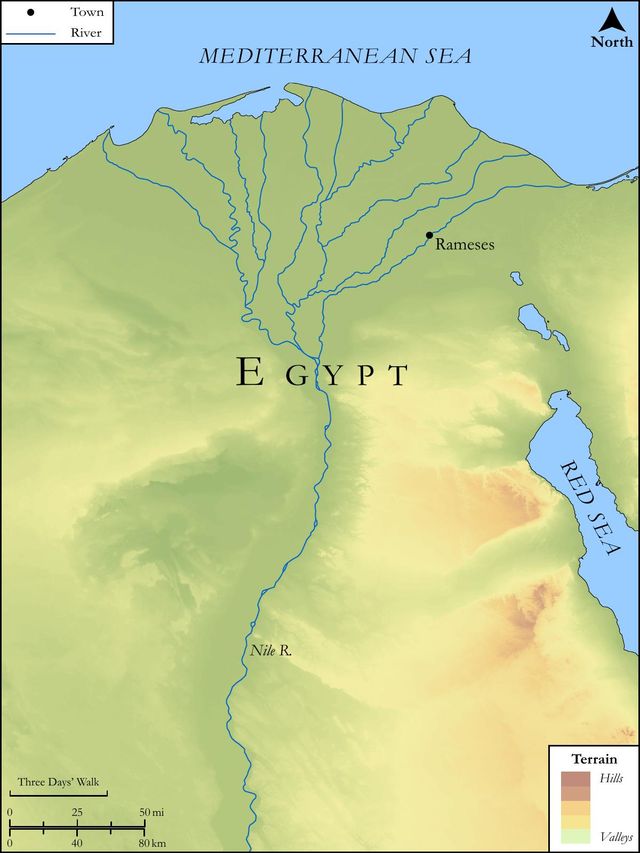
The "land of Goshen" (Hebrew: Gôshen) was a fertile and distinct region located in the eastern Nile Delta, where Jacob and his family had been settled by Pharaoh centuries earlier, as recorded in Genesis 47:6. This geographical separation from the main Egyptian population centers facilitated the clear demonstration of God's selective judgment. The plagues themselves were not merely natural disasters but direct confrontations with the pantheon of Egyptian deities, challenging their supposed dominion over various aspects of creation. The hail plague, in particular, directly assailed deities associated with the sky (e.g., Nut), air (e.g., Shu), and agricultural fertility (e.g., Osiris, Min), proving Yahweh's supreme authority over all creation and every false god. God's precise targeting of Egypt while sparing Goshen served as a public, undeniable declaration of His unique covenant relationship with Israel and His absolute, unrivaled control over the natural world.
Key Themes
ShowHideExodus 9:26 powerfully contributes to several overarching themes in the book of Exodus and the broader Pentateuch. Firstly, it underscores the theme of Divine Distinction and Separation, highlighting God's active choice to set apart His covenant people from the nations that oppose Him. Secondly, it exemplifies Divine Protection and Provision, demonstrating God's unwavering commitment to safeguard those He loves, even amidst widespread calamity and judgment. This theme is foundational to Israel's identity as God's chosen nation. Thirdly, the selective nature of the plague powerfully asserts the Sovereignty of God over all creation, including the elements, natural forces, and the destinies of nations and individuals. He alone commands judgment and mercy with absolute precision. Finally, this verse reinforces the theme of God's Faithfulness to His Covenant Promises, particularly those made to Abraham, Isaac, and Jacob, to multiply their descendants and to be their God (Genesis 12:1-3). The protection of Israel in Goshen was a tangible sign of His enduring commitment.
Exposition and Analysis
ShowHideKey Word Analysis
ShowHideThis term refers to the specific geographical region in Egypt where the Israelites resided. Its repeated mention throughout the plague narratives, particularly in instances of divine distinction (e.g., Exodus 8:22, Exodus 9:4), emphasizes God's precise knowledge of His people's location and His deliberate act of setting them apart. It functions as a divinely appointed sanctuary, a tangible sign of God's protective presence.
While literally meaning "son," in this context, "children" (Hebrew: bên) refers to the descendants or posterity of Israel, signifying the entire nation. This highlights that the protection extended to Goshen was not due to any inherent quality of the land itself, but solely because God's chosen covenant people, the "children of Israel," were dwelling there. It underscores the personal and relational nature of God's protective care.
This word denotes the destructive frozen precipitation that fell throughout Egypt. The emphatic statement "no hail" (Hebrew: lō' hāyāh bārād) signifies a complete and absolute immunity. This was not a partial or lesser impact but a total absence of the devastating phenomenon, underscoring the miraculous nature of the exemption and demonstrating God's total control over the elements and His ability to protect precisely whom He wills.
Verse Breakdown
ShowHideThe verse, "Only in the land of Goshen, where the children of Israel [were], was there no hail," is concise yet packed with profound theological meaning:
Literary Devices
ShowHideThe primary literary device employed in Exodus 9:26 is juxtaposition and stark contrast. The horrific and widespread devastation of the hail plague throughout Egypt, described in the preceding verses, is immediately set against the serene, untouched, and miraculously preserved land of Goshen. This dramatic opposition serves to powerfully highlight God's omnipotence, His discerning judgment, and His unwavering, selective protection of His people. It is a vivid, experiential demonstration of the theological distinction God makes between those who are His and those who oppose Him, a theme echoed later in Scripture, such as in Malachi 3:18. The use of hyperbole in describing the hail's destructive power across Egypt further magnifies the miraculous nature of Goshen's complete immunity.
Theological and Thematic Connections
ShowHideExodus 9:26 profoundly encapsulates several enduring theological truths that resonate throughout biblical history. It teaches that God is not merely a distant deity but an active, discerning, and interventionist Lord who intimately knows and deliberately distinguishes between His people and those who oppose Him. This divine separation is rooted not in human merit, but in God's sovereign choice and His unwavering faithfulness to His covenant promises. The verse stands as a powerful testament to God's active and unwavering protection of His chosen, demonstrating that even amidst widespread calamity and judgment, He provides a sanctuary and ensures the safety of those He loves. This selective preservation unequivocally demonstrates God's absolute control over all creation—the elements, natural forces, and the destinies of nations and individuals—proving that He is the one true God, unrivaled in power and authority.
Reflection and Application
ShowHideExodus 9:26 offers enduring encouragement and a profound challenge for believers today, reminding us of God's unchanging character and our privileged position within His sovereign plan. Just as God knew the precise location of His people in Goshen and extended His hand of protection, He knows and watches over those who are His today. We are not lost in the vastness of humanity; God's eye is upon us, and His hand is actively at work in our lives, even when circumstances seem chaotic or overwhelming. This truth should cultivate a deep sense of security, belonging, and peace, knowing that our ultimate sanctuary is found in Him. While we may not always experience physical exemption from hardship in a fallen world, this verse assures us that God can provide a spiritual "Goshen"—a place of peace, presence, and protection for our souls, even when external circumstances are tumultuous. Our faith is rightly placed in a God who can command the elements, make precise distinctions, and ultimately deliver His people.
Questions for Reflection
ShowHideFAQ
ShowHideWas the land of Goshen naturally immune to hail, or was this a miracle?
ShowHideThe biblical text explicitly presents this as a miraculous intervention by God, not a natural phenomenon. The preceding verses (Exodus 9:23-25) describe the widespread and unprecedented devastation of the hail throughout "all the land of Egypt," making the complete exemption of Goshen a clear and undeniable act of divine distinction and power. If it were merely a natural weather pattern, it would undermine the profound theological point of God's specific and intentional protection of Israel, and the narrative would lose its force as a demonstration of Yahweh's supremacy over Pharaoh and the Egyptian gods.
Does God still make such clear distinctions between people today?
ShowHideWhile we may not always witness such dramatic physical distinctions as seen in the plagues, the Bible unequivocally teaches that God absolutely makes a spiritual distinction between those who are His and those who are not. Believers are "in Christ" and are spiritually protected from the ultimate judgment that awaits the unrighteous (John 3:18). God continues to providentially care for and preserve His people, though His methods may vary according to His sovereign will and the purposes of His kingdom. The ultimate distinction is between those who have received salvation through faith in Jesus and those who remain under condemnation.
Why did God need to send so many plagues to convince Pharaoh?
ShowHideThe series of plagues served multiple, interconnected purposes. They were designed to demonstrate God's absolute sovereignty over all creation and over the gods of Egypt, progressively revealing Yahweh's unrivaled power. They were also the means by which God redeemed His people from slavery, establishing His name and power not only in Egypt but throughout the world. Furthermore, the plagues served to harden Pharaoh's heart, not because God desired his destruction, but to showcase divine justice and the stubbornness of human rebellion, ultimately magnifying God's glory through Pharaoh's persistent defiance (Romans 9:17). Each plague was a direct challenge to a specific Egyptian deity or aspect of their worldview, systematically dismantling their spiritual foundations and proving Yahweh's supremacy.
Christ-Centered Fulfillment
ShowHideThe divine distinction and protective sanctuary demonstrated in Exodus 9:26 find their ultimate fulfillment and profound amplification in the person and redemptive work of Jesus Christ. Just as Goshen was a physical refuge from God's judgment upon Egypt, Jesus Christ is the ultimate spiritual sanctuary for all who believe. Through His atoning death on the cross and His glorious resurrection, He provides a perfect and eternal refuge from the wrath of God against sin. To be "in Christ" is to be in a spiritual Goshen, completely protected and eternally secure from the condemnation that awaits the world (Romans 8:1). The cross of Christ stands as the ultimate point of distinction; there, Jesus, the spotless Lamb of God, bore the full weight of divine judgment and the "hail" of God's wrath that was due to humanity, allowing those who trust in Him to be set apart, declared righteous, and reconciled to God (2 Corinthians 5:21). While believers in Christ are not guaranteed physical exemption from all suffering in this fallen world (John 16:33), they are guaranteed ultimate spiritual protection and preservation unto eternal life. Jesus' prayer for His disciples was not that they be taken out of the world, but that they be "kept from the evil one" (John 17:15), echoing the divine protection seen in Goshen, now applied to the spiritual realm and eternal destiny. The Exodus from Egypt, with its miraculous deliverance and divine distinction, powerfully foreshadows the greater exodus from sin and death accomplished by Christ, who leads His people out of spiritual slavery and into His eternal kingdom, protecting them from ultimate judgment.