


Genesis 37:12
Bible text: King James Version (1769 Blayney text) · Public domain
Bible text: Berean Standard Bible · Public domain
Bible text: American Standard Version (1901) · Public domain
Bible text: World English Bible, Messianic edition · Public domain
Bible text: Geneva Bible (1599) · Public domain
Bible text: Young's Literal Translation · Public domain
- וַיֵּלְכוּvai·ye·le·Khuand they wentH1980Conj-w ¦ V-Qal-ConsecImperf-3mpVerb Qal Consecutive Imperfect 3rd Plural Masculineוַandיֵּלְכוּthey went
- אֶחָיו'e·Chavhis brothersH251N-mpc ¦ 3msNoun Plural Masculine Constructאֶחָיbrothersוhis
- לִרְעוֹתlir·'otto pastureH7462Prep-l ¦ V-Qal-InfVerb Qal Infinitive Constructלִtoרְעוֹתpasture
- אֶׄתׄ'et<obj.>H853DirObjMParticle Object Indicator
- צֹאןtzon[the] flock ofH6629N-cscNoun Singular common gender Construct
- אֲבִיהֶם'a·vi·Hemtheir fatherH1N-msc ¦ 3mpNoun Singular Masculine Constructאֲבִיfatherהֶםtheir
- בִּשְׁכֶםbish·Khemat ShechemH7927Prep-b ¦ N-properNoun Proper LocationבִּatשְׁכֶםShechem
English is a literal word-by-word gloss of the Hebrew, not the KJV's wording. Why?
This is the original text the KJV's translators worked from — each Hebrew word with its own literal English meaning in this verse, prepared by scholars at Tyndale House, Cambridge. The KJV translates whole sentences, not word by word, so its wording differs: one Hebrew word can become several English words, and the KJV may choose “the LORD” where the gloss reads “Yahweh”. Both are faithful — they answer different questions. For the KJV's own rendering, switch to the KJV text.
Details
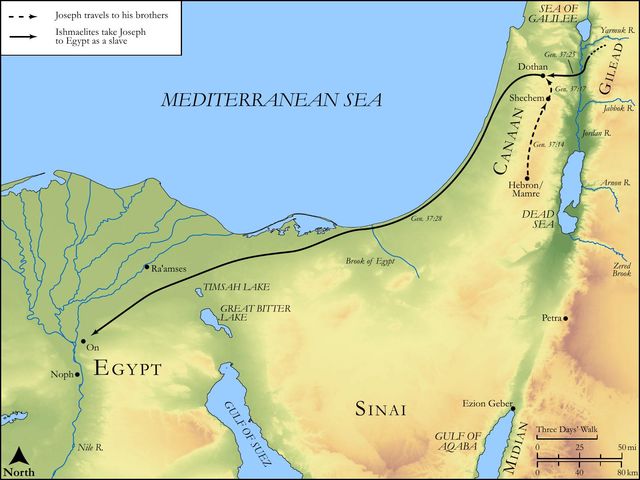
See on the biblical-era maps


Study this verse
Public-domain commentary
Matthew Henry
From his Commentary on the Whole Bible. Henry comments on passages, not single verses — this entry covers Genesis 37:12–22. His two-level outline is real structure in the source text, so it is rendered as structure.
Here is, I. The kind visit which Joseph, in obedience to his father's command, made to his brethren, who were feeding the flock at Shechem, many miles off. Some suggest that they went thither on purpose, expecting that Joseph would be sent to see them, and that then they should have an opportunity to do him a mischief. However, Joseph and his father had both of them more of the innocence of the dove than of the wisdom of the serpent, else he had never come thus into the hands of those that hated him: but God designed it all for good. See in Joseph an instance, 1. Of dutifulness to his father. Though he was his father's darling, yet he was made, and was willing to be, his father's servant. How readily does he wait his father's orders! Here I am, Gen 37:13. Note, Those children that are best beloved by their parents should be most obedient to their parents; and then their love is well-bestowed and well-returned. 2. Of kindness to his brethren. Though he knew they hated him and envied him, yet he made no objections against his father's commands, either from the distance of the place or the danger of the journey, but cheerfully embraced the opportunity of showing his respect to his brethren. Note, It is a very good lesson, though it is learnt with difficulty and rarely practised, to love those that hate us; if our relations do not their duty to us, yet we must not be wanting in our duty to them. This is thank-worthy. Joseph was sent by his father to Shechem, to see whether his brethren were well there, and whether the country had not risen upon them and destroyed them, in revenge of their barbarous murder of the Shechemites some years before. But Joseph, not finding them there, went to Dothan, which showed that he undertook this journey, not only in obedience to his father (for then he might have returned when he missed them at Shechem, having done what his father told him), but out of love to his brethren, and therefore he sought diligently till he found them. Thus, let brotherly love continue, and let us give proofs of it.
II.The bloody and malicious plot of his brethren against him, who rendered good for evil, and, for his love, were his adversaries. Observe,
1.How deliberate they were in the contrivance of this mischief: when they saw him afar off, they conspired against him, Gen 37:18. It was not in a heat, or upon a sudden provocation, that they thought to slay him, but from malice prepense, and in cold blood. Note, Whosoever hateth his brother is a murderer; for he will be one if he have an opportunity, Jo1 3:15. Malice is a most mischievous thing, and is in danger of making bloody work where it is harboured and indulged. The more there is of a project and contrivance in a sin the worse it is; it is bad to do evil, but worse to devise it.
2.How cruel they were in their design; nothing less than his blood would satisfy them: Come, and let us slay him, Gen 37:20. Note, The old enmity hunts for the precious life. It is the blood-thirsty that hate the upright (Pro 29:10), and it is the blood of the saints that the harlot is drunk with.
3.How scornfully they reproached him for his dreams (Gen 37:19): This dreamer cometh; and (Gen 37:20), We shall see what will become of his dreams. This shows what it was that fretted and enraged them. They could not endure to think of doing homage to him; this was what they were plotting to prevent by the murder of him. Note, Men that fret and rage at God's counsels are impiously aiming to defeat them; but they imagine a vain thing, Psa 2:1-3. God's counsels will stand.
4.How they agreed to keep one another's counsel, and to cover the murder with a lie: We will say, Some evil beast hath devoured him; whereas in thus consulting to devour him they proved themselves worse than the most evil beasts; for evil beasts prey not on those of their own kind, but they were tearing a piece of themselves.
III.Reuben's project to deliver him, Gen 37:21, Gen 37:22.
Note, God can raise up friends for his people, even among their enemies; for he has all hearts in his hands. Reuben, of all the brothers, had most reason to be jealous of Joseph, for he was the first-born, and so entitled to those distinguishing favours which Jacob was conferring on Joseph; yet he proves his best friend. Reuben's temper seems to have been soft and effeminate, which had betrayed him to the sin of uncleanness; while the temper of the next two brothers, Simeon and Levi, was fierce, which betrayed them to the sin of murder, a sin which Reuben startled at the thought of. Note, Our natural constitution should be guarded against those sins to which it is most inclinable, and improved (as Reuben's here) against those sins to which it is most averse. Reuben made a proposal which they thought would effectually answer their intention of destroying Joseph, and yet which he designed should answer his intention of rescuing Joseph out of their hands and restoring him to his father, probably hoping thereby to recover his father's favour, which he had lately lost; but God overruled all to serve his own purpose of making Joseph an instrument to save much people alive. Joseph was here a type of Christ. Though he was the beloved Son of his Father, and hated by a wicked world, yet the Father sent him out of his bosom to visit us in great humility and love. He came from heaven to earth, to seek and save us; yet then malicious plots were laid against him. He came to his own, and his own not only received him not, but consulted against him: This is the heir, come let us kill him; Crucify him, crucify him. This he submitted to, in pursuance of his design to redeem and save us.
Continue studying Genesis 37:12 across the web’s major study libraries — every link below opens this exact verse, chapter, or book on the destination site.
Read & Compare
 BibleGatewayThis verse in more than 200 translations and 70 languages.
 Bible.comThe YouVersion reader — hundreds of translations, reading plans, and highlights.
 ESV.orgCrossway's official English Standard Version reader.
 NET BibleThe NET translation with 60,000+ translators' notes on every rendering decision.
 STEP BibleTyndale House's free study tool — original text, vocabulary, and scholarly resources.
 BibliaLogos Bible Software's free web reader.
 USCCBThe New American Bible (Revised Edition) with the U.S. bishops' study notes.
Commentaries
 BibleHub CommentariesDozens of classic commentaries on this verse, gathered on one page.
 StudyLightMore than 100 commentary sets — the largest collection on the web.
 BibleRefPlain-English commentary on what this verse means, verse by verse.
 Enduring WordDavid Guzik's free commentary on this chapter, widely used by Bible teachers.
 Bible Study ToolsVerse commentary alongside Greek and Hebrew study aids.
Original Language & Research
- BibleHub InterlinearThe verse word by word — original language, transliteration, and English.
- BibleHub LexiconEvery word's original-language definition and Strong's entry.
 Blue Letter BibleDeep-study tools — Strong's numbers, concordance, and word studies.
 SefariaThe Hebrew text with Rashi and centuries of Jewish commentary.
Sermons, Hymns & Audio


TrulyRandomVerse is not affiliated with these sites and doesn’t control their content. They’re linked because they’re genuinely useful.
Summary
Genesis 37:12 marks a deceptively simple yet profoundly significant moment in the unfolding saga of Joseph and his family. This seemingly routine pastoral journey by Joseph's brothers to Shechem, a place laden with both historical significance and past family trauma, serves as the immediate catalyst for the dramatic events that will propel Joseph into suffering and, ultimately, into a position of redemptive power. It subtly introduces the setting where God's sovereign hand will orchestrate human choices and circumstances to fulfill His grand purposes for the nascent nation of Israel.
Context
ShowHideLiterary Context
This verse immediately follows the introduction of Joseph's prophetic dreams and his brothers' escalating hatred and envy, fueled by Jacob's overt favoritism (Genesis 37:3-11). The narrative has already established a deep familial rift. The brothers' departure to Shechem is presented as a practical necessity for their extensive flocks, but it also creates the geographical and situational opportunity for the brothers' animosity to manifest in a decisive act against Joseph. This seemingly ordinary departure sets the stage for Jacob's subsequent decision to send Joseph to check on his brothers, thereby leading Joseph directly into their snare (Genesis 37:13-14).
Historical & Cultural Context
In the patriarchal era, shepherding was the primary occupation and source of wealth for nomadic or semi-nomadic peoples like Jacob's family. Large flocks required extensive grazing lands, often necessitating long journeys to find suitable pastures. Shechem, located approximately 50 miles north of Hebron (where Jacob's family was settled), was renowned for its fertile valleys and abundant water sources, making it an ideal, though distant, grazing ground. However, Shechem also carried a complex and violent history for Jacob's family, having been the site of Abraham's first altar in Canaan (Genesis 12:6-7), Jacob's own purchase of land and altar-building upon returning from Paddan-Aram (Genesis 33:18-20), and, most notably, the brutal retaliation by Simeon and Levi against the Shechemites after the defilement of their sister Dinah (Genesis 34:25-31). The brothers' return to this place, despite its troubled past, underscores the economic pressures of their pastoral life and inadvertently positions them for the pivotal events to come.
Key Themes
ShowHideGenesis 37:12 contributes to several overarching themes in the Joseph narrative and the book of Genesis. Firstly, it highlights Divine Sovereignty, demonstrating how God orchestrates even mundane human activities to advance His redemptive plan, often unbeknownst to the human agents involved. Secondly, it underscores the persistent theme of Family Dysfunction and Sibling Rivalry, a recurring motif throughout Genesis, from Cain and Abel to Isaac and Ishmael, and Jacob and Esau. Here, the brothers' journey provides the setting for their deep-seated envy of Joseph to culminate in betrayal. Thirdly, the mention of "feeding their father's flock" subtly introduces the Shepherd Motif, which is central to the patriarchal narratives and later becomes a powerful metaphor for leadership and divine care, foreshadowing God as the ultimate Shepherd of His people. Finally, the specific location of Shechem reinforces the theme of Covenant Land and its Significance, as it is a place repeatedly marked by key events in the history of God's chosen family.
Exposition and Analysis
ShowHideThe concise statement in Genesis 37:12 initiates a chain of events that will profoundly impact the trajectory of Jacob's family and the fulfillment of God's covenant promises.
Key Word Analysis
ShowHideThis word (H251) denotes a brother in the widest sense, encompassing literal kinship and metaphorical affinity. In this context, it emphasizes the familial relationship between Joseph and his siblings, making their subsequent betrayal all the more poignant. Despite being "brothers," their actions reveal a profound lack of brotherly love and a deep-seated animosity, highlighting the brokenness within Jacob's family.
This verb (H7462) is more comprehensive than simply providing food. It means "to tend a flock," encompassing the full responsibilities of a shepherd: leading, guiding, protecting, pasturing, and caring for the sheep or goats. It implies a diligent, watchful oversight. The brothers are engaged in their primary vocational duty, a task that symbolizes care and provision, yet their actions towards Joseph will starkly contradict the very essence of "shepherding" their own family member.
This collective noun (H6629) refers to a group of sheep or goats, representing the primary source of wealth and sustenance for the patriarchal family. The extensive size of their "flock" necessitated their journey to distant pastures like Shechem, underscoring the practical demands of their nomadic lifestyle and inadvertently creating the circumstances for Joseph's fateful encounter.
Verse Breakdown
ShowHide"And his brethren went"
This opening phrase immediately shifts the narrative focus from Joseph's dreams and Jacob's favoritism to the collective action of Joseph's brothers. The verb "went" (Hebrew, yâlak) signifies a deliberate journey, setting the physical stage for the unfolding drama. Their unity in this action contrasts sharply with their disunity and malicious intent towards Joseph, highlighting the underlying tension that defines their relationship.
"to feed their father's flock"
This clause describes the purpose of their journey—a routine, yet essential, pastoral duty. The phrase "their father's flock" underscores their responsibility to Jacob and the family's livelihood. The act of "feeding" (Hebrew, râʻâh) signifies the comprehensive care and protection required of shepherds, an ironic backdrop given their impending failure to "shepherd" or care for their own brother, Joseph, whom they will soon abandon.
"in Shechem"
The specific geographical location is crucial. Shechem was a fertile region known for good pasture, making it a practical destination for their large flocks. However, its historical baggage for Jacob's family, particularly the violent events of Genesis 34, adds a layer of tension and foreboding. The choice to return to this place, despite its fraught history, highlights the economic necessity of their nomadic existence and inadvertently positions them for the pivotal encounter with Joseph, transforming a mundane journey into a divinely orchestrated turning point.
Literary Devices
ShowHideThe verse employs several literary devices. Foreshadowing is prominent, as this seemingly ordinary journey sets the stage for the extraordinary events to follow, leading directly to Joseph's betrayal and the subsequent divine plan of salvation. There is a subtle Irony in the brothers' task: they are "shepherding" their father's flock, a role implying care and protection, yet they are about to act with extreme malice and abandonment towards their own brother. This contrast highlights their moral failure. The recurring mention of Shechem, a place with a significant and often troubled history for the patriarchs, functions as a Symbolic Setting, linking the current events to the broader covenant narrative and reminding the reader of God's ongoing interaction with this specific family in this specific land.
Theological and Thematic Connections
ShowHideGenesis 37:12 serves as a powerful illustration of divine sovereignty working through ordinary human circumstances and choices, even those motivated by sin. The brothers' routine task of shepherding their flocks becomes a crucial link in God's intricate plan to preserve His covenant people and prepare them for their future in Egypt. This verse reminds us that God's purposes are not confined to grand, miraculous interventions but are often woven into the mundane fabric of daily life, demonstrating His meticulous oversight of history. It also highlights the persistent theme of family brokenness and sibling rivalry within the patriarchal narratives, setting the stage for the profound lessons of forgiveness and reconciliation that will emerge later in the Joseph story.
Reflection and Application
ShowHideGenesis 37:12 invites us to consider how God's hand is at work even in the most ordinary and seemingly insignificant moments of our lives. Just as the brothers' routine journey to find pasture became a pivotal step in God's larger redemptive plan for Joseph and the entire family of Israel, so too can our daily tasks, responsibilities, and even challenges be part of a divine purpose that we may not immediately discern. This passage also serves as a poignant reminder of the complexities inherent in family relationships, where shared responsibilities can coexist with deep-seated envy, resentment, and conflict. It prompts us to examine our own hearts for unresolved tensions and to seek reconciliation, recognizing that unaddressed relational brokenness can lead to significant and far-reaching consequences. Ultimately, it encourages a posture of trust in God's overarching sovereignty, even when circumstances appear chaotic or unjust, knowing that He is always working towards His good and perfect will.
Questions for Reflection
ShowHideFAQ
ShowHideWhy did Jacob's sons go all the way to Shechem, given its troubled history for their family?
ShowHideJacob's family possessed extensive flocks, which necessitated seeking out new and fertile pastures, even those at a considerable distance from their primary residence in Hebron. Shechem was well-known for its rich grazing lands. Despite the violent incident involving Dinah and the Shechemites recorded in Genesis 34, the practical and economic necessity of sustaining their vast livelihood likely outweighed the risks, or perhaps the immediate threat from that past event had subsided over time, making the fertile grounds of Shechem an unavoidable destination for their pastoral needs.
What is the significance of the Hebrew word "ra'ah" (to feed or shepherd) in this context?
ShowHideThe Hebrew word ra'ah (רָעָה), translated as "to feed," carries a much deeper and broader meaning than simply providing sustenance. It encompasses the full responsibilities of a shepherd: leading the flock to pasture and water, guarding them from predators and dangers, tending to their needs, and providing overall care and protection. This term is highly significant because it is frequently used metaphorically throughout the Bible to describe leadership, particularly God's relationship with His people as their Shepherd (Psalm 23:1), and later, the role of spiritual leaders. In the context of Genesis 37:12, it highlights the brothers' vocational duty while ironically foreshadowing their egregious failure to "shepherd" or care for their own brother, Joseph.
Christ-Centered Fulfillment
ShowHideGenesis 37:12 serves as the seemingly innocuous beginning of Joseph's journey, a narrative arc that profoundly prefigures the path of Christ. Just as Joseph, sent by his father to his brethren, was rejected, betrayed, and suffered unjustly at the hands of those who should have protected him, yet ultimately became the means of salvation and preservation for his family and many others, so too was Christ sent by His Father to His own people. He was rejected by His brethren (John 1:11), suffered betrayal and death, yet through His suffering and subsequent exaltation, He became the Savior of all who believe (Philippians 2:6-11). The "shepherd" motif, implicit in the brothers' task of tending the flock, finds its ultimate and perfect fulfillment in Christ, the Good Shepherd, who not only cares for His sheep but lays down His life for them (John 10:11). This verse, therefore, marks the initial, seemingly ordinary step in a divinely orchestrated narrative that powerfully illustrates God's redemptive plan through a suffering servant, culminating in Christ's atoning work on the cross and His eternal reign.