


Genesis 37:13
- וַיֹּאמֶרvai·Yo·merand he saidH559Conj-w ¦ V-Qal-ConsecImperf-3msVerb Qal Consecutive Imperfect 3rd Singular Masculineוַandיֹּאמֶרhe said
- יִשְׂרָאֵלYis·ra·'ElIsraelH3478N-proper-mNoun Proper Masculine
- אֶל'eltoH413PrepPreposition
- יוֹסֵףyo·SefJosephH3130N-proper-mNoun Proper Masculine
- הֲלוֹאha·Lo'¿ notH3808Interrog ¦ NegParticle Negativeהֲ¿לוֹאnot
- אַחֶיךָ'a·Chei·kha[are] your brothersH251N-mpc ¦ 2msNoun Plural Masculine Constructאַחֶי[are] brothersךָyour
- רֹעִיםro·'ImpasturingH7462V-Qal-Prtcpl-mpVerb Qal Participle Plural Masculine Absolute
- בִּשְׁכֶםbish·Khemat ShechemH7927Prep-b ¦ N-properNoun Proper LocationבִּatשְׁכֶםShechem
- לְכָהle·Khahcome !H1980V-Qal-Imp-2ms ¦ SfxVerb Qal Imperative 2nd Singular Masculineלְכָcomeה!
- וְאֶשְׁלָחֲךָve·'esh·la·cha·Khaand I will send youH7971Conj-w ¦ V-Qal-ConjImperf-1cs ¦ 2msVerb Qal Conjunction+Imperfect 1st Singular common genderוְandאֶשְׁלָחֲI will sendךָyou
- אֲלֵיהֶם'a·lei·Hemto themH413Prep ¦ 3mpPreposition Definiteאֲלֵיtoהֶםthem
- וַיֹּאמֶרvai·Yo·merand he saidH559Conj-w ¦ V-Qal-ConsecImperf-3msVerb Qal Consecutive Imperfect 3rd Singular Masculineוַandיֹּאמֶרhe said
- לוֹloto <the> himPrep-l ¦ 3msSuffix Personal 3rd Singular Masculineלto <the>וֹhim
- הִנֵּנִיhi·Ne·nihere [am] IH2009Prt ¦ 1csParticle Interjectionהִנֵּhere [am]נִיI
English is a literal word-by-word gloss of the Hebrew, not the KJV's wording. Why?
This is the original text the KJV's translators worked from — each Hebrew word with its own literal English meaning in this verse, prepared by scholars at Tyndale House, Cambridge. The KJV translates whole sentences, not word by word, so its wording differs: one Hebrew word can become several English words, and the KJV may choose “the LORD” where the gloss reads “Yahweh”. Both are faithful — they answer different questions. For the KJV's own rendering, switch to the KJV text.
Details
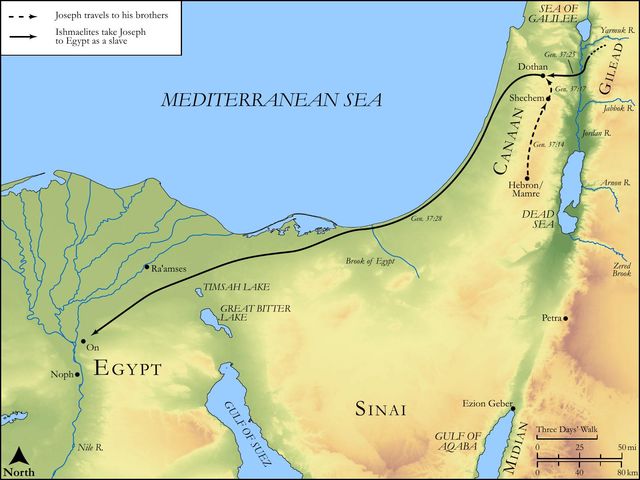
See on the biblical-era map


Study this verse
Public-domain commentary
Matthew Henry
From his Commentary on the Whole Bible. Henry comments on passages, not single verses — this entry covers Genesis 37:12–22. His two-level outline is real structure in the source text, so it is rendered as structure.
Here is, I. The kind visit which Joseph, in obedience to his father's command, made to his brethren, who were feeding the flock at Shechem, many miles off. Some suggest that they went thither on purpose, expecting that Joseph would be sent to see them, and that then they should have an opportunity to do him a mischief. However, Joseph and his father had both of them more of the innocence of the dove than of the wisdom of the serpent, else he had never come thus into the hands of those that hated him: but God designed it all for good. See in Joseph an instance, 1. Of dutifulness to his father. Though he was his father's darling, yet he was made, and was willing to be, his father's servant. How readily does he wait his father's orders! Here I am, Gen 37:13. Note, Those children that are best beloved by their parents should be most obedient to their parents; and then their love is well-bestowed and well-returned. 2. Of kindness to his brethren. Though he knew they hated him and envied him, yet he made no objections against his father's commands, either from the distance of the place or the danger of the journey, but cheerfully embraced the opportunity of showing his respect to his brethren. Note, It is a very good lesson, though it is learnt with difficulty and rarely practised, to love those that hate us; if our relations do not their duty to us, yet we must not be wanting in our duty to them. This is thank-worthy. Joseph was sent by his father to Shechem, to see whether his brethren were well there, and whether the country had not risen upon them and destroyed them, in revenge of their barbarous murder of the Shechemites some years before. But Joseph, not finding them there, went to Dothan, which showed that he undertook this journey, not only in obedience to his father (for then he might have returned when he missed them at Shechem, having done what his father told him), but out of love to his brethren, and therefore he sought diligently till he found them. Thus, let brotherly love continue, and let us give proofs of it.
II.The bloody and malicious plot of his brethren against him, who rendered good for evil, and, for his love, were his adversaries. Observe,
1.How deliberate they were in the contrivance of this mischief: when they saw him afar off, they conspired against him, Gen 37:18. It was not in a heat, or upon a sudden provocation, that they thought to slay him, but from malice prepense, and in cold blood. Note, Whosoever hateth his brother is a murderer; for he will be one if he have an opportunity, Jo1 3:15. Malice is a most mischievous thing, and is in danger of making bloody work where it is harboured and indulged. The more there is of a project and contrivance in a sin the worse it is; it is bad to do evil, but worse to devise it.
2.How cruel they were in their design; nothing less than his blood would satisfy them: Come, and let us slay him, Gen 37:20. Note, The old enmity hunts for the precious life. It is the blood-thirsty that hate the upright (Pro 29:10), and it is the blood of the saints that the harlot is drunk with.
3.How scornfully they reproached him for his dreams (Gen 37:19): This dreamer cometh; and (Gen 37:20), We shall see what will become of his dreams. This shows what it was that fretted and enraged them. They could not endure to think of doing homage to him; this was what they were plotting to prevent by the murder of him. Note, Men that fret and rage at God's counsels are impiously aiming to defeat them; but they imagine a vain thing, Psa 2:1-3. God's counsels will stand.
4.How they agreed to keep one another's counsel, and to cover the murder with a lie: We will say, Some evil beast hath devoured him; whereas in thus consulting to devour him they proved themselves worse than the most evil beasts; for evil beasts prey not on those of their own kind, but they were tearing a piece of themselves.
III.Reuben's project to deliver him, Gen 37:21, Gen 37:22.
Note, God can raise up friends for his people, even among their enemies; for he has all hearts in his hands. Reuben, of all the brothers, had most reason to be jealous of Joseph, for he was the first-born, and so entitled to those distinguishing favours which Jacob was conferring on Joseph; yet he proves his best friend. Reuben's temper seems to have been soft and effeminate, which had betrayed him to the sin of uncleanness; while the temper of the next two brothers, Simeon and Levi, was fierce, which betrayed them to the sin of murder, a sin which Reuben startled at the thought of. Note, Our natural constitution should be guarded against those sins to which it is most inclinable, and improved (as Reuben's here) against those sins to which it is most averse. Reuben made a proposal which they thought would effectually answer their intention of destroying Joseph, and yet which he designed should answer his intention of rescuing Joseph out of their hands and restoring him to his father, probably hoping thereby to recover his father's favour, which he had lately lost; but God overruled all to serve his own purpose of making Joseph an instrument to save much people alive. Joseph was here a type of Christ. Though he was the beloved Son of his Father, and hated by a wicked world, yet the Father sent him out of his bosom to visit us in great humility and love. He came from heaven to earth, to seek and save us; yet then malicious plots were laid against him. He came to his own, and his own not only received him not, but consulted against him: This is the heir, come let us kill him; Crucify him, crucify him. This he submitted to, in pursuance of his design to redeem and save us.
Continue studying Genesis 37:13 across the web’s major study libraries — every link below opens this exact verse, chapter, or book on the destination site.
Read & Compare
 BibleGatewayThis verse in more than 200 translations and 70 languages.
 Bible.comThe YouVersion reader — hundreds of translations, reading plans, and highlights.
 ESV.orgCrossway's official English Standard Version reader.
 NET BibleThe NET translation with 60,000+ translators' notes on every rendering decision.
 STEP BibleTyndale House's free study tool — original text, vocabulary, and scholarly resources.
 BibliaLogos Bible Software's free web reader.
 USCCBThe New American Bible (Revised Edition) with the U.S. bishops' study notes.
Commentaries
 BibleHub CommentariesDozens of classic commentaries on this verse, gathered on one page.
 StudyLightMore than 100 commentary sets — the largest collection on the web.
 BibleRefPlain-English commentary on what this verse means, verse by verse.
 Enduring WordDavid Guzik's free commentary on this chapter, widely used by Bible teachers.
 Bible Study ToolsVerse commentary alongside Greek and Hebrew study aids.
Original Language & Research
- BibleHub InterlinearThe verse word by word — original language, transliteration, and English.
- BibleHub LexiconEvery word's original-language definition and Strong's entry.
 Blue Letter BibleDeep-study tools — Strong's numbers, concordance, and word studies.
 SefariaThe Hebrew text with Rashi and centuries of Jewish commentary.
Sermons, Hymns & Audio


TrulyRandomVerse is not affiliated with these sites and doesn’t control their content. They’re linked because they’re genuinely useful.
Summary
Genesis 37:13 marks a pivotal moment in the Joseph narrative, depicting Israel (Jacob) dispatching his beloved son Joseph to inquire about his brothers and their flocks in Shechem. This seemingly routine paternal command, met with Joseph's immediate and obedient response, "Here am I," unwittingly initiates a profound sequence of events that will dramatically shape Joseph's destiny, test the very fabric of his family, and ultimately serve as a crucial step in God's sovereign plan for the emerging nation of Israel.
Context
ShowHideLiterary Context
The immediate literary context of Genesis 37:13 is one of profound family dysfunction and escalating tension within Jacob's household. The preceding verses establish Jacob's overt favoritism towards Joseph, evident in the special tunic he bestows upon him, as described in Genesis 37:3. This preferential treatment, coupled with Joseph's prophetic dreams detailing his future ascendancy over his brothers and parents (see Genesis 37:5 and Genesis 37:9), has ignited a deep-seated hatred among his older siblings. Jacob's seemingly innocuous command for Joseph to check on his brothers thus becomes the narrative hinge, propelling Joseph directly into the path of their malevolence, serving as the dramatic prelude to his betrayal and subsequent journey into Egypt.
Historical & Cultural Context
From a historical and cultural standpoint, the narrative reflects the patriarchal society of the ancient Near East, where the father's authority was paramount, and sons were expected to obey. Jacob, as the patriarch, holds responsibility for the well-being of his extensive family and their primary livelihood, which was pastoralism. Sending a son to check on the flocks and brothers was a common practice. The location, Shechem, holds particular historical weight for Jacob's family. While it was a known grazing area, it was also the site of the violent retribution exacted by Simeon and Levi after the rape of Dinah, recounted in Genesis 34. This history, though perhaps not immediately at the forefront of Jacob's mind regarding his sons' intentions, underscores the inherent dangers and complexities of travel and inter-clan relations in that era, adding a layer of dramatic irony to Jacob's seemingly simple request.
Key Themes
ShowHideThis verse contributes significantly to several overarching themes within the book of Genesis and the broader biblical narrative. Foremost among them is Divine Providence, demonstrating how God orchestrates human actions—even those born of familial discord and seemingly mundane—to accomplish His grand redemptive plan, a truth powerfully articulated by Joseph himself in Genesis 50:20. The theme of Family Dysfunction is starkly present, highlighting the destructive consequences of favoritism and jealousy, yet also setting the stage for eventual reconciliation and the preservation of the nascent nation of Israel. Furthermore, Joseph's immediate and unhesitating obedience introduces the theme of Faithful Obedience, a characteristic that will define his journey and trials, mirroring the obedience of other biblical figures called by God, such as Abraham in Genesis 22.
Exposition and Analysis
ShowHideKey Word Analysis
ShowHideFrom שָׂרָה and אֵל; he will rule as God; Jisrael, a symbolical name of Jacob; also (typically) of his posterity; Israel. In this context, the use of "Israel" rather than "Jacob" emphasizes his covenantal identity as the patriarch, the one who wrestled with God and prevailed (Genesis 32:28), underscoring the divine significance of the family line and the unfolding plan through his descendants.
Future of יָסַף; let him add (or perhaps simply active participle adding); Joseph, the name of seven Israelites; Joseph. The name itself, meaning "he adds" or "may he add," carries profound narrative weight, foreshadowing Joseph's future role not only in adding to Jacob's lineage but, more significantly, in preserving and adding to the prosperity and survival of the entire family in Egypt.
A primitive root; to send away, for, or out (in a great variety of applications); [idiom] any wise, appoint, bring (on the way), cast (away, out), conduct, [idiom] earnestly, forsake, give (up), grow long, lay, leave, let depart (down, go, loose), push away, put (away, forth, in, out), reach forth, send (away, forth, out), set, shoot (forth, out), sow, spread, stretch forth (out). This verb is pivotal, as Jacob's act of "sending" Joseph sets in motion the entire narrative of Joseph's journey, exile, suffering, and eventual exaltation, serving as a clear demonstration of God's sovereign orchestration through human agency.
Verse Breakdown
ShowHide"And Israel said unto Joseph"
This opening phrase immediately establishes the primary actors and the patriarchal authority. "Israel" refers to Jacob, highlighting his divinely bestowed name and his position as the covenant head, initiating a crucial command to his beloved son, Joseph.
"Do not thy brethren feed [the flock] in Shechem?"
Jacob's question is rhetorical, serving as an inquiry and a preamble to his instruction. It reveals his concern for his other sons and their livelihood, indicating a desire for information about their well-being and the status of the flocks in a distant, potentially problematic, location.
"come, and I will send thee unto them."
This is Jacob's direct command. The imperative "come" followed by "I will send thee" underscores Jacob's authoritative role. It is a paternal directive, seemingly simple, yet it carries immense narrative weight as it propels Joseph from the safety of home into the dangerous encounter with his brothers, setting the stage for the entire saga.
"And he said to him, Here [am I]."
Joseph's immediate and concise response is profoundly significant. The Hebrew hineni (הִנְנִי), translated as "Here am I," denotes a posture of ready availability, willingness, and full attention. It is a response of unhesitating obedience to a call, a characteristic that will define Joseph's faithful endurance through subsequent trials and ultimately enable him to fulfill God's redemptive purposes.
Literary Devices
ShowHideIn Genesis 37:13, several literary devices enhance the narrative's depth and dramatic tension. Irony is profoundly present, as Jacob's loving concern for his sons inadvertently sends his favored son directly into the hands of those who despise him, leading to his perceived demise. The seemingly routine pastoral errand functions as a powerful inciting incident, the narrative catalyst that sets in motion the entire Joseph saga. Joseph's simple yet profound response, "Here am I," serves as foreshadowing, hinting at his future character of obedience, availability, and resilience in the face of immense trials. Furthermore, the specific mention of Shechem acts as an allusion, recalling the previous violent and deceitful episode involving Dinah and her brothers in Genesis 34, subtly hinting at the potential for danger and conflict that awaits Joseph, even if Jacob himself is unaware of the specific threat from his own sons. This verse, therefore, is not merely a factual account but a carefully crafted narrative moment laden with deeper meaning and dramatic tension.
Theological and Thematic Connections
ShowHideThis verse serves as a powerful illustration of Divine Sovereignty and Providence, demonstrating how God orchestrates human decisions—even those seemingly ordinary or born of complex family dynamics—to advance His overarching redemptive plan. Jacob's simple instruction to Joseph, and Joseph's obedient response, become the divinely appointed means by which Joseph is set upon a path of suffering, testing, and eventual exaltation, all for the preservation of the covenant family and the future nation of Israel. It underscores the biblical truth that God's purposes are not thwarted by human sin or shortsightedness, but rather can be woven into the fabric of human history to bring about His perfect will. The narrative also highlights the profound significance of Obedience and Availability in the divine economy, as Joseph's ready "Here am I" positions him as an instrument for God's grand design, despite the immediate hardship it entails.
Reflection and Application
ShowHideGenesis 37:13 offers profound insights for contemporary believers regarding the nature of obedience and divine calling. Joseph's immediate and unhesitating "Here am I" in response to his father's command, despite the unknown and perilous path ahead, serves as a powerful model of availability and trust. This challenges us to cultivate a similar posture of readiness and submission to God's leading in our own lives. It reminds us that seemingly small acts of obedience, or even difficult circumstances we are "sent" into, can be integral components of God's grand, sovereign plan for our lives and for the advancement of His kingdom. Our personal journeys, with all their unexpected turns and trials, are often interwoven with God's larger redemptive narrative, calling us to a faith that trusts His purposes even when the immediate path is unclear or painful. We are encouraged to embrace a spirit of "hineni" – a willingness to be present and available for whatever God calls us to, knowing He works all things for good.
Questions for Reflection
ShowHideFAQ
ShowHideWhy did Jacob send Joseph to Shechem, given its troubled history for his family?
ShowHideWhile Shechem had a violent past for Jacob's family, as seen in the events of Genesis 34, it was also a place where Jacob had previously settled and bought land (Genesis 33:18-19). It was a known pasturing ground in the region. Jacob likely sent Joseph there out of practical concern for his sons and their flocks, perhaps not fully aware of the depth of his sons' hatred for Joseph, or perhaps assuming the passage of time had dulled the memory of past dangers. From a theological perspective, this seemingly ordinary decision served as a crucial step in God's providential plan for Joseph and the future of Israel, demonstrating how divine purposes unfold through human circumstances.
What is the significance of Joseph's response, "Here am I"?
ShowHideJoseph's response, "Here am I" (Hebrew: hineni), is a significant biblical phrase that denotes more than just a simple "yes" or "I'm here." It conveys a posture of immediate readiness, attentiveness, and willing availability to serve or be sent. It implies full commitment to the task or call, regardless of personal cost. This same phrase is used by other key biblical figures in moments of divine encounter or significant calling, such as Abraham responding to God's command in Genesis 22:1 and Isaiah responding to God's call to prophetic ministry in Isaiah 6:8. Joseph's use of hineni highlights his obedient character and sets the stage for his willingness to endure hardship as part of God's larger redemptive plan for his family and the world.
Christ-Centered Fulfillment
ShowHideGenesis 37:13 offers a compelling typological foreshadowing of Christ, particularly through Joseph's role as a figure sent by the father. Just as Jacob, the earthly father, sends his beloved son Joseph on a mission that leads to suffering and eventual exaltation, so too did God the Father send His beloved Son, Jesus, into the world. Joseph's immediate and obedient response, "Here am I," powerfully parallels Christ's perfect and unwavering obedience to the Father's will, even unto the ultimate sacrifice on the cross, as described in Philippians 2:8. Joseph was sent to his brothers, who ultimately rejected and betrayed him, echoing how Christ "came to His own, and His own people did not receive Him," as recorded in John 1:11. Yet, through this rejection and suffering, both Joseph and Christ became the means of salvation and preservation for their respective peoples. Joseph's journey, initiated by this sending, thus prefigures the divine mission, the obedient suffering, and the ultimate redemptive triumph of Jesus Christ, who, like Joseph, would become the savior of many, not only His people but also the nations, fulfilling the promise of Genesis 12:3.