


Genesis 37:19
Bible text: King James Version (1769 Blayney text) · Public domain
Bible text: Berean Standard Bible · Public domain
Bible text: American Standard Version (1901) · Public domain
Bible text: World English Bible, Messianic edition · Public domain
Bible text: Geneva Bible (1599) · Public domain
Bible text: Young's Literal Translation · Public domain
- וַיֹּאמְרוּvai·yo·me·Ruand they saidH559Conj-w ¦ V-Qal-ConsecImperf-3mpVerb Qal Consecutive Imperfect 3rd Plural Masculineוַandיֹּאמְרוּthey said
- אִישׁ'isheachH376N-msNoun Singular Masculine Absolute
- אֶל'eltoH413PrepPreposition
- אָחִיו'a·Chivhis brotherH251N-msc ¦ 3msNoun Singular Masculine Constructאָחִיbrotherוhis
- הִנֵּהhi·Nehthere!H2009PrtParticle Interjection
- בַּעַלBa·'al[the] master ofH1167N-mscNoun Singular Masculine Construct
- הַחֲלֹמוֹתha·cha·lo·Mot<the> dreamsH2472Art ¦ N-fpNoun Plural Feminine Absoluteהַ<the>חֲלֹמוֹתdreams
- הַלָּזֶהha·la·ZehthisH1976PrtParticle Demonstrative
- בָּאBa'[is] comingH935V-Qal-Prtcpl-msVerb Qal Participle Singular Masculine Absolute
English is a literal word-by-word gloss of the Hebrew, not the KJV's wording. Why?
This is the original text the KJV's translators worked from — each Hebrew word with its own literal English meaning in this verse, prepared by scholars at Tyndale House, Cambridge. The KJV translates whole sentences, not word by word, so its wording differs: one Hebrew word can become several English words, and the KJV may choose “the LORD” where the gloss reads “Yahweh”. Both are faithful — they answer different questions. For the KJV's own rendering, switch to the KJV text.
Details
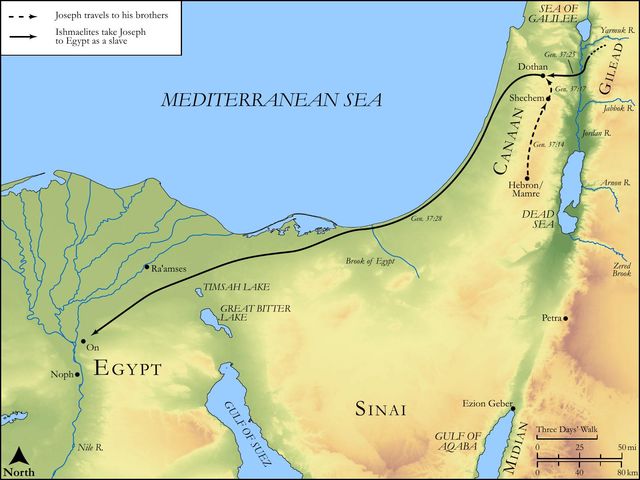
See on the biblical-era maps


Study this verse
Public-domain commentary
Matthew Henry
From his Commentary on the Whole Bible. Henry comments on passages, not single verses — this entry covers Genesis 37:12–22. His two-level outline is real structure in the source text, so it is rendered as structure.
Here is, I. The kind visit which Joseph, in obedience to his father's command, made to his brethren, who were feeding the flock at Shechem, many miles off. Some suggest that they went thither on purpose, expecting that Joseph would be sent to see them, and that then they should have an opportunity to do him a mischief. However, Joseph and his father had both of them more of the innocence of the dove than of the wisdom of the serpent, else he had never come thus into the hands of those that hated him: but God designed it all for good. See in Joseph an instance, 1. Of dutifulness to his father. Though he was his father's darling, yet he was made, and was willing to be, his father's servant. How readily does he wait his father's orders! Here I am, Gen 37:13. Note, Those children that are best beloved by their parents should be most obedient to their parents; and then their love is well-bestowed and well-returned. 2. Of kindness to his brethren. Though he knew they hated him and envied him, yet he made no objections against his father's commands, either from the distance of the place or the danger of the journey, but cheerfully embraced the opportunity of showing his respect to his brethren. Note, It is a very good lesson, though it is learnt with difficulty and rarely practised, to love those that hate us; if our relations do not their duty to us, yet we must not be wanting in our duty to them. This is thank-worthy. Joseph was sent by his father to Shechem, to see whether his brethren were well there, and whether the country had not risen upon them and destroyed them, in revenge of their barbarous murder of the Shechemites some years before. But Joseph, not finding them there, went to Dothan, which showed that he undertook this journey, not only in obedience to his father (for then he might have returned when he missed them at Shechem, having done what his father told him), but out of love to his brethren, and therefore he sought diligently till he found them. Thus, let brotherly love continue, and let us give proofs of it.
II.The bloody and malicious plot of his brethren against him, who rendered good for evil, and, for his love, were his adversaries. Observe,
1.How deliberate they were in the contrivance of this mischief: when they saw him afar off, they conspired against him, Gen 37:18. It was not in a heat, or upon a sudden provocation, that they thought to slay him, but from malice prepense, and in cold blood. Note, Whosoever hateth his brother is a murderer; for he will be one if he have an opportunity, Jo1 3:15. Malice is a most mischievous thing, and is in danger of making bloody work where it is harboured and indulged. The more there is of a project and contrivance in a sin the worse it is; it is bad to do evil, but worse to devise it.
2.How cruel they were in their design; nothing less than his blood would satisfy them: Come, and let us slay him, Gen 37:20. Note, The old enmity hunts for the precious life. It is the blood-thirsty that hate the upright (Pro 29:10), and it is the blood of the saints that the harlot is drunk with.
3.How scornfully they reproached him for his dreams (Gen 37:19): This dreamer cometh; and (Gen 37:20), We shall see what will become of his dreams. This shows what it was that fretted and enraged them. They could not endure to think of doing homage to him; this was what they were plotting to prevent by the murder of him. Note, Men that fret and rage at God's counsels are impiously aiming to defeat them; but they imagine a vain thing, Psa 2:1-3. God's counsels will stand.
4.How they agreed to keep one another's counsel, and to cover the murder with a lie: We will say, Some evil beast hath devoured him; whereas in thus consulting to devour him they proved themselves worse than the most evil beasts; for evil beasts prey not on those of their own kind, but they were tearing a piece of themselves.
III.Reuben's project to deliver him, Gen 37:21, Gen 37:22.
Note, God can raise up friends for his people, even among their enemies; for he has all hearts in his hands. Reuben, of all the brothers, had most reason to be jealous of Joseph, for he was the first-born, and so entitled to those distinguishing favours which Jacob was conferring on Joseph; yet he proves his best friend. Reuben's temper seems to have been soft and effeminate, which had betrayed him to the sin of uncleanness; while the temper of the next two brothers, Simeon and Levi, was fierce, which betrayed them to the sin of murder, a sin which Reuben startled at the thought of. Note, Our natural constitution should be guarded against those sins to which it is most inclinable, and improved (as Reuben's here) against those sins to which it is most averse. Reuben made a proposal which they thought would effectually answer their intention of destroying Joseph, and yet which he designed should answer his intention of rescuing Joseph out of their hands and restoring him to his father, probably hoping thereby to recover his father's favour, which he had lately lost; but God overruled all to serve his own purpose of making Joseph an instrument to save much people alive. Joseph was here a type of Christ. Though he was the beloved Son of his Father, and hated by a wicked world, yet the Father sent him out of his bosom to visit us in great humility and love. He came from heaven to earth, to seek and save us; yet then malicious plots were laid against him. He came to his own, and his own not only received him not, but consulted against him: This is the heir, come let us kill him; Crucify him, crucify him. This he submitted to, in pursuance of his design to redeem and save us.
Historical interpretation
Historical reception
1 surviving comment on this verse from the historical church.
Every kind of honour and happiness was bestowed upon you, and then was fulfilled that which is written, "My beloved ate and drank, and was enlarged and became fat, and kicked." [Deuteronomy 32:15] Hence flowed emulation and envy, strife and sedition, persecution and disorder, war and captivity. So the worthless rose up against the honoured, those of no reputation against such as were renowned, the foolish against the wise, the young against those advanced in years. For this reason righteousness and peace are now far departed from you, inasmuch as every one abandons the fear of God, and has become blind in His faith, neither walks in the ordinances of His appointment, nor acts a part becoming a Christian, but walks after his own wicked lusts, resuming the practice of an unrighteous and ungodly envy, by which death itself entered into the world. [Wisdom 2:24]
For thus it is written: "And it came to pass after certain days, that Cain brought of the fruits of the earth a sacrifice unto God; and Abel also brought of the firstlings of his sheep, and of the fat thereof. And God had respect to Abel and to his offerings, but Cain and his sacrifices He did not regard. And Cain was deeply grieved, and his countenance fell. And God said to Cain, Why are you grieved, and why is your countenance fallen? If you offer rightly, but do not divide rightly, have you not sinned? Be at peace: your offering returns to yourself, and you shall again possess it. And Cain said to Abel his brother, Let us go into the field. And it came to pass, while they were in the field, that Cain rose up against Abel his brother, and slew him." [Genesis 4:3-8] You see, brethren, how envy and jealousy led to the murder of a brother. Through envy, also, our father Jacob fled from the face of Esau his brother [Genesis 27:41-45]. Envy made Joseph be persecuted unto death, and to come into bondage. [Genesis 37:18-28] Envy compelled Moses to flee from the face of Pharaoh king of Egypt, when he heard these words from his fellow-countryman, "Who made you a judge or a ruler over us? Will you kill me, as you killed the Egyptian yesterday?" [Exodus 2:14] On account of envy, Aaron and Miriam had to make their abode without the camp. [Numbers 12:14-15] Envy brought down Dathan and Abiram alive to Hades, through the sedition which they excited against God's servant Moses. [Numbers 16:33] Through envy, David not only underwent the hatred of foreigners, but was also persecuted by Saul king of Israel. [1 Samuel 21:10-15]
Continue studying Genesis 37:19 across the web’s major study libraries — every link below opens this exact verse, chapter, or book on the destination site.
Read & Compare
 BibleGatewayThis verse in more than 200 translations and 70 languages.
 Bible.comThe YouVersion reader — hundreds of translations, reading plans, and highlights.
 ESV.orgCrossway's official English Standard Version reader.
 NET BibleThe NET translation with 60,000+ translators' notes on every rendering decision.
 STEP BibleTyndale House's free study tool — original text, vocabulary, and scholarly resources.
 BibliaLogos Bible Software's free web reader.
 USCCBThe New American Bible (Revised Edition) with the U.S. bishops' study notes.
Commentaries
 BibleHub CommentariesDozens of classic commentaries on this verse, gathered on one page.
 StudyLightMore than 100 commentary sets — the largest collection on the web.
 BibleRefPlain-English commentary on what this verse means, verse by verse.
 Enduring WordDavid Guzik's free commentary on this chapter, widely used by Bible teachers.
 Bible Study ToolsVerse commentary alongside Greek and Hebrew study aids.
Original Language & Research
- BibleHub InterlinearThe verse word by word — original language, transliteration, and English.
- BibleHub LexiconEvery word's original-language definition and Strong's entry.
 Blue Letter BibleDeep-study tools — Strong's numbers, concordance, and word studies.
 SefariaThe Hebrew text with Rashi and centuries of Jewish commentary.
Sermons, Hymns & Audio


TrulyRandomVerse is not affiliated with these sites and doesn’t control their content. They’re linked because they’re genuinely useful.
Summary
Genesis 37:19 vividly captures the culmination of Joseph's brothers' deep-seated jealousy and hatred, as they mockingly identify him as "this dreamer" upon seeing him approach. This derisive label, steeped in contempt for his prophetic dreams and resentment of his favored status, immediately precedes their conspiracy to eliminate him and thwart his perceived destiny, setting the stage for the dramatic unfolding of God's sovereign plan.
Context
ShowHideLiterary Context
This verse is a pivotal moment in the narrative of Joseph, the eleventh son of Jacob (Israel). It follows Jacob's clear favoritism towards Joseph, evidenced by the "coat of many colors" Genesis 37:3, and Joseph's sharing of two prophetic dreams Genesis 37:5 and Genesis 37:9 that depicted his family, including his brothers, bowing down to him. These factors ignited intense envy and animosity among his ten older brothers. The immediate preceding verse Genesis 37:18 describes the brothers seeing Joseph "afar off" and conspiring "to slay him." Thus, verse 19 is not a spontaneous outburst but a verbal declaration of their premeditated malice as Joseph draws near, illustrating the depth of their resentment before they enact their cruel plan.
Historical & Cultural Context
In the patriarchal society of ancient Israel, family dynamics were crucial, and primogeniture often dictated inheritance and authority. Jacob's blatant favoritism towards Joseph, a younger son born to his beloved Rachel, would have been highly provocative and culturally disruptive, fueling resentment among the older sons, particularly those born to Leah and the servant wives. The nomadic pastoral lifestyle meant that brothers often worked together, tending flocks, which provided ample opportunity for their animosity to fester away from their father's watchful eye. Dreams, in the days of the patriarchs, were often considered significant, sometimes even divine communications, but they could also be viewed with suspicion, especially if they challenged established hierarchies or personal ambitions. Joseph's dreams, foretelling his ascendancy, would have been interpreted by his brothers as arrogant claims to power, further justifying their hostile reaction within their competitive family structure.
Key Themes
ShowHideGenesis 37 contributes significantly to several major themes that permeate the book of Genesis and the broader biblical narrative. The verse highlights the destructive power of sibling rivalry and jealousy, a recurring motif from Cain and Abel Genesis 4 to Jacob and Esau Genesis 27. It also underscores the theme of divine sovereignty at work through human actions, even sinful ones, as the brothers' malicious intent unwittingly becomes the catalyst for God's plan to preserve Israel. Furthermore, Joseph's suffering and eventual exaltation, initiated by this moment of rejection, foreshadows the broader biblical pattern of suffering leading to glory and the deliverer figure who rises through adversity. The mocking of Joseph's dreams also touches on the theme of divine revelation and human resistance, as God's chosen messenger is scorned by those who refuse to acknowledge His purposes.
Exposition and Analysis
ShowHideThe KJV text of Genesis 37:19, "And they said one to another, Behold, this dreamer cometh," encapsulates the brothers' immediate and collective reaction to Joseph's appearance, revealing a statement dripping with scorn and malice.
Key Word Analysis
ShowHideFrom the article and זֶה (zeh), meaning "this very" or "this." In this context, the use of "this" (H1976) is highly demonstrative and dismissive, pointing to Joseph with contempt. It serves to objectify him, reducing him from a brother to a mere "dreamer" and an object of their scorn, emphasizing their utter disdain and the personal nature of their animosity.
From בָּעַל, meaning "a master," "owner," or "possessor." When combined with "chălôwm" (dream), it forms the phrase "master of dreams" or "possessor of dreams." Here, H1167 is used sarcastically to label Joseph as someone who presumptuously "owns" or "masters" dreams, implying that he is a self-appointed visionary whose claims are laughable and arrogant. This term, typically denoting authority, is twisted into an insult, highlighting their rejection of any authority Joseph might claim, especially through divine revelation.
From חָלַם, meaning "a dream." This word (H2472) refers to the content of Joseph's visions. When combined with "baʻal," it forms the full derisive title "baʻal hachalomot" (master/possessor of dreams). The brothers use this term to mock the very source of Joseph's perceived arrogance—his dreams. By calling him "this dreamer," they are not acknowledging the divine origin of his dreams but rather ridiculing him as a fantasist, a deluded individual whose visions are mere figments of an overactive imagination, unworthy of respect or belief.
Verse Breakdown
ShowHide"And they said one to another"
This phrase emphasizes the collective nature of their animosity. It was not a singular, spontaneous outburst but a shared sentiment, a confirmation of their communal hatred. This verbal exchange signifies a moment of unified purpose and agreement among the brothers, solidifying their conspiracy and revealing a deep-seated, festering resentment that had reached its boiling point. It underscores the deliberateness of their subsequent actions.
"Behold, this dreamer cometh"
This is a statement laden with sarcasm, derision, and malice. The exclamation "Behold!" (Hebrew: הִנֵּה, hinneh) draws immediate attention, not in wonder, but in scorn. The phrase "this dreamer" (Hebrew: בַּעַל הַחֲלֹמוֹת, ba'al hachalomot, "the master of dreams") is a pejorative label, a public dismissal of Joseph's God-given dreams and, by extension, of Joseph himself. It signifies their utter disbelief and disdain for the divine origin of his visions, viewing them instead as arrogant fantasies. This mocking title underscores their desire to undermine his authority and destiny, serving as a verbal justification for the evil they are about to commit.
Literary Devices
ShowHideThe verse employs several potent literary devices to convey the brothers' animosity and the narrative's tension. Irony is prominent, as the brothers' derisive label "this dreamer" inadvertently confirms Joseph's true identity and future role as God's chosen visionary, whose dreams will indeed come to pass. Their attempt to diminish him paradoxically highlights his significance. Sarcasm is evident in their tone and the mocking use of "master of dreams," twisting a potentially honorable title into an insult. This verbal derision serves as a prelude to their physical violence, demonstrating how contemptuous words can escalate into destructive actions. The phrase also functions as foreshadowing, hinting at the fulfillment of Joseph's dreams through his later rise to power, despite the brothers' immediate efforts to prevent it. Finally, the collective utterance, "they said one to another," emphasizes the unanimity of their hatred, creating a sense of impending doom and highlighting the deep-seated malice within the family unit.
Theological and Thematic Connections
ShowHideThis verse powerfully illustrates the destructive nature of envy and hatred within human relationships, particularly within a family. It highlights how sin can blind individuals to truth and lead them to reject God's chosen instruments, even when those instruments bear divine revelation. Despite the brothers' wicked intent to thwart God's plan by eliminating the "dreamer," their actions unwittingly become the very means by which God's sovereign purposes for Joseph's life and the salvation of Israel are set in motion. This tension between human malice and divine sovereignty is a recurring theme throughout biblical history.
Reflection and Application
ShowHideGenesis 37:19 serves as a stark reminder of how deeply rooted sin, particularly jealousy and hatred, can be within the human heart, leading to destructive words and actions. It prompts us to examine our own attitudes toward others, especially those we perceive as rivals or those who seemingly possess more favor or giftedness. The brothers' reaction demonstrates the profound danger of allowing bitterness to fester, as it can escalate from contemptuous words to murderous intent. Conversely, this narrative encourages us to trust in God's overarching plan, even when faced with mockery, rejection, or adversity, recognizing that human evil cannot ultimately thwart divine purpose. It also challenges us to consider how we respond when God's truth or His chosen ones challenge our own comfort, status, or preconceived notions.
Questions for Reflection
ShowHideFAQ
ShowHideWhy do Joseph's brothers call him "this dreamer"?
ShowHideThey call him "this dreamer" as a term of profound derision and contempt. It is a sarcastic dismissal of his prophetic dreams, which they viewed as arrogant fantasies that threatened their own position and future. By labeling him a "dreamer," they intended to mock his perceived grandiosity and justify their hatred, reducing him to a figure of ridicule rather than acknowledging any potential divine origin of his visions.
Did the brothers believe Joseph's dreams were from God?
ShowHideThe text does not explicitly state whether they believed the dreams were from God, but their reaction strongly suggests they perceived the dreams as a direct threat to their authority and status, regardless of their origin. Their immediate response was to eliminate the "dreamer" and prevent the dreams from coming true, indicating a recognition of their potential significance and power, even if they scorned their divine source and Joseph's role as the recipient. Their animosity was rooted in the perceived challenge to their own standing.
What is the significance of "cometh" in this verse?
ShowHideThe word "cometh" (Hebrew: בּוֹא, bôw') highlights the immediacy and directness of their reaction. They saw him "afar off" Genesis 37:18 and immediately formulated their plan and verbalized their contempt as he approached. It emphasizes the sudden, overwhelming surge of their hatred and the swiftness of their decision to act upon it. The act of him "coming" directly into their presence served as the final catalyst for their long-simmering resentment to erupt into open hostility and conspiracy.
Christ-Centered Fulfillment
ShowHideJoseph, the "dreamer" mocked and rejected by his own brothers, profoundly foreshadows Jesus Christ. Like Joseph, Jesus was the beloved Son of His Father Matthew 3:17, sent to His own people John 1:11, yet He was met with scorn, rejection, and a conspiracy against His life by those who should have received Him Matthew 26:3-4. The brothers' derisive "Behold, this dreamer cometh" echoes the world's rejection of Christ's divine claims and His kingdom Matthew 27:29-30. Yet, just as Joseph's suffering and rejection ultimately led to his exaltation and the salvation of his family and nations from famine, so too did Christ's rejection, crucifixion, and resurrection lead to His glorification Philippians 2:8-11 and the eternal salvation of all who believe Acts 4:12, fulfilling God's sovereign plan despite human malice. Joseph's story is a powerful prefigurement of the One who came to His own, was rejected, yet through His suffering became the ultimate deliverer.