


Genesis 16:6
Bible text: King James Version (1769 Blayney text) · Public domain
Bible text: King James Version with Strong's numbers · Public domain
Bible text: Berean Standard Bible · Public domain
Bible text: American Standard Version (1901) · Public domain
Bible text: World English Bible, Messianic edition · Public domain
Bible text: Geneva Bible (1599) · Public domain
Bible text: Young's Literal Translation · Public domain
- וַיֹּאמֶרvai·Yo·merand he saidH559Conj-w ¦ V-Qal-ConsecImperf-3msVerb Qal Consecutive Imperfect 3rd Singular Masculineוַandיֹּאמֶרhe said
- אַבְרָם'av·RamAbramH87N-proper-mNoun Proper Masculine
- אֶל'eltoH413PrepPreposition
- שָׂרַיsa·RaiSaraiH8297N-proper-fNoun Proper Feminine
- הִנֵּהhi·Nehthere!H2009PrtParticle Interjection
- שִׁפְחָתֵךְshif·cha·teKhyour maidservantH8198N-fsc ¦ 2fsNoun Singular Feminine Constructשִׁפְחָתֵmaidservantךְyour
- בְּיָדֵךְbe·ya·Dekh[is] in your handH3027Prep-b ¦ N-csc ¦ 2fsNoun Singular common gender Constructבְּ[is] inיָדֵhandךְyour
- עֲשִׂי'a·sidoH6213V-Qal-Imp-2fsVerb Qal Imperative 2nd Singular Feminine
- לָהּlahto <the> herPrep-l ¦ 3fsSuffix Personal 3rd Singular Feminineלָto <the>הּher
- הַטּוֹבha·Tovthe goodH2896Art ¦ Adj-msAdjective Singular Masculine Absoluteהַtheטּוֹבgood
- בְּעֵינָיִךְbe·'ei·Na·yikhin your viewH5869Prep-b ¦ N-fdc ¦ 2fsNoun Dual Feminine Constructבְּinעֵינָיִviewךְyour
- וַתְּעַנֶּהָva·te·'a·Ne·haand she afflicted herH6031Conj-w ¦ V-Piel-ConsecImperf-3fs ¦ 3fsVerb Piel Consecutive Imperfect 3rd Singular Feminineוַandתְּעַנֶּshe afflictedהָher
- שָׂרַיsa·RaiSaraiH8297N-proper-fNoun Proper Feminine
- וַתִּבְרַחva·tiv·Rachand she fledH1272Conj-w ¦ V-Qal-ConsecImperf-3fsVerb Qal Consecutive Imperfect 3rd Singular Feminineוַandתִּבְרַחshe fled
- מִפָּנֶיהָmi·pa·Nei·hafrom her beforeH6440Prep-m ¦ N-mpc ¦ 3fsNoun Plural Masculine Constructמִfromפָּנֶיbeforeהָher
English is a literal word-by-word gloss of the Hebrew, not the KJV's wording. Why?
This is the original text the KJV's translators worked from — each Hebrew word with its own literal English meaning in this verse, prepared by scholars at Tyndale House, Cambridge. The KJV translates whole sentences, not word by word, so its wording differs: one Hebrew word can become several English words, and the KJV may choose “the LORD” where the gloss reads “Yahweh”. Both are faithful — they answer different questions. For the KJV's own rendering, switch to the KJV text.
Details
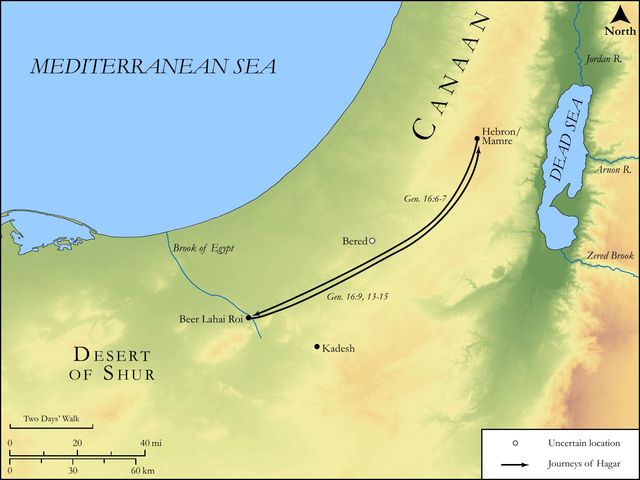
See on the biblical-era maps


Study this verse
Public-domain commentary
Matthew Henry
From his Commentary on the Whole Bible. Henry comments on passages, not single verses — this entry covers Genesis 16:4–6. His three-level outline is real structure in the source text, so it is rendered as structure.
We have here the immediate bad consequences of Abram's unhappy marriage to Hagar. A great deal of mischief it made quickly. When we do not well both sin and trouble lie at the door; and we may thank ourselves for the guilt and grief that follow us when we go out of the way of our duty. See it in this story.
I.Sarai is despised, and thereby provoked and put into a passion, Gen 16:4.
Hagar no sooner perceives herself with child by her master than she looks scornfully upon her mistress, upbraids her perhaps with her barrenness, insults over her, to make her to fret (as Sa1 1:6), and boasts of the prospect she had of bringing an heir to Abram, to that good land, and to the promise. Now she thinks herself a better woman than Sarai, more favoured by Heaven, and likely to be better beloved by Abram; and therefore she will not submit as she has done. Note,
1.Mean and servile spirits, when favoured and advanced either by God or man, are apt to grow haughty and insolent, and to forget their place and origin. See Pro 29:21; Pro 30:21-23. It is a hard thing to bear honour aright.
2.We justly suffer by those whom we have sinfully indulged, and it is a righteous thing with God to make those instruments of our trouble whom we have made instruments of our sin, and to ensnare us in our own evil counsels: this stone will return upon him that rolleth it.
II.Abram is clamoured upon, and cannot be easy while Sarai is out of humour; she upbraids him vehemently, and very unjustly charges him with the injury (Gen 16:5): My wrong be upon thee, with a most unreasonable jealousy suspecting that he countenanced Hagar's insolence; and, as one not willing to hear what Abram had to say for the rectifying of the mistake and the clearing of himself, she rashly appeals to God in the case: The Lord judge between me and thee; as if Abram had refused to right her. Thus does Sarai, in her passion, speak as one of the foolish women speaketh. Note,
1.It is an absurdity which passionate people are often guilty of to quarrel with others for that of which they themselves must bear the blame. Sarai could not but own that she had given her maid to Abram, and yet she cries out, My wrong be upon thee, when she should have said, What a fool was I to do so! That is never said wisely which pride and anger have the inditing of; when passion is upon the throne, reason is out of doors, and is neither heard nor spoken.
2.Those are not always in the right who are most loud and forward in appealing to God. Rash and bold imprecations are commonly evidences of guilt and a bad cause.
III.Hagar is afflicted, and driven from the house, Gen 16:6. Observe,
1.Abram's meekness resigns the matter of the maid-servant to Sarai, whose proper province it was to rule that part of the family: Thy maid is in thy hand. Though she was his wife, he would not countenance nor protect her in any thing that was disrespectful to Sarai, for whom he still retained the same affection that ever he had. Note, Those who would keep up peace and love must return soft answers to hard accusations. Husbands and wives particularly should agree, and endeavour not to be both angry together. Yielding pacifies great offenses. See Pro 15:1.
2.Sarai's passion will be revenged upon Hagar: She dealt hardly with her, not only confining her to her usual place and work as a servant, but probably making her to serve with rigour. Note, God takes notice of, and is displeased with, the hardships which harsh masters unreasonably put upon their servants. They ought to forbear threatening, with Job's thought, Did not he that made me make him? Job 31:15.
3.Hagar's pride cannot bear it, her high spirit having become impatient of rebuke: She fled from her face. She not only avoided her wrath for the present, as David did Saul's, but she totally deserted her service, and ran away from the house, forgetting,
(1.)What wrong she hereby did to her mistress, whose servant she was, and to her master, whose wife she was. Note, Pride will hardly be restrained by any bonds of duty, no, not by many.
(2.)That she herself had first given the provocation, by despising her mistress. Note, Those that suffer for their faults ought to bear their sufferings patiently, Pe1 2:20.
Historical interpretation
Historical reception
3 surviving comments on this verse. Each one is dated, so this reads as a timeline rather than a list.
Select a marker to jump to its quote. Markers stagger vertically where authors wrote within a few decades of each other.
In the literal sense, this statement introduces the beginner to the passionlessness (apatheia) of the patriarch, who had received the slave girl from his wife without looking for pleasure and who now yields to his wife and withdraws in accordance with her wishes. As for the spiritual sense, the zealous man, even if he is still at the introductory level, since he is not altogether a stranger to virtue, receives with pleasure her reproaches and thus more rapidly abandons the petty things. As one who submits to her, he follows her directions in the use of the preparatory exercises and allows her to control them. Since he is desirous to make virtue the goal of all his words, actions and thoughts, he willingly accepts any corrections that come from her.
There is a kind of maltreatment of the slave girl that we have likened, by anagogy, to the preparatory exercises (progymnasmata): the shadow [Hagar] of things to come [the generative promise] is transcended. For one who is hastening toward perfection no longer needs that which is preparatory. This is why it is quite natural that the slave girl should flee, because what belongs to the introductory level no longer remains when progress and perfection have arrived.
And here follow the times of Abraham’s sons, the one by Hagar the bondmaid, the other by Sarah the free woman, about whom we have already spoken in the previous book. As regards this transaction, Abraham is in no way to be branded as guilty concerning this concubine. For he dealt with her for the begetting of progeny, not for the gratification of lust, and not to insult but rather to obey his wife, who supposed it would be solace of her barrenness if she could make use of the fruitful womb of her handmaid to supply the defect of her own nature. By that law of which the apostle says, “Likewise also the husband has not power of his own body, but the wife,” Sarah could, as a wife, do benefit to him through childbearing by another, when she could not do so in her own person. Here there is no wanton lust, no crude lewdness. The handmaid is delivered to the husband by the wife for the sake of progeny and is received by the husband for the sake of progeny, each seeking not guilty excess but natural fruit. Then the pregnant bondwoman despised her barren mistress, and Sarah, with womanly jealousy, rather laid the blame of this on her husband. Yet even then Abraham showed that he was not a slavish lover but a free begetter of children and that in using Hagar he had guarded the chastity of Sarah his wife and had gratified her will and not his own. He had received her without seeking her, gone in to her without being attached, impregnated without loving her. For he says, “Behold, your maid is in your power; do to her as you please.” Here is a man able to treat different women as they require—his wife temperately, his handmaid compliantly, neither intemperately!
Continue studying Genesis 16:6 across the web’s major study libraries — every link below opens this exact verse, chapter, or book on the destination site.
Read & Compare
 BibleGatewayThis verse in more than 200 translations and 70 languages.
 Bible.comThe YouVersion reader — hundreds of translations, reading plans, and highlights.
 ESV.orgCrossway's official English Standard Version reader.
 NET BibleThe NET translation with 60,000+ translators' notes on every rendering decision.
 STEP BibleTyndale House's free study tool — original text, vocabulary, and scholarly resources.
 BibliaLogos Bible Software's free web reader.
 USCCBThe New American Bible (Revised Edition) with the U.S. bishops' study notes.
Commentaries
 BibleHub CommentariesDozens of classic commentaries on this verse, gathered on one page.
 StudyLightMore than 100 commentary sets — the largest collection on the web.
 BibleRefPlain-English commentary on what this verse means, verse by verse.
 Enduring WordDavid Guzik's free commentary on this chapter, widely used by Bible teachers.
 Bible Study ToolsVerse commentary alongside Greek and Hebrew study aids.
Original Language & Research
- BibleHub InterlinearThe verse word by word — original language, transliteration, and English.
- BibleHub LexiconEvery word's original-language definition and Strong's entry.
 Blue Letter BibleDeep-study tools — Strong's numbers, concordance, and word studies.
 SefariaThe Hebrew text with Rashi and centuries of Jewish commentary.
Sermons, Hymns & Audio


TrulyRandomVerse is not affiliated with these sites and doesn’t control their content. They’re linked because they’re genuinely useful.
Summary
Genesis 16:6 vividly portrays the escalating domestic crisis in Abram's household, detailing Abram's decision to grant Sarai full authority over her maidservant Hagar, who was pregnant with Abram's child. This delegation of power led to Sarai's severe mistreatment of Hagar, compelling the vulnerable maidservant to flee into the wilderness. The verse encapsulates the immediate, painful consequences of human impatience and the attempt to fulfill divine promises through human contrivance, highlighting the suffering inflicted upon those caught in the crossfire of such decisions.
Context
ShowHideLiterary Context
This pivotal verse is situated within the broader narrative of Abram and Sarai's struggle with barrenness, a central theme following God's profound covenantal promises. In Genesis 12:2, God promised Abram numerous descendants and a great nation, a promise reiterated and specified in Genesis 15:4 that an heir would come from his own body. Despite these clear assurances, Sarai, in her impatience and perceived inability to bear children, proposed a culturally accepted, though divinely unsanctioned, solution: that Abram take her Egyptian maidservant, Hagar, as a concubine to bear a child on her behalf (Genesis 16:2). Upon conceiving, Hagar's status and attitude shifted, leading her to despise Sarai (Genesis 16:4). Sarai then bitterly complained to Abram, who, in this verse, effectively relinquishes full authority over Hagar back to Sarai, setting the stage for the severe mistreatment and Hagar's subsequent flight, which is detailed immediately after this verse. This moment marks a critical turning point, escalating the domestic conflict and revealing the human cost of circumventing God's plan.
Historical & Cultural Context
The practice of a barren wife providing her husband with a maidservant to bear children on her behalf was a recognized custom among the patriarchs, as when Rachel gave her handmaid Bilhah to Jacob. In such cases the children were considered the offspring of the primary wife. Sarai's proposal in Genesis 16:2 was thus culturally understandable, reflecting a societal pressure to produce an heir and ensure the continuation of the family line. However, while culturally permissible, this practice was not divinely ordained for Abram and Sarai, as God had promised an heir directly through Sarai. Furthermore, the concept of "doing as it pleases" within a household, while granting significant authority to the mistress over her servants, was expected to be exercised within certain bounds of justice and care, even if those bounds were often transgressed in practice. Sarai's subsequent "hard dealing" with Hagar likely pushed beyond even societal expectations of reasonable treatment, reflecting the deep emotional distress and jealousy at play.
Key Themes
ShowHideGenesis 16:6 contributes significantly to several overarching themes within the book of Genesis and the broader biblical narrative. Firstly, it underscores the theme of Divine Promise and Human Impatience, highlighting the dangers of attempting to fulfill God's promises through human contrivance rather than trusting in His perfect timing and methods. Abram and Sarai's actions demonstrate a profound lack of faith, leading to unforeseen and painful consequences. Secondly, the verse illuminates the theme of Authority and Responsibility, particularly in patriarchal and marital contexts. Abram's abdication of his protective responsibility over Hagar, a vulnerable member of his household, and Sarai's subsequent misuse of authority, serve as a cautionary tale about the ethical exercise of power. Thirdly, it introduces the theme of Suffering of the Vulnerable and God's Compassion, as Hagar, an overlooked figure, becomes a victim of the domestic turmoil. While this verse details her affliction, the subsequent narrative in Genesis 16:7-14 powerfully reveals God's attentiveness and compassion toward the oppressed, even those outside the immediate covenant line. Finally, this episode foreshadows Future Conflict and its Enduring Legacy, as the discord initiated here between Sarai and Hagar, and subsequently between their sons Isaac and Ishmael (Genesis 21:9), sets the stage for long-standing ethnic and spiritual tensions.
Exposition and Analysis
ShowHideKey Word Analysis
ShowHideThis primitive word, referring to the open hand, is used with vast literal and figurative applications. In the phrase "in thy hand," it signifies power, control, possession, and disposal. Abram's declaration, "Behold, thy maid is in thy hand," is an idiom granting Sarai complete authority and discretion over Hagar, effectively placing Hagar entirely at Sarai's mercy and under her jurisdiction. It implies that Sarai has the means and ability to act as she deems fit.
This primitive root carries the strong sense of "to depress," "to afflict," "to oppress," "to humble," or "to mistreat severely." It implies a deliberate, often cruel, and systematic form of ill-treatment designed to put someone down, cause suffering, or assert dominance. Sarai's actions were not merely disciplinary but were intended to humble and punish Hagar severely, reflecting a deep-seated resentment and jealousy.
A primitive root meaning "to bolt," or figuratively, "to flee suddenly." This word conveys a sense of urgency, desperation, and immediate escape. Hagar's flight was not a calm departure but a sudden, urgent act of self-preservation, indicating the extreme nature of the affliction she endured and her perceived inability to remain safely in the household.
Verse Breakdown
ShowHide"But Abram said unto Sarai, Behold, thy maid [is] in thy hand;"
Following Sarai's bitter complaint about Hagar's changed demeanor, Abram responds by ceding his authority and responsibility over Hagar entirely to Sarai. The phrase "in thy hand" is an idiomatic expression signifying that Hagar is completely under Sarai's control and at her disposal. This statement represents a significant abdication of Abram's patriarchal duty to protect all members of his household, particularly the vulnerable.
"do to her as it pleaseth thee."
This clause reinforces the absolute authority Abram grants Sarai. The Hebrew phrase "as it pleaseth thee" (literally "good in your eyes" using H2896 ṭôwb and H5869 ʻayin) means "do whatever seems good or right to you." It gives Sarai unrestrained discretion, effectively a blank check to treat Hagar as she sees fit, without any apparent limitations or oversight from Abram. This permission directly enables Sarai's subsequent harsh actions.
"And when Sarai dealt hardly with her,"
This describes Sarai's immediate and severe response to the authority granted her. The Hebrew verb ʻânâh (H6031) translated "dealt hardly with" implies a deliberate, harsh, and oppressive form of mistreatment, intended to humble, afflict, or punish Hagar. This was not a minor disagreement but a severe and likely abusive course of action, driven by Sarai's jealousy and frustration.
"she fled from her face."
The consequence of Sarai's harsh treatment was Hagar's desperate flight. "From her face" (Hebrew pânîym, H6440) emphasizes the directness and intensity of the oppression, suggesting that Hagar could no longer endure being in Sarai's presence due to the severity of the affliction. Her flight signifies her profound distress and her desperate attempt to escape an unbearable situation.
Literary Devices
ShowHideThe narrative of Genesis 16:6 employs several powerful literary devices. Idiom is prominent in Abram's declaration, "thy maid is in thy hand; do to her as it pleaseth thee," which is a Hebrew idiom signifying complete control and discretion. This idiomatic language underscores the totality of the authority Abram delegates to Sarai. There is also a strong element of Irony present; Sarai, who herself is suffering from barrenness and the inability to bear an heir, becomes an oppressor of another woman who is able to conceive. This highlights the destructive nature of jealousy and impatience, turning a victim into a perpetrator. Furthermore, the verse utilizes Cause and Effect to propel the narrative, clearly linking Sarai's harsh treatment as the direct cause of Hagar's flight, emphasizing the immediate and severe consequences of human actions. The scene also serves as Foreshadowing, hinting at the future conflicts that will arise from this ill-conceived attempt to secure an heir outside of God's perfect timing, particularly the ongoing tension between the descendants of Isaac and Ishmael.
Theological and Thematic Connections
ShowHideGenesis 16:6 serves as a stark reminder of the profound consequences that arise when human impatience and lack of faith attempt to circumvent God's sovereign plan. Abram and Sarai's decision to take matters into their own hands, rather than patiently waiting for God to fulfill His promise, introduces sin, conflict, and suffering into their household. This narrative highlights the ripple effect of disobedience, demonstrating how personal choices rooted in distrust can lead to the oppression of the vulnerable and create lasting familial and even national discord. Yet, even amidst human failure, the broader biblical narrative assures us of God's unwavering faithfulness to His promises, often working through and despite human sin to bring about His ultimate purposes.
Reflection and Application
ShowHideGenesis 16:6 offers profound lessons for believers today, primarily emphasizing the critical importance of trusting in God's perfect timing and methods. We are reminded that attempting to force divine outcomes through human ingenuity or impatience often leads to unforeseen complications, fractured relationships, and unnecessary pain. This narrative calls us to exercise patience and unwavering faith, even when God's promises seem delayed or impossible, recognizing that God's ways are higher than our ways. Furthermore, it serves as a powerful reminder for those in positions of authority—whether in family, workplace, or church—to wield power with wisdom, compassion, and justice, rather than using it to oppress or mistreat others, especially the vulnerable. Our decisions, particularly when driven by frustration, fear, or a lack of faith, have far-reaching consequences that extend beyond ourselves, impacting those around us and potentially shaping future generations. We are called to reflect God's character in our exercise of authority, demonstrating love, mercy, and equity.
Questions for Reflection
ShowHideFAQ
ShowHideWhy did Abram allow Sarai to treat Hagar harshly?
ShowHideAbram's statement, "Behold, thy maid is in thy hand; do to her as it pleaseth thee," reflects a complex mix of factors. He was likely seeking to restore peace to his household and resolve the intense marital conflict stemming from Sarai's jealousy and Hagar's contempt. By delegating full authority over Hagar back to Sarai, he effectively abdicated his responsibility to protect the vulnerable and ensure justice within his household. This decision, though perhaps intended to appease Sarai and avoid further confrontation, ultimately led to Hagar's severe mistreatment and flight, highlighting a failure in his leadership and trust in God's ultimate plan.
What does "dealt hardly with her" imply about Sarai's actions?
ShowHideThe Hebrew verb 'anah (עָנָה), translated as "dealt hardly with her," signifies more than mere annoyance or unpleasantness. It implies severe mistreatment, affliction, oppression, or even humiliation. Sarai's actions were likely deliberate and harsh, intended to humble Hagar, assert her dominance, and perhaps punish her for the perceived disrespect. This mistreatment was so severe that it compelled Hagar, who was pregnant, to flee into the dangerous wilderness, underscoring the profound distress and lack of safety she experienced in Abram's household.
Christ-Centered Fulfillment
ShowHideThe narrative of Genesis 16:6, marked by human impatience, sin, and the suffering of the innocent, points profoundly to the necessity of Christ. Abram and Sarai's failure to trust God's timing and their resort to human means highlights humanity's inherent inability to achieve divine promises through its own strength or wisdom. In stark contrast, Jesus Christ perfectly fulfilled God's will, not by human contrivance or impatience, but through perfect obedience and self-sacrifice, even to the point of death on a cross (Philippians 2:8). He is the ultimate deliverer, who, unlike Abram, never abdicates responsibility, but instead takes on the suffering of the oppressed and offers true liberation and rest to those who are weary and burdened (Matthew 11:28-30). Where human authority leads to affliction and flight, Christ's authority brings healing, justice, and a secure refuge. His perfect life, atoning death, and glorious resurrection are God's true and ultimate answer to humanity's deepest needs, fulfilling the promise of a true heir and a multitude of descendants (spiritual Israel) not through human schemes or fleshly efforts, but through divine grace, the perfect work of the Son, and faith in Him (Galatians 3:16; Galatians 3:29). He is the one who came in the "fullness of time" (Galatians 4:4), perfectly executing God's plan.