


Genesis 21:17
Bible text: King James Version (1769 Blayney text) · Public domain
Bible text: King James Version with Strong's numbers · Public domain
Bible text: Berean Standard Bible · Public domain
Bible text: American Standard Version (1901) · Public domain
Bible text: World English Bible, Messianic edition · Public domain
Bible text: Geneva Bible (1599) · Public domain
Bible text: Young's Literal Translation · Public domain
- וַיִּשְׁמַעvai·yish·Ma'and he heardH8085Conj-w ¦ V-Qal-ConsecImperf-3msVerb Qal Consecutive Imperfect 3rd Singular Masculineוַandיִּשְׁמַעhe heard
- אֱלֹהִים'E·lo·HimGodH430N-mpNoun Plural Masculine Absolute
- אֶת'et<obj.>H853DirObjMParticle Object Indicator
- קוֹלKol[the] sound ofH6963N-mscNoun Singular Masculine Construct
- הַנַּעַרha·na·'Arthe ladH5288Art ¦ N-msNoun Singular Masculine Absoluteהַtheנַּעַרlad
- וַיִּקְרָאvai·yik·Ra'and he calledH7121Conj-w ¦ V-Qal-ConsecImperf-3msVerb Qal Consecutive Imperfect 3rd Singular Masculineוַandיִּקְרָאhe called
- מַלְאַךְmal·'Akh[the] angel ofH4397N-mscNoun Singular Masculine Construct
- אֱלֹהִים'E·lo·HimGodH430N-mpNoun Plural Masculine Absolute
- אֶל'eltoH413PrepPreposition
- הָגָרha·GarHagarH1904N-proper-fNoun Proper Feminine
- מִןminfromH4480PrepPreposition
- הַשָּׁמַיִםha·sha·Ma·yimthe heavensH8064Art ¦ N-mpNoun Plural Masculine Absoluteהַtheשָּׁמַיִםheavens
- וַיֹּאמֶרvai·Yo·merand he saidH559Conj-w ¦ V-Qal-ConsecImperf-3msVerb Qal Consecutive Imperfect 3rd Singular Masculineוַandיֹּאמֶרhe said
- לָהּlahto <the> herPrep-l ¦ 3fsSuffix Personal 3rd Singular Feminineלָto <the>הּher
- מַהmahwhat?H4100InterrogPronoun Interrogative
- לָּךְlakh[is] to <the> youPrep-l ¦ 2fsSuffix Personal 2nd Singular Feminineלָּ[is] to <the>ךְyou
- הָגָרha·GarO HagarH1904N-proper-fNoun Proper Feminine
- אַל'almay notH408NegParticle Negative
- תִּירְאִיtir·'Iyou be afraidH3372V-Qal-Imperf-2fsVerb Qal Imperfect 2nd Singular Feminine
- כִּיkiforH3588PrtParticle Conditional
- שָׁמַעsha·Ma'he has heardH8085V-Qal-Perf-3msVerb Qal Perfect 3rd Singular Masculine
- אֱלֹהִים'E·lo·HimGodH430N-mpNoun Plural Masculine Absolute
- אֶל'el<to>H413PrepPreposition
- קוֹלKol[the] sound ofH6963N-mscNoun Singular Masculine Construct
- הַנַּעַרha·Na·'arthe ladH5288Art ¦ N-msNoun Singular Masculine Absoluteהַtheנַּעַרlad
- בַּאֲשֶׁרba·'a·Sherat whereH834Prep-b ¦ RelParticle Relativeבַּatאֲשֶׁרwhere
- הוּאhu'heH1931Pro-3msPronoun Personal 3rd Singular Masculine
- שָׁםSham[is] thereH8033AdvAdverb
English is a literal word-by-word gloss of the Hebrew, not the KJV's wording. Why?
This is the original text the KJV's translators worked from — each Hebrew word with its own literal English meaning in this verse, prepared by scholars at Tyndale House, Cambridge. The KJV translates whole sentences, not word by word, so its wording differs: one Hebrew word can become several English words, and the KJV may choose “the LORD” where the gloss reads “Yahweh”. Both are faithful — they answer different questions. For the KJV's own rendering, switch to the KJV text.
Details
See on the biblical-era maps


Study this verse
Public-domain commentary
Matthew Henry
From his Commentary on the Whole Bible. Henry comments on passages, not single verses — this entry covers Genesis 21:14–21. His four-level outline is real structure in the source text, so it is rendered as structure.
Here is, I. The casting out of the bond-woman, and her son from the family of Abraham, Gen 21:14. Abraham's obedience to the divine command in this matter was speedy - early in the morning, we may suppose immediately after he had, in the night's visions, received orders to do this. It was also submissive; it was contrary to his judgment, at least to his own inclination, to do it; yet as soon as he perceives that it is the mind of God he makes no objections, but silently does as he is bidden, as one trained up to an implicit obedience. In sending them away without any attendants, on foot, and slenderly provided for, it is probable that he observed the directions given him. If Hagar and Ishmael had conducted themselves well in Abraham's family, they might have continued there; but they threw themselves out by their own pride and insolence, which were thus justly chastised. Note, By abusing our privileges we forfeit them. Those that know not when they are well off, in such a desirable place as Abraham's family, deserve to be cashiered, and to be made to know the worth of mercies by the want of them.
II.Their wandering in the wilderness, missing their way to the place Abraham designed them for a settlement.
1.They were reduced to great distress there. Their provisions were spent, and Ishmael was sick. He that used to be full fed in Abraham's house, where he waxed fat and kicked, now fainted and sunk, when he was brought to short allowance. Hagar is in tears, and sufficiently mortified. Now she wishes for the crumbs she had wasted and made light of at her master's table. Like one under the power of the spirit of bondage, she despairs of relief, counts upon nothing but the death of the child (Gen 21:15, Gen 21:16), though God had told her, before he was born, that he should live to be a man, a great man. We are apt to forget former promises, when present providences seem to contradict them; for we live by sense.
2.In this distress, God graciously appeared for their relief: he heard the voice of the lad, Gen 21:17. We read not of a word he said; but his sighs, and groans, and calamitous state, cried aloud in the ears of mercy. An angel was sent to comfort Hagar, and it was not the first time that she had met with God's comforts in a wilderness; she had thankfully acknowledged the former kind visit which God made his in such a case (Gen 16:13), and therefore God now visited her again with seasonable succours.
(1.)The angel assures her of the cognizance God took of her distress: God has heard the voice of the lad where he is, though he is in a wilderness (for, wherever we are, there is a way open heaven-ward); therefore lift up the lad, and hold him in thy hand, Gen 21:18. Note, God's readiness to help us when we are in trouble must not slacken, but quicken, our endeavours to help ourselves.
(2.)He repeats the promise concerning her son, that he should be a great nation, as a reason why she should bestir herself to help him. Note, It should engage our care and pains about children and young people to consider that we know not what God has designed them for, nor what great use Providence may make of them.
(3.)He directs her to a present supply (Gen 21:19): He opened her eyes (which were swollen and almost blinded with weeping), and then she saw a well of water. Note, Many that have reason enough to be comforted go mourning from day to day, because they do not see the reason they have for comfort. There is a well of water by them in the covenant of grace, but they are not aware of it; they have not the benefit of it, till the same God that opened their eyes to see their wound opens them to see their remedy, Joh 16:6, Joh 16:7. Now the apostle tells us that those things concerning Hagar and Ishmael are allegoroumena (Gal 4:24), they are to be allegorized; this then will serve to illustrate the folly,
[1.]Of those who, like the unbelieving Jews, seek for righteousness by the law and the carnal ordinances of it, and not by the promise made in Christ, thereby running themselves into a wilderness of want and despair. Their comforts are soon exhausted, and if God save them not by his special prerogative, and by a miracle of mercy open their eyes and undeceive them, they are undone.
[2.]Of those who seek for satisfaction and happiness in the world and the things of it. Those that forsake the comforts of the covenant and communion with God, and choose their portion in this earth, take up with a bottle of water, poor and slender provision, and that soon spent; they wander endlessly in pursuit of satisfaction, and, at length, sit down short of it.
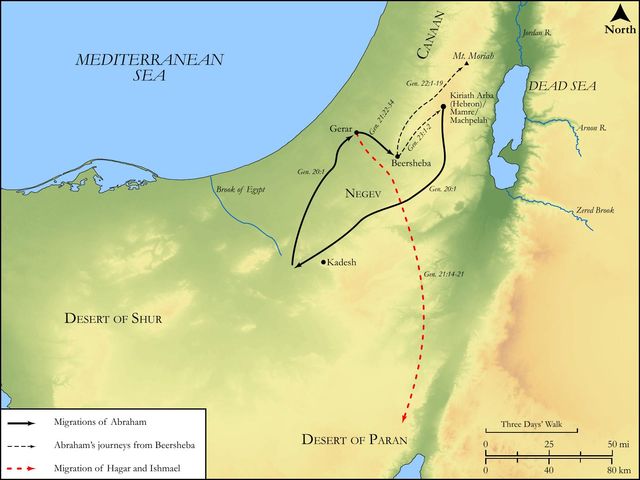
III.The settlement of Ishmael, at last, in the wilderness of Paran (Gen 21:20, Gen 21:21), a wild place, fittest for a wild man; and such a one he was, ch. 16. 12. Those that are born after the flesh take up with the wilderness of this world, while the children of the promise aim at the heavenly Canaan, and cannot be at rest till they are there. Observe, 1. He had some tokens of God's presence: God was with the lad; his outward prosperity was owing to this. 2. By trade he was an archer, which intimates that craft was his excellency and sport his business: rejected Esau was a cunning hunter. 3. He matched among his mother's relations; she took him a wife out of Egypt: as great an archer as he was, he did not think he could take his aim well, in the business of marriage, if he proceeded without his mother's advice and consent.
Continue studying Genesis 21:17 across the web’s major study libraries — every link below opens this exact verse, chapter, or book on the destination site.
Read & Compare
 BibleGatewayThis verse in more than 200 translations and 70 languages.
 Bible.comThe YouVersion reader — hundreds of translations, reading plans, and highlights.
 ESV.orgCrossway's official English Standard Version reader.
 NET BibleThe NET translation with 60,000+ translators' notes on every rendering decision.
 STEP BibleTyndale House's free study tool — original text, vocabulary, and scholarly resources.
 BibliaLogos Bible Software's free web reader.
 USCCBThe New American Bible (Revised Edition) with the U.S. bishops' study notes.
Commentaries
 BibleHub CommentariesDozens of classic commentaries on this verse, gathered on one page.
 StudyLightMore than 100 commentary sets — the largest collection on the web.
 BibleRefPlain-English commentary on what this verse means, verse by verse.
 Enduring WordDavid Guzik's free commentary on this chapter, widely used by Bible teachers.
 Bible Study ToolsVerse commentary alongside Greek and Hebrew study aids.
Original Language & Research
- BibleHub InterlinearThe verse word by word — original language, transliteration, and English.
- BibleHub LexiconEvery word's original-language definition and Strong's entry.
 Blue Letter BibleDeep-study tools — Strong's numbers, concordance, and word studies.
 SefariaThe Hebrew text with Rashi and centuries of Jewish commentary.
Sermons, Hymns & Audio


TrulyRandomVerse is not affiliated with these sites and doesn’t control their content. They’re linked because they’re genuinely useful.
Summary
Genesis 21:17 marks a pivotal moment of divine intervention and profound compassion, as God hears the desperate cries of Ishmael, abandoned and perishing in the vast wilderness with his mother, Hagar. In response, the angel of God calls out from heaven, offering Hagar immediate reassurance, dispelling her fear, and revealing God's intimate awareness of the lad's suffering, thereby paving the way for miraculous provision and the continuation of God's specific promises concerning Ishmael's future.
Context
ShowHideLiterary Context
This verse immediately follows the heart-wrenching account of Abraham sending Hagar and Ishmael into the wilderness of Beersheba at Sarah's insistent demand, as detailed in Genesis 21:14. Having exhausted their meager water supply, Hagar, unable to bear the agony of watching her son die, laid Ishmael under a shrub and moved a bowshot away, a poignant act of maternal despair. It is in this moment of utter desolation, as Ishmael cries out in distress, that God intervenes. The narrative pivots sharply from human abandonment and despair to divine attentiveness and miraculous provision, setting the stage for Ishmael's survival and future, which God had previously promised to Abraham.
Historical & Cultural Context
The wilderness of Beersheba was a harsh, unforgiving environment, where survival depended entirely on access to water and sustenance. Being cast out into such a landscape, especially as a single woman with a young boy, was tantamount to a death sentence. Hagar, an Egyptian slave, and Ishmael, a son born of a concubine, occupied a precarious social position, making their vulnerability profound. The cultural understanding of divine intervention in such dire circumstances was often tied to the cries of the helpless, highlighting a pervasive belief in a deity who hears and responds to human suffering, especially when all human resources are exhausted.
Key Themes
ShowHideGenesis 21:17 powerfully contributes to several overarching themes within the book of Genesis and the broader biblical narrative. It underscores God's Divine Attentiveness and Compassion, demonstrating that His care extends beyond the immediate covenant line to all humanity, including the lowly and outcast. It also highlights God's Faithfulness to His Promises, as this intervention ensures Ishmael's survival, directly fulfilling God's earlier assurances to Abraham that He would make a great nation of Ishmael, even though he was not the son of promise through Sarah (Genesis 17:20 and Genesis 21:13). Furthermore, the verse exemplifies Divine Intervention in Despair, showcasing God's timely rescue when human efforts fail and hope is lost.
Exposition and Analysis
ShowHideKey Word Analysis
ShowHideThis verb signifies far more than mere auditory perception. It implies an attentive listening that leads to understanding, consideration, and, crucially, responsive action. When God "hears" in Scripture, it often means He is not only aware of a situation but is actively engaged and preparing to intervene. In this context, God's hearing of Ishmael's voice indicates His deep compassion and readiness to act on behalf of the distressed lad.
Derived from a root meaning "to despatch as a deputy," mal'akh refers to a messenger, specifically a divine messenger or angel. In the Old Testament, the "angel of God" or "angel of the LORD" often functions as a direct manifestation or representative of God Himself, speaking with divine authority and conveying God's will and presence with unquestionable power. This emphasizes the direct and authoritative nature of God's intervention in Hagar's and Ishmael's plight.
This term refers to a boy, ranging from infancy to adolescence, and by implication, can also mean a servant. Its use here highlights Ishmael's youth and vulnerability. God's specific focus on the "voice of the lad" underscores His particular compassion for the helpless and innocent, emphasizing that His intervention is primarily for the child's sake, who is at the brink of death.
Verse Breakdown
ShowHide"And God heard the voice of the lad"
This opening clause immediately establishes the divine initiative. Despite Hagar having moved away, unable to watch her son die, God's omniscience and omnipresence are powerfully demonstrated. It is Ishmael's voice, likely a cry of distress or a dying groan, that God specifically hears, underscoring His direct and compassionate attention to the vulnerable boy's suffering. This hearing is not passive but signifies active engagement and impending response.
"and the angel of God called to Hagar out of heaven"
The intervention is direct and from a transcendent source. The "angel of God" acts as God's personal emissary, bridging the gap between the divine realm and the earthly despair. The call "out of heaven" emphasizes the supernatural origin of the help, signifying that salvation comes from beyond human capabilities and expectations. This divine voice cuts through Hagar's despair and isolation.
"and said unto her, What aileth thee, Hagar? fear not; for God hath heard the voice of the lad where he [is]."
The angel's address begins with an empathetic, rhetorical question, designed to acknowledge Hagar's profound distress and capture her attention. The immediate command, "fear not," is a common divine imperative in Scripture, offering comfort and reassurance in moments of terror. The reason for this comfort is then provided: God has indeed heard Ishmael's voice. The poignant phrase "where he [is]" profoundly emphasizes God's perfect knowledge and omnipresence; He knows precisely Ishmael's location, his desperate state, and the exact circumstances, even in the vast, desolate wilderness. This intimate divine knowledge forms the basis for the subsequent miraculous provision and the restoration of hope.
Literary Devices
ShowHideGenesis 21:17 employs several literary devices to convey its powerful message. Anthropomorphism is evident in the phrase "God heard the voice," attributing a human sensory action to God to convey His active awareness and responsiveness to human suffering. The appearance of the "angel of God" is an Angelophany (or potentially a Theophany), a manifestation of divine presence and communication, emphasizing the direct and authoritative nature of God's intervention. The Repetition of the phrase "God hath heard the voice of the lad" serves to underscore the central truth of the verse and to provide profound reassurance to Hagar, cementing the reason for her comfort. There is also an element of Dramatic Irony as Hagar moves away from Ishmael to avoid witnessing his death, precisely at the moment God's divine presence and intervention are most intimately focused on the boy's exact location. Finally, the Symbolism of the wilderness as a place of extreme testing and isolation, yet also a site of profound divine encounter and miraculous provision, is central to the narrative.
Theological and Thematic Connections
ShowHideThis verse profoundly illustrates God's boundless compassion and unwavering attentiveness to the cries of the distressed, regardless of their perceived status or lineage. It shatters any notion of a distant or indifferent deity, revealing a God who is intimately involved in the suffering of His creation. God's hearing of Ishmael's cry, even when Hagar herself had moved away in despair, underscores His particular care for the vulnerable and outcast. Furthermore, this divine intervention serves as a powerful testament to God's faithfulness to His promises, ensuring the survival of Ishmael in accordance with the prior assurances given to Abraham, demonstrating that God's word will always be fulfilled, even through unexpected means. This narrative offers enduring hope, reminding us that no cry of distress goes unheard by the God who sees and knows all.
Reflection and Application
ShowHideGenesis 21:17 offers profound encouragement for anyone facing overwhelming trials, despair, or the feeling of being utterly abandoned. It stands as a powerful testament that no cry, no silent groan, no desperate prayer goes unheard by God, regardless of our perceived status, our past mistakes, or the depth of our suffering. When we feel isolated, forgotten, or at the absolute end of our resources, this verse assures us that God is intimately attentive to our plight, knowing precisely "where we are" in our distress. It calls us to trust in God's unfailing compassion and His sovereign ability to intervene even in the most dire circumstances, providing hope and a way forward where none seems to exist. Just as God provided for Hagar and Ishmael in their wilderness experience, He remains faithful to sustain His people and fulfill His purposes, offering comfort and provision in our own moments of deepest need, reminding us that His ear is always inclined to the cries of His children.
Questions for Reflection
ShowHideFAQ
ShowHideWhy did God explicitly hear the "voice of the lad" and not Hagar's cries?
ShowHideWhile Hagar was undoubtedly in deep distress, the text's emphasis on Ishmael's voice, likely his cries or groans as a dying child, highlights God's direct compassion for the vulnerable and innocent. This focus also connects directly to God's earlier promises made to Abraham regarding Ishmael's future, specifically that He would make him into a great nation (Genesis 17:20 and Genesis 21:13). God's attentiveness to Ishmael's voice underscores His commitment to the boy's survival for the fulfillment of His covenantal word, even as He responds to the broader desperate situation.
Who is the "angel of God" mentioned in this verse?
ShowHideThe "angel of God" (Hebrew: mal'akh Elohim) is a divine messenger. In many Old Testament instances, particularly when the angel speaks with divine authority and acts as a direct representative of God (as seen here with the declaration "God hath heard"), this figure is often understood by theologians as a Christophany—a pre-incarnate appearance of Jesus Christ—or at least a direct, authoritative manifestation of God Himself. This interpretation emphasizes the directness, power, and personal nature of God's intervention in Hagar and Ishmael's dire circumstances.
What is the significance of "where he [is]" in God's statement?
ShowHideThe phrase "where he [is]" profoundly emphasizes God's perfect knowledge and omnipresence. It signifies that God is not a distant, detached deity, but one who is intimately aware of every detail of our circumstances, even in the most desolate and seemingly forgotten places. It reassures Hagar that God knows precisely Ishmael's location and his exact condition of suffering. This divine knowledge is the basis for His precise and effective intervention, underscoring that no one is ever truly lost or beyond the scope of God's watchful eye and compassionate care.
Christ-Centered Fulfillment
ShowHideThe divine intervention in Genesis 21:17, where God hears the cry of the distressed and sends His angel to bring comfort and provision, finds its ultimate and most profound fulfillment in Jesus Christ. Just as God heard Ishmael's desperate plea and provided life-saving water in the wilderness, Christ is the ultimate source of living water, offering eternal life and spiritual sustenance to all who thirst (John 4:10-14 and John 7:37-38). Furthermore, the "angel of God" who brings divine reassurance and direction powerfully foreshadows Christ Himself, who is the ultimate Messenger and perfect Revelation of God (Hebrews 1:1-3). In Christ, God's compassion for the suffering and outcast reaches its zenith, as He not only hears our cries but fully enters into our human suffering (Hebrews 4:15), intercedes on our behalf (Romans 8:34), and provides ultimate salvation and eternal comfort. Through His atoning sacrifice and resurrection, Christ ensures that no one who trusts in Him will ever truly perish in their wilderness of sin and despair, but will find abundant life and everlasting hope.