


Judges 18:23
Bible text: King James Version (1769 Blayney text) · Public domain
Bible text: Berean Standard Bible · Public domain
Bible text: American Standard Version (1901) · Public domain
Bible text: World English Bible, Messianic edition · Public domain
Bible text: Geneva Bible (1599) · Public domain
Bible text: Young's Literal Translation · Public domain
- וַיִּקְרְאוּvai·yik·re·'Uand they called outH7121Conj-w ¦ V-Qal-ConsecImperf-3mpVerb Qal Consecutive Imperfect 3rd Plural Masculineוַandיִּקְרְאוּthey called out
- אֶל'eltoH413PrepPreposition
- בְּנֵיbe·nei[the] descendants ofH1121N-mpcNoun Plural Masculine Construct
- דָןDanDanH1835N-properNoun Proper Location
- וַיַּסֵּבּוּvai·yas·Se·buand they turned roundH5437Conj-w ¦ V-Hiphil-ConsecImperf-3mpVerb Hiphil Consecutive Imperfect 3rd Plural Masculineוַandיַּסֵּבּוּthey turned round
- פְּנֵיהֶםpe·nei·Hemtheir facesH6440N-mpc ¦ 3mpNoun Plural Masculine Constructפְּנֵיfacesהֶםtheir
- וַיֹּאמְרוּvai·yo·me·Ruand they saidH559Conj-w ¦ V-Qal-ConsecImperf-3mpVerb Qal Consecutive Imperfect 3rd Plural Masculineוַandיֹּאמְרוּthey said
- לְמִיכָהle·mi·Khahto MicahH4318Prep-l ¦ N-proper-mNoun Proper MasculineלְtoמִיכָהMicah
- מַהmahwhat?H4100InterrogPronoun Interrogative
- לְּךָle·Kha[is that] to youPrep-l ¦ 2msSuffix Personal 2nd Singular Masculineלְּ[is that] toךָyou
- כִּיkithatH3588PrtParticle Conditional
- נִזְעָקְתָּniz·'A·ke·tayou have been called togetherH2199V-Niphal-Perf-2msVerb Niphal Perfect 2nd Singular Masculine
English is a literal word-by-word gloss of the Hebrew, not the KJV's wording. Why?
This is the original text the KJV's translators worked from — each Hebrew word with its own literal English meaning in this verse, prepared by scholars at Tyndale House, Cambridge. The KJV translates whole sentences, not word by word, so its wording differs: one Hebrew word can become several English words, and the KJV may choose “the LORD” where the gloss reads “Yahweh”. Both are faithful — they answer different questions. For the KJV's own rendering, switch to the KJV text.
Details
See on the biblical-era maps
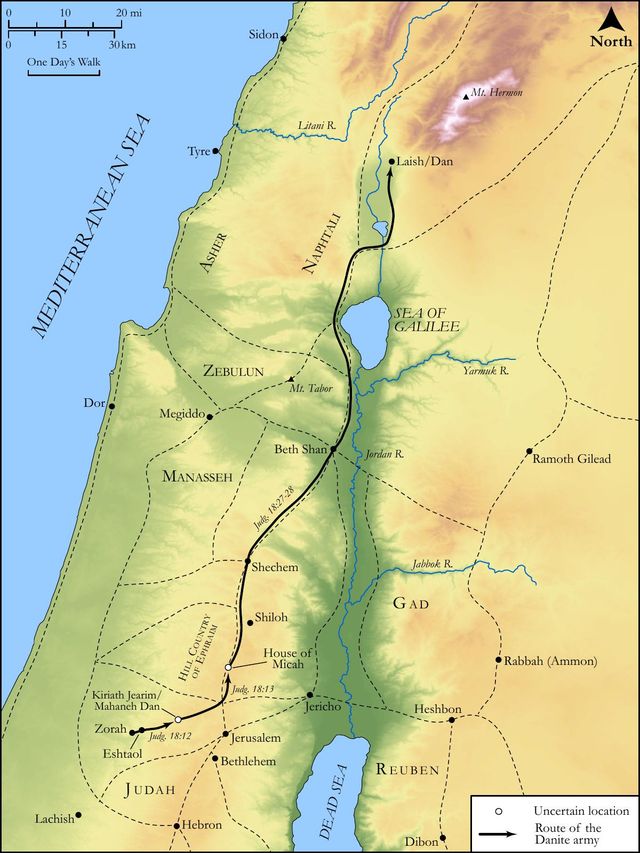
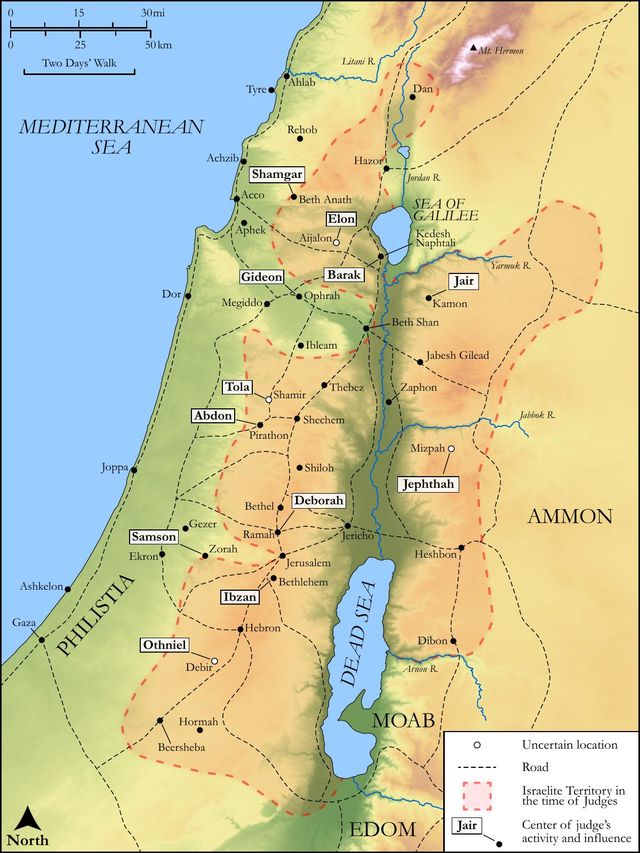
Study this verse
Public-domain commentary
Matthew Henry
From his Commentary on the Whole Bible. Henry comments on passages, not single verses — this entry covers Judges 18:14–26. His three-level outline is real structure in the source text, so it is rendered as structure.
The Danites had sent out their spies to find out a country for them, and they sped well in their search; but here, now that they came to the place (for till this brought it to their mind it does not appear that they had mentioned it to their brethren), they oblige them with a further discovery - they can tell them where there are gods: "Here, in these houses, there are an ephod, and teraphim, and a great many fine things for devotion, such as we have not the like in our country; now therefore consider what you have to do, Jdg 18:14. We consulted them, and had a good answer from them; they are worth having, nay, they are worth stealing (that is, having upon the worst terms), and, if we can but make ourselves masters of these gods, we may the better hope to prosper, and make ourselves masters of Laish." So far they were in the right, that it was desirable to have God's presence with them, but wretchedly mistaken when they took these images (which were fitter to be used in a puppet-play than in acts of devotion) for tokens of God's presence. They thought an oracle would be pretty company for them in their enterprise, and instead of a council of war to consult upon every emergency; and, the place they were going to settle in being so far from Shiloh, they thought they had more need of a house of gods among themselves than Micah had that lived so near to it. They might have made as good an ephod and teraphim themselves as these were, and such as would have served their purpose every whit as well; but the reputation which they found them in possession of (though they had had that reputation but a while) amused them into a strange veneration for this house of gods, which they would soon have dropped if they had had so much sense as to enquire into its origin, and examine whether there were any thing divine in its institution. Being determined to take these gods along with them, we are here told how they stole the images, cajoled the priest, and frightened Micah from attempting to rescue them.
I.The five men that knew the house and the avenues to it, and particularly the chapel, went in and fetched out the images, with the ephod, and teraphim, and all the appurtenances, while the 600 kept the priest in talk at the gate, Jdg 18:16-18. See what little care this sorry priest took of his gods; while he was sauntering at the gate, and gazing at the strangers, his treasure (such as it was) was gone. See how impotent these sorry gods were, that could not keep themselves from being stolen. It is mentioned as the reproach of idols that they themselves had gone into captivity, Isa 46:2. O the sottishness of these Danites! How could they imagine those gods should protect them that could not keep themselves from being stolen? Yet because they went by the name of gods, as if it were not enough that they had with them the presence of the invisible God, nor that they stood in relation to the tabernacle, where there were even visible tokens of his presence, nothing will serve them but they must have gods to go before them, not of their own making indeed, but, which was as bad, of their own stealing. Their idolatry began in theft, a proper prologue for such an opera. In order to the breaking of the second commandment, they begin with the eighth, and take their neighbour's goods to make them their gods. The holy God hates robbery for burnt-offerings, but the devil loves it. Had these Danites seized the images to deface and abolish them, and the priest to punish him, they would have done like Israelites indeed, and would have appeared jealous for their God as their fathers had done (Jos 22:16); but to take them for their own use was such a complicated crime as showed that they neither feared God nor regarded man, but were perfectly lost both to godliness and honesty.
II.They set upon the priest, and flattered him into a good humour, not only to let the gods go, but to go himself along with them; for without him they knew not well how to make use of the gods. Observe,
1.How they tempted him, Jdg 18:19. They assured him of better preferment with them than what he now had. It would be more honour and profit to be chaplain to a regiment (for they were no more, though they called themselves a tribe) than to be only a domestic chaplain to a private gentleman. Let him go with them, and he shall have more dependants on him, more sacrifices brought to his altar, and more fees for consulting his teraphim, than he had here.
2.How they won him. A little persuasion served: His heart was glad, Jdg 18:20. The proposal took well enough with his rambling fancy, which would never let him stay long at a place, and gratified his covetousness and ambition. He had no reason to say but that he was well off where he was; Micah had not deceived him, nor changed his wages. He was not moved with any remorse of conscience for attending on a graven image: had he gone away to Shiloh to minister to the Lord's priests, according to the duty of a Levite, he might have been welcome there (Deu 18:6), and his removal would have been commendable; but, instead of this, he takes the images with him, and carries the infection of the idolatry into a whole city. It would have been very unjust and ungrateful to Micah if he had only gone away himself, but it was much more so to take the images along with him, which he knew the heart of Micah was set upon. Yet better could not be expected from a treacherous Levite. What house can be sure of him who has forsaken the house of the Lord? Or what friend will he be true to that has been false to his God? He could not pretend that he was under compulsive force, for he was glad in his heart to go. If ten shekels won him (as bishop Hall expresses it), eleven would lose him; for what can hold those that have made shipwreck of a good conscience? The hireling flees because he is a hireling. The priest and his gods went in the midst of the people. There they placed him, that they might secure him either from going back himself, if his mind should change, or from being fetched back by Micah; or perhaps this post was assigned to him in imitation of the order of Israel's march through the wilderness, in which the ark and the priests went in the midst of their camp.
III.They frightened Micah back when he pursued them to recover his gods.
As soon as ever he perceived that his chapel was plundered, and his chaplain had run away from him, he mustered all the forces he could and pursued the robbers, Jdg 18:22. His neighbours, and perhaps tenants, that used to join with him in his devotions, were forward to help him on this occasion; they got together, and pursued the robbers, who, having their children and cattle before them (Jdg 18:21), could make no great haste, so that they soon overtook them, hoping by strength of reason to recover what was stolen, for the disproportion of their numbers was such that they could not hope to do it by strength of arm. The pursuers called after them, desiring to speak a word with them; those in the rear (where it is probable they posted the fiercest and strongest of their company, expecting there to be attacked) turned about and asked Micah what ailed him that he was so much concerned, and what he would have, Jdg 18:23. He argues with them, and pleads his right, which he thought should prevail; but they, in answer, plead their might, which, it proved, did prevail; for it is common that might overcomes right.
1.He insists upon the wrong they had certainly done him (Jdg 18:24): "You have taken away my gods, my images of God, which I have an incontestable title to, for I made them myself, and which I have such an affection for that I am undone if I lose them; for what have I more that will do me any good if these be lost?" Now,
(1.)This discovers to us the folly of idolaters, and the power that Satan has over them. What a folly was it for him to call those his gods which he had made, when he only that made us is to be worshipped by us as a God! Folly indeed to set his heart upon such silly idle things, and to look upon himself as undone when he had lost them!
(2.)This may discover to us our spiritual idolatry. That creature which we place our happiness in, which we set our affections inordinately upon, and which we can by no means find in our hearts to part with, of which we say, "What have we more?" that we make an idol of. That is put in God's place, and is a usurper, which we are concerned about as if our life and comfort, our hope and happiness, and our all, were bound up in it. But,
(3.)If all people will thus walk in the name of their god, shall we not be in like manner affected towards our God, the true God? Let us reckon the having of an interest in God and communion with him incomparably the richest portion, and the loss of God the sorest loss. Woe unto us if he depart, for what have we more? Deserted souls that are lamenting after the Lord may well wonder, as Micah did, that you should ask what ails them; for the tokens of God's favour are suspended, his comforts are withdrawn, and what have they more?
2.They insist upon the mischief they would certainly do him if he prosecuted his demand. They would not hear reason, nor do justice, nor so much as offer to pay him the prime cost he had been at upon those images, nor promise to make restitution of what they had taken when they had served their present purpose with them in this expedition and had time to copy them and make others like them for themselves: much less had they any compassion for a loss he so bitterly lamented. They would not so much as give him good words, but resolved to justify their robbery with murder if he did not immediately let fall his claims, Jdg 18:25. "Take heed lest angry fellows run upon thee, and thou lose thy life, and that is worse than losing thy gods." Wicked and unreasonable men reckon it a great provocation to be asked to do justice, and support themselves by their power against right and reason. Micah's crime is asking his own, yet, for this, he is in danger of losing his life and the lives of his household. Micah has not courage enough to venture his life for the rescue of his gods, so little opinion has he of their being able to protect him and bear him out, and therefore tamely gives them up (Jdg 18:26): He turned and went back to his house; and if the loss of his idols did but convince him (as, one would think, it should) of their vanity and impotency, and his own folly in setting his heart upon them, and send him back to the true God from whom he had revolted, he that lost them had a much better bargain than those that by force of arms carried them off. If the loss of our idols cure us of the love of them, and make us say, What have we to do any more with idols? the loss will be unspeakable gain. See Isa 2:20; Isa 30:22.
Continue studying Judges 18:23 across the web’s major study libraries — every link below opens this exact verse, chapter, or book on the destination site.
Read & Compare
 BibleGatewayThis verse in more than 200 translations and 70 languages.
 Bible.comThe YouVersion reader — hundreds of translations, reading plans, and highlights.
 ESV.orgCrossway's official English Standard Version reader.
 NET BibleThe NET translation with 60,000+ translators' notes on every rendering decision.
 STEP BibleTyndale House's free study tool — original text, vocabulary, and scholarly resources.
 BibliaLogos Bible Software's free web reader.
 USCCBThe New American Bible (Revised Edition) with the U.S. bishops' study notes.
Commentaries
 BibleHub CommentariesDozens of classic commentaries on this verse, gathered on one page.
 StudyLightMore than 100 commentary sets — the largest collection on the web.
 BibleRefPlain-English commentary on what this verse means, verse by verse.
 Enduring WordDavid Guzik's free commentary on this chapter, widely used by Bible teachers.
 Bible Study ToolsVerse commentary alongside Greek and Hebrew study aids.
Original Language & Research
- BibleHub InterlinearThe verse word by word — original language, transliteration, and English.
- BibleHub LexiconEvery word's original-language definition and Strong's entry.
 Blue Letter BibleDeep-study tools — Strong's numbers, concordance, and word studies.
 SefariaThe Hebrew text with Rashi and centuries of Jewish commentary.
Sermons, Hymns & Audio


TrulyRandomVerse is not affiliated with these sites and doesn’t control their content. They’re linked because they’re genuinely useful.
Summary
Judges 18:23 depicts the futile confrontation between Micah and the Danite warriors, who had just plundered his household sanctuary, stolen his cultic images, and abducted his Levite priest. This pivotal verse vividly illustrates the Danites' overwhelming power and their contemptuous dismissal of Micah's desperate plea for justice, encapsulating the pervasive lawlessness and moral decay characteristic of Israel during the period of the Judges, where brute force frequently superseded covenantal righteousness.
Context
ShowHideLiterary Context
This verse serves as a climactic moment within the broader narrative of Judges chapter 18, which, along with Judges 17, forms a crucial appendix at the end of the Book of Judges. Chapters 17-18 detail the establishment of Micah's private, syncretistic cult, complete with idols and a hired Levite priest, followed by the tribe of Dan's search for new territory due to their failure to conquer their allotted inheritance. Danite spies discover Micah's setup and, upon returning to their tribe, lead 600 armed warriors to Micah's house. They persuade the Levite priest to join them and then forcibly take Micah's cultic objects. Verse 23 describes Micah's desperate, yet ultimately futile, pursuit of the departing Danites with his neighbors, attempting to reclaim his stolen property. The Danites' dismissive and intimidating response highlights their complete disregard for Micah's rights and their reliance on overwhelming military might.
Historical & Cultural Context
The period of the Judges was a tumultuous era in Israel's history, repeatedly characterized by the refrain, "there was no king in Israel; every man did that which was right in his own eyes" (Judges 21:25). This era was marked by political decentralization, tribal disunity, and profound spiritual decline, a stark contrast to the covenant ideals established at Sinai. The incident involving Micah and the Danites perfectly exemplifies this chaos: a private individual establishing a syncretistic cult, a Levite acting as a mercenary priest, and a tribe resorting to theft and violence to secure its future, all without any central authority to enforce justice or uphold the Mosaic Law. The Danites' actions reflect a prevailing culture where power dictated outcomes, and the strong exploited the weak, showcasing a society far removed from the just and righteous community God intended for His people.
Key Themes
ShowHideJudges 18:23 powerfully contributes to several key themes prevalent throughout the Book of Judges. Firstly, it underscores the theme of Spiritual Anarchy and Moral Decay, vividly illustrating the consequences of Israel's widespread abandonment of Yahweh's covenant. Micah's idolatry and the Danites' casual theft of religious artifacts demonstrate a profound spiritual confusion and a blatant disregard for the exclusive worship of God as commanded in the Decalogue. Secondly, the verse highlights the theme of Might Over Right, where the Danites' superior numbers and weaponry allow them to completely disregard Micah's legitimate claims. Their rhetorical question is not a genuine inquiry but an assertion of dominance, reflecting a society where justice is not administered but seized through force. Finally, the narrative subtly points to the Futility of Idolatry, as Micah's "gods" are utterly powerless to protect themselves or their owner, leaving Micah desolate and vulnerable. This serves as a poignant reminder of the vanity of trusting in created things rather than the living God, a theme echoed in prophetic critiques of idolatry, such as those found in Isaiah 44.
Exposition and Analysis
ShowHideKey Word Analysis
ShowHideThis verb (H7121) signifies calling out, crying aloud, or proclaiming. In this context, it denotes Micah's desperate, perhaps even wailing, appeal to the Danites. It is a cry of distress and an appeal for the return of his stolen property, highlighting his anguish and sense of injustice in the face of overwhelming power.
This verb (H5437) means to revolve, surround, or turn around. Here, it describes the Danites' deliberate action of turning to face Micah. This is not a casual glance but a decisive movement, indicating their readiness for confrontation, their lack of fear, and their assertion of control over the situation, setting the stage for their intimidating response.
This word (H2199), derived from a root meaning "to shriek" or "to assemble," refers to the gathering or assembly that Micah has brought with him. The Danites' use of this word in their question ("such a company") is dismissive and mocking, highlighting the stark contrast between Micah's small, civilian group and their own formidable armed force. It underscores their contempt for Micah's attempt to challenge them.
Verse Breakdown
ShowHide"And they cried unto the children of Dan."
This refers to Micah and his hastily assembled neighbors, who have pursued the Danite contingent. Their "cry" is an act of profound desperation and an appeal for the return of his stolen cultic items and his Levite priest, reflecting the deep distress and sense of violation Micah feels.
"And they turned their faces, and said unto Micah,"
The Danites, a formidable force of 600 armed men, deliberately halt and confront Micah. This action is a calculated display of their confidence and superior power, signaling that they are not intimidated by Micah's pursuit and are fully prepared to assert their dominance.
"What aileth thee, that thou comest with such a company?"
This is the Danites' intimidating rhetorical question. It is designed to belittle Micah, mock his futile attempt to reclaim his property, and subtly threaten him. It highlights the vast power imbalance between the well-armed Danites and Micah's small, civilian entourage, effectively shutting down any possibility of negotiation or justice through its scornful and dismissive tone.
Literary Devices
ShowHideThe verse effectively employs Rhetorical Question ("What aileth thee?") to convey intimidation and superiority rather than seeking genuine information. This device powerfully underscores the Danites' complete disregard for Micah's rights and their reliance on brute force. There is also a strong element of Irony in Micah's predicament: he, who invested so much in his man-made gods for security and blessing, finds them utterly incapable of defending themselves or him. His distress over the loss of powerless idols highlights the profound futility of his syncretistic worship. Furthermore, the verse presents a stark Contrast between the small, desperate, and vulnerable company of Micah and the large, armed, arrogant, and dominant force of the Danites, emphasizing the pervasive theme of "might makes right" that characterizes the era of the Judges.
Theological and Thematic Connections
ShowHideJudges 18:23 is a microcosm of Israel's spiritual and moral decline during the Judges period. It vividly illustrates the devastating consequences of a society that has abandoned God's covenant and where "every man did what was right in his own eyes." The Danites' actions, driven purely by self-interest and a blatant disregard for justice, represent the pervasive lawlessness and the triumph of power over righteousness. Micah's futile pursuit and the Danites' scornful response serve as a stark warning against the emptiness of idolatry and the dangers of a spiritual vacuum, where the absence of true worship leads inevitably to chaos and oppression. This incident underscores the desperate need for righteous leadership and a return to God's established laws for societal order and individual well-being.
Reflection and Application
ShowHideThe scene in Judges 18:23 offers profound lessons for contemporary believers. It serves as a powerful reminder of the societal and personal chaos that ensues when divine authority is disregarded and moral relativism takes hold. Micah's misplaced trust in his idols, which proved utterly useless in his moment of crisis, challenges us to examine where we place our ultimate security and hope. Do we, like Micah, invest our energy and resources in things that ultimately cannot deliver or protect us? Furthermore, the Danites' use of intimidation and superior force to silence Micah's legitimate claims prompts us to consider how we respond when faced with injustice or oppression. While we may not always have the worldly power to enforce our rights, our true strength and ultimate vindication come from God. This narrative calls us to prioritize true worship, uphold righteousness, and courageously stand for justice, even when outnumbered, trusting in God's sovereign power rather than succumbing to worldly might.
Questions for Reflection
ShowHideFAQ
ShowHideWhy did the Danites take Micah's idols and priest instead of just finding new land?
ShowHideThe Danites' actions were driven by a combination of pragmatism, convenience, and a prevailing spiritual emptiness. They were seeking a new home and, in doing so, desired to establish a religious center for their new settlement. Micah's cultic objects and the Levite priest offered a ready-made "spiritual package" that they could simply appropriate. This reflects their opportunistic nature and their syncretistic understanding of worship, viewing religious items as portable assets rather than sacred covenant obligations. They saw it as an efficient means to legitimize their new territory with a "god" and a "priest," demonstrating a profound disregard for true worship and a sense of entitlement that characterized the era of "every man doing what was right in his own eyes" (Judges 21:25).
What does "What aileth thee?" truly mean in this context?
ShowHideWhile literally meaning "What is to you?" or "What is your problem?", in this context, the phrase is a rhetorical question laden with scorn, challenge, and a thinly veiled threat. It is not a genuine inquiry but a dismissive and intimidating statement. The Danites, being a superior armed force, use it to assert their dominance and mock Micah's desperate attempt to reclaim his property. It effectively communicates, "Why are you bothering us? You are powerless against us, so what do you think you can do?" This highlights the "might makes right" mentality prevalent in this period of Israel's history.
How does this incident reflect the overall message of the Book of Judges?
ShowHideThe entire narrative of Micah and the Danites (Judges 17-18) serves as a powerful illustration of the central message of the Book of Judges: the devastating consequences of Israel's apostasy and the absence of righteous leadership. It exemplifies the cycle of spiritual decline, moral decay, and social chaos that occurred when "there was no king in Israel" and the people abandoned Yahweh's covenant. The syncretism of Micah, the mercenary nature of the Levite, and the lawless violence of the Danites all underscore the deep spiritual and moral bankruptcy of the nation, highlighting the desperate need for a true and righteous king who would lead the people in obedience to God's law.
Christ-Centered Fulfillment
ShowHideThe chaos and lawlessness depicted in Judges 18:23, where human authority is absent and "might makes right," powerfully foreshadow the desperate need for a true King and a perfect High Priest. Micah's reliance on powerless, man-made idols, which could not protect themselves or their owner, stands in stark contrast to the omnipotent and ever-present God revealed in Jesus Christ. While Micah's "gods" were stolen and left him desolate, Jesus is the Lamb of God who takes away the sin of the world, the one true God who cannot be stolen or overthrown. The mercenary Levite priest, who abandoned his post for better prospects, pales in comparison to Jesus, our great High Priest who offered Himself as the perfect sacrifice once for all (Hebrews 7:23-28). The Danites' assertion of worldly power and intimidation is ultimately overcome by Christ, who, though possessing all authority in heaven and on earth, chose to lay down His life in humility and love, establishing a kingdom founded on righteousness and justice, not on brute force. He is the true King who brings order to chaos, justice to injustice, and true worship to a world lost in idolatry, offering salvation and security that no man-made god or worldly power can provide (Colossians 1:15-20).