


2 Kings 6:28
Bible text: King James Version (1769 Blayney text) · Public domain
Bible text: King James Version with Strong's numbers · Public domain
Bible text: Berean Standard Bible · Public domain
Bible text: American Standard Version (1901) · Public domain
Bible text: World English Bible, Messianic edition · Public domain
Bible text: Geneva Bible (1599) · Public domain
Bible text: Young's Literal Translation · Public domain
- וַיֹּאמֶרvai·yo·merand he saidH559Conj-w ¦ V-Qal-ConsecImperf-3msVerb Qal Consecutive Imperfect 3rd Singular Masculineוַandיֹּאמֶרhe said
- לָהּlahto herPrep-l ¦ 3fsSuffix Personal 3rd Singular Feminineלָtoהּher
- הַמֶּלֶךְha·Me·lekhthe kingH4428Art ¦ N-msNoun Singular Masculine Absoluteהַtheמֶּלֶךְking
- מַהmahwhat?H4100InterrogPronoun Interrogative
- לָּךְLakh[is] to youPrep-l ¦ 2fsSuffix Personal 2nd Singular Feminineלָּ[is] toךְyou
- וַתֹּאמֶרva·To·merand she saidH559Conj-w ¦ V-Qal-ConsecImperf-3fsVerb Qal Consecutive Imperfect 3rd Singular Feminineוַandתֹּאמֶרshe said
- הָאִשָּׁהha·'i·Shahthe womanH802Art ¦ N-fsNoun Singular Feminine Absoluteהָtheאִשָּׁהwoman
- הַזֹּאתha·Zot<the> thisH2063Art ¦ PrtParticle Demonstrativeהַ<the>זֹּאתthis
- אָמְרָה'a·me·Rahshe saidH559V-Qal-Perf-3fsVerb Qal Perfect 3rd Singular Feminine
- אֵלַי'e·Laito meH413Prep ¦ 1csPrepositionאֵלַtoיme
- תְּנִיte·NigiveH5414V-Qal-Imp-2fsVerb Qal Imperative 2nd Singular Feminine
- אֶת'et<obj.>H853DirObjMParticle Object Indicator
- בְּנֵךְbe·neKhyour sonH1121N-msc ¦ 2fsNoun Singular Masculine Constructבְּנֵsonךְyour
- וְנֹאכְלֶנּוּve·no·khe·Le·nuso we may eat himH398Conj-w ¦ V-Qal-ConjImperf-1cp ¦ 3msVerb Qal Conjunction+Imperfect 1st Plural common genderוְsoנֹאכְלֶwe may eatנּוּhim
- הַיּוֹםhai·Yomthis dayH3117Art ¦ N-msNoun Singular Masculine Absoluteהַthisיּוֹםday
- וְאֶתve·'Etand <obj.>H853Conj-w ¦ DirObjMParticle Object Indicatorוְandאֶת<obj.>
- בְּנִיbe·Nimy sonH1121N-msc ¦ 1csNoun Singular Masculine Constructבְּנִsonיmy
- נֹאכַלno·Khalwe will eatH398V-Qal-Imperf-1cpVerb Qal Imperfect 1st Plural common gender
- מָחָרma·ChartomorrowH4279N-msNoun Singular Masculine Absolute
English is a literal word-by-word gloss of the Hebrew, not the KJV's wording. Why?
This is the original text the KJV's translators worked from — each Hebrew word with its own literal English meaning in this verse, prepared by scholars at Tyndale House, Cambridge. The KJV translates whole sentences, not word by word, so its wording differs: one Hebrew word can become several English words, and the KJV may choose “the LORD” where the gloss reads “Yahweh”. Both are faithful — they answer different questions. For the KJV's own rendering, switch to the KJV text.
Details
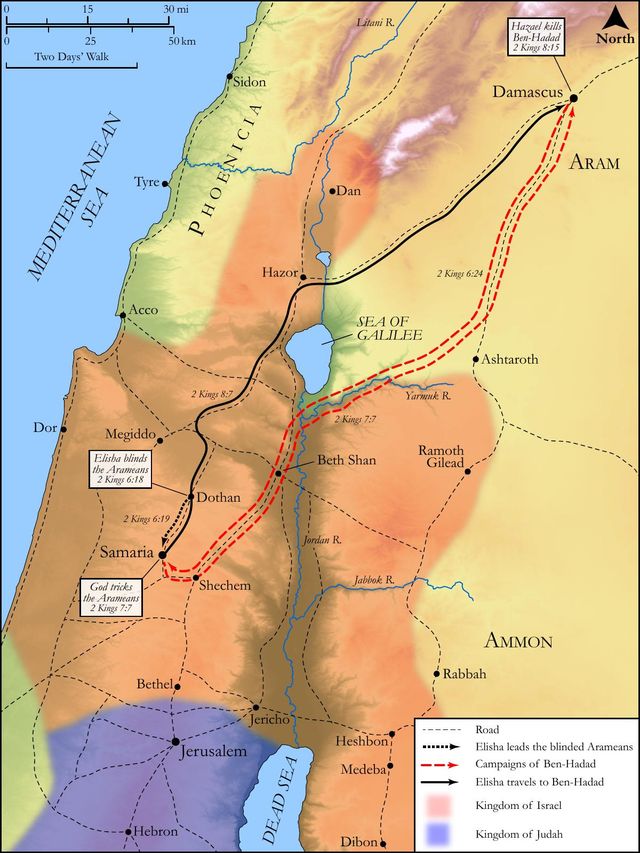
See on the biblical-era map
Study this verse
Public-domain commentary
Matthew Henry
From his Commentary on the Whole Bible. Henry comments on passages, not single verses — this entry covers 2 Kings 6:24–33.
This last paragraph of this chapter should, of right, have been the first of the next chapter, for it begins a new story, which is there continued and concluded. Here is,
I.The siege which the king of Syria laid to Samaria and the great distress which the city was reduced to thereby.
The Syrians had soon forgotten the kindnesses they had lately received in Samaria, and very ungratefully, for aught that appears without any provocation, sought the destruction of it, Kg2 6:24. There are base spirits that can never feel obliged. The country, we may suppose, was plundered and laid waste when this capital city was brought to the last extremity, Kg2 6:25. The dearth which had of late been in the land was probably the occasion of the emptiness of their stores, or the siege was so sudden that they had not time to lay in provisions; so that, while the sword devoured without, the famine within was more grievous (Lam 4:9): for, it should seem, the Syrians designed not to storm the city, but to starve it. So great was the scarcity that an ass's head, that has but little flesh on it and that unsavoury, unwholesome, and ceremonially unclean, was sold for five pounds, and a small quantity of fitches, or lentiles, or some such coarse corn, then called dove's dung, no more of it than the quantity of six eggs, for five pieces of silver, about twelve or fifteen shillings. Learn to value plenty, and to be thankful for it; see how contemptible money is, when, in time of famine, it is so freely parted with for anything that is eatable.
II.The sad complaint which a poor woman had to make to the king, in the extremity of the famine.
He was passing by upon the wall to give orders for the mounting of the guard, the posting of the archers, the repair of the breaches, and the like, when a woman of the city cried to him, Help, my lord, O king! Kg2 6:26. Whither should the subject, in distress, go for help but to the prince, who is, by office, the protector of right and the avenger of wrong? He returns but a melancholy answer (Kg2 6:27): If the Lord do not help thee, whence shall I? Some think it was a quarrelling word, and the language of his fretfulness: "Why dost thou expect anything from me, when God himself deals thus hardly with us?" Because he could not help her as he would, out of the floor or the wine-press, he would not help her at all. We must take heed of being made cross by afflictive providences. It rather seems to be a quieting word: "Let us be content, and make the best of our affliction, looking up to God, for, till he help us, I cannot help thee." 1. He laments the emptiness of the floor and the wine-press. These were not as they had been; even the king's failed. We read (Kg2 6:23) of great provisions which he had a command, sufficient for the entertainment of an army, yet now he has not wherewithal to relieve one poor woman. Scarcity sometimes follows upon great plenty; we cannot be sure that tomorrow shall be as this day, Isa 56:12; Psa 30:6. 2. He acknowledges himself thereby disabled to help, unless God would help them. Note, Creatures are helpless things without God, for every creature is that, all that, and only that, which he makes it to be. However, though he cannot help her, he is willing to hear her (Kg2 6:28): "What ails thee? Is there anything singular in thy case, or dost thou fare worse than thy neighbours?" Truly yes; she and one of her neighbours had made a barbarous agreement, that, all provisions failing, they should boil and eat her son first and then her neighbour's; hers was eaten (who can think of it without horror?) and now her neighbour hid hers, Kg2 6:28, Kg2 6:29. See an instance of the dominion which the flesh has got above the spirit, when the most natural affections of the mind may be thus overpowered by the natural appetites of the body. See the word of God fulfilled; among the threatenings of God's judgments upon Israel for their sins this was one (Deu 28:53-57), that they should eat the flesh of their own children, which one would think incredible, yet it came to pass.
III.The king's indignation against Elisha upon this occasion.
He lamented the calamity, rent his clothes, and had sackcloth upon his flesh (Kg2 6:30), as one heartily concerned for the misery of his people, and that it was not in his power to help them; but he did not lament his own iniquity, nor the iniquity of his people, which was the procuring cause of the calamity; he was not sensible that his ways and his doings had procured this to himself; this is his wickedness, for it is bitter. The foolishness of man perverteth his way, and then his heart fretteth against the Lord. Instead of vowing to pull down the calves at Dan and Beth-el, or letting the law have its course against the prophets of Baal and of the groves, he swears the death of Elisha, Kg2 6:31. Why, what is the matter? What had Elisha done? his head is the most innocent and valuable in all Israel, and yet that must be devoted, and made an anathema. Thus in the days of the persecuting emperors, when the empire groaned under any extraordinary calamity, the fault was laid on the Christians, and they were doomed to destruction. Christianos ad leones - Away with the Christians to the lions. Perhaps Jehoram was in this heat against Elisha because he had foretold this judgment, or had persuaded him to hold out, and not surrender, or rather because he did not, by his prayers, raise the siege, and relieve the city, which he though he could do but would not; whereas till they repented and reformed, and were ready for deliverance, they had no reason to expect that the prophet should pray for it.
IV.The foresight Elisha had of the king's design against him, Kg2 6:32.
He sat in his house well composed, and the elders with him, well employed no doubt, while the king was like a wild bull in a net, or like the troubled sea when it cannot rest; he told the elders there was an officer coming from the king to cut off his head, and bade them stop him at the door, and not let him in, for the king his master was just following him, to revoke the order, as we may suppose. The same spirit of prophecy that enabled Elisha to tell him what was done at a distance authorized him to call the king the son of a murderer, which, unless we could produce such an extraordinary commission, it is not for us to initiate; far be it from us to despise dominion and to speak evil of dignities. He appealed to the elders whether he had deserved so ill at the king's hands: "See whether in this he be not the son of a murderer?" For what evil had Elisha done? He had not desired the woeful day, Jer 17:16.
V.The king's passionate speech, when he came to prevent the execution of his edict for the beheading of Elisha.
He seems to have been in a struggle between his convictions and his corruptions, knew not what to say, but, seeing things brought to the last extremity, he even abandoned himself to despair (Kg2 6:33): This evil is of the Lord. Therein his notions were right and well applied; it is a general truth that all penal evil is of the Lord, as the first cause, and sovereign judge (Amo 3:6), and this we ought to apply to particular cases: if all evil, then this evil, whatever it is we are now groaning under, whoever are the instruments, God is the principal agent of it. But his inference from this truth was foolish and wicked: What should I wait for the Lord any longer? When Eli, and David, and Job, said, It is of the Lord, they grew patient upon it, but this bad man grew outrageous upon it: "I will neither fear worse nor expect better, for worse cannot come and better never will come: we are all undone, and there is no remedy." It is an unreasonable thing to be weary of waiting for God, for he is a God of judgment, and blessed are all those that wait for him.
Historical interpretation
Historical reception
2 surviving comments on this verse. Each one is dated, so this reads as a timeline rather than a list.
“Some time later King Ben-hadad of Aram mustered his entire army; he marched against Samaria and laid siege to it.” This is that Ben-hadad who had been condemned to death by God; and Ahab had received the order to execute him. But he spared his life and sent him back in peace. Therefore the Arameans besieged the city and prolonged the siege for many days, because their army occupied the whole surrounding area, so that bread began to be more and more scarce, and famine ruled. And when [the citizens] did not find the usual sustenance and food, they fell on the corpses of the dead. For the Scripture relates that there were certain mothers who decided to kill their children to assuage their hunger. And after one of them had put her son to death, when her companion in crime hid her own son (in order to save him) and broke the contract, an argument rose between them, and they both went before the judge. And they began to expound their reasons before the king, that is, Jehoram, the son of Ahab. The king, seeing that that was a harsh trial for him, was taken over by a violent rage against Elisha. For he thought [the prophet] was the cause of his disaster. Therefore he said, “Yesterday he gave abundant goods to Aramean robbers, and today has given sufficient bread to his disciples, and they are not lacking food, but he has no care for the people of his city and abandons them in their need.” And he swore that on that day itself he would take revenge on Elisha for the blood of his people. But Jehoram had no right to accuse the prophet, but rather Ahab, his father, who had scorned the prophets. In fact, if he had been persuaded by their words and had killed Ben-hadad, that [king] would have never besieged Samaria and would have never thrown him into such calamities.From the symbolic point of view the atrocious famine which tortured the Samaritans for so many days and forced them to eat in such an abominable manner shows the lack of heavenly nourishment, which affected in those days all the nations of the earth. So the city of Samaria signifies the whole of humankind, and its famine represents the famine of all. But Elisha made it disappear through his prayer, as well as through the grace of Christ. The sick were fortified by his strength, and “those who were full hired themselves out for bread.” This means that the apostles, announcers [of the gospel], have transmitted to the Gentiles the knowledge of salvation, and it has flowed, as Isaiah predicted, like “the waters covering the sea.” In the same manner it had been decreed before God that the hungry should eat the crop of the foolish and that the thirsty should absorb his goods, as the friend of the righteous Job said. Indeed, as the Samaritans plundered the food that they had collected for the Arameans and the needs of their army and brought it into their army, so the church of the Gentiles took the holy books which were preserved in the Hebrew synagogues, and gave them for the benefit of their descendants.
“Famine in Samaria became so great that a donkey’s head was sold for eighty shekels of silver.” The donkey’s head, which the Scripture reports here to be so expensive, signifies the teaching coming from the ravings of the philosophers and the scientists of the world. And it was an abominable and rotting food but was very precious when the famine reigned over the earth, and there was no one to break and give the bread to those children who asked for it, that is, until the advent of Christ.“And one-fourth of a kab of dove’s dung [was sold] for five shekels of silver.” Even though the symbol is contrary—in fact, it does not fit in with the Word—but because the righteous are likened to a dove, we say that the kab of dove’s dung represents the teaching of the law of Moses, if we compare it with the gospel of Christ. So it can be said that it was mud, a mud precious to the Jews at that time, with which they covered their eyes, which were to be opened soon by the spiritual bath and the gospel of Christ.
Continue studying 2 Kings 6:28 across the web’s major study libraries — every link below opens this exact verse, chapter, or book on the destination site.
Read & Compare
 BibleGatewayThis verse in more than 200 translations and 70 languages.
 Bible.comThe YouVersion reader — hundreds of translations, reading plans, and highlights.
 ESV.orgCrossway's official English Standard Version reader.
 NET BibleThe NET translation with 60,000+ translators' notes on every rendering decision.
 STEP BibleTyndale House's free study tool — original text, vocabulary, and scholarly resources.
 BibliaLogos Bible Software's free web reader.
 USCCBThe New American Bible (Revised Edition) with the U.S. bishops' study notes.
Commentaries
 BibleHub CommentariesDozens of classic commentaries on this verse, gathered on one page.
 StudyLightMore than 100 commentary sets — the largest collection on the web.
 BibleRefPlain-English commentary on what this verse means, verse by verse.
 Enduring WordDavid Guzik's free commentary on this chapter, widely used by Bible teachers.
 Bible Study ToolsVerse commentary alongside Greek and Hebrew study aids.
Original Language & Research
- BibleHub InterlinearThe verse word by word — original language, transliteration, and English.
- BibleHub LexiconEvery word's original-language definition and Strong's entry.
 Blue Letter BibleDeep-study tools — Strong's numbers, concordance, and word studies.
 SefariaThe Hebrew text with Rashi and centuries of Jewish commentary.
Sermons, Hymns & Audio


TrulyRandomVerse is not affiliated with these sites and doesn’t control their content. They’re linked because they’re genuinely useful.
Summary
The chilling exchange in 2 Kings 6:28 reveals the horrific depths of a severe famine during the Syrian siege of Samaria, where two women resorted to cannibalism. The king's initial inquiry into a woman's distress quickly escalates into a shocking confession of a broken agreement to consume their own children, laying bare the utter desperation, moral collapse, and profound suffering that gripped the besieged city. This verse serves as a stark testament to the extreme consequences of war and deprivation, highlighting the breakdown of societal norms and the desperate measures people take when pushed beyond the limits of human endurance.
Context
ShowHideLiterary Context
This verse is situated within a harrowing narrative of siege and famine in Samaria. The preceding verses 2 Kings 6:24-27 describe the severe blockade by Ben-hadad, king of Syria, which has led to astronomical prices for even the most undesirable food items, such as a donkey's head and dove's dung. The king of Israel, Jehoram (identified in 2 Kings 6:23), is walking on the city wall, likely inspecting its defenses or simply observing the dire situation, when he is accosted by a woman crying out for his intervention. Her plea for "help, my lord, O king!" (2 Kings 6:26) sets the stage for the shocking revelation of cannibalism in 2 Kings 6:28, immediately preceding the king's visceral reaction of grief and anger (2 Kings 6:30) and his subsequent vow to execute Elisha. The narrative then shifts to Elisha's prophecy of impending abundance, demonstrating God's sovereign hand even in such extreme circumstances, as seen in 2 Kings 7:1.
Historical & Cultural Context
The siege of Samaria by Aram (Syria) was a historical reality that brought immense suffering. Sieges in that day were brutal affairs, often designed to starve a city into submission. Famine was a common and devastating consequence, leading to extreme measures. The act of cannibalism, particularly of one's own children, was considered the ultimate taboo and a sign of utter societal collapse and divine judgment. It was explicitly warned against in the Mosaic Law as a curse for disobedience, as detailed in Deuteronomy 28:53 and Leviticus 26:29. The king's role in ancient Israel included judicial responsibilities, hence the woman's appeal for justice. However, the severity of the situation underscores his powerlessness to provide basic sustenance for his people, highlighting the failure of human leadership in the face of divine judgment or overwhelming crisis.
Key Themes
ShowHideThis verse powerfully illustrates several key themes. First, it highlights Extreme Desperation and Depravity, showing the horrific extent to which human beings can be driven when basic survival is at stake, leading to the complete breakdown of natural affection and moral boundaries. Second, it underscores the Consequences of Covenant Disobedience, echoing the curses foretold in the Law for turning away from God, particularly the prophetic warnings of cannibalism during siege conditions found in Deuteronomy 28:53. This suggests a theological understanding of the famine as a divine judgment, even if mediated through human conflict. Third, it reveals the King's Powerlessness and the limitations of human authority in the face of overwhelming suffering. Despite his position, the king is unable to alleviate the famine, leading to his despair and a desperate search for a scapegoat, as seen in his reaction in 2 Kings 6:30. This sets the stage for the subsequent demonstration of God's miraculous power through Elisha, as the narrative shifts dramatically in 2 Kings 7.
Exposition and Analysis
ShowHideKey Word Analysis
ShowHideThis word refers to the monarch, Jehoram, who holds the ultimate authority and responsibility in Israel. His presence on the wall and the woman's appeal to him underscore his position as the one expected to provide justice and protection. However, in this dire situation, the "king" is revealed to be utterly powerless in the face of the overwhelming famine, highlighting the limitations of human sovereignty when confronted with divine judgment or extreme crisis.
This term, meaning "son" or "child," is central to the horror of the verse. It represents the most precious and vulnerable member of a family, whose life is meant to be protected and nurtured. The fact that a "son" is offered and consumed for survival signifies the complete collapse of natural affection, parental duty, and the very fabric of human society under the extreme duress of the siege. The use of this word emphasizes the unthinkable nature of the act.
This primitive root means "to eat" or "to consume." While a common verb, its application here to the consumption of a human child is profoundly disturbing. The word itself is neutral, but in this context, it conveys the ultimate violation of human dignity and the natural order. The stark, almost clinical repetition of "eat him today" and "eat my son tomorrow" underscores the calculated, desperate, and morally bankrupt agreement reached, stripping the act of any emotional or moral weight in the women's immediate recounting.
Verse Breakdown
ShowHide"And the king said unto her, What aileth thee?"
This opening establishes the king's judicial role and his initial ignorance of the specific, unimaginable horror unfolding among his people. His question is a standard inquiry for someone seeking justice or relief, implying he anticipates a complaint about theft, injustice, or perhaps even a lack of food, but certainly not the depravity that is about to be revealed. It sets a tone of initial normalcy that is about to be shattered.
"And she answered, This woman said unto me, Give thy son, that we may eat him to day,"
The woman's immediate response is not a plea for food, but a demand for justice regarding a broken agreement. Her direct quotation of the other woman's proposal reveals the pre-meditated, consensual, and utterly horrific nature of the act. The phrase "Give thy son, that we may eat him" is chilling in its bluntness, indicating that the children were viewed as a commodity for survival, not as beloved offspring. The "to day" implies a shared, immediate consumption.
"and we will eat my son to morrow."
This clause completes the horrifying pact, revealing a sequential, reciprocal agreement. The "tomorrow" aspect adds a layer of calculated, cold-blooded planning to the act, suggesting a desperate attempt to ration their unspeakable "food source." The broken promise — the other woman's refusal to fulfill her part of the agreement — is the specific grievance the first woman brings to the king, highlighting that even in such extreme depravity, a sense of "justice" or adherence to a pact persists, albeit twisted.
Literary Devices
ShowHideThe passage employs several powerful literary devices to convey its horrific message. Pathos is overwhelmingly present, evoking intense pity and sorrow for the victims of the famine, particularly the children, and for the desperate women driven to such acts. The king's initial mundane question ("What aileth thee?") followed by the woman's shocking revelation creates dramatic Irony, as the ordinary inquiry is met with an extraordinary and grotesque truth. The narrative also uses Understatement in the woman's plain, almost factual recounting of the agreement; the lack of overt emotional language in her description of cannibalism makes the act even more chilling and highlights the extent to which human beings can be desensitized by extreme suffering. Furthermore, the very presence of such a narrative serves as a Foreshadowing of the dire consequences of Israel's disobedience and the desperate need for divine intervention, which eventually comes through Elisha's prophecy in the subsequent chapter.
Theological and Thematic Connections
ShowHideThis passage serves as a grim and potent reminder of the consequences of a people's turning away from God, echoing the covenant curses outlined in the Torah. While the immediate cause of the famine is the Syrian siege, the severity of the suffering, including acts of cannibalism, directly fulfills the prophetic warnings given to Israel regarding the outcomes of persistent disobedience. It underscores the fragility of human morality and social order when divine guidance is rejected and people are pushed to the brink of survival. The scene highlights humanity's capacity for extreme depravity when cut off from God's sustaining grace and the societal breakdown that results from a lack of faith and justice. Ultimately, it sets the stage for God's miraculous intervention through Elisha, demonstrating that even in the darkest moments of human despair and sin, God's sovereignty and capacity for deliverance remain.
Reflection and Application
ShowHideThe horrific account in 2 Kings 6:28 forces us to confront the devastating realities of human suffering, the depths of depravity to which people can sink under extreme duress, and the dire consequences of societal and spiritual decay. It is a stark reminder that prolonged hardship, whether from war, famine, or other forms of oppression, can erode the very foundations of human compassion and morality. For us today, this passage calls for profound empathy for those enduring unimaginable suffering in conflict zones or areas of extreme poverty. It challenges us to consider the importance of justice, the sanctity of life, and the critical need for spiritual and moral foundations that prevent such a breakdown. It also highlights the desperate human need for external intervention when all human solutions fail, pointing us towards the ultimate hope found only in God's power and provision.
Questions for Reflection
ShowHideFAQ
ShowHideWas cannibalism a common practice in ancient sieges, or was this an isolated incident?
ShowHideWhile not "common" in the sense of being a regular occurrence, acts of cannibalism, particularly of children, were tragically documented during severe and prolonged sieges, as here at Samaria and later at Jerusalem. This was considered the absolute last resort, a sign of ultimate desperation and societal collapse, and was universally abhorred. The Bible itself prophesied such horrific acts as a consequence of extreme famine and divine judgment for disobedience, as seen in Deuteronomy 28:53 and Lamentations 4:10, indicating that it was a known, albeit extreme, possibility. Scripture records the same desperate measures again in the later siege of Jerusalem. Thus, while not an everyday event, it was a terrifying reality that could emerge when a city was starved to its breaking point.
Christ-Centered Fulfillment
ShowHideThe gruesome scene in 2 Kings 6:28, depicting humanity at its most desperate and depraved, powerfully foreshadows the profound need for a divine deliverer who can address not only physical hunger but also the spiritual starvation and moral decay of humanity. The inability of the earthly king to provide sustenance or justice in this crisis points to the ultimate inadequacy of human leadership and systems to truly save. In contrast, Jesus Christ is presented as the true and ultimate provider, the Bread of Life who satisfies the deepest hunger of the soul, so that those who come to Him will never hunger or thirst again. Where human beings were driven to consume their own children for survival, Christ willingly offered His own body and blood, not for our physical sustenance in famine, but as the ultimate sacrifice for our eternal life, conquering sin and death (see John 6:53-56 and Hebrews 2:14-15). The horror of Samaria's famine underscores the desperate state of humanity under the curse of sin, a spiritual famine that only the Lamb of God, who takes away the sin of the world, can truly remedy, offering not a temporary, horrific meal, but eternal life and spiritual nourishment.