


Genesis 16:8
Bible text: King James Version (1769 Blayney text) · Public domain
Bible text: Berean Standard Bible · Public domain
Bible text: American Standard Version (1901) · Public domain
Bible text: World English Bible, Messianic edition · Public domain
Bible text: Geneva Bible (1599) · Public domain
Bible text: Young's Literal Translation · Public domain
- וַיֹּאמַרvai·yo·Marand he saidH559Conj-w ¦ V-Qal-ConsecImperf-3msVerb Qal Consecutive Imperfect 3rd Singular Masculineוַandיֹּאמַרhe said
- הָגָרha·GarO HagarH1904N-proper-fNoun Proper Feminine
- שִׁפְחַתshif·Chat[the] maidservant ofH8198N-fscNoun Singular Feminine Construct
- שָׂרַיsa·RaiSaraiH8297N-proper-fNoun Proper Feminine
- אֵי'eiwhere?H335InterrogParticle Interrogative
- מִזֶּהmi·Zehfrom thisH2088Prep-m ¦ PrtParticle Demonstrativeמִfromזֶּהthis
- בָאתvathave you comeH935V-Qal-Perf-2fsVerb Qal Perfect 2nd Singular Feminine
- וְאָנָהve·'A·nahand where?H575Conj-w ¦ InterrogParticle Interrogativeוְandאָנָהwhere?
- תֵלֵכִיte·Le·khiare you goingH1980V-Qal-Imperf-2fsVerb Qal Imperfect 2nd Singular Feminine
- וַתֹּאמֶרva·To·merand she saidH559Conj-w ¦ V-Qal-ConsecImperf-3fsVerb Qal Consecutive Imperfect 3rd Singular Feminineוַandתֹּאמֶרshe said
- מִפְּנֵיmi·pe·Neifrom beforeH6440Prep-m ¦ N-mpcNoun Plural Masculine Constructמִfromפְּנֵיbefore
- שָׂרַיsa·RaiSaraiH8297N-proper-fNoun Proper Feminine
- גְּבִרְתִּיge·vir·Timy mistressH1404N-fsc ¦ 1csNoun Singular Feminine Constructגְּבִרְתִּmistressיmy
- אָנֹכִי'a·no·KhiIH595Pro-1csPronoun Personal 1st Singular common gender
- בֹּרַחַתbo·Ra·chat[am] fleeingH1272V-Qal-Prtcpl-fsVerb Qal Participle Singular Feminine Absolute
English is a literal word-by-word gloss of the Hebrew, not the KJV's wording. Why?
This is the original text the KJV's translators worked from — each Hebrew word with its own literal English meaning in this verse, prepared by scholars at Tyndale House, Cambridge. The KJV translates whole sentences, not word by word, so its wording differs: one Hebrew word can become several English words, and the KJV may choose “the LORD” where the gloss reads “Yahweh”. Both are faithful — they answer different questions. For the KJV's own rendering, switch to the KJV text.
Details
See on the biblical-era maps


Study this verse
Public-domain commentary
Matthew Henry
From his Commentary on the Whole Bible. Henry comments on passages, not single verses — this entry covers Genesis 16:7–9. His three-level outline is real structure in the source text, so it is rendered as structure.
Here is the first mention we have in scripture of an angel's appearance. Hagar was a type of the law, which was given by the disposition of angels; but the world to come is not put in subjection to them, Heb 2:5. Observe,
I.How the angel arrested her in her flight, Heb 2:7.
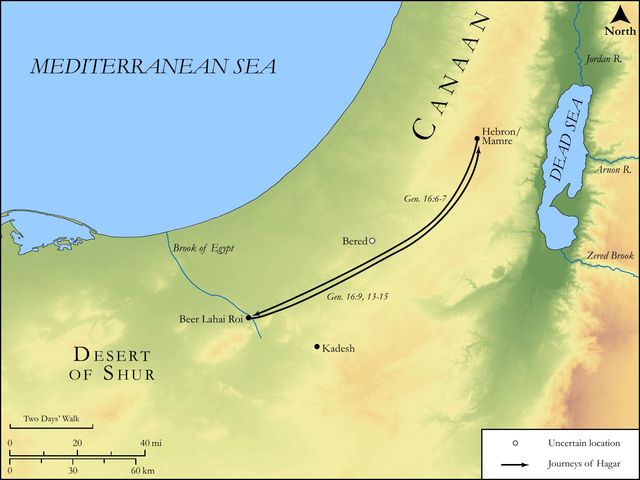
It should seem, she was making towards her own country; for she was in the way to Shur, which lay towards Egypt. It were well if our afflictions would make us think of our home, the better country. But Hagar was now out of her place, and out of the way of her duty, and going further astray, when the angel found her. Note,
1.It is a great mercy to be stopped in a sinful way either by conscience or by Providence.
2.God suffers those that are out of the way to wander awhile, that when they see their folly, and what a loss they have brought themselves to, they may be the better disposed to return. Hagar was not stopped till she was in the wilderness, and had set down, weary enough, and glad of clear water to refresh herself with. God brings us into a wilderness, and there meets us, Hos 2:14.
II.How he examined her, Gen 16:8. Observe,
1.He called her Hagar, Sarai's maid,
(1.)As a check to her pride. Though she was Abram's wife, and, as such, was obliged to return, yet he calls her Sarai's maid, to humble her. Note, Though civility teaches us to call others by their highest titles, yet humility and wisdom teach us to call ourselves by the lowest.
(2.)As a rebuke to her flight. Sarai's maid ought to be in Sarai's tent, and not wandering in the wilderness and sauntering by a fountain of water. Note, It is good for us often to call to mind what our place and relation are. See Ecc 10:4.
2.The questions the angel put to her were proper and very pertinent. (1.) "Whence comest thou? Consider that thou art running away both from the duty thou wast bound to and the privileges thou wast blessed with in Abram's tent." Note, It is a great advantage to live in a religious family, which those ought to consider who have that advantage, yet upon every slight inducement are forward to quit it. (2.) "Whither wilt thou go? Thou art running thyself into sin, in Egypt" (if she return to that people, she will return to their gods), "and into danger, in the wilderness," through which she must travel, Deu 8:15. Note, Those who are forsaking God and their duty would do well to remember not only whence they have fallen, but whither they are falling. See Jer 2:18, What hast thou to do (with Hagar) in the way of Egypt? Joh 6:68.
3.Her answer was honest, and a fair confession: I flee from the face of my mistress. In this,
(1.)She acknowledges her fault in fleeing from her mistress, and yet,
(2.)Excuses it, that it was from the face, of displeasure, of her mistress. Note, Children and servants must be treated with mildness and gentleness, lest we provoke them to take any irregular courses and so become accessory to their sins, which will condemn us, though it will not justify them.
4.How he sent her back, with suitable and compassionate counsel: "Return to thy mistress, and submit thyself under her hand, Gen 16:9. Go home, and humble thyself for what thou hast done amiss, and beg pardon, and resolve for the future to behave thyself better." He makes no question but she would be welcome, though it does not appear that Abram sent after her. Note, Those that have gone away from their place and duty, when they are convinced of their error, must hasten their return and reformation, how mortifying soever it may be.
Historical interpretation
Historical reception
2 surviving comments on this verse. Each one is dated, so this reads as a timeline rather than a list.
From this text one gains insight into the virtue of Hagar as well, and one becomes aware that she is a woman not to be despised since an angel converses with her and shows concern for her that is hardly superficial, for it is evidently by the will of God that [the angel speaks]. It is not at all improbable that Hagar was a person of zeal, because she was chosen by the holy woman Sarah to sleep with Abraham. Her nobility of soul is likewise shown by the fact that she says, “I am fleeing from my mistress, Sarah,” without saying anything bad about her. We earlier had hypothesized that Sarah represented virtue and a spiritual understanding of the Scriptures but that Hagar represented the introductory knowledge and the shadow. One who approaches the divine teaching should listen to Scripture in such a way as to understand it first according to the letter, while grasping its spirit gradually and in due order.Sarah’s child therefore requires an introductory course so that by this means he might reach the more perfect things. Similarly it would be said of the Israelites that they were “the first to whom the oracles of God were entrusted,” which were given to them “until the time of correction.” No one, in fact, who remains trapped in the letter and at the introductory level can claim Wisdom itself. If then lovers of Wisdom, who make use of what belongs to the introductory level, should remain there, they are in a sense despising virtue, but if they return to better sentiments, they put aside the introductory method so that it makes a kind of flight. For once progress has arrived, the earlier things pass away. That which has been the possession of Hagar the Egyptian is transcended. It is to earthly examples that the introductory teaching appeals for support.…
The angel then, having found her fleeing because of the greatness of virtue, makes her retrace her steps. The word of the Master indeed causes even what belongs to the introductory exercises to redound to virtue.…
The virtuous one must in fact know the principles and the goal, while the one who is still at the introductory stage often remains at this level under the pretext that virtue is too high. He flees, as it were, the effort required by perfection. This is what is revealed in the statement “I am fleeing from Sarah, my mistress.”
Moreover, when the beauty of the spiritual law is illuminated, that which is no more than shadow flees. Sacrifices that are luminous compared with those of “the shadow” were in fact announced in the transmitted teaching and have been effectively introduced in practice. Likewise too “that which was only partial” is abolished when that which is perfect is present. A case of “fleeing far from the face” is the one who, on hearing the Lord say, you must “be born from above,” inquires, “How can a man be born when he is old?” for he is interpreting a divine saying in human terms.
Continue studying Genesis 16:8 across the web’s major study libraries — every link below opens this exact verse, chapter, or book on the destination site.
Read & Compare
 BibleGatewayThis verse in more than 200 translations and 70 languages.
 Bible.comThe YouVersion reader — hundreds of translations, reading plans, and highlights.
 ESV.orgCrossway's official English Standard Version reader.
 NET BibleThe NET translation with 60,000+ translators' notes on every rendering decision.
 STEP BibleTyndale House's free study tool — original text, vocabulary, and scholarly resources.
 BibliaLogos Bible Software's free web reader.
 USCCBThe New American Bible (Revised Edition) with the U.S. bishops' study notes.
Commentaries
 BibleHub CommentariesDozens of classic commentaries on this verse, gathered on one page.
 StudyLightMore than 100 commentary sets — the largest collection on the web.
 BibleRefPlain-English commentary on what this verse means, verse by verse.
 Enduring WordDavid Guzik's free commentary on this chapter, widely used by Bible teachers.
 Bible Study ToolsVerse commentary alongside Greek and Hebrew study aids.
Original Language & Research
- BibleHub InterlinearThe verse word by word — original language, transliteration, and English.
- BibleHub LexiconEvery word's original-language definition and Strong's entry.
 Blue Letter BibleDeep-study tools — Strong's numbers, concordance, and word studies.
 SefariaThe Hebrew text with Rashi and centuries of Jewish commentary.
Sermons, Hymns & Audio


TrulyRandomVerse is not affiliated with these sites and doesn’t control their content. They’re linked because they’re genuinely useful.
Summary
A pivotal divine encounter in the desolate wilderness records the Angel of the Lord confronting Hagar, Sarai's runaway maidservant, with direct and probing questions about her past and future. This moment serves as a profound intervention, initiating a process of accountability and self-reflection for Hagar while simultaneously revealing God's compassionate awareness of her desperate plight and His sovereign oversight even in human despair.
Context
ShowHideLiterary Context
This verse is a crucial turning point within the broader narrative of Abraham and Sarai's struggle with barrenness and the unfolding of God's covenant promises. Immediately preceding this encounter, Genesis 16:1-6 details Sarai's decision to give her Egyptian maidservant, Hagar, to Abraham to bear a child, a practice seen again when Rachel gave Bilhah to Jacob. Hagar's subsequent conception leads to her despising Sarai, which in turn provokes Sarai's harsh treatment, causing Hagar to flee into the wilderness. The Angel of the Lord's appearance in Genesis 16:7 sets the stage for this direct confrontation, which then leads to divine instruction and prophecy regarding Hagar and her unborn son, Ishmael, in Genesis 16:9-12. This intervention highlights God's active involvement in the lives of individuals, even those outside the immediate covenant line, and His providential care amidst human failings.
Historical & Cultural Context
The practice of a barren wife providing a maidservant to her husband to bear children was a recognized custom among the patriarchs, as when Rachel gave her handmaid Bilhah to Jacob. This was an attempt to ensure family lineage and inheritance, particularly crucial in a society where descendants were seen as a blessing and a fulfillment of divine promise. Hagar, as an Egyptian slave, would have been at the lowest rung of the household hierarchy, vulnerable to the authority of her mistress. Her flight into the wilderness was a desperate act, likely an attempt to return to her homeland, Egypt, or at least escape the oppressive situation. The wilderness, a dangerous and desolate place, underscores her extreme vulnerability and isolation, making the divine encounter all the more significant as an act of grace and protection for one without human recourse.
Key Themes
ShowHideThe encounter in Genesis 16 contributes to several overarching themes in Genesis. It profoundly illustrates God's compassion and concern for the vulnerable and overlooked, demonstrating that His care extends beyond the covenant family to a foreign slave. It also highlights the theme of divine sovereignty and providence, showing that even when human actions (like Sarai's plan or Hagar's flight) seem to deviate from or complicate God's original promises, He remains actively involved, guiding events toward His ultimate purposes. The questions posed by the Angel introduce the theme of accountability and self-reflection, prompting Hagar to confront her circumstances and choices. Furthermore, the narrative foreshadows the future of Ishmael, establishing him as the progenitor of a great nation, thereby expanding the scope of God's interaction with humanity beyond the direct line of Abraham and Isaac, as seen in Genesis 17:20.
Exposition and Analysis
ShowHideKey Word Analysis
ShowHideOf uncertain (perhaps foreign) derivation; Hagar, the mother of Ishmael. The Angel's direct address, "Hagar," immediately identifies her by name, signifying divine recognition and personal attention. Despite her status as a runaway slave, she is known and seen by God, underscoring His intimate awareness of individuals regardless of their social standing or perceived insignificance.
A primitive root; to bolt, i.e. figuratively, to flee suddenly; chase (away); drive away, fain, flee (away), put to flight, make haste, reach, run away, shoot. Hagar's concise response, "I flee," uses this verb, accurately describing her desperate and sudden departure from Sarai's oppressive presence. It conveys her immediate distress and the urgency of her action, highlighting her attempt to escape a difficult situation.
Feminine of גְּבִיר; mistress; lady, mistress. Hagar's identification of Sarai as her "mistress" (literally "lady") defines the power dynamic and the source of her oppression. This term emphasizes Sarai's authority and Hagar's subordinate position, providing the immediate context for her flight and the harsh treatment she endured.
Verse Breakdown
ShowHide"And he said, Hagar, Sarai's maid"
The Angel of the Lord's opening words establish His omniscient awareness of Hagar's identity, her relationship to Sarai, and her current circumstances. This direct address is not merely a greeting but a statement of divine knowledge, signifying that Hagar, though alone in the wilderness, is not unseen or unknown by God. The specific mention of "Sarai's maid" immediately grounds the encounter in the domestic conflict that led to Hagar's flight.
"whence camest thou? and whither wilt thou go?"
These two probing questions are at the heart of the divine interrogation. "Whence camest thou?" (Hebrew: mê'ayin bā't?) compels Hagar to confront her past, the circumstances that led to her flight, and the responsibility for her current state. It is a question designed to elicit self-awareness and an honest reckoning with her situation. "And whither wilt thou go?" (Hebrew: wə'ānāh tēlēkī?) challenges her aimless flight and forces her to consider her future direction, purpose, and destination. Together, these questions serve as a spiritual inventory, inviting Hagar to pause, reflect, and acknowledge her desperate situation before God.
"And she said, I flee from the face of my mistress Sarai."
Hagar's response is remarkably concise, honest, and direct. It reveals her immediate distress and the oppressive reality that drove her into the wilderness. Her confession, "I flee from the face of my mistress Sarai," acknowledges the harsh treatment she received and the reason for her desperate act. This unvarnished truth lays the groundwork for the divine instruction and promise that follow, demonstrating her readiness to receive God's guidance.
Literary Devices
ShowHideThe passage employs several significant Literary Devices. The primary one is Divine Interrogation, where the Angel of the Lord poses direct, penetrating questions to Hagar. These are not merely informational queries but serve a theological purpose, compelling Hagar to confront her past and future, and preparing her for divine instruction. This technique highlights God's active involvement in human affairs and His desire for individuals to reflect on their choices. There is also an element of Symbolism in Hagar's flight into the wilderness; the wilderness represents a place of desolation, vulnerability, and testing, but also paradoxically, a place where God often reveals Himself and provides sustenance, as seen throughout biblical narratives. Finally, the encounter contains Foreshadowing, as the Angel's subsequent prophecy about Ishmael's numerous descendants and his wild nature (Genesis 16:10-12) sets the stage for future conflicts and the distinct lineage that will arise from Hagar.
Theological and Thematic Connections
ShowHideThis encounter profoundly illustrates God's active care and compassion for the lowly, the oppressed, and those in distress, extending His concern beyond the immediate covenant family to a foreign maidservant. It demonstrates that God sees and knows those who are suffering, even when they feel utterly alone and without hope. The Angel's intervention is an act of divine providence, ensuring the continuation of Hagar's life and the lineage of Ishmael, who, though not the covenant heir, is still part of God's broader plan for humanity. This narrative underscores the truth that God's sovereignty operates even amidst human error, conflict, and flight, turning moments of crisis into opportunities for divine revelation and guidance.
Reflection and Application
ShowHideThe encounter between Hagar and the Angel of the Lord offers profound lessons for contemporary believers. When feeling lost, isolated, or overwhelmed by life's difficulties, we are reminded that God sees our distress. Like Hagar in the wilderness, we are never beyond God's watchful eye and compassionate care. This narrative echoes the psalmist's assurance that the Lord is near to those who have a broken heart and saves those who are crushed in spirit. The Angel's probing questions invite us to periodically pause and reflect on our own "whence" and "whither"—where our choices have led us, and where we are headed. Such introspection, coupled with an honest acknowledgment of our circumstances, can be a crucial step toward seeking and aligning with God's will, even when we have made impulsive decisions or attempted to flee from our problems. Divine guidance is available even in moments of desperation and despair, offering a way forward and reminding us that God's grace extends to the most vulnerable.
Questions for Reflection
ShowHideFAQ
ShowHideWhy did God intervene for Hagar, who was not part of Abraham's direct covenant lineage?
ShowHideGod's intervention for Hagar demonstrates His universal compassion and sovereignty, extending beyond the immediate covenant family. While the Abrahamic covenant was specific to Abraham's descendants through Isaac (Genesis 17:19-21), God's character is one of justice and mercy for all humanity. Hagar was a vulnerable individual, oppressed and in distress, and God, in His boundless grace, saw her plight. Furthermore, her son, Ishmael, was destined to become the father of a great nation (Genesis 16:10), and God's intervention ensured the preservation of this lineage as part of His broader providential plan, even though it was distinct from the covenant line of Isaac. This highlights that God's care is not limited to one chosen people but extends to all whom He creates.
Christ-Centered Fulfillment
ShowHideThe encounter between Hagar and the Angel of the Lord powerfully prefigures Christ's own compassionate ministry to the lowly and outcast. Just as the Angel of the Lord met Hagar in her wilderness of despair, so too does Christ seek out and minister to those who are lost, broken, and fleeing from their circumstances. He is the ultimate "Angel of the Lord," the visible manifestation of God's love and concern, who came not for the righteous but for sinners (Mark 2:17), for the sick, and for those in desperate need of divine intervention. His life and ministry exemplify God's profound awareness of human suffering and His willingness to meet individuals in their deepest crises, offering not just probing questions but ultimate salvation and a path to true belonging and peace. He is the Good Shepherd who leaves the ninety-nine to seek out the one lost sheep (Luke 15:4-7), embodying the divine compassion first shown to Hagar, the forgotten maidservant, and extending it to all who are weary and heavy-laden (Matthew 11:28-30).