


Genesis 26:5
- עֵקֶב'E·kevconsequenceH6118N-mscNoun Singular Masculine Construct
- אֲשֶׁר'a·SherthatH834RelParticle Relative
- שָׁמַעsha·Ma'he listenedH8085V-Qal-Perf-3msVerb Qal Perfect 3rd Singular Masculine
- אַבְרָהָם'av·ra·HamAbrahamH85N-proper-mNoun Proper Masculine
- בְּקֹלִיbe·ko·Lito my voiceH6963Prep-b ¦ N-msc ¦ 1csNoun Singular Masculine Constructבְּtoקֹלִvoiceיmy
- וַיִּשְׁמֹרvai·yish·Morand he keptH8104Conj-w ¦ V-Qal-ConsecImperf-3msVerb Qal Consecutive Imperfect 3rd Singular Masculineוַandיִּשְׁמֹרhe kept
- מִשְׁמַרְתִּיmish·mar·Timy dutyH4931N-fsc ¦ 1csNoun Singular Feminine Constructמִשְׁמַרְתִּdutyיmy
- מִצְוֹתַיmitz·vo·Taimy commandmentsH4687N-fpc ¦ 1csNoun Plural Feminine Constructמִצְוֹתַcommandmentsיmy
- חֻקּוֹתַיchu·ko·Taimy statutesH2708N-fpc ¦ 1csNoun Plural Feminine Constructחֻקּוֹתַstatutesיmy
- וְתוֹרֹתָיve·to·ro·Taiand my lawsH8451Conj-w ¦ N-fpc ¦ 1csNoun Plural Feminine Constructוְandתוֹרֹתָlawsיmy
English is a literal word-by-word gloss of the Hebrew, not the KJV's wording. Why?
This is the original text the KJV's translators worked from — each Hebrew word with its own literal English meaning in this verse, prepared by scholars at Tyndale House, Cambridge. The KJV translates whole sentences, not word by word, so its wording differs: one Hebrew word can become several English words, and the KJV may choose “the LORD” where the gloss reads “Yahweh”. Both are faithful — they answer different questions. For the KJV's own rendering, switch to the KJV text.
Details
See on the biblical-era maps


Study this verse
Public-domain commentary
Matthew Henry
From his Commentary on the Whole Bible. Henry comments on passages, not single verses — this entry covers Genesis 26:1–5. His two-level outline is real structure in the source text, so it is rendered as structure.
Here, I. God tried Isaac by his providence. Isaac had been trained up in a believing dependence upon the divine grant of the land of Canaan to him and his heirs; yet now there is a famine in the land, Gen 26:1. What shall he think of the promise when the promised land will not find him bread? Is such a grant worth accepting, upon such terms, and after so long a time? Yes, Isaac will still cleave to the covenant; and the less valuable Canaan in itself seems to be the better he is taught to value it, 1. As a token of God's everlasting kindness to him; and, 2. As a type of heaven's everlasting blessedness. Note, The intrinsic worth of God's promises cannot be lessened in a believer's eye by any cross providences.
II.He directed him under this trial by his word.
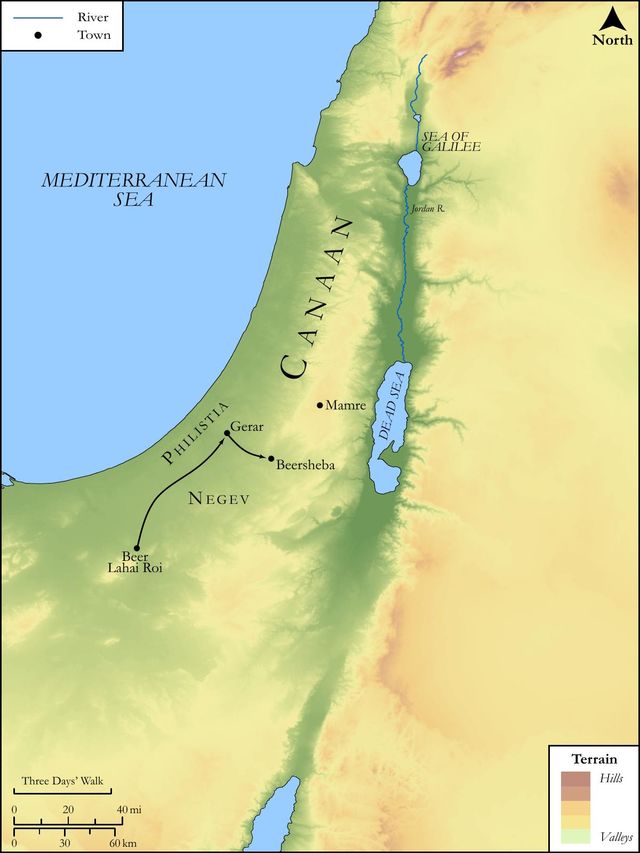
Isaac finds himself straitened by the scarcity of provisions. Somewhere he must go for supply; it should seem, he set out for Egypt, whither his father went in the like strait, but he takes Gerar in his way, full of thoughts, no doubt, which way he had best steer his course, till God graciously appeared to him, and determined him, abundantly to his satisfaction.
1.God bade him stay where he was, and not go down into Egypt: Sojourn in this land, Gen 26:2, Gen 26:3. There was a famine in Jacob's days, and God bade him go down into Egypt (Gen 46:3, Gen 46:4), a famine in Isaac's days, and God bade him not to go down, a famine in Abraham's days, and God left him to his liberty, directing him neither way. This variety in the divine procedure (considering that Egypt was always a place of trial and exercise to God's people) some ground upon the different characters of these three patriarchs. Abraham was a man of very high attainments, and intimate communion with God; and to him all places and conditions were alike. Isaac was a very good man, but not cut out for hardship; therefore he is forbidden to go to Egypt. Jacob was inured to difficulties, strong and patient; and therefore he must go down into Egypt, that the trial of his faith might be to praise, and honour, and glory. Thus God proportions his people's trials to their strength.
2.He promised to be with him, and bless him, Gen 26:3. As we may go any where with comfort when God's blessing goes with us, so we may stay any where contentedly if that blessing rest upon us.
3.He renewed the covenant with him, which had so often been made with Abraham, repeating and ratifying the promises of the land of Canaan, a numerous issue, and the Messiah, Gen 26:3, Gen 26:4. Note, Those that must live by faith have need often to review, and repeat to themselves, the promises they are to live upon, especially when they are called to any instance of suffering or self-denial.
4.He recommended to him the good example of his father's obedience, as that which had preserved the entail of the covenant in his family (Gen 26:5): "Abraham obeyed my voice; do thou do so too, and the promise shall be sure to thee." Abraham's obedience is here celebrated, to his honour; for by it he obtained a good report both with God and men. A great variety of words is here used to express the divine will, to which Abraham was obedient (my voice, my charge, my commandments, my statutes, and my laws), which may intimate that Abraham's obedience was universal; he obeyed the original laws of nature, the revealed laws of divine worship, particularly that of circumcision, and all the extraordinary precepts God gave him, as that of quitting his country, and that (which some think is more especially referred to) of the offering up of his son, which Isaac himself had reason enough to remember. Note, Those only shall have the benefit and comfort of God's covenant with their godly parents that tread in the steps of their obedience.
Historical interpretation
Historical reception
2 surviving comments on this verse. Each one is dated, so this reads as a timeline rather than a list.
Select a marker to jump to its quote. Markers stagger vertically where authors wrote within a few decades of each other.
But what is the meaning of “for the reason that he obeyed my voice and kept my commands, my orders, and my judgments”? I said to Abraham, “Go forth from your country and your kindred, onward to a land that I will show you.” He left what he had and set off for an uncertain goal. He did not dally or delay; instead, with complete enthusiasm, Abraham obeyed my call and carried out my commands. In turn I promised him things beyond nature and, despite his despair on the score of age and the unsuitability for childbearing on the part of himself and your mother, he heard from me that his descendants would develop into such a great number as to fill the whole land. Yet he did not become deranged in mind or lose faith. Hence it was reckoned as righteousness in Abraham to trust in my power and have confidence in my promises.…After your birth your mother was ill disposed toward her maidservant’s child Ishmael and wanted to drive him out of the house with Hagar so that he should have nothing in common with you. The patriarch had some natural inclination toward him out of his fatherly affection; but when he heard from me, “Do what Sarah wants,” he ignored his natural affection and drove out Ishmael along with the maidservant, obeying my call and keeping my commands in every detail. I mean, when he received the ultimate command from me to offer up as a sacrifice the son he so much desired, the gift of his old age, Abraham did not pry into the reasons. Neither was he disturbed in his thinking; nor did he betray the news to your mother or reveal to you what was about to be done by him. Instead, with steadfast resolve and heightened zeal, he pressed ahead to put my command into effect. So I rewarded his intention by preventing the execution of the deed. Since, then, he had in everything given evidence of complete obedience and observance of my commands, consequently I am making you, his child, the inheritor of the promises made to him. So imitate his obedience, and believe my words so as to be found worthy of a manifold reward for your father’s virtue and also for your own obedience. Don’t go down into Egypt; rather, stay here. Do you see God’s loving kindness in strengthening Isaac’s resolve through the memory of his father’s virtue?
Isaac is a patriarch who had no second wife, nor any concubine, but was content with the twins who were the fruit of a single intercourse. He too had the same fears as his father of the perilous beauty of his wife when he lived among strangers, and he too called her sister without a word about her being his wife, since in fact she was nearly related on the paternal and the maternal side. And Rebekah too was safe, once it was known that she was his wife. Not, however, that we should esteem him higher than his father for knowing no woman other than his single wife; undoubtedly the merits of his father’s faith and obedience were so much greater that it was because of the father that God was so good to the son.
Continue studying Genesis 26:5 across the web’s major study libraries — every link below opens this exact verse, chapter, or book on the destination site.
Read & Compare
 BibleGatewayThis verse in more than 200 translations and 70 languages.
 Bible.comThe YouVersion reader — hundreds of translations, reading plans, and highlights.
 ESV.orgCrossway's official English Standard Version reader.
 NET BibleThe NET translation with 60,000+ translators' notes on every rendering decision.
 STEP BibleTyndale House's free study tool — original text, vocabulary, and scholarly resources.
 BibliaLogos Bible Software's free web reader.
 USCCBThe New American Bible (Revised Edition) with the U.S. bishops' study notes.
Commentaries
 BibleHub CommentariesDozens of classic commentaries on this verse, gathered on one page.
 StudyLightMore than 100 commentary sets — the largest collection on the web.
 BibleRefPlain-English commentary on what this verse means, verse by verse.
 Enduring WordDavid Guzik's free commentary on this chapter, widely used by Bible teachers.
 Bible Study ToolsVerse commentary alongside Greek and Hebrew study aids.
Original Language & Research
- BibleHub InterlinearThe verse word by word — original language, transliteration, and English.
- BibleHub LexiconEvery word's original-language definition and Strong's entry.
 Blue Letter BibleDeep-study tools — Strong's numbers, concordance, and word studies.
 SefariaThe Hebrew text with Rashi and centuries of Jewish commentary.
Sermons, Hymns & Audio


TrulyRandomVerse is not affiliated with these sites and doesn’t control their content. They’re linked because they’re genuinely useful.
Summary
Genesis 26:5 serves as a profound divine declaration, explaining God's rationale for reaffirming the Abrahamic covenant to Isaac. It underscores that the enduring legacy of blessing upon Abraham's lineage is directly tied to Abraham's comprehensive and faithful obedience to God's revealed will. This verse highlights God's unwavering commitment to His promises, demonstrating that Abraham's diligent adherence to God's voice, charge, commandments, statutes, and laws—even prior to the formal Mosaic Law—established a foundational precedent for generational blessings, illustrating the profound impact of a life lived in full submission to divine authority.
Context
ShowHideLiterary Context
Genesis 26 unfolds during a severe famine, mirroring a similar crisis in Abraham's time. Isaac, like his father, contemplates migrating to Egypt but is divinely instructed by God to remain in Gerar. It is in this context of potential fear and uncertainty that God appears to Isaac, reaffirming the covenant promises initially made to Abraham. This divine appearance and the subsequent declaration in Genesis 26:2-4 precede and set the stage for verse 5, which provides the explicit reason for God's renewed commitment to Isaac. The immediate narrative then details Isaac's interactions with Abimelech, his prosperity, and the envy it provokes, all of which implicitly flow from the blessings promised and justified by Abraham's obedience.
Historical & Cultural Context
The patriarchal period (roughly 2000-1500 BC) was characterized by nomadic or semi-nomadic existence, reliance on divine guidance, and the foundational development of a covenant relationship between God and a chosen people. In this era, formal, written legal codes like the Mosaic Law were centuries away. Therefore, "laws," "statutes," and "commandments" for Abraham would have referred to direct, progressive divine revelation received through personal communication, prophetic instruction, or inherent moral principles understood by humanity. The concept of a father's legacy and the generational transfer of blessings and curses was deeply ingrained in ancient Near Eastern cultures, making God's explicit link between Abraham's obedience and Isaac's blessing highly significant and culturally resonant.
Key Themes
ShowHideThis verse powerfully contributes to several overarching themes in Genesis and the broader biblical narrative. Firstly, it reinforces the theme of Covenant Faithfulness, demonstrating God's unwavering commitment to His promises across generations, even when human circumstances are challenging. Secondly, it highlights the Generational Impact of Obedience, illustrating how the faithfulness of one generation can secure blessings for succeeding ones, a principle echoed throughout the Old Testament (e.g., Exodus 20:6). Thirdly, it delves into the Nature of Pre-Mosaic Revelation and Obedience, showing that God had a revealed will for humanity and His chosen people long before Sinai, and that true faith was always characterized by active submission to that will. Finally, it subtly foreshadows the ultimate Blessing to All Nations through Abraham's seed, a promise that finds its ultimate fulfillment in Christ, as seen in passages like Galatians 3:8-9.
Exposition and Analysis
ShowHideThe KJV text of Genesis 26:5 explicitly states the divine reason for God's continued blessings upon Isaac: "Because that Abraham obeyed my voice, and kept my charge, my commandments, my statutes, and my laws." This declaration highlights a fundamental biblical principle: God honors and rewards obedience. It's not merely a casual observation but a direct causal link established by God Himself, demonstrating His faithfulness to His covenant and His recognition of Abraham's devoted walk. The verse emphasizes that Abraham's obedience was not selective but holistic, encompassing every aspect of God's revealed will to him.
Key Word Analysis
ShowHideThis term, derived from a root meaning "heel" or "end," here functions adverbially to denote "on account of" or "as a result of." It establishes a clear causal link, indicating that the blessings pronounced upon Isaac are directly consequent to Abraham's actions. It underscores the principle of divine recompense for faithful adherence.
More than merely "hearing," this primitive root implies an intelligent and attentive hearing that leads to action, often with the implication of attention and obedience. In this context, it signifies Abraham's active listening and responsive submission to God's direct communications and instructions, such as the call to leave Ur or the command to sacrifice Isaac.
This verb means "to guard," "to protect," or "to attend to." When applied to God's commands, it signifies a diligent, careful, and active observance, a watchful adherence to what has been entrusted. It suggests a sustained commitment to God's directives, not merely a one-time act but a lifestyle of preservation and adherence.
This term refers to an "enactment" or "ordinance," often implying something prescribed, fixed, or engraved. It denotes established decrees or customary practices that Abraham was to follow, representing the settled and unchangeable aspects of God's will revealed to him. Its presence alongside "commandments" and "laws" emphasizes the comprehensive nature of God's revealed will and Abraham's holistic adherence.
Verse Breakdown
ShowHide"Because that Abraham obeyed my voice"
This initial clause establishes the foundational reason for God's continued blessing. Abraham's obedience was not merely intellectual assent but an active, responsive heeding of God's direct, personal communication. This "voice" (qôwl) implies specific, often verbal, instructions from God, to which Abraham consistently demonstrated a willingness to listen and act.
"and kept my charge, my commandments, my statutes, and my laws"
This comprehensive enumeration details the breadth and depth of Abraham's obedience. "My charge" (mishmereth) refers to something entrusted to his care, a duty or ordinance to be observed diligently. "My commandments" (mitsvâh) are general divine precepts. "My statutes" (chuqqâh) denote fixed ordinances or decrees. "My laws" (tôwrâh), in its plural form, signifies the entirety of God's revealed instruction and guidance. Together, these terms paint a picture of Abraham's life as one of holistic, consistent, and diligent submission to every facet of God's revealed will, even in the absence of a formal, codified law like the Mosaic Law.
Literary Devices
ShowHideThe verse employs several significant literary devices to emphasize its core message. Repetition is evident in the cumulative list of terms describing God's revealed will: "my voice," "my charge," "my commandments," "my statutes," and "my laws." This Accumulation or Polysyndeton (the repeated use of "and") serves to underscore the comprehensive and multifaceted nature of Abraham's obedience, demonstrating that he did not merely obey one command but diligently adhered to every aspect of God's instruction. The structure itself creates a sense of Emphasis on the profound and thorough nature of Abraham's faithfulness. Furthermore, the opening word "Because" establishes a clear Causal Language, presenting Abraham's obedience as the direct and explicit reason for God's continued covenant blessings upon Isaac, thereby highlighting the divine principle of rewarding faithfulness.
Theological and Thematic Connections
ShowHideGenesis 26:5 is a cornerstone verse for understanding the dynamic relationship between divine promise, human obedience, and generational blessing within the biblical narrative. It powerfully articulates that while God's covenant with Abraham was initiated by grace and rooted in God's sovereign choice, the continuation and manifestation of its blessings are intrinsically linked to the faithful response of His people. This verse demonstrates God's unwavering faithfulness to His covenant, showing that He remembers and acts upon the obedience of His chosen servant, extending the benefits of that obedience across generations. It underscores that true faith is not passive but actively expressed through a comprehensive and diligent adherence to God's revealed will, setting a precedent for the importance of obedience throughout redemptive history, even before the formal giving of the Law at Sinai.
Reflection and Application
ShowHideGenesis 26:5 offers profound and enduring lessons for believers today, emphasizing that God values and takes note of our obedience. It reminds us that our faithfulness to God's revealed will can play a significant role in how His blessings manifest in our lives and the lives of those connected to us, extending a spiritual legacy across generations. This verse calls us to a holistic and comprehensive submission, recognizing that genuine faith is not merely intellectual assent but is expressed through active and diligent obedience to God's Word in every facet of our existence. Just as God remained faithful to Abraham and Isaac, we can trust in His unwavering faithfulness to His promises as we walk in diligent obedience. This encourages us to live lives of intentional devotion, understanding that our present faithfulness can lay a foundation for future blessings for our families, communities, and even future generations, demonstrating the tangible impact of a life lived in alignment with divine will.
Questions for Reflection
ShowHideFAQ
ShowHideWhat kind of "laws" did Abraham obey if the Mosaic Law hadn't been given yet?
ShowHideThe terms used in Genesis 26:5—"voice," "charge," "commandments," "statutes," and "laws"—refer to God's direct instructions, moral expectations, and the progressive revelation of His will given to Abraham personally. These were not the codified laws of the Mosaic covenant, which would be given centuries later at Mount Sinai. Abraham's obedience was to the specific, communicated will of God for his time, such as the command to leave his homeland (Genesis 12:1), the instruction to circumcise all males in his household (Genesis 17:9-14), or the ultimate test to sacrifice Isaac (Genesis 22:1-2). His life demonstrated a comprehensive adherence to God's communicated will for his era, reflecting a deep, personal relationship with the Almighty.
How does Abraham's obedience in this verse relate to God's grace?
ShowHideAbraham's obedience in Genesis 26:5 is presented as the reason for the continuation of covenant blessings to Isaac, not the basis for Abraham's initial salvation or God's initial choice of him. Abraham was chosen by God's sovereign grace (Genesis 12:1-3), and his faith was credited as righteousness before any major acts of obedience like circumcision or the offering of Isaac (Genesis 15:6). His subsequent obedience was therefore a response to that grace and a demonstration of his living faith, as articulated in the New Testament (James 2:22). Thus, obedience flows from faith and grace, and God, in His faithfulness, rewards and blesses that obedience within the framework of His covenant promises.
Christ-Centered Fulfillment
ShowHideGenesis 26:5, highlighting Abraham's obedience as the basis for generational blessing, finds its ultimate fulfillment and perfection in the person and work of Jesus Christ. Abraham's obedience, though profound and exemplary, was imperfect and incomplete, marked by moments of doubt and failure. Christ, however, lived a life of perfect, unblemished obedience to the Father's "voice," "commandments," "statutes," and "laws" from beginning to end. His life of sinless obedience culminated in His ultimate act of submission on the cross, where He "became obedient to the point of death, even death on a cross" (Philippians 2:8). Through Christ's perfect obedience, the curse of human disobedience is reversed, and the blessings promised to Abraham's "seed"—which is Christ Himself (Galatians 3:16)—are secured and extended to all who believe. His singular, perfect obedience is the true and lasting foundation for the "blessing of Abraham" to come upon the Gentiles (Galatians 3:14), ushering in a new and greater covenant of grace and eternal life for all nations (Romans 5:19).