


Genesis 26:6
- וַיֵּשֶׁבvai·Ye·shevand he dweltH3427Conj-w ¦ V-Qal-ConsecImperf-3msVerb Qal Consecutive Imperfect 3rd Singular Masculineוַandיֵּשֶׁבhe dwelt
- יִצְחָקyitz·ChakIsaacH3327N-proper-mNoun Proper Masculine
- בִּגְרָרbig·Rarin GerarH1642Prep-b ¦ N-properNoun Proper LocationבִּinגְרָרGerar
English is a literal word-by-word gloss of the Hebrew, not the KJV's wording. Why?
This is the original text the KJV's translators worked from — each Hebrew word with its own literal English meaning in this verse, prepared by scholars at Tyndale House, Cambridge. The KJV translates whole sentences, not word by word, so its wording differs: one Hebrew word can become several English words, and the KJV may choose “the LORD” where the gloss reads “Yahweh”. Both are faithful — they answer different questions. For the KJV's own rendering, switch to the KJV text.
Details
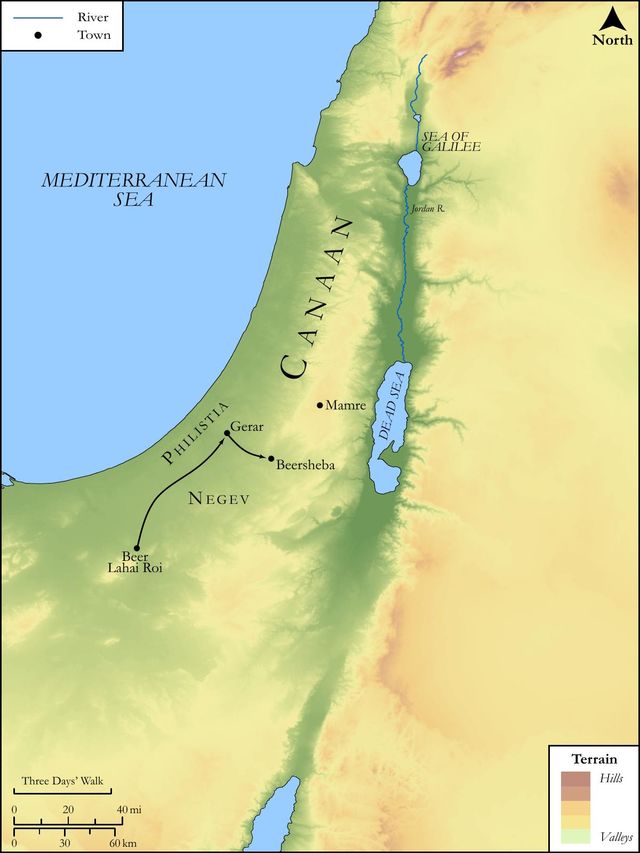
See on the biblical-era maps


Study this verse
Public-domain commentary
Matthew Henry
From his Commentary on the Whole Bible. Henry comments on passages, not single verses — this entry covers Genesis 26:6–11. His two-level outline is real structure in the source text, so it is rendered as structure.
Isaac had now laid aside all thoughts of going to Egypt, and, in obedience to the heavenly vision, sets up his staff in Gerar, the country in which he was born (Gen 26:6), yet there he enters into temptation, the same temptation that his good father had been once and again surprised and overcome by, namely, to deny his wife, and to give out that she was his sister. Observe,
I.How he sinned, Gen 26:7.
Because his wife was handsome, he fancied the Philistines would find some way or other to take him off, that some of them might marry her; and therefore she must pass for his sister. It is an unaccountable thing that both these great and good men should be guilty of so strange a piece of dissimulation, by which they so much exposed both their own and their wives' reputation. But we see,
1.That very good men have sometimes been guilty of very great faults and follies. Let those therefore that stand take heed lest they fall, and those that have fallen not despair of being helped up again.
2.That there is an aptness in us to imitate even the weaknesses and infirmities of those we have a value for. We have need therefore to keep our foot, lest, while we aim to tread in the steps of good men, we sometimes tread in their by-steps.
II.How he was detected, and the cheat discovered, by the king himself.
Abimelech (not the same that was in Abraham's days, ch. 20, for this was nearly 100 years after that, but this was the common name of the Philistine kings, as Caesar of the Roman emperors) saw Isaac more familiar and pleasant with Rebekah than he knew he would be with his sister (Gen 26:8): he saw him sporting with her, or laughing; it is the same word with that from which Isaac has his name. He was rejoicing with the wife of his youth, Pro 5:18. It becomes those in that relation to be pleasant with one another, as those that are pleased with one another. Nowhere may a man more allow himself to be innocently merry than with his own wife and children. Abimelech charged him with the fraud (Gen 26:9), showed him how frivolous his excuse was and what might have been the bad consequences of it (Gen 26:10), and then, to convince him how groundless and unjust his jealousy of them was, took him and his family under his particular protection, forbidding any injury to be done to him or his wife upon pain of death, Gen 26:11. Note,
1.A lying tongue is but for a moment. Truth is the daughter of time; and, in time, it will out.
2.One sin is often the inlet to many, and therefore the beginnings of sin ought to be avoided.
3.The sins of professors shame them before those that are without.
4.God can make those that are incensed against his people, though there may be some colour of cause for it, to know that it is at their peril if they do them any hurt. See Psa 105:14, Psa 105:15.
Continue studying Genesis 26:6 across the web’s major study libraries — every link below opens this exact verse, chapter, or book on the destination site.
Read & Compare
 BibleGatewayThis verse in more than 200 translations and 70 languages.
 Bible.comThe YouVersion reader — hundreds of translations, reading plans, and highlights.
 ESV.orgCrossway's official English Standard Version reader.
 NET BibleThe NET translation with 60,000+ translators' notes on every rendering decision.
 STEP BibleTyndale House's free study tool — original text, vocabulary, and scholarly resources.
 BibliaLogos Bible Software's free web reader.
 USCCBThe New American Bible (Revised Edition) with the U.S. bishops' study notes.
Commentaries
 BibleHub CommentariesDozens of classic commentaries on this verse, gathered on one page.
 StudyLightMore than 100 commentary sets — the largest collection on the web.
 BibleRefPlain-English commentary on what this verse means, verse by verse.
 Enduring WordDavid Guzik's free commentary on this chapter, widely used by Bible teachers.
 Bible Study ToolsVerse commentary alongside Greek and Hebrew study aids.
Original Language & Research
- BibleHub InterlinearThe verse word by word — original language, transliteration, and English.
- BibleHub LexiconEvery word's original-language definition and Strong's entry.
 Blue Letter BibleDeep-study tools — Strong's numbers, concordance, and word studies.
 SefariaThe Hebrew text with Rashi and centuries of Jewish commentary.
Sermons, Hymns & Audio


TrulyRandomVerse is not affiliated with these sites and doesn’t control their content. They’re linked because they’re genuinely useful.
Summary
Genesis 26:6 succinctly records, "And Isaac dwelt in Gerar," marking a significant moment of obedient faith in Isaac's life. Amidst a severe famine, this verse highlights his decision to remain in the land God had directed him to, rather than seeking refuge in Egypt. His settled presence in the Philistine city of Gerar underscores his profound trust in divine guidance and provision, echoing the enduring covenant faithfulness God had previously demonstrated to his father, Abraham.
Context
ShowHideLiterary Context
This verse is deeply embedded within the immediate narrative of Genesis 26, which opens with a severe famine in the land, reminiscent of the one Abraham faced in Genesis 12:10. Isaac, like his father, initially considers going to Egypt for relief. However, in Genesis 26:2, God explicitly intervenes, commanding Isaac not to go down to Egypt but to "dwell in this land," promising to be with him, bless him, and fulfill the covenant made with Abraham. Isaac's dwelling in Gerar, therefore, is a direct, immediate, and faithful response to this divine injunction, setting the stage for the subsequent narrative of God's provision and blessing in a challenging environment. The verse acts as a pivot, confirming Isaac's obedience before detailing the consequences and further interactions in Gerar.
Historical & Cultural Context
The setting is the land of Canaan, specifically the region of Gerar, a Philistine city-state, during a period of famine. Famines were common occurrences in the ancient Near East, often prompting migrations to more fertile regions like Egypt, known for its reliable Nile-fed agriculture. The Philistines were a non-Semitic people who had settled in the coastal plain of Canaan, and their interactions with the patriarchs, as seen in Genesis 20 and Genesis 21, indicate a complex relationship of both conflict and coexistence. For Isaac to "dwell" in a Philistine city, rather than simply pass through, suggests a degree of established interaction and perhaps even a treaty, as was the case with Abraham and Abimelech. God's command to stay in the land, despite the famine and the presence of foreign peoples, emphasized the theological significance of the promised land as the locus of His covenant faithfulness.
Key Themes
ShowHideGenesis 26:6 contributes significantly to several overarching themes in the book of Genesis and the patriarchal narratives. Firstly, it highlights Obedience to Divine Command, demonstrating Isaac's immediate submission to God's specific instruction to remain in the land, contrasting with the human tendency to seek pragmatic solutions during hardship. Secondly, it underscores Divine Guidance and Provision, as God actively directs Isaac and promises to sustain him even in a famine-stricken area. Thirdly, the verse reinforces the theme of Covenant Continuity, showing God's faithfulness to His promises made to Abraham, now extended to Isaac, particularly concerning the land and the perpetuation of the chosen lineage (Genesis 26:3-5). Finally, it touches upon the theme of Sojourning and Inheritance, as Isaac, like his father, lives as a sojourner in the land promised to his descendants, awaiting its full inheritance.
Exposition and Analysis
ShowHideKey Word Analysis
ShowHideFrom the root meaning "laughter," this name (H3327) is deeply significant, recalling the laughter of Abraham and Sarah at the impossible prospect of his birth (Genesis 17:17 and Genesis 18:12). While the name itself doesn't directly describe his action in this verse, it serves as a constant reminder of God's miraculous intervention and faithfulness in bringing about the covenant heir. His very existence is a testament to divine promise, which undergirds his obedience in Gerar.
This primitive root (H3427) is rich in meaning, encompassing "to sit down," "to remain," and "to settle." It implies a more permanent or prolonged residence, a deliberate establishment of oneself, rather than a temporary stop or a fleeting visit. In the context of Genesis 26:6, Isaac's decision to yashab in Gerar signifies a settled purpose and a committed act of obedience to God's command to "dwell in this land" (Genesis 26:3). It highlights his resolve to abide in God's chosen place despite the famine, trusting in divine provision.
Meaning "a rolling country" (H1642), Gerar was a Philistine city located in the Negev region. Its mention here anchors Isaac's obedience to a specific, known geographical location. It is significant that this is the same city where Abraham had previously sojourned and faced challenges (Genesis 20:1). For Isaac to "dwell" here, rather than moving to Egypt, emphasizes his adherence to God's specific instruction and the continuity of the patriarchal narrative within the promised land, even in its less hospitable parts.
Verse Breakdown
ShowHide"And Isaac"
This opening phrase immediately identifies the subject of the action, Isaac, the covenant heir and son of Abraham. The conjunction "And" links this verse directly to the preceding narrative, particularly God's command in Genesis 26:2, establishing Isaac's subsequent action as a direct response.
"dwelt in Gerar:"
This clause describes Isaac's immediate and committed action. The verb "dwelt" (Hebrew yashab) implies a settled, prolonged residence, not merely a temporary stop. This signifies Isaac's full obedience to God's directive to remain in the land He had shown him, rather than descending to Egypt. His choice to settle in Gerar, a Philistine city in the midst of a famine, underscores his profound trust in God's promise of provision and presence, even in challenging circumstances.
Literary Devices
ShowHideThe verse "And Isaac dwelt in Gerar:" is marked by its profound Conciseness, delivering a pivotal narrative point with extreme brevity. This brevity, however, belies its theological depth, implying a significant act of obedience without needing to explicitly state Isaac's internal struggle or decision-making process. It functions as a crucial Narrative Transition, shifting the focus from God's command in the preceding verses to Isaac's immediate response, setting the stage for the subsequent events of divine blessing and conflict in Gerar. Furthermore, the act of "dwelling" in Gerar, a place of hardship and foreign presence, carries Symbolism of Isaac's faith. It represents his willingness to remain in the promised land, even when it is not easy, trusting God's word over his own perceived need for security elsewhere. This act of settled presence becomes a testament to his reliance on divine providence.
Theological and Thematic Connections
ShowHideIsaac's obedient decision to "dwell in Gerar" is a profound theological statement. It underscores the principle that obedience to God's specific commands is paramount for experiencing His blessing and fulfilling His covenant purposes. Despite the severe famine that might have logically driven him to Egypt, Isaac chose to trust God's word over his immediate circumstances, demonstrating a deep reliance on divine guidance and provision. This act of faith ensured the continuity of the covenant lineage within the promised land, even if it meant sojourning among foreign peoples. It highlights God's active involvement in the lives of His covenant people, directing their steps and sustaining them even in adversity.
Reflection and Application
ShowHideGenesis 26:6 serves as a timeless testament to the power and necessity of obedience in the face of uncertainty. Isaac's choice to "dwell in Gerar," despite the famine and the natural inclination to seek easier pastures, exemplifies a profound trust in God's specific instruction. This narrative encourages believers today to cultivate a similar posture of faith, prioritizing God's revealed will over our own logical conclusions or perceived necessities, especially during times of hardship or discomfort. It reminds us that God's commands, though sometimes challenging, are always accompanied by His promise of presence and provision. When we choose to remain where God has placed us, trusting in His sovereignty, we position ourselves to experience His faithfulness and see His purposes unfold, often in ways more abundant and profound than we could have imagined. This verse invites us to rest in God's providence, understanding that He is faithful to His promises and will provide for those who walk in obedience to Him, regardless of external circumstances.
Questions for Reflection
ShowHideFAQ
ShowHideWhy did God specifically tell Isaac not to go to Egypt?
ShowHideGod's command for Isaac not to go to Egypt in Genesis 26:2 was crucial for several reasons. Firstly, it prevented Isaac from repeating Abraham's earlier mistake of going to Egypt during a famine (Genesis 12:10), which led to complications and a moral compromise. Secondly, and more significantly, it reinforced the importance of the promised land as the exclusive place of covenant blessing and the unfolding of God's redemptive plan. God desired Isaac to remain in the land He had promised, even if it meant facing hardship there, thereby testing and strengthening Isaac's obedience and faith. This command demonstrated God's desire for His people to rely solely on His provision within the boundaries He sets, rather than seeking security in worldly powers or perceived havens.
What is the significance of the word "dwelt" in this verse?
ShowHideThe Hebrew word for "dwelt" is yashav (יָשַׁב), which implies a settled, prolonged residence rather than a temporary stay or visit. Its use here emphasizes Isaac's complete and committed obedience to God's command to remain in the land. It signifies a deliberate decision to establish himself in Gerar, trusting God to sustain him there despite the prevailing famine, rather than merely passing through or seeking a quick solution elsewhere. This settled presence highlights Isaac's faith in God's promise of provision and His unwavering commitment to the covenant.
Christ-Centered Fulfillment
ShowHideIsaac's obedient dwelling in Gerar, a place of hardship amidst famine, profoundly prefigures Christ's perfect obedience and His ultimate dwelling among humanity. Just as Isaac remained in the promised land by divine command, trusting God's provision, Jesus, the true Son of Abraham and the ultimate heir of the covenant promises, perfectly fulfilled the Father's will. He "dwelt" or "tabernacled" among us (John 1:14), entering a world marked by spiritual famine, sin, and death. Christ's obedience, unlike Isaac's, was without flaw, leading not merely to temporal provision but to eternal life and the ultimate fulfillment of all covenant promises. He is the ultimate "place" where God's people find refuge and provision, and through His perfect life, atoning death, and resurrection, we are enabled to "abide" or "dwell" in Him (John 15:4), receiving spiritual sustenance and blessing that transcends any earthly circumstance. His dwelling among us, culminating in His sacrifice, provides the true and lasting solution to humanity's spiritual famine, offering living water and the bread of life (John 6:35).