


1 Samuel 2:25
Bible text: King James Version (1769 Blayney text) · Public domain
Bible text: King James Version with Strong's numbers · Public domain
Bible text: Berean Standard Bible · Public domain
Bible text: American Standard Version (1901) · Public domain
Bible text: World English Bible, Messianic edition · Public domain
Bible text: Geneva Bible (1599) · Public domain
Bible text: Young's Literal Translation · Public domain
- אִם'imifH518PrtParticle Conditional
- יֶחֱטָאye·che·Ta'he will sinH2398V-Qal-Imperf-3msVerb Qal Imperfect 3rd Singular Masculine
- אִישׁ'isha personH376N-msNoun Singular Masculine Absolute
- לְאִישׁle·'Ishto a personH376Prep-l ¦ N-msNoun Singular Masculine Absoluteלְtoאִישׁa person
- וּפִלְלוֹu·fi·Loand he will mediate for himH6419Conj-w ¦ V-Piel-ConsecPerf-3ms ¦ 3msVerb Piel Consecutive Perfect 3rd Singular Masculineוּandפִלְלhe will mediate forוֹhim
- אֱלֹהִים'E·lo·HimGodH430N-mpNoun Plural Masculine Absolute
- וְאִםve·'Imand ifH518Conj-w ¦ PrtParticle Conditionalוְandאִםif
- לַיהוָהla·Yah·wehto YahwehH3068Prep-l ¦ N-properNoun Proper TitleלַtoיהוָהYahweh
- יֶחֱטָאye·che·ta'he will sinH2398V-Qal-Imperf-3msVerb Qal Imperfect 3rd Singular Masculine
- אִישׁ'Isha personH376N-msNoun Singular Masculine Absolute
- מִיmiwho?H4310InterrogPronoun Interrogative
- יִתְפַּלֶּלyit·pa·lelwill he intercedeH6419V-Hithpael-Imperf-3msVerb Hithpael Imperfect 3rd Singular Masculine
- לוֹlofor <the> himPrep-l ¦ 3msSuffix Personal 3rd Singular Masculineלfor <the>וֹhim
- וְלֹאve·Lo'and notH3808Conj-w ¦ NegParticle Negativeוְandלֹאnot
- יִשְׁמְעוּyish·me·'Uthey listenedH8085V-Qal-Imperf-3mpVerb Qal Imperfect 3rd Plural Masculine
- לְקוֹלle·Kolto [the] voice ofH6963Prep-l ¦ N-mscNoun Singular Masculine Constructלְtoקוֹל[the] voice of
- אֲבִיהֶם'a·vi·Hemtheir fatherH1N-msc ¦ 3mpNoun Singular Masculine Constructאֲבִיfatherהֶםtheir
- כִּיkiforH3588PrtParticle Conditional
- חָפֵץcha·Fetzhe desiredH2654V-Qal-Perf-3msVerb Qal Perfect 3rd Singular Masculine
- יְהוָהYah·wehYahwehH3068N-properNoun Proper Title
- לַהֲמִיתָםla·ha·mi·Tamto put to death themH4191Prep-l ¦ V-Hiphil-Inf ¦ 3mpVerb Hiphil Infinitive Constructלַtoהֲמִיתָput to deathםthem
English is a literal word-by-word gloss of the Hebrew, not the KJV's wording. Why?
This is the original text the KJV's translators worked from — each Hebrew word with its own literal English meaning in this verse, prepared by scholars at Tyndale House, Cambridge. The KJV translates whole sentences, not word by word, so its wording differs: one Hebrew word can become several English words, and the KJV may choose “the LORD” where the gloss reads “Yahweh”. Both are faithful — they answer different questions. For the KJV's own rendering, switch to the KJV text.
Details
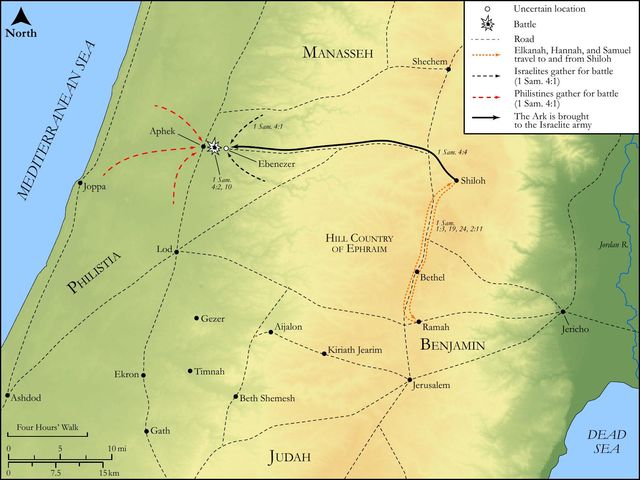
See on the biblical-era map
Study this verse
Public-domain commentary
Matthew Henry
From his Commentary on the Whole Bible. Henry comments on passages, not single verses — this entry covers 1 Samuel 2:11–26. His four-level outline is real structure in the source text, so it is rendered as structure.
In these verses we have the good character and posture of Elkanah's family, and the bad character and posture of Eli's family. The account of these two is observably interwoven throughout this whole paragraph, as if the historian intended to set the one over against the other, that they might set off one another. The devotion and good order of Elkanah's family aggravated the iniquity of Eli's house; while the wickedness of Eli's sons made Samuel's early piety appear the more bright and illustrious.
I.Let us see how well things went in Elkanah's family and how much better than formerly.
1.Eli dismissed them from the house of the Lord, when they had entered their little son there, with a blessing, Sa1 2:20. He blessed as one having authority: The Lord give thee more children of this woman, for the loan that is lent to the Lord. If Hannah had then had many children, it would not have been such a generous piece of piety to part with one out of many for the service of the tabernacle; but when she had but one, an only one whom she loved, her Isaac, to present him to the Lord was such an act of heroic piety as should by no means lose its reward. As when Abraham had offered Isaac he received the promise of a numerous issue (Gen 22:16, Gen 22:17), so did Hannah, when she had presented Samuel unto the Lord a living sacrifice. Note, What is lent to the Lord will certainly be repaid with interest, to our unspeakable advantage, and oftentimes in kind. Hannah resigns one child to God, and is recompensed with five; for Eli's blessing took effect (Sa1 2:21): She bore three sons and two daughters. There is nothing lost by lending to God or losing for him; it shall be repaid a hundred-fold, Mat 19:29.
2.They returned to their own habitation. This is twice mentioned, Sa1 2:11, and again Sa1 2:20. It was very pleasant to attend at God's house, to bless him, and to be blessed of him. But they have a family at home that must be looked after, and thither they return, cheerfully leaving the dear little one behind them, knowing they left him in a good place; and it does not appear that he cried after them, but was as willing to stay as they were to leave him, so soon did he put away childish things and behave like a man.
3.They kept up their constant attendance at the house of God with their yearly sacrifice, Sa1 2:19. They did not think that their son's ministering there would excuse them, or that that offering must serve instead of other offerings; but, having found the benefit of drawing near to God, they would omit no appointed season for it, and now they had one loadstone more in Shiloh to draw them thither. We may suppose they went thither to see their child oftener than once a year, for it was not ten miles from Ramah; but their annual visit is taken notice of because then they brought their yearly sacrifice, and then Hannah fitted up her son (and some think oftener than once a year) with a new suit of clothes, a little coat (Sa1 2:19) and every thing belonging to it. She undertook to find him with clothes during his apprenticeship at the tabernacle, and took care he should be well provided, that he might appear the more decent and sightly in his ministration, and to encourage him in his towardly beginnings. Parents must take care that their children want nothing that is fit for them, whether they are with them or from them; but those that are dutiful and hopeful, and minister to the Lord, must be thought worthy of double care and kindness.
4.The child Samuel did very well. Four separate times he is mentioned in these verses, and two things we are told of: - (1.) The service he did to the Lord. He did well indeed, for he ministered to the Lord (Sa1 2:11, Sa1 2:18) according as his capacity was. He learned his catechism and was constant to his devotions, soon learned to read, and took a pleasure in the book of the law, and thus he ministered to the Lord. He ministered before Eli, that is, under his inspection, and as he ordered him, not before Eli's sons; all parties were agreed that they were unfit to be his tutors. Perhaps he attended immediately on Eli's person, was ready to him to fetch and bring as he had occasion, and that is called ministering to the Lord. Some little services perhaps he was employed in about the altar, though much under the age appointed by the law for the Levites' ministration. He could light a candle, or hold a dish, or run on an errand, or shut a door; and, because he did this with a pious disposition of mind it is called ministering to the Lord, and great notice is taken of it. After awhile he did his work so well that Eli appointed that he should minister with a linen ephod as the priests did (though he was no priest), because he saw that God was with him. Note, Little children must learn betimes to minister to the Lord. Parents must train them up to it, and God will accept them. Particularly let them learn to pay respect to their teachers, as Samuel to Eli. None can begin too soon to be religious. See Psa 8:2, and Mat 21:15, Mat 21:16. (2.) The blessing he received from the Lord: He grew before the Lord, as a tender plant (Sa1 2:21), grew on (Sa1 2:26) in strength and stature, and especially in wisdom and understanding and fitness for business. Note, Those young people that serve God as well as they can will obtain grace to improve, that they may serve him better. Those that are planted in God's house shall flourish, Psa 92:13. He was in favour with the Lord and with man. Note, It is a great encouragement to children to be tractable, and virtuous, and good betimes, that if they be both God and man will love them. Such children are the darlings both of heaven and earth. What is here said of Samuel is said of our blessed Saviour, that great example, Luk 2:52.
II.Let us now see how ill things went in Eli's family, though seated at the very door of the tabernacle. The nearer the church the further from God.
1.The abominable wickedness of Eli's sons (Sa1 2:12): The sons of Eli were sons of Belial. It is emphatically expressed. Nothing appears to the contrary but that Eli himself was a very good man, and no doubt had educated his sons well, giving them good instructions, setting them good examples, and putting up many a good prayer for them; and yet, when they grew up, they proved sons of Belial, profane wicked men, and arrant rakes: They knew not the Lord. They could not but have a notional knowledge of God and his law, a form of knowledge (Rom 2:20), yet, because their practice was not conformable to it, they are spoken of as wholly ignorant of God; they lived as if they knew nothing at all of God. Note, Parents cannot give grace to their children, nor does it run in the blood. Many that are sincerely pious themselves live to see those that come from them notoriously impious and profane; for the race is not to the swift. Eli was high priest and judge in Israel. His sons were priests by their birth. Their character was sacred and honourable, and obliged them, for their reputation-sake, to observe decorum. They were resident at the fountain-head both of magistracy and ministry, and yet they were sons of Belial, and their honour, power, and learning, made them so much the worse. They did not go to serve other gods, as those did that lived at a distance from the altar, for from the house of God they had their wealth and dignity; but, which was worse, they managed the service of God as if he had been one of the dunghill deities of the heathen. It is hard to say which dishonours God more, idolatry or profaneness, especially the profaneness of the priests. Let us see the wickedness of Eli's sons; and it is a sad sight.
(1.)They profaned the offerings of the Lord, and made a gain to themselves, or rather a gratification of their own luxury, out of them. God had provided competently for them out of the sacrifices. The offerings of the Lord made by fire were a considerable branch of their revenue, but not enough to please them; they served not the God of Israel, but their own bellies (Rom 16:18), being such as the prophet calls greedy dogs that can never have enough, Isa 56:11.
[1.]They robbed the offerers, and seized for themselves some of their part of the sacrifice of the peace-offerings. The priests had for their share the wave-breast and the heave shoulder (Lev 7:34), but these did not content them; when the flesh was boiling for the offerer to feast upon religiously with his friends, they sent a servant with a flesh-hook of three teeth, a trident, and that must be stuck into the pot, and whatever that brought up the priest must have (Sa1 2:13, Sa1 2:14), and the people, out of their great veneration, suffered this to grow into a custom, so that after awhile prescription was pleaded for this manifest wrong.
[2.]They stepped in before God himself, and encroached upon his right too. As if it were a small thing to weary men, they wearied my God also, Isa 7:13. Be it observed, to the honour of Israel, that though the people tamely yielded to their unwarrantable demands from them, yet they were very solicitous that God should not be robbed: Let them not fail to burn the fat presently, Sa1 2:16. Let the altar have its due, for that is the main matter. Unless God have the fat, they can feast with little comfort upon the flesh. It was a shame that the priests should need to be thus admonished by the people of their duty; but they regarded not the admonition. The priest will be served first, and will take what he thinks fit of the fat too, for he is weary of boiled meat, he must have roast, and, in order to that, they must give it to him raw; and if the offerer dispute it, though not in his own favour (let the priest take what he pleases of his part) but in favour of the altar (let them be sure to burn the fat first), even the priest's servant had grown so very imperious that he would either have it now or take it by force, than which there could not be a greater affront to God nor a greater abuse to the people. The effect was, First, That God was displeased: The sin of the young men was very great before the Lord, Sa1 2:17. Nothing is more provoking to God than the profanation of sacred things, and men serving their lusts with the offerings of the Lord. Secondly, That religion suffered by it: Men abhorred the offerings of the Lord. All good men abhorred their management of the offerings, and too many insensibly fell into a contempt of the offerings themselves for their sakes. It was the people's sin to think the worse of God's institutions, but it was the much greater sin of the priests that gave them occasion to do so. Nothing brings a greater reproach upon religion than ministers' covetousness, sensuality, and imperiousness. In the midst of this sad story comes in the repeated mention of Samuel's devotion. But Samuel ministered before the Lord, as an instance of the power of God's grace, in preserving him pure and pious in the midst of this wicked crew; and this helped to keep up the sinking credit of the sanctuary in the minds of the people, who, when they had said all they could against Eli's sons, could not but admire Samuel's seriousness, and speak well of religion for his sake.
(2.)They debauched the women that came to worship at the door of the tabernacle, Sa1 2:22. They had wives of their own, but were like fed horses, Jer 5:8. To have gone to the harlots' houses, the common prostitutes, would have been abominable wickedness, but to use the interest which as priests they had in those women that had devout dispositions and were religiously inclined, and to bring them to commit their wickedness, was such horrid impiety as one can scarcely think it possible that men who called themselves priests should ever be guilty of. Be astonished, O heavens! at this, and tremble, O earth! No words can sufficiently express the villany of such practices as these.
2.The reproof which Eli gave his sons for this their wickedness: Eli was very old (Sa1 2:22) and could not himself inspect the service of the tabernacle as he had done, but left all to his sons, who, because of the infirmities of his age, slighted him, and did what they would. However, he was told of the wickedness of his sons, and we may well imagine what a heart-breaking it was to him, and how much it added to the burdens of his age; but it should seem he did not so much as reprove them till he heard of their debauching the women, and then he thought fit to give them a check. Had he rebuked them for their greediness and luxury, this might have been prevented. Young people should be told of their faults as soon as it is perceived that they begin to be extravagant, lest their hearts be hardened. Now concerning the reproof he gave them observe,
(1.)That it was very just and rational. That which he said was very proper. [1.] He tells them that the matter of fact was too plain to be denied and too public to be concealed: "I hear of your evil dealings by all this people, Sa1 2:23. It is not the surmise of one or two, but the avowed testimony of many; all your neighbours cry out shame on you, and bring their complaints to me, expecting that I should redress the grievance." [2.] He shows them the bad consequences of it, that they not only sinned, but made Israel to sin, and would have the people's sin to answer for as well as their own: "You that should turn men from iniquity (Mal 2:6), you make the Lord's people to transgress, and corrupt the nation instead of reforming it; you tempt people to go and serve other gods when they see the God of Israel so ill served." [3.] He warns them of the danger they brought themselves into by it, Sa1 2:25. He intimates to them what God afterwards told him, that the iniquity would not be purged with sacrifice nor offering, Sa1 3:14. If one man sin against another, the judge (that is, the priest, who was appointed to be the judge in many cases, Deu 17:9) shall judge him, shall undertake his cause, arbitrate the matter, and make atonement for the offender; but if a man sin against the Lord (that is, if a priest profane the holy things of the Lord, if a man that deals with God for others do himself affront him) who shall entreat for him? Eli was himself a judge, and had often made intercession for transgressors, but, says he, "You that sin against the Lord," that is, "against the law and honour of God, in those very things which immediately pertain to him, and by which reconciliation is to be made, how can I entreat for you?" Their condition was deplorable indeed when their own father could not speak a good word for them, nor could have the face to appear as their advocate. Sins against the remedy, the atonement itself, are most dangerous, treading under foot the blood of the covenant, for then there remains no more sacrifice, Heb 10:26.
(2.)It was too mild and gentle. He should have rebuked them sharply. Their crimes deserved sharpness; their temper needed it; the softness of his dealing with them would but harden them the more. The animad-version was too easy when he said, It is no good report. he should have said, "It is a shameful scandalous thing, and not to be suffered!" Whether it was because he loved them or because he feared them that he dealt thus tenderly with them, it was certainly an evidence of his want of zeal for the honour of God and his sanctuary. He bound them over to God's judgment, but he should have taken cognizance of their crimes himself, as high priest and judge, and have restrained and punished them. What he said was right, but it was not enough. Note, It is sometimes necessary that we put an edge upon the reproofs we give. There are those that must be saved with fear, Jde 1:23. 3. Their obstinacy against this reproof. His lenity did not at all work upon them: They hearkened not to their father, though he was also a judge. They had no regard either to his authority or to his affection, which was to them an evident token of perdition; it was because the Lord would slay them. They had long hardened their hearts, and now God, in a way of righteous judgment, hardened their hearts, and seared their consciences, and withheld from them the grace they had resisted and forfeited. Note, Those that are deaf to the reproofs of wisdom are manifestly marked for ruin. The Lord has determined to destroy them, Ch2 25:16. See Pro 29:1. Immediately upon this, Samuel's tractableness is again mentioned (Sa1 2:26), to shame their obstinacy: The child Samuel grew. God's grace is his own; he denied it to the sons of the high priest and gave it to the child of an obscure country Levite.
Historical interpretation
Fifteen Centuries of Reception
7 surviving comments on this verse. Each one is dated, so this reads as a timeline rather than a list.
Select a marker to jump to its quote. Markers stagger vertically where authors wrote within a few decades of each other.
The law prohibits priests in the case of certain sins from offering a sacrifice to gain people forgiveness for the transgressions for which sacrifices are made. For though the priest has authority to make an offering for certain inadvertent sins or transgressions, nevertheless he does not offer a burnt offering and a sin offering for adultery, deliberate murder, or any other graver fault. Therefore, it is in the same way that the apostles and those like the apostles, since they are priests according to the great High Priest, have received knowledge of God’s healing and know, since they are taught by the Spirit, for what sins sacrifice must be offered and when and how; and they know for what sins it is wrong to do this. Thus, Eli the priest, when he knew that his sons Hophni and Phinehas were sinning, realizing he could in no way contribute to the forgiveness of their sins, acknowledged it as a hopeless case and said, “If a man sins against a man, they will pray for him; but if he sins against he Lord, who will pray for him?”
Because their father [Eli] did not chastise them with enough severity … he moved the forbearance of God to wrath so great that foreign peoples rose up against them and killed those sons of his in war in one day. His entire nation, furthermore, was vanquished, and a considerable number of his people fell. Now, this happened even with the ark of the holy covenant of God nearby—an unheard of thing—so that the ark, which it was not lawful at any time for the Israelites or even for all their priests themselves to touch and which was kept in a special place, was carried hither and yon by impious hands and was put in the shrines of idols instead of the holy temples. Under such circumstances one can readily conjecture the amount of laughter and mockery that was inflicted upon the very name of God by these foreigners. Add to this, also, that Eli himself is recorded to have met a most pitiable end after hearing the threat that his seed would be removed from the priestly dignity; and so it happened.Such, then, were the disasters which befell that nation. Such griefs did the father suffer because of the iniquity of his sons, even though no accusation was ever made against Eli’s personal life. Moreover, he did not bear with those sons of his silence, but he earnestly exhorted them not to persist longer in those same wicked deeds, saying, “Do not act this way, my sons; for I hear no good report concerning you.” And to stress the enormity of their sin, he confronted them with an alarming view of their perilous state. “If one man shall sin against another,” he said, “they will pray for him to the Lord; but if a man shall sin against God, who shall pray for him?” Yet, as I said, because he did not exercise a suitable rigor of zeal in their regard, the disaster recounted above took place. And so I find throughout the Old Testament a great many instances of this kind illustrating the condemnation of all disobedience.
“Eli the priest speaks, stating, ‘If a man sins against another man, they shall offer entreaties on his behalf; but if he sins against God, who shall offer entreaties on his behalf?’ ” In the same way John writes, “If anyone knows that his brother commits a sin which does not lead to death, he shall implore [God] on his behalf, and God shall give him life. Indeed, there is a sin that leads to death; I do not say that you should pray about that.” You see that all of this refers to sins still remaining, not to those persons who have at any time sinned and have begun to repent before anyone asks on their behalf. It is too long a task for us to go over such instances. Observe every one of the sins for which the Lord makes threats; you will at once see that they are current ones.
The sin of one who blasphemes against the Holy Spirit is unpardonable. Compare with this judgment what is said in the book of Kings [Samuel]: “If one man shall sin against the Lord, who shall pray for him?” Thus, it is one and the same sin whether we blaspheme against the Holy Spirit or against God, and it is inexpiable. Hence, the nature of the Holy Spirit begins to dawn in our minds.
If a man sins against a man, etc. Both refer to the sons of Eli. For he sinned against a man when the priest violated the wife of another man under the pretext of religion; but this could be dismissed with appropriate penance by God. Not only this was done, but he sinned even worse against the Lord, when the same priest, contaminated by fornication, approached the holy mysteries of the altar not only unworthily, but completely unworthy. Indeed, the terrible sentence of Eli against such presumptuous persons resounds, but much more terrible is the word of the judge himself, who says: Whoever speaks a word against the Son of Man, it will be forgiven him; but whoever speaks against the Holy Spirit, it will not be forgiven him, neither in this age nor in the age to come (Matt. XII; Luke XII).
[25] Because the Lord would slay them: In consequence of their manifold sacrileges, he would not soften their hearts with his efficacious grace, but was determined to destroy them.
Who shall pray for him: By this word Heli would have his sons understand, that by their wicked abuse of sacred things, and of the very sacrifices which were appointed to appease the Lord, they deprived themselves of the ordinary means of reconciliation with God; which was by sacrifices. The more, because they were the chief priests whose business it was to intercede for all others, they had no other to offer sacrifices and to make atonement for them. Ibid.
Continue studying 1 Samuel 2:25 across the web’s major study libraries — every link below opens this exact verse, chapter, or book on the destination site.
Read & Compare
 BibleGatewayThis verse in more than 200 translations and 70 languages.
 Bible.comThe YouVersion reader — hundreds of translations, reading plans, and highlights.
 ESV.orgCrossway's official English Standard Version reader.
 NET BibleThe NET translation with 60,000+ translators' notes on every rendering decision.
 STEP BibleTyndale House's free study tool — original text, vocabulary, and scholarly resources.
 BibliaLogos Bible Software's free web reader.
 USCCBThe New American Bible (Revised Edition) with the U.S. bishops' study notes.
Commentaries
 BibleHub CommentariesDozens of classic commentaries on this verse, gathered on one page.
 StudyLightMore than 100 commentary sets — the largest collection on the web.
 BibleRefPlain-English commentary on what this verse means, verse by verse.
 Enduring WordDavid Guzik's free commentary on this chapter, widely used by Bible teachers.
 Bible Study ToolsVerse commentary alongside Greek and Hebrew study aids.
Original Language & Research
- BibleHub InterlinearThe verse word by word — original language, transliteration, and English.
- BibleHub LexiconEvery word's original-language definition and Strong's entry.
 Blue Letter BibleDeep-study tools — Strong's numbers, concordance, and word studies.
 SefariaThe Hebrew text with Rashi and centuries of Jewish commentary.
Sermons, Hymns & Audio


TrulyRandomVerse is not affiliated with these sites and doesn’t control their content. They’re linked because they’re genuinely useful.
Summary
1 Samuel 2:25 presents a profound and sobering declaration contrasting the remediable nature of sin between humans with the dire, seemingly irremediable consequences of sin committed directly against the LORD. This verse tragically encapsulates the unheeded warning of Eli to his corrupt sons, Hophni and Phinehas, whose persistent and defiant rebellion against divine authority had reached a critical juncture, culminating in God's sovereign decree of their impending judgment and destruction. It powerfully underscores the ultimate and inescapable consequences of unrepentant contempt for the Holy One of Israel.
Context
ShowHideLiterary Context
This pivotal verse is embedded within a critical narrative segment (1 Samuel 2:12-36) that starkly contrasts the profound moral decay within the priestly house of Eli with the nascent faithfulness of young Samuel. Eli's sons, Hophni and Phinehas, are introduced as "worthless men" who "did not know the LORD" (1 Samuel 2:12), despite their sacred office as priests. They shamelessly abused their priestly prerogatives, extorting offerings, treating the Lord's sacrifices with contempt, and engaging in immoral acts at the very entrance of the tabernacle (1 Samuel 2:13-17, 1 Samuel 2:22). Eli, though he offered a mild rebuke (1 Samuel 2:23-24), failed to restrain them effectively, leading to a severe divine pronouncement of judgment against his house by a "man of God" (1 Samuel 2:27-36). Verse 25 captures Eli's final, desperate, and ultimately futile attempt to warn his sons, emphasizing the depth of their hardened hearts and the inevitability of the divine judgment that had been decreed against them. It marks a tragic turning point where their fate is sealed, setting the stage for their demise and the eventual transfer of the priesthood.
Historical & Cultural Context
The setting is the tumultuous period of the Judges, a time characterized by widespread spiritual and moral decline in Israel, famously summarized by the phrase, "everyone did what was right in his own eyes" (Judges 21:25). The priesthood held a central and revered role in Israelite life, serving as mediators between God and His people, administering the Law, and overseeing the meticulously prescribed sacrificial system outlined in the Pentateuch (e.g., Leviticus 1-7). The Tabernacle, or Tent of Meeting, was the sacred dwelling place of God's presence, and its rituals were designed to maintain the holiness of worship and the purity of the covenant relationship. Hophni and Phinehas's actions were not merely personal failings but a profound desecration of God's holy institution, a public affront to His honor, and a direct violation of the covenant established at Sinai. Their behavior undermined the very foundation of Israel's relationship with God, bringing contempt upon the Lord's offerings and the sacred office itself. Such egregious sin, especially from those in spiritual leadership, was considered an abomination and carried severe consequences under the Mosaic Law, threatening the spiritual well-being of the entire nation.
Key Themes
ShowHideThis verse powerfully articulates several crucial themes. Firstly, it highlights the uniqueness and unparalleled gravity of sin committed directly against God compared to interpersonal offenses. While human judges can mediate disputes between people, no human intercessor or earthly court can atone for or avert the consequences of direct rebellion against the Almighty. Secondly, it underscores the theme of divine judgment and the hardening of hearts. The sons' refusal to heed their father's warning is not merely stubbornness but is presented as a consequence of God's active will, indicating that their persistent and egregious sin had led to a state where divine judgment was inevitable. This echoes similar narratives where continued rebellion leads to a divine "giving over" or hardening, as seen with Pharaoh's heart in Exodus (e.g., Exodus 7:3). Thirdly, it serves as a stark warning about the consequences of impenitence and spiritual rebellion, particularly for those entrusted with sacred responsibilities. Their actions brought dishonor to God and His worship, and their demise was a necessary act of divine justice to uphold God's holiness and covenant integrity, demonstrating that God will not be mocked.
Exposition and Analysis
ShowHideKey Word Analysis
ShowHideThis primitive root (חָטָא) properly means "to miss," and hence, figuratively and generally, "to sin." It encompasses the idea of missing a mark, failing to meet a standard, or going astray. In the context of 1 Samuel 2:25, when applied to sin "against the LORD," it signifies a direct offense against God's character, law, and holiness. The persistent and deliberate nature of Hophni and Phinehas's "missing the mark" demonstrated a profound contempt for God, moving beyond mere error to active rebellion.
This primitive root (פָּלַל) means "to judge (officially or mentally)," and by extension, "to intercede" or "pray." In Eli's rhetorical question, "who shall intreat for him?", it emphasizes the dire and hopeless situation of his sons. It suggests that for a sin committed directly against the LORD, especially one characterized by such persistent and public defiance of His laws and the sanctity of His tabernacle, no human intercession or offering would be sufficient or accepted to avert the decreed judgment. It highlights the absolute nature of God's justice when His holiness is so flagrantly violated without repentance.
This primitive root (מוּת) means "to die" or, causatively, "to kill" or "to put to death." The phrase "because the LORD would slay them" signifies more than a mere prediction; it conveys a divine decree. It indicates God's active involvement and sovereign will in bringing about their judgment. This is not a passive allowance but an active determination, underscoring God's ultimate authority over life and death, and His unwavering commitment to upholding His righteous standards and executing justice for unrepentant sin.
Verse Breakdown
ShowHide"If one man sin against another, the judge shall judge him:"
This initial clause establishes a baseline for human jurisprudence and societal order. It acknowledges that within human communities, mechanisms exist—specifically, the role of a judge—to address, mediate, and resolve conflicts, wrongs, and sins committed between individuals. These systems are designed to bring about a measure of justice, reconciliation, or restitution, and to maintain social harmony. It implies that such offenses, while serious, fall within the scope of human arbitration and potential resolution.
"but if a man sin against the LORD, who shall intreat for him?"
This is the pivotal contrast and rhetorical question that elevates the gravity of the discussion. It highlights the incomparable nature of sin directed against God Himself. Unlike human offenses that can be arbitrated by human judges, sin against the infinite, holy, and sovereign God transcends human jurisdiction and capacity for mediation. The question implies that no human being, no earthly sacrifice, no intercession from a mere mortal, is sufficient to mediate or atone for such a profound spiritual offense, especially when it is characterized by persistent, defiant rebellion and contempt for God's holiness. It underscores the utter helplessness of humanity in the face of divine wrath.
"Notwithstanding they hearkened not unto the voice of their father,"
This clause reveals the stubborn impenitence and hardened hearts of Hophni and Phinehas. Despite Eli's warning—a warning from their father, the High Priest, and God's appointed leader—they remained obstinate and unyielding. Their refusal to listen (hearken) underscores their complete disregard for both paternal authority and divine law. This demonstrates their active and deliberate choice in rebellion, even in the face of impending doom, highlighting a deep-seated spiritual insensitivity.
"because the LORD would slay them."
This concluding clause provides the divine explanation for their stubbornness and inevitable fate. Their refusal to listen was not simply human stubbornness in isolation; it was ultimately a consequence of God's sovereign will and decree. Due to their persistent and egregious sin, they had reached a point where God had determined their judgment. This signifies that their hearts were hardened by divine will towards their impending destruction, a judicial act of God in response to their profound and unrepentant wickedness, demonstrating that God's patience has limits and His justice will prevail.
Literary Devices
ShowHideThe verse employs several powerful literary devices to convey its profound message. Contrast is central, sharply delineating between the remediable nature of human-to-human sin and the seemingly irremediable nature of sin against the LORD. This contrast elevates the holiness and absolute authority of God, emphasizing that offenses against Him are of a different, infinitely more serious order. The rhetorical question, "who shall intreat for him?", functions as a form of Apostrophe and Rhetorical Question, directly addressing the reader or an implied audience, inviting them to ponder the gravity of the situation and the absence of any earthly solution. This question also serves as a potent form of Foreshadowing, hinting at the inevitable doom awaiting Eli's sons. Furthermore, the final clause, "because the LORD would slay them," highlights the themes of Divine Sovereignty and Divine Judgment, portraying God not as a passive observer but as the active agent in bringing about the just consequences of unrepentant sin. The Irony is palpable: Eli, as the High Priest and judge, is utterly unable to judge or mediate effectively for his own sons when their sin is against the ultimate Judge, the LORD, underscoring the limitations of human authority in the face of divine decree.
Theological and Thematic Connections
ShowHide1 Samuel 2:25 profoundly illuminates the nature of sin as ultimately an offense against God, even when it manifests in interpersonal wrongs. While human justice systems can address horizontal transgressions, the vertical dimension of sin—its affront to God's holiness, authority, and covenant—requires a divine solution. The verse underscores God's absolute sovereignty in judgment, demonstrating that persistent and defiant rebellion against Him can lead to a state where divine intervention for judgment becomes inevitable. This highlights the terrifying reality of a hardened heart, where continued rejection of God's warnings results in a judicial "giving over" to the consequences of one's chosen path. It serves as a stark reminder that God's justice is as real as His mercy, and that His holiness demands a righteous response to sin, particularly from those who profane His sacred institutions.
Reflection and Application
ShowHideThis ancient narrative offers timeless and sobering lessons for contemporary believers. The stark contrast between sin against man and sin against God should deepen our understanding that all sin, regardless of its immediate target, ultimately offends a holy and righteous God. This realization should cultivate a profound sense of awe and reverence for God's character and a greater urgency for genuine repentance. The tragic fate of Hophni and Phinehas serves as a powerful warning against spiritual complacency and the insidious danger of a hardened heart. Persistent disregard for God's Word, His warnings, and the promptings of His Spirit can lead to a spiritual insensitivity where one is no longer able to hear or respond to truth, ultimately inviting divine judgment. It is crucial for us to respond to God's voice today, while it is called "today," to avoid such a tragic state of impenitence. Furthermore, for those in positions of spiritual leadership, the narrative of Eli's sons stands as a solemn reminder of the immense accountability that comes with influence. Leaders are called to live with integrity, uphold God's standards, and shepherd His flock faithfully, recognizing that their actions profoundly impact others and bring either honor or dishonor to God's name.
Questions for Reflection
ShowHideFAQ
ShowHideDid God force Eli's sons to sin, or did He merely decree their judgment?
ShowHideThe phrase "because the LORD would slay them" indicates God's sovereign determination concerning their fate, not that He compelled them to sin. Eli's sons were already engaged in persistent, defiant, and egregious sin (1 Samuel 2:12-17, 1 Samuel 2:22). Their refusal to heed Eli's warnings (1 Samuel 2:23-24) was a manifestation of their own hardened hearts and deliberate rebellion. God's decision to "slay them" was a righteous judgment in response to their unrepentant wickedness and their profound contempt for His holiness and covenant. It signifies that they had reached a point of no return, where divine justice was the inevitable outcome of their choices, much like Pharaoh's heart was hardened by God after his repeated defiance. God's sovereignty often works in conjunction with human responsibility, bringing about just consequences for persistent sin.
How does this verse relate to God's mercy and grace?
ShowHideWhile this verse highlights God's justice and the severity of unrepentant sin, it implicitly underscores the necessity and preciousness of God's mercy and grace. The rhetorical question, "who shall intreat for him?" points to humanity's utter inability to atone for sin against God. This dire situation is precisely why God, in His boundless mercy, provided a perfect solution in Christ. The Old Testament sacrificial system, though temporary, pointed to this need for divine provision. The very fact that God did provide a way for reconciliation (e.g., through the Day of Atonement, Leviticus 16) demonstrates His desire for relationship, even with a sinful people. The judgment on Eli's sons serves as a stark reminder of the consequences of rejecting that mercy and grace, emphasizing that God's grace is not to be presumed upon or despised.
What is the "unforgivable sin" in light of this verse?
ShowHideThis verse does not directly define the "unforgivable sin" as understood in the New Testament (e.g., Matthew 12:31-32). However, it illustrates a principle that contributes to such a state: persistent, defiant, and unrepentant rebellion against God's known will and truth, particularly when it involves contempt for His holiness. Eli's sons had repeatedly and publicly desecrated sacred things, ignoring warnings, and showing no remorse. This kind of hardened heart, which ultimately rejects all opportunities for repentance and despises the very means of grace, leads to a state where divine judgment is the only remaining outcome. The "unforgivable sin" in the New Testament context is typically understood as the blasphemy against the Holy Spirit, which is a final, deliberate, and unrepentant rejection of God's saving work, attributing it to evil. This aligns with the idea of a heart so hardened that it can no longer receive God's grace or respond to His call to repentance.
Christ-Centered Fulfillment
ShowHide1 Samuel 2:25, with its poignant question "who shall intreat for him?" when a man sins against the LORD, powerfully foreshadows the ultimate need for a perfect Mediator, a role that only Jesus Christ could fulfill. The tragic inability of Eli, the High Priest, to intercede effectively for his own sons highlights the inherent limitations of the Old Covenant priesthood and the sacrificial system. These were temporary provisions, pointing to a greater reality. In the New Covenant, Jesus is revealed as the Lamb of God who takes away the sin of the world, the perfect and final sacrifice for sin. More profoundly, He is our great High Priest, who, unlike Eli's sons, was "holy, innocent, unstained, separated from sinners, and exalted above the heavens" (Hebrews 7:26). He does not need to offer sacrifices for His own sins, but "He entered once for all into the holy places, not by means of the blood of goats and calves but by means of His own blood, thus securing an eternal redemption" (Hebrews 9:12). Therefore, when we sin against the LORD, we are not left without an advocate, for Christ Jesus is the one mediator between God and men, who always lives to make intercession for us (Hebrews 7:25). His perfect life, atoning death, and resurrection provide the only sufficient "entreaty" for sin against God, offering forgiveness and reconciliation to all who believe, a stark contrast to the hopeless fate of Eli's unrepentant sons.