


1 Samuel 2:29
- לָמָּהLa·mah<to> why?H4100Prep-l ¦ InterrogPronoun Interrogativeלָ<to>מָּהwhy?
- תִבְעֲטוּtiv·'a·Tudo you kickH1163V-Qal-Imperf-2mpVerb Qal Imperfect 2nd Plural Masculine
- בְּזִבְחִיbe·ziv·Chiat my sacrificeH2077Prep-b ¦ N-msc ¦ 1csNoun Singular Masculine Constructבְּatזִבְחִsacrificeיmy
- וּבְמִנְחָתִיu·ve·min·cha·Tiand at my offeringH4503Conj-w ¦ Prep-b ¦ N-fsc ¦ 1csNoun Singular Feminine Constructוּandבְatמִנְחָתִofferingיmy
- אֲשֶׁר'a·SherwhichH834RelParticle Relative
- צִוִּיתִיtzi·Vi·tiI commandedH6680V-Piel-Perf-1csVerb Piel Perfect 1st Singular common gender
- מָעוֹןma·'ona dwelling placeH4583N-msNoun Singular Masculine Absolute
- וַתְּכַבֵּדva·te·kha·Bedand you honorH3513Conj-w ¦ V-Piel-ConsecImperf-2msVerb Piel Consecutive Imperfect 2nd Singular Masculineוַandתְּכַבֵּדyou honor
- אֶת'et<obj.>H853DirObjMParticle Object Indicator
- בָּנֶיךָba·Nei·khayour sonsH1121N-mpc ¦ 2msNoun Plural Masculine Constructבָּנֶיsonsךָyour
- מִמֶּנִּיmi·Me·nimore than meH4480Prep ¦ 1csPreposition Definiteמִמֶּmore thanנִּיme
- לְהַבְרִיאֲכֶםle·hav·ri·'a·Khemby fattening yourselvesH1254Prep-l ¦ V-Hiphil-Inf ¦ 2mpVerb Hiphil Infinitive Constructלְbyהַבְרִיאֲfatteningכֶםyourselves
- מֵרֵאשִׁיתme·re·Shitfrom [the] choicest ofH7225Prep-m ¦ N-fscNoun Singular Feminine Constructמֵfromרֵאשִׁית[the] choicest of
- כָּלkoleveryH3605N-mscNoun Singular Masculine Construct
- מִנְחַתmin·Chat<the> offering ofH4503N-fscNoun Singular Feminine Construct
- יִשְׂרָאֵלYis·ra·'ElIsraelH3478N-properNoun Proper Location
- לְעַמִּיle·'a·Miof my peopleH5971Prep-l ¦ N-msc ¦ 1csNoun Singular Masculine Constructלְofעַמִּpeopleיmy
English is a literal word-by-word gloss of the Hebrew, not the KJV's wording. Why?
This is the original text the KJV's translators worked from — each Hebrew word with its own literal English meaning in this verse, prepared by scholars at Tyndale House, Cambridge. The KJV translates whole sentences, not word by word, so its wording differs: one Hebrew word can become several English words, and the KJV may choose “the LORD” where the gloss reads “Yahweh”. Both are faithful — they answer different questions. For the KJV's own rendering, switch to the KJV text.
Details
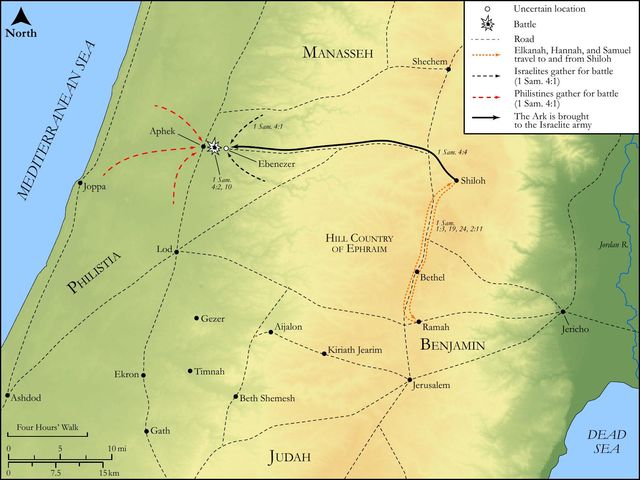
See on the biblical-era map
Study this verse
Public-domain commentary
Matthew Henry
From his Commentary on the Whole Bible. Henry comments on passages, not single verses — this entry covers 1 Samuel 2:27–36. His three-level outline is real structure in the source text, so it is rendered as structure.
Eli reproved his sons too gently, and did not threaten them as he should, and therefore God sent a prophet to him to reprove him sharply, and to threaten him, because, by his indulgence of them, he had strengthened their hands in their wickedness. If good men be wanting in their duty, and by their carelessness and remissness contribute any thing to the sin of sinners, they must expect both to hear of it and to smart for it. Eli's family was now nearer to God than all the families of the earth, and therefore he will punish them, Amo 3:2. The message is sent to Eli himself, because God would bring him to repentance and save him; not to his sons, whom he had determined to destroy. And it might have been a means of awakening him to do his duty at last, and so to have prevented the judgment, but we do not find it had any great effect upon him. The message this prophet delivers from God is very close.
I.He reminds him of the great things God had done for the house of his fathers and for his family.
He appeared to Aaron in Egypt (Exo 4:27), in the house of bondage, as a token of further favour which he designed for him, Sa1 2:27. He advanced him to the priesthood, entailed it upon his family, and thereby dignified it above any of the families of Israel. He entrusted him with honourable work, to offer on God's altar, to burn incense, and to wear that ephod in which was the breast-plate of judgment. He settled upon him an honourable maintenance, a share out of all the offerings made by fire, Sa1 2:28. What could he have done more for them, to engage them to be faithful to him? Note, The distinguishing favours we have received from God, especially those of the spiritual priesthood, are great aggravations of sin, and will be remembered against us in the day of account, if we profane our crown and betray our trusts, Deu 32:6; Sa2 12:7, Sa2 12:8.
II.He exhibits a high charge against him and his family.
His children did wickedly, and he connived at it, and thereby involved himself in the guilt; the indictment therefore runs against them all, Sa1 2:29.
1.His sons had impiously profaned the holy things of God: "You kick at my sacrifice which I have commanded; not only trample upon the institution as a mean thing, but spurn at it as a thing you hate to be tied up to." They did the utmost despite imaginable to the offerings of the Lord when they committed all that outrage and rapine about them that we read of, and violently plundered the pots on which, in effect, Holiness to the Lord was written (Zac 14:20), and took that fat to themselves which God had appointed to be burnt on his altar.
2.Eli had bolstered them up in it, by not punishing their insolence and impiety: "Thou for thy part honourest thy sons above me," that is, "thou hadst rather see my offerings disgraced by their profanation of them than see thy sons disgraced by a legal censure upon them for so doing, which ought to have been inflicted, even to suspension and deprivation ab officio et beneficio - of their office and its emoluments." Those that allow and countenance their children in any evil way, and do not use their authority to restrain and punish them, do in effect honour them more than God, being more tender of their reputation than of his glory and more desirous to humour them than to honour him.
3.They had all shared in the gains of the sacrilege. It is to be feared that Eli himself, though he disliked and reproved the abuses they committed, yet did not forbear to eat of the roast meat they sacrilegiously got, Sa1 2:15. He was a fat heavy man (Sa1 4:18), and therefore it is charged upon the whole family (though Hophni and Phinehas were principally guilty), You make yourselves fat with the chief of all the offerings. God gave them sufficient to feed them, but that would not suffice; they made themselves fat, and served their lusts with that which God was to be served with. See Hos 4:8.
III.He declares the cutting off of the entail of the high priesthood from his family (Sa1 2:30):
"The Lord God of Israel, who is jealous for his own honour and Israel's, says, and lets thee know it, that thy commission is revoked and superseded." I said, indeed, that thy house, and the house of thy father Ithamar (for from that younger son of Aaron Eli descended), should walk before me for ever. Upon what occasion the dignity of the high priesthood was transferred from the family of Eleazar to that of Ithamar does not appear; but it seems this had been done, and Eli stood fair to have that honour perpetuated to his posterity. But observe, the promise carried its own condition along with it: They shall walk before me forever, that is, "they shall have the honour, provided they faithfully do the service." Walking before God is the great condition of the covenant, Gen 17:1. Let them set me before their face, and I will set them before my face continually (Psa 41:12), otherwise not. But now the Lord says, Be it far from me. "Now that you cast me off you can expect no other than that I should cast you off; you will not walk before me as you should, and therefore you shall not." Such wicked and abusive servants God will discard, and turn out of his service. Some think there is a further reach in this recall of the grant, and that it was not only to be fulfilled shortly in the deposing of the posterity of Eli, when Zadok, who descended from Eleazar, was put in Abiathar's room, but it was to have its complete accomplishment at length in the total abolition of the Levitical priesthood by the priesthood of Christ.
IV.He gives a good reason for this revocation, taken from a settled and standing rule of God's government, according to which all must expect to be dealt with (like that by which Cain was tried, Gen 4:7): Those that honour me I will honour, and those that despise me shall be lightly esteemed.
1.Observe in general,
(1.)That God is the fountain of honour and dishonour; he can exalt the meanest and put contempt upon the greatest.
(2.)As we deal with God we must expect to be dealt with by him, and yet more favourably than we deserve. See Psa 18:25, Psa 18:26.
2.Particularly,
(1.)Be it spoken, to the everlasting reputation of religion or of serious godliness, that it gives honour to God and puts honour upon men. By it we seek and serve the glory of God, and he will be behind-hand with none that do so, but here and hereafter will secure their glory. The way to be truly great is to be truly good. If we humble and deny ourselves in any thing to honour God, and have a single eye to him in it, we may depend upon this promise, he will put the best honour upon us. See Joh 12:26.
(2.)Be it spoken, to the everlasting reproach of impiety or profaneness, that this does dishonour to God (despises the greatest and best of beings, whom angels adore) and will bring dishonour upon men, for those that do so shall be lightly esteemed; not only God will lightly esteem them (that perhaps they will not regard, as those that honour him value his honour, of whom therefore it is said, I will honour them), but they shall be lightly esteemed by all the world; the very honour they are proud of shall be laid in the dust; they shall see themselves despised by all mankind, their names a reproach; when they are gone, their memory shall rot, and, when they rise again, it shall be to everlasting shame and contempt. The dishonour which their impotent malice puts upon God and his omnipotent justice will return upon their own heads, Psa 79:12.
V.He foretels the particular judgments which should come upon his family, to its perpetual ignominy.
A curse should be entailed upon his posterity, and a terrible curse it is, and shows how jealous God is in the matters of his worship and how ill he takes it when those who are bound by their character and profession to preserve and advance the interests of his glory are false to their trust, and betray them. If God's ministers be vicious and profane, of how much sorer punishment will they be thought worthy, here and for ever, than other sinners! Let such read the doom here passed on Eli's house, and tremble. It is threatened,
1.That their power should be broken (Sa1 2:31): I will cut off thy arm, and the arm of thy father's house. They should be stripped of all their authority, should be deposed, and have no influence upon the people as they had had. God would make them contemptible and base. See Mal 2:8, Mal 2:9. The sons had abused their power to oppress the people and encroach upon their rights, and the father had not used his power, as he ought to have done, to restrain and punish them, and therefore it was justly threatened that the arm should be cut off which was not stretched out as it should have been.
2.That their lives should be shortened. He was himself an old man; but instead of using the wisdom, gravity, experience, and authority of his age, for the service of God and the support of religion, he had suffered the infirmities of age to make him more cool and remiss in his duty, and therefore it is here threatened that none of his posterity should live to be old, Sa1 2:31, Sa1 2:32. It is twice spoken: "There shall not be an old man in thy house for ever;" and again (Sa1 2:33), "All the increase of thy house, from generation to generation, shall die in the flower of their age, when they are in the midst of the years of their service," so that though the family should not be extinct, yet it should never be considerable, nor should any member of it come to be eminent in his day. Bishop Patrick relates, out of some of the Jewish writers, that long after this, there being a family in Jerusalem none of which commonly lived above eighteen years, upon search it was found that they descended from the house of Eli, on which this sentence was passed.
3.That all their comforts should be embittered.
(1.)The comfort they had in the sanctuary, in its wealth and prosperity: Thou shalt see an enemy in my habitation. This was fulfilled in the Philistines' invasions and the mischiefs they did to Israel, by which the country was impoverished (Sa1 13:19), and no doubt the priests' incomes were thereby very much impaired. The captivity of the ark was such an act of hostility committed upon God's habitation as broke Eli's heart. As it is a blessing to a family to see peace upon Israel (Psa 128:5, Psa 128:6), so the contrary is a sore judgment upon a family, especially a family of priests.
(2.)The comfort of their children: "The man of thine whom I shall not cut off by an untimely death shall live to be a blot and burden to the family, a scandal and vexation to his relations; he shall be to consume thy eyes and grieve thy heart, for his foolishness or his sickliness, his wickedness or his poverty." Grief for a dead child is great, but for a bad child often greater.
4.That their substance should be wasted and they should be reduced to extreme poverty (Sa1 2:36): "He that is left alive in thy house shall have little joy of his life, for want of a livelihood; he shall come and crouch to the succeeding family for a subsistence." (1.) He shall beg for the smallest alms - a piece of silver (and the word signifies the least piece) and a morsel of bread. See how this answered the sin. Eli's sons must have the best pieces of flesh, but their sons will be glad of a morsel of bread. Note, Want is the just punishment of wantonness. Those who could not be content without dainties and varieties are brought, they or theirs, to want necessaries, and the Lord is righteous in thus visiting them. (2.) He shall beg for the meanest office: Put me into somewhat belonging to the priesthood (as it is in the original); make me as one of the hired servants, the fittest place for a prodigal. Plenty and power are forfeited when they are abused. They should not be able to pretend to any good preferment, not to any place at the altar, but should petition for some poor employment, be the work ever so hard and the wages ever so small, so they might but get bread. This, it is probable, was fully accomplished when Abiathar, who was of Eli's race, was deposed by Solomon for treason, and he and his turned out of office in the temple (Kg1 2:26, Kg1 2:27), by which it is easy to think his posterity were reduced to the extremities here described.
5.That God would shortly begin to execute these judgments in the death of Hophni and Phinehas, the sad tidings of which Eli himself should live to hear: This shall be a sign to thee, Sa1 2:34. When thou hearest it, say, "Now the word of God begins to operate; here is one threatening fulfilled, from which I infer that all the rest will be fulfilled in their order." Hophni and Phinehas had many a time sinned together, and it is here foretold that they should die together both in one day. Bind these tares in a bundle for the fire. This was fulfilled, Sa1 4:11.
VI.In the midst of all these threatenings against the house of Eli, here is mercy promised to Israel (v. 35): I will raise me up a faithful priest.
1.This was fulfilled in Zadoc, of the family of Eleazar, who came into Abiathar's place in the beginning of Solomon's reign, and was faithful to his trust; and the high priests were of his posterity as long as the Levitical priesthood continued. Note, The wickedness of ministers, though it destroy themselves, yet it shall not destroy the ministry. How bad soever the officers are, the office shall continue always to the end of the world. If some betray their trust, yet others shall be raised up that will be true to it. God's work shall never fall to the ground for want of hands to carry it on. The high priest is here said to walk before God's anointed (that is, David and his seed) because he wore the breast-plate of judgment, which he was to consult, not in common cases, but for the king, in the affairs of state. Note, Notwithstanding the degeneracy we see and lament in many families, God will secure to himself a succession. If some grow worse than their ancestors, others, to balance that, shall grow better.
2.It has its full accomplishment in the priesthood of Christ, that merciful and faithful high priest whom God raised up when the Levitical priesthood was thrown off, who in all things did his father's mind, and for whom God will build a sure house, build it on a rock, so that the gates of hell cannot prevail against it.
Historical interpretation
Historical reception
2 surviving comments on this verse. Each one is dated, so this reads as a timeline rather than a list.
Select a marker to jump to its quote. Markers stagger vertically where authors wrote within a few decades of each other.
Sometimes, though, greater evil ensues when in the case of wicked persons a policy of equality is adhered to rather than of discipline. Eli, for example, overcome by misguided affection and unwilling to chastise his delinquent sons, struck both himself and his sons before the strict judge with a cruel sentence, for the divine utterance was, “You have honored your sons rather than me.”
And you honored your sons above me, etc. Not content with the portion that I granted you, you also tried to take the firstfruits which were due to me; which can be understood both of the time and of the portion of the sacrifices; because before the fat was burned, they presumed to take for themselves the best parts to be eaten from the victims, as was read above.
Continue studying 1 Samuel 2:29 across the web’s major study libraries — every link below opens this exact verse, chapter, or book on the destination site.
Read & Compare
 BibleGatewayThis verse in more than 200 translations and 70 languages.
 Bible.comThe YouVersion reader — hundreds of translations, reading plans, and highlights.
 ESV.orgCrossway's official English Standard Version reader.
 NET BibleThe NET translation with 60,000+ translators' notes on every rendering decision.
 STEP BibleTyndale House's free study tool — original text, vocabulary, and scholarly resources.
 BibliaLogos Bible Software's free web reader.
 USCCBThe New American Bible (Revised Edition) with the U.S. bishops' study notes.
Commentaries
 BibleHub CommentariesDozens of classic commentaries on this verse, gathered on one page.
 StudyLightMore than 100 commentary sets — the largest collection on the web.
 BibleRefPlain-English commentary on what this verse means, verse by verse.
 Enduring WordDavid Guzik's free commentary on this chapter, widely used by Bible teachers.
 Bible Study ToolsVerse commentary alongside Greek and Hebrew study aids.
Original Language & Research
- BibleHub InterlinearThe verse word by word — original language, transliteration, and English.
- BibleHub LexiconEvery word's original-language definition and Strong's entry.
 Blue Letter BibleDeep-study tools — Strong's numbers, concordance, and word studies.
 SefariaThe Hebrew text with Rashi and centuries of Jewish commentary.
Sermons, Hymns & Audio


TrulyRandomVerse is not affiliated with these sites and doesn’t control their content. They’re linked because they’re genuinely useful.
Summary
1 Samuel 2:29 delivers a scathing divine indictment against Eli, the high priest, and by extension his sons, Hophni and Phinehas. It reveals God's profound displeasure at their contemptuous treatment of His sacrifices and offerings, which were commanded for His tabernacle. The verse highlights Eli's grave spiritual failure in prioritizing his wicked sons over the Lord, allowing them to exploit their priestly office for personal gain by illicitly consuming the choicest parts of the offerings, thereby dishonoring God and corrupting the worship of Israel.
Context
ShowHideLiterary Context
This verse is a direct accusation from God, delivered through an unnamed "man of God," to Eli, the high priest. It follows a detailed description of the egregious sins of Eli's sons, Hophni and Phinehas, who were priests at Shiloh. 1 Samuel 2:12-17 vividly portrays their contempt for the Lord's sacrifices, taking portions that were not theirs and even engaging in immorality at the tabernacle entrance. Eli's mild rebukes to his sons (found in 1 Samuel 2:22-25) proved ineffective, demonstrating his failure to exercise proper authority and discipline. The divine message in 1 Samuel 2:27-36 serves as a pronouncement of judgment, detailing the severe consequences that will befall Eli's household due to their sin, with verse 29 encapsulating the core reasons for this impending divine wrath.
Historical & Cultural Context
The events unfold at Shiloh, which served as the central place of worship for Israel during the period of the Judges, housing the Tabernacle and the Ark of the Covenant before the establishment of the monarchy. The Mosaic Law, particularly in books like Leviticus and Numbers, meticulously prescribed the procedures for sacrifices and the portions designated for the priests. Priests were to receive specific parts of the offerings for their sustenance, but only after the fat and other designated portions were offered to the Lord (e.g., Leviticus 7:28-36). Eli's sons, however, were flagrantly violating these divine commands, seizing the best portions for themselves before they were properly offered, thereby treating God's holy things with utter disdain. Eli, as the high priest, was responsible for upholding these laws and ensuring the purity of worship, making his inaction a profound breach of his sacred duty.
Key Themes
ShowHideThis verse powerfully contributes to several overarching themes in 1 Samuel. Firstly, it underscores the theme of Contempt for God's Ordinances, as the actions of Eli's sons, and Eli's complicity, demonstrate a blatant disregard for the divinely established sacrificial system. This directly contrasts with the reverence and obedience God demands, as seen in the laws of Leviticus. Secondly, it highlights the theme of Misplaced Honor and Priority, as God explicitly accuses Eli of "honourest thy sons above me." This reveals a critical spiritual failing where familial loyalty and comfort superseded divine reverence and obedience, a theme that recurs throughout the biblical narrative, often with dire consequences. Thirdly, the phrase "to make yourselves fat with the chiefest of all the offerings" points to the pervasive theme of Greed and Self-Indulgence within the priesthood, where sacred office was exploited for personal, material gain rather than selfless service. Finally, the verse serves as a potent reminder of Divine Accountability, particularly for those in positions of spiritual leadership. Eli's failure to uphold his responsibilities and confront sin within his own household leads directly to the severe judgment pronounced against his lineage, foreshadowing the divine principle that "those who honor me I will honor, and those who despise me shall be lightly esteemed" (as stated in 1 Samuel 2:30).
Exposition and Analysis
ShowHideKey Word Analysis
ShowHideThe Hebrew verb בָּעַט (bâʻaṭ), translated "kick," carries a strong connotation of treating something with contempt, trampling upon it, or spurning it with disdain. It suggests a violent and disrespectful rejection, often implying a deliberate act of rebellion or scorn. In this context, it vividly portrays the priests' actions as a defiant and contemptuous disregard for God's holy sacrifices, treating them as worthless or beneath consideration, rather than with the reverence due to divine commands.
The verb כָּבַד (kâbad), here in the Hiphil stem (causative), means "to make heavy," "to honor," "to give weight to." God's accusation, "honourest thy sons above me," implies that Eli had given greater weight, importance, and deference to his sons' desires and comfort than to God's commands and glory. His inaction in disciplining them effectively communicated that their well-being or the avoidance of familial conflict was more significant to him than upholding God's holiness and the integrity of worship.
The Hiphil infinitive לְהַבְרִיאֲכֶם (l'havri'achem), derived from the root בָּרָא (bârâʼ) which can mean "to be fat" or "to be healthy/prosperous," here implies an unholy enrichment or indulgence. It refers to the physical act of making oneself corpulent by consuming the choicest portions of the offerings, but also carries the metaphorical sense of gaining wealth, comfort, or status through illicit means. It underscores the selfish motivation and gluttony that drove the priests to exploit their sacred office for personal, material gain at the expense of God's honor.
Verse Breakdown
ShowHide"Wherefore kick ye at my sacrifice and at mine offering, which I have commanded [in my] habitation;"
This opening rhetorical question expresses God's profound indignation and bewilderment at the blatant disrespect shown by Eli and his sons. The "kicking" metaphorically describes their contemptuous treatment of the sacred sacrifices and offerings, which were not merely rituals but God's divinely ordained means of communion and atonement. The phrase "which I have commanded [in my] habitation" emphasizes the divine origin and sanctity of these practices, performed at the Tabernacle (God's dwelling place), making their actions a direct affront to God Himself and His holy presence.
"and honourest thy sons above me,"
This clause pinpoints Eli's central sin: a profound misplacement of honor and priority. God directly accuses Eli of valuing his own sons, despite their wickedness, more than he valued God. This "honor" was demonstrated not by active endorsement of their sin, but by his passive failure to restrain them, to discipline them effectively, and to uphold God's standards above his personal comfort or familial attachments. This spiritual compromise was an act of disloyalty to the Lord.
"to make yourselves fat with the chiefest of all the offerings of Israel my people?"
This final clause reveals the selfish motivation and outcome of their contemptuous actions. The priests were not merely neglecting their duties; they were actively exploiting their position to enrich themselves. By taking the "chiefest" (the best, the prime portions) of the offerings, which were meant either for God (e.g., the fat) or for the priests in a prescribed, holy manner, they were indulging their own appetites and greed. This act was a theft from God and from the people of Israel, who brought their offerings in faith, and it further highlighted the corruption that had permeated the very heart of Israel's worship.
Literary Devices
ShowHideThe verse employs several potent literary devices to convey God's severe rebuke. The most prominent is the Rhetorical Question, "Wherefore kick ye... and honourest... to make yourselves fat...?" This is not a question seeking information but a powerful expression of divine indignation, emphasizing the inexcusable nature of their actions and inviting reflection on their profound spiritual failure. The phrase "kick ye at my sacrifice" utilizes Metaphor, portraying a violent and contemptuous rejection of what is sacred, transforming an abstract concept of disrespect into a visceral, physical act. Similarly, "make yourselves fat" is a Metonymy or Synecdoche, referring to physical indulgence that represents a broader spiritual gluttony and exploitation of sacred resources for personal gain. The entire verse also exhibits Parallelism in its structure, presenting two distinct but related accusations (kicking at sacrifices, honoring sons over God) that both lead to the same outcome of self-indulgence, reinforcing the comprehensive nature of their sin.
Theological and Thematic Connections
ShowHide1 Samuel 2:29 serves as a stark reminder of the profound importance of revering God's holiness and the severe consequences of spiritual compromise, particularly for those in leadership. It underscores the principle that God demands absolute loyalty and that any misplaced honor, whether for family, personal gain, or comfort, constitutes a direct affront to His sovereignty and character. The corruption of the priestly office at Shiloh highlights the danger of ritual without righteousness and the devastating impact of leaders who fail to uphold divine standards. This passage foreshadows the broader biblical theme of divine judgment against those who profane sacred things and abuse positions of trust, emphasizing that God will not be mocked and will hold His servants accountable for their stewardship.
Reflection and Application
ShowHide1 Samuel 2:29 challenges believers to deeply examine their own hearts and priorities. Are we, in any way, "kicking" at God's commands or His sacred truths by treating them casually, selectively, or with disdain in our daily lives? Do we honor anything or anyone—our careers, our families, our desires, our comfort—above God? Eli's tragic example serves as a powerful warning against spiritual complacency and the dangers of failing to confront sin, both in ourselves and in those under our influence. True reverence for God demands that we prioritize His will, uphold His standards, and refuse to compromise His holiness for personal gain or convenience. This verse calls us to a life of integrity, where our actions consistently demonstrate that God's honor and commands are paramount, and where we seek to serve Him faithfully with our best, rather than exploiting His grace for selfish ends.
Questions for Reflection
ShowHideFAQ
ShowHideWhat does it mean for Eli to "kick" at God's sacrifice?
ShowHideThe phrase "kick ye at my sacrifice" (from the Hebrew bâʻaṭ) is a vivid metaphor expressing profound contempt, disdain, and a violent rejection of something sacred. It signifies treating God's holy offerings and the divinely commanded worship system with utter disrespect and scorn, as if trampling them underfoot. It's not merely neglect but an active, defiant disregard for God's holiness and His established ways of relating to His people. Eli, through his sons' actions and his own passive complicity, allowed the sacred rituals to be profaned, effectively "kicking" at the very heart of Israel's covenant relationship with God. This contempt was manifested in their taking the best portions of the sacrifices for themselves before they were offered to the Lord, a direct violation of God's laws concerning offerings (e.g., Leviticus 3:16-17).
How did Eli honor his sons above God?
ShowHideEli honored his sons above God not necessarily by encouraging their sin, but by his profound failure to restrain them and hold them accountable. Despite being aware of their egregious actions—their illicit taking of offerings and their immorality at the Tabernacle entrance (as described in 1 Samuel 2:22-25)—Eli offered only weak rebukes. His inaction demonstrated that his concern for their comfort, his desire to avoid confrontation, or perhaps his personal peace outweighed his commitment to God's glory, the purity of worship, and the integrity of the priesthood. By allowing their wickedness to continue unchecked, he implicitly prioritized his familial ties and personal ease over God's explicit commands and the sanctity of His house, thereby dishonoring God. 1 Samuel 2:30 further clarifies this, stating, "those who honor me I will honor, and those who despise me shall be lightly esteemed." Eli's actions showed he despised God by not honoring Him.
Christ-Centered Fulfillment
ShowHide1 Samuel 2:29, with its depiction of a corrupt priesthood and defiled sacrifices, powerfully foreshadows the need for a perfect High Priest and a final, unblemished sacrifice. Eli and his sons represent the failure of the Old Covenant priesthood, which, despite its divine institution, was susceptible to human sin, greed, and corruption. Their "kicking" at God's sacrifices and "making themselves fat" stands in stark contrast to the perfect obedience and self-giving of Jesus Christ. He is the Great High Priest who offered Himself as the spotless Lamb of God—the ultimate sacrifice that perfectly honored the Father and took away the sin of the world, once for all. Unlike Eli, who honored his sons above God, Jesus perfectly honored His Father, declaring, "I always do what pleases him." Through His perfect life, atoning death, and resurrection, Jesus established a new and better covenant, fulfilling all the types and shadows of the Old Testament sacrificial system. His sacrifice was not for personal gain but for the redemption of humanity, providing eternal access to God's presence, unlike the temporary and flawed access offered by the Levitical priests.