


1 Samuel 5:1
Bible text: King James Version (1769 Blayney text) · Public domain
Bible text: Berean Standard Bible · Public domain
Bible text: American Standard Version (1901) · Public domain
Bible text: World English Bible, Messianic edition · Public domain
Bible text: Geneva Bible (1599) · Public domain
Bible text: Young's Literal Translation · Public domain
- וּפְלִשְׁתִּיםu·fe·lish·Timand [the] PhilistinesH6430Conj-w ¦ N-mpNoun Gentilic Plural Masculine Absoluteוּandפְלִשְׁתִּים[the] Philistines
- לָקְחוּla·ke·Chuthey tookH3947V-Qal-Perf-3cpVerb Qal Perfect 3rd Plural common gender
- אֵת'et<obj.>H853DirObjMParticle Object Indicator
- אֲרוֹן'a·Ron[the] ark ofH727N-mscNoun Singular Masculine Construct
- הָאֱלֹהִיםha·'E·lo·Him<the> GodH430Art ¦ N-mpNoun Plural Masculine Absoluteהָ<the>אֱלֹהִיםGod
- וַיְבִאֻהוּvay·vi·'U·huand they brought itH935Conj-w ¦ V-Hiphil-ConsecImperf-3mp ¦ 3msVerb Hiphil Consecutive Imperfect 3rd Plural Masculineוַandיְבִאֻthey broughtהוּit
- מֵאֶבֶןme·'E·venfrom Eben-H72Prep-m ¦ N-properNoun Proper LocationמֵfromאֶבֶןEben-
- הָעֵזֶרha·'E·zer<the> -ezerH72Art ¦ N-properNoun Proper Locationהָ<the>עֵזֶר-ezer
- אַשְׁדּוֹדָה'ash·Do·dahAshdod towardsH795N-proper ¦ SfxNoun Proper LocationאַשְׁדּוֹדָAshdodהtowards
English is a literal word-by-word gloss of the Hebrew, not the KJV's wording. Why?
This is the original text the KJV's translators worked from — each Hebrew word with its own literal English meaning in this verse, prepared by scholars at Tyndale House, Cambridge. The KJV translates whole sentences, not word by word, so its wording differs: one Hebrew word can become several English words, and the KJV may choose “the LORD” where the gloss reads “Yahweh”. Both are faithful — they answer different questions. For the KJV's own rendering, switch to the KJV text.
Details
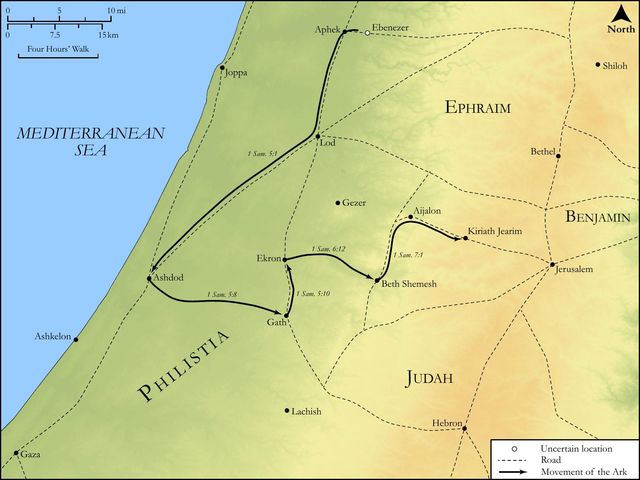
See on the biblical-era map
Study this verse
Public-domain commentary
Matthew Henry
From his Commentary on the Whole Bible. Henry comments on passages, not single verses — this entry covers 1 Samuel 5:1–5. His three-level outline is real structure in the source text, so it is rendered as structure.
Here is, I. The Philistines' triumph over the ark, which they were the more pleased, the more proud, to be now masters of, because before the battle they were possessed with a great fear of it, Sa1 4:7. When they had it in their hands God restrained them, that they did not offer any violence to it, did not break it to pieces, as the Israelites were ordered to do by the idols of the heathen, but showed some respect to it, and carefully carried it to a place of safety. Whether their curiosity led them to open it, and to read what was written with the finger of God on the two tables of stone that were in it, we are not told; perhaps they looked no further than the golden outside and the cherubim that covered it, like children that are more affected with the fine binding of their bibles than with the precious matter contained in them. They carried it to Ashdod, one of their five cities, and that in which Dagon's temple was; there they placed the ark of God, by Dagon (Sa1 5:2), either 1. As a sacred thing, which they designed to pay some religious respect to, in conjunction with Dagon; for the gods of the heathen were never looked upon as averse to partners. Though the nations would not change their gods, yet they would multiply them and add to them. But they were mistaken in the God of Israel when, in putting his ark by Dagon's image, they intended to do him honour; for he is not worshipped at all if he is not worshipped alone. The Lord our God is one Lord. Or rather, 2. They placed it there as a trophy of victory, in honour of Dagon their god, to whom no doubt they intended to offer a great sacrifice, as they had done when they had taken Samson (Jdg 16:23, Jdg 16:24), boasting that as then they had triumphed over Israel's champion so now over Israel's God. What a reproach was this to God's great name! what a disgrace to the throne of his glory! Shall the ark, the symbol of God's presence, be a prisoner to Dagon, a dunghill deity? (1.) So it is, because God will show of how little account the ark of the covenant is if the covenant itself be broken and neglected; even sacred signs are not things that either he is tied to or we can trust to. (2.) So it is for a time, that God may have so much the more glory, in reckoning with those that thus affront him, and get him honour upon them. Having punished Israel, that betrayed the ark, by giving it into the hands of the Philistines, he will next deal with those that abused it, and will fetch it out of their hands again. Thus even the wrath of man shall praise him; and he is bringing about his own glory even when he seems to neglect it, Psa 76:10. Out of the eater shall come forth meat.
II.The ark's triumph over Dagon.
Once and again Dagon was made to fall before it. If they designed to do honour to the ark, God thereby showed that he valued not their honour, nor would he accept it; for he will be worshipped, not with any god, but above all gods. He owes a shame (as bishop Hall expresses it) to those who will be making matches betwixt himself and Belial. But they really designed to affront it, and though for some hours Dagon stood by the ark, and it is likely stood above it (the ark, as its footstool), yet the next morning, when the worshippers of Dagon came to pay their devotions to his shrine, they found their triumphing short, Job 20:5.
1.Dagon, that is, the image (for that was all the god), had fallen upon his face to the earth before the ark, Sa1 5:3. God had seemed to forget the ark, but see how the Psalmist speaks of his appearing, at last, to vindicate his own honour. When he had delivered his strength into captivity, and all seemed going to ruin, then the Lord awaked as one out of sleep, and like a mighty man that shouteth by reason of wine, Psa 78:59-65. And therefore he prevented the utter desolations of the Jewish church, because he feared the wrath of the enemy, Deu 32:26, Deu 32:27. Great care was taken, in setting up the images of their gods, to fix them. The prophet takes notice of it, Isa 41:7, He fastened it with nails that it should not be moved; and again, Isa 46:7. And yet Dagon's fastenings stood him in no stead. The ark of God triumphs over him upon his own dunghill, in his own temple. Down he comes before the ark, directly towards it (though the ark was set on one side of him), as it were, pointing to the conqueror, to whom he is constrained to yield and do homage. Note, The kingdom of Satan will certainly fall before the kingdom of Christ, error before truth, profaneness before godliness, and corruption before grace in the hearts of the faithful. When the interests of religion seem to be run down and ready to sink, yet even then we may be confident that the day of their triumph will come. Great is the truth, and will prevail. Dagon by falling prostrate before the ark of God, which was a posture of adoration, did as it were direct his worshippers to pay their homage to the God of Israel, as greater than all gods. See Exo 18:11.
2.The priests, finding their idol on the floor, make all the haste they can, before it be known, to set him in his place again. A sorry silly thing it was to make a god of, which, when it was down, wanted help to get up again; and sottish wretches those were that could pray for help from that idol that needed, and in effect implored, their help. How could they attribute their victory to the power of Dagon when Dagon himself could not keep his own ground before the ark? But they are resolved Dagon shall be their god still, and therefore set him in his place. Bishop Hall observes hence, It is just with God that those who want grace shall want wit too; and it is the work of superstition to turn men into the stocks and stones they worship. Those that make them are like unto them. What is it that the great upholders of the antichristian kingdom are doing at this day but heaving Dagon up, and labouring to set him in his place again, and healing the deadly wound that has been given to the beast? but if the reformation be the cause of God, before which it has begun to fall, it shall not prevail, but shall surely fall before it.
3.The next night Dagon fell the second time, Sa1 5:4. They rose early, either, as usual, to make their addresses to their god, or earlier than usual, being impatient to know whether Dagon had kept his standing this night; and, to their great confusion, they find his case worse now than before. Whether the matter of which the image was made was apt to break or no, so it was that the head and hands were cut off upon the threshold, so that nothing remained but the stump, or, as the margin reads it, the fishy part of Dagon; for (as many learned men conjecture) the upper part of this image was in a human shape, the lower in the shape of a fish, as mermaids are painted. Such strong delusions were idolaters given up to, so vain were they in their imaginations, and so wretchedly darkened were their foolish hearts, as to worship the images, not only of creatures, but of nonentities, the mere figments of fancy. Well, the misshapen monster is by this fall made to appear,
(1.)Very ridiculous, and worthy to be despised. A pretty figure Dagon made now, when the fall had anatomized him, and shown how the human part and the fishy part were artificially put together, which perhaps the ignorant devotees had been made to believe was done by miracle!
(2.)Very impotent, and unworthy to be prayed to or trusted in; for his losing his head and hands proved him utterly destitute both of wisdom and power, and for ever disabled either to advise or act for his worshippers. This they got by setting Dagon in his place again; they had better have let him alone when he was down. But those can speed no better that contend with God, and will set up that which he is throwing down, Mal 1:4. God, by this, magnified his ark and made it honourable, when they vilified and made it contemptible. He also showed what will be the end of all that which is set up in opposition to him. Gird yourselves, but you shall be broken to pieces, Isa 8:9.
4.The threshold of Dagon's temple was ever looked upon as sacred, and not to be trodden on, Sa1 5:5. Some think that reference is had to this superstitious usage of Dagon's worshippers in Zep 1:9, where God threatens to punish those who, in imitation of them, leaped over the threshold. One would have thought that this incontestable proof of the ark's victory over Dagon would convince the Philistines of their folly in worshipping such a senseless thing, and that henceforward they would pay their homage to the conqueror; but, instead of being reformed, they were hardened in their idolatry, and, as evil men and seducers are wont to do, became worse and worse, Ti2 3:13. Instead of despising Dagon, for the threshold's sake that beheaded him, they were almost ready to worship the threshold because it was the block on which he was beheaded, and will never set their feet on that on which Dagon lost his head, shaming those who tread under foot the blood of the covenant and trample on things truly sacred. Yet this piece of superstition would help to perpetuate the remembrance of Dagon's disgrace; for, with the custom, the reason would be transmitted to posterity, and the children that should be born, enquiring why the threshold of Dagon's temple must not be trodden on, would be told that Dagon fell before the ark of the Lord. Thus God would have honour even out of their superstition. We are not told that they repaired the broken image; it is probable that they sent the art of God away first, and then they patched it up again, and set it in its place; for, it seems, they cannot deliver their souls, nor say, Is there not a lie in our right hand? Isa 44:20.
Historical interpretation
Historical reception
1 surviving comment on this verse from the historical church.
The Philistines took the Ark of God, etc. The Gentiles received the word of the Gospel from Judea, where the Lord was born in the flesh, lived, and suffered, leaving the places of His dispensation sacred to the mysteries to this day. And they carried it, with a joyous reputation, into the foreign provinces of the world, which until then were burning with the flames of sins, dissolved by the enticements of the flesh. Hence, Azotus, which is called Eradod in Hebrew, according to its ancient name, signifies dissolution or effusion, or conflagration.
Continue studying 1 Samuel 5:1 across the web’s major study libraries — every link below opens this exact verse, chapter, or book on the destination site.
Read & Compare
 BibleGatewayThis verse in more than 200 translations and 70 languages.
 Bible.comThe YouVersion reader — hundreds of translations, reading plans, and highlights.
 ESV.orgCrossway's official English Standard Version reader.
 NET BibleThe NET translation with 60,000+ translators' notes on every rendering decision.
 STEP BibleTyndale House's free study tool — original text, vocabulary, and scholarly resources.
 BibliaLogos Bible Software's free web reader.
 USCCBThe New American Bible (Revised Edition) with the U.S. bishops' study notes.
Commentaries
 BibleHub CommentariesDozens of classic commentaries on this verse, gathered on one page.
 StudyLightMore than 100 commentary sets — the largest collection on the web.
 BibleRefPlain-English commentary on what this verse means, verse by verse.
 Enduring WordDavid Guzik's free commentary on this chapter, widely used by Bible teachers.
 Bible Study ToolsVerse commentary alongside Greek and Hebrew study aids.
Original Language & Research
- BibleHub InterlinearThe verse word by word — original language, transliteration, and English.
- BibleHub LexiconEvery word's original-language definition and Strong's entry.
 Blue Letter BibleDeep-study tools — Strong's numbers, concordance, and word studies.
 SefariaThe Hebrew text with Rashi and centuries of Jewish commentary.
Sermons, Hymns & Audio


TrulyRandomVerse is not affiliated with these sites and doesn’t control their content. They’re linked because they’re genuinely useful.
Summary
The opening verse of 1 Samuel chapter 5 dramatically shifts the narrative focus from Israel's devastating defeat to the Philistines' capture and relocation of the Ark of God. It concisely records the Ark's journey from the battlefield at Ebenezer to Ashdod, a prominent Philistine city. This seemingly simple statement inaugurates a profound theological narrative, demonstrating God's uncontainable sovereignty and His active, judgmental presence, even when His most sacred symbol is in enemy hands and His people are in disgrace.
Context
ShowHideLiterary Context
This verse serves as the immediate sequel to the catastrophic events detailed in 1 Samuel 4. Israel, having suffered a crushing defeat, compounded their theological error by presumptuously bringing the Ark of the Covenant into battle, treating it as a magical charm rather than a symbol of God's holy presence demanding obedience (1 Samuel 4:3-4). The consequence was a devastating loss of 30,000 Israelite soldiers and, most significantly, the capture of the Ark itself. The news of the Ark's capture, combined with the deaths of her sons Hophni and Phinehas, led to the death of Eli, the high priest, and the tragic naming of Ichabod, meaning "the glory has departed from Israel" (1 Samuel 4:17-22). Thus, 1 Samuel 5:1 initiates the narrative of the Ark's sojourn in Philistine territory, which will powerfully demonstrate that God's glory had not departed, but was about to be displayed in a new, unexpected, and terrifying way, revealing His supremacy over all false gods.
Historical & Cultural Context
The Philistines were a formidable group of "Sea Peoples" who had settled along the southwestern coast of Canaan, establishing a powerful pentapolis of five major cities: Gaza, Ashkelon, Ashdod, Gath, and Ekron. At this period, they possessed military superiority over Israel, notably through their mastery of iron weaponry. Among the nations, warfare was often understood as a contest between the gods of the opposing peoples, as the Rabshakeh boasted before Jerusalem of the gods of the lands he had taken. The Philistines were accustomed to display the spoils of their victories in the house of their gods, as they would later put the armour of Saul in the house of Ashtaroth, signifying the superiority of the victorious god. The Philistines, therefore, viewed the Ark of God as a captured deity, a symbol of Yahweh's defeat, and intended to parade it as such. Ashdod, one of their principal cities, was a prominent center for the worship of Dagon, their chief deity, making it the logical and symbolic destination for their grand war trophy. Ebenezer, ironically meaning "stone of help," was the site of Israel's crushing defeat, marking the starting point of the Ark's journey into enemy hands.
Key Themes
ShowHideThis verse introduces several crucial themes that will unfold throughout the subsequent chapters. First, it highlights God's Uncontainable Sovereignty. Despite the apparent defeat of Israel and the capture of His Ark, God is not diminished or contained. The narrative will powerfully demonstrate that He remains in absolute control, using even the actions of His enemies to display His glory and execute judgment. Second, it underscores the Profound Significance of the Ark. Far from being a mere object, the Ark was the most sacred artifact in Israel, symbolizing God's throne on earth and His unique, holy presence among His people (Exodus 25:22). Its capture was a theological crisis for Israel, signaling God's severe displeasure with their sin and unfaithfulness. However, its presence among the Philistines would soon become a source of divine judgment and plague for them, demonstrating the Ark's inherent power not as a charm, but as a vessel of the living God. Finally, the verse sets the stage for a dramatic confrontation between Pagan Misconception and the True God. The Philistines' triumphal procession of the Ark to Ashdod, likely intended to be placed in Dagon's temple, was a pagan gesture of conquest. This act directly challenges the true nature of God, who cannot be conquered or confined, and foreshadows the impending demonstration of His supremacy over all false gods, as seen in 1 Samuel 5:2-4.
Exposition and Analysis
ShowHideKey Word Analysis
ShowHideA patrial term referring to the inhabitants of Pelesheth, the Philistine territory. These were a non-Semitic, militarily powerful people who were Israel's primary adversaries during the period of the Judges and early monarchy. Their action of "taking" the Ark signifies not merely a military capture but a perceived conquest of Israel's deity, meant to demonstrate, in the Philistines' view, the supremacy of Dagon over the God of Israel.
A primitive root meaning "to take" in a wide variety of applications, including to accept, seize, or carry away. In this context, it denotes a forceful seizure, emphasizing the Philistines' military victory and their appropriation of what they considered a war trophy. This act, however, would ironically become the means by which God would demonstrate His unchallengeable power.
This term refers to the sacred chest, the Ark of the Covenant, which was the most holy object in Israelite worship. It symbolized God's unique, holy presence, His throne on earth, and the covenant relationship with His people. Its capture was not merely the loss of a physical object, but a profound theological crisis for Israel, representing the apparent "departure" of God's presence and power due to their sin. For the Philistines, it was a captured deity, yet its inherent power would soon prove devastating.
This plural noun, often used with the article to refer to the supreme God (Yahweh), denotes divine beings in general but specifically the one true God of Israel. The phrase "the ark of God" emphasizes its divine ownership and sacredness, highlighting the Philistines' audacity and theological blindness in attempting to contain or conquer the sovereign Lord.
A primitive root meaning "to go or come," often implying movement into a place. Here, it describes the Philistines' deliberate action of transporting the Ark from the battlefield to their city. This "bringing" was a triumphal procession, intended to publicly display their conquest and the supposed subjugation of Israel's God, setting the stage for the dramatic divine intervention that follows.
Meaning "stone of the help," this place name ironically marks the site of Israel's crushing defeat. The Ark's journey from this place of Israelite shame underscores the depth of their humiliation and the apparent abandonment by their God. It signifies the beginning of the Ark's involuntary exile from Israelite territory.
One of the five major Philistine cities, located on the Mediterranean coast. It was a significant administrative and religious center, notably for the worship of the god Dagon. The choice of Ashdod as the destination for the Ark was strategic, intended to display the "conquered" deity in the heart of Philistine power and in the temple of their chief god, setting the stage for the dramatic events that follow.
Verse Breakdown
ShowHide"And the Philistines took the ark of God"
This clause immediately establishes the dire reality of Israel's defeat and the profound theological crisis it represents. The "ark of God" emphasizes its divine ownership and sacredness, highlighting the audacity and theological blindness of the Philistines in seizing it. For the Philistines, this was the ultimate war trophy, signifying the defeat of Yahweh, the God of Israel, by their own gods. For Israel, it was a symbol of their profound spiritual failure and God's severe judgment, a tangible sign that "the glory has departed."
"and brought it from Ebenezer"
Ebenezer, meaning "stone of help," was the site of the recent battle where Israel suffered a crushing defeat. The Ark's journey from this place of Israelite shame underscores the depth of their humiliation and the ironic reversal of the name's meaning. It marks the beginning of the Ark's involuntary exile from Israelite territory, a stark visual representation of God's apparent withdrawal from His disobedient people, yet simultaneously a prelude to His self-vindication.
"unto Ashdod"
The destination of the Ark was Ashdod, a major Philistine city and a prominent center of Dagon worship. This movement was not random but a deliberate act of triumphal procession. The Philistines intended to display their conquest in a prominent location, likely within Dagon's temple, to publicly assert the supremacy of their god over the God of Israel. This act, however, would soon backfire dramatically, demonstrating the true power dynamic and the futility of human attempts to contain or conquer the living God.
Literary Devices
ShowHideThe verse employs several potent literary devices that enrich its theological impact. Irony is prominent, as the Ark, intended to be a symbol of God's victorious presence and a source of strength for Israel, is now a captured trophy in the hands of their pagan enemies. This ironic reversal underscores Israel's spiritual decline and God's disciplinary judgment. The seemingly triumphant act of the Philistines also serves as powerful foreshadowing, hinting at the dramatic and devastating consequences that will befall them as a result of their sacrilege and their blasphemous attempts to subjugate the true God. The presence of the Ark itself acts as profound symbolism, representing not just a physical object but the very presence and uncontainable power of the living God. Even in captivity, the Ark remains potent, symbolizing God's independent nature and His ability to act decisively, regardless of human control or geographic location, setting the stage for His self-vindication in the subsequent narrative.
Theological and Thematic Connections
ShowHideThe capture of the Ark, as described in 1 Samuel 5:1, is a profound theological statement that transcends the immediate historical context. It reveals that God's sovereignty is not contingent upon the faithfulness of His people, the security of His sacred objects, or the outcome of human battles. While Israel's sin led to the Ark's capture, God allowed this not as a sign of His defeat, but as a sovereign means to demonstrate His power and judgment, both upon His disobedient people and upon the pagan nations who dared to challenge Him. The Philistines believed they had conquered Israel's God, but the narrative quickly reveals that God cannot be confined, manipulated, or defeated by human hands or false deities. He uses even the actions of His enemies to accomplish His purposes and display His glory, turning what appeared to be a divine setback into a powerful demonstration of His absolute supremacy. This episode serves as a powerful reminder that God is never truly captive; rather, He orchestrates events to reveal His unchallengeable authority over all creation and every false god.
Reflection and Application
ShowHideThe account of the Ark's capture in 1 Samuel 5:1 offers profound and enduring lessons for believers today. It serves as a stark reminder that God's presence and power are not tied to physical objects, religious rituals, or even our own perceived spiritual success. When we, like ancient Israel, treat sacred things casually, presumptuously, or as mere charms for our own benefit, we risk experiencing God's disciplinary hand. Yet, even in our failures, in moments of deep humiliation, or in times when circumstances seem to indicate God's absence or defeat, He remains utterly sovereign and actively at work. This narrative encourages us to trust implicitly in God's ultimate plan, even when it unfolds in ways that are painful, defy our expectations, or appear to contradict His power. It calls us to recognize that God can use even the most challenging or humiliating situations to display His glory and to bring about His purposes, often by exposing the futility of our idols and the limitations of human power and wisdom. Our faith should rest not in external symbols or our own efforts, but in the uncontainable, sovereign God who reigns supreme over all.
Questions for Reflection
ShowHideFAQ
ShowHideWhy did God allow the Ark of His Covenant to be captured by the Philistines?
ShowHideGod allowed the Ark to be captured primarily as a severe judgment upon Israel for their deep-seated sin and presumption, particularly the wickedness of Eli's sons, Hophni and Phinehas, and the nation's casual, superstitious approach to God's holy presence. Instead of repenting and seeking God's will, Israel treated the Ark as a magical talisman to guarantee victory, demonstrating a profound lack of faith and reverence (1 Samuel 4:3-4). While seemingly a defeat for God, His allowing the Ark's capture was a strategic act to demonstrate His sovereignty not only over Israel but also over the pagan Philistines and their gods. The subsequent events in 1 Samuel 5 and 1 Samuel 6 powerfully illustrate that God is not bound or defeated; rather, He uses even His apparent "captivity" to display His glory, execute judgment on those who oppose Him, and ultimately compel the Philistines to return the Ark themselves, acknowledging His supremacy.
Christ-Centered Fulfillment
ShowHideThe narrative of the Ark's capture and its journey through Philistine territory, beginning in 1 Samuel 5:1, finds profound Christ-centered fulfillment. The Ark, as the earthly throne of God's presence among His people, serves as a powerful type of Christ. Just as the Ark was God's dwelling place, so too in Christ "all the fullness of the Deity lives in bodily form" (Colossians 2:9), for He is "God with us" (Immanuel, Matthew 1:23). The apparent "defeat" and "captivity" of the Ark by the Philistines foreshadows the ultimate, yet seemingly paradoxical, "defeat" of Christ on the cross. On Calvary, Jesus, the very embodiment of God's presence, was "taken" by hostile forces, seemingly conquered by sin and death. Yet, this apparent defeat was not God's undoing but His sovereign plan for redemption. Just as the Ark's presence brought judgment and plague upon the Philistines and their false god Dagon, causing Dagon to fall repeatedly before the Ark (1 Samuel 5:2-5), so Christ's death and resurrection utterly defeated the powers of sin, death, and the devil, exposing their futility and establishing His supreme authority (Colossians 2:15). The Ark, though physically taken, remained spiritually potent; similarly, Christ's death was not the end but the means to His glorious resurrection and exaltation, proving His uncontainable power and eternal sovereignty (Philippians 2:8-11). He is the true and ultimate "Ark of God," whose presence cannot be confined by human sin or enemy power, but who reigns eternally, having secured victory for all who believe.