


Exodus 4:27
Bible text: King James Version (1769 Blayney text) · Public domain
Bible text: Berean Standard Bible · Public domain
Bible text: American Standard Version (1901) · Public domain
Bible text: World English Bible, Messianic edition · Public domain
Bible text: Geneva Bible (1599) · Public domain
Bible text: Young's Literal Translation · Public domain
- וַיֹּאמֶרvai·Yo·merand he saidH559Conj-w ¦ V-Qal-ConsecImperf-3msVerb Qal Consecutive Imperfect 3rd Singular Masculineוַandיֹּאמֶרhe said
- יְהוָהYah·wehYahwehH3068N-properNoun Proper Title
- אֶל'eltoH413PrepPreposition
- אַהֲרֹן'a·ha·RonAaronH175N-proper-mNoun Proper Masculine
- לֵךְlekhgoH1980V-Qal-Imp-2msVerb Qal Imperative 2nd Singular Masculine
- לִקְרַאתlik·Ratto meetH7122Prep-l ¦ V-Qal-InfVerb Qal Infinitive Constructלִtoקְרַאתmeet
- מֹשֶׁהmo·ShehMosesH4872N-proper-mNoun Proper Masculine
- הַמִּדְבָּרָהha·mid·Ba·rahthe wilderness towardsH4057Art ¦ N-ms ¦ SfxNoun Singular Masculine Absoluteהַtheמִּדְבָּרָwildernessהtowards
- וַיֵּלֶךְvai·Ye·lekhand he wentH1980Conj-w ¦ V-Qal-ConsecImperf-3msVerb Qal Consecutive Imperfect 3rd Singular Masculineוַandיֵּלֶךְhe went
- וַיִּפְגְּשֵׁהוּvai·yif·ge·She·huand he met himH6298Conj-w ¦ V-Qal-ConsecImperf-3ms ¦ 3msVerb Qal Consecutive Imperfect 3rd Singular Masculineוַandיִּפְגְּשֵׁhe metהוּhim
- בְּהַרbe·Harat [the] mountain ofH2022Prep-b ¦ N-mscNoun Singular Masculine Constructבְּatהַר[the] mountain of
- הָאֱלֹהִיםha·'E·lo·Him<the> GodH430Art ¦ N-mpNoun Plural Masculine Absoluteהָ<the>אֱלֹהִיםGod
- וַיִּשַּׁקvai·yi·shakand he kissedH5401Conj-w ¦ V-Qal-ConsecImperf-3msVerb Qal Consecutive Imperfect 3rd Singular Masculineוַandיִּשַּׁקhe kissed
- לוֹlo<to> <the> himPrep-l ¦ 3msSuffix Personal 3rd Singular Masculineל<to> <the>וֹhim
English is a literal word-by-word gloss of the Hebrew, not the KJV's wording. Why?
This is the original text the KJV's translators worked from — each Hebrew word with its own literal English meaning in this verse, prepared by scholars at Tyndale House, Cambridge. The KJV translates whole sentences, not word by word, so its wording differs: one Hebrew word can become several English words, and the KJV may choose “the LORD” where the gloss reads “Yahweh”. Both are faithful — they answer different questions. For the KJV's own rendering, switch to the KJV text.
Details
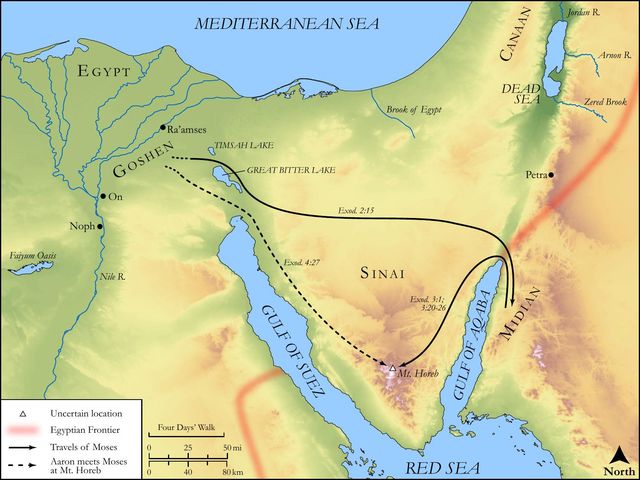
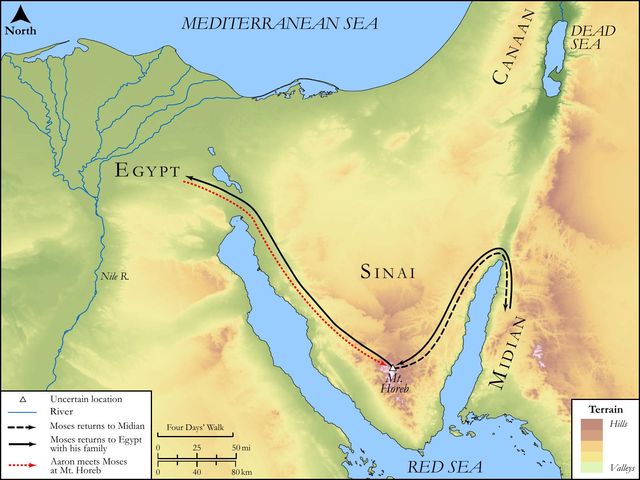
See on the biblical-era maps

Study this verse
Public-domain commentary
Matthew Henry
From his Commentary on the Whole Bible. Henry comments on passages, not single verses — this entry covers Exodus 4:24–31. His three-level outline is real structure in the source text, so it is rendered as structure.
Moses is here going to Egypt, and we are told,
I.How God met him in anger, Exo 4:24-26.
This is a very difficult passage of story; much has been written, and excellently written, to make it intelligible; we will try to make it improving. Here is,
1.The sin of Moses, which was neglecting to circumcise his son. This was probably the effect of his being unequally yoked with a Midianite, who was too indulgent of her child, while Moses was too indulgent of her. Note,
(1.)We have need to watch carefully over our own hearts, lest fondness for any relation prevail above our love to God, and take us off from our duty to him. It is charged upon Eli that he honoured his sons more than God (Sa1 2:29); and see Mat 10:37.
(2.)Even good men are apt to cool in their zeal for God and duty when they have long been deprived of the society of the faithful: solitude has its advantages, but they seldom counterbalance the loss of Christian communion.
2.God's displeasure against him. He met him, and, probably by a sword in an angel's hand, sought to kill him. This was a great change; very lately God was conversing with him, and lodging a trust in him, as a friend; and now he is coming forth against him as an enemy. Note,
(1.)Omissions are sins, and must come into judgment, and particularly the contempt and neglect of the seals of the covenant; for it is a sign that we undervalue the promises of the covenant, and are displeased with the conditions of it. He that has made a bargain, and is not willing to seal and ratify it, one may justly suspect, neither likes it nor designs to stand to it.
(2.)God takes notice of, and is much displeased with, the sins of his own people. If they neglect their duty, let them expect to hear of it by their consciences, and perhaps to feel from it by cross providences: for this cause many are sick and weak, as some think Moses was here.
3.The speedy performance of the duty for the neglect of which God had now a controversy with him. His son must be circumcised; Moses is unable to circumcise him; therefore, in this case of necessity, Zipporah does it, whether with passionate words (expressing her dislike of the ordinance itself, or at least the administration of it to so young a child, and in a journey), as to me it seems, or with proper words - solemnly expressing the espousal of the child to God by the covenant of circumcision (as some read it) or her thankfulness to God for sparing her husband, giving him a new life, and thereby giving her, as it were, a new marriage to him, upon her circumcising her son (as others read it) - I cannot determine: but we learn,
(1.)That when God discovers to us what is amiss in our lives we must give all diligence to amend it speedily, and particularly return to the duties we have neglected.
(2.)The putting away of our sins is indispensably necessary to the removal of God's judgements. This is the voice of every rod, it calls to us to return to him that smites us.
4.The release of Moses thereupon: So he let him go; the distemper went off, the destroying angel withdrew, and all was well: only Zipporah cannot forget the fright she was in, but will unreasonably call Moses a bloody husband, because he obliged her to circumcise the child; and, upon this occasion (it is probable), he sent them back to his father-in-law, that they might not create him any further uneasiness. Note,
(1.)When we return to God in a way of duty he will return to us in a way of mercy; take away the cause, and the effect will cease.
(2.)We must resolve to bear it patiently, if our zeal for God and his institutions be misinterpreted and discouraged by some that should understand themselves, and us, and their duty, better, as David's zeal was misinterpreted by Michal; but if this be to be vile, if this be to be bloody, we must be yet more so.
(3.)When we have any special service to do for God we should remove as far from us as we can that which is likely to be our hindrance. Let the dead bury their dead, but follow thou me.
II.How Aaron met him in love, Exo 4:27, Exo 4:28.
1.God sent Aaron to meet him, and directed him where to find him, in the wilderness that lay towards Midian. Note, The providence of God is to be acknowledged in the comfortable meeting of relations and friends.
2.Aaron made so much haste, in obedience to his God, and in love to his brother, that he met him in the mount of God, the place where God had met with him.
3.They embraced one another with mutual endearments. The more they saw of God's immediate direction in bringing them together the more pleasant their interview was: they kissed, not only in token of brotherly affection, and in remembrance of ancient acquaintance, but as a pledge of their hearty concurrence in the work to which they were jointly called.
4.Moses informed his brother of the commission he had received, with all the instructions and credentials affixed to it, Exo 4:28. Note, What we know of God we should communicate for the benefit of others; and those that are fellow-servants to God in the same work should use a mutual freedom, and endeavour rightly and fully to understand one another.
III.How the elders of Israel met him in faith and obedience.
When Moses and Aaron first opened their commission in Egypt, said what they were ordered to say, and, to confirm it, did what they were ordered to do, they met with a better reception than they promised themselves, Exo 4:29-31. 1. The Israelites gave credit to them: The people believed, as God had foretold (Exo 3:18), knowing that no man could do those works that they did, unless God were with him. They gave glory to God: They bowed their heads and worshipped, therein expressing not only their humble thankfulness to God, who had raised them up and sent them a deliverer, but also their cheerful readiness to observe orders, and pursue the methods of their deliverance.
Continue studying Exodus 4:27 across the web’s major study libraries — every link below opens this exact verse, chapter, or book on the destination site.
Read & Compare
 BibleGatewayThis verse in more than 200 translations and 70 languages.
 Bible.comThe YouVersion reader — hundreds of translations, reading plans, and highlights.
 ESV.orgCrossway's official English Standard Version reader.
 NET BibleThe NET translation with 60,000+ translators' notes on every rendering decision.
 STEP BibleTyndale House's free study tool — original text, vocabulary, and scholarly resources.
 BibliaLogos Bible Software's free web reader.
 USCCBThe New American Bible (Revised Edition) with the U.S. bishops' study notes.
Commentaries
 BibleHub CommentariesDozens of classic commentaries on this verse, gathered on one page.
 StudyLightMore than 100 commentary sets — the largest collection on the web.
 BibleRefPlain-English commentary on what this verse means, verse by verse.
 Enduring WordDavid Guzik's free commentary on this chapter, widely used by Bible teachers.
 Bible Study ToolsVerse commentary alongside Greek and Hebrew study aids.
Original Language & Research
- BibleHub InterlinearThe verse word by word — original language, transliteration, and English.
- BibleHub LexiconEvery word's original-language definition and Strong's entry.
 Blue Letter BibleDeep-study tools — Strong's numbers, concordance, and word studies.
 SefariaThe Hebrew text with Rashi and centuries of Jewish commentary.
Sermons, Hymns & Audio


TrulyRandomVerse is not affiliated with these sites and doesn’t control their content. They’re linked because they’re genuinely useful.
Summary
Exodus 4:27 narrates the divinely orchestrated reunion of Moses and his elder brother Aaron in the desolate wilderness, specifically at the sacred "mount of God." This pivotal encounter, marked by a warm fraternal kiss, signifies the commencement of their collaborative leadership and partnership, a crucial step in God's unfolding plan to liberate the Israelites from Egyptian bondage and prepare them for their monumental mission as God's appointed agents.
Context
ShowHideLiterary Context
This verse serves as a critical turning point in the narrative of Moses's divine commission. It immediately follows a series of intense exchanges between the LORD and Moses at the burning bush, where Moses repeatedly expressed his reluctance and perceived inadequacy to lead Israel, particularly his struggle with eloquence (Exodus 4:10). In response to Moses's persistent objections, God, in His gracious provision, appointed Aaron, Moses's eloquent brother, to be his spokesman and assistant (Exodus 4:14-16). The LORD then directly commanded Aaron to go into the wilderness to meet Moses, setting the stage for this significant reunion. This meeting solidifies the leadership duo and prepares them for the confrontation with Pharaoh detailed in the subsequent chapters of Exodus.
Historical & Cultural Context
The "wilderness" (Hebrew: midbâr) refers to the vast, arid region of the Sinai Peninsula, a place often associated with divine revelation and testing in biblical narratives. The "mount of God" is unequivocally Mount Horeb, also known as Mount Sinai, the very site where Moses first encountered the LORD in the burning bush (Exodus 3:1) and where the Mosaic Law and the covenant would later be delivered to Israel (Exodus 19). Culturally, the act of kissing in the days of the patriarchs was a common and powerful gesture of greeting, affection, respect, and sometimes, the sealing of a bond or reconciliation between close relatives or allies, as seen in the reunion of Jacob and Esau or Joseph and his brothers. This cultural practice underscores the genuine fraternal bond and mutual acceptance between Moses and Aaron, essential for their formidable joint mission.
Key Themes
ShowHideExodus 4:27 contributes significantly to several overarching themes within the book of Exodus. Firstly, it highlights Divine Sovereignty and Providence, demonstrating God's meticulous orchestration of events and His chosen instruments to fulfill His redemptive purposes. God actively directs the paths of both Moses and Aaron, bringing them together at a precise moment and location. Secondly, the verse underscores the theme of Divine Equipping and Provision, as God provides Aaron to complement Moses's perceived weaknesses, affirming that He always equips those He calls for the tasks He sets before them. Thirdly, it introduces the critical theme of United Leadership and Partnership, emphasizing the necessity of harmony, mutual support, and a unified front in divinely appointed service, especially in the face of daunting challenges. This reunion sets the stage for the collaborative effort required to confront Pharaoh and lead a nation.
Exposition and Analysis
ShowHideExodus 4:27 concisely narrates a moment of profound significance in the unfolding drama of the Exodus, showcasing divine initiative and human obedience.
Key Word Analysis
ShowHideThis is the covenant name of God (H3068), emphasizing His self-existent, eternal nature, and His personal relationship with Israel. The use of "LORD" here underscores that the command for Aaron to meet Moses is not a mere suggestion but a divine imperative from the sovereign God who is actively involved in the history of His people. It highlights the divine authority behind the entire mission.
And God (Hebrew, ʼĕlôhîym'): (H430) The phrase "mount of God" refers to a mountain or range of hills associated with the divine. This specific location, Mount Horeb/Sinai, is not merely a geographical point but a sacred space where God reveals Himself and establishes His covenant. Its designation as "the mount of God" signifies its consecrated nature and the divine presence that permeates it, making it the ideal setting for this crucial reunion and the subsequent revelations.
This primitive root signifies to kiss, literally or figuratively, often implying a deep connection or attachment. In this context, it is a powerful gesture of affection, reconciliation, and mutual acceptance between the two brothers. It seals their partnership and signifies the immediate restoration of their fraternal bond, which is vital for their unified leadership in the challenging mission ahead.
Verse Breakdown
ShowHide"And the LORD said to Aaron, Go into the wilderness to meet Moses."
This opening clause establishes the divine origin of the meeting. It was not a chance encounter but a direct, authoritative command from Yahweh, the covenant God. Aaron's journey is an act of immediate obedience, demonstrating his readiness to participate in God's plan. The "wilderness" is the vast, desolate region separating Egypt from Mount Sinai, serving as a crucible for divine encounter and preparation.
"And he went, and met him in the mount of God,"
This clause highlights Aaron's prompt compliance. He "went" without hesitation, confirming his faith and submission to the LORD's directive. The meeting location, "the mount of God" (Mount Horeb/Sinai), is profoundly significant. This is the very place where Moses received his commission and where the covenant would later be established. Their reunion at this sacred mountain emphasizes the divine nature of their mission and the holy ground upon which their joint leadership would be forged.
"and kissed him."
This concluding act symbolizes the genuine fraternal bond and mutual acceptance between Moses and Aaron. Among kinsmen in Scripture, a kiss was a common and powerful gesture among relatives and close friends, signifying deep affection, respect, and often, reconciliation or the sealing of a covenant. This act solidifies their partnership, a crucial foundation for the immense challenges they were about to face in confronting Pharaoh and leading the Israelites out of bondage.
Literary Devices
ShowHideThe narrative in Exodus 4:27 employs several literary devices to convey its profound message. Divine Command is central, as the verse opens with "the LORD said to Aaron," immediately establishing God's sovereign initiative and control over the unfolding events. This highlights the Theophany (divine appearance/revelation) that precedes and undergirds the entire Exodus narrative, emphasizing that the human agents are merely instruments of a greater divine purpose. The phrase "mount of God" serves as Symbolism, representing not just a physical location but a sacred space of divine presence, revelation, and covenant. The Action of Aaron going and meeting Moses, followed by the Gesture of kissing, provides a concise yet powerful depiction of obedience, reunion, and the formation of a unified leadership. This scene also functions as Foreshadowing, setting the stage for the collaborative leadership that will be essential for the liberation of Israel and the establishment of the covenant at this very mountain.
Theological and Thematic Connections
ShowHideExodus 4:27 powerfully illustrates God's meticulous providence and His active involvement in orchestrating the lives and ministries of His chosen servants. It underscores that divine assignments are often fulfilled through collaborative efforts, where God sovereignly brings individuals together at precise moments and locations to accomplish His purposes. The immediate unity and fraternal affection displayed between Moses and Aaron highlight the importance of harmonious relationships and mutual support in leadership, especially when facing daunting challenges. God, in His wisdom, provides the necessary partners and equips His called, ensuring that His plans are brought to fruition through complementary gifts and unified obedience.
Reflection and Application
ShowHideExodus 4:27 offers profound lessons for contemporary believers. Firstly, it reminds us that God is intimately involved in the details of our lives, often orchestrating divine appointments and bringing specific individuals into our paths to aid us in our callings. We are rarely called to serve in isolation; God frequently provides partners who complement our strengths and weaknesses, fostering a spirit of collaboration rather than competition. Secondly, the immediate unity and affectionate reunion between Moses and Aaron underscore the profound value of harmonious relationships, particularly within the Body of Christ and in leadership. When God's people work together in unity, aligned with His purposes, His blessings flow more abundantly, and His work is advanced more effectively. Finally, Aaron's swift obedience to God's command serves as a powerful example: responding promptly and faithfully to divine directives often positions us for significant moments in God's unfolding plan, leading us to places and encounters we might not anticipate but are crucial for our spiritual journey and service to His Kingdom.
Questions for Reflection
ShowHideFAQ
ShowHideWhy did God command Aaron to meet Moses specifically in the wilderness at the "mount of God"?
ShowHideGod commanded Aaron to meet Moses in the wilderness at the "mount of God" (Mount Horeb/Sinai) for several strategic and symbolic reasons. This was the sacred site where God had revealed Himself to Moses in the burning bush and commissioned him (Exodus 3:1). Bringing Aaron to this holy ground underscored the divine origin and sacred nature of their joint mission. It served as a place of preparation, consecration, and alignment with God's will before they confronted Pharaoh. The wilderness also represented a place of divine encounter and testing, setting the tone for the journey ahead.
What is the significance of the "kiss" between Moses and Aaron?
ShowHideThe kiss (Hebrew: nâshaq) between Moses and Aaron was a culturally significant gesture among kinsmen in Israel's history, signifying deep affection, respect, and reconciliation or the sealing of a bond. In this context, it confirms the genuine fraternal love and mutual acceptance between the brothers, despite Moses's initial reluctance to lead and Aaron's sudden appointment as his spokesman. It symbolizes the immediate unity and harmony essential for their formidable joint leadership, assuring that they would work together without internal strife as they embarked on the monumental task of delivering Israel.
Does this verse suggest that Moses and Aaron were already aware of God's plan for the Exodus?
ShowHideThe verse itself does not explicitly state their full awareness of the entire Exodus plan. However, it strongly implies that Aaron was aware enough of God's command to Moses to travel to meet him. Moses had just received his comprehensive commission at the burning bush (Exodus 3:7-10), and the LORD had informed him that Aaron would meet him and speak on his behalf (Exodus 4:14-16). Aaron's immediate obedience suggests he had received a direct divine instruction, likely including the purpose of their meeting, even if the full scope and challenges of the Exodus were yet to unfold for them.
Christ-Centered Fulfillment
ShowHideWhile Exodus 4:27 directly concerns the beginning of Israel's liberation from physical bondage, it subtly foreshadows Christ's ultimate work of spiritual redemption. Just as God sovereignly appointed and united Moses and Aaron for the deliverance of His people, God the Father sovereignly appointed and sent His Son, Jesus Christ, as the ultimate Deliverer from the slavery of sin and death (John 3:16-17). Christ, as the greater Moses, leads His people out of spiritual bondage into true freedom and life in the promised land of God's Kingdom (Hebrews 3:1-6). He not only fulfills the prophetic and priestly roles hinted at in the Old Testament figures but also perfectly embodies the divine unity and purpose. Furthermore, Christ calls and equips His followers, uniting them in His Body, the Church, to participate in His ongoing mission of reconciliation and evangelism, demonstrating a perfect unity and divine orchestration that far surpasses that of Moses and Aaron (Ephesians 4:11-13). He is the one who perfectly fulfills God's plan for salvation, ensuring that all who believe are brought into relationship with God.