


Exodus 4:28
Bible text: King James Version (1769 Blayney text) · Public domain
Bible text: Berean Standard Bible · Public domain
Bible text: American Standard Version (1901) · Public domain
Bible text: World English Bible, Messianic edition · Public domain
Bible text: Geneva Bible (1599) · Public domain
Bible text: Young's Literal Translation · Public domain
- וַיַּגֵּדvai·ya·Gedand he toldH5046Conj-w ¦ V-Hiphil-ConsecImperf-3msVerb Hiphil Consecutive Imperfect 3rd Singular Masculineוַandיַּגֵּדhe told
- מֹשֶׁהmo·ShehMosesH4872N-proper-mNoun Proper Masculine
- לְאַהֲרֹןle·'a·ha·Ronto AaronH175Prep-l ¦ N-proper-mNoun Proper MasculineלְtoאַהֲרֹןAaron
- אֵת'et<obj.>H853DirObjMParticle Object Indicator
- כָּלkolallH3605N-mscNoun Singular Masculine Construct
- דִּבְרֵיdiv·Rei[the] words ofH1697N-mpcNoun Plural Masculine Construct
- יְהוָהYah·wehYahwehH3068N-properNoun Proper Title
- אֲשֶׁר'a·SherwhichH834RelParticle Relative
- שְׁלָחוֹshe·la·Chohe had sent himH7971V-Qal-Perf-3ms ¦ 3msVerb Qal Perfect 3rd Singular Masculineשְׁלָחhe had sentוֹhim
- וְאֵתve·'Etand <obj.>H853Conj-w ¦ DirObjMParticle Object Indicatorוְandאֵת<obj.>
- כָּלkolallH3605N-mscNoun Singular Masculine Construct
- הָאֹתֹתha·'o·Totthe signsH226Art ¦ N-fpNoun Plural Feminine Absoluteהָtheאֹתֹתsigns
- אֲשֶׁר'a·SherwhichH834RelParticle Relative
- צִוָּהוּtzi·Va·huhe had commanded himH6680V-Piel-Perf-3ms ¦ 3msVerb Piel Perfect 3rd Singular Masculineצִוָּhe had commandedהוּhim
English is a literal word-by-word gloss of the Hebrew, not the KJV's wording. Why?
This is the original text the KJV's translators worked from — each Hebrew word with its own literal English meaning in this verse, prepared by scholars at Tyndale House, Cambridge. The KJV translates whole sentences, not word by word, so its wording differs: one Hebrew word can become several English words, and the KJV may choose “the LORD” where the gloss reads “Yahweh”. Both are faithful — they answer different questions. For the KJV's own rendering, switch to the KJV text.
Details
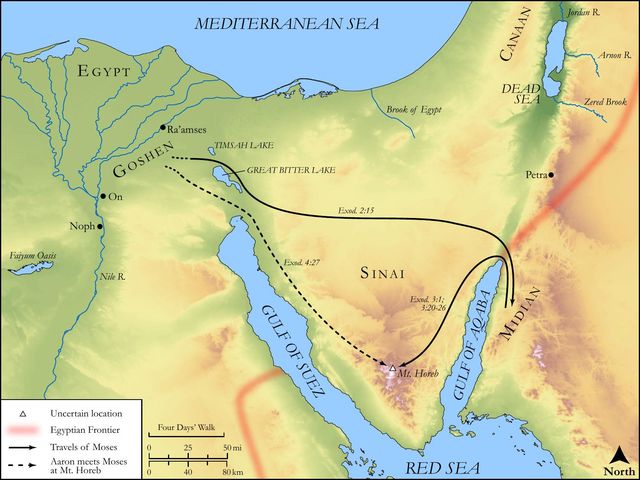
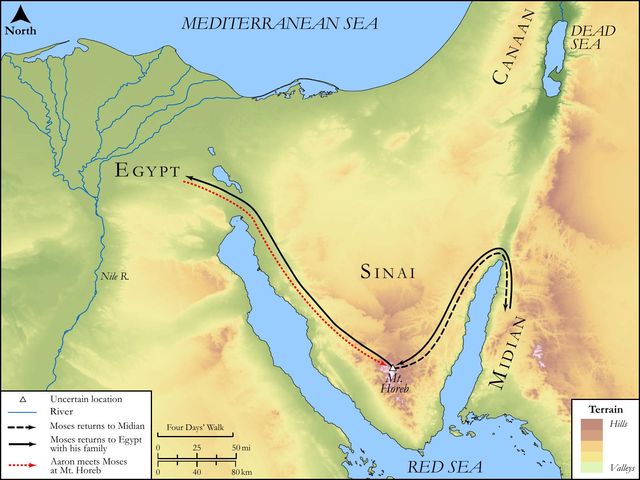
See on the biblical-era maps

Study this verse
Public-domain commentary
Matthew Henry
From his Commentary on the Whole Bible. Henry comments on passages, not single verses — this entry covers Exodus 4:24–31. His three-level outline is real structure in the source text, so it is rendered as structure.
Moses is here going to Egypt, and we are told,
I.How God met him in anger, Exo 4:24-26.
This is a very difficult passage of story; much has been written, and excellently written, to make it intelligible; we will try to make it improving. Here is,
1.The sin of Moses, which was neglecting to circumcise his son. This was probably the effect of his being unequally yoked with a Midianite, who was too indulgent of her child, while Moses was too indulgent of her. Note,
(1.)We have need to watch carefully over our own hearts, lest fondness for any relation prevail above our love to God, and take us off from our duty to him. It is charged upon Eli that he honoured his sons more than God (Sa1 2:29); and see Mat 10:37.
(2.)Even good men are apt to cool in their zeal for God and duty when they have long been deprived of the society of the faithful: solitude has its advantages, but they seldom counterbalance the loss of Christian communion.
2.God's displeasure against him. He met him, and, probably by a sword in an angel's hand, sought to kill him. This was a great change; very lately God was conversing with him, and lodging a trust in him, as a friend; and now he is coming forth against him as an enemy. Note,
(1.)Omissions are sins, and must come into judgment, and particularly the contempt and neglect of the seals of the covenant; for it is a sign that we undervalue the promises of the covenant, and are displeased with the conditions of it. He that has made a bargain, and is not willing to seal and ratify it, one may justly suspect, neither likes it nor designs to stand to it.
(2.)God takes notice of, and is much displeased with, the sins of his own people. If they neglect their duty, let them expect to hear of it by their consciences, and perhaps to feel from it by cross providences: for this cause many are sick and weak, as some think Moses was here.
3.The speedy performance of the duty for the neglect of which God had now a controversy with him. His son must be circumcised; Moses is unable to circumcise him; therefore, in this case of necessity, Zipporah does it, whether with passionate words (expressing her dislike of the ordinance itself, or at least the administration of it to so young a child, and in a journey), as to me it seems, or with proper words - solemnly expressing the espousal of the child to God by the covenant of circumcision (as some read it) or her thankfulness to God for sparing her husband, giving him a new life, and thereby giving her, as it were, a new marriage to him, upon her circumcising her son (as others read it) - I cannot determine: but we learn,
(1.)That when God discovers to us what is amiss in our lives we must give all diligence to amend it speedily, and particularly return to the duties we have neglected.
(2.)The putting away of our sins is indispensably necessary to the removal of God's judgements. This is the voice of every rod, it calls to us to return to him that smites us.
4.The release of Moses thereupon: So he let him go; the distemper went off, the destroying angel withdrew, and all was well: only Zipporah cannot forget the fright she was in, but will unreasonably call Moses a bloody husband, because he obliged her to circumcise the child; and, upon this occasion (it is probable), he sent them back to his father-in-law, that they might not create him any further uneasiness. Note,
(1.)When we return to God in a way of duty he will return to us in a way of mercy; take away the cause, and the effect will cease.
(2.)We must resolve to bear it patiently, if our zeal for God and his institutions be misinterpreted and discouraged by some that should understand themselves, and us, and their duty, better, as David's zeal was misinterpreted by Michal; but if this be to be vile, if this be to be bloody, we must be yet more so.
(3.)When we have any special service to do for God we should remove as far from us as we can that which is likely to be our hindrance. Let the dead bury their dead, but follow thou me.
II.How Aaron met him in love, Exo 4:27, Exo 4:28.
1.God sent Aaron to meet him, and directed him where to find him, in the wilderness that lay towards Midian. Note, The providence of God is to be acknowledged in the comfortable meeting of relations and friends.
2.Aaron made so much haste, in obedience to his God, and in love to his brother, that he met him in the mount of God, the place where God had met with him.
3.They embraced one another with mutual endearments. The more they saw of God's immediate direction in bringing them together the more pleasant their interview was: they kissed, not only in token of brotherly affection, and in remembrance of ancient acquaintance, but as a pledge of their hearty concurrence in the work to which they were jointly called.
4.Moses informed his brother of the commission he had received, with all the instructions and credentials affixed to it, Exo 4:28. Note, What we know of God we should communicate for the benefit of others; and those that are fellow-servants to God in the same work should use a mutual freedom, and endeavour rightly and fully to understand one another.
III.How the elders of Israel met him in faith and obedience.
When Moses and Aaron first opened their commission in Egypt, said what they were ordered to say, and, to confirm it, did what they were ordered to do, they met with a better reception than they promised themselves, Exo 4:29-31. 1. The Israelites gave credit to them: The people believed, as God had foretold (Exo 3:18), knowing that no man could do those works that they did, unless God were with him. They gave glory to God: They bowed their heads and worshipped, therein expressing not only their humble thankfulness to God, who had raised them up and sent them a deliverer, but also their cheerful readiness to observe orders, and pursue the methods of their deliverance.
Continue studying Exodus 4:28 across the web’s major study libraries — every link below opens this exact verse, chapter, or book on the destination site.
Read & Compare
 BibleGatewayThis verse in more than 200 translations and 70 languages.
 Bible.comThe YouVersion reader — hundreds of translations, reading plans, and highlights.
 ESV.orgCrossway's official English Standard Version reader.
 NET BibleThe NET translation with 60,000+ translators' notes on every rendering decision.
 STEP BibleTyndale House's free study tool — original text, vocabulary, and scholarly resources.
 BibliaLogos Bible Software's free web reader.
 USCCBThe New American Bible (Revised Edition) with the U.S. bishops' study notes.
Commentaries
 BibleHub CommentariesDozens of classic commentaries on this verse, gathered on one page.
 StudyLightMore than 100 commentary sets — the largest collection on the web.
 BibleRefPlain-English commentary on what this verse means, verse by verse.
 Enduring WordDavid Guzik's free commentary on this chapter, widely used by Bible teachers.
 Bible Study ToolsVerse commentary alongside Greek and Hebrew study aids.
Original Language & Research
- BibleHub InterlinearThe verse word by word — original language, transliteration, and English.
- BibleHub LexiconEvery word's original-language definition and Strong's entry.
 Blue Letter BibleDeep-study tools — Strong's numbers, concordance, and word studies.
 SefariaThe Hebrew text with Rashi and centuries of Jewish commentary.
Sermons, Hymns & Audio


TrulyRandomVerse is not affiliated with these sites and doesn’t control their content. They’re linked because they’re genuinely useful.
Summary
Exodus 4:28 marks a pivotal moment in the unfolding drama of Israel's deliverance, as Moses, freshly commissioned by God, faithfully meets his brother Aaron in the wilderness and relays with precision "all the words of the LORD" who had sent him, alongside "all the signs" God had commanded him to perform. This comprehensive disclosure not only solidified their divinely ordained partnership but also unequivocally established Moses' divine authority and the miraculous foundation of their monumental mission to lead the Israelites out of Egyptian bondage, underscoring the absolute truth and power inherent in God's redemptive plan.
Context
ShowHideLiterary Context
This verse serves as the immediate culmination of Moses' profound encounter with God at the burning bush. Following God's detailed commission, Moses' initial hesitations regarding his speaking ability and the Israelites' belief in his message are addressed by God's provision of miraculous signs (Exodus 4:1-9) and the appointment of Aaron as his spokesman (Exodus 4:10-17). Having received God's blessing to return to Egypt (Exodus 4:18-20), Moses is now en route, and God explicitly instructs Aaron to meet him in the wilderness (Exodus 4:27). Therefore, Exodus 4:28 describes the crucial moment of their designated rendezvous and the immediate, faithful transmission of the divine mandate, setting the stage for their joint ministry to the elders of Israel and Pharaoh.
Historical & Cultural Context
The narrative takes place against the backdrop of Israel's brutal slavery in Egypt, a period of intense oppression lasting approximately 400 years, as prophesied in Genesis 15:13. Pharaoh, as the divine king of Egypt, wielded absolute power, and challenging him required not only immense courage but also undeniable supernatural backing. In Scripture, a messenger's authority derived entirely from the one who sent him; thus, Moses' ability to convey "words" and perform "signs" was paramount for establishing his legitimacy before both his own people, who had long suffered under foreign rule, and the formidable Egyptian court. The wilderness meeting point itself is significant, symbolizing a liminal space between the old life of bondage and the journey towards freedom, a place where divine encounters often occurred, such as with Hagar or Elijah.
Key Themes
ShowHideThis verse powerfully contributes to several overarching themes within Exodus and the Pentateuch. It highlights the theme of Divine Initiative and Commission, demonstrating that God sovereignly chooses and equips His servants, despite their perceived inadequacies, for His redemptive purposes. The emphasis on "words" and "signs" underscores the theme of Divine Revelation and Authority, revealing God's nature as a speaking God who communicates His will clearly and validates His messengers through supernatural acts. Furthermore, the immediate and complete relaying of information between Moses and Aaron establishes the theme of Obedience and Collaborative Leadership, illustrating the importance of faithful stewardship of God's message and the necessity of unity and teamwork in fulfilling a divinely appointed mission, a pattern often seen in God's work, from Noah's obedience to the apostles' teamwork.
Exposition and Analysis
ShowHideKey Word Analysis
ShowHideThis term signifies far more than simple utterances or spoken sounds. It encompasses divine decrees, commands, promises, prophecies, and the very essence of God's communicative will and purpose. In this context, it refers to the comprehensive divine message Moses received: God's identification, His remembrance of the covenant, His intention to deliver Israel, the instructions for confronting Pharaoh, and the ultimate goal of worshiping God on the mountain. Moses conveyed the full scope of God's revelation, ensuring Aaron understood the divine origin and profound purpose of their mission, highlighting the absolute authority and comprehensive nature of God's communication.
This primitive root means "to front, i.e., stand boldly out opposite; by implication (causatively), to manifest; figuratively, to announce (always by word of mouth to one present); specifically, to expose, predict, explain, praise." Moses' act of "telling" Aaron was a bold and comprehensive declaration, not a mere recounting. It implies a full manifestation and explanation of the divine message and instructions, ensuring Aaron was completely informed and prepared to stand alongside Moses as God's representative. This verb emphasizes the clarity, directness, and completeness of Moses' disclosure.
This word denotes a signal, mark, miracle, omen, or token. These were not arbitrary acts but powerful, supernatural demonstrations of God's active involvement and Moses' divine appointment. God had specifically equipped Moses with these miraculous proofs—the staff turning into a snake, his hand becoming leprous, and water turning to blood (Exodus 4:1-9)—to validate his calling before the elders of Israel and Pharaoh. Moses' faithful transmission of these instructions to Aaron was vital, as Aaron would serve as the active performer of many of these miracles before Pharaoh, establishing their shared authority and the undeniable power of the God of Israel.
Verse Breakdown
ShowHide"And Moses told Aaron"
This opening phrase immediately establishes the direct and personal nature of the communication. Moses, having received the divine commission, now faithfully transmits it to his divinely appointed partner, Aaron. The act of "telling" (H5046, nâgad') implies a comprehensive and clear declaration, not merely a casual conversation, underscoring the gravity and significance of the information being shared.
"all the words of the LORD who had sent him"
This clause highlights the divine origin and comprehensive nature of the message. The "words" (H1697, dâbâr') refer to the entire divine revelation Moses received at the burning bush, including God's identity, His covenant promises, His plan for Israel's deliverance, and the specific instructions for dealing with Pharaoh. The phrase "who had sent him" reiterates Moses' role as a divinely commissioned messenger, emphasizing that his authority and message were not his own but derived directly from Yahweh, the self-existent God.
"and all the signs which he had commanded him"
This final clause specifies the second crucial component of Moses' disclosure: the miraculous proofs. The "signs" (H226, ʼôwth') were the supernatural demonstrations God had empowered Moses to perform (staff to snake, hand to leprosy, water to blood) to authenticate his mission before the Israelites and Pharaoh. The phrase "which he had commanded him" underscores that these signs were not random acts but divinely ordained and instructed, serving as irrefutable evidence of God's presence and power, and essential for convincing a skeptical audience.
Literary Devices
ShowHideThe verse employs several significant literary devices. Repetition of the word "all" ("all the words," "all the signs") serves to emphasize the completeness and comprehensive nature of Moses' disclosure to Aaron. This highlights that nothing was held back, ensuring Aaron was fully equipped and informed for their joint mission. Metonymy is present in "the words of the LORD," where "words" stands for the entire divine revelation, including God's will, commands, and promises. Similarly, "signs" serves as synecdoche, representing the miraculous power and divine authentication that accompanied Moses' mission. The entire verse functions as a narrative bridge, connecting Moses' private divine encounter with the public execution of God's plan, transitioning from individual commission to collaborative action.
Theological and Thematic Connections
ShowHideThis verse powerfully establishes the foundation for Israel's deliverance, rooted in God's sovereign initiative and His meticulous preparation of His chosen instruments. It underscores the absolute authority of God's word and the undeniable power of His miraculous signs as validation for His messengers. The faithful transmission of this divine mandate from Moses to Aaron highlights the importance of obedience, clear communication, and collaborative partnership in fulfilling God's purposes. This dynamic between God, Moses, and Aaron foreshadows the pattern of divine revelation and human response throughout biblical history, emphasizing that God's work is accomplished through His word, His power, and His people working in unity.
Reflection and Application
ShowHideExodus 4:28 offers profound and enduring lessons for contemporary believers. Just as God meticulously prepared Moses and Aaron for their daunting task, providing both His "words" and validating "signs," so too does He equip those He calls today. This verse reminds us that our authority in ministry or any God-given task does not stem from our own abilities or eloquence, but from the divine source of our commission. Moses' faithful and complete communication to Aaron underscores the vital importance of transparency, clarity, and unity in shared spiritual endeavors. It challenges us to be diligent and accurate stewards of God's truth, whether we are teaching, leading, or simply sharing our faith. Moreover, the divinely ordained partnership between Moses and Aaron serves as a powerful illustration of the effectiveness of teamwork and mutual support within the body of Christ, reminding us that God often calls us to serve not in isolation, but in community, leveraging diverse gifts for a common purpose.
Questions for Reflection
ShowHideFAQ
ShowHideWhy was it important for Moses to tell Aaron "all the words" and "all the signs"?
ShowHideIt was absolutely crucial for several interconnected reasons. Firstly, it ensured Aaron's full comprehension of the divine mandate, the specific message for Pharaoh and Israel, and the ultimate purpose of their mission. Secondly, it equipped him to serve effectively as Moses' divinely appointed spokesman, allowing him to articulate God's message with accuracy and conviction. Thirdly, it prepared him to perform the miraculous signs that would authenticate their authority before both the skeptical Israelites and the formidable Pharaoh, demonstrating God's irrefutable power. This complete disclosure fostered unity, understanding, and effective collaboration, laying the groundwork for their shared, monumental task.
Does this verse imply Aaron was subordinate to Moses?
ShowHideWhile God primarily spoke to Moses and commissioned him as the central figure and leader of the Exodus, the verse highlights a divinely ordained collaborative partnership rather than strict subordination in the sense of a lesser role. Moses received direct revelation, and Aaron was appointed to assist in its delivery and demonstration. Aaron acted as Moses' spokesman to the people and Pharaoh (Exodus 4:16), and later became the first High Priest, indicating a distinct and vital role within the divine plan. This arrangement established a clear chain of command and communication, with Moses as the primary recipient of God's word and Aaron as the empowered co-laborer, demonstrating a functional hierarchy designed for effective mission execution.
Christ-Centered Fulfillment
ShowHideExodus 4:28 profoundly foreshadows Christ, who is the ultimate and complete fulfillment of God's "words" and "signs." Moses, as the faithful prophet and mediator who received and transmitted "all the words of the LORD," serves as a powerful type of Christ, who is Himself the incarnate Word of God, the very embodiment of God's complete revelation to humanity (John 1:1-3). Just as Moses was sent with divine authority and miraculous "signs" to deliver Israel from bondage, Jesus came with unparalleled authority, performing countless signs and wonders—from healing the sick to raising the dead—to confirm His divine identity and His ultimate mission of salvation from sin and death (John 20:30-31). The collaborative ministry of Moses and Aaron also prefigures Christ's equipping and sending of His disciples, empowering them with His words and His Spirit to continue His work of proclaiming the gospel and demonstrating God's power to a lost world (Matthew 28:18-20; Acts 1:8). Ultimately, Christ is the perfect and final revelation of God's "words" and the supreme "sign" of His redemptive love, through whom all God's promises find their "Yes" and "Amen" (2 Corinthians 1:20).