


Genesis 29:11
Bible text: King James Version (1769 Blayney text) · Public domain
Bible text: Berean Standard Bible · Public domain
Bible text: American Standard Version (1901) · Public domain
Bible text: World English Bible, Messianic edition · Public domain
Bible text: Geneva Bible (1599) · Public domain
Bible text: Young's Literal Translation · Public domain
- וַיִּשַּׁקvai·yi·Shakand he kissedH5401Conj-w ¦ V-Qal-ConsecImperf-3msVerb Qal Consecutive Imperfect 3rd Singular Masculineוַandיִּשַּׁקhe kissed
- יַעֲקֹבya·'a·KoJacobH3290N-proper-mNoun Proper Masculine
- לְרָחֵלle·ra·Chel<to> RachelH7354Prep-l ¦ N-proper-fNoun Proper Feminineלְ<to>רָחֵלRachel
- וַיִּשָּׂאvai·yi·Sa'and he lifted upH5375Conj-w ¦ V-Qal-ConsecImperf-3msVerb Qal Consecutive Imperfect 3rd Singular Masculineוַandיִּשָּׂאhe lifted up
- אֶת'et<obj.>H853DirObjMParticle Object Indicator
- קֹלוֹko·Lohis voiceH6963N-msc ¦ 3msNoun Singular Masculine Constructקֹלvoiceוֹhis
- וַיֵּבְךְּvai·Ye·vekand he weptH1058Conj-w ¦ V-Qal-ConsecImperf-3msVerb Qal Consecutive Imperfect 3rd Singular Masculineוַandיֵּבְךְּhe wept
English is a literal word-by-word gloss of the Hebrew, not the KJV's wording. Why?
This is the original text the KJV's translators worked from — each Hebrew word with its own literal English meaning in this verse, prepared by scholars at Tyndale House, Cambridge. The KJV translates whole sentences, not word by word, so its wording differs: one Hebrew word can become several English words, and the KJV may choose “the LORD” where the gloss reads “Yahweh”. Both are faithful — they answer different questions. For the KJV's own rendering, switch to the KJV text.
Details
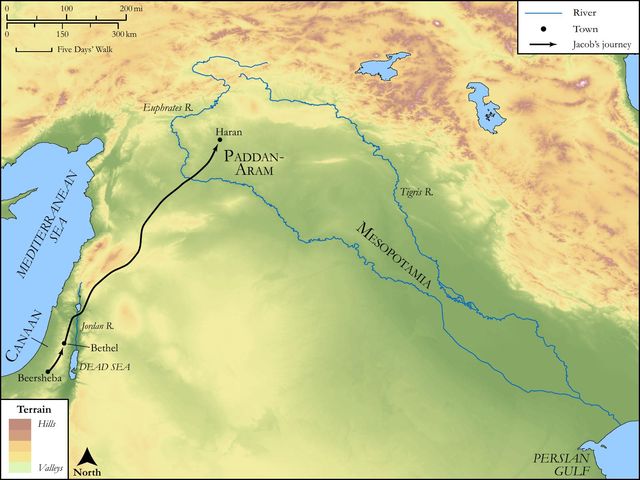
See on the biblical-era maps


Study this verse
Public-domain commentary
Matthew Henry
From his Commentary on the Whole Bible. Henry comments on passages, not single verses — this entry covers Genesis 29:9–14.
Here we see, 1. Rachel's humility and industry: She kept her father's sheep (Gen 29:9), that is, she took the care of them, having servants under her that were employed about them. Rachel's name signifies a sheep. Note, Honest useful labour is that which nobody needs be ashamed of, nor ought it to be a hindrance to any one's preferment. 2. Jacob's tenderness and affection. When he understood that this was his kinswoman (probably he had heard of her name before), knowing what his errand was into that country, we may suppose it struck his mind immediately that his must be his wife. Being already smitten with her ingenuous comely face (though it was probably sun-burnt, and she was in the homely dress of a shepherdess), he is wonderfully officious, and anxious to serve her (Gen 29:10), and addresses himself to her with tears of joy and kisses of love, Gen 29:11. She runs with all haste to tell her father; for she will by no means entertain her kinsman's address without her father's knowledge and approbation, Gen 29:12. These mutual respects, at their first interview, were good presages of their being a happy couple. 3. Providence made that which seemed contingent and fortuitous to give speedy satisfaction to Jacob's mind, as soon as ever he came to the place which he was bound for. Abraham's servant, when he came upon a similar errand, met with similar encouragement. Thus God guides his people with his eye, Psa 32:8. It is a groundless conceit which some of the Jewish writers have, that Jacob, when he kissed Rachel, wept because he had been set upon in his journey by Eliphaz the eldest son of Esau, at the command of his father, and robbed of all his money and jewels, which his mother had given him when she sent him away. It was plain that it was his passion for Rachel, and the surprise of this happy meeting, that drew these tears from his eyes. 4. Laban, though none of the best-humoured men, bade him welcome, was satisfied in the account he gave of himself, and of the reason of his coming in such poor circumstances. While we avoid the extreme, on the one hand, of being foolishly credulous, we must take heed of falling into the other extreme, of being uncharitably jealous and suspicious. Laban owned him for his kinsman: Thou art my bone and my flesh, Gen 29:14. Note, Those are hard-hearted indeed that are unkind to their relations, and that hide themselves from their own flesh, Isa 58:7.
Historical interpretation
Two Centuries of Reception
3 surviving comments on this verse. Each one is dated, so this reads as a timeline rather than a list.
Select a marker to jump to its quote. Markers stagger vertically where authors wrote within a few decades of each other.
Jacob continued on and turned aside to a well where he saw Rachel the shepherd girl, who, with her bare feet, her shabby clothing and her face burned from the sun, could not be distinguished from the charred brands that come out of the fire. Jacob knew at once that he who had provided the beautiful Rebekah at the spring now provided Rachel in her shabby clothing at the well. Then he performed a heroic deed in her presence, for, through the Son who was hidden in it, he rolled away the stone that even many could raise only with great difficulty. When he betrothed her to God through this marvelous deed, Jacob then returned and married himself to her with a kiss.
In addition Rachel is interpreted as a “sheep of God.” And some consider her to be with good reason a symbol of the church among the nations. She is also the sheep of Christ, mixed in the ancient folds, and finally received in the fold of the Savior. Therefore he said, “And other sheep I have, which are not of this fold, them also I must bring, and they shall hear my voice; and there shall be one fold, and one shepherd.” And the holy disciples acted as shepherds of the church of Christ, when they supported her as reasonable creatures and when they were her lovers and bridegrooms and presented her to God as a pure virgin without spots or wrinkles, or as something similar, “holy and immaculate.”
We have frequently mentioned to your charity, dearly beloved, that blessed Jacob was a type and figure of our Lord and Savior. Moreover, how Christ was to come into the world to be joined to the church was prefigured also in blessed Jacob when he traveled into a distant country to choose a wife. Therefore blessed Jacob, as you have heard, went into Mesopotamia to take a wife. When he had come to a certain well, he saw Rachel coming with her father’s sheep—after he recognized her as his cousin, he kissed her as soon as the flock was supplied with water. If you notice carefully, brothers, you can recognize that it was not without reason that the holy patriarchs found their wives at wells or fountains. If this had happened only once, someone might say it was accidental and not for some definite reason. Blessed Rebekah who was to be united to blessed Isaac was found at the well; Rachel whom blessed Jacob was to marry was recognized at the well; and Zipporah who was joined to Moses was found at the well. Doubtless then we ought to understand some mysteries in these facts. Since all three of those patriarchs typified our Lord and Savior, for this reason they found their wives at fountains or wells, because Christ was to find his church at the waters of baptism. Moreover, when Jacob came to the well, Rachel first watered the flock, and then he kissed her. It is true, dearly beloved, unless the Christian people are first washed from all evil by the waters of baptism, they do not deserve to possess the peace of Christ. Could not blessed Jacob have kissed his cousin upon seeing her, before the flock was watered? Doubtless he could have, but a mystery was involved: for it was necessary for the church to be freed from all iniquity and dissension by the grace of baptism and thus to merit peace with God.
Continue studying Genesis 29:11 across the web’s major study libraries — every link below opens this exact verse, chapter, or book on the destination site.
Read & Compare
 BibleGatewayThis verse in more than 200 translations and 70 languages.
 Bible.comThe YouVersion reader — hundreds of translations, reading plans, and highlights.
 ESV.orgCrossway's official English Standard Version reader.
 NET BibleThe NET translation with 60,000+ translators' notes on every rendering decision.
 STEP BibleTyndale House's free study tool — original text, vocabulary, and scholarly resources.
 BibliaLogos Bible Software's free web reader.
 USCCBThe New American Bible (Revised Edition) with the U.S. bishops' study notes.
Commentaries
 BibleHub CommentariesDozens of classic commentaries on this verse, gathered on one page.
 StudyLightMore than 100 commentary sets — the largest collection on the web.
 BibleRefPlain-English commentary on what this verse means, verse by verse.
 Enduring WordDavid Guzik's free commentary on this chapter, widely used by Bible teachers.
 Bible Study ToolsVerse commentary alongside Greek and Hebrew study aids.
Original Language & Research
- BibleHub InterlinearThe verse word by word — original language, transliteration, and English.
- BibleHub LexiconEvery word's original-language definition and Strong's entry.
 Blue Letter BibleDeep-study tools — Strong's numbers, concordance, and word studies.
 SefariaThe Hebrew text with Rashi and centuries of Jewish commentary.
Sermons, Hymns & Audio


TrulyRandomVerse is not affiliated with these sites and doesn’t control their content. They’re linked because they’re genuinely useful.
Summary
Genesis 29:11 captures a pivotal and deeply emotional moment in Jacob's life, marking his first encounter with Rachel, his cousin and future beloved wife. This verse signifies the divinely orchestrated culmination of a long, solitary, and uncertain journey, bringing Jacob to the threshold of his destiny and the beginning of a new chapter defined by love, family, and the continuation of God's covenant promises to Abraham and Isaac.
Context
ShowHideLiterary Context
This verse is situated at a critical juncture in the narrative of Jacob's life, following his flight from Esau and his profound encounter with God at Bethel. Having received divine promises of protection and prosperity in Genesis 28:10-22, Jacob continues his journey to Haran. The preceding verses (Genesis 29:1-10) meticulously detail Jacob's arrival at a well, his inquiry about Laban, and the providential appearance of Rachel with her father's sheep. Jacob's extraordinary act of single-handedly rolling the massive stone from the well's mouth, a task typically requiring multiple shepherds, not only demonstrates his strength but also sets the stage for the immediate and intense emotional reaction described in this verse, underscoring the significance of this meeting.
Historical & Cultural Context
In Jacob's day, wells were vital communal gathering places, serving as centers for social interaction, news exchange, and the watering of flocks. The act of watering sheep was a common duty, often performed by women in pastoral societies, as seen with Rebekah (Jacob's mother) in Genesis 24. Kissing among relatives was a customary greeting, signifying kinship and welcome, but its intensity in this context suggests more than mere formality. The patriarchal society placed immense value on lineage and family continuity, making the discovery of kin, especially a potential spouse, a moment of profound significance for a lonely traveler like Jacob.
Key Themes
ShowHideGenesis 29:11 contributes significantly to several overarching themes in the book of Genesis. It highlights Divine Providence, demonstrating God's active guidance in Jacob's journey, bringing him precisely to the right place at the right time to meet Rachel, fulfilling the promises made at Bethel. The verse also underscores the theme of Covenant Continuity, as this encounter with Rachel, a descendant of Abraham's brother Nahor, is crucial for the establishment of Jacob's family, through whom the covenant promises of a great nation and land would be realized (compare Genesis 12:2-3). Furthermore, it introduces the powerful theme of Profound Human Emotion and Love, setting the stage for Jacob's deep affection for Rachel, which would shape much of his future narrative, as evidenced by his willingness to serve Laban for fourteen years for her.
Exposition and Analysis
ShowHideGenesis 29:11 succinctly captures Jacob's immediate and overwhelming reaction upon meeting Rachel, conveying a depth of emotion and significance far beyond a simple greeting.
Key Word Analysis
ShowHideA primitive root meaning "to kiss, literally or figuratively (touch)." In this context, it signifies not merely a customary greeting among relatives but an immediate, profound expression of affection, recognition, and perhaps an intuitive sense of destiny. It suggests an instant, powerful attraction and the establishment of an intimate connection.
A primitive root meaning "to lift, in a great variety of applications." Here, it describes the physical act of raising his voice, indicating an audible and unrestrained outpouring of emotion. This is not a quiet or contained reaction but a public and demonstrative one, emphasizing the intensity of the moment.
A primitive root meaning "to weep; generally to bemoan." This strong verb denotes a deep, unrestrained outpouring of emotion, often accompanied by audible lamentation or crying out. Jacob's weeping here is not necessarily sorrowful but a complex release of pent-up emotions—relief, gratitude, joy, and the overwhelming impact of divine providence.
Verse Breakdown
ShowHide"And Jacob kissed Rachel,"
This opening clause describes Jacob's first physical interaction with Rachel. While a kiss was a common greeting among relatives, here it carries profound weight. For Jacob, a lonely fugitive who had just completed a long and arduous journey, this kiss represents an immediate recognition of kinship and a powerful, instantaneous affection. It signifies finding family, a sense of belonging after alienation, and the dawning of a deep personal bond that would define his life. It is an act of welcome, both from Jacob to Rachel and, implicitly, a sign of his own welcome into Laban's household.
"and lifted up his voice, and wept."
This second clause reveals the intensity of Jacob's emotional state. The phrase "lifted up his voice" emphasizes the audible and unrestrained nature of his weeping. His tears were not quiet sniffles but a profound, audible outpouring. This weeping was likely a complex mixture of emotions: immense relief at the successful completion of his journey and the fulfillment of God's promise of guidance (compare Genesis 28:15); overwhelming joy at finding his mother's kin and, specifically, Rachel, who would become the love of his life; and the release of pent-up fear, loneliness, and uncertainty from his solitary flight. It marks an emotional culmination, signifying the end of a difficult period and the beginning of a new, hopeful chapter in his life, where he would establish his family and contribute to the covenant lineage.
Literary Devices
ShowHideThe verse employs several literary devices to convey its profound emotional and theological significance. Emotional Resonance is paramount, as Jacob's raw, unrestrained display of weeping immediately immerses the reader in the intensity of the moment. The actions of kissing and weeping are rich in Symbolism: the kiss symbolizes immediate affection, kinship, and the nascent bond of love, while the weeping symbolizes a complex release of pent-up emotions—relief, joy, gratitude, and the culmination of a long, arduous journey. There is also an element of Foreshadowing, as this intense initial encounter powerfully anticipates the deep and enduring love Jacob will have for Rachel, a love that will shape his life and the narrative of Israel's origins. The concise yet impactful phrasing of the verse contributes to its Dramatic Effect, highlighting the immediate and overwhelming nature of Jacob's reaction.
Theological and Thematic Connections
ShowHideGenesis 29:11 is a powerful testament to God's meticulous and loving providence, demonstrating how He orchestrates events to fulfill His promises, even through human emotion and relationships. Jacob's journey, marked by deception and flight, culminates in a moment of profound joy and belonging, not by chance, but by divine design. This encounter with Rachel is a crucial step in the unfolding of God's covenant with Abraham and Isaac, ensuring the continuation of the promised lineage through which the nation of Israel would be formed. It underscores that God's plan often unfolds in personal, deeply emotional ways, affirming the value of human connection and love within His sovereign will.
Reflection and Application
ShowHideGenesis 29:11 offers profound lessons for contemporary believers, reminding us that even in periods of great uncertainty, loneliness, or hardship, God's providence is actively at work, meticulously guiding us to where we need to be. Jacob's journey from a solitary fugitive to a man embraced by family, culminating in this raw emotional display, teaches us the importance of trusting in God's perfect timing and His intricate plan for our lives. His uninhibited weeping also provides a powerful example of emotional authenticity; it is natural and healthy to express our deepest feelings—whether tears of joy, relief, or even sorrow—especially in moments of significant transition or divine intervention. This verse encourages us to embrace our humanity, to acknowledge and release our emotions before God, and to find comfort in the knowledge that He orchestrates encounters and circumstances to bring us to moments of profound joy, belonging, and the fulfillment of His promises. It calls us to recognize the hand of God in the seemingly ordinary, yet divinely appointed, intersections of our lives.
Questions for Reflection
ShowHideFAQ
ShowHideWhy did Jacob weep upon meeting Rachel?
ShowHideJacob's weeping was a complex and profound outpouring of intense emotion, rather than solely sorrow. It signified overwhelming relief after a long, solitary, and dangerous journey, deep gratitude for God's faithfulness in guiding him to his destination and family, and profound joy at finding his mother's kin, particularly Rachel, who would become the love of his life (as seen in Genesis 29:20). It was an emotional release marking the end of a lonely and uncertain period and the beginning of a new, hopeful chapter in his life.
What is the significance of Jacob kissing Rachel immediately?
ShowHideJacob's kiss was both a customary greeting among relatives and a powerful expression of immediate, profound affection and recognition. For Jacob, a lonely fugitive, it symbolized finding family, a sense of belonging, and the instant, deep connection he felt with Rachel. It was a tangible expression of welcome and the dawning of their significant relationship, which was crucial for the unfolding of God's covenant plan and the continuation of the promised lineage. This act immediately set the tone for their future relationship, which would be marked by deep love and devotion.
Christ-Centered Fulfillment
ShowHideJacob's journey, marked by divine guidance, the promise of a great nation, and the finding of his beloved bride, Rachel, serves as a profound foreshadowing of Christ and His relationship with His Church. Just as Jacob, a wanderer and supplanter, was led by God's providence to the well where he found Rachel, the one through whom his lineage would continue and the covenant promises would progress, so too Christ, in His earthly journey, came to seek and save His beloved bride, the Church. He is the true Shepherd who gathers His flock, just as Jacob watered Rachel's sheep (compare John 10:11). Through Christ, we find true belonging and the ultimate fulfillment of God's promises, as He offers the "living water" that quenches our spiritual thirst (see John 4:10-14). His love for His Church, like Jacob's deep love for Rachel, is profound, sacrificial, and enduring (as described in Ephesians 5:25-27), ensuring that all who are united with Him become part of God's eternal family and the inheritors of His covenant blessings, establishing a spiritual lineage that transcends earthly boundaries.