


Genesis 29:12
- וַיַּגֵּדvai·ya·Gedand he toldH5046Conj-w ¦ V-Hiphil-ConsecImperf-3msVerb Hiphil Consecutive Imperfect 3rd Singular Masculineוַandיַּגֵּדhe told
- יַעֲקֹבya·'a·KoJacobH3290N-proper-mNoun Proper Masculine
- לְרָחֵלle·ra·Chelto RachelH7354Prep-l ¦ N-proper-fNoun Proper FeminineלְtoרָחֵלRachel
- כִּיkithatH3588PrtParticle Conditional
- אֲחִי'a·Chi[was] [the] relative ofH251N-mscNoun Singular Masculine Construct
- אָבִיהָ'a·Vi·haher fatherH1N-msc ¦ 3fsNoun Singular Masculine Constructאָבִיfatherהָher
- הוּאHu'heH1931Pro-3msPronoun Personal 3rd Singular Masculine
- וְכִיve·Khiand thatH3588Conj-w ¦ PrtParticle Conditionalוְandכִיthat
- בֶןven[was] [the] son ofH1121N-mscNoun Singular Masculine Construct
- רִבְקָהriv·KahRebekahH7259N-proper-fNoun Proper Feminine
- הוּאHu'heH1931Pro-3msPronoun Personal 3rd Singular Masculine
- וַתָּרָץva·Ta·rotzand she ranH7323Conj-w ¦ V-Qal-ConsecImperf-3fsVerb Qal Consecutive Imperfect 3rd Singular Feminineוַandתָּרָץshe ran
- וַתַּגֵּדva·ta·Gedand she toldH5046Conj-w ¦ V-Hiphil-ConsecImperf-3fsVerb Hiphil Consecutive Imperfect 3rd Singular Feminineוַandתַּגֵּדshe told
- לְאָבִיהָle·'a·Vi·hato her fatherH1Prep-l ¦ N-msc ¦ 3fsNoun Singular Masculine Constructלְtoאָבִיfatherהָher
English is a literal word-by-word gloss of the Hebrew, not the KJV's wording. Why?
This is the original text the KJV's translators worked from — each Hebrew word with its own literal English meaning in this verse, prepared by scholars at Tyndale House, Cambridge. The KJV translates whole sentences, not word by word, so its wording differs: one Hebrew word can become several English words, and the KJV may choose “the LORD” where the gloss reads “Yahweh”. Both are faithful — they answer different questions. For the KJV's own rendering, switch to the KJV text.
Details
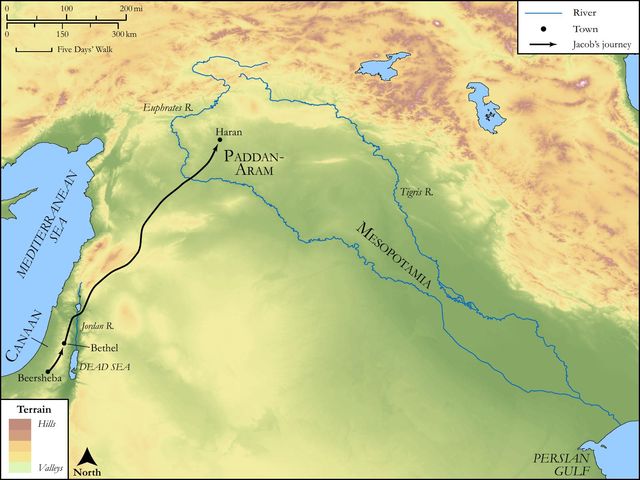
See on the biblical-era map


Study this verse
Public-domain commentary
Matthew Henry
From his Commentary on the Whole Bible. Henry comments on passages, not single verses — this entry covers Genesis 29:9–14.
Here we see, 1. Rachel's humility and industry: She kept her father's sheep (Gen 29:9), that is, she took the care of them, having servants under her that were employed about them. Rachel's name signifies a sheep. Note, Honest useful labour is that which nobody needs be ashamed of, nor ought it to be a hindrance to any one's preferment. 2. Jacob's tenderness and affection. When he understood that this was his kinswoman (probably he had heard of her name before), knowing what his errand was into that country, we may suppose it struck his mind immediately that his must be his wife. Being already smitten with her ingenuous comely face (though it was probably sun-burnt, and she was in the homely dress of a shepherdess), he is wonderfully officious, and anxious to serve her (Gen 29:10), and addresses himself to her with tears of joy and kisses of love, Gen 29:11. She runs with all haste to tell her father; for she will by no means entertain her kinsman's address without her father's knowledge and approbation, Gen 29:12. These mutual respects, at their first interview, were good presages of their being a happy couple. 3. Providence made that which seemed contingent and fortuitous to give speedy satisfaction to Jacob's mind, as soon as ever he came to the place which he was bound for. Abraham's servant, when he came upon a similar errand, met with similar encouragement. Thus God guides his people with his eye, Psa 32:8. It is a groundless conceit which some of the Jewish writers have, that Jacob, when he kissed Rachel, wept because he had been set upon in his journey by Eliphaz the eldest son of Esau, at the command of his father, and robbed of all his money and jewels, which his mother had given him when she sent him away. It was plain that it was his passion for Rachel, and the surprise of this happy meeting, that drew these tears from his eyes. 4. Laban, though none of the best-humoured men, bade him welcome, was satisfied in the account he gave of himself, and of the reason of his coming in such poor circumstances. While we avoid the extreme, on the one hand, of being foolishly credulous, we must take heed of falling into the other extreme, of being uncharitably jealous and suspicious. Laban owned him for his kinsman: Thou art my bone and my flesh, Gen 29:14. Note, Those are hard-hearted indeed that are unkind to their relations, and that hide themselves from their own flesh, Isa 58:7.
Continue studying Genesis 29:12 across the web’s major study libraries — every link below opens this exact verse, chapter, or book on the destination site.
Read & Compare
 BibleGatewayThis verse in more than 200 translations and 70 languages.
 Bible.comThe YouVersion reader — hundreds of translations, reading plans, and highlights.
 ESV.orgCrossway's official English Standard Version reader.
 NET BibleThe NET translation with 60,000+ translators' notes on every rendering decision.
 STEP BibleTyndale House's free study tool — original text, vocabulary, and scholarly resources.
 BibliaLogos Bible Software's free web reader.
 USCCBThe New American Bible (Revised Edition) with the U.S. bishops' study notes.
Commentaries
 BibleHub CommentariesDozens of classic commentaries on this verse, gathered on one page.
 StudyLightMore than 100 commentary sets — the largest collection on the web.
 BibleRefPlain-English commentary on what this verse means, verse by verse.
 Enduring WordDavid Guzik's free commentary on this chapter, widely used by Bible teachers.
 Bible Study ToolsVerse commentary alongside Greek and Hebrew study aids.
Original Language & Research
- BibleHub InterlinearThe verse word by word — original language, transliteration, and English.
- BibleHub LexiconEvery word's original-language definition and Strong's entry.
 Blue Letter BibleDeep-study tools — Strong's numbers, concordance, and word studies.
 SefariaThe Hebrew text with Rashi and centuries of Jewish commentary.
Sermons, Hymns & Audio


TrulyRandomVerse is not affiliated with these sites and doesn’t control their content. They’re linked because they’re genuinely useful.
Summary
Records the pivotal moment of Jacob's arrival in Haran, where he identifies himself to Rachel as her father's kinsman and Rebekah's son. This revelation immediately prompts Rachel to run and inform her father, Laban, of his unexpected and significant arrival. This encounter is not merely a familial reunion but a divinely orchestrated event that initiates Jacob's sojourn with his maternal relatives, setting the stage for the formation of his family and the eventual twelve tribes of Israel.
Context
ShowHideLiterary Context
This verse is a crucial turning point following Jacob's flight from Esau's wrath after securing the birthright and blessing through deception, as recounted in Genesis 27. His journey was divinely sanctioned, marked by the profound encounter with God at Bethel, where he received a vision and a reaffirmation of the Abrahamic covenant promises in Genesis 28:10-22. The narrative then transitions to Jacob's arrival in Haran, his mother Rebekah's homeland, specifically at a well—a recurring motif in biblical narratives as a significant meeting place, often for pivotal encounters that lead to marriage or new beginnings (e.g., Genesis 24:11-20; Exodus 2:16-21). Jacob's immediate identification of himself to Rachel, who is tending sheep at the well, establishes the familial link that will govern the next two decades of his life, directly leading to his marriages and the birth of his children.
Historical & Cultural Context
In the ancient Near East, kinship ties were paramount, forming the bedrock of identity, security, and social structure. A person's lineage determined their place in society, their rights, and their responsibilities. Hospitality was a sacred duty, especially towards relatives, and a stranger's identity was crucial for acceptance and protection. Wells were vital communal hubs, serving as primary water sources and central meeting points for shepherds, travelers, and local villagers. They were often places where news was exchanged and relationships were forged. Jacob's declaration of his relationship to Laban through Rebekah, his mother, was not a casual introduction but a formal assertion of his claim to kinship and the accompanying rights of hospitality and integration into the family. Rachel's immediate reaction of running to tell her father underscores the deep cultural significance of discovering a relative, particularly one from a distant branch of the family, as it expanded their network and potentially brought resources or alliances.
Key Themes
ShowHideGenesis 29:12 contributes significantly to several overarching themes in Genesis. Firstly, it highlights Divine Providence and Guidance, demonstrating God's faithfulness in directing Jacob's steps precisely to his mother's family, fulfilling the promise made at Bethel to be with him and bring him back (Genesis 28:15). Secondly, the verse underscores the Importance of Kinship and Family in God's redemptive plan, as the formation of Jacob's family is central to the establishment of the nation of Israel, through whom the covenant promises would be realized. Thirdly, it sets the stage for the theme of Covenant Continuity, showing how God continues to work through imperfect individuals like Jacob to advance His purposes for the Abrahamic lineage, ensuring the promised seed will multiply and inherit the land, as first articulated in Genesis 12:1-3.
Exposition and Analysis
ShowHideKey Word Analysis
ShowHideThis primitive root (H5046) properly means "to front," i.e., to stand boldly out opposite, and by implication, to manifest or announce. Figuratively, it means to declare, report, or explain, always by word of mouth to one present. Here, it emphasizes Jacob's direct and clear declaration of his identity, not merely a casual mention but a formal announcement. The repetition of this verb ("Jacob told Rachel... and she ran and told her father") highlights the crucial act of communication and revelation that drives the narrative forward.
A primitive word (H251) meaning a brother, but used in the widest sense of literal relationship and metaphorical affinity or resemblance. While Jacob was Laban's nephew, not his literal brother, the term 'ach' encompassed a broader concept of kinsman or close relative within the same clan or extended family. This usage clearly signifies Jacob's close familial relationship to Laban's household through his mother Rebekah, Laban's sister, thereby establishing his rightful connection and claim as family.
Derived from the root "to build" (H1121), this word refers to a son as a "builder of the family name" and is used in the widest sense of literal and figurative relationship, including grandson, subject, or even a member of a group. Here, "Rebekah's son" serves as the definitive and undeniable proof of Jacob's direct lineage and close kinship to Rachel's family, solidifying his claim and ensuring his acceptance.
Verse Breakdown
ShowHide"And Jacob told Rachel"
This clause immediately establishes the direct communication between Jacob and Rachel, highlighting Jacob's initiative in revealing his identity. It signals a pivotal moment of encounter and the beginning of a new relationship.
"that he was her father's brother"
This is Jacob's initial declaration of kinship. While technically Jacob was Laban's nephew, the Hebrew term for "brother" (אָח, 'ach') was often used broadly to mean kinsman or relative. This statement asserts a close familial bond, establishing his claim to hospitality and belonging within Laban's household.
"and that he was Rebekah's son"
This second part of Jacob's declaration provides the undeniable proof of his identity and deepens the familial connection. Rebekah was Laban's sister, so identifying himself as her son immediately clarified the precise nature of his relationship to Rachel and her father, leaving no room for doubt about his legitimate claim to kinship.
"and she ran and told her father"
Rachel's immediate and enthusiastic response underscores the profound cultural significance of this revelation. Her action demonstrates the joy and importance placed on family connections and the duty to inform the patriarch of the household about such a significant arrival, setting in motion the formal acceptance and integration of Jacob.
Literary Devices
ShowHideThe verse effectively employs Foreshadowing by presenting the well as a significant meeting place, a motif that recurs throughout Genesis to signify pivotal encounters leading to marriage and the continuation of the covenant line (e.g., Isaac and Rebekah, Moses and Zipporah). This encounter at the well foreshadows the unfolding narrative of Jacob's family formation. There is also a subtle Irony in Jacob, the "supplanter" who fled his home due to deception, now being embraced by his family through a straightforward declaration of identity, setting the stage for his own experiences of deception and labor within Laban's household. The Repetition of the verb "told" (Hebrew, nâgad) emphasizes the act of revelation and communication as the driving force of the narrative, first Jacob telling Rachel, then Rachel telling Laban. Finally, the narrative demonstrates divine Providence, subtly illustrating God's unseen hand guiding Jacob precisely to his kinsfolk, fulfilling His promises despite Jacob's earlier flaws and flight.
Theological and Thematic Connections
ShowHideThis pivotal verse showcases God's unwavering covenant faithfulness and sovereign orchestration, even amidst Jacob's flawed character and his flight from home. God providentially guides Jacob to the very family from whom his wives would come, ensuring the continuation of the promised seed and the lineage leading to the Messiah. The seemingly chance encounter at the well is revealed as an act of divine direction, illustrating that God sovereignly directs the paths of His people, even in their mundane travels and interactions, to fulfill His greater purposes. The emphasis on kinship and family reunion underscores the biblical importance of the family unit as the primary vehicle through which God's covenant promises are passed down and His people are multiplied, laying the groundwork for the formation of the nation of Israel.
Reflection and Application
ShowHideGenesis 29:12 serves as a powerful reminder that God's providence is actively at work in the seemingly ordinary moments of our lives, orchestrating connections and guiding our paths even when we are unaware of His grand design. Just as Jacob was divinely guided to his family, we can trust that God is intimately involved in our journeys, shaping our relationships and circumstances for His purposes and our good. This verse also highlights the enduring value of clear and honest communication about our identity and connections, fostering trust and belonging within our communities and families. Recognizing the significant role that relationships play in God's unfolding plan for us encourages us to steward them wisely, knowing that through them, God often accomplishes His will and reveals His faithfulness.
Questions for Reflection
ShowHideFAQ
ShowHideWhy was Jacob's identity revelation so important to Rachel and her father?
ShowHideIn ancient Near Eastern culture, kinship was the bedrock of society, providing identity, security, and social standing. For a lone traveler like Jacob, identifying himself as a close relative (a "kinsman" or "brother" in the broader sense of the Hebrew 'ach') of Laban, Rachel's father, immediately established his legitimacy and right to hospitality and protection. Without such a clear declaration of familial ties, a stranger might be viewed with suspicion. Rachel's swift action in running to tell her father signifies the immense importance and joy of discovering a long-lost or distant relative, as it meant an expansion of their protective and supportive family network. It was a matter of immediate acceptance and integration into the household, setting the stage for Jacob's long stay and eventual marriage within Laban's family, as seen in Genesis 29:13-14.
Christ-Centered Fulfillment
ShowHideThe providential guidance of Jacob to his kinsfolk in Genesis 29:12 profoundly foreshadows God's meticulous plan to establish the lineage through which the Messiah would come. Jacob's journey, his marriages, and the formation of his family, though marked by human imperfection and complex relationships, were divinely orchestrated steps in the unfolding history of redemption, ultimately leading to the birth of Jesus Christ, the true Son of Abraham and Jacob (Matthew 1:1). Just as Jacob was gathered to his family by God's design, Christ, the ultimate Kinsman-Redeemer, gathers a new family—His church—from every tribe and nation (Revelation 5:9), bringing them into the ultimate covenant relationship with God through His sacrificial death and glorious resurrection (Ephesians 2:19-20). In Christ, all who believe, regardless of their earthly lineage, become children of God and heirs according to the promise (Galatians 3:26-29), fulfilling the covenant promises made to the patriarchs in a way far grander than Jacob could have imagined.