


Genesis 29:13
Bible text: King James Version (1769 Blayney text) · Public domain
Bible text: King James Version with Strong's numbers · Public domain
Bible text: Berean Standard Bible · Public domain
Bible text: American Standard Version (1901) · Public domain
Bible text: World English Bible, Messianic edition · Public domain
Bible text: Geneva Bible (1599) · Public domain
Bible text: Young's Literal Translation · Public domain
- וַיְהִיvay·Hiand it wasH1961Conj-w ¦ V-Qal-ConsecImperf-3msVerb Qal Consecutive Imperfect 3rd Singular Masculineוַandיְהִיit was
- כִשְׁמֹעַkhish·Mo·a'when heardH8085Prep-k ¦ V-Qal-InfVerb Qal Infinitive Constructכִwhenשְׁמֹעַheard
- לָבָןla·VanLabanH3837N-proper-mNoun Proper Masculine
- אֶת'et<obj.>H853DirObjMParticle Object Indicator
- שֵׁמַעShe·ma'[the] report ofH8088N-mscNoun Singular Masculine Construct
- יַעֲקֹבya·'a·KoJacobH3290N-proper-mNoun Proper Masculine
- בֶּןben[the] son ofH1121N-mscNoun Singular Masculine Construct
- אֲחֹתוֹ'a·cho·Tohis sisterH269N-fsc ¦ 3msNoun Singular Feminine Constructאֲחֹתsisterוֹhis
- וַיָּרָץvai·Ya·rotzand he ranH7323Conj-w ¦ V-Qal-ConsecImperf-3msVerb Qal Consecutive Imperfect 3rd Singular Masculineוַandיָּרָץhe ran
- לִקְרָאתוֹlik·ra·Toto meet himH7122Prep-l ¦ V-Qal-Inf ¦ 3msVerb Qal Infinitive Constructלִtoקְרָאתmeetוֹhim
- וַיְחַבֶּקvay·cha·bekand he embracedH2263Conj-w ¦ V-Piel-ConsecImperf-3msVerb Piel Consecutive Imperfect 3rd Singular Masculineוַandיְחַבֶּקhe embraced
- לוֹlo<to> <the> himPrep-l ¦ 3msSuffix Personal 3rd Singular Masculineל<to> <the>וֹhim
- וַיְנַשֶּׁקvay·na·shekand he kissedH5401Conj-w ¦ V-Piel-ConsecImperf-3msVerb Piel Consecutive Imperfect 3rd Singular Masculineוַandיְנַשֶּׁקhe kissed
- לוֹlo<to> <the> himPrep-l ¦ 3msSuffix Personal 3rd Singular Masculineל<to> <the>וֹhim
- וַיְבִיאֵהוּvay·vi·'E·huand he brought himH935Conj-w ¦ V-Hiphil-ConsecImperf-3ms ¦ 3msVerb Hiphil Consecutive Imperfect 3rd Singular Masculineוַandיְבִיאֵhe broughtהוּhim
- אֶל'eltoH413PrepPreposition
- בֵּיתוֹbei·Tohis houseH1004N-msc ¦ 3msNoun Singular Masculine Constructבֵּיתhouseוֹhis
- וַיְסַפֵּרvay·sa·Perand he recountedH5608Conj-w ¦ V-Piel-ConsecImperf-3msVerb Piel Consecutive Imperfect 3rd Singular Masculineוַandיְסַפֵּרhe recounted
- לְלָבָןle·la·Vanto LabanH3837Prep-l ¦ N-proper-mNoun Proper MasculineלְtoלָבָןLaban
- אֵת'et<obj.>H853DirObjMParticle Object Indicator
- כָּלkolallH3605N-mscNoun Singular Masculine Construct
- הַדְּבָרִיםha·de·va·Rimthe thingsH1697Art ¦ N-mpNoun Plural Masculine Absoluteהַtheדְּבָרִיםthings
- הָאֵלֶּהha·'E·leh<the> theseH428Art ¦ PrtParticle Demonstrativeהָ<the>אֵלֶּהthese
English is a literal word-by-word gloss of the Hebrew, not the KJV's wording. Why?
This is the original text the KJV's translators worked from — each Hebrew word with its own literal English meaning in this verse, prepared by scholars at Tyndale House, Cambridge. The KJV translates whole sentences, not word by word, so its wording differs: one Hebrew word can become several English words, and the KJV may choose “the LORD” where the gloss reads “Yahweh”. Both are faithful — they answer different questions. For the KJV's own rendering, switch to the KJV text.
Details
See on the biblical-era maps


Study this verse
Public-domain commentary
Matthew Henry
From his Commentary on the Whole Bible. Henry comments on passages, not single verses — this entry covers Genesis 29:9–14.
Here we see, 1. Rachel's humility and industry: She kept her father's sheep (Gen 29:9), that is, she took the care of them, having servants under her that were employed about them. Rachel's name signifies a sheep. Note, Honest useful labour is that which nobody needs be ashamed of, nor ought it to be a hindrance to any one's preferment. 2. Jacob's tenderness and affection. When he understood that this was his kinswoman (probably he had heard of her name before), knowing what his errand was into that country, we may suppose it struck his mind immediately that his must be his wife. Being already smitten with her ingenuous comely face (though it was probably sun-burnt, and she was in the homely dress of a shepherdess), he is wonderfully officious, and anxious to serve her (Gen 29:10), and addresses himself to her with tears of joy and kisses of love, Gen 29:11. She runs with all haste to tell her father; for she will by no means entertain her kinsman's address without her father's knowledge and approbation, Gen 29:12. These mutual respects, at their first interview, were good presages of their being a happy couple. 3. Providence made that which seemed contingent and fortuitous to give speedy satisfaction to Jacob's mind, as soon as ever he came to the place which he was bound for. Abraham's servant, when he came upon a similar errand, met with similar encouragement. Thus God guides his people with his eye, Psa 32:8. It is a groundless conceit which some of the Jewish writers have, that Jacob, when he kissed Rachel, wept because he had been set upon in his journey by Eliphaz the eldest son of Esau, at the command of his father, and robbed of all his money and jewels, which his mother had given him when she sent him away. It was plain that it was his passion for Rachel, and the surprise of this happy meeting, that drew these tears from his eyes. 4. Laban, though none of the best-humoured men, bade him welcome, was satisfied in the account he gave of himself, and of the reason of his coming in such poor circumstances. While we avoid the extreme, on the one hand, of being foolishly credulous, we must take heed of falling into the other extreme, of being uncharitably jealous and suspicious. Laban owned him for his kinsman: Thou art my bone and my flesh, Gen 29:14. Note, Those are hard-hearted indeed that are unkind to their relations, and that hide themselves from their own flesh, Isa 58:7.
Continue studying Genesis 29:13 across the web’s major study libraries — every link below opens this exact verse, chapter, or book on the destination site.
Read & Compare
 BibleGatewayThis verse in more than 200 translations and 70 languages.
 Bible.comThe YouVersion reader — hundreds of translations, reading plans, and highlights.
 ESV.orgCrossway's official English Standard Version reader.
 NET BibleThe NET translation with 60,000+ translators' notes on every rendering decision.
 STEP BibleTyndale House's free study tool — original text, vocabulary, and scholarly resources.
 BibliaLogos Bible Software's free web reader.
 USCCBThe New American Bible (Revised Edition) with the U.S. bishops' study notes.
Commentaries
 BibleHub CommentariesDozens of classic commentaries on this verse, gathered on one page.
 StudyLightMore than 100 commentary sets — the largest collection on the web.
 BibleRefPlain-English commentary on what this verse means, verse by verse.
 Enduring WordDavid Guzik's free commentary on this chapter, widely used by Bible teachers.
 Bible Study ToolsVerse commentary alongside Greek and Hebrew study aids.
Original Language & Research
- BibleHub InterlinearThe verse word by word — original language, transliteration, and English.
- BibleHub LexiconEvery word's original-language definition and Strong's entry.
 Blue Letter BibleDeep-study tools — Strong's numbers, concordance, and word studies.
 SefariaThe Hebrew text with Rashi and centuries of Jewish commentary.
Sermons, Hymns & Audio


TrulyRandomVerse is not affiliated with these sites and doesn’t control their content. They’re linked because they’re genuinely useful.
Summary
Genesis 29:13 describes Laban's immediate and demonstrably warm reception of his nephew Jacob upon his arrival in Haran. This pivotal moment marks the end of Jacob's solitary flight and the beginning of a new, complex chapter in his life, where he would establish his family, find his wives, and lay foundational roots for the burgeoning nation of Israel, all under the guiding hand of divine providence.
Context
ShowHideLiterary Context
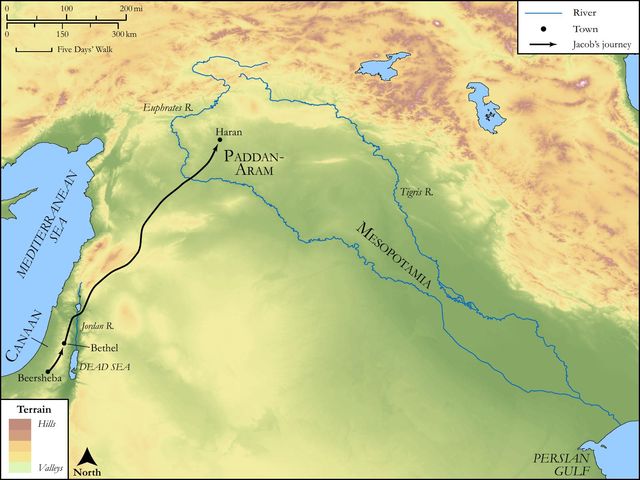
This verse immediately follows Jacob's arduous journey from Beersheba, fleeing his brother Esau, and his transformative encounter with God at Bethel, as detailed in Genesis 28:10-22. The narrative then shifts to Jacob's arrival in Haran, where he first encounters Rachel at a well (Genesis 29:1-12). Laban, Rachel's father, hears of Jacob's arrival and identity, prompting the enthusiastic welcome described in this verse. This reception sets the stage for Jacob's twenty years of service and family formation in Laban's household, a period marked by both blessing and significant familial strife.
Historical & Cultural Context
In Laban's household, kinship ties were paramount, and hospitality was a sacred duty, especially towards a close relative who had traveled a great distance. Laban's actions—running, embracing, and kissing—were customary and deeply meaningful gestures of welcome, signifying acceptance, familial recognition, and the provision of refuge. The "tidings" Laban heard would have included not only Jacob's arrival but also his identity as Rebekah's son, establishing his legitimate claim to kinship and the expectation of welcome and protection within the family compound. Such hospitality was not merely politeness but a vital social contract ensuring safety and provision for travelers.
Key Themes
ShowHideGenesis 29:13 contributes to several overarching themes within the book of Genesis. It highlights Divine Providence, demonstrating God's faithfulness in guiding Jacob to his destination and the family line through which the covenant promises would continue, despite Jacob's earlier deceptions and flight. The verse also underscores the Importance of Kinship and Hospitality in the family of Abraham, setting a cultural expectation that will later be both upheld and exploited by Laban. Furthermore, it marks a New Beginning for Jacob, signaling the transition from his solitary journey to a period of family formation and the eventual growth of the twelve tribes, thus ensuring Covenantal Continuity as promised to Abraham in Genesis 12:1-3.
Exposition and Analysis
ShowHideKey Word Analysis
ShowHideThis word implies more than just passive hearing; it suggests an intelligent reception of information, often with an implication of attention or even obedience. In this context, Laban didn't just hear a sound; he received and processed the "tidings" (H8088, shêmaʻ), understanding the significance of Jacob's identity and arrival. This active hearing prompts his immediate and decisive response.
This primitive root means "to clasp (the hands or in embrace)." It denotes a physical act of holding someone close, signifying affection, welcome, and intimate familial connection. Laban's embrace of Jacob was a powerful, non-verbal affirmation of their kinship and his acceptance of Jacob into his household, a gesture of profound warmth and recognition.
This versatile word means "a word," but by implication, it can refer to a "matter," "thing," "affair," or "report." Here, "all these things" refers to the comprehensive narrative Jacob recounted to Laban. This would have included his flight from Esau, his dream at Bethel and God's promises, and the purpose of his journey to find a wife among their kin. It signifies a full disclosure, establishing the basis for their relationship.
Verse Breakdown
ShowHide"And it came to pass, when Laban heard the tidings of Jacob his sister's son"
This opening clause establishes the catalyst for Laban's actions. The "tidings" (Hebrew: shema) would have been a report confirming Jacob's identity as Rebekah's son, a close blood relative, and likely the circumstances of his arrival. The emphasis on "his sister's son" highlights the strong familial bond that immediately obligated Laban to act.
"that he ran to meet him, and embraced him, and kissed him, and brought him to his house."
This series of rapid, active verbs vividly portrays Laban's enthusiastic and immediate response. "He ran to meet him" signifies eagerness and a desire to close the distance quickly. The subsequent actions of embracing and kissing were deeply personal and customary expressions of affection and welcome among close relatives, as when Esau ran to meet Jacob and embraced him, conveying warmth, acceptance, and a sense of belonging. Finally, "brought him to his house" completed the act of hospitality, formally inviting Jacob into his home, providing him with shelter, safety, and a place of rest after his long and arduous journey.
"And he told Laban all these things."
Upon entering Laban's home, Jacob reciprocated the welcome by sharing his story. "All these things" likely encompassed his flight from Esau, his transformative encounter with God at Bethel where divine promises were reaffirmed (Genesis 28:12-15), and the purpose of his journey to find a wife from his mother's family. This act of sharing his personal narrative was crucial for establishing trust and understanding, laying the groundwork for their complex and often challenging future relationship.
Literary Devices
ShowHideThe verse effectively employs Polysyndeton through the repeated use of the conjunction "and" ("and ran... and embraced... and kissed... and brought... And he told..."). This creates a sense of rapid succession and emphasizes the immediate, continuous, and enthusiastic nature of Laban's actions. The vivid description of Laban's physical gestures—running, embracing, kissing—uses strong Imagery to convey the warmth of the initial welcome. Furthermore, the verse subtly employs Foreshadowing and Dramatic Irony. While the immediate scene depicts genuine familial warmth, the reader, aware of Laban's later manipulative character (e.g., Genesis 29:25) and the ensuing conflicts, perceives an underlying tension. The initial effusive welcome stands in stark contrast to the difficult relationship that will unfold, hinting at the complexities of human nature and familial bonds.
Theological and Thematic Connections
ShowHideGenesis 29:13, while seemingly a simple narrative of welcome, is deeply interwoven with the broader theological tapestry of God's unfolding plan. Jacob's safe arrival in Haran, after a journey fraught with uncertainty and the weight of his past deceptions, serves as a powerful testament to God's unwavering providence and faithfulness. Despite Jacob's flaws, God actively guides him to the very place where he will find his wives and begin to raise the twelve sons who will form the tribes of Israel, thus ensuring the continuity of the Abrahamic covenant. This moment underscores that God's promises are not contingent on human perfection but are sovereignly fulfilled through His steadfast commitment to His chosen lineage, even using the ordinary circumstances of human relationships to advance His divine purposes.
Reflection and Application
ShowHideGenesis 29:13 offers a poignant lesson on the enduring significance of hospitality and the profound impact of a warm, genuine welcome. Laban's immediate and demonstrative actions—running to meet Jacob, embracing, kissing, and bringing him into his home—set a powerful example of how we are called to receive others, especially those who are weary, vulnerable, or in need of refuge. This initial welcome provided Jacob with much-needed solace and a sense of belonging after his long and solitary journey, underscoring the spiritual and emotional nourishment that true hospitality can offer. However, the subsequent narrative in Genesis subtly reminds us that while first impressions are vital and sincere hospitality is a virtue, they do not always reveal the full depth of a person's character or future intentions. For believers, this verse challenges us to extend Christ-like welcome to all, while also exercising discernment, recognizing that human relationships, even within families, can be complex and require wisdom, grace, and forgiveness.
Questions for Reflection
ShowHideFAQ
ShowHideWhy was Laban so eager to meet Jacob, especially given his later manipulative character?
ShowHideLaban's initial eagerness, demonstrated by his running, embracing, and kissing Jacob, stemmed from a combination of strong cultural norms and personal interest. Primarily, Jacob was his sister Rebekah's son, a close blood relative. Among the kin of Abraham and Nahor, kinship ties were extremely strong, and extending immediate, effusive hospitality to a kinsman, especially one who had traveled a great distance, was a paramount duty and honor. This was a public demonstration of familial loyalty and protection. Additionally, Jacob's "tidings" (H8088, shêmaʻ) likely included not only his identity but also the story of his family's wealth (even though Jacob himself was fleeing with little) and perhaps even a hint of the divine promises made to him at Bethel (Genesis 28:12-15). Laban, a shrewd and opportunistic individual, may have quickly perceived the potential for benefit from this connection, even as his genuine familial affection was also present in that initial moment. The later manipulative actions of Laban, as seen in Genesis 29:25 and Genesis 31:7, reveal a complex character whose initial warmth was unfortunately not sustained by consistent integrity.
Christ-Centered Fulfillment
ShowHideWhile Genesis 29:13 depicts a human act of familial welcome, it subtly foreshadows the ultimate divine welcome offered through Jesus Christ. Jacob's safe arrival at Laban's house, despite his past deceptions and the arduous journey, underscores God's providential care in preserving the lineage through whom the Messiah would ultimately come (Galatians 3:16). Just as Jacob found a temporary home and rest after his weary travels, believers find their ultimate welcome, rest, and security in Christ. He is the perfect Host who runs to meet us, embraces us in His love, and brings us into the eternal "house" of God (John 14:2-3). Unlike Laban, whose initial warmth eventually gave way to manipulation, Christ's welcome is unfailing, unconditional, and eternally true. He fulfills all the promises of God, providing a permanent spiritual dwelling and a secure place within the family of God for all who come to Him, transforming strangers into beloved children and co-heirs (Ephesians 2:19).