


Genesis 29:14
Bible text: King James Version (1769 Blayney text) · Public domain
Bible text: Berean Standard Bible · Public domain
Bible text: American Standard Version (1901) · Public domain
Bible text: World English Bible, Messianic edition · Public domain
Bible text: Geneva Bible (1599) · Public domain
Bible text: Young's Literal Translation · Public domain
- וַיֹּאמֶרvai·Yo·merand he saidH559Conj-w ¦ V-Qal-ConsecImperf-3msVerb Qal Consecutive Imperfect 3rd Singular Masculineוַandיֹּאמֶרhe said
- לוֹloto <the> himPrep-l ¦ 3msSuffix Personal 3rd Singular Masculineלto <the>וֹhim
- לָבָןla·VanLabanH3837N-proper-mNoun Proper Masculine
- אַךְ'akhsurelyH389AdvAdverb
- עַצְמִי'atz·Mi[are] my boneH6106N-fsc ¦ 1csNoun Singular Feminine Constructעַצְמִ[are] boneיmy
- וּבְשָׂרִיu·ve·sa·Riand my fleshH1320Conj-w ¦ N-msc ¦ 1csNoun Singular Masculine Constructוּandבְשָׂרִfleshיmy
- אָתָּה'A·tahyouH859Pro-2msPronoun Personal 2nd Singular Masculine
- וַיֵּשֶׁבvai·Ye·shevand he remainedH3427Conj-w ¦ V-Qal-ConsecImperf-3msVerb Qal Consecutive Imperfect 3rd Singular Masculineוַandיֵּשֶׁבhe remained
- עִמּוֹi·Mowith himH5973Prep ¦ 3msPreposition Definiteעִמּwithוֹhim
- חֹדֶשׁCho·desha month ofH2320N-mscNoun Singular Masculine Construct
- יָמִיםya·MimdaysH3117N-mpNoun Plural Masculine Absolute
English is a literal word-by-word gloss of the Hebrew, not the KJV's wording. Why?
This is the original text the KJV's translators worked from — each Hebrew word with its own literal English meaning in this verse, prepared by scholars at Tyndale House, Cambridge. The KJV translates whole sentences, not word by word, so its wording differs: one Hebrew word can become several English words, and the KJV may choose “the LORD” where the gloss reads “Yahweh”. Both are faithful — they answer different questions. For the KJV's own rendering, switch to the KJV text.
Details
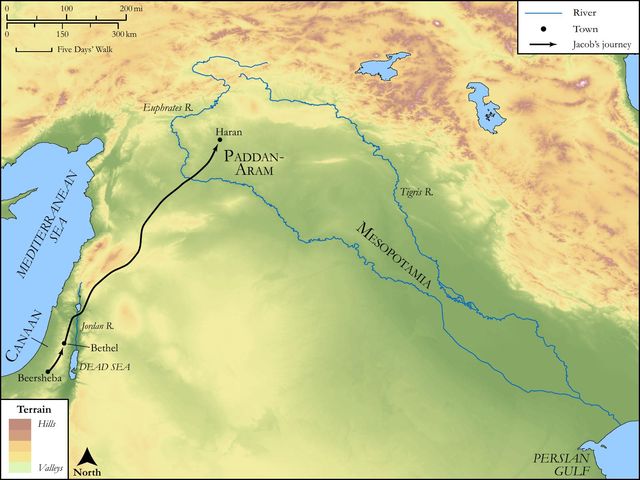
See on the biblical-era maps


Study this verse
Public-domain commentary
Matthew Henry
From his Commentary on the Whole Bible. Henry comments on passages, not single verses — this entry covers Genesis 29:9–14.
Here we see, 1. Rachel's humility and industry: She kept her father's sheep (Gen 29:9), that is, she took the care of them, having servants under her that were employed about them. Rachel's name signifies a sheep. Note, Honest useful labour is that which nobody needs be ashamed of, nor ought it to be a hindrance to any one's preferment. 2. Jacob's tenderness and affection. When he understood that this was his kinswoman (probably he had heard of her name before), knowing what his errand was into that country, we may suppose it struck his mind immediately that his must be his wife. Being already smitten with her ingenuous comely face (though it was probably sun-burnt, and she was in the homely dress of a shepherdess), he is wonderfully officious, and anxious to serve her (Gen 29:10), and addresses himself to her with tears of joy and kisses of love, Gen 29:11. She runs with all haste to tell her father; for she will by no means entertain her kinsman's address without her father's knowledge and approbation, Gen 29:12. These mutual respects, at their first interview, were good presages of their being a happy couple. 3. Providence made that which seemed contingent and fortuitous to give speedy satisfaction to Jacob's mind, as soon as ever he came to the place which he was bound for. Abraham's servant, when he came upon a similar errand, met with similar encouragement. Thus God guides his people with his eye, Psa 32:8. It is a groundless conceit which some of the Jewish writers have, that Jacob, when he kissed Rachel, wept because he had been set upon in his journey by Eliphaz the eldest son of Esau, at the command of his father, and robbed of all his money and jewels, which his mother had given him when she sent him away. It was plain that it was his passion for Rachel, and the surprise of this happy meeting, that drew these tears from his eyes. 4. Laban, though none of the best-humoured men, bade him welcome, was satisfied in the account he gave of himself, and of the reason of his coming in such poor circumstances. While we avoid the extreme, on the one hand, of being foolishly credulous, we must take heed of falling into the other extreme, of being uncharitably jealous and suspicious. Laban owned him for his kinsman: Thou art my bone and my flesh, Gen 29:14. Note, Those are hard-hearted indeed that are unkind to their relations, and that hide themselves from their own flesh, Isa 58:7.
Continue studying Genesis 29:14 across the web’s major study libraries — every link below opens this exact verse, chapter, or book on the destination site.
Read & Compare
 BibleGatewayThis verse in more than 200 translations and 70 languages.
 Bible.comThe YouVersion reader — hundreds of translations, reading plans, and highlights.
 ESV.orgCrossway's official English Standard Version reader.
 NET BibleThe NET translation with 60,000+ translators' notes on every rendering decision.
 STEP BibleTyndale House's free study tool — original text, vocabulary, and scholarly resources.
 BibliaLogos Bible Software's free web reader.
 USCCBThe New American Bible (Revised Edition) with the U.S. bishops' study notes.
Commentaries
 BibleHub CommentariesDozens of classic commentaries on this verse, gathered on one page.
 StudyLightMore than 100 commentary sets — the largest collection on the web.
 BibleRefPlain-English commentary on what this verse means, verse by verse.
 Enduring WordDavid Guzik's free commentary on this chapter, widely used by Bible teachers.
 Bible Study ToolsVerse commentary alongside Greek and Hebrew study aids.
Original Language & Research
- BibleHub InterlinearThe verse word by word — original language, transliteration, and English.
- BibleHub LexiconEvery word's original-language definition and Strong's entry.
 Blue Letter BibleDeep-study tools — Strong's numbers, concordance, and word studies.
 SefariaThe Hebrew text with Rashi and centuries of Jewish commentary.
Sermons, Hymns & Audio


TrulyRandomVerse is not affiliated with these sites and doesn’t control their content. They’re linked because they’re genuinely useful.
Summary
Genesis 29:14 records Laban's immediate and familial recognition of Jacob, declaring him "my bone and my flesh," an ancient idiom signifying deep kinship and shared identity. This warm welcome provided Jacob with an initial, temporary refuge for a month, establishing the groundwork for his extended residence in Haran and demonstrating God's providential care for him following his flight from Esau.
Context
ShowHideLiterary Context
This verse immediately follows Jacob's dramatic arrival in Haran, where he encounters his cousin Rachel at a well and, in a display of strength and eagerness, rolls the stone from the well's mouth to water her flock (Genesis 29:10). Rachel, in turn, rushes to inform her father, Laban, of Jacob's arrival and their familial connection. Laban's subsequent declaration and hospitality in verse 14 serve as the initial response to this reunion, setting the stage for Jacob's long and often tumultuous sojourn in Paddan-Aram, which will involve marriage, the birth of his children, and significant conflict with Laban over wages and flocks, ultimately leading to Jacob's departure (Genesis 31).
Historical & Cultural Context
In Hebrew thought, kinship ties were paramount, forming the bedrock of social structure, identity, and security. The phrase "bone and flesh" was a powerful and common idiom to express the closest possible blood relationship and mutual belonging, often implying obligations of hospitality, protection, and support. When a kinsman arrived, especially after a long journey, immediate welcome and provision were expected. The "space of a month" served as a customary period of initial hospitality and assessment, during which the host and guest would evaluate character, needs, and potential for a more permanent arrangement, such as employment or marriage, before formalizing any long-term agreements. This practice reflects the importance of honor, reputation, and reciprocal duties within the patriarchal society.
Key Themes
ShowHideGenesis 29:14 contributes to several overarching themes within the book of Genesis. It highlights the theme of God's Providence and Faithfulness, demonstrating how God guides Jacob to his kinsmen, providing refuge despite Jacob's vulnerable state as a fugitive from Esau's wrath (Genesis 27:41-45). The verse also introduces the theme of Kinship and Family Dynamics, which will be central to Jacob's narrative, showcasing both the blessings and complexities inherent in familial relationships, especially as the narrative unfolds to reveal Laban's deceptive nature (Genesis 29:20-30). Furthermore, it subtly touches upon the theme of Hospitality and Covenant Obligations, as Laban's initial welcome, though later tainted, aligns with the societal expectation of providing shelter and care to one's own.
Exposition and Analysis
ShowHideKey Word Analysis
ShowHideFrom עָצַם; a bone (as strong); by extension, the body; figuratively, the substance, i.e. (as pron.) selfsame. In this context, "bone" signifies the very core or essence of a person's physical being and, by extension, their fundamental identity and shared lineage. It speaks to an undeniable, intrinsic connection.
From בָּשַׂר; flesh (from its freshness); by extension, body, person. "Flesh" complements "bone" to complete the picture of a shared physical and biological heritage. Together, "bone and flesh" form a powerful merism, emphasizing the totality of a person's being and their absolute consanguinity.
A primitive root; properly, to sit down; by implication, to dwell, to remain; causatively, to settle. This verb denotes a period of dwelling or settling, indicating that Jacob did not merely visit but took up residence. The duration "the space of a month" suggests a temporary, probationary stay before a more permanent arrangement was established, reflecting ancient customs of hospitality and assessment.
Verse Breakdown
ShowHide"And Laban said to him, Surely thou art my bone and my flesh."
This opening declaration from Laban is a profound statement of recognition and kinship. The adverb "Surely" (Hebrew, ʼak') emphasizes the certainty and conviction of Laban's assertion. By calling Jacob "my bone and my flesh," Laban employs a powerful Hebrew idiom that signifies the closest possible blood relationship. It is a declaration of consanguinity, meaning "you are truly my family," "you are one of us," or "you are intrinsically connected to me by blood." This phrase communicates immediate acceptance, a shared identity, and implies the social and moral obligations of care and protection that come with such a deep familial bond.
"And he abode with him the space of a month."
This second clause describes Jacob's immediate action following Laban's welcome. Jacob "abode" or "dwelt" with Laban for a period of "a month." This duration was a common cultural practice for initial hospitality, allowing both host and guest to assess the situation, understand each other's character, and determine the feasibility of a longer-term arrangement, such as employment or a more permanent residency. This temporary stay provided Jacob with essential refuge and a period of rest after his arduous journey, demonstrating God's immediate provision for him.
Literary Devices
ShowHideThe most prominent literary device in this verse is Idiom. The phrase "my bone and my flesh" is a powerful Hebrew idiom for the closest possible blood relationship and shared identity. It is used elsewhere in scripture to denote deep kinship, as when Adam recognizes Eve as "bone of my bones, and flesh of my flesh" (Genesis 2:23), or when the tribes of Israel affirm their loyalty to David by saying, "Behold, we are thy bone and thy flesh" (2 Samuel 5:1). This idiom emphasizes the profound importance of familial ties in patriarchal society. Additionally, there is subtle Foreshadowing in the brevity of the "month-long" initial stay. While the welcome is warm, the subsequent narrative reveals the complex and often deceptive relationship that will unfold between Jacob and Laban, suggesting that this initial period of assessment will not lead to a simple, straightforward kinship, but one fraught with tension and manipulation.
Theological and Thematic Connections
ShowHideGenesis 29:14 underscores the enduring significance of family and kinship within God's redemptive plan, even amidst human brokenness. Laban's declaration of Jacob as "my bone and my flesh" highlights the foundational role of bloodlines in the covenant narrative, as God's promises to Abraham were passed down through specific family lines. This initial welcome, despite the future deceptions, serves as a testament to God's faithful providence, guiding Jacob to a place of refuge and family, fulfilling His promise to be with him and watch over him. It reminds us that God often works through human relationships, even imperfect ones, to accomplish His divine purposes.
Reflection and Application
ShowHideGenesis 29:14 offers profound insights into the human need for belonging and the enduring importance of family and community. Laban's immediate recognition of Jacob as "my bone and my flesh" speaks to a deep, innate desire within us to be accepted, to find our place within a larger group, and to experience the security that comes from shared identity. In a world that often promotes individualism and can feel increasingly fragmented, this verse calls us to actively cultivate and cherish our connections, particularly within our families and the broader community of faith. It reminds us of the biblical imperative for hospitality, urging us to open our homes and hearts to those in need, offering refuge and support, especially to fellow believers who are "bone of our bone and flesh of our flesh" in Christ. However, the subsequent narrative with Laban also serves as a crucial reminder that while initial welcomes are vital, true character and trustworthiness are revealed over time, prompting us to exercise discernment and wisdom even within trusted relationships, just as Jacob learned through his challenging experiences with Laban's deceptions.
Questions for Reflection
ShowHideFAQ
ShowHideWhat is the significance of Laban calling Jacob "my bone and my flesh"?
ShowHideThe phrase "my bone and my flesh" is a powerful Hebrew idiom signifying the closest possible blood relationship and shared identity. It is a declaration of consanguinity, meaning "you are truly my family," "you are one of us," or "you are intrinsically connected to me by blood." This expression emphasizes deep kinship, mutual belonging, and often implies obligations of care and protection. It highlights Laban's immediate recognition of Jacob as a genuine kinsman, deserving of hospitality and inclusion within his household, setting the stage for Jacob's extended stay in Haran.
Christ-Centered Fulfillment
ShowHideWhile Jacob found temporary refuge and kinship with Laban, a relationship that ultimately proved imperfect and fraught with deception, the ultimate and perfect belonging is found in Christ. He is our true "bone and flesh," having fully identified with humanity by taking on human form, being "made in the likeness of men" (Philippians 2:7). Through His incarnation, Christ became truly one of us, sharing in our humanity so that He might redeem us from sin and death (Hebrews 2:14-17). In Him, we are not merely welcomed for a month, but are adopted into God's eternal family, becoming "fellow citizens with the saints and members of the household of God" (Ephesians 2:19). This spiritual kinship in Christ far surpasses any earthly bond, offering an everlasting home, unwavering provision, and perfect faithfulness, fulfilling God's promise to be with His people in a way that no human relationship, like that between Jacob and Laban, ever could.