


1 Samuel 2:36
Bible text: King James Version (1769 Blayney text) · Public domain
Bible text: King James Version with Strong's numbers · Public domain
Bible text: Berean Standard Bible · Public domain
Bible text: American Standard Version (1901) · Public domain
Bible text: World English Bible, Messianic edition · Public domain
Bible text: Geneva Bible (1599) · Public domain
Bible text: Young's Literal Translation · Public domain
- וְהָיָהve·ha·Yahand it will beH1961Conj-w ¦ V-Qal-ConsecPerf-3msVerb Qal Consecutive Perfect 3rd Singular Masculineוְandהָיָהit will be
- כָּלkoleveryH3605N-msNoun Singular Masculine Absolute
- הַנּוֹתָרha·no·Tar<the> [one who] remainsH3498Art ¦ V-Niphal-Prtcpl-msVerb Niphal Participle Singular Masculine Absoluteהַ<the>נּוֹתָר[one who] remains
- בְּבֵיתְךָbe·Vei·te·khain your houseH1004Prep-b ¦ N-msc ¦ 2msNoun Singular Masculine Constructבְּinבֵיתְhouseךָyour
- יָבוֹאya·Vo'he will comeH935V-Qal-Imperf-3msVerb Qal Imperfect 3rd Singular Masculine
- לְהִשְׁתַּחֲוֹתle·hish·ta·cha·Votto bow downH7812Prep-l ¦ V-Hishtaphel-InfVerb Hishtaphel Infinitive Constructלְtoהִשְׁתַּחֲוֹתbow down
- לוֹloto <the> himPrep-l ¦ 3msSuffix Personal 3rd Singular Masculineלto <the>וֹhim
- לַאֲגוֹרַתla·'a·Go·ratfor a payment ofH95Prep-l ¦ N-fscNoun Singular Feminine Constructלַforאֲגוֹרַתa payment of
- כֶּסֶףKe·sefsilverH3701N-msNoun Singular Masculine Absolute
- וְכִכַּרve·khi·karand a round loaf ofH3603Conj-w ¦ N-fscNoun Singular Feminine Constructוְandכִכַּרa round loaf of
- לָחֶםLa·chembreadH3899N-msNoun Singular Masculine Absolute
- וְאָמַרve·'a·Marand he will sayH559Conj-w ¦ V-Qal-ConsecPerf-3msVerb Qal Consecutive Perfect 3rd Singular Masculineוְandאָמַרhe will say
- סְפָחֵנִיse·fa·Che·niattach meH5596V-Qal-Imp-2ms ¦ 1csVerb Qal Imperative 2nd Singular Masculineסְפָחֵattachנִיme
- נָאna'pleaseH4994PrtParticle Interjection
- אֶל'eltoH413PrepPreposition
- אַחַת'a·Chatone ofH259N-fscNoun Singular Feminine Construct
- הַכְּהֻנּוֹתha·ke·hu·Notthe priesthoodsH3550Art ¦ N-fpNoun Plural Feminine Absoluteהַtheכְּהֻנּוֹתpriesthoods
- לֶאֱכֹלle·'e·Kholto eatH398Prep-l ¦ V-Qal-InfVerb Qal Infinitive Constructלֶtoאֱכֹלeat
- פַּתpata piece ofH6595N-fscNoun Singular Feminine Construct
- לָחֶםLa·chembreadH3899N-msNoun Singular Masculine Absolute
English is a literal word-by-word gloss of the Hebrew, not the KJV's wording. Why?
This is the original text the KJV's translators worked from — each Hebrew word with its own literal English meaning in this verse, prepared by scholars at Tyndale House, Cambridge. The KJV translates whole sentences, not word by word, so its wording differs: one Hebrew word can become several English words, and the KJV may choose “the LORD” where the gloss reads “Yahweh”. Both are faithful — they answer different questions. For the KJV's own rendering, switch to the KJV text.
Details
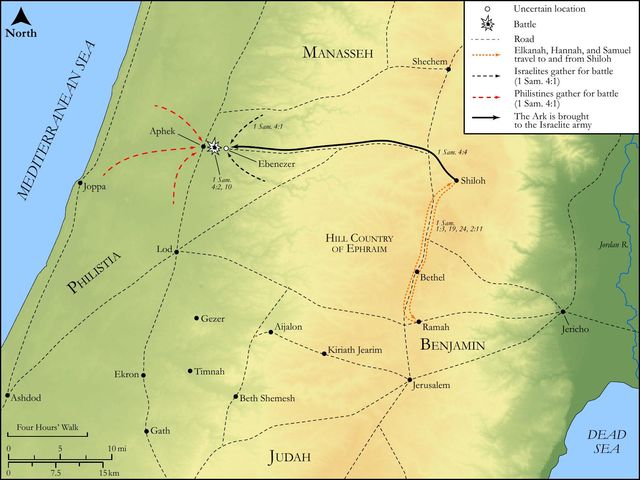
See on the biblical-era map
Study this verse
Public-domain commentary
Matthew Henry
From his Commentary on the Whole Bible. Henry comments on passages, not single verses — this entry covers 1 Samuel 2:27–36. His three-level outline is real structure in the source text, so it is rendered as structure.
Eli reproved his sons too gently, and did not threaten them as he should, and therefore God sent a prophet to him to reprove him sharply, and to threaten him, because, by his indulgence of them, he had strengthened their hands in their wickedness. If good men be wanting in their duty, and by their carelessness and remissness contribute any thing to the sin of sinners, they must expect both to hear of it and to smart for it. Eli's family was now nearer to God than all the families of the earth, and therefore he will punish them, Amo 3:2. The message is sent to Eli himself, because God would bring him to repentance and save him; not to his sons, whom he had determined to destroy. And it might have been a means of awakening him to do his duty at last, and so to have prevented the judgment, but we do not find it had any great effect upon him. The message this prophet delivers from God is very close.
I.He reminds him of the great things God had done for the house of his fathers and for his family.
He appeared to Aaron in Egypt (Exo 4:27), in the house of bondage, as a token of further favour which he designed for him, Sa1 2:27. He advanced him to the priesthood, entailed it upon his family, and thereby dignified it above any of the families of Israel. He entrusted him with honourable work, to offer on God's altar, to burn incense, and to wear that ephod in which was the breast-plate of judgment. He settled upon him an honourable maintenance, a share out of all the offerings made by fire, Sa1 2:28. What could he have done more for them, to engage them to be faithful to him? Note, The distinguishing favours we have received from God, especially those of the spiritual priesthood, are great aggravations of sin, and will be remembered against us in the day of account, if we profane our crown and betray our trusts, Deu 32:6; Sa2 12:7, Sa2 12:8.
II.He exhibits a high charge against him and his family.
His children did wickedly, and he connived at it, and thereby involved himself in the guilt; the indictment therefore runs against them all, Sa1 2:29.
1.His sons had impiously profaned the holy things of God: "You kick at my sacrifice which I have commanded; not only trample upon the institution as a mean thing, but spurn at it as a thing you hate to be tied up to." They did the utmost despite imaginable to the offerings of the Lord when they committed all that outrage and rapine about them that we read of, and violently plundered the pots on which, in effect, Holiness to the Lord was written (Zac 14:20), and took that fat to themselves which God had appointed to be burnt on his altar.
2.Eli had bolstered them up in it, by not punishing their insolence and impiety: "Thou for thy part honourest thy sons above me," that is, "thou hadst rather see my offerings disgraced by their profanation of them than see thy sons disgraced by a legal censure upon them for so doing, which ought to have been inflicted, even to suspension and deprivation ab officio et beneficio - of their office and its emoluments." Those that allow and countenance their children in any evil way, and do not use their authority to restrain and punish them, do in effect honour them more than God, being more tender of their reputation than of his glory and more desirous to humour them than to honour him.
3.They had all shared in the gains of the sacrilege. It is to be feared that Eli himself, though he disliked and reproved the abuses they committed, yet did not forbear to eat of the roast meat they sacrilegiously got, Sa1 2:15. He was a fat heavy man (Sa1 4:18), and therefore it is charged upon the whole family (though Hophni and Phinehas were principally guilty), You make yourselves fat with the chief of all the offerings. God gave them sufficient to feed them, but that would not suffice; they made themselves fat, and served their lusts with that which God was to be served with. See Hos 4:8.
III.He declares the cutting off of the entail of the high priesthood from his family (Sa1 2:30):
"The Lord God of Israel, who is jealous for his own honour and Israel's, says, and lets thee know it, that thy commission is revoked and superseded." I said, indeed, that thy house, and the house of thy father Ithamar (for from that younger son of Aaron Eli descended), should walk before me for ever. Upon what occasion the dignity of the high priesthood was transferred from the family of Eleazar to that of Ithamar does not appear; but it seems this had been done, and Eli stood fair to have that honour perpetuated to his posterity. But observe, the promise carried its own condition along with it: They shall walk before me forever, that is, "they shall have the honour, provided they faithfully do the service." Walking before God is the great condition of the covenant, Gen 17:1. Let them set me before their face, and I will set them before my face continually (Psa 41:12), otherwise not. But now the Lord says, Be it far from me. "Now that you cast me off you can expect no other than that I should cast you off; you will not walk before me as you should, and therefore you shall not." Such wicked and abusive servants God will discard, and turn out of his service. Some think there is a further reach in this recall of the grant, and that it was not only to be fulfilled shortly in the deposing of the posterity of Eli, when Zadok, who descended from Eleazar, was put in Abiathar's room, but it was to have its complete accomplishment at length in the total abolition of the Levitical priesthood by the priesthood of Christ.
IV.He gives a good reason for this revocation, taken from a settled and standing rule of God's government, according to which all must expect to be dealt with (like that by which Cain was tried, Gen 4:7): Those that honour me I will honour, and those that despise me shall be lightly esteemed.
1.Observe in general,
(1.)That God is the fountain of honour and dishonour; he can exalt the meanest and put contempt upon the greatest.
(2.)As we deal with God we must expect to be dealt with by him, and yet more favourably than we deserve. See Psa 18:25, Psa 18:26.
2.Particularly,
(1.)Be it spoken, to the everlasting reputation of religion or of serious godliness, that it gives honour to God and puts honour upon men. By it we seek and serve the glory of God, and he will be behind-hand with none that do so, but here and hereafter will secure their glory. The way to be truly great is to be truly good. If we humble and deny ourselves in any thing to honour God, and have a single eye to him in it, we may depend upon this promise, he will put the best honour upon us. See Joh 12:26.
(2.)Be it spoken, to the everlasting reproach of impiety or profaneness, that this does dishonour to God (despises the greatest and best of beings, whom angels adore) and will bring dishonour upon men, for those that do so shall be lightly esteemed; not only God will lightly esteem them (that perhaps they will not regard, as those that honour him value his honour, of whom therefore it is said, I will honour them), but they shall be lightly esteemed by all the world; the very honour they are proud of shall be laid in the dust; they shall see themselves despised by all mankind, their names a reproach; when they are gone, their memory shall rot, and, when they rise again, it shall be to everlasting shame and contempt. The dishonour which their impotent malice puts upon God and his omnipotent justice will return upon their own heads, Psa 79:12.
V.He foretels the particular judgments which should come upon his family, to its perpetual ignominy.
A curse should be entailed upon his posterity, and a terrible curse it is, and shows how jealous God is in the matters of his worship and how ill he takes it when those who are bound by their character and profession to preserve and advance the interests of his glory are false to their trust, and betray them. If God's ministers be vicious and profane, of how much sorer punishment will they be thought worthy, here and for ever, than other sinners! Let such read the doom here passed on Eli's house, and tremble. It is threatened,
1.That their power should be broken (Sa1 2:31): I will cut off thy arm, and the arm of thy father's house. They should be stripped of all their authority, should be deposed, and have no influence upon the people as they had had. God would make them contemptible and base. See Mal 2:8, Mal 2:9. The sons had abused their power to oppress the people and encroach upon their rights, and the father had not used his power, as he ought to have done, to restrain and punish them, and therefore it was justly threatened that the arm should be cut off which was not stretched out as it should have been.
2.That their lives should be shortened. He was himself an old man; but instead of using the wisdom, gravity, experience, and authority of his age, for the service of God and the support of religion, he had suffered the infirmities of age to make him more cool and remiss in his duty, and therefore it is here threatened that none of his posterity should live to be old, Sa1 2:31, Sa1 2:32. It is twice spoken: "There shall not be an old man in thy house for ever;" and again (Sa1 2:33), "All the increase of thy house, from generation to generation, shall die in the flower of their age, when they are in the midst of the years of their service," so that though the family should not be extinct, yet it should never be considerable, nor should any member of it come to be eminent in his day. Bishop Patrick relates, out of some of the Jewish writers, that long after this, there being a family in Jerusalem none of which commonly lived above eighteen years, upon search it was found that they descended from the house of Eli, on which this sentence was passed.
3.That all their comforts should be embittered.
(1.)The comfort they had in the sanctuary, in its wealth and prosperity: Thou shalt see an enemy in my habitation. This was fulfilled in the Philistines' invasions and the mischiefs they did to Israel, by which the country was impoverished (Sa1 13:19), and no doubt the priests' incomes were thereby very much impaired. The captivity of the ark was such an act of hostility committed upon God's habitation as broke Eli's heart. As it is a blessing to a family to see peace upon Israel (Psa 128:5, Psa 128:6), so the contrary is a sore judgment upon a family, especially a family of priests.
(2.)The comfort of their children: "The man of thine whom I shall not cut off by an untimely death shall live to be a blot and burden to the family, a scandal and vexation to his relations; he shall be to consume thy eyes and grieve thy heart, for his foolishness or his sickliness, his wickedness or his poverty." Grief for a dead child is great, but for a bad child often greater.
4.That their substance should be wasted and they should be reduced to extreme poverty (Sa1 2:36): "He that is left alive in thy house shall have little joy of his life, for want of a livelihood; he shall come and crouch to the succeeding family for a subsistence." (1.) He shall beg for the smallest alms - a piece of silver (and the word signifies the least piece) and a morsel of bread. See how this answered the sin. Eli's sons must have the best pieces of flesh, but their sons will be glad of a morsel of bread. Note, Want is the just punishment of wantonness. Those who could not be content without dainties and varieties are brought, they or theirs, to want necessaries, and the Lord is righteous in thus visiting them. (2.) He shall beg for the meanest office: Put me into somewhat belonging to the priesthood (as it is in the original); make me as one of the hired servants, the fittest place for a prodigal. Plenty and power are forfeited when they are abused. They should not be able to pretend to any good preferment, not to any place at the altar, but should petition for some poor employment, be the work ever so hard and the wages ever so small, so they might but get bread. This, it is probable, was fully accomplished when Abiathar, who was of Eli's race, was deposed by Solomon for treason, and he and his turned out of office in the temple (Kg1 2:26, Kg1 2:27), by which it is easy to think his posterity were reduced to the extremities here described.
5.That God would shortly begin to execute these judgments in the death of Hophni and Phinehas, the sad tidings of which Eli himself should live to hear: This shall be a sign to thee, Sa1 2:34. When thou hearest it, say, "Now the word of God begins to operate; here is one threatening fulfilled, from which I infer that all the rest will be fulfilled in their order." Hophni and Phinehas had many a time sinned together, and it is here foretold that they should die together both in one day. Bind these tares in a bundle for the fire. This was fulfilled, Sa1 4:11.
VI.In the midst of all these threatenings against the house of Eli, here is mercy promised to Israel (v. 35): I will raise me up a faithful priest.
1.This was fulfilled in Zadoc, of the family of Eleazar, who came into Abiathar's place in the beginning of Solomon's reign, and was faithful to his trust; and the high priests were of his posterity as long as the Levitical priesthood continued. Note, The wickedness of ministers, though it destroy themselves, yet it shall not destroy the ministry. How bad soever the officers are, the office shall continue always to the end of the world. If some betray their trust, yet others shall be raised up that will be true to it. God's work shall never fall to the ground for want of hands to carry it on. The high priest is here said to walk before God's anointed (that is, David and his seed) because he wore the breast-plate of judgment, which he was to consult, not in common cases, but for the king, in the affairs of state. Note, Notwithstanding the degeneracy we see and lament in many families, God will secure to himself a succession. If some grow worse than their ancestors, others, to balance that, shall grow better.
2.It has its full accomplishment in the priesthood of Christ, that merciful and faithful high priest whom God raised up when the Levitical priesthood was thrown off, who in all things did his father's mind, and for whom God will build a sure house, build it on a rock, so that the gates of hell cannot prevail against it.
Historical interpretation
Historical reception
2 surviving comments on this verse. Each one is dated, so this reads as a timeline rather than a list.
It will happen, however, that whoever remains in your house, etc. And some daily not only from the priestly, but also from every tribe of Israel, and all at the end of the world the remnants of that nation, so that they may be reconciled to God, come to the church; and, rejecting the flesh of the sacrifices, they offer the word consummating and shortening of the life-giving confession, and the bread of spiritual sacrifice. For indeed silver signifies the word of the confession of faith, and the coin expresses the brevity of the same confession, which is contained in the Creed. And this man of God, who is shown to be a prophet by his office, said: Whoever remains in your house, which is what Isaiah said: The remnant shall be saved. (Rom. XII). And the apostle, recalling the words of Elijah: So therefore, he says, also at this time there is a remnant according to the election of grace that has been saved (Isa. XI).
And let him say, Let me go, I pray, to one of the priestly parts. It signifies to the very people, illustrious to Christ the priest; to whom Peter says: But you are a chosen race, a royal priesthood (I Pet. II). And as he adds: That I may eat a morsel of bread, he also elegantly expressed the very kind of that sacrifice, concerning which the priest himself says: The bread which I will give is my flesh for the life of the world (John VI). For since he had said above, giving food to the house of Aaron from the sacrifices of the Old Testament, which were the sacrifices of the Jews, therefore he said here: One must ask to eat a morsel of bread, which is the sacrifice of Christians in the New Testament.
Continue studying 1 Samuel 2:36 across the web’s major study libraries — every link below opens this exact verse, chapter, or book on the destination site.
Read & Compare
 BibleGatewayThis verse in more than 200 translations and 70 languages.
 Bible.comThe YouVersion reader — hundreds of translations, reading plans, and highlights.
 ESV.orgCrossway's official English Standard Version reader.
 NET BibleThe NET translation with 60,000+ translators' notes on every rendering decision.
 STEP BibleTyndale House's free study tool — original text, vocabulary, and scholarly resources.
 BibliaLogos Bible Software's free web reader.
 USCCBThe New American Bible (Revised Edition) with the U.S. bishops' study notes.
Commentaries
 BibleHub CommentariesDozens of classic commentaries on this verse, gathered on one page.
 StudyLightMore than 100 commentary sets — the largest collection on the web.
 BibleRefPlain-English commentary on what this verse means, verse by verse.
 Enduring WordDavid Guzik's free commentary on this chapter, widely used by Bible teachers.
 Bible Study ToolsVerse commentary alongside Greek and Hebrew study aids.
Original Language & Research
- BibleHub InterlinearThe verse word by word — original language, transliteration, and English.
- BibleHub LexiconEvery word's original-language definition and Strong's entry.
 Blue Letter BibleDeep-study tools — Strong's numbers, concordance, and word studies.
 SefariaThe Hebrew text with Rashi and centuries of Jewish commentary.
Sermons, Hymns & Audio


TrulyRandomVerse is not affiliated with these sites and doesn’t control their content. They’re linked because they’re genuinely useful.
Summary
1 Samuel 2:36 delivers the devastating culmination of divine judgment against the house of Eli, the high priest, prophesying a future of abject destitution and profound humiliation for his surviving descendants. Due to the egregious unfaithfulness and corruption of his sons, Hophni and Phinehas, the once-privileged and divinely appointed priestly lineage will be reduced to desperate begging for the most meager sustenance, seeking even the lowest and most menial priestly tasks not out of devotion or calling, but purely out of a desperate need for food. This verse powerfully illustrates the profound and irreversible reversal of fortune for a family that once held a position of immense honor, spiritual authority, and material provision, serving as a stark and enduring warning about the severe consequences of despising the Lord's name and neglecting sacred spiritual duties.
Context
ShowHideLiterary Context
This verse provides the climactic and most poignant detail of the divine judgment pronounced against Eli's house by an unnamed "man of God" in 1 Samuel 2:27-36. The prophecy begins by recounting God's steadfast covenant faithfulness to Eli's ancestors (Aaron) and the unparalleled privilege bestowed upon his family, sharply contrasting it with Eli's profound failure to honor God above his own sons (1 Samuel 2:29). The preceding verses meticulously detail the specific consequences of this spiritual negligence: the cutting off of Eli's strength, the simultaneous death of his two wicked sons on the same day (1 Samuel 2:34), and the promise of God raising up a "faithful priest" who will execute His will (1 Samuel 2:35). Verse 36 then vividly paints the picture of the lingering shame, poverty, and utter degradation that will afflict the remaining members of Eli's line, providing a concrete and heart-wrenching image of their fallen state and the complete reversal of their former glory.
Historical & Cultural Context
In ancient Israel, the priesthood was a divinely ordained, hereditary office, specifically assigned to the descendants of Aaron from the tribe of Levi. Priests were indispensable mediators between God and the people, responsible for offering sacrifices, teaching the Law, maintaining the tabernacle (and later the temple), and discerning God's will. Their livelihood was guaranteed by divine decree through tithes and specific portions of the sacrifices, ensuring they could dedicate themselves fully to their sacred duties without worldly distraction (e.g., Numbers 18:8-20). Eli's family, as the high priestly line serving at Shiloh, enjoyed immense prestige, spiritual authority, and substantial material provision. The prophecy in 1 Samuel 2:36 directly contradicts and shatters this established norm, depicting a future where their descendants, once entitled to a comfortable and honorable living from sacred offerings, would be reduced to the lowest form of destitution, begging for basic necessities and any menial priestly task, highlighting a complete and humiliating reversal of their once-privileged and esteemed status.
Key Themes
ShowHideThis verse powerfully contributes to the overarching theme of Divine Justice and Retribution in 1 Samuel, demonstrating God's unwavering commitment to holding His covenant people, especially their leaders, accountable for their actions and spiritual integrity. It underscores the profound severity of Despising God's Name and Sacred Things, as Eli's sons did by treating the Lord's offerings with utter contempt and engaging in immoral behavior (1 Samuel 2:12-17). The theme of Reversal of Fortune is prominently displayed, as a family once guaranteed a perpetual priesthood and ample provision is prophesied to experience extreme poverty, humiliation, and the loss of their sacred calling. Furthermore, this passage subtly introduces the theme of God's Sovereignty in Raising Up and Pulling Down Leaders, as the catastrophic downfall of Eli's house paves the way for the rise of a "faithful priest" (1 Samuel 2:35), foreshadowing the shift in priestly authority and ultimately pointing towards Samuel's righteous leadership and the future Davidic monarchy.
Exposition and Analysis
ShowHideKey Word Analysis
ShowHideThis verb (שָׁחָה, H7812) typically means "to bow down," "to prostrate oneself," or "to do obeisance." It is frequently employed in contexts of worship, profound respect, and humble submission (e.g., Genesis 24:48). In 1 Samuel 2:36, its application is deeply ironic and tragic. Instead of bowing in worship to God or receiving honor and reverence from the people, Eli's descendants will be compelled to humble themselves in a demeaning posture of begging, symbolizing their utter loss of dignity, authority, and self-sufficiency. It signifies a complete and humiliating reversal of their former esteemed position, reduced to a state of abject subservience.
This term (אֲגוֹרָה, H95) refers to a very small, minimal amount of currency, akin to a single coin or a tiny fragment of silver. Its inclusion here emphasizes the extreme poverty and desperation of Eli's descendants. They will not be seeking a comfortable living or substantial payment for their services, but literally the smallest possible monetary unit, highlighting their dire need and the complete collapse of their family's once-guaranteed material provision. This detail underscores their reduction to begging for mere survival, far from the abundance they once enjoyed.
This noun (לֶחֶם, H3899) signifies food in general, but most commonly refers to bread, the staple of the ancient Israelite diet. The phrase "a morsel of bread" (with H3603 kikkâr for "morsel") further highlights the abject hunger and the basic, fundamental nature of their need. Their plea for priestly office is not for spiritual devotion or fulfilling their sacred calling, but purely for the most basic physical sustenance. This reveals the depth of their degradation and the complete collapse of their family's former status and sacred purpose, reducing the once-honored priesthood to a mere means of warding off starvation.
Verse Breakdown
ShowHide"And it shall come to pass, [that] every one that is left in thine house shall come [and] crouch to him for a piece of silver and a morsel of bread,"
This opening clause establishes the absolute certainty and inevitability of the prophecy ("it shall come to pass") and details the future state of Eli's surviving descendants. "Every one that is left" implies a remnant, suggesting that many will have already perished as part of the initial judgment. Their action of "crouching" to "him" (referring to the faithful priest mentioned in 1 Samuel 2:35) signifies deep humiliation, subservience, and a loss of all former dignity. The motivation for this abject posture is the desperate need for "a piece of silver and a morsel of bread," emphasizing their extreme poverty and complete dependence on others for basic sustenance, a stark and ironic contrast to the ample priestly provision they once enjoyed.
"and shall say, Put me, I pray thee, into one of the priests' offices,"
This clause reveals the specific plea of Eli's impoverished descendants. Their request to be "put... into one of the priests' offices" is not born of a desire to serve God, fulfill their ancestral calling, or uphold the sanctity of the priesthood, but rather out of a pragmatic and desperate need for livelihood. The phrase "I pray thee" underscores their position of supplication, powerlessness, and utter lack of leverage. They are reduced to begging for any available position, no matter how menial or undignified, within the very institution their family once led with great honor and authority.
"that I may eat a piece of bread."
This concluding phrase lays bare the singular and stark motivation behind their plea for priestly service. Their desire is not for spiritual fulfillment, divine honor, or the performance of sacred duties, but simply to "eat a piece of bread." This highlights the ultimate degradation of their once-sacred office, which has been reduced in their eyes to a mere means of survival. It powerfully encapsulates the profound consequences of their family's spiritual decay and the divine judgment that stripped them not only of their dignity and provision but also of the very purpose and meaning of their inherited calling.
Literary Devices
ShowHideThe passage in 1 Samuel 2:36 employs several potent literary devices to convey its message of divine judgment, reversal, and profound degradation. Irony is central to the verse, as the descendants of a high priestly family, once guaranteed ample provision and honor through their sacred office, are reduced to begging for scraps and seeking the lowest priestly positions solely for physical sustenance. Their "crouching" is an ironic inversion of the reverence and worship typically associated with the priestly office, now a posture of desperate supplication. Symbolism is powerfully evident in the "piece of silver and a morsel of bread," which symbolize not just extreme poverty, but the complete loss of their sacred inheritance, the stripping away of their divine provision, and the reduction of their spiritual calling to mere physical survival. The act of "crouching" itself symbolizes their utter humiliation, subservience, and the complete collapse of their former status. Furthermore, the passage uses Foreshadowing, as the prophecy of Eli's house being brought low sets the stage for the rise of a new, faithful priesthood, ultimately fulfilled in Zadok's line and pointing towards a greater, perfect priest. The vivid imagery also creates a strong sense of Pathos, evoking pity for the tragic fate of a once-noble lineage.
Theological and Thematic Connections
ShowHide1 Samuel 2:36 serves as a powerful testament to God's unwavering justice and His intolerance for spiritual corruption, particularly among those entrusted with sacred leadership and high office. It underscores the profound biblical principle that privilege does not exempt one from accountability; rather, greater privilege often entails greater responsibility and a higher standard of faithfulness. The severe judgment on Eli's house demonstrates that God honors those who honor Him, but those who despise Him will be lightly esteemed (1 Samuel 2:30). This verse highlights the devastating, long-term consequences of neglecting one's spiritual duties, failing to discipline sin within one's sphere of influence, and treating sacred things with contempt. It also reveals God's absolute sovereignty in orchestrating the rise and fall of leaders and dynasties, ensuring that His divine purposes are ultimately fulfilled through faithful servants, even if it necessitates the removal of unfaithful ones. The abject state of Eli's descendants emphasizes that true spiritual authority, lasting blessing, and genuine provision come solely from God's favor and faithfulness, not from inherited status, human privilege, or mere lineage.
Reflection and Application
ShowHideThe stark and haunting image of Eli's descendants begging for a piece of bread and a menial priestly office offers a sobering and profound reflection for all believers, particularly those who hold positions of spiritual leadership or influence within the church or their communities. It serves as a powerful reminder that God is not mocked, and while His patience is vast, His justice is certain and unwavering. Our service to God must always be motivated by genuine devotion, reverence, and a pure heart, never by personal gain, comfort, status, or worldly ambition. The integrity of our lives, both public and private, and our unwavering commitment to upholding righteousness and holiness within our families, churches, and broader communities, are paramount. Eli's tragic failure to restrain his sons and honor God above them resulted in a devastating and enduring legacy for his entire lineage. This narrative calls us to a deep examination of our own lives: are we truly honoring God above all else? Are we diligent and courageous in addressing sin and upholding truth, even when it is difficult, uncomfortable, or unpopular? The pursuit of spiritual office, influence, or ministry should always be for the glory of God, the advancement of His kingdom, and the genuine benefit and spiritual nourishment of His people, never for self-preservation, material sustenance, or personal aggrandizement.
Questions for Reflection
ShowHideFAQ
ShowHideWhat does "crouch to him for a piece of silver and a morsel of bread" truly signify about their condition?
ShowHideThis phrase vividly portrays the extreme destitution and profound humiliation of Eli's surviving descendants. "Crouching" (Hebrew: shâchâh) implies a posture of deep submission, begging, or even prostration, far removed from the dignity and authority once associated with their high priestly lineage. It signifies they are reduced to a state of utter powerlessness and dependency, stripped of all former honor. The "piece of silver" (H95, ʼăgôwrâh') and "morsel of bread" (H3603, kikkâr, and H3899, lechem) represent the absolute minimum needed for survival, emphasizing their abject poverty and desperate hunger. They are not seeking a comfortable living or a return to their former status, but merely enough to ward off starvation. This detail underscores the complete and humiliating reversal of fortune and the severity of divine judgment, where those once sustained by the Lord's offerings are now begging for scraps from those who have replaced them. It highlights that their once-sacred office has become nothing more than a desperate means to secure basic physical sustenance, completely devoid of its spiritual purpose and sacred calling. This is a powerful illustration of the consequences of despising the Lord, as clearly stated in 1 Samuel 2:30.
Christ-Centered Fulfillment
ShowHideThe judgment against Eli's house in 1 Samuel 2:36, culminating in the promise of a "faithful priest" in 1 Samuel 2:35, finds its ultimate and perfect fulfillment in the person and work of Jesus Christ. While the immediate historical fulfillment was likely Zadok, who replaced Abiathar (a descendant of Eli) as high priest, the complete and eternal priesthood belongs to Christ alone. Unlike the Levitical priests, who were fallible, sinful, and subject to death and judgment, Jesus is our perfect, sinless, and eternal High Priest, described as "holy, innocent, unstained, separated from sinners, and exalted above the heavens" (Hebrews 7:26). He did not serve for a "piece of bread" or a "morsel of bread" but offered Himself as the true "bread of life" (John 6:35) and the ultimate, once-for-all sacrifice, providing eternal sustenance, forgiveness, and abundant life for all who believe. The destitution and humiliation prophesied for Eli's line stand in stark contrast to the immeasurable spiritual riches and abundant provision found in Christ, who is the source of all spiritual blessings in the heavenly places (Ephesians 1:3). Through His one perfect sacrifice and His unchangeable priesthood, Jesus has established a new covenant, ensuring that those who come to God through Him will never "crouch" in spiritual hunger, humiliation, or desperation, but will find full, eternal satisfaction and glorious access to God's presence (Hebrews 7:24-25).