


1 Samuel 3:1
Bible text: King James Version (1769 Blayney text) · Public domain
Bible text: Berean Standard Bible · Public domain
Bible text: American Standard Version (1901) · Public domain
Bible text: World English Bible, Messianic edition · Public domain
Bible text: Geneva Bible (1599) · Public domain
Bible text: Young's Literal Translation · Public domain
- וְהַנַּעַרve·ha·Na·'arand the ladH5288Conj-w ¦ Art ¦ N-msNoun Singular Masculine Absoluteוְandהַtheנַּעַרlad
- שְׁמוּאֵלshe·mu·'ElSamuelH8050N-proper-mNoun Proper Masculine
- מְשָׁרֵתme·sha·Ret[was] servingH8334V-Piel-Prtcpl-msVerb Piel Participle Singular Masculine Absolute
- אֶת'et<obj.>H853DirObjMParticle Object Indicator
- יְהוָהYah·wehYahwehH3068N-properNoun Proper Title
- לִפְנֵיlif·Nei<to> beforeH6440Prep-l ¦ N-mpcNoun Plural Masculine Constructלִ<to>פְנֵיbefore
- עֵלִי'e·LiEliH5941N-proper-mNoun Proper Masculine
- וּדְבַרu·de·varand [the] word ofH1697Conj-w ¦ N-mscNoun Singular Masculine Constructוּandדְבַר[the] word of
- יְהוָהYah·wehYahwehH3068N-properNoun Proper Title
- הָיָהha·Yahit wasH1961V-Qal-Perf-3msVerb Qal Perfect 3rd Singular Masculine
- יָקָרya·KarrareH3368Adj-msAdjective Singular Masculine Absolute
- בַּיָּמִיםbai·ya·Mimin the daysH3117Prep-b ¦ N-mpNoun Plural Masculine Absoluteבַּin theיָּמִיםdays
- הָהֵםha·Hem<the> thoseH1992Art ¦ Pro-3mpPronoun Personal 3rd Plural Masculineהָ<the>הֵםthose
- אֵין'einnotH369N-mscNoun Singular Masculine Construct
- חָזוֹןcha·ZonvisionH2377N-msNoun Singular Masculine Absolute
- נִפְרָץnif·Ratz[was] spread outH6555V-Niphal-Prtcpl-msVerb Niphal Participle Singular Masculine Absolute
English is a literal word-by-word gloss of the Hebrew, not the KJV's wording. Why?
This is the original text the KJV's translators worked from — each Hebrew word with its own literal English meaning in this verse, prepared by scholars at Tyndale House, Cambridge. The KJV translates whole sentences, not word by word, so its wording differs: one Hebrew word can become several English words, and the KJV may choose “the LORD” where the gloss reads “Yahweh”. Both are faithful — they answer different questions. For the KJV's own rendering, switch to the KJV text.
Details
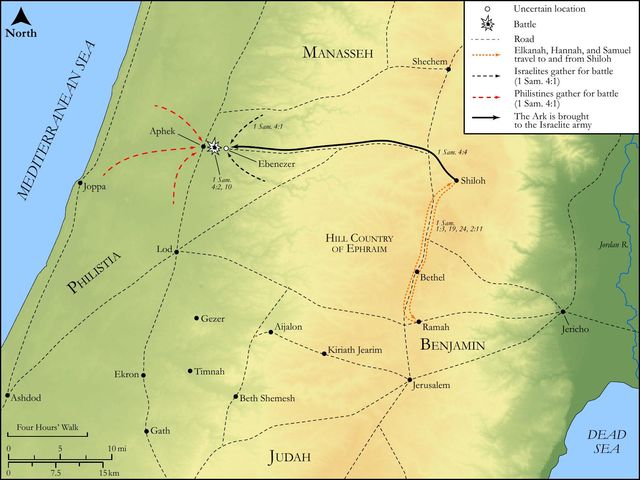
See on the biblical-era map
Study this verse
Public-domain commentary
Matthew Henry
From his Commentary on the Whole Bible. Henry comments on passages, not single verses — this entry covers 1 Samuel 3:1–10. His three-level outline is real structure in the source text, so it is rendered as structure.
To make way for the account of God's revealing himself first to Samuel, we are here told, 1. How industrious Samuel was in serving God, according as his place and capacity were (Sa1 3:1): The child Samuel, though but a child, ministered unto the Lord before Eli. It was an aggravation of the wickedness of Eli's sons that the child Samuel shamed them. They rebelled against the Lord, but Samuel ministered to him; they slighted their father's admonitions, but Samuel was observant of them; he ministered before Eli, under his eye and direction. It was the praise of Samuel that he was so far from being influenced by their bad example that he did not in the least fall off, but improved and went on. And it was a preparative for the honours God intended him; he that was thus faithful in a little was soon after entrusted with much more. Let those that are young be humble and diligent, which they will find the surest way to preferment. Those are fittest to rule who have learnt to obey. 2. How scarce a thing prophecy then was, which made the call of Samuel to be the greater surprise to himself and the greater favour to Israel: The word of the Lord was precious in those days. Now and then a man of God was employed as a messenger upon an extraordinary occasion (as Sa1 2:27), but there were no settled prophets, to whom the people might have recourse for counsel, nor from whom they might expect the discoveries of the divine will. And the rarity of prophecy made it the more precious in the account of all those that knew how to put a right value upon it. It was precious, for what there was (it seems) was private: There was no open vision, that is, there were none that were publicly known to have visions. Perhaps the impiety and impurity that prevailed in the tabernacle, and no doubt corrupted the whole nation, had provoked God, as a token of his displeasure, to withdraw the Spirit of prophecy, till the decree had gone forth for the raising up of a more faithful priest, and then, as an earnest of that, this faithful prophet was raised up.
The manner of God's revealing himself to Samuel is here related very particularly, for it was uncommon.
I.Eli had retired.
Samuel had waited on him to his bed, and the rest that attended the service of the sanctuary had gone, we may suppose, to their several apartments (Sa1 3:2): Eli had laid down in his place; he went to bed betimes, being unfit for business and soon weary of it, and perhaps loving his ease too well. Probably he kept his chamber much, which gave his sons the greater liberty. And he sought retirement the more because his eyes began to wax dim, an affliction which came justly upon him for winking at his sons' faults.
II.Samuel had laid down to sleep, in some closet near to Eli's room, as his page of the back-stairs, ready within call if the old man should want any thing in the night, perhaps to read to him if he could not sleep. He chose to take Samuel into this office rather than any of his own family, because of the towardly disposition he observed in him. When his own sons were a grief to him, his little servitor was his joy. Let those that are afflicted in their children thank God if they have any about them in whom they are comforted. Samuel had laid down ere the lamp of God went out, Sa1 3:3. It should seem he lay somewhere so near the holy place that he went to bed by that light, before any of the lamps in the branches of the candlestick went out (for the main lamp never went out), which probably was towards midnight. Till that time Samuel had been employing himself in some good exercise or other, reading and prayer, or perhaps cleaning or making ready the holy place; and then went softly to his bed. Then we may expect God's gracious visits, when we are constant and diligent in our duty.
III.God called him by name, and he took it for Eli's call, and ran to him, Sa1 3:4, Sa1 3:5.
Samuel lay awake in his bed, his thoughts, no doubt, well employed (as David's Psa 63:6), when the Lord called to him, bishop Patrick thinks out of the most holy place, and so the Chaldee paraphrase reads it, A voice was heard out of the temple of the Lord; but Eli, though it is likely he lay nearer, heard it not; yet possibly it might come some other way. Hereupon we have an instance,
1.Of Samuel's industry, and readiness to wait on Eli; supposing it was he that called him, he hastened out of his warm bed and ran to him, to see if he wanted any thing, and perhaps fearing he was not well. "Here am I," said he - a good example to servants, to come when they are called; and to the younger, not only to submit to the elder, but to be careful and tender of them.
2.Of his infirmity, and unacquaintedness with the visions of the Almighty, that he took that to be only Eli's call which was really the call of God. Such mistakes as these we make oftener than we think of. God calls to us by his word, and we take it to be only the call of the minister, and answer it accordingly; he calls to us by his providences, and we look only at the instruments. His voice cries, and it is but here and there a man of wisdom that understands it to be his voice. Eli assured him he did not call him, yet did not chide him for disturbing him with being over-officious, did not call him a fool, and tell him he dreamed, but mildly bade him lie down again, he had nothing for him to do. If servants must be ready at their masters' call, masters also must be tender of their servants' comfort: that thy man-servant and thy maid-servant may rest as well as thou. So Samuel went and lay down. God calls many by the ministry of the word, and they say, as Samuel did, "Here am I;" but not looking at God, nor discerning his voice in the call, the impressions of it are soon lost; they lie down again, and their convictions come to nothing.
IV.The same call was repeated, and the same mistake made, a second and third time, Sa1 3:6-9.
1.God continued to call the child yet again (Sa1 3:6), and again the third time, Sa1 3:8. Note, The call which divine grace designs to make effectual shall be repeated till it is so, that is, till we come at the call; for the purpose of God, according to which we are called, shall certainly stand.
2.Samuel was still ignorant that it was the Lord that called him (Sa1 3:7): Samuel did not yet know the Lord. He knew the written word, and was acquainted with the mind of God in that, but he did not yet apprehend the way in which God reveals himself to his servants the prophets, especially by a still small voice; this was altogether new and strange to him. Perhaps he would have been sooner aware of a divine revelation had it come in a dream or a vision; but this was a way he had not only not known himself, but not heard of. Those that have the greatest knowledge of divine things must remember the time when they were as babes, unskilful in the word of righteousness. When I was a child I understood as a child. Yet let us not despise the day of small things. Thus did Samuel (so the margin reads it) before he knew the Lord, and before the word of the Lord was revealed unto him; thus he blundered one time after another, but afterwards he understood his duty better. The witness of the Spirit in the hearts of the faithful is often thus mistaken, by which means they lose the comfort of it; and the strivings of the Spirit with the consciences of sinners are likewise often mistaken, and so the benefit of their convictions is lost. God speaketh once, yea, twice, but man perceiveth it not, Job 33:14.
3.Samuel went to Eli this second and third time, the voice perhaps resembling his, and the child being very near to him; and he tells Eli, with great assurance, "Thou didst call me (Sa1 3:6-8), it could be no one else." Samuel's disposition to come when he was called, though but by Eli, proving him dutiful and active, qualified him for the favour now to be shown him; God chooses to employ such. But there was a special providence in it, that he should go thus often to Eli; for hereby, at length, Eli perceived that the Lord had called the child, Sa1 3:8. And,
(1.)This would be a mortification to him, and he would apprehend it to be a step towards his family's being degraded, that when God had something to say he should choose to say it to the child Samuel, his servant that waited on him, and not to him. And it would humble him the more when afterwards he found it was a message to himself, and yet sent to him by a child. He had reason to look upon this as a further token of God's displeasure.
(2.)This would put him upon enquiring what it was that God said to Samuel, and would abundantly satisfy him of the truth and certainty of what should be delivered, and no room would be left for him to suggest that it was but a fancy of Samuel's; for before the message was delivered he himself perceived that God was about to speak to him, and yet must not know what it was till he had it from Samuel himself. Thus even the infirmities and mistakes of those whom God employs are overruled by infinite Wisdom, and made serviceable to his purposes.
V.At length Samuel was put into a posture to receive a message from God, not to be lodged with himself and go no further, but, that he might be a complete prophet, to be published and made an open vision.
1.Eli, perceiving that it was the voice of God that Samuel heard, gave him instructions what to say, Sa1 3:9. This was honestly done, that though it was a disgrace to him for God's call to pass him by, and be directed to Samuel, yet he put him in the way how to entertain it. Had he been envious of this honour done to Samuel, he would have done what he could to deprive him of it, and, since he did not perceive it himself, would have bidden him lie down and sleep, and never heed it, it was but a dream; but he was of a better spirit than to act so; he gave him the best advice he could, for the forwarding of his advancement. Thus the elder should, without grudging, do their utmost to assist and improve the younger that are rising up, though they see themselves likely to be darkened and eclipsed by them. Let us never be wanting to inform and instruct those that are coming after us, even such as will soon be preferred before us, Joh 1:30. The instruction Eli gave him was, when God called the next time, to say, Speak, Lord, for they servant heareth. He must call himself God's servant, must desire to know the mind of God. "Speak, Lord, speak to me, speak now:" and he must prepare to hear, and promise to attend: Thy servant heareth. Note, Then we may expect that God will speak to us, when we set ourselves to hearken to what he says, Psa 85:8; Hab 2:1. When we come to read the word of God, and to attend on the preaching of it, we should come thus disposed, submitting ourselves to the commanding light and power of it: Speak, Lord, for thy servant heareth.
2.It should seem that God spoke the fourth time in a way somewhat different from the other; though the call was, as at other times, a call to him by name, yet now he stood and called, which intimates that there was now some visible appearance of the divine glory to Samuel, a vision that stood before him, like that before Eliphaz, though he could not discern the form thereof, Job 4:16. This satisfied him that it was not Eli that called; for he now saw the voice that spoke with him, as it is expressed, Rev 1:12. Now also the call was doubled - Samuel, Samuel, as if God delighted in the mention of his name, or to intimate that now he should be made to understand who spoke to him. God hath spoken once, twice have I heard this, Psa 62:11. It was an honour to him that God was pleased to know him by name (Exo 33:12), and then his call was powerful and effectual when he called him by name, and so brought it particularly to him, as Saul, Saul. Thus God called to Abraham by name, Gen 22:1.
3.Samuel said, as he was taught, Speak, for thy servant heareth. Note, Good words should be put into children's mouths betimes, and apt expressions of pious and devout affections, by which they may be prepared for a better acquaintance with divine things, and trained up to a holy converse with them. Teach young people what they shall say, for they cannot order their speech by reason of darkness. Samuel did not now rise and run as before when he thought Eli called, but lay still and listened. The more sedate and composed our spirits are the better prepared they are for divine discoveries. Let all tumultuous thoughts and passions be kept under, and every thing be quiet and serene in the soul, and then we are fit to hear from God. All must be silent when he speaks. But observe, Samuel left out one word; he did not say, Speak, Lord, but only, Speak, for thy servant heareth, way was made for the message he was now to receive, and Samuel was brought acquainted with the words of God and visions of the Almighty, and this ere the lamp of God went out (Sa1 3:3) in the temple of the Lord, which some of the Jewish writers put a mystical sense upon; before the fall of Eli, and the eclipsing of the Urim and Thummim for some time thereby, God called Samuel, and made him an oracle, whence they have an observation among their doctors, That the sun riseth, and the sun goeth down (Ecc 1:5), that is, say they, Ere God maketh the sun of one righteous man to set, he makes the sun of another righteous man to rise. Smith ex Kimchi.
Historical interpretation
Ten Centuries of Reception
2 surviving comments on this verse. Each one is dated, so this reads as a timeline rather than a list.
Select a marker to jump to its quote. Markers stagger vertically where authors wrote within a few decades of each other.
But the boy Samuel was ministering to the Lord in the presence of Eli, etc. The boy who was born to us in the flesh, in the sight of the Jewish priests, was ministering his gifts to the early Church both personally and through his evangelizing disciples. And the word of the Lord was rare at that time, precious because of its rarity, for the harvest was indeed plentiful, but the workers were few (Matthew 9). Nor was there a Pharisee, Scribe, or priest who could unlock the hidden visions and the manifest sayings of the prophets for the people with exposition.
Precious: That is, rare.
Continue studying 1 Samuel 3:1 across the web’s major study libraries — every link below opens this exact verse, chapter, or book on the destination site.
Read & Compare
 BibleGatewayThis verse in more than 200 translations and 70 languages.
 Bible.comThe YouVersion reader — hundreds of translations, reading plans, and highlights.
 ESV.orgCrossway's official English Standard Version reader.
 NET BibleThe NET translation with 60,000+ translators' notes on every rendering decision.
 STEP BibleTyndale House's free study tool — original text, vocabulary, and scholarly resources.
 BibliaLogos Bible Software's free web reader.
 USCCBThe New American Bible (Revised Edition) with the U.S. bishops' study notes.
Commentaries
 BibleHub CommentariesDozens of classic commentaries on this verse, gathered on one page.
 StudyLightMore than 100 commentary sets — the largest collection on the web.
 BibleRefPlain-English commentary on what this verse means, verse by verse.
 Enduring WordDavid Guzik's free commentary on this chapter, widely used by Bible teachers.
 Bible Study ToolsVerse commentary alongside Greek and Hebrew study aids.
Original Language & Research
- BibleHub InterlinearThe verse word by word — original language, transliteration, and English.
- BibleHub LexiconEvery word's original-language definition and Strong's entry.
 Blue Letter BibleDeep-study tools — Strong's numbers, concordance, and word studies.
 SefariaThe Hebrew text with Rashi and centuries of Jewish commentary.
Sermons, Hymns & Audio


TrulyRandomVerse is not affiliated with these sites and doesn’t control their content. They’re linked because they’re genuinely useful.
Summary
1 Samuel 3:1 introduces a period of profound spiritual scarcity in Israel, marked by a rare and highly valued divine word and a notable absence of widespread prophetic vision. This verse not only establishes the dire spiritual climate under Eli's high priesthood but also subtly highlights the unique position of the young Samuel, who faithfully ministered in the Tabernacle, setting the stage for God's dramatic intervention to break the spiritual silence through him and usher in a new era of prophetic revelation.
Context
ShowHideLiterary Context
This verse serves as a pivotal transition within the book of 1 Samuel, strategically placed to set the stage for Samuel's divine call. It immediately follows a detailed and damning account of the moral corruption of Eli's sons, Hophni and Phinehas, who "disregarded the LORD" and shamelessly profaned the sacrifices at the Tabernacle, even engaging in sexual immorality at the entrance of the tent of meeting (1 Samuel 2:12-17 and 1 Samuel 2:22). This depravity stands in stark contrast to the repeated affirmations of Samuel's faithful service and growth "before the LORD" (1 Samuel 2:11, 1 Samuel 2:18-21, 1 Samuel 2:26). The preceding chapter also includes a prophetic word against Eli's house (1 Samuel 2:27-36), foretelling its demise due to their unfaithfulness. The declaration in 1 Samuel 3:1 that "there was no open vision" thus creates a profound narrative tension, signaling God's intention to raise a new prophetic voice to replace the failing priestly line, which unfolds dramatically in the subsequent verses with God's direct call to Samuel (1 Samuel 3:2-14).
Historical & Cultural Context
The events of 1 Samuel are situated within the tumultuous period of the Judges, a time characterized by spiritual and political instability where "everyone did what was right in his own eyes" (Judges 21:25). Shiloh served as the central sanctuary where the Tabernacle, housing the Ark of the Covenant, was located, making it the primary spiritual and religious hub for Israel. Eli, as the high priest, held immense spiritual and judicial authority, embodying the spiritual state of the nation. However, the pervasive corruption within the priesthood, as vividly detailed in 1 Samuel 2, reflected a broader decline in faithfulness to the Mosaic covenant among the people. In ancient Israel, "vision" and "word of the LORD" were primary and authoritative modes of divine communication, indicating direct prophetic revelation and guidance. The scarcity of such revelation, explicitly stated in 1 Samuel 3:1, pointed to a deep spiritual malaise and suggested that God's direct voice was withheld due to the nation's unfaithfulness, creating a profound spiritual vacuum and a desperate need for divine intervention.
Key Themes
ShowHideThis verse powerfully introduces and reinforces several pivotal themes that permeate the book of 1 Samuel. Firstly, it highlights Spiritual Scarcity and Divine Silence, explicitly stating that "the word of the LORD was precious in those days; there was no open vision." This indicates a period of profound spiritual drought where direct prophetic guidance from God was exceedingly rare, contrasting sharply with later periods of abundant prophecy. Secondly, it underscores Faithfulness Amidst Corruption, as the "child Samuel ministered unto the LORD before Eli" despite the pervasive spiritual darkness and the escalating wickedness of Eli's own sons and the broader national apostasy. This sets Samuel apart as a unique and pure vessel whom God would choose to break the silence. Finally, the verse masterfully builds Anticipation for New Revelation. The declaration of "no open vision" creates a compelling narrative tension, foreshadowing God's imminent and dramatic intervention to initiate a new era of prophetic activity through Samuel, marking a divine turning point in Israel's history, where Samuel would become a recognized prophet throughout the land (1 Samuel 3:19-21).
Exposition and Analysis
ShowHideKey Word Analysis
ShowHideThis verb, derived from a primitive root meaning "to attend as a menial or worshipper," signifies dedicated service, attendance, or waiting upon, often in a sacred or priestly context. For the "child Samuel," it emphasizes his active, devoted, and unique role in religious duties within the Tabernacle, setting him apart from the general population and, crucially, from Eli's corrupt sons. It suggests a heart prepared and positioned for divine communication.
This adjective, meaning "valuable (objectively or subjectively)," denotes something rare, costly, or highly esteemed due to its scarcity. When applied to "the word of the LORD," it does not imply that God's word was inherently difficult to understand, but rather that its direct, prophetic manifestation—clear divine utterances and revelations—was infrequent and therefore highly sought after, like a rare and valuable gem. It powerfully underscores the spiritual famine of revelation prevalent in that era.
This noun, derived from a root meaning "to gaze" or "to behold," refers to a sight (mentally), specifically a dream, revelation, or oracle, typically indicating direct prophetic communication from God. The phrase "no open vision" (with "open" derived from pârats, meaning "to break out" or "to spread abroad") conveys that prophetic revelation was not common, clear, or breaking through the spiritual atmosphere in a public and frequent manner. It signifies a lack of authoritative divine communication and clear prophetic direction for the nation, highlighting a period of spiritual silence from God.
Verse Breakdown
ShowHide"And the child Samuel ministered unto the LORD before Eli."
This opening clause immediately establishes Samuel's context and character. Despite his youth (the Hebrew term naʻar can refer to a boy from infancy to adolescence), Samuel was actively engaged in sacred service at the Tabernacle in Shiloh, under the nominal supervision of Eli. This highlights Samuel's early dedication and spiritual purity, positioning him in stark contrast to the spiritual decay surrounding him, particularly the corrupt practices of Eli's own sons. Samuel's faithful and humble service uniquely prepared him for God's direct address.
"And the word of the LORD was precious in those days;"
This phrase describes the prevailing spiritual climate of the era. It signifies a period when direct, authoritative communication from God—prophetic utterances, divine instructions, or clear guidance—was exceedingly rare. The "preciousness" of God's word was a direct consequence of its scarcity, indicating a spiritual drought or a divine withholding of revelation, likely due to the unfaithfulness of the priesthood and the broader nation. It conveys a deep spiritual hunger for God's voice.
"[there was] no open vision."
This final clause reinforces and clarifies the preceding statement, providing the reason for the "preciousness" of God's word. It means that prophetic visions, which were a common and expected means of divine revelation in Israel, were not widespread, clear, or publicly accessible (the Hebrew for "open" implies breaking forth or spreading). The spiritual channels for God's direct communication seemed closed, leaving the people without clear divine direction or understanding of God's will. This profound spiritual silence created a desperate need that God was about to address through Samuel.
Literary Devices
ShowHideThe verse employs several potent literary devices to convey its profound message. Juxtaposition is central, contrasting the faithful and dedicated "child Samuel ministered unto the LORD" with the pervasive spiritual decline of the nation, epitomized by the scarcity of divine revelation and the corruption of Eli's household. This contrast highlights Samuel's unique purity and receptivity amidst a spiritually barren landscape. Foreshadowing is also prominent; the declaration of "no open vision" immediately creates a powerful expectation for God to break this silence, which He dramatically does in the subsequent verses through His direct, audible call to Samuel. There is a subtle irony in that the very place where God's word should be most accessible and abundant—the Tabernacle under the high priest—is precisely where it is most "precious" or rare, underscoring the profound failure of the established religious leadership. Finally, the phrase "the word of the LORD was precious" functions as a metaphor, likening divine revelation to a rare and valuable commodity, underscoring its scarcity and the spiritual hunger it created.
Theological and Thematic Connections
ShowHide1 Samuel 3:1 powerfully illustrates the theological truth that God, though sovereign and eternally communicative, can choose to limit or withdraw His direct prophetic communication in response to human unfaithfulness, spiritual apathy, and moral corruption. The "preciousness" of God's word and the absence of "open vision" underscore a period of divine silence, not because God was unable to speak, but because the spiritual environment was unreceptive or actively rebellious. This highlights the immense value of divine revelation and the dire consequences when it is absent or ignored. Yet, even in such a period of spiritual drought, God remains sovereignly active, capable of raising up faithful individuals like Samuel to re-establish His communication with His people and usher in a new era of prophetic activity. This verse reminds us that God's word is never to be taken for granted; it is a life-giving source that sustains, guides, and corrects, and its presence is a sign of God's active engagement with His people.
Reflection and Application
ShowHideThe spiritual landscape described in 1 Samuel 3:1 serves as a profound mirror for contemporary believers. In an age of unprecedented access to the Bible, God's written Word, do we truly perceive it as "precious," or have we allowed its abundance to diminish its perceived value? The scarcity of "open vision" in Samuel's day highlights the critical importance of a spiritually receptive heart and a faithful community for God's voice to be heard clearly. While we may not experience a literal absence of prophetic vision in the same way, we can still suffer from spiritual deafness if we neglect God's Word, allow unconfessed sin to hinder our communion with Him, or fail to cultivate environments conducive to hearing His voice through diligent study of Scripture, fervent prayer, and attentiveness to the Holy Spirit. Samuel's example reminds us that even in times of widespread spiritual decline, God seeks out and uses those who faithfully minister to Him, preparing them to be vessels for His revelation. This verse challenges us to diligently seek and cherish God's word, ensuring that our spiritual lives are marked not by scarcity, but by a vibrant, ongoing dialogue with our Creator, allowing His truth to shape our every step.
Questions for Reflection
ShowHideFAQ
ShowHideWhy was "the word of the LORD precious" and "no open vision" in those days?
ShowHideThe spiritual scarcity described in 1 Samuel 3:1 was primarily a consequence of the widespread spiritual decline and unfaithfulness within Israel, particularly among its religious leadership. Eli's sons, Hophni and Phinehas, were notoriously corrupt priests who profaned the sacrifices and disregarded the LORD (1 Samuel 2:12-17). This corruption within the priesthood, coupled with a general lack of reverence for God among the people, created an environment where God's direct communication was withheld or became exceedingly rare. It was not that God was unable to speak, but rather that the channels for His revelation were obstructed by sin and spiritual apathy. This period of divine silence served as a stark indicator of the nation's spiritual health and highlighted the urgent need for a new, faithful prophetic voice to guide Israel, a need God was about to meet through Samuel.
Does God ever go silent today?
ShowHideWhile God has provided His complete and authoritative written revelation in the Bible, which is always accessible and sufficient for faith and life (2 Timothy 3:16-17), there can be times when individuals or communities may feel a lack of clear direction, a diminished sense of God's presence, or a perceived "silence" in specific circumstances. This is distinct from the "no open vision" of 1 Samuel 3:1, which referred to a widespread absence of direct prophetic revelation for an entire nation. Today, any perceived silence is often due to our own spiritual receptivity, unconfessed sin, a failure to diligently engage with Scripture, or simply God's sovereign timing and methods for communication. God continues to speak consistently through His Word, His Spirit, and His providential workings, though not always in dramatic, audible ways. The challenge for us is to cultivate a heart that is always listening and responsive to His voice, as Samuel did.
Christ-Centered Fulfillment
ShowHideThe spiritual scarcity and "no open vision" described in 1 Samuel 3:1 powerfully foreshadow the ultimate and complete revelation of God in Jesus Christ. In the Old Testament, God spoke "at various times and in various ways by the prophets" (Hebrews 1:1), but these were often fragmented, rare, or limited in scope. The period leading up to Christ's first advent, particularly the 400 years between the prophet Malachi and the Gospel of Matthew, was another era of perceived prophetic silence, mirroring the spiritual drought of Samuel's time. However, Jesus Himself is the "Word of the LORD" made flesh (John 1:1-14), the ultimate and perfect "open vision" of God. He is the one through whom God has now "spoken to us by his Son" (Hebrews 1:2), fully revealing the Father's character, will, and saving plan. Jesus, the true Prophet, Priest, and King, breaks all spiritual silence, offering not just a precious, rare word, but the very presence of God and the full, clear revelation of His will and saving grace. He is the one who establishes a New Covenant where God's law is written on hearts (Jeremiah 31:33), and through the indwelling Holy Spirit, believers are continually guided into all truth (John 16:13). Thus, the longing for an "open vision" in 1 Samuel 3:1 finds its glorious and complete fulfillment in the person and work of Jesus Christ, the Living Word, who is the full and final revelation of God to humanity.