


Revelation 1:12
Bible text: King James Version (1769 Blayney text) · Public domain
Bible text: Berean Standard Bible · Public domain
Bible text: American Standard Version (1901) · Public domain
Bible text: World English Bible, Messianic edition · Public domain
Bible text: Geneva Bible (1599) · Public domain
Bible text: Young's Literal Translation · Public domain
- ΚαὶKaiAndG2532CONJConjunction
- ἐπέστρεψαepestrepsaI turnedG1994V-2AAI-1SVerb 2nd Aorist Active Indicative 1st Singular
- βλέπεινblepeinto seeG991V-PANVerb Present Active Infinitive
- τὴνtēntheG3588T-ASFDefinite article Accusative Singular Feminine
- φωνὴνphōnēnvoiceG5456N-ASFNoun Accusative Singular Feminine
- ἥτιςhētisthatG3748R-NSFRelative pronoun Nominative Singular Feminine
- ἐλάλειelaleiwas speakingG2980V-IAI-3SVerb Imperfect Active Indicative 3rd Singular
- μετ᾽met᾽withG3326PREPPreposition
- ἐμοῦemoumeG1473S-1SGSNPossessive pronoun Genitive 1st Person Singular Neuter
- καὶkaiAndG2532CONJConjunction
- ἐπιστρέψαςepistrepsashaving turnedG1994V-AAP-NSMVerb Aorist Active Participle Nominative Singular Masculine
- εἶδονeidonI sawG1492V-2AAI-1SVerb 2nd Aorist Active Indicative 1st Singular
- ἑπτὰheptasevenG2033A-NUIAdjective
- λυχνίαςluchniaslampstandsG3087N-APFNoun Accusative Plural Feminine
- χρυσᾶςchrusasgoldenG5552A-APFAdjective Accusative Plural Feminine
English is a literal word-by-word gloss of the Greek, not the KJV's wording. Why?
This is the original text the KJV's translators worked from — each Greek word with its own literal English meaning in this verse, prepared by scholars at Tyndale House, Cambridge. The KJV translates whole sentences, not word by word, so its wording differs: one Greek word can become several English words, and the KJV may choose “charity” where the gloss reads “love”. Both are faithful — they answer different questions. For the KJV's own rendering, switch to the KJV text.
Details
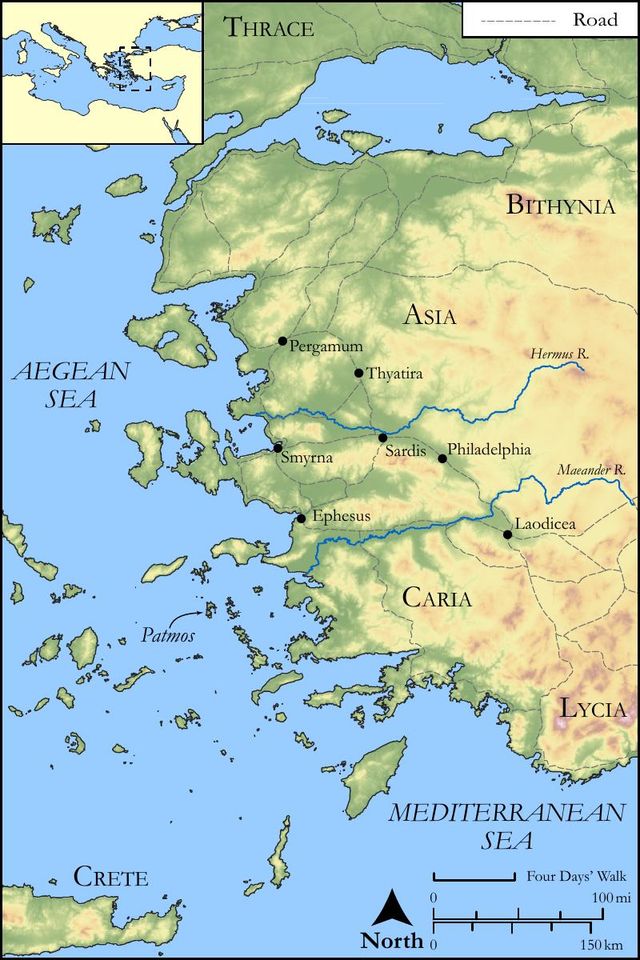
See on the biblical-era maps

Study this verse
Public-domain commentary
Matthew Henry
From his Commentary on the Whole Bible. Henry comments on passages, not single verses — this entry covers Revelation 1:9–20. His four-level outline is real structure in the source text, so it is rendered as structure.
We have now come to that glorious vision which the apostle had of the Lord Jesus Christ, when he came to deliver this revelation to him, where observe,
I.The account given of the person who was favoured with this vision. He describes himself,
1.By his present state and condition. He was the brother and companion of these churches in tribulation, and in the kingdom and patience of Christ. He was, at their time, as the rest of true Christians were, a persecuted man, banished, and perhaps imprisoned, for his adherence to Christ. He was their brother, though an apostle; he seems to value himself upon his relation to the church, rather than his authority in it: Judas Iscariot may be an apostle, but not a brother in the family of God. He was their companion: the children of God should choose communion and society with each other. He was their companion in tribulation: the persecuted servants of God did not suffer alone, the same trials are accomplished in others. He was their companion in patience, not only a sharer with them in suffering circumstances, but in suffering graces: if we have the patience of the saints, we should not grudge to meet with their trials. He was their brother and companion in the patience of the kingdom of Christ, a sufferer for Christ's cause, for asserting his kingly power over the church and the world, and for adhering to it against all who would usurp upon it. By this account he gives of his present state, he acknowledges his engagements to sympathize with them, and to endeavour to give them counsel and comfort, and bespeaks their more careful attention to what he had to say to them from Christ their common Lord.
2.By the place where he was when he was favoured with this vision: he was in the isle Patmos. He does not say who banished him thither. It becomes Christians to speak sparingly and modestly of their own sufferings. Patmos is said to be an island in the Aegean Sea, One of those called Cyclades, and was about thirty-five miles in compass; but under this confinement it was the apostle's comfort that he did not suffer as an evil-doer, but that it was for the testimony of Jesus, for bearing witness to Christ as the Immanuel, the Saviour. This was a cause worth suffering for; and the Spirit of glory and of God rested upon this persecuted apostle.
3.The day and time in which he had this vision: it was the Lord's day, the day which Christ had separated and set apart for himself, as the eucharist is called the Lord's supper. Surely this can be no other than the Christian sabbath, the first day of the week, to be observed in remembrance of the resurrection of Christ. Let us who call him our Lord honour him on his own day, the day which the Lord hath made and in which we ought to rejoice.
4.The frame that his soul was in at this time: He was in the Spirit. He was not only in a rapture when he received the vision, but before he received it; he was in a serious, heavenly, spiritual frame, under the blessed gracious influences of the Spirit of God. God usually prepares the souls of his people for uncommon manifestations of himself, by the quickening sanctifying influences of his good Spirit. Those who would enjoy communion with God on the Lord's day must endeavour to abstract their thoughts and affections from flesh and fleshly things, and be wholly taken up with things of a spiritual nature.
II.The apostle gives an account of what he heard when thus in the Spirit.
An alarm was given as with the sound of a trumpet, and then he heard a voice, the voice of Christ applying to himself the character before given, the first and the last, and commanding the apostle to commit to writing the things that were now to be revealed to him, and to send it immediately to the seven Asian churches, whose names are mentioned. Thus our Lord Jesus, the captain of our salvation, gave the apostle notice of his glorious appearance, as with the sound of a trumpet.
III.We have also an account of what he saw.
He turned to see the voice, whose it was and whence it came; and then a wonderful scene of vision opened itself to him.
1.He saw a representation of the church under the emblem of seven golden candlesticks, as it is explained in the last verse of the chapter. The churches are compared to candlesticks, because they hold forth the light of the gospel to advantage. The churches are not candles: Christ only is our light, and his gospel our lamp; but they receive their light from Christ and the gospel, and hold it forth to others. They are golden candlesticks, for they should be precious and pure, comparable to fine gold; not only the ministers, but the members of the churches ought to be such; their light should so shine before men as to engage others to give glory to God.
2.He saw a representation of the Lord Jesus Christ in the midst of the golden candlesticks; for he has promised to be with his churches always to the end of the world, filling them with light, and life, and love, for he is the very animating informing soul of the church. And here we observe,
(1.)The glorious form in which Christ appeared in several particulars.
[1.]He was clothed with a garment down to the foot, a princely and priestly robe, denoting righteousness and honour.
[2.]He was girt about with a golden girdle, the breast-plate of the high priest, on which the names of his people are engraven; he was ready girt to do all the work of a Redeemer.
[3.]His head and hairs were white like wool or snow. He was the Ancient of days; his hoary head was no sign of decay, but was indeed a crown of glory.
[4.]His eyes were as a flame of fire, piercing and penetrating into the very hearts and reins of men, scattering terrors among his adversaries.
[5.]His feet were like unto fine burning brass, strong and stedfast, supporting his own interest, subduing his enemies, treading them to powder.
[6.]His voice was as the sound of many waters, of many rivers falling in together. He can and will make himself heard to those who are afar off as well as to those who are near. His gospel is a profluent and mighty stream, fed by the upper springs of infinite wisdom and knowledge.
[7.]He had in his right hand seven stars, that is, the ministers of the seven churches, who are under his direction, have all their light and influence from him, and are secured and preserved by him.
[8.]Out of his mouth went a two-edged sword, his word, which both wounds and heals, strikes at sin on the right hand and on the left,
[9.]His countenance was as the sun shining, its strength too bright and dazzling for mortal eyes to behold.
(2.)The impression this appearance of Christ made upon the apostle John (Rev 1:17): He fell at the feet of Christ as dead; he was overpowered with the greatness of the lustre and glory in which Christ appeared, though he had been so familiar with him before. How well is it for us that God speaks to us by men like ourselves, whose terrors shall not make us afraid, for none can see the face of God and live!
(3.)The condescending goodness of the Lord Jesus to his disciple: He laid his hand upon him, Rev 1:17. He raised him up; he did not plead against him with his great power, but he put strength into him, he spoke kind words to him.
[1.]Words of comfort and encouragement: Fear not. He commanded away the slavish fears of his disciple.
[2.]Words of instruction, telling him particularly who he was that thus appeared to him. And here he acquaints him, First, with his divine nature: The first and the last. Secondly, With his former sufferings: I was dead; the very same that his disciples saw upon the cross dying for the sins of men. Thirdly, With his resurrection and life: "I live, and am alive for evermore, have conquered death and opened the grave, and am partaker of an endless life." Fourthly, With his office and authority: I have the keys of hell and of death, a sovereign dominion in and over the invisible world, opening and none can shut, shutting so that none can open, opening the gates of death when he pleases and the gates of the eternal world, of happiness or misery, as the Judge of all, from whose sentence there lies no appeal. Fifthly, With his will and pleasure: Write the things which thou hast seen, and the things which are, and which shall be hereafter. Sixthly, With the meaning of the seven stars, that they are the ministers of the churches; and of the seven candlesticks, that they are the seven churches, to whom Christ would now send by him particular and proper messages.
Historical interpretation
Eight Centuries of Reception
8 surviving comments on this verse. Each one is dated, so this reads as a timeline rather than a list.
Select a marker to jump to its quote. Markers stagger vertically where authors wrote within a few decades of each other.
Neither Moses nor Elijah nor Ezekiel, who all had many celestial visions, saw God. Rather, what they did see were likenesses of the splendor of the Lord and prophecies of things to come. It is evident that the Father is indeed invisible, of whom also the Lord said, “No man has seen God at any time.” But his Word, as he himself willed it, and for the benefit of those who beheld, did show the Father’s brightness and explained his purposes, as also the Lord said, “The only begotten God, which is in the bosom of the Father, he has declared [him].” … John also, the Lord’s disciple, when seeing the priestly and glorious advent of his kingdom, says in the Apocalypse: “I turned to see the voice that spoke with me. And, being turned, I saw seven golden candlesticks, and in their midst One like the Son of man, clothed with a garment reaching to the feet, and wrapped around the chest with a golden girdle. His head and his hair were white, as white as wool, and as snow. His eyes were like a flame of fire. His feet were like fine brass, as if they were forged in a furnace. His voice [was] like the sound of waters. He had in his right hand seven stars. Out of his mouth came a sharp two-edged sword. He looked like the sun shining at full strength.” For in these words he sets forth something of the glory [which he has received] from his Father, as the head. He sets forth something of the priestly office, as in the case of the long garment reaching to the feet. And this was the reason why Moses vested the high priest after this fashion. Something also alludes to the end [of all things], as [where he speaks of] the fine brass being forged in the fire, which denotes the power of faith, and constant prayer, because of the consuming fire which is to come at the end of time.
That after He had risen again He should receive from His Father all power, and His power should be everlasting. In Daniel: "I saw in a vision by night, and behold as it were the Son of man, coming in the clouds of heaven, came even to the Ancient of days, and stood in His sight. And they who stood beside Him brought Him before Him: and to Him was given a royal power, and all the kings of the earth by their generation, and all glory obeying Him: and His power is eternal, which shall not be taken away, and His kingdom shall not be destroyed." Also in Isaiah: "Now will I arise, saith the Lord; now will I be glorified, now will I be exalted, now ye shall see, now ye shall understand, now ye shall be confounded. Vain will be the strength of your spirit: the fire shall consume you." Also in the cixth Psalm: "The Lord said unto my Lord, Sit Thou on my fight hand, until I make Thine enemies the footstool of Thy feet. God will send the rod of Thy power out of Sion, and Thou shalt rule in the midst of Thine enemies." Also in the Apocalypse: "And I turned and looked to see the voice which spake with me. And I saw seven golden candlesticks, and in the midst of the candlesticks one like unto the Son of man, clothed with a long garment, and He was girt about the paps with a golden girdle. And His head and His hairs were white as wool or snow, and His eyes as a flame of fire, and His feet like to fine brass from a furnace of fire, and His voice like the sound of many waters. And He had in His right hand seven stars: and out of His mouth went a sharp two-edged sword; and His face shone as the sun in his might. And when I saw Him, I fell at His feet as dead. And He laid His right hand upon me, and said, Fear not; I am the first and the last, and He that liveth and was dead; and, lo, I am living for evermore and I have the keys of death and of hell." Likewise in the Gospel, the Lord after His resurrection says to His disciples: "All power is given unto me in heaven and in earth. Go therefore and teach all nations, baptizing them in the name of the Father, and of the Son, and of the Holy Ghost, teaching them to observe all things whatsoever I have commanded you."
"The court which is within the temple leave out." The space which is called the court is the empty altar within the walls: these being such as were not necessary, he commanded to be ejected from the Church.
"It is given to be trodden down by the Gentiles." That is, to the men of this world, that it may be trodden under foot by the nations, or with the nations. Then he repeats about the destruction and slaughter of the last time, and says:-
"They shall tread the holy city down for forty and two months; and I will give to my two witnesses, and they shall predict a thousand two hundred and threescore days clothed in sackcloth." That is, three years and six months: these make forty-two months. Therefore their preaching is three years and six months, and the kingdom of Antichrist as much again.
Resting on three arms, a lampstand raises the body of a single shaft, and upon this shaft there is placed a lamp of light. “For no other foundation can any one lay than that which is laid, which is Jesus Christ,” says the apostle, “from which the whole body, joined and knit together by every joint with which it is supplied, makes bodily growth and upbuilds itself in love, according to the work and ability of each member.” This is that branch of which it is said: “There shall come forth a branch from the stump of Jesse.” Upon this branch a light is placed, that is, the light of the catholic church is made ready, so that seized by the truth of his light, she might herself bring forth perpetual light, and marked by the manifestation of one faith, she might be exalted by the light of the divine majesty.
He shows that the voice was not sensory when he says, “I turned,” not to hear but “to see the voice.” For spiritual hearing and spiritual seeing are the same thing.
And having turned, etc. Here the form of the Church is beautifully described, bearing the light of divine love in the brightness of a pure heart. According to what the Lord says: "Let your loins be girded and your lamps burning" (Luke XII). He designates the perfection of its interior and exterior by the two parts of the number seven, while each one, consisting of the four qualities of the body, loves the Lord God with all their heart, all their soul, and all their strength.
And I turned to see the voice that spoke with me. By saying to see, he shows that it was not a physical voice, which cannot be seen, but a spiritual one, with which seeing it is no different from hearing it. Allegorically, the Church turned to see the voice, because it directed its attention, out of the desire of its mind, to the words of the law and of the prophets, so as to see their mysteries now fulfilled. And being turned, I saw seven golden candlesticks: and in the midst of the seven golden candlesticks, one like to the Son of man. By the seven candlesticks is represented the sevenfold Church, in whose midst is Christ, who is called like to the Son of man because he was now immortal, or because he appeared not with sin, but in the likeness of the flesh of sin. We read that he appeared in the midst according to this: Where there are two or three gathered together in my name, there am I in the midst of them. [Matt. 18:20] It is appropriate for the Church to be symbolized by seven golden candlesticks, for the sevenfold operation of the Holy Spirit is symbolized by the number, and the brightness of eternal wisdom is symbolized by gold. So just as gold, tried by fire and stretched by blows, is made into a candlestick, so does the Church, melted by the fire of tribulation until purification, and extended into long-suffering by the blows of temptations, reach completion; whence Isaiah says, The Lord hath said it, whose fire is in Sion, and his furnace in Jerusalem. [Is. 31:9] Furthermore, one should know that one Church is represented by both the seven candlesticks and the Son of man, because the person of Christ and of the Church is one. So the same Lord who appeared clothed with a garment down to the feet in the midst of the candlesticks, put on as a garment the candlesticks themselves. Therefore, Christ's clothes are the same as the seven candlesticks, that is the Church. Indeed genus is joined to genus, when the Church is meant by both the seven candlesticks and the Son of man. Note also that the likeness to the Son of man concerns us, because just as our Head has risen again in deed, so have we in hope. Clothed with a garment down to the feet (a poderes). Podes means “feet” in Greek. What do we understand by the poderes, that is a tunic reaching the ankles, which Zechariah says is a priestly garment, [Probable reference to Zec. 3:4 LXX] if not the flesh of Christ specifically, and the whole Church generally? Indeed, by offering himself on the cross to God the Father, he carried out a priesthood. Now, this priestly garment is down to the ankles because his body, which is the Church, down to its very last members, fills up those things that are wanting of the sufferings of Christ; [Cf. Col. 1:24] or if not, then certainly his garment down to the ankles was his work of love to the suffering of death. And girt about the paps with a golden girdle. What one should know is that Daniel saw a man girt about the loins [Dan. 10:5] and John saw him girt about the paps because the Old Testament restrains the lust of the flesh, whereas the New restrains also that of the mind. However, that double girding does not refer to the Head, but to the limbs, since it is certain that our Redeemer has been touched by neither the lust of the body nor that of the heart. So it is fitting to say that this girdle was golden, because whoever is a citizen of the heavenly fatherland, forsakes uncleanness, not out of fear of punishment, but out of love for heavenly brightness. The order given to the apostles in the New Testament, Let your loins be girt, [Luke 12:35] is given, through their persons, to those who, not yet restraining the fornication of the flesh, belong to the man of the old life; for the apostles themselves had already forsaken the uncleanness of the flesh. Alternatively, the angel is girt about the paps with a golden girdle because the Church, coming from two peoples, is united in Christ by the bond of love.
"The seven lampstands," as John himself goes on to explain, are the seven churches to which he has been commanded to write; he calls them "lampstands" because they bear the light of the glory of Christ. For he does not call them lamps, but "lampstands." This lamp itself does not emit light; rather, it contains within itself the power to illuminate. Christ illuminates His churches spiritually. For just as the holy apostle encourages those who have received the faith: "Become like stars in the world, holding forth the word of life," (Philip. 2:15-16) so too, the star itself does not possess light by itself but is receptive to an external light. In the same way, here the evangelist saw the churches not as lamps themselves but as "lampstands." For it has been said concerning Christ, "you wonderfully illuminate from eternal mountains," (Ps. 75:3) perhaps that means angelic powers; and again, towards the Father; "send forth your light and your truth" (Ps. 43:3); and again, the illumination of your face, O Lord. (Ps. 44:3) The participants in the divine light were recorded, some as stars, others as lamps.
John says that the "lampstands" are "golden" because it is honorable and surpassing to receive the divine radiance.
And he says that "in the midst of the seven lampstands, one like a son of man"; for if the Lord Himself promises to dwell and walk among the souls that received Him, how would He not be "seen in the midst of the lampstands"?
He says that the "Son of Man," Christ, who humbled himself for us "taking the form of a servant," (Philip. 2:7) became the fruit of the womb according to the divine melody (Ps. 126:3); the womb of the undefiled and ever-virgin Mary; for since Mary is a human and our sister, it is fitting that the one born from her without seed, according to the flesh the Word of God, is called the "Son of Man."
And he has spoken carefully without saying "the son of man", but "like a son of man," and also God and Lord of all, Emmanuel; and the vision shows his varied form, outlining the shape from his works and powers.
And first, he puts on a priestly garment; for the long "robe" and the "belt" are priestly garments; for it is said to him from God and the Father: "You are a priest forever according to the order of Melchizedek." (Heb. 5:6; Ps. 109:4) But the apostle also calls Christ "a high priest and apostle of our confession," (Heb. 3:1) as one who performs priestly service and brings to himself and to the Father and the Spirit our confession of faith.
And he puts on "a golden belt," having a belt with decorated attire [φάρους], as prescribed by the law for priests. For it was necessary for the difference between slaves and master to be shown, between the shadowy law and the truth in the New Covenant.
"His head and his hair were white like wool, as white as snow." For the mystery according to Christ is new in its appearance, but indeed eternal in its good pleasure. For the divine apostle wrote concerning him the mystery hidden from the ages and from the generations, which now has been revealed to his saints, to whom he willed. Therefore, the ancient aspect of the mystery, as far as it reached into divine favor, reveals the gray of the head intermingled with "wool" and "snow."
"and his eyes were like a flame." It is shown since Christ is also light, and He calls Himself this, saying "I am the light and the truth," (Jn. 8:12; 14:6) or He reveals the fearful things and the threat against the seven churches to which the things of the Revelation are sent, as those who are not following His laws perfectly. And He says,
"his feet were like gleaming bronze." They say that the copper mined in Mount Lebanon is both pure and self-originating, becoming purer after being purified in a furnace from the moderate impurity within it; through this, the firm and unshakable faith in Christ, bright and visible, is shown to have been firmly established in safekeeping. For Christ has been called the rock [πέτρα] by the apostle (1 Cor. 10:4), and a precious stone [λίθος] in the foundations of Zion by Isaiah (Isa. 28:16). Or he means that the "gleaming bronze" is incense that is bronze-like, which the physicians [ἰατρῶν παῖδες] have been accustomed to call male [ἄρρενα].
But this one is fragrant when it is burning; for the burning "furnace" is a sign that it is being burned. It shows that the foundation of the evangelical proclamation; for the foundation of the rest of the body are the "feet," which is Christ; for He is fragrant and, by fixing the spiritual fragrance, both the things in heaven and those on earth. The foundation is Christ, and Paul refers to this in a certain letter he wrote to the Corinthians, wisely saying, "I have laid the foundation as an expert builder; another is building upon it. Each person must consider how they build upon it, for no one can lay any foundation other than the one already laid, which is Jesus Christ." (1 Cor. 3:10-11) That Christ is fragrant in a spiritual sense is attested by the bride in the Song of Songs, who, having received a share of His fragrance, declares both that "the scent of your perfumes is more delightful than all spices" and that "your name is like a poured-out perfume." (Song 1:3) Moreover, the Lord Himself presents Himself as fragrant in His words to the bride, saying, "I am the flower of the field, the lily of the valleys." (Song 2:1) What then? Did not Paul also, having become fragrant from the participation [μετουσίας] in Christ, say: "that we are the fragrance of Christ?" (2 Cor. 2:15) And again: "and the aroma of the knowledge of Him is revealed to us." (2 Cor. 2:14)
"and his voice was like the sound of many waters," John said; and rightly so. For how else could his utterance have reached every part of the earth, and the proclamation about him to the ends of the inhabited world, if it were not unheard of? Not by audible loudness, but by the power of the proclamation.
"and he had seven stars in his right hand," he said. He himself interprets these stars as the angels of the seven churches, as the divine Gregory said in the presence of the bishops, addressing the ruling angels; "for I believe that each church is guarded by a different angel, as John teaches in the Revelation." I believe that the "stars" are called the holy angels because of the abundant illumination of Christ within them; and they "are in His right hand." For they are deemed worthy of the most honorable position before God, and as if they rest in the hand of God.
"and out of his mouth went a sharp two-edged sword." Therefore, the divine David says to the Lord, "Fix your sword upon your thigh, O mighty one." (Ps. 44:4) For at that time, the evangelical laws commanded us to observe them strictly, for violating them was deadly; therefore, the place of the thigh where the sword was placed indicated a delay in punishment, for it was not yet fully prepared for slaughter. Now from "his mouth" comes forth the "sword," signifying the riddle [αἰνίγματος] that those who are disobedient to the evangelical commandments face the danger of being cut in two by the sword of the soul. This is what the Lord declares in the Gospels, making this clear; and the apostle said: "for the word of God is living and active, and sharper than any two-edged sword" (Heb.4:12) against those who disobey, clearly indicating the threat it raises. Therefore, this sharpness is also attributed to John; it is the same as the sharp style found in the writings of Paul.
"and his face was like the sun shining in its power," John said. Well said, "like the sun"; for the Lord is "the sun of righteousness," according to the prophet Malachi. (Mal. 4:2) But so that you do not think the illumination of Christ's "face," which enlightens every person coming into the world (Jn. 1:9), is a physical body that is transparent and visibly shining, he attributed it to his power, as if to say: the light of Christ is intelligible, operating by power (Col. 1:29), not a bodily appearance, but one that enlightens the eyes of the soul.
Continue studying Revelation 1:12 across the web’s major study libraries — every link below opens this exact verse, chapter, or book on the destination site.
Read & Compare
 BibleGatewayThis verse in more than 200 translations and 70 languages.
 Bible.comThe YouVersion reader — hundreds of translations, reading plans, and highlights.
 ESV.orgCrossway's official English Standard Version reader.
 NET BibleThe NET translation with 60,000+ translators' notes on every rendering decision.
 STEP BibleTyndale House's free study tool — original text, vocabulary, and scholarly resources.
 BibliaLogos Bible Software's free web reader.
 USCCBThe New American Bible (Revised Edition) with the U.S. bishops' study notes.
Commentaries
 BibleHub CommentariesDozens of classic commentaries on this verse, gathered on one page.
 StudyLightMore than 100 commentary sets — the largest collection on the web.
 BibleRefPlain-English commentary on what this verse means, verse by verse.
 Enduring WordDavid Guzik's free commentary on this chapter, widely used by Bible teachers.
 Bible Study ToolsVerse commentary alongside Greek and Hebrew study aids.
Original Language & Research
- BibleHub InterlinearThe verse word by word — original language, transliteration, and English.
- BibleHub LexiconEvery word's original-language definition and Strong's entry.
 Blue Letter BibleDeep-study tools — Strong's numbers, concordance, and word studies.
 CNTR CollationThe earliest Greek manuscripts of this verse, collated letter by letter.
Sermons, Hymns & Audio


TrulyRandomVerse is not affiliated with these sites and doesn’t control their content. They’re linked because they’re genuinely useful.
Summary
Revelation 1:12 marks a pivotal moment in John's apocalyptic vision, transitioning from an auditory command to a profound visual revelation. Having heard a powerful voice instructing him to document his forthcoming visions for the seven churches, John instinctively turns to identify the speaker, only to encounter not a person, but a symbolic array of seven golden lampstands. This turning point initiates the central visual narrative of the book, unveiling the glorified Christ in the midst of His Church, setting the stage for the messages to the churches and the subsequent prophetic disclosures.
Context
ShowHideLiterary Context
This verse immediately follows John's initial encounter with the divine voice in Revelation 1:10-11. John, "in the Spirit on the Lord's day," hears a loud voice "as of a trumpet" commanding him to write what he sees and send it to the seven churches in Asia. His act of turning in Revelation 1:12 is a direct response to this authoritative auditory command, initiating the visual component of the revelation that will dominate the rest of the book. The subsequent verses (Revelation 1:13-16) describe the glorious figure of the Son of Man standing among the lampstands, and Revelation 1:20 explicitly reveals the symbolic meaning of the lampstands as the seven churches. Thus, Revelation 1:12 serves as the crucial bridge between John's commission and the unveiling of Christ and His Church.
Historical & Cultural Context
John's vision occurs while he is exiled on the island of Patmos, a penal colony, likely during the reign of the Roman Emperor Domitian (c. AD 81-96), who initiated a severe persecution of Christians. This context of imperial oppression and the burgeoning cult of emperor worship would have made the message of Christ's supreme authority and the Church's enduring presence particularly vital for the seven churches of Asia Minor (Ephesus, Smyrna, Pergamum, Thyatira, Sardis, Philadelphia, and Laodicea). Culturally, "candlesticks" or "lampstands" (lychnia) were common household items, essential for providing light in ancient homes and public spaces. They were not merely decorative but functional, holding lamps (oil-filled vessels with wicks) that illuminated dark rooms. This common understanding would immediately convey the idea of light-bearing and visibility, making the symbolism resonate deeply with John's original audience.
Key Themes
ShowHideRevelation 1:12 introduces several foundational themes that permeate the book of Revelation. Firstly, it highlights the Divine Initiative of the revelation; John does not seek the vision, but rather responds to a divine summons, underscoring that God is the primary agent of all prophetic disclosure. Secondly, the act of "turning" signifies Attentiveness and Obedience to divine revelation, a posture critical for receiving spiritual truth. Thirdly, the immediate visual of the "seven golden candlesticks" introduces the profound Symbolism of the Church. As later clarified in Revelation 1:20, these lampstands represent the seven churches, emphasizing their role as light-bearers in a dark world. The number "seven" itself is a pervasive theme in Revelation, consistently signifying Completeness and Divine Perfection, suggesting that these churches, though specific, represent the universal Church in its totality. This verse thus powerfully establishes the setting for Christ's direct address to His people.
Exposition and Analysis
ShowHideKey Word Analysis
ShowHideThis verb signifies a physical reorientation, "to revert" or "turn about." In this context, it denotes John's deliberate action of turning his body to face the source of the powerful voice he heard. It implies an active, responsive posture, moving from an auditory experience to a visual one, indicative of his readiness to receive the full revelation.
While primarily referring to an audible sound, "voice" here functions as a metonymy, representing the speaker himself. John turns not merely to see the sound waves, but to identify the entity from which the authoritative sound emanated. This "voice" is later revealed to be that of the glorified Christ, underscoring the divine authority behind the message.
This term, often translated as "candlesticks" in older versions, more accurately means "lampstand" or "light-holder." It refers to a stand designed to hold a lamp (a vessel containing oil and a wick) and elevate its light. This distinction is crucial, as the lampstand itself does not generate light but supports and displays it. In Revelation, these lampstands are explicitly identified as the churches, symbolizing their function as bearers of Christ's light to the world.
Verse Breakdown
ShowHide"And I turned to see the voice that spake with me."
John's immediate, natural human reaction to the authoritative, trumpet-like voice he heard was to physically pivot and attempt to visually identify the speaker. This clause emphasizes John's active engagement and curiosity, driven by the profound impact of the divine utterance. It sets up the transition from an auditory experience to the awe-inspiring visual revelation that follows.
"And being turned, I saw seven golden candlesticks;"
Having completed his physical reorientation, John's gaze falls upon a distinct and symbolic sight: seven lampstands, crafted from gold. The repetition of "turned" ("being turned") emphasizes the completed action and the immediate consequence of seeing. The number "seven" immediately signals divine completeness or perfection, while "golden" conveys preciousness, purity, and divine glory. The "candlesticks" (lampstands) are the first visual element of the revelation, introducing a key symbol that will be interpreted later in the chapter as representing the churches themselves.
Literary Devices
ShowHideThe verse employs several significant literary devices. Metonymy is evident in the phrase "to see the voice," where "voice" stands in for the person speaking. John does not literally see sound waves, but rather turns to see the source of the voice, the speaker. This highlights the profound impact and authority of the divine utterance. Symbolism is paramount, as the "seven golden candlesticks" are not literal objects to be understood prosaically, but rather represent the seven churches of Asia Minor, as explicitly stated later in Revelation 1:20. The number "seven" itself is a powerful symbol throughout Revelation, consistently denoting completeness, perfection, or divine fullness. The material "golden" further enhances this symbolism, conveying the preciousness, purity, and divine nature associated with the entities represented. Finally, the vivid Imagery of "golden candlesticks" immediately evokes a sense of sacredness, light, and the presence of God, preparing the reader for the subsequent detailed description of the glorified Christ.
Theological and Thematic Connections
ShowHideRevelation 1:12 introduces the profound theological truth of Christ's intimate presence and active oversight within His Church. John's turning to see the source of the voice leads him not to an isolated figure, but to the "seven golden candlesticks," which are explicitly revealed to be the churches. This immediately establishes the Church as central to Christ's concern and the focus of His immediate revelation. The image underscores that the Church is not merely an earthly institution but a divine entity, precious ("golden") and illuminated by Christ's presence. It signifies that the glorified Christ is not distant but walks among His people, actively upholding and illuminating them, ensuring their witness in the world. The vision emphasizes the Church's vital role as a light-bearer, reflecting Christ's truth and glory in a world shrouded in darkness, thereby fulfilling its mission as God's chosen vessel for His ongoing work.
Reflection and Application
ShowHideJohn's immediate and obedient response to the divine voice—to turn and see—serves as a powerful model for believers today. In a world filled with distractions and competing voices, we are called to cultivate a spiritual attentiveness that prioritizes God's revelation. When God speaks, whether through His Word, prayer, or the guidance of the Holy Spirit, our posture should be one of active listening and eager reception, ready to "turn" and behold what He desires to show us. Furthermore, the vision of the seven golden lampstands, representing the Church, profoundly impacts our understanding of our collective identity and mission. It reminds us that each local church, and indeed the global body of Christ, is a precious, divinely appointed vessel designed to hold forth the light of Christ in a dark world. We are not the source of the light, but the bearers of it, called to shine brightly through our witness, worship, and service. This image compels us to consider how faithfully we are fulfilling this sacred trust, ensuring that our lampstands are clean, filled with oil, and positioned to illuminate our communities with the truth and love of Jesus Christ.
Questions for Reflection
ShowHideFAQ
ShowHideWhy does John turn "to see the voice" rather than the speaker?
ShowHideThis phrase uses a literary device called metonymy, where "voice" stands in for the person or entity from whom the voice originates. John is not literally trying to see sound waves, but rather to identify the source of the powerful, authoritative voice he just heard. It's a natural human response to a commanding sound – to turn and look at who is speaking. The subsequent vision reveals the glorious figure of Christ, confirming that John's turning led him directly to the speaker himself, the Son of Man.
What is the significance of "seven golden candlesticks"?
ShowHideThe "seven golden candlesticks" (more accurately, lampstands) are highly symbolic. As explicitly revealed in Revelation 1:20, they represent the seven churches of Asia Minor to whom John is commanded to write. The number "seven" consistently signifies completeness or divine perfection throughout the book of Revelation, suggesting these specific churches represent the universal Church. "Golden" symbolizes their preciousness, purity, and divine value in God's eyes. As lampstands, they are not the source of light but are designed to hold and display the light, symbolizing the Church's mission to bear witness to Christ, who is the true light of the world (John 8:12).
Christ-Centered Fulfillment
ShowHideRevelation 1:12, though initially focused on John's response and the symbolic lampstands, profoundly points to Christ as its ultimate fulfillment and central figure. John turns to "see the voice," and what he sees is not merely abstract symbolism, but the glorified Son of Man standing in the midst of the lampstands. This immediately establishes Christ as the one who speaks with divine authority, the one who initiates and orchestrates the entire revelation. The "seven golden candlesticks" are revealed to be the churches, signifying that Christ's primary concern and active presence are with His people. He is not a distant deity but the one who "walks in the midst of the seven golden candlesticks" (Revelation 2:1), intimately aware of their struggles and triumphs. Thus, the vision underscores that the Church's existence, purpose, and very illumination derive solely from Christ. He is the true light (John 1:9) that the Church, as His lampstand, is called to reflect. The entire book of Revelation, initiated by this pivotal turning point, is ultimately a revelation of "Jesus Christ" (Revelation 1:1), demonstrating His supreme sovereignty over history, His unwavering commitment to His Church, and His ultimate victory over all opposing forces, culminating in His eternal reign.