


Ezekiel 43:6
Bible text: King James Version (1769 Blayney text) · Public domain
Bible text: Berean Standard Bible · Public domain
Bible text: American Standard Version (1901) · Public domain
Bible text: World English Bible, Messianic edition · Public domain
Bible text: Geneva Bible (1599) · Public domain
Bible text: Young's Literal Translation · Public domain
- וָאֶשְׁמַעva·'esh·Ma'and I heardH8085Conj-w ¦ V-Qal-ConsecImperf-1csVerb Qal Consecutive Imperfect 1st Singular common genderוָandאֶשְׁמַעI heard
- מִדַּבֵּרmi·da·Ber[one who] spokeH1696V-Piel-InfVerb Piel Infinitive Construct
- אֵלַי'e·Laito meH413Prep ¦ 1csPrepositionאֵלַtoיme
- מֵהַבָּיִתme·ha·Ba·yitfrom the houseH1004Prep-m ¦ Art ¦ N-msNoun Singular Masculine Absoluteמֵfromהַtheבָּיִתhouse
- וְאִישׁve·'Ishand a manH376Conj-w ¦ N-msNoun Singular Masculine Absoluteוְandאִישׁa man
- הָיָהha·Yahhe wasH1961V-Qal-Perf-3msVerb Qal Perfect 3rd Singular Masculine
- עֹמֵד'o·MedstandingH5975V-Qal-Prtcpl-msVerb Qal Participle Singular Masculine Absolute
- אֶצְלִי'etz·Libeside meH681N-csc ¦ 1csNoun Singular common gender Constructאֶצְלִbesideיme
English is a literal word-by-word gloss of the Hebrew, not the KJV's wording. Why?
This is the original text the KJV's translators worked from — each Hebrew word with its own literal English meaning in this verse, prepared by scholars at Tyndale House, Cambridge. The KJV translates whole sentences, not word by word, so its wording differs: one Hebrew word can become several English words, and the KJV may choose “the LORD” where the gloss reads “Yahweh”. Both are faithful — they answer different questions. For the KJV's own rendering, switch to the KJV text.
Details
See on the biblical-era map
Study this verse
Public-domain commentary
Matthew Henry
From his Commentary on the Whole Bible. Henry comments on passages, not single verses — this entry covers Ezekiel 43:1–6.
After Ezekiel has patiently surveyed the temple of God, the greatest glory of this earth, he is admitted to a higher form, and honoured with a sight of the glories of the upper world; it is said to him, Come up hither. He has seen the temple, and sees it to be very spacious and splendid; but, till the glory of God comes into it, it is but like the dead bodies he had seen in vision (ch. 37), that had no breath till the Spirit of life entered into them. Here therefore he sees the house filled with God's glory.
I.He has a vision of the glory of God (Eze 43:2), the glory of the God of Israel, that God who is in covenant with Israel, and whom they serve and worship. The idols of the heathen have no glory but what they owe to the goldsmith or the painter; but this is the glory of the God of Israel. This glory came from the way of the east, and therefore he was brought to the gate that leads towards the east, to expect the appearance and approach of it. Christ's star was seen in the east, and he is that other angel that ascends out of the east, Rev 7:2. For he is the morning star, he is the sun of righteousness. Two things he observed in this appearance of the glory of God: - 1. The power of his word which he heard: His voice was like a noise of many waters, which is heard very far, and makes impressions; the noise of purling streams is grateful, of a roaring sea dreadful, Rev 1:15; Rev 14:2. Christ's gospel, in the glory of which he shines, was to be proclaimed aloud, the report of it to be heard far; to some it is a savour of life, to others of death, according as they are. 2. The brightness of his appearance which he saw: The earth shone with his glory; for God is light, and none can bear the lustre of his light, none has seen nor can see it. Note, That glory of God which shines in the church shines on the world. When God appeared for David the brightness that was before him dispersed the clouds, Psa 18:12. This appearance of the glory of God to Ezekiel he observed to be the same with the vision he saw when he first received his commission (Eze 1:4), according to that by the river Chebar (Eze 43:3); because God is the same, he was pleased to manifest himself in the same manner, for with him is no variableness. "It was the same" (says he) "as that which I saw when I came to destroy the city, that is, to foretel the city's destruction," which he did with such authority and efficacy, and the event did so certainly answer the prediction, that he might be said to destroy it. As a judge, in God's name, he passed a sentence upon it, which was soon executed. God appeared in the same manner when he sent him to speak words of terror and when he sent him to speak words of comfort; for in both God is and will be glorified. He kills and he makes alive; he wounds and he heals, Deu 32:39. To the same hand that destroyed we must look for deliverance. He has smitten, and he will bind up. Una eademque manus vulnus opemque tulit - The same hand inflicted the wound and healed it.
II.He has a vision of the entrance of this glory into the temple.
When he saw this glory he fell upon his face (Eze 43:3), as not able to bear the lustre of God's glory, or rather as one willing to give him the glory of it by a humble and reverent adoration. But the Spirit took him up (Eze 43:5) when the glory of the Lord had come into the house (Eze 43:4), that he might see how the house was filled with it. He saw how the glory of the Lord in this same appearance departed from the temple, because it was profaned, to his great grief; now he shall see it return to the temple to his great satisfaction. See Eze 10:18, Eze 10:19; Eze 11:23. Note, Though God may forsake his people for a small moment, he will return with everlasting loving-kindness. God's glory filled the house as it had filled the tabernacle which Moses set up and the temple of Solomon, Exo 40:34; Kg1 8:10. Now we do not find that ever the Shechinah did in that manner take possession of the second temple, and therefore this was to have its accomplishment in that glory of the divine grace which shines so brightly in the gospel church, and fills it. Here is no mention of a cloud filling the house as formerly, for we now with open face behold the glory of the Lord, in the face of Christ, and not as of old through the cloud of types.
III.He receives instructions more immediately from the glory of the Lord, as Moses did when God had taken possession of the tabernacle (Lev 1:1): I heard him speaking to me out of the house, Eze 43:6. God's glory shining in the church, we must thence expect to receive divine oracles. The man stood by me; we could not bear to hear the voice of God any more than to see the face of God if Jesus Christ did not stand by us as Mediator. Or, if this was a created angel, it is observable that when God began to speak to Ezekiel he stood by and gave way, having no more to say. Nay, he stood by the prophet, as a learner with him; for to the principalities and powers, to the angels themselves, who desire to look into these things, is known by the church the manifold wisdom of God, Eph 3:10. The man stood by him to conduct him thither where he might receive further discoveries, Eze 44:1.
Historical interpretation
Historical reception
2 surviving comments on this verse. Each one is dated, so this reads as a timeline rather than a list.
Select a marker to jump to its quote. Markers stagger vertically where authors wrote within a few decades of each other.
(Chapter 43, verses 1 onwards) "And he brought me to the gate that faced east. And behold, the glory of the God of Israel was coming from the east. And the sound of his coming was like the sound of many waters, and the earth shone with his majesty. And I saw a vision like the vision that I had seen when he came to destroy the city. And the vision that I saw was like the vision that I had seen by the river Chebar. And I fell on my face. And the majesty of the Lord entered the temple through the gate facing east. And the spirit lifted me up and brought me into the inner court, and behold, the glory of the Lord filled the house. And I heard someone speaking to me from the house. And the man standing beside me said to me, 'Son of man, this is the place of my throne and the place of the soles of my feet, where I will dwell in the midst of the people of Israel forever. And the house of Israel shall no more defile my holy name, they and their kings, by their whoring and by the dead bodies of their kings at their high places, by setting their threshold by my threshold and their doorposts beside my doorposts, with only a wall between me and them. They have defiled my holy name by their abominations that they have committed, so I have consumed them in my anger.' So now they shall put far from themselves their fornication and the ruins of their kings from me, and I will dwell in their midst forever. LXX: And he brought me to the gate, which looked toward the East, and he led me out; and behold the glory of the God of Israel was coming from the East, and the voice of the camp was like the voice of many waters, and the earth shone with the brightness of the glory on every side. And the vision that I saw was like the vision that I saw when I entered to anoint the city. And the vision of the chariot that I saw was like the vision that I saw by the river Chebar, and I fell on my face. And the glory of the Lord entered the house through the way of the gate that faced east. And the spirit took hold of me and brought me into the inner court, and behold, the glory of the Lord filled the house. And I stood, and behold, a voice from the house speaking to me, and a man stood beside me and said to me: Have you seen, son of man, the place of my throne and the place of the soles of my feet, where my name shall dwell in the midst of the house of Israel forever. And they shall no longer defile the house of Israel with their idols and with their detestable things and with all their transgressions, but I will save them from all the backslidings in which they have sinned, and will cleanse them; and they shall be my people, and I will be their God. » First, about the variety of translation, it must be said that what the Septuagint put: 'And he led me out' is not found in the Hebrew. For if he had been led to the gate facing East, why was it necessary for him to be led out, since he was brought in to see what was being done at the Eastern gate? Then, where it is said: 'The voice was to him,' no doubt it is a voice of God, like the sound of many waters, which John also confirms in his Apocalypse, the Septuagint put: 'And the voice of the camp, like the voice of many geminators' (Apoc. XIV). In the third place, it is written in Hebrew: I saw a vision according to the appearance that I had seen when he came to destroy the city. But that one came, who at the beginning of this prophet was clothed in linen, and had an ink horn at his waist, along with six others, to destroy the city, not to anoint, which the Seventy translated as: And the vision of the chariot that I had seen, which is not found in Hebrew. Let us speak separately about each one, to the extent that the difficulty of explanation allows: lest while we strive for brevity, the veil remain not only on Moses, but also on Ezekiel the prophet in us, who desire to contemplate the revealed truth of the Lord (Exod. 34; 2 Cor. 3). Therefore the glory of the God of Israel enters by the eastern way, by which it had also departed when the city of the Lord was struck by fury. It enters, or rather returns to it, because it had shown the temple of the Lord built on the mountain. And yet there is much more that is said in what follows: The spirit lifted me up and brought me into the outer court, and behold the glory of the Lord filled the house. For here is where only the glory of the God of Israel enters; but there it is said that the fullness of the glory of the Lord was in the temple, as Isaiah also writes: I saw the Lord sitting on a high and lofty throne, and the house was full of his glory (Isaiah 6:1); when we contemplate the revealed face of the glory of the Lord, we are transformed into the image of the Creator. There was also the voice of God, like the voice of many waters, that is, of all the peoples in the whole world, as John the Evangelist explains (Apoc. XIV): or like the voice of armies, and like the voice of many praising God, that the army of God might know the sacraments. Jacob, understanding this, called the name of that place Camp (Genes. XXXII). And elsewhere it is written: The chariots of God are multiplied by ten thousand, thousands of rejoicers (Ps. LXVII, 18). But one voice is said to be of the camp and the multitude, because of the unanimous praise of God. And the voice of those singing is doubled for the Father, and the Son, and the Holy Spirit: Holy, holy, holy Lord God of hosts, the earth is full of his glory (Isa. VI, 3). It follows: And the earth shone with his majesty (Psalm XVIII). Which properly happened at the coming of Christ; when the sound of the apostles went out into all the earth, and their words to the ends of the world (Rom. XVIII): and it is fulfilled daily in believers, and will be fulfilled completely, when this corruptible shall have put on incorruption, and this mortal shall have put on immortality (I Cor. XV). But the following is added: 'And I saw a vision in the likeness of the vision which I had seen when he came to destroy the city.' For which the Seventy have rendered: 'When I went in to anoint the city,' since it is clear contrary to the Hebrew; but according to the LXX it is very dark. How Ezekiel went in to anoint the city, and what was the purport of his prophecy, we have stated, unless we say, of course, that the prophet’s representation means the anointing of the city, and that the anointing with oil of joy is sacerdotal and regal, and that they become anointed of the Lord who willingly receive and hear Him to whom it is written: 'Do not touch My Christs;' and to those who touch them: 'My prophets, do not harm.' (Ps. 104:15). But he can anoint the city according to the anagoge, of which it is written: Glorious things are said of you, O city of God (Psalm 86:2); he who saw the vision of the chariot and the mysteries of God, which Ezekiel witnessed by the river Chebar, which signifies the burden and weight. For what is heavier than the Babylonian rivers, over which David sat and wept when he remembered Zion? Of which it is written: For the form of this world is passing away (Psalm 136). And I think that there is nothing perpetual in the confusion of this world, but everything passes and flows (1 Corinthians 7:31). Whoever considers this will fall on their face, understanding how far they are from the majesty of God, and will bow their knees to the Father in the name of Jesus Christ. And when, he says, I had fallen, the majesty of the Lord entered the temple through the gate facing east, and immediately the spirit lifted me up (for I could not go on lying down), and he led me into the court of annihilation, for I had fallen outside; and behold, I saw the glory of the God of Israel coming from the east, and I saw the glory of the Lord filling his house, and I heard a voice speaking to me from inside the house. What this is spoken about, the Scripture does not narrate, unless perhaps that of the Apostle: And I heard unspeakable words, that it is not lawful for a man to utter (2 Corinthians 12:4). But the man, he says, who stood beside the prophet, said to him: whom we clearly understand to be the Lord. For who else could it befit what follows: Son of man, the place of My throne, and the place of the soles of My feet, where I dwell in the midst of the children of Israel forever, except those who dwell in the Church in the midst of the children of Israel who behold God, and dwell forever, not according to the temple of Solomon for a time? And his place is the one about which it is written: And his place became peaceful (Psalm 75:2), which surpasses all understanding. And the place of his footsteps, as the Apostles say: Let us worship in the place where his feet stood (Psalm 31:7). And beautifully it is said, they stood: for the feet of the Lord stand in the Church, they walk in the synagogue and pass by. But in order that we may know that this is said about the Church, it is joined: And they will no longer defile my holy name, the house of Israel: which properly belongs to those who dwell in holy conversation in the Church. However, those who have defiled the holy name of God are more clearly specified: both their kings and their people, as well as their priests, in their own acts of fornication, through which they have fornicated with God; and in the ruins of their kings, who in vain, through pride, assume the royal name. Finally, it follows: And in high places. For an arrogant mind offends God; a humble one incites mercy. These people, after pride, or rather through pride, have fashioned their threshold next to the threshold of God, and their doorposts next to His doorposts. Let these women burdened with sins, carried about by every wind of doctrine, always learning but never able to come to the knowledge of the truth; having a form of godliness but denying its power, turn away from such people. For among them are those who creep into households and captivate weak-willed women weighed down with sins, led away by various lusts, always learning and never able to come to the knowledge of the truth. Now as Jannes and Jambres resisted Moses, so do these also resist the truth: men of corrupt minds, disapproved concerning the faith; but they will progress no further, for their folly will be manifest to all, as theirs also was. And the Apostle also says: But let a man examine himself, and so let him eat of that bread and drink of that cup (I Cor. XI, 28). And to make what he said more serious, he follows it with the verse: And there was a wall between me and them; so that a very short wall would separate the priestly sacrifices and the places of the sacraments of the body and blood of Christ. And they have polluted, he says, my holy name, in the abominations which they have committed. What is the advantage of dwelling near, and a wall, the wall of the Lord's altar, between our cell and the altar of the Lord, when in those things which we do in secret, and which it is even shameful to speak of, the name of the Lord is defiled and polluted? I think this, that the name of the Lord is not polluted, except by the one who has seen his name and believed, and is considered in his name. And just as he who previously believed in Christ pollutes the name of God, so also the one who previously accepted his name in faith pollutes it. Otherwise, the Gentile and the Jew, although they are defiled and contaminated, indeed contamination itself and pollution, cannot pollute and defile the name of God: what they pollute is attributed to them, to whom it is said, 'My name is blasphemed among the Gentiles because of you' (Rom. 2:24). Therefore, because of these reasons, I consumed them in my anger, because they did the things we have mentioned. And yet the merciful Lord again commands the prophets to tell them to remove their former fornications from themselves and to abandon the ruins of their kings and rulers, and to not only reject them from themselves, but also from God. And he immediately promises rewards for good deeds, saying: "And I will dwell among them," as it is written in the Gospel: "There stands among you one whom you do not know" (John 1:26). And he will dwell not for a short time, like in the Synagogue, but forever, as is confirmed in the Church of Christ.
He showed me that there was an angel who measured the building, and he showed me these things; and he was very like Michael, who was given the responsibility of looking after the people.
Continue studying Ezekiel 43:6 across the web’s major study libraries — every link below opens this exact verse, chapter, or book on the destination site.
Read & Compare
 BibleGatewayThis verse in more than 200 translations and 70 languages.
 Bible.comThe YouVersion reader — hundreds of translations, reading plans, and highlights.
 ESV.orgCrossway's official English Standard Version reader.
 NET BibleThe NET translation with 60,000+ translators' notes on every rendering decision.
 STEP BibleTyndale House's free study tool — original text, vocabulary, and scholarly resources.
 BibliaLogos Bible Software's free web reader.
 USCCBThe New American Bible (Revised Edition) with the U.S. bishops' study notes.
Commentaries
 BibleHub CommentariesDozens of classic commentaries on this verse, gathered on one page.
 StudyLightMore than 100 commentary sets — the largest collection on the web.
 BibleRefPlain-English commentary on what this verse means, verse by verse.
 Enduring WordDavid Guzik's free commentary on this chapter, widely used by Bible teachers.
 Bible Study ToolsVerse commentary alongside Greek and Hebrew study aids.
Original Language & Research
- BibleHub InterlinearThe verse word by word — original language, transliteration, and English.
- BibleHub LexiconEvery word's original-language definition and Strong's entry.
 Blue Letter BibleDeep-study tools — Strong's numbers, concordance, and word studies.
 SefariaThe Hebrew text with Rashi and centuries of Jewish commentary.
Sermons, Hymns & Audio


TrulyRandomVerse is not affiliated with these sites and doesn’t control their content. They’re linked because they’re genuinely useful.
Summary
Ezekiel 43:6 captures a pivotal moment in the prophet's grand vision, where he receives direct divine communication emanating from the very core of the newly revealed temple. This powerful voice, belonging to the Lord whose glory has just majestically re-entered and filled the sanctuary, unequivocally signifies God's re-established presence, active engagement, and sovereign authority among His people. The unwavering presence of "the man," the angelic guide who has accompanied Ezekiel throughout this profound visionary journey, further emphasizes the solemnity, interpretative depth, and divine validation of this revelation, setting the stage for the crucial instructions that follow regarding the temple's sacred purpose and the renewed covenant relationship between God and Israel.
Context
ShowHideLiterary Context
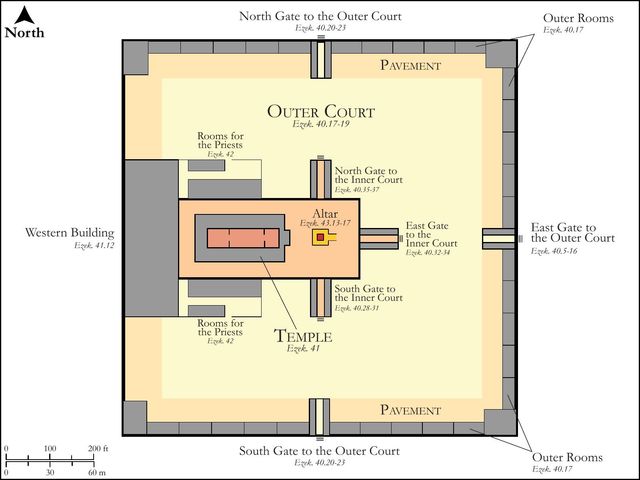
This verse immediately follows the breathtaking account of the glory of the God of Israel entering the visionary temple from the east gate, filling the entire house with its radiant presence (Ezekiel 43:1-5). This dramatic event serves as a profound reversal of the earlier, sorrowful departure of God's glory from the first temple and Jerusalem due to Israel's persistent sin and idolatry, as vividly detailed in passages like Ezekiel 10:18-19 and Ezekiel 11:23. The voice emanating "out of the house" in Ezekiel 43:6 powerfully confirms that God has indeed taken up residence again within His sanctuary and is now actively communicating from His restored dwelling place. This divine utterance establishes the foundational premise for the subsequent detailed instructions concerning the temple's laws, its sacred boundaries, and the renewed covenant relationship between God and His people, which are elaborated upon in Ezekiel 43:7ff.
Historical & Cultural Context
Ezekiel, a priest living in exile in Babylon, received this complex and expansive vision during a period of profound national despair and spiritual desolation following the destruction of the Jerusalem temple in 586 BC and the Babylonian captivity. The vision of a new, glorious temple, meticulously detailed, and the dramatic return of God's presence offered immense hope for future restoration, a new covenant, and a renewed, unblemished relationship with God. In ancient Israelite thought, the temple was far more than a mere building; it was understood as the very dwelling place of God on earth, the sacred nexus where heaven and earth met, and where God's presence was uniquely manifested. God's communication from His sanctuary, reminiscent of His speaking from the mercy seat in the Tabernacle (e.g., Exodus 25:22), underscored His immanence, accessibility, and sovereign authority. The cultural understanding of a divine voice emanating directly from the sacred space would have powerfully affirmed the authenticity, gravity, and binding nature of the revelation for Ezekiel and his audience.
Key Themes
ShowHideA central and overarching theme in Ezekiel 43:6 is Divine Presence and Communication. The awe-inspiring return of God's glory, immediately followed by His authoritative voice from within the temple, unequivocally establishes His active, immanent, and intimate presence among His people. This signifies not only a renewed covenant relationship but also the restoration of divine favor and communion. This direct communication from the sanctuary highlights Divine Authority and Revelation, as the Lord's voice from His throne room within the temple underscores His ultimate sovereignty and His intention to reveal critical truths, sacred laws, and specific commands concerning the proper worship and conduct of His people in this restored era. Furthermore, the consistent presence of "the man," the angelic guide who has been with Ezekiel since the beginning of the temple vision in Ezekiel 40:3, emphasizes the theme of Divine Guidance and Mediation. His proximity to Ezekiel signifies the necessity of spiritual assistance in comprehending profound and often overwhelming divine visions, ensuring the prophet accurately receives, understands, and transmits these powerful messages.
Exposition and Analysis
ShowHideKey Word Analysis
ShowHideFrom the primitive root H1696, this word primarily means "to arrange," but is most frequently used figuratively (of words) "to speak." It implies an intentional, authoritative, and often declarative communication, rather than a mere sound. In this context, it underscores that the voice Ezekiel hears is not an indistinct murmur but a deliberate, articulate message from the divine, conveying specific meaning and purpose.
This term refers to a house in its broadest applications, encompassing a domestic dwelling, a palace, or, as here, a temple. In Ezekiel's vision, it specifically denotes the visionary temple, the sacred dwelling place of God. The voice emanating "out of the house" powerfully emphasizes that the source of the communication is the very heart of God's sanctuary, signifying His re-established presence, authority, and active engagement from within His sacred abode.
This word denotes an individual man or male person. In the context of Ezekiel's extensive temple vision (from Ezekiel 40 onwards), "the man" consistently refers to the angelic guide who accompanies the prophet, measures the temple, and interprets various aspects of the vision. His presence "by me" signifies his continued role as a celestial mediator, witness, and supportive companion to Ezekiel, validating the divine revelation and aiding the prophet's comprehension.
Verse Breakdown
ShowHide"And I heard [him] speaking unto me out of the house"
This opening clause describes Ezekiel's direct reception of an auditory message. The "him" unequivocally refers to the Lord, whose glory has just filled the temple (Ezekiel 43:4-5), making it clear that the voice originates from the divine presence itself, now resident within the sanctuary. The phrase "out of the house" powerfully conveys that God has not only re-inhabited His sacred dwelling but is now actively communicating from His throne room, signaling a reversal of His earlier departure and the dawn of a new era of divine presence and revelation.
"and the man stood by me"
This second clause highlights the continued, attentive presence and proximity of the angelic guide. "The man" has been Ezekiel's constant companion and interpreter throughout the entire temple vision (beginning from Ezekiel 40:3). His standing "by me" signifies his unwavering support, attentive posture, and validating presence, ensuring Ezekiel's comprehension and emphasizing the profound solemnity and divine authority of the communication being received.
Literary Devices
ShowHideEzekiel 43:6 is rich with several potent literary devices that amplify its theological significance. Auditory Imagery is paramount, as the verse centers on Ezekiel "hearing" a voice, emphasizing the direct, personal, and verbal nature of divine communication. This is not merely a visual revelation but a clear, articulate message. The "house" functions as a profound Symbolism, representing not just a physical structure but the sacred dwelling place of God, the very locus of His presence, authority, and the covenant relationship with Israel. The voice emanating from it signifies God's re-established immanence and active engagement. Furthermore, the very act of God speaking from His dwelling constitutes a Theophany, a manifestation of God's presence, though here it is primarily auditory rather than visual, underscoring His active involvement in the unfolding vision. Finally, the consistent presence of "the man" throughout Ezekiel's vision serves as a form of Divine Mediation, highlighting the profound nature of the revelation and the need for divine assistance and interpretation in comprehending such overwhelming spiritual truths.
Theological and Thematic Connections
ShowHideEzekiel 43:6 profoundly underscores God's unwavering commitment to dwell among His people and communicate His divine will. The return of God's voice from the temple, after a period of divine absence due to Israel's sin and disobedience, signifies a renewed covenant and the restoration of a vibrant, intimate relationship. It teaches us that God is not silent but actively seeks to reveal Himself and His purposes, particularly from the place of His established presence. This pivotal moment sets the stage for further divine instruction, emphasizing that true worship, genuine obedience, and faithful living flow directly from hearing and responding to God's authoritative Word. It powerfully reminds us that God's presence is intrinsically linked to His revelation, and where His glory dwells, His voice will be heard, guiding, commanding, and comforting His people for their good and His glory.
Reflection and Application
ShowHideEzekiel 43:6 offers a powerful and enduring reminder that God is a speaking God, one who deeply desires to communicate intimately and purposefully with His people. Just as the Lord's voice returned to the temple, signifying a renewed presence and a fresh outpouring of divine purpose, so too does God desire to speak into our lives today, even after periods of spiritual dryness, perceived absence, or personal wandering. This verse challenges us to cultivate an attentive and obedient spirit, actively listening for His voice in His inspired Word, through fervent prayer, and by the subtle yet profound guidance of the Holy Spirit. The continued presence of the angelic guide standing faithfully by Ezekiel reminds us that understanding profound divine truth often requires humility, a willingness to seek spiritual discernment, and an earnest reliance on the Holy Spirit as our ultimate guide and interpreter, enabling us to grasp and faithfully apply God's profound messages in our daily walk and in all circumstances.
Questions for Reflection
ShowHideFAQ
ShowHideWho is "him" speaking in this verse?
ShowHideThe "him" refers to the Lord himself, the God of Israel, whose glory has just dramatically re-entered and filled the visionary temple in Ezekiel 43:4-5. This is a direct, authoritative divine communication, signifying God's re-established presence and active engagement from His sacred dwelling place.
Who is "the man" mentioned in this verse?
ShowHide"The man" refers to the angelic guide who has been accompanying Ezekiel throughout this extensive and detailed temple vision, beginning in Ezekiel 40:3. He serves as a divine interpreter, measurer, and guide, ensuring Ezekiel comprehends the profound spiritual realities, architectural details, and divine instructions being revealed to him. His continued presence underscores the solemnity and interpretive nature of the divine encounter.
What is the significance of the voice coming "out of the house"?
ShowHideThe phrase "out of the house" is profoundly significant as it indicates that God has unequivocally re-inhabited His sanctuary and is now actively communicating from His throne room within the temple. This event powerfully reverses the earlier, sorrowful departure of God's glory from the first temple and Jerusalem due to Israel's sin, as described in Ezekiel 10:18-19 and Ezekiel 11:23. It marks a new era of divine presence, direct revelation, renewed covenant relationship, and the establishment of new laws for a purified people.
Christ-Centered Fulfillment
ShowHideEzekiel 43:6, with its profound emphasis on God's voice emanating from His dwelling place, finds its ultimate and glorious fulfillment in the person of Jesus Christ. The visionary temple, from which the Lord speaks, serves as a powerful Old Testament type foreshadowing Christ himself, who is the true and ultimate dwelling place of God among humanity. As John 1:14 so beautifully declares, "The Word became flesh and made his dwelling among us. We have seen his glory, the glory of the one and only Son, who came from the Father, full of grace and truth." In Christ, God's glorious presence is no longer confined to a physical structure, however magnificent, but is fully embodied in a living, breathing person. Jesus is the very Word of God made manifest, the one through whom God speaks most clearly, definitively, and personally to humanity (as powerfully articulated in Hebrews 1:1-2). He is the ultimate "man" who stands by us, not merely as an angelic guide but as the Good Shepherd whose voice His sheep hear and follow, leading them to eternal life (John 10:27). Furthermore, through Christ's atoning work and the indwelling of the Holy Spirit, believers themselves become the temple of the Holy Spirit (1 Corinthians 3:16; 1 Corinthians 6:19), a spiritual house from which God's presence and voice continue to resonate in the world through His redeemed people. Thus, the divine communication from the "house" in Ezekiel points forward to the incarnate Christ, the living temple, who perfectly reveals God's will and establishes a new covenant where God dwells not just among His people, but intimately within them.