


1 Samuel 3:21
Bible text: King James Version (1769 Blayney text) · Public domain
Bible text: Berean Standard Bible · Public domain
Bible text: American Standard Version (1901) · Public domain
Bible text: World English Bible, Messianic edition · Public domain
Bible text: Geneva Bible (1599) · Public domain
Bible text: Young's Literal Translation · Public domain
- וַיֹּסֶףvai·Yo·sefand he repeatedH3254Conj-w ¦ V-Hiphil-ConsecImperf-3msVerb Hiphil Consecutive Imperfect 3rd Singular Masculineוַandיֹּסֶףhe repeated
- יְהוָהYah·wehYahwehH3068N-properNoun Proper Title
- לְהֵרָאֹהle·he·ra·'Ohto appearH7200Prep-l ¦ V-Niphal-InfAbsVerb Niphal Infinitive Absoluteלְtoהֵרָאֹהappear
- בְשִׁלֹהve·shi·Lohat ShilohH7887Prep-b ¦ N-properNoun Proper LocationבְatשִׁלֹהShiloh
- כִּיkiforH3588PrtParticle Conditional
- נִגְלָהnig·Lahhe revealed himselfH1540V-Niphal-Perf-3msVerb Niphal Perfect 3rd Singular Masculine
- יְהוָהYah·wehYahwehH3068N-properNoun Proper Title
- אֶל'eltoH413PrepPreposition
- שְׁמוּאֵלshe·mu·'ElSamuelH8050N-proper-mNoun Proper Masculine
- בְּשִׁלוֹbe·shi·Loat ShilohH7887Prep-b ¦ N-properNoun Proper LocationבְּatשִׁלוֹShiloh
- בִּדְבַרbid·Varby [the] word ofH1697Prep-b ¦ N-mscNoun Singular Masculine Constructבִּbyדְבַר[the] word of
- יְהוָהYah·wehYahwehH3068N-properNoun Proper Title
English is a literal word-by-word gloss of the Hebrew, not the KJV's wording. Why?
This is the original text the KJV's translators worked from — each Hebrew word with its own literal English meaning in this verse, prepared by scholars at Tyndale House, Cambridge. The KJV translates whole sentences, not word by word, so its wording differs: one Hebrew word can become several English words, and the KJV may choose “the LORD” where the gloss reads “Yahweh”. Both are faithful — they answer different questions. For the KJV's own rendering, switch to the KJV text.
Details
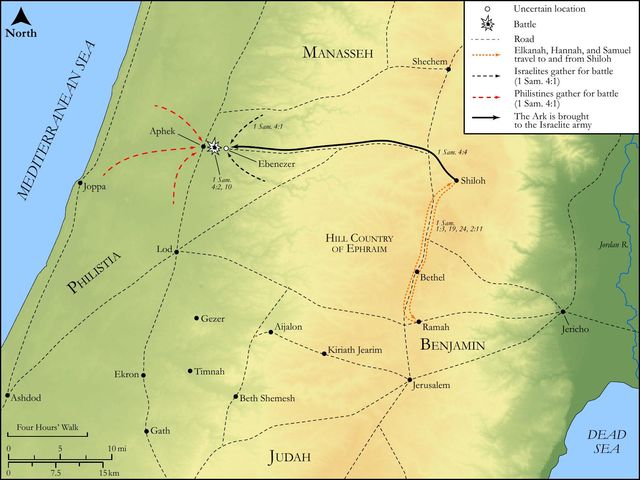
See on the biblical-era map
Study this verse
Public-domain commentary
Matthew Henry
From his Commentary on the Whole Bible. Henry comments on passages, not single verses — this entry covers 1 Samuel 3:19–21. His two-level outline is real structure in the source text, so it is rendered as structure.
Samuel being thus brought acquainted with the visions of God, we have here an account of the further honour done him as a prophet.
I.God did him honour.
Having begun to favour him, he carried on and crowned his own work in him: Samuel grew, for the Lord was with him, Sa1 3:19. All our increase in wisdom and grace is owing to the presence of God with us; this is all in all to our growth. God honoured Samuel,
1.By further manifestations of himself to him. Samuel had faithfully delivered the message he was entrusted with, and therefore God employed him again in his service: The Lord revealed himself again to Samuel in Shiloh, Sa1 3:21. Note, God will graciously repeat his visits to those that receive them aright.
2.By fulfilling what he spoke by him: God did let none of his words fall to the ground, Sa1 3:19. Whatever Samuel said, as a prophet, it proved true, and was accomplished in its season. Probably there were some remarkable instances of the truth of Samuel's predictions that happened soon after, which confirmed those that were afterwards to be fulfilled, and gave general satisfaction as to his mission. God will confirm the word of his servants, and perform the counsel of his messengers (Isa 44:26), and will do what he hath said.
II.Israel did him honour. They all knew and owned that Samuel was established to be a prophet, Sa1 3:20.
1.He grew famous; all that came up to Shiloh to worship took notice of him, and admired him, and talked of him when they returned home. Early piety will be the greatest honour of young people, and bring them, as much as any thing, and as soon, into reputation. Those that honour God he will honour.
2.He grew useful and very serviceable to his generation. He that began betimes to be good soon came to do good. His established commission from God, and established reputation with the people, gave him a great opportunity of shining as a light in Israel. When old Eli was rejected, young Samuel was established; for God will never leave himself without a witness nor his church without a guide.
Continue studying 1 Samuel 3:21 across the web’s major study libraries — every link below opens this exact verse, chapter, or book on the destination site.
Read & Compare
 BibleGatewayThis verse in more than 200 translations and 70 languages.
 Bible.comThe YouVersion reader — hundreds of translations, reading plans, and highlights.
 ESV.orgCrossway's official English Standard Version reader.
 NET BibleThe NET translation with 60,000+ translators' notes on every rendering decision.
 STEP BibleTyndale House's free study tool — original text, vocabulary, and scholarly resources.
 BibliaLogos Bible Software's free web reader.
 USCCBThe New American Bible (Revised Edition) with the U.S. bishops' study notes.
Commentaries
 BibleHub CommentariesDozens of classic commentaries on this verse, gathered on one page.
 StudyLightMore than 100 commentary sets — the largest collection on the web.
 BibleRefPlain-English commentary on what this verse means, verse by verse.
 Enduring WordDavid Guzik's free commentary on this chapter, widely used by Bible teachers.
 Bible Study ToolsVerse commentary alongside Greek and Hebrew study aids.
Original Language & Research
- BibleHub InterlinearThe verse word by word — original language, transliteration, and English.
- BibleHub LexiconEvery word's original-language definition and Strong's entry.
 Blue Letter BibleDeep-study tools — Strong's numbers, concordance, and word studies.
 SefariaThe Hebrew text with Rashi and centuries of Jewish commentary.
Sermons, Hymns & Audio


TrulyRandomVerse is not affiliated with these sites and doesn’t control their content. They’re linked because they’re genuinely useful.
Summary
First Samuel 3:21 serves as a profound capstone to Samuel's call narrative, solidifying his nascent role as a legitimate prophet of the LORD throughout Israel. Following God's dramatic initial call and the revelation of severe judgment against Eli's corrupt household, this verse underscores God's sustained, active presence and consistent self-disclosure at Shiloh, the central sanctuary. It emphasizes that God's communication with Samuel was not a singular, isolated event but an ongoing, personal relationship, consistently conveyed "by the word of the LORD," thereby establishing Samuel's divine authority and the unimpeachable origin of his prophetic messages.
Context
ShowHideLiterary Context
This verse provides a powerful conclusion to a pivotal chapter in Samuel's life and the broader narrative arc of Israel's transition from the period of Judges to the monarchy. Chapter 3 commences by lamenting that "the word of the LORD was rare in those days; there was no frequent vision" (1 Samuel 3:1). Against this backdrop of spiritual barrenness, God initiates a dramatic, audible call to young Samuel, revealing a severe and unalterable judgment against Eli's house due to his sons' wickedness (1 Samuel 3:11-14). Samuel, despite his youth and initial trepidation, faithfully conveys this difficult message to Eli (1 Samuel 3:15-18). The immediate preceding verse, 1 Samuel 3:20, explicitly states that "all Israel from Dan even to Beersheba knew that Samuel was established to be a prophet of the LORD." Thus, 1 Samuel 3:21 functions as the theological explanation for how Samuel's prophetic authority was established and maintained: through repeated, direct, and verbal divine encounters. It sets the stage for Samuel's extensive future ministry as a judge, prophet, and king-maker, marking the beginning of a new era of divine communication.
Historical & Cultural Context
Shiloh held immense religious significance as the primary sanctuary and worship center of Israel during the period of the Judges and early monarchy. It was the designated location for the Tabernacle and, crucially, the Ark of the Covenant (Joshua 18:1; Judges 18:31). This made Shiloh the focal point for Israelite worship, pilgrimage, and divine presence. However, the spiritual climate of the era was marked by severe decline, epitomized by the moral corruption and flagrant abuses of Eli's sons, Hophni and Phinehas, who defiled the sanctuary and despised the LORD's offerings (1 Samuel 2:12-17). In this context of widespread spiritual barrenness, priestly failure, and a scarcity of divine communication, God's deliberate choice to "appear again" and "reveal himself" to a young, faithful boy like Samuel, specifically in Shiloh, carried profound symbolic weight. It signaled a divine intervention, a bypass of the corrupt established order, and a strategic shift in leadership. It underscored God's unwavering commitment to His covenant people, even when their human leaders faltered, and His sovereign willingness to raise up new, righteous instruments for the accomplishment of His purposes.
Key Themes
ShowHide1 Samuel 3:21 powerfully encapsulates several foundational themes central to the book of 1 Samuel and the broader Old Testament narrative. Foremost is the theme of Divine Revelation and Ongoing Presence. The repeated appearance of the LORD in Shiloh emphasizes God's active, personal, and consistent engagement with His people, choosing to make Himself known in a specific sacred place and to a divinely chosen individual. This stands in stark contrast to the "rare" word of the LORD at the chapter's opening (1 Samuel 3:1), highlighting God's sovereign initiative in restoring and maintaining communication. Closely intertwined is the theme of Prophetic Succession and Legitimate Authority. With Eli's house demonstrably failing and incurring divine judgment, God sovereignly raises Samuel as a new, legitimate voice for His people, confirming his prophetic calling through direct, verbal revelation. This establishes Samuel as a true prophet, whose words carry an undeniable divine authority, a stark contrast to the self-initiated or false prophecies that often plagued Israel. Finally, the concluding phrase "by the word of the LORD" underscores the absolute Sovereignty and Efficacy of God's Word. It is not human insight, wisdom, or political maneuvering, but God's direct, authoritative utterance that shapes history, reveals His immutable will, and establishes His chosen instruments. This theme is foundational throughout the prophetic books, where prophets are consistently portrayed as faithful messengers of God's precise and powerful word (e.g., Jeremiah 1:9; Ezekiel 2:7).
Exposition and Analysis
ShowHideKey Word Analysis
ShowHideWhile the form here is the Niphal of the root râʼâh (H7200), meaning "to be seen" or "to appear," its core meaning from the primitive root is "to see, literally or figuratively." When God is the subject in the Niphal, it consistently denotes a theophany—a visible or perceptible manifestation of God's presence. The addition of "again" (H3254, yâçaph) with nir'ah emphasizes that this was not a singular event but a recurring, deliberate act of God making Himself perceptible to Samuel, confirming an ongoing, intimate relationship and continuous divine revelation.
This is the Niphal form of the verb gâlâh (H1540), meaning "to denude," "to disclose," or "to reveal." Similar to râʼâh, when applied to God, it signifies an active, intentional act of self-disclosure, making what was previously hidden known. It implies a deliberate unveiling of God's character, will, or purpose. The combination of "appeared" and "revealed himself" underscores the intensity, clarity, and personal nature of God's communication with Samuel, distinguishing it from mere spiritual intuition or general providence.
The Hebrew term dâbâr (H1697) is exceptionally rich and expansive in meaning, encompassing "word," "speech," "matter," "thing," "affair," or "event." In the context of divine communication, "the word of the LORD" (דְּבַר יְהוָה, dvar YHWH) is a standard, authoritative prophetic formula, indicating a direct, authoritative, and often verbal message from God. It highlights that God's revelation to Samuel was not merely a feeling, an impression, or a general sense, but a concrete, intelligible, and propositional message that Samuel was to receive and transmit. It emphasizes the verbal, declarative, and inherently powerful nature of God's communication with His chosen prophet.
Verse Breakdown
ShowHide"And the LORD appeared again in Shiloh:"
This opening clause re-establishes God's active and manifest presence at Shiloh, the central sanctuary. The crucial adverb "again" (עוֹד, 'od) signifies a continuation or repetition of God's self-manifestation, building upon the initial audible call and encounter in 1 Samuel 3:4. It underscores that God's engagement with Samuel was not an isolated incident but an ongoing, consistent relationship, thereby validating Samuel's prophetic calling through repeated divine encounters in the very place where God's presence was meant to dwell, despite the spiritual decay of the priesthood.
"for the LORD revealed himself to Samuel in Shiloh"
This clause provides the explicit purpose and recipient of God's repeated appearances: it was for the express purpose of God revealing Himself specifically to Samuel. The repetition of "the LORD" and "in Shiloh" emphatically highlights both divine initiative and the specific, divinely chosen location of this ongoing revelation. The verb "revealed himself" (נִגְלָה, niglah) denotes a deliberate, intentional act of God making Himself known, not just generally to Israel, but personally and directly to Samuel. This intimate and direct revelation is what fundamentally establishes Samuel's unique relationship with God and his legitimacy as a prophet, setting him apart from the corrupt and failing priestly line of Eli.
"by the word of the LORD."
This concluding phrase specifies the precise means and nature of God's revelation. It was not primarily through dreams, visions, or indirect signs alone, but fundamentally through direct, verbal communication—"the word of the LORD." This phrase is the hallmark of true prophecy, indicating that Samuel's messages were not his own thoughts, interpretations, or human wisdom, but the direct, authoritative, and divinely inspired utterances of God Himself. It underscores the divine origin, absolute authority, and inherent power of Samuel's prophetic ministry, confirming that his authority was rooted in God's spoken word, which he faithfully received and conveyed to the people.
Literary Devices
ShowHideThe verse employs several powerful literary devices to convey its profound theological message regarding divine revelation and prophetic authority. Repetition is prominently featured, with "the LORD" appearing three times and "in Shiloh" twice. This reiteration serves to emphasize God's consistent presence and His deliberate choice of location for His revelation, creating a sense of divine intentionality and reiterating the sanctity of Shiloh as a place of encounter, even amidst the corruption of its human custodians. Emphasis is further achieved through the use of two distinct but closely related verbs for divine manifestation: "appeared" (nir'ah) and "revealed himself" (niglah). This dual expression intensifies the description of God's self-disclosure, highlighting its clarity, directness, and ongoing nature. The verse also functions as a form of Theophany, describing a divine manifestation that establishes a direct and personal link between God and His chosen prophet, Samuel. Finally, the verse implicitly uses Contrast by juxtaposing God's abundant, clear, and consistent revelation to Samuel with the spiritual barrenness and the "rare" word of the LORD mentioned at the chapter's beginning (1 Samuel 3:1). This stark contrast powerfully underscores God's faithfulness to raise up a new, pure channel of communication in a time of profound spiritual decline and institutional failure.
Theological and Thematic Connections
ShowHide1 Samuel 3:21 is a foundational text concerning the nature of divine revelation and the establishment of prophetic authority in Israel. It powerfully asserts God's active, personal, and ongoing presence among His people, even in times of spiritual darkness and institutional failure. God does not abandon His covenant or His people but actively seeks to communicate His will, choosing faithful individuals through whom to speak His truth. The emphatic repetition of "the word of the LORD" highlights that true revelation is not subjective human insight, fleeting emotion, or cultural trend, but originates solely from God's direct, authoritative, and verbal utterance. This verse sets the stage for Samuel's entire ministry, confirming that his words carried the absolute weight of divine authority because they were God's very own. It teaches us that God is a speaking God, always seeking to make Himself known and to guide His people through His revealed truth, ensuring that His purposes are fulfilled regardless of human shortcomings.
Reflection and Application
ShowHideThe profound truth embedded within 1 Samuel 3:21 resonates deeply with believers today, serving as a powerful reminder that God is not a distant, disengaged deity but an actively engaged, speaking God who passionately desires to make Himself known to His people. Just as He continually "appeared again" and "revealed himself" to Samuel, God continues to reveal His character, His immutable will, and His redemptive purposes to us, primarily and supremely through His inspired and inerrant written Word, the Holy Bible. This verse calls us to cultivate a posture of profound attentiveness, humble readiness, and disciplined listening, much like young Samuel, to hear and receive God's voice. In a world saturated with noise, competing narratives, and subjective opinions, the consistent discipline of daily engaging with Scripture—reading, meditating, studying, and obeying—coupled with fervent prayer and reliance on the illuminating work of the Holy Spirit, becomes paramount. Our spiritual authority, guidance, and direction, much like Samuel's, must be firmly rooted in the authentic "word of the LORD," not in fleeting emotions, prevailing cultural trends, or human wisdom. This passage challenges us to discern true spiritual guidance from false, recognizing that God's revelation is always consistent with His character and His revealed Word. Furthermore, it offers immense hope and encouragement that even in times of spiritual decline, institutional weakness, or moral compromise, God remains sovereign and faithful, always raising up pure channels and faithful voices to speak His truth and guide His people back to Himself.
Questions for Reflection
ShowHideFAQ
ShowHideWhy does the verse say "appeared again" and "revealed himself"? Aren't these redundant?
ShowHideThe use of both "appeared again" (from râʼâh, H7200, in the Niphal) and "revealed himself" (from gâlâh, H1540, in the Niphal) is not redundant but rather a powerful literary and theological emphasis on the nature and continuity of God's communication with Samuel. "Appeared again" highlights the visible or perceptible manifestation of God's presence, building on the initial audible call in 1 Samuel 3:4. It signifies that God's engagement was not a one-off, isolated event but an ongoing, repeated, and consistent act of self-disclosure. "Revealed himself" focuses more specifically on the content and purpose of that manifestation—God intentionally making His will, character, or purposes known in a clear and understandable way. Together, these two verbs underscore the clarity, directness, and consistent nature of God's personal relationship with Samuel, establishing him as a prophet whose authority derived from continuous divine encounter and specific, verbal revelation, thereby solidifying the divine origin of Samuel's prophetic office.
What is the significance of God revealing himself "in Shiloh"?
ShowHideShiloh was the central religious sanctuary of Israel during this period, housing the Tabernacle and the Ark of the Covenant (Joshua 18:1). It was the divinely designated place where God's presence was meant to dwell among His people. However, the priesthood under Eli had become profoundly corrupt (1 Samuel 2:12-17), leading to a time when "the word of the LORD was rare" (1 Samuel 3:1). God's deliberate decision to continue revealing Himself in Shiloh, specifically to Samuel, is profoundly significant. It demonstrates God's unwavering faithfulness to His covenant and His commitment to His presence, even when human institutions and their leaders fail. It powerfully signifies that God is sovereignly raising up a new, pure channel of communication and a righteous leader in the very heart of the corrupted religious system, emphasizing His ultimate authority over human leadership and His commitment to maintaining a true witness and a faithful voice among His people.
How does "by the word of the LORD" define Samuel's prophetic ministry?
ShowHideThe phrase "by the word of the LORD" (בִּדְבַר יְהוָה, bidvar YHWH) is the crucial definer of Samuel's, and indeed any true, prophetic ministry. It signifies that Samuel's messages were not his own thoughts, personal insights, interpretations, or human opinions, but direct, verbal communications originating from God Himself. This phrase fundamentally distinguishes true prophecy from human speculation, false prophecy, or self-initiated pronouncements. It establishes the divine authority, infallibility, and binding nature of Samuel's pronouncements. As a prophet, Samuel's primary role was to be God's faithful mouthpiece, meticulously receiving and accurately transmitting the precise "word of the LORD" to the people. This concept is foundational to understanding the authority of all biblical prophets and, by extension, the ultimate authority and divine inspiration of Scripture itself as God's breathed-out word (2 Timothy 3:16; 2 Peter 1:21).
Christ-Centered Fulfillment
ShowHide1 Samuel 3:21, with its profound emphasis on God's ongoing self-revelation "by the word of the LORD" through the prophet Samuel, finds its ultimate, most comprehensive, and glorious fulfillment in the person of Jesus Christ. Samuel was indeed a faithful prophet through whom God spoke, but Jesus is infinitely more: He is the very Word of God incarnate (John 1:1; John 1:14). While God revealed Himself partially and progressively through prophets like Samuel "at various times and in various ways" throughout Old Testament history, He has now "in these last days spoken to us by His Son" (Hebrews 1:1-2). Jesus is not merely a messenger who delivers God's word; He is the living embodiment of that Word, the perfect, complete, and final revelation of God's character, will, and redemptive plan. He is the ultimate Prophet, who not only spoke God's words with unparalleled authority but is God's most comprehensive and perfect word to humanity. In Christ, God did not just "appear again" or "reveal himself" through an intermediary; He fully disclosed Himself in human flesh, making the invisible God visible and knowable (Colossians 1:15). The continuous, authoritative revelation Samuel received finds its culmination in the person and work of Jesus, through whom all of God's promises are definitively "Yes" and "Amen" (2 Corinthians 1:20), inviting all to hear and believe His perfect Word.