


Joshua 19:21
Bible text: King James Version (1769 Blayney text) · Public domain
Bible text: King James Version with Strong's numbers · Public domain
Bible text: Berean Standard Bible · Public domain
Bible text: American Standard Version (1901) · Public domain
Bible text: World English Bible, Messianic edition · Public domain
Bible text: Geneva Bible (1599) · Public domain
Bible text: Young's Literal Translation · Public domain
- וְרֶמֶתve·Re·metand RemethH7432Conj-w ¦ N-properNoun Proper LocationוְandרֶמֶתRemeth
- וְעֵיןve·'einand EnH5873Conj-w ¦ N-properNoun Proper LocationוְandעֵיןEn
- גַּנִּיםga·NimGannimH5873N-properNoun Proper Location
- וְעֵיןve·'Einand EnH5876Conj-w ¦ N-properNoun Proper LocationוְandעֵיןEn
- חַדָּהcha·DahHaddahH5876N-properNoun Proper Location
- וּבֵיתu·Veitand BethH1048Conj-w ¦ N-properNoun Proper LocationוּandבֵיתBeth
- פַּצֵּץpa·TzetzPazzezH1048N-properNoun Proper Location
English is a literal word-by-word gloss of the Hebrew, not the KJV's wording. Why?
This is the original text the KJV's translators worked from — each Hebrew word with its own literal English meaning in this verse, prepared by scholars at Tyndale House, Cambridge. The KJV translates whole sentences, not word by word, so its wording differs: one Hebrew word can become several English words, and the KJV may choose “the LORD” where the gloss reads “Yahweh”. Both are faithful — they answer different questions. For the KJV's own rendering, switch to the KJV text.
Details
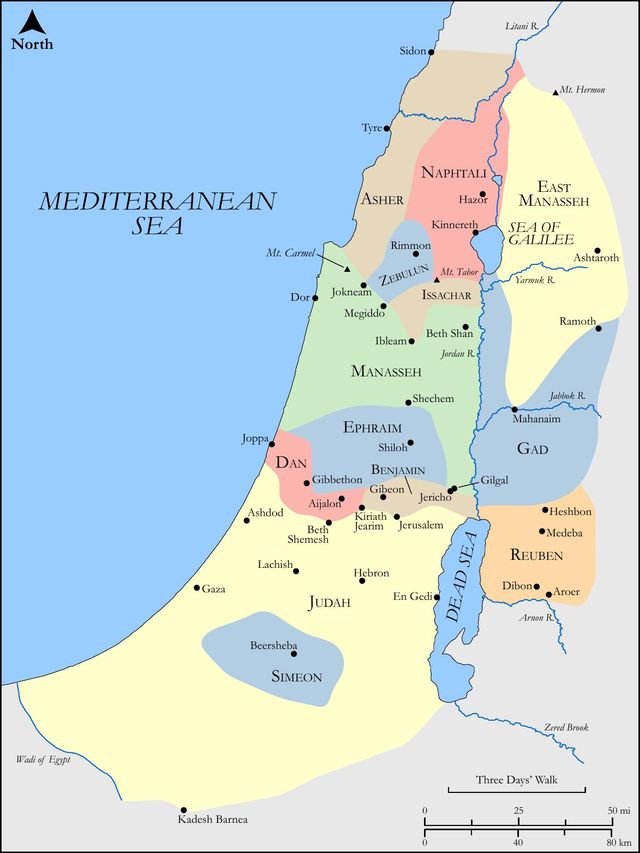
See on the biblical-era maps
Study this verse
Public-domain commentary
Matthew Henry
From his Commentary on the Whole Bible. Henry comments on passages, not single verses — this entry covers Joshua 19:17–23.
The lot of Issachar ran from Jordan in the east to the great sea in the west, Manasseh on the south, and Zebulun on the north. A numerous tribe, Num 26:25. Tola, one of the judges, was of this tribe, Jdg 10:1. So was Baasha, one of the kings of Israel, Kg1 15:27. The most considerable places in this tribe were, 1. Jezreel, in which was Ahab's palace, and near it Naboth's vineyard. 2. Shunem, where lived that good Shunamite that entertained Elisha. 3. The river Kishon, on the banks of which, in this tribe, Sisera was beaten by Deborah and Barak. 4. The mountains of Gilboa, on which Saul and Jonathan were slain, which were not far from Endor, where Saul consulted the witch. 5. The valley of Megiddo, where Josiah was slain near Hadad-rimmon, Kg2 23:29; Zac 12:11.
Continue studying Joshua 19:21 across the web’s major study libraries — every link below opens this exact verse, chapter, or book on the destination site.
Read & Compare
 BibleGatewayThis verse in more than 200 translations and 70 languages.
 Bible.comThe YouVersion reader — hundreds of translations, reading plans, and highlights.
 ESV.orgCrossway's official English Standard Version reader.
 NET BibleThe NET translation with 60,000+ translators' notes on every rendering decision.
 STEP BibleTyndale House's free study tool — original text, vocabulary, and scholarly resources.
 BibliaLogos Bible Software's free web reader.
 USCCBThe New American Bible (Revised Edition) with the U.S. bishops' study notes.
Commentaries
 BibleHub CommentariesDozens of classic commentaries on this verse, gathered on one page.
 StudyLightMore than 100 commentary sets — the largest collection on the web.
 BibleRefPlain-English commentary on what this verse means, verse by verse.
 Enduring WordDavid Guzik's free commentary on this chapter, widely used by Bible teachers.
 Bible Study ToolsVerse commentary alongside Greek and Hebrew study aids.
Original Language & Research
- BibleHub InterlinearThe verse word by word — original language, transliteration, and English.
- BibleHub LexiconEvery word's original-language definition and Strong's entry.
 Blue Letter BibleDeep-study tools — Strong's numbers, concordance, and word studies.
 SefariaThe Hebrew text with Rashi and centuries of Jewish commentary.
Sermons, Hymns & Audio


TrulyRandomVerse is not affiliated with these sites and doesn’t control their content. They’re linked because they’re genuinely useful.
Summary
Joshua 19:21 is a concise yet profoundly significant verse, meticulously listing four towns—Remeth, Engannim, Enhaddah, and Bethpazzez—as integral components of the territorial inheritance divinely allotted to the tribe of Issachar. This seemingly simple enumeration is a vital element within the comprehensive record of land distribution in Canaan, powerfully underscoring God's unwavering faithfulness in fulfilling His ancient covenant promises to Abraham and his descendants, ensuring each tribe received its precisely defined and divinely appointed portion with meticulous detail.
Context
ShowHideLiterary Context
Joshua 19 marks a pivotal stage in the book of Joshua, detailing the final phase of land allocation to the remaining seven Israelite tribes: Benjamin, Simeon, Zebulun, Issachar, Asher, Naphtali, and Dan. This chapter follows the initial, larger divisions granted to Judah, Ephraim, and Manasseh in earlier chapters, establishing a complete picture of the tribal inheritances. The entire process of distributing the land was conducted by lot at Shiloh, the central place of worship where the tabernacle resided, under the authoritative supervision of Joshua, Eleazar the priest, and the heads of the tribal families. Specifically, Joshua 19:17-23 outlines the boundaries and cities belonging to the tribe of Issachar, with verse 21 providing a further enumeration of specific towns within their designated territory. The inclusion of such detailed lists throughout Joshua 13-19 serves as an indispensable legal and historical record, validating the divine fulfillment of God's promises and establishing clear land titles for each tribe.
Historical & Cultural Context
The events described in Joshua 19 unfold during the crucial initial settlement period of Canaan, immediately following the successful military campaigns led by Joshua. In Israel, land was not merely property; it was the fundamental basis of wealth, identity, social standing, and long-term security. A clearly defined tribal inheritance was therefore paramount for maintaining social order, preventing inter-tribal disputes, and ensuring the long-term viability and continuity of each family line within the larger nation of Israel. The meticulous recording of these boundaries and cities reflected a practice of establishing legal deeds and property rights, akin to modern land registries, as when Jeremiah signed and sealed the deed for his cousin's field. Furthermore, the allocation by lot at Shiloh, under the guidance of Israel's spiritual and political leadership, profoundly emphasized that the land was a divine gift, not merely a conquest, reinforcing God's absolute sovereignty over the land and its people, as promised to Abraham in Genesis 15:18.
Key Themes
ShowHideThe meticulous enumeration of towns in Joshua 19:21, though seemingly mundane, powerfully contributes to several overarching themes foundational to the book of Joshua and the Pentateuch. First, it highlights Divine Faithfulness and Fulfillment, demonstrating God's absolute commitment to honoring His covenant promises made to the patriarchs, particularly Abraham, concerning the land of Canaan. Every city listed, every boundary drawn, testifies to God's unwavering word and His capacity to bring His promises to pass. Second, it underscores Order and Specificity in God's divine plan. The precise nature of the land distribution, down to individual towns and their named features, reveals that God's governance is not vague or arbitrary but meticulously detailed, ensuring each tribe received its exact, divinely appointed inheritance and minimizing future conflicts over territory. Finally, these lists establish Tribal Identity and Inheritance, solidifying the distinct geographical and communal identity of the tribe of Issachar, as well as all other tribes. Each tribe had a specific place and role within the unified nation of Israel, emphasizing both their individual heritage and their collective identity under God's sovereign rule, as seen in the broader account of the land's division in Joshua 14.
Exposition and Analysis
ShowHideKey Word Analysis
ShowHideFrom the root רָמָה (ramah), meaning "height," this name likely indicates a town situated on elevated ground or a place of prominence. Such geographical features were often strategically important and could signify a place of strong defense or a vantage point within the tribal territory, highlighting the diverse landscape of Issachar's inheritance.
Literally translating to "fountain of gardens," this name vividly portrays a place of natural abundance. The presence of a "fountain" (עַיִן, ʿayin) signifies a vital and reliable water source, crucial for sustenance in the semi-arid climate of Canaan. "Gardens" (גַּן, gan) further suggests fertile, cultivated land, indicating agricultural prosperity and divine provision within Issachar's inheritance.
Derived from בַּיִת (bayit, "house") and a root related to פּוּץ (puts, "to scatter" or "disperse"), this name means "house of dispersion." While its specific historical context is debated, such names could refer to a place where people were scattered, perhaps a former battleground, a place of settlement for dispersed families, or even a place where goods were spread out for market. Its inclusion, like the others, precisely delineates the boundaries of Issachar's inheritance.
Verse Breakdown
ShowHide"And Remeth"
This phrase introduces the first of four specific towns listed in this verse as part of Issachar's inheritance. Its inclusion signifies a precise geographical location, contributing to the detailed mapping of the tribe's designated territory and underscoring the granular nature of the land distribution.
"and Engannim"
Following Remeth, Engannim is named, likely a significant settlement known for its fertile springs and cultivated areas. Its inclusion not only marks another boundary point but also highlights the natural abundance and agricultural potential within Issachar's allotted land, serving as a tangible testament to God's generous provision.
"and Enhaddah"
This third town, characterized by a "swift spring," further emphasizes the presence of vital water sources within Issachar's territory. The repetition of "spring" in the names of successive towns underscores the critical importance of water for sustenance, agriculture, and prosperity in the region, reflecting the life-giving nature of the promised land.
"and Bethpazzez"
The final town listed in this specific verse, Bethpazzez completes this segment of Issachar's territorial description. While its precise meaning ("house of dispersion") invites speculation about its historical character, its inclusion, like the others, contributes to the exhaustive and precise record of the land division, ensuring no part of the divinely promised inheritance was left unrecorded or undefined.
Literary Devices
ShowHideThe primary literary device employed in Joshua 19:21, and indeed throughout the land division chapters of Joshua, is Cataloging or Listing. This technique involves the systematic enumeration of items—in this case, towns—to convey a profound sense of completeness, precision, and historical authenticity. The sheer volume and meticulous detail of these lists serve to emphasize the exhaustive nature of God's fulfillment of His promises to Israel. The repeated use of the conjunction "and" (polysyndeton) linking each town name creates a rhythmic, almost incantatory effect, reinforcing the meticulous and comprehensive nature of the land allocation process. Furthermore, the Geographical Specificity inherent in the place names themselves (e.g., "fountain of gardens," "swift spring") functions as a descriptive device, providing a mental map of the territory and highlighting the natural features and resources of the land God graciously provided. This detailed nomenclature transforms what might seem like a mere list into a vibrant testament to divine provision and order.
Theological and Thematic Connections
ShowHideJoshua 19:21, though a simple list of names, is profoundly significant in its theological implications. It stands as a testament to God's meticulous and unwavering faithfulness in fulfilling His covenant promises. The detailed enumeration of towns, even those seemingly obscure to a modern reader, underscores that God's plans are not vague abstractions but concrete realities, precisely executed. This divine attention to detail in the physical distribution of land reflects God's sovereign control over all creation and human affairs, demonstrating that His word is reliable and His promises are certain. For the Israelites, these lists were not merely geographical data; they were a tangible, verifiable record of their heritage, a constant reminder of God as their ultimate Provider and the One who keeps His word across generations. This divine precision in land distribution foreshadows God's meticulous care in every aspect of His redemptive plan, culminating in the person and work of Jesus Christ.
Reflection and Application
ShowHideWhile Joshua 19:21 might initially appear as a dry, genealogical-style listing of names, its profound spiritual lessons lie in its context and implications. This verse reminds us that God is a God of meticulous detail, who faithfully fulfills every promise, no matter how small or seemingly insignificant. Just as He precisely allocated land to each tribe, down to the specific towns and their characteristics, so too does He have a specific plan and purpose for each of our lives, extending even to the seemingly minor details. This should inspire profound trust and unwavering confidence in His providence, even when our circumstances seem mundane, our path unclear, or His promises delayed. It encourages us to recognize God's hand in the seemingly ordinary aspects of our lives, appreciating His faithfulness in providing for our needs and guiding our steps, just as He provided a tangible and detailed inheritance for Issachar. This passage calls us to reflect on the absolute certainty of God's promises, knowing that if He was faithful in the physical inheritance of Israel, He will be even more faithful in the spiritual inheritance promised to us through Christ, which is far greater and eternal.
Questions for Reflection
ShowHideFAQ
ShowHideWhy are these specific cities listed, and what is their significance?
ShowHideThe cities listed in Joshua 19:21—Remeth, Engannim, Enhaddah, and Bethpazzez—are part of the comprehensive and detailed record of the territorial inheritance allotted to the tribe of Issachar. Their listing served a crucial legal and historical purpose, acting as a definitive deed for the tribe's possessions within the Promised Land. The names themselves often carry descriptive meanings in Hebrew, such as "fountain of gardens" for Engannim or "house of dispersion" for Bethpazzez, which provides insight into the geographical and agricultural characteristics of the land God provided. The ultimate significance lies in demonstrating God's unwavering faithfulness and precision in fulfilling His covenant promises to Israel, establishing their distinct tribal identities, and ensuring a clear, undisputed inheritance for each family. This meticulous detail underscores that God's plan for His people is concrete and reliable.
Does this verse have any prophetic significance?
ShowHideWhile Joshua 19:21 is not directly prophetic in the sense of foretelling a specific future event, it carries profound theological significance that points forward to the broader narrative of God's redemptive plan. The meticulous fulfillment of God's promise to give Israel a physical inheritance in the land serves as a powerful type or shadow of the ultimate, spiritual inheritance provided through Jesus Christ. It underscores the foundational principle of God's absolute faithfulness to His word. This faithfulness, demonstrated in the land distribution, assures believers that God will also fulfill His greater promises of eternal life and an incorruptible inheritance in the heavenly kingdom, which are fully realized in Christ. It foreshadows the divine precision with which God orchestrates salvation history, culminating in the new heavens and new earth.
Christ-Centered Fulfillment
ShowHideThe detailed land distribution in Joshua, including the specific towns listed in Joshua 19:21, finds its ultimate and glorious fulfillment in Jesus Christ. The earthly inheritance of Canaan, though a tangible expression of God's faithfulness to Israel, was always a shadow pointing to a greater, eternal reality. Jesus is the true and ultimate inheritance for God's people, the one who secures for us not merely a plot of land, but an eternal dwelling in the "heavenly country" (as described in Hebrews 11:16). Just as God meticulously ensured every tribe received its portion, Christ, as the heir of all things (Hebrews 1:2), grants to believers an inheritance that is imperishable, undefiled, and unfading, kept in heaven for us (1 Peter 1:4). Through His atoning work, we are "chosen... having been predestined according to the purpose of Him who works all things according to the counsel of His will, to the end that we who were the first to hope in Christ would be to the praise of His glory" (Ephesians 1:11-12). The precision of the land allocation in Joshua foreshadows the divine precision of God's redemptive plan, where every promise finds its "Yes" and "Amen" in Christ (2 Corinthians 1:20), culminating in the new heavens and new earth where righteousness dwells and God's people inherit eternal life with Him (Revelation 21:1-4).