


Joshua 19:20
- וְהָרַבִּיתve·ha·ra·Bitand <the> RabbithH7245Conj-w ¦ Art ¦ N-properNoun Proper Locationוְandהָ<the>רַבִּיתRabbith
- וְקִשְׁיוֹןve·kish·Yonand KishionH7191Conj-w ¦ N-properNoun Proper LocationוְandקִשְׁיוֹןKishion
- וָאָבֶץva·'A·vetzand EbezH77Conj-w ¦ N-properNoun Proper LocationוָandאָבֶץEbez
English is a literal word-by-word gloss of the Hebrew, not the KJV's wording. Why?
This is the original text the KJV's translators worked from — each Hebrew word with its own literal English meaning in this verse, prepared by scholars at Tyndale House, Cambridge. The KJV translates whole sentences, not word by word, so its wording differs: one Hebrew word can become several English words, and the KJV may choose “the LORD” where the gloss reads “Yahweh”. Both are faithful — they answer different questions. For the KJV's own rendering, switch to the KJV text.
Details
See on the biblical-era map
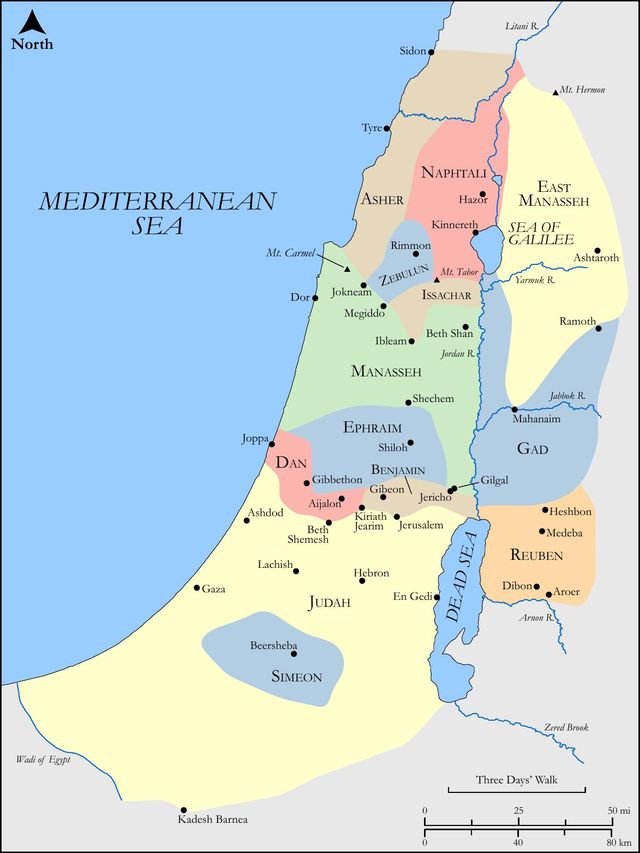
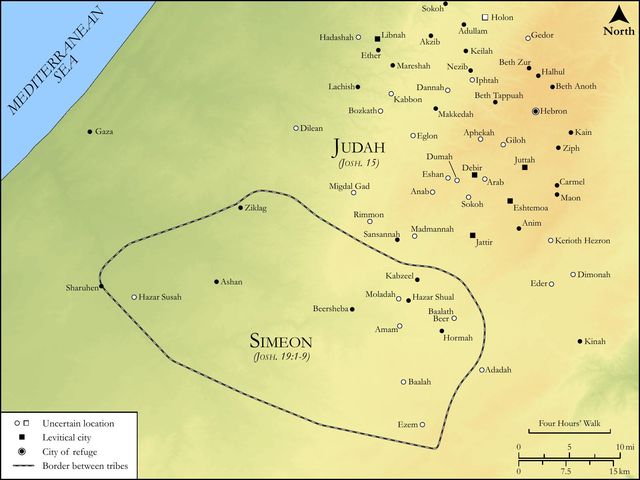
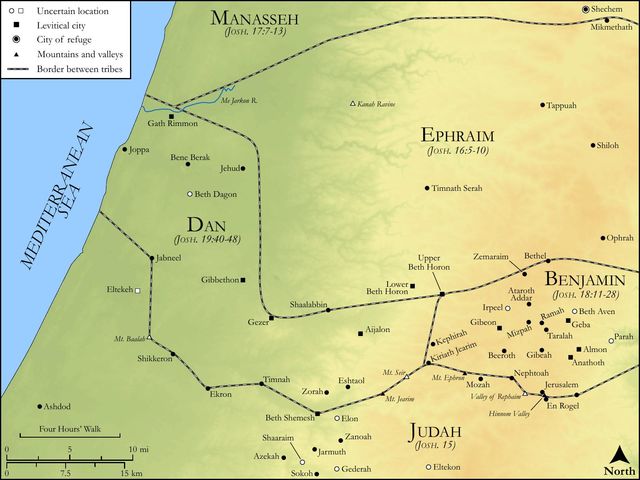
Study this verse
Public-domain commentary
Matthew Henry
From his Commentary on the Whole Bible. Henry comments on passages, not single verses — this entry covers Joshua 19:17–23.
The lot of Issachar ran from Jordan in the east to the great sea in the west, Manasseh on the south, and Zebulun on the north. A numerous tribe, Num 26:25. Tola, one of the judges, was of this tribe, Jdg 10:1. So was Baasha, one of the kings of Israel, Kg1 15:27. The most considerable places in this tribe were, 1. Jezreel, in which was Ahab's palace, and near it Naboth's vineyard. 2. Shunem, where lived that good Shunamite that entertained Elisha. 3. The river Kishon, on the banks of which, in this tribe, Sisera was beaten by Deborah and Barak. 4. The mountains of Gilboa, on which Saul and Jonathan were slain, which were not far from Endor, where Saul consulted the witch. 5. The valley of Megiddo, where Josiah was slain near Hadad-rimmon, Kg2 23:29; Zac 12:11.
Continue studying Joshua 19:20 across the web’s major study libraries — every link below opens this exact verse, chapter, or book on the destination site.
Read & Compare
 BibleGatewayThis verse in more than 200 translations and 70 languages.
 Bible.comThe YouVersion reader — hundreds of translations, reading plans, and highlights.
 ESV.orgCrossway's official English Standard Version reader.
 NET BibleThe NET translation with 60,000+ translators' notes on every rendering decision.
 STEP BibleTyndale House's free study tool — original text, vocabulary, and scholarly resources.
 BibliaLogos Bible Software's free web reader.
 USCCBThe New American Bible (Revised Edition) with the U.S. bishops' study notes.
Commentaries
 BibleHub CommentariesDozens of classic commentaries on this verse, gathered on one page.
 StudyLightMore than 100 commentary sets — the largest collection on the web.
 BibleRefPlain-English commentary on what this verse means, verse by verse.
 Enduring WordDavid Guzik's free commentary on this chapter, widely used by Bible teachers.
 Bible Study ToolsVerse commentary alongside Greek and Hebrew study aids.
Original Language & Research
- BibleHub InterlinearThe verse word by word — original language, transliteration, and English.
- BibleHub LexiconEvery word's original-language definition and Strong's entry.
 Blue Letter BibleDeep-study tools — Strong's numbers, concordance, and word studies.
 SefariaThe Hebrew text with Rashi and centuries of Jewish commentary.
Sermons, Hymns & Audio


TrulyRandomVerse is not affiliated with these sites and doesn’t control their content. They’re linked because they’re genuinely useful.
Summary
Joshua 19:20, a succinct verse listing Rabbith, Kishion, and Abez, meticulously enumerates three cities allotted to the tribe of Issachar within their territorial inheritance. Far from a mere geographical detail, this verse profoundly underscores God's meticulous faithfulness in fulfilling His ancient covenant promises to Israel, demonstrating the orderly and tangible reality of their settlement in the Promised Land under divine guidance and precise provision.
Context
ShowHideLiterary Context
Joshua 19:20 is embedded within the extensive account of the land distribution among the tribes of Israel, specifically detailing the inheritance of Issachar (Joshua 19:17-23). This section follows the division of land for other tribes (e.g., Judah, Ephraim, Manasseh) and precedes the allocation for Asher, Naphtali, and Dan, culminating in Joshua's own inheritance. The consistent listing of boundaries, cities, and villages throughout Joshua 13-19 emphasizes the comprehensive and systematic nature of the land allocation, serving as a tangible record of God's promise fulfilled. The specific mention of cities like Rabbith, Kishion, and Abez provides concrete evidence of the detailed fulfillment of the divine covenant, transforming abstract promises into specific, inhabitable places, reinforcing the historical veracity of the narrative.
Historical & Cultural Context
The events described in Joshua 19 occur in the post-conquest period, after Israel's military campaigns against the Canaanite city-states and prior to the establishment of the monarchy. The division of the land by lot, overseen by Joshua and Eleazar the priest (as mentioned in Joshua 19:51), was a divinely sanctioned method to ensure impartiality and to signify God's direct hand in the inheritance. The tribe of Issachar was known for its agricultural prowess and its strategic location in the fertile Jezreel Valley, a vital corridor for trade and military movements. Historically, the possession of specific towns and territories was foundational to tribal identity, economic stability, and the establishment of a national presence, directly fulfilling the Abrahamic covenant promises of land and nationhood found in Genesis 12:7. This meticulous division laid the groundwork for Israel's unique identity as a people dwelling in a land given by YHWH.
Key Themes
ShowHideThe inclusion of these seemingly obscure city names contributes significantly to several overarching themes within the book of Joshua and the broader biblical narrative. Firstly, it powerfully illustrates Divine Faithfulness, serving as irrefutable proof that God meticulously honors every detail of His covenant promises, even down to specific geographical locations. Secondly, the systematic enumeration highlights Orderly Inheritance, demonstrating God's preference for order, justice, and precise provision for His people, ensuring each tribe received a clearly defined and undisputed portion. This orderly division prevented chaos and laid the groundwork for Israel's societal structure and future governance. Lastly, these lists collectively portray God's Bountiful Provision, showcasing His generosity in granting His people a land of rest and abundance after generations of wandering and warfare, a land "flowing with milk and honey" as promised in Exodus 3:8 and reiterated throughout the Pentateuch.
Exposition and Analysis
ShowHideKey Word Analysis
ShowHideDerived from a root meaning "multitude," this name suggests a populous place or one with the potential for significant habitation. Its inclusion underscores the tangible nature of the inheritance, implying a place of dwelling and growth within Issachar's territory, reflecting the prosperity God intended for His people.
This name is linked to the concept of "hard ground." While its exact implications for the city are debated, it could suggest a place with firm foundations, perhaps a fortified position, or simply a descriptor of the local terrain. Its mention confirms the specific, diverse geographical features included in the tribal allotments.
From a root likely meaning "to gleam," this name signifies "conspicuous." This might indicate a prominent landmark, a city situated on a height, or one that was easily identifiable within the landscape. Its listing, alongside the others, reinforces the precise and verifiable nature of the land distribution.
Verse Breakdown
ShowHide"And Rabbith,"
This clause introduces the first of three specific cities listed in this particular sequence for the tribe of Issachar. The conjunction "and" links it directly to the preceding descriptions of Issachar's boundaries and other cities, emphasizing the continuous and comprehensive nature of their inheritance. It signifies another distinct, identifiable location within the tribe's allotted territory.
"and Kishion,"
The second city in this triad, its inclusion further reinforces the meticulous detail with which the land was divided. Each named city represents a tangible piece of the divine promise, validating the accuracy and thoroughness of the biblical record concerning the land distribution and God's precise fulfillment of His word.
"and Abez,"
The final city in this short enumeration, completing the list for this specific verse. The repetition of the conjunction "and" before each city name creates a cumulative effect, highlighting the numerous and specific places that constituted Issachar's allotted territory, demonstrating a complete and precise fulfillment of God's word to His people.
Literary Devices
ShowHideThe primary literary device at play in Joshua 19:20 is Enumeration or Cataloging. The verse presents a simple list of three place names: Rabbith, Kishion, and Abez. This technique is used extensively throughout Joshua 13-19 to document the precise boundaries and cities allotted to each tribe. Its purpose is not to tell a story but to provide a factual, detailed record, lending an air of Verisimilitude and historical accuracy to the narrative. The specific, often obscure, names of these cities serve to ground the account in concrete reality, demonstrating that the inheritance was not a vague promise but a tangible, geographically defined possession. The repeated use of the conjunction "and" before each city name also functions as a subtle form of Polysyndeton, emphasizing the additive nature of the inheritance and the completeness of the divine provision, underscoring the thoroughness of God's fulfillment.
Theological and Thematic Connections
ShowHideJoshua 19:20, despite its brevity, serves as a powerful testament to the meticulous nature of God's covenant faithfulness. The listing of these specific, often obscure, cities underscores that God's promises are not vague generalities but precise and tangible realities. Just as a legal deed meticulously lists properties, this verse confirms the divine "deed" of the land to Israel. It highlights God's commitment to every detail of His word, demonstrating that His provision is both comprehensive and exact. This meticulousness should inspire profound trust in His care for every aspect of our lives, knowing that if He is faithful in such grand, detailed promises, He is certainly faithful in our individual circumstances, down to the seemingly insignificant details.
Reflection and Application
ShowHideJoshua 19:20, a seemingly mundane list of ancient cities, carries profound implications for contemporary believers. It reminds us that God is a God of intricate details, and His faithfulness extends to every specific promise He makes. Just as He precisely allocated land to the tribes of Israel, down to individual towns like Rabbith, Kishion, and Abez, He meticulously cares for the specific needs, circumstances, and "inheritances" of His people today. This verse encourages us to cultivate a deep trust in God's unwavering faithfulness, even when our lives feel ordinary or when we are navigating seemingly insignificant details. It challenges us to recognize God's hand in the everyday provisions and to see our own lives as part of a larger, divinely ordered plan. Furthermore, it prompts us to consider our spiritual inheritance in Christ—a reality far grander than any physical land—and to live in light of the certainty of those eternal promises, stewarding the blessings He has bestowed upon us with gratitude and purpose.
Questions for Reflection
ShowHideFAQ
ShowHideWhy are these specific cities listed, and what is their significance?
ShowHideThese specific cities—Rabbith, Kishion, and Abez—are listed as part of the territorial inheritance allotted to the tribe of Issachar. Their significance lies not in their individual historical prominence (which is often obscure), but in their collective function within the biblical narrative. They serve as tangible, verifiable proof of God's meticulous faithfulness in fulfilling His ancient covenant promises to Abraham and his descendants regarding the land of Canaan. The detailed enumeration underscores the orderly and precise nature of the land division, demonstrating that Israel's inheritance was a concrete reality, not a vague concept. It also highlights the divine hand in the allocation, as the land was divided by lot under the supervision of Joshua and Eleazar the priest, as described in Joshua 19:51. This attention to detail emphasizes God's commitment to every aspect of His word.
Christ-Centered Fulfillment
ShowHideWhile Joshua 19:20 describes a physical land inheritance, it powerfully foreshadows the spiritual inheritance that believers receive in Christ. The meticulous detail with which God allocated earthly territory to Israel points to the even greater precision and certainty of the spiritual blessings He has prepared for His people through His Son. Just as the land was a gift of rest and provision after wandering and warfare, so too is Christ our ultimate rest and the source of every spiritual blessing. Through Him, we are blessed with "every spiritual blessing in the heavenly places" (Ephesians 1:3) and have obtained an "inheritance" (Ephesians 1:11) that is imperishable, undefiled, and unfading, kept in heaven for us (1 Peter 1:4). The physical land was a shadow; Christ is the substance. He is the mediator of a new covenant, so that those who are called may receive the promised eternal inheritance (Hebrews 9:15). The true "Promised Land" for the Christian is not a geographical location, but a living reality in union with Christ, where we share in the "inheritance of the saints in light" (Colossians 1:12) and anticipate the ultimate fulfillment when the meek shall inherit the earth (Matthew 5:5) as part of the new heavens and new earth.