


Joshua 19:36
Bible text: King James Version (1769 Blayney text) · Public domain
Bible text: American Standard Version (1901) · Public domain
Bible text: World English Bible, Messianic edition · Public domain
Bible text: Geneva Bible (1599) · Public domain
Bible text: Young's Literal Translation · Public domain
- וַאֲדָמָהva·'a·da·Mahand AdamahH128Conj-w ¦ N-properNoun Proper LocationוַandאֲדָמָהAdamah
- וְהָרָמָהve·ha·ra·Mahand <the> RamahH7414Conj-w ¦ Art ¦ N-properNoun Proper Locationוְandהָ<the>רָמָהRamah
- וְחָצוֹרve·cha·Tzorand HazorH2674Conj-w ¦ N-properNoun Proper LocationוְandחָצוֹרHazor
English is a literal word-by-word gloss of the Hebrew, not the KJV's wording. Why?
This is the original text the KJV's translators worked from — each Hebrew word with its own literal English meaning in this verse, prepared by scholars at Tyndale House, Cambridge. The KJV translates whole sentences, not word by word, so its wording differs: one Hebrew word can become several English words, and the KJV may choose “the LORD” where the gloss reads “Yahweh”. Both are faithful — they answer different questions. For the KJV's own rendering, switch to the KJV text.
Details
See on the biblical-era maps
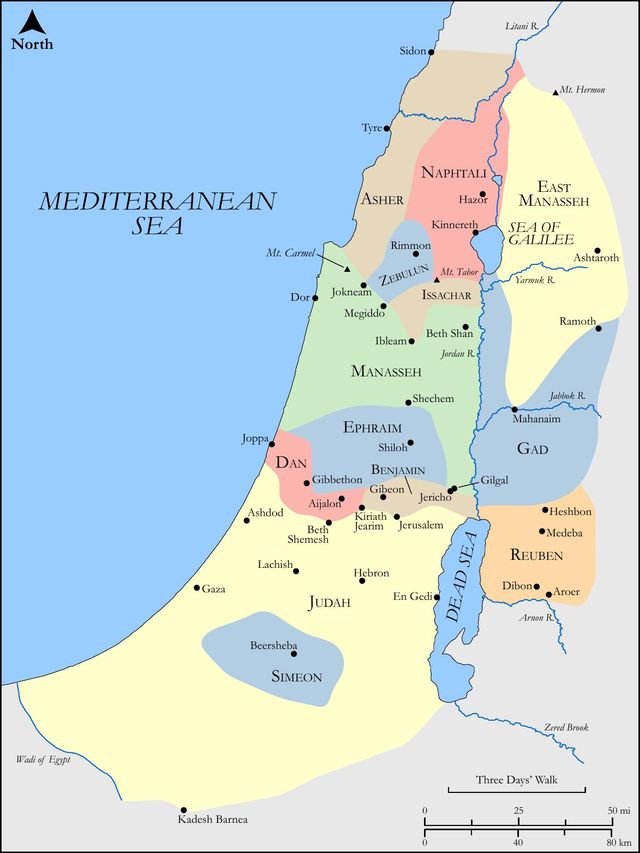
Study this verse
Public-domain commentary
Matthew Henry
From his Commentary on the Whole Bible. Henry comments on passages, not single verses — this entry covers Joshua 19:32–39.
Naphtali lay furthest north of all the tribes, bordering on Mount Libanus. The city of Leshem, or Liash, lay on the utmost edge of it to the north, and therefore when the Danites had made themselves masters of it, and called it Dan, the length of Canaan from north to south was reckoned from Dan to Beersheba. It had Zebulun on the south, Asher on the west, and Judah upon Jordan, probably a city of that name, and so distinguished from the tribe of Judah on the east. It was in the lot of this tribe, near the waters of Merom, that Joshua fought and routed Jabin, Jos 11:1. etc. In this tribe stood Capernaum and Bethsaida, on the north end of the sea of Tiberias, in which Christ did so many mighty works; and the mountain (as is supposed) on which Christ preached, Mat 5:1.
Continue studying Joshua 19:36 across the web’s major study libraries — every link below opens this exact verse, chapter, or book on the destination site.
Read & Compare
 BibleGatewayThis verse in more than 200 translations and 70 languages.
 Bible.comThe YouVersion reader — hundreds of translations, reading plans, and highlights.
 ESV.orgCrossway's official English Standard Version reader.
 NET BibleThe NET translation with 60,000+ translators' notes on every rendering decision.
 STEP BibleTyndale House's free study tool — original text, vocabulary, and scholarly resources.
 BibliaLogos Bible Software's free web reader.
 USCCBThe New American Bible (Revised Edition) with the U.S. bishops' study notes.
Commentaries
 BibleHub CommentariesDozens of classic commentaries on this verse, gathered on one page.
 StudyLightMore than 100 commentary sets — the largest collection on the web.
 BibleRefPlain-English commentary on what this verse means, verse by verse.
 Enduring WordDavid Guzik's free commentary on this chapter, widely used by Bible teachers.
 Bible Study ToolsVerse commentary alongside Greek and Hebrew study aids.
Original Language & Research
- BibleHub InterlinearThe verse word by word — original language, transliteration, and English.
- BibleHub LexiconEvery word's original-language definition and Strong's entry.
 Blue Letter BibleDeep-study tools — Strong's numbers, concordance, and word studies.
 SefariaThe Hebrew text with Rashi and centuries of Jewish commentary.
Sermons, Hymns & Audio


TrulyRandomVerse is not affiliated with these sites and doesn’t control their content. They’re linked because they’re genuinely useful.
Summary
Joshua 19:36 is a concise yet profoundly significant verse, embedded within the meticulous record of the land allotments to the Israelite tribes following their conquest of Canaan. It specifically names three cities—Adamah, Ramah, and Hazor—as part of the divinely appointed inheritance for the tribe of Naphtali. This seemingly simple enumeration underscores God's unwavering faithfulness in fulfilling His ancient covenant promises, demonstrating His meticulous order and provision in establishing His people within the Promised Land, thereby securing their identity and future prosperity.
Context
ShowHideLiterary Context
This verse is situated within Joshua chapter 19, which meticulously details the boundaries and cities assigned to the final six tribes of Israel: Simeon, Zebulun, Issachar, Asher, Naphtali, and Dan. The preceding chapters describe the initial conquest of Canaan and the establishment of the Tabernacle at Shiloh, a pivotal moment signifying the beginning of settled life (Joshua 18:1). Joshua, Eleazar the priest, and the tribal heads oversaw this land division by lot, a process understood as divinely guided, ensuring that God's promise to Abraham and his descendants to inherit the land was precisely fulfilled (Genesis 12:7). The inclusion of specific city names like Adamah, Ramah, and Hazor within Naphtali's portion emphasizes the thoroughness and divine precision of this distribution, transforming a vast, conquered territory into defined, tribal inheritances.
Historical & Cultural Context
The division of land was a foundational act for the nascent Israelite nation, transitioning them from nomadic conquerors to settled inhabitants. In Israel, land ownership was synonymous with identity, security, and economic stability. The meticulous listing of cities and boundaries was crucial for establishing clear tribal jurisdictions, preventing disputes, and facilitating governance and defense. The act of casting lots for land distribution was not seen as a gamble but as a means for God to reveal His specific will, ensuring that each tribe received its designated portion directly from Him. This period marked the fulfillment of centuries of divine promises, establishing Israel as a distinct people with a divinely sanctioned homeland, a critical step in their covenant relationship with Yahweh.
Key Themes
ShowHideThe meticulous detailing of land allotments throughout Joshua, including the specific cities in Joshua 19:36, powerfully highlights God's unwavering faithfulness in fulfilling His covenant promises. The land, a central component of the Abrahamic Covenant (Genesis 15:18), is now precisely distributed, demonstrating God's commitment to His word across generations. Furthermore, this systematic division underscores God's divine order and meticulous provision. Every tribe, down to the specific cities within their inheritance, received a clear and secure portion, reflecting God's careful attention to the needs and future of His people. Finally, these geographical markers were indispensable for establishing tribal identity and inheritance, solidifying the boundaries and future prosperity of the tribe of Naphtali within the Promised Land, rooting their communal and individual lives in the tangible reality of God's gift.
Exposition and Analysis
ShowHideKey Word Analysis
ShowHideVerse Breakdown
ShowHide"And Adamah,"
The verse begins with a conjunction, linking it to the preceding list of cities within Naphtali's inheritance. "Adamah" signifies a specific, named settlement, a tangible piece of the tribe's allotted territory, emphasizing the precise and individual nature of God's provision and the concrete reality of the promised land.
"and Ramah,"
The repetition of the conjunction "and" continues the enumeration, adding another distinct city to Naphtali's portion. "Ramah," with its connotation of elevation, highlights the varied topography within the tribal boundaries and the strategic importance of its settlements, demonstrating God's comprehensive provision for diverse needs.
"and Hazor,"
The final city listed in this particular verse, "Hazor," further completes this segment of the territorial description. Its name, suggesting a fortified place, underscores the practical realities of settlement in Canaan, where defense and security were paramount, even as God provided the land, indicating that divine provision often works through human effort and strategy.
"And Adamah, and Ramah, and Hazor"
The cumulative effect of this brief list, like many others in Joshua, is to convey the meticulous detail and comprehensive scope of the land distribution. It transforms abstract promises into concrete geographical realities, affirming God's faithfulness in fulfilling His word down to the very names of the towns and villages, establishing a secure and defined inheritance for His people.
Literary Devices
ShowHideJoshua 19:36, though brief, effectively employs several literary devices. The primary device is Catalogue or Enumeration, as the verse is part of an extended list of cities belonging to the tribe of Naphtali. This methodical listing serves to demonstrate the comprehensive nature of the land division and the precise fulfillment of God's promise. The repeated use of the conjunction "and" ("And Adamah, and Ramah, and Hazor") is an example of Polysyndeton, which slows the pace of reading and emphasizes each item in the list individually, giving each city distinct importance within the tribal inheritance and highlighting the thoroughness of the divine allocation. Furthermore, the use of Toponymy (the study of place names) is central, as the names themselves (Adamah meaning "ground," Ramah meaning "height," Hazor meaning "enclosure") often carry descriptive or historical significance, subtly informing the reader about the nature or location of these settlements and adding layers of meaning to the geographical details.
Theological and Thematic Connections
ShowHideJoshua 19:36, by listing specific cities within Naphtali's inheritance, powerfully reinforces the overarching biblical theme of God's covenant faithfulness and His meticulous care for His people. The physical land of Canaan was not merely a conquest but a divine inheritance, a tangible fulfillment of promises made centuries earlier to Abraham. This precise allocation demonstrates that God's promises are not vague generalities but specific, detailed commitments that He brings to pass. It underscores the divine order in creation and redemption, where every detail, even seemingly minor place names, contributes to the grand tapestry of God's redemptive plan. The secure possession of this land was foundational to Israel's identity as God's chosen people, providing the necessary stability for their national and spiritual development and serving as a testament to Yahweh's sovereignty and reliability.
Reflection and Application
ShowHideThe seemingly dry list of names in Joshua 19:36 offers profound spiritual lessons for contemporary believers. It serves as a powerful reminder of God's meticulous attention to detail and His unwavering commitment to His promises. Just as God precisely allotted every piece of land to each tribe, down to the specific cities, He cares for the intricate details of our lives and provides for our every need. This verse encourages us to trust in God's faithfulness, knowing that if He was so precise in fulfilling ancient land promises, He is certainly faithful to His greater spiritual promises to us. It invites us to consider our own "inheritance" in Christ—not a physical land, but a spiritual reality of belonging, purpose, and eternal security. Every part of God's Word, even the seemingly insignificant, contributes to the larger narrative of His redemptive plan, urging us to seek Him in every detail of our lives and to find our ultimate security and identity in His unfailing character.
Questions for Reflection
ShowHideFAQ
ShowHideWhy are these detailed lists of cities important in the book of Joshua?
ShowHideThese detailed lists are crucial for several reasons. First, they serve as legal and historical documentation, confirming the precise fulfillment of God's covenant promises to give the land of Canaan to Israel (Genesis 12:7). Second, they established clear tribal boundaries, which were essential for maintaining order, preventing disputes, and ensuring the distinct identity and administration of each tribe within the newly settled land. Third, they demonstrate God's meticulous and orderly nature, showing that His provision for His people is comprehensive and specific, down to the very towns they would inhabit. Finally, they underscore the tangible reality of the inheritance, moving from abstract promise to concrete possession, solidifying the foundation for Israel's future as a nation.
Is the Hazor mentioned in Joshua 19:36 the same famous Hazor whose king Jabin was defeated by Joshua?
ShowHideWhile the name "Hazor" (meaning "enclosure" or "fortress") was common in ancient Canaan, the Hazor mentioned in Joshua 19:36 as part of Naphtali's inheritance is generally considered to be a different, smaller settlement than the great northern city of Hazor, whose king Jabin was a powerful adversary defeated by Joshua earlier in the conquest (Joshua 11:1-11). The famous Hazor was a major Canaanite city-state, strategically located, and its destruction was a significant military achievement that impacted the entire region. The Hazor in Naphtali's list was likely a less prominent town that simply shared the common descriptive name, indicating its fortified nature rather than its regional dominance.
Christ-Centered Fulfillment
ShowHideThe physical inheritance of land in Joshua, exemplified by the cities of Adamah, Ramah, and Hazor given to Naphtali, serves as a powerful type and shadow pointing to the ultimate spiritual inheritance found in Jesus Christ. Just as Israel received a promised land for their rest and dwelling, believers in Christ are granted a far greater, eternal inheritance—the Kingdom of God itself, and all the spiritual blessings that come with being co-heirs with Christ (Ephesians 1:11 and Romans 8:17). The conquest and settlement in Canaan prefigure the believer's spiritual victory over sin and death through Christ's finished work on the cross, leading to a spiritual "rest" that transcends any earthly peace (Hebrews 4:1-11). Jesus is the true Joshua, leading His people into a new and living covenant, securing for them an imperishable, undefiled, and unfading inheritance reserved in heaven (1 Peter 1:3-5). Thus, the meticulous detail of Joshua 19:36, affirming God's faithfulness to a physical promise, ultimately magnifies His even greater faithfulness in providing a spiritual, eternal inheritance through His Son, the Lamb of God who takes away the sin of the world, whose sacrifice guarantees our eternal dwelling with Him.