


Numbers 34:6
Bible text: King James Version (1769 Blayney text) · Public domain
Bible text: Berean Standard Bible · Public domain
Bible text: American Standard Version (1901) · Public domain
Bible text: World English Bible, Messianic edition · Public domain
Bible text: Geneva Bible (1599) · Public domain
Bible text: Young's Literal Translation · Public domain
- וּגְבוּלu·ge·Vuland [the] border ofH1366Conj-w ¦ N-mscNoun Singular Masculine Constructוּandגְבוּל[the] border of
- יָםYam[the] westH3220N-msNoun Singular Masculine Absolute
- וְהָיָהve·ha·Yahand it will beH1961Conj-w ¦ V-Qal-ConsecPerf-3msVerb Qal Consecutive Perfect 3rd Singular Masculineוְandהָיָהit will be
- לָכֶםla·Khemfor <the> youPrep-l ¦ 2mpSuffix Personal 2nd Plural Masculineלָfor <the>כֶםyou
- הַיָּםhai·Yamthe seaH3220Art ¦ N-msNoun Singular Masculine Absoluteהַtheיָּםsea
- הַגָּדוֹלha·ga·Dol<the> greatH1419Art ¦ Adj-msAdjective Singular Masculine Absoluteהַ<the>גָּדוֹלgreat
- וּגְבוּלu·ge·Vuland a borderH1366Conj-w ¦ N-msNoun Singular Masculine Absoluteוּandגְבוּלa border
- זֶהzehthisH2088PrtParticle Demonstrative
- יִהְיֶהyih·Yehit will beH1961V-Qal-Imperf-3msVerb Qal Imperfect 3rd Singular Masculine
- לָכֶםla·Khemof youPrep-l ¦ 2mpSuffix Personal 2nd Plural Masculineלָofכֶםyou
- גְּבוּלge·Vulborder ofH1366N-mscNoun Singular Masculine Construct
- יָםYam[the] westH3220N-msNoun Singular Masculine Absolute
English is a literal word-by-word gloss of the Hebrew, not the KJV's wording. Why?
This is the original text the KJV's translators worked from — each Hebrew word with its own literal English meaning in this verse, prepared by scholars at Tyndale House, Cambridge. The KJV translates whole sentences, not word by word, so its wording differs: one Hebrew word can become several English words, and the KJV may choose “the LORD” where the gloss reads “Yahweh”. Both are faithful — they answer different questions. For the KJV's own rendering, switch to the KJV text.
Details
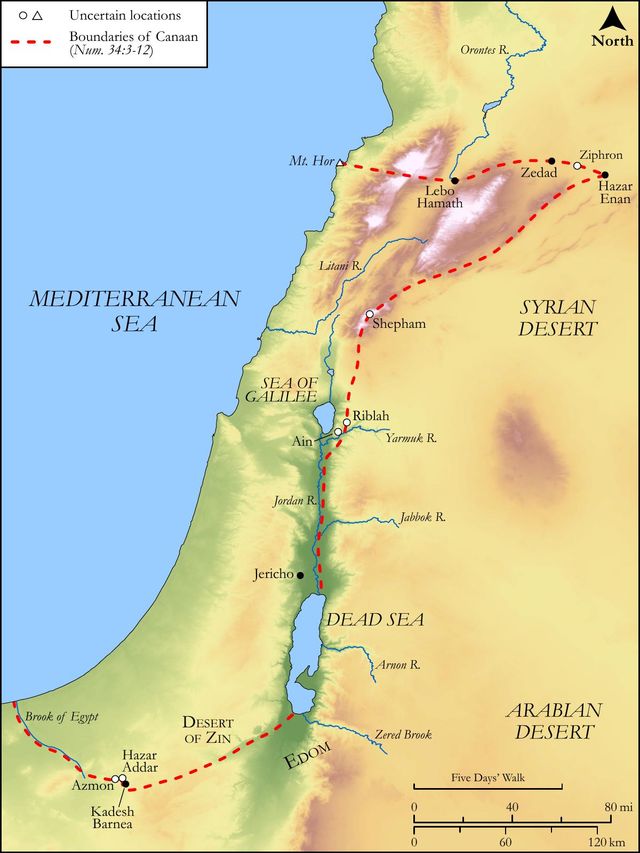
See on the biblical-era map
Study this verse
Continue studying Numbers 34:6 across the web’s major study libraries — every link below opens this exact verse, chapter, or book on the destination site.
Read & Compare
 BibleGatewayThis verse in more than 200 translations and 70 languages.
 Bible.comThe YouVersion reader — hundreds of translations, reading plans, and highlights.
 ESV.orgCrossway's official English Standard Version reader.
 NET BibleThe NET translation with 60,000+ translators' notes on every rendering decision.
 STEP BibleTyndale House's free study tool — original text, vocabulary, and scholarly resources.
 BibliaLogos Bible Software's free web reader.
 USCCBThe New American Bible (Revised Edition) with the U.S. bishops' study notes.
Commentaries
 BibleHub CommentariesDozens of classic commentaries on this verse, gathered on one page.
 StudyLightMore than 100 commentary sets — the largest collection on the web.
 BibleRefPlain-English commentary on what this verse means, verse by verse.
 Enduring WordDavid Guzik's free commentary on this chapter, widely used by Bible teachers.
 Bible Study ToolsVerse commentary alongside Greek and Hebrew study aids.
Original Language & Research
- BibleHub InterlinearThe verse word by word — original language, transliteration, and English.
- BibleHub LexiconEvery word's original-language definition and Strong's entry.
 Blue Letter BibleDeep-study tools — Strong's numbers, concordance, and word studies.
 SefariaThe Hebrew text with Rashi and centuries of Jewish commentary.
Sermons, Hymns & Audio


TrulyRandomVerse is not affiliated with these sites and doesn’t control their content. They’re linked because they’re genuinely useful.
Summary
Numbers 34:6 precisely defines the western boundary of the land of Canaan, the divinely promised inheritance for the tribes of Israel, as the "Great Sea" (the Mediterranean). This concise verse, part of God's meticulous instructions to Moses, underscores the certainty and tangibility of His covenant promises to provide a specific, secure territory for His people, ensuring clarity and preventing future disputes over the sacred land. It highlights the divine precision in fulfilling ancient pledges and establishing Israel's national identity within its God-given borders.
Context
ShowHideLiterary Context
Numbers 34:6 is situated within a detailed legal and administrative section (Numbers 34:1-12) where the Lord directly instructs Moses on the exact geographical boundaries of the land of Canaan, which is to be distributed among the nine and a half tribes of Israel. This passage immediately follows the account of the allocation of land to the tribes of Reuben, Gad, and half of Manasseh on the east side of the Jordan River, as described in Numbers 32:33, and precedes the appointment of the specific leaders who would oversee the division of the land, detailed in Numbers 34:16-29. The meticulous detail reflects the divine blueprint for Israel's settlement, emphasizing order, preventing future territorial conflicts, and ensuring that the inheritance is received according to God's precise design.
Historical & Cultural Context
After forty years of wilderness wandering, the Israelites were on the cusp of entering the Promised Land. This period marked a crucial transition from a nomadic existence to a settled national life. Establishing clear, divinely mandated borders was paramount for the nascent nation, providing security against encroaching peoples and a defined territory for their unique identity as God's covenant people. Among the nations, land ownership and clear boundaries were paramount, often leading to disputes and warfare. God's precise delineation, including natural features like the "Great Sea," served to legitimize Israel's claim and provide a basis for their national sovereignty, directly fulfilling the ancient promises made to Abraham, as recorded in Genesis 15:18. This divine mapping ensured the land was a gift, not merely a conquest.
Key Themes
ShowHideThis verse contributes significantly to several overarching themes in Numbers and the broader Pentateuch. Firstly, it highlights Divine Faithfulness and Provision, demonstrating God's unwavering commitment to fulfilling His covenant promises to Abraham, Isaac, and Jacob to give their descendants a specific land, a promise reiterated in Genesis 12:7. Secondly, the meticulous geographical detail emphasizes Divine Order and Sovereignty, showing God's meticulous planning and control over the destiny of His people, down to the very borders of their inheritance. This divine precision ensures stability and prevents chaos. Thirdly, it underscores the theme of Inheritance and Possession, portraying the land not merely as conquered territory but as a sacred, secure gift from God, foundational to Israel's national and religious identity within the covenant, a concept central to the book of Joshua.
Exposition and Analysis
ShowHideKey Word Analysis
ShowHideThis word (H3220) is crucial as it appears three times in the KJV text of Numbers 34:6, translated as "western," "sea," and "west." Its primary meaning is a large body of water, specifically the Mediterranean Sea, often described as "roaring" due to its waves. Crucially, it also denotes the geographical "west" (as the Mediterranean was west of Canaan). This dual meaning makes it the perfect, unambiguous marker for Israel's western boundary, being both a vast natural feature and a clear directional indicator.
Meaning "great" or "large" (H1419), this adjective modifies "sea" to form "the Great Sea." It emphasizes the immense size and permanence of the Mediterranean, solidifying its role as an unalterable, divinely appointed landmark. The term reinforces the idea that this is not a minor stream but a significant, unmistakable natural barrier, reflecting the grandeur of God's provision.
This term (H1366) signifies a fixed, defined boundary, often marked by natural features or human-made markers. Derived from a root meaning "to twist" (like a cord used for measurement), it implies a precise demarcation. In this verse, its repetition (appearing three times) underscores the legal and theological weight of this divinely sanctioned limit of Israel's inheritance, emphasizing its certainty and finality, leaving no room for ambiguity or dispute.
Verse Breakdown
ShowHide"And as for the western border"
This opening clause immediately sets the geographical focus, indicating a specific direction within the overall land survey. It signals a systematic transition from the southern boundary previously described in Numbers 34:3-5, moving methodically around the land to ensure comprehensive delineation.
"ye shall even have the great sea for a border"
This is the core declaration, directly assigning the Mediterranean Sea as the definitive western boundary. The phrase "ye shall even have" (וְהָיָה לָכֶם, v'hayah lakhem') conveys a sense of divine decree and assured possession, emphasizing that this is a gift from God. The "Great Sea" is not merely a geographical feature but is formally designated as the legal and practical limit, unchangeable and unmistakable.
"this shall be your west border"
This concluding phrase reiterates and reinforces the previous statement, providing a clear and unambiguous summary. The repetition serves to emphasize the certainty and permanence of this divinely established boundary, leaving absolutely no room for doubt or future dispute regarding Israel's western frontier. It solidifies the divine mandate.
Literary Devices
ShowHideThe verse primarily employs Repetition and Geographical Specificity. The repetition of the word "border" (Hebrew, gᵉbûwl') three times within this short verse serves to emphasize the certainty, permanence, and divine authority behind the demarcation of the land. This linguistic reinforcement underscores the non-negotiable nature of God's decree regarding Israel's territory, ensuring its fixed status. The use of "the Great Sea" is a prime example of Geographical Specificity, providing an unmistakable and enduring natural landmark that removes all ambiguity. This precision reflects God's meticulous attention to detail and His desire for order and clarity in the inheritance He bestows upon His people. Furthermore, the verse functions as a form of Legal Declaration, formally establishing a boundary within a larger divine legal code for the nascent nation of Israel, underscoring the divine authority behind their territorial claims.
Theological and Thematic Connections
ShowHideNumbers 34:6, while seemingly a mere geographical detail, is deeply theological. It powerfully illustrates God's absolute faithfulness to His covenant promises, specifically His pledge to provide a land for Abraham's descendants. The precision of the boundary, defined by an unchangeable natural feature like the Mediterranean Sea, underscores the unwavering certainty and reliability of God's word. This divine provision of a secure, defined inheritance speaks to God's meticulous care for His people, establishing their national identity and providing a tangible space for their covenant relationship with Him to flourish. It is a testament to the fact that God's plans are not vague aspirations but concrete realities, precisely laid out and certainly fulfilled, demonstrating His sovereignty over all creation and His unwavering commitment to His chosen people.
Reflection and Application
ShowHideThe meticulous detail of Numbers 34:6, defining the western border of Israel's inheritance, offers profound lessons for our lives today. Just as God provided a clear, secure, and divinely ordained territory for His ancient people, He also provides boundaries and guidance for our lives. These are not meant to restrict us but to define our spiritual inheritance, protect us from chaos, and enable us to flourish within His will. The certainty of the "Great Sea" as an unchangeable border reminds us that God's promises are firm and His provision unwavering. We can trust that His plans for us are precise, purposeful, and will come to pass, even when the path seems unclear. This verse encourages us to embrace God's order, find security in His boundaries, and rest in the faithfulness of a God who meticulously fulfills every detail of His word, demonstrating His enduring love and care for His people across generations.
Questions for Reflection
ShowHideFAQ
ShowHideWhy was it so important for God to give such detailed geographical instructions for the land?
ShowHideIt was critically important for several reasons. First, it demonstrated God's absolute faithfulness in fulfilling His ancient covenant promises to Abraham, Isaac, and Jacob to give their descendants a specific land, a promise first articulated in Genesis 12:7. The precision underscored the tangibility and certainty of this divine gift. Second, clear boundaries prevented future disputes among the tribes themselves and with neighboring nations, promoting peace and order within the nascent nation. Third, a defined territory was essential for Israel's national identity, security, and the establishment of their unique covenant relationship with God as a distinct people. It was the physical space where God's laws would be lived out and His presence manifested, as further elaborated in Deuteronomy 4.
Christ-Centered Fulfillment
ShowHideWhile Numbers 34:6 speaks of a physical inheritance for ancient Israel, its deeper theological resonance finds ultimate fulfillment in Christ. The "Great Sea" as an unchangeable border for a physical land foreshadows the boundless and eternal spiritual inheritance secured for believers through Jesus Christ. Just as God meticulously defined Israel's earthly dwelling, Christ, through His atoning work, has prepared an eternal dwelling and an immeasurable spiritual inheritance for all who believe, as He promised in John 14:2-3. The certainty of the "Great Sea" as a border points to the unwavering certainty of God's new covenant promises, ratified by the blood of Christ, which are "yes" and "amen" in Him, as affirmed in 2 Corinthians 1:20. Our "borders" are no longer geographical but are defined by the boundless grace and eternal life found in Him, making us co-heirs with Christ in an inheritance that is imperishable, undefiled, and unfading, kept in heaven for us, as beautifully described in Romans 8:17 and 1 Peter 1:4.