


Ezekiel 47:20
Bible text: King James Version (1769 Blayney text) · Public domain
Bible text: Berean Standard Bible · Public domain
Bible text: American Standard Version (1901) · Public domain
Bible text: World English Bible, Messianic edition · Public domain
Bible text: Geneva Bible (1599) · Public domain
Bible text: Young's Literal Translation · Public domain
- וּפְאַתu·fe·'atand [the] side ofH6285Conj-w ¦ N-fscNoun Singular Feminine Constructוּandפְאַת[the] side of
- יָםyam[the] westH3220N-msNoun Singular Masculine Absolute
- הַיָּםhai·Yam[is] the seaH3220Art ¦ N-msNoun Singular Masculine Absoluteהַ[is] theיָּםsea
- הַגָּדוֹלha·ga·Dol<the> greatH1419Art ¦ Adj-msAdjective Singular Masculine Absoluteהַ<the>גָּדוֹלgreat
- מִגְּבוּלmi·ge·Vulfrom [the] borderH1366Prep-m ¦ N-msNoun Singular Masculine Absoluteמִfromגְּבוּל[the] border
- עַד'adtoH5704PrepPreposition
- נֹכַחNo·khachoppositeH5227Adj-mscAdjective Numerical Singular Masculine Construct
- לְבוֹאle·Vo'LeboH935V-Qal-InfVerb Qal Infinitive Construct
- חֲמָתcha·MatHamathH2574N-properNoun Proper Location
- זֹאתzotthisH2063PrtParticle Demonstrative
- פְּאַתpe·'at[is the] side ofH6285N-fscNoun Singular Feminine Construct
- יָםYam[the] westH3220N-msNoun Singular Masculine Absolute
English is a literal word-by-word gloss of the Hebrew, not the KJV's wording. Why?
This is the original text the KJV's translators worked from — each Hebrew word with its own literal English meaning in this verse, prepared by scholars at Tyndale House, Cambridge. The KJV translates whole sentences, not word by word, so its wording differs: one Hebrew word can become several English words, and the KJV may choose “the LORD” where the gloss reads “Yahweh”. Both are faithful — they answer different questions. For the KJV's own rendering, switch to the KJV text.
Details
See on the biblical-era map
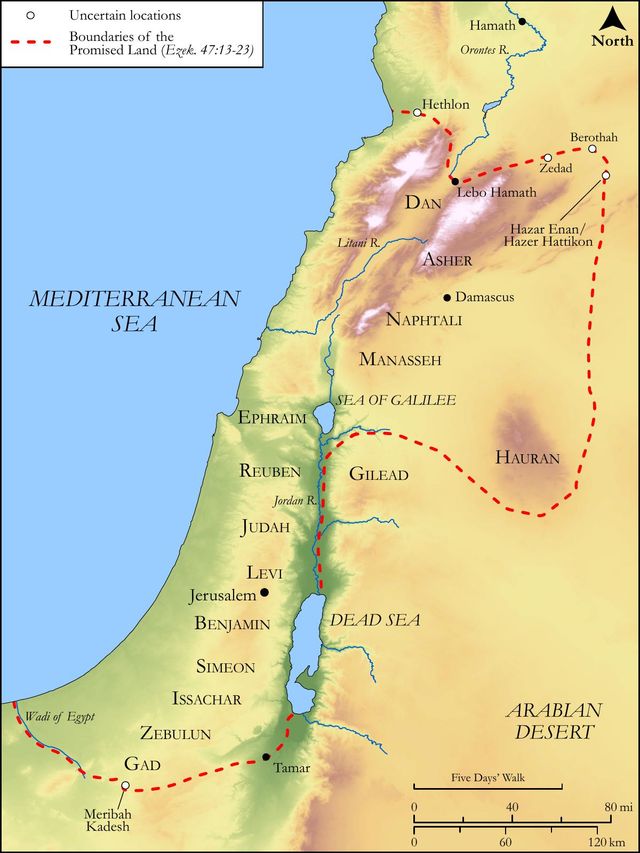
Study this verse
Public-domain commentary
Matthew Henry
From his Commentary on the Whole Bible. Henry comments on passages, not single verses — this entry covers Ezekiel 47:13–23.
We are now to pass from the affairs of the sanctuary to those of the state, from the city to the country. 1. The Land of Canaan is here secured to them for an inheritance (Eze 47:14): I lifted up my hand to give it unto your fathers, that is, promised it upon oath to them and their posterity. Though the possession had been a great while discontinued, yet God had not forgotten his oath which he swore to their fathers. Though God's providences may for a time seem to contradict his promises, yet the promise will certainly take place at last, for God will be ever mindful of his covenant. I lifted up my hand to give it, and therefore it shall without fail fall to you for an inheritance. Thus the heavenly Canaan is sure to all the seed, because it is what God, who cannot lie, has promised. 2. It is here circumscribed, and the bounds and limits of it are fixed, which they must not pass over to encroach upon their neighbours and which their neighbours shall not break through to encroach upon them. We had such a draught of the borders of Canaan when Joshua was to put the people in possession of it, Num 34:1, etc. That begins with the salt sea in the south, goes round and ends there. This begins with Hamath about Damascus in the north, and so goes round and ends there, Eze 47:20. Note, It is God that appoints the bounds of our habitation; and his Israel shall always have cause to say that the lines have fallen to them in pleasant places. The lake of Sodom is here called the east sea, for it, being healed by the waters of the sanctuary, it is no more to be called a salt sea, as it was in Numbers. 3. It is here ordered to be divided among the tribes of Israel, reckoning Joseph for two tribes, to make up the number of twelve, when Levi was taken out to attend the sanctuary, and had his lot adjoining to that (Eze 47:13, Eze 47:21): You shall inherit it, one as well as another, Eze 47:14. The tribes shall have an equal share, one as much as another. As the tribes returned out of Babylon, this seems unequal, because some tribes were much more numerous than the other, and indeed the most were of Judah and Benjamin and very few of the other ten tribes; but as the twelve tribes stand, in type and vision, for the gospel-church, the Israel of God, it was very equal, because we find in another vision an equal number of each of the twelve tribes sealed for the living God, just 12,000 of each, Rev 7:5, etc. And to those sealed ones these allotments did belong. It intimates likewise that all the subjects of Christ's kingdom have obtained like precious faith. Male and female, Jew and Gentile, bond and free, are all alike welcome to Christ and made partakers of him. 4. The strangers who sojourn among them, who shall beget children and be built up into families, and so help to people their country, shall have inheritance among the tribes, as if they had been native Israelites (Eze 47:22, Eze 47:23), which was by no means allowed in Joshua's division of the land. This is an act for a general naturalization, which would teach the Jews who was their neighbour, not those only of their own nation and religion, but those, whoever they were, that they had an opportunity of showing kindness to, because from them they would be willing to receive kindness. It would likewise invite strangers to come and settle among them, and put themselves under the wings of the divine Majesty. But it certainly looks at gospel-times, when the partition-wall between Jew and Gentile was taken down, and both one in Christ, in whom there is no difference, Rom 10:12. This land was a type of the heavenly Canaan, that better country (Heb 11:16), in which believing Gentiles shall have a blessed lot, as well as believing Jews, Isa 56:3.
Historical interpretation
Historical reception
1 surviving comment on this verse from the historical church.
(Verse 20) And the plague of the sea, the great sea from the border in a straight line, until you come to Emath, this is the plague of the sea. Of which the Book of Numbers writes more clearly and briefly. But the western plague will begin from the great sea and will conclude at the very end, that is, from sea to sea: to the torrent, namely the Rhinocorura, which flows into the sea, up to the place that is opposite the city of Emath in Syria, of which we have spoken above. But the setting sun, according to the laws of tropology, is always in the sea: always in the salt and waves, where shipwrecks occur daily, and the deaths of the wretched, and the loss of wealth and goods, and yet when we have endured all these with patience, we come straight to Emath, that is, to the truth of the Lord, who, having conquered persecutions, has promised us eternal rewards.
Continue studying Ezekiel 47:20 across the web’s major study libraries — every link below opens this exact verse, chapter, or book on the destination site.
Read & Compare
 BibleGatewayThis verse in more than 200 translations and 70 languages.
 Bible.comThe YouVersion reader — hundreds of translations, reading plans, and highlights.
 ESV.orgCrossway's official English Standard Version reader.
 NET BibleThe NET translation with 60,000+ translators' notes on every rendering decision.
 STEP BibleTyndale House's free study tool — original text, vocabulary, and scholarly resources.
 BibliaLogos Bible Software's free web reader.
 USCCBThe New American Bible (Revised Edition) with the U.S. bishops' study notes.
Commentaries
 BibleHub CommentariesDozens of classic commentaries on this verse, gathered on one page.
 StudyLightMore than 100 commentary sets — the largest collection on the web.
 BibleRefPlain-English commentary on what this verse means, verse by verse.
 Enduring WordDavid Guzik's free commentary on this chapter, widely used by Bible teachers.
 Bible Study ToolsVerse commentary alongside Greek and Hebrew study aids.
Original Language & Research
- BibleHub InterlinearThe verse word by word — original language, transliteration, and English.
- BibleHub LexiconEvery word's original-language definition and Strong's entry.
 Blue Letter BibleDeep-study tools — Strong's numbers, concordance, and word studies.
 SefariaThe Hebrew text with Rashi and centuries of Jewish commentary.
Sermons, Hymns & Audio


TrulyRandomVerse is not affiliated with these sites and doesn’t control their content. They’re linked because they’re genuinely useful.
Summary
Ezekiel 47:20 precisely delineates a significant portion of the western boundary for the divinely promised land in the prophet's grand vision of Israel's restoration. This verse meticulously specifies that the western extent of the territory will be defined by "the great sea" (the Mediterranean), stretching northward to the region "over against Hamath," thereby establishing a clear and expansive geographical limit for the future inheritance of the twelve tribes. It powerfully underscores the meticulous nature of God's covenant promises and His sovereign plan for His people's return to a secure and flourishing homeland.
Context
ShowHideLiterary Context
Ezekiel 47:20 is embedded within the concluding section of Ezekiel's prophecy (chapters 40-48), which presents a detailed, visionary blueprint for a restored Israel. This section begins with the elaborate description of a new temple and its worship, then transitions in chapter 47 to the miraculous, life-giving river flowing from the temple, symbolizing spiritual renewal and abundant blessing. Following this, the chapter shifts focus to the precise geographical boundaries of the re-allotted land for the tribes of Israel (Ezekiel 47:13-23). Verse 20, along with its surrounding verses, meticulously defines the western limits of this restored territory, emphasizing the divine precision and tangible reality of God's comprehensive restoration plan for the exiles. The inclusion of such specific geographical details grounds the eschatological vision in a concrete, understandable reality, assuring the exiled community of a definite and secure future.
Historical & Cultural Context
The phrase "the great sea" in Ezekiel 47:20 unequivocally refers to the Mediterranean Sea, which historically served as the natural western frontier of the ancient Near East and the land of Canaan. "Hamath," identified with modern Hama in Syria, was a prominent ancient city-state located significantly north of Israel's traditional borders. In biblical geography, Hamath frequently functioned as a conventional northern marker, signifying the ideal or maximal extent of the Promised Land, as evidenced in other scriptural accounts such as Numbers 34:8 and 1 Kings 8:65. For the exiled Israelites, these familiar geographical reference points would have resonated deeply, serving as powerful reminders of the ancient covenant promises regarding the land that God had solemnly sworn to their ancestors. The emphasis on precise boundaries was paramount in ancient Near Eastern land deeds, treaties, and divine allocations, signifying clear ownership, secure inheritance, and the unassailable nature of God's gift.
Key Themes
ShowHideThe meticulous geographical description in Ezekiel 47:20 contributes significantly to several overarching theological and narrative themes within the book of Ezekiel and broader biblical theology. Firstly, it powerfully underscores the theme of Divine Sovereignty and Allocation. God's absolute authority over the land is demonstrated through His meticulous care in its precise measurement and distribution. The land is not merely returned but divinely apportioned, emphasizing that it is a sacred gift and an eternal inheritance, not merely a conquered territory. Secondly, this verse reinforces the theme of Restoration and Covenant Fulfillment. Following the devastating experience of exile and national ruin, this vision promises a complete and thorough restoration of Israel, encompassing not only spiritual renewal but also the physical re-establishment within a divinely defined and secure homeland. This echoes and affirms earlier covenant promises made to Abraham concerning the land, as recorded in passages like Genesis 15:18. Finally, the delineation of these "ideal" boundaries, extending northward to Hamath, speaks to the theme of God's Maximal Blessing and Full Inheritance. It portrays the full, ideal scope of the Promised Land, often referenced in other biblical texts as the ultimate extent of Israel's inheritance, such as in Numbers 34:6.
Exposition and Analysis
ShowHideKey Word Analysis
ShowHideDerived from an unused root meaning "to roar," this term refers to a sea or any large body of water. Crucially, when used with the definite article, as it is here ("the great sea"), it almost exclusively denotes the Mediterranean Sea, which lies to the west of the land of Israel. Its inclusion firmly anchors the prophetic vision in recognizable geography, underscoring the tangible nature of the future restoration and God's precise plan for His people. The term also carries the local directional meaning of "west," which is explicitly stated in the verse, reinforcing its role as the western boundary.
This adjective signifies "great" in various senses, including magnitude, importance, or extent. When paired with "sea," it serves to emphasize the vastness, prominence, and significance of the Mediterranean as a natural and unmistakable boundary. Its presence highlights the grandeur of the divinely appointed territory and the immense scope of God's promised inheritance, reflecting the expansive nature of His blessing.
Originating from a root meaning "walled," Hamath was a historically significant ancient city situated in Syria, considerably north of the traditional Israelite settlements. In the context of biblical geography, Hamath consistently served as a conventional northern marker for the ideal or maximal extent of the Promised Land. Its mention in this verse solidifies the extensive reach of the restored land's western border, extending to a well-known and distant landmark, signifying the full breadth of the territory God intends for His people.
Verse Breakdown
ShowHide"The west side also [shall be] the great sea from the border"
This opening clause establishes the fundamental western boundary of the envisioned land. "The west side" (literally "the side of the sea") is unequivocally defined by "the great sea," which refers to the vast Mediterranean. The phrase "from the border" indicates that this immense body of water itself forms the primary and initial line of demarcation for the western extent of the territory, commencing from a specified point. This highlights the natural and divinely appointed nature of this boundary.
"till a man come over against Hamath"
This phrase precisely delineates the northern reach of the western boundary. It specifies that the border, defined by the Mediterranean Sea, extends northward "until one comes opposite Hamath." Hamath, a well-known city far to the north, functions as a clear geographical landmark, signifying the maximal northern extent of the western coastline that belongs to the restored Israel. This detail emphasizes the expansive and generous nature of the promised inheritance, reaching its ideal limits.
"This [is] the west side"
This concluding declaration serves as a powerful reiteration and emphatic confirmation of the preceding geographical description. It succinctly summarizes and validates the defined western boundary, leaving no ambiguity about its precise location and extent. The repetition underscores the divine authority, certainty, and unalterable nature of this geographical allocation, reinforcing God's faithfulness to His detailed plan.
Literary Devices
ShowHideEzekiel 47:20 masterfully employs several literary devices to convey its message with clarity, certainty, and profound emphasis. Precision is a paramount feature, as the verse meticulously details specific geographical markers such as "the great sea" and "Hamath." This exactitude leaves no room for ambiguity regarding the western boundary, underscoring the tangible and certain nature of God's promises for the land. Repetition is evident in the concluding phrase, "This is the west side," which reiterates and confirms the preceding description. This serves to reinforce the divine decree concerning the land's allocation, impressing upon the reader the unalterable nature of God's plan. Furthermore, the entire vision, including this verse, utilizes profound Symbolism. While describing a literal land, the meticulous detail of its boundaries can symbolize the comprehensive and perfect nature of God's restoration, the security He provides for His people, and the completeness of their inheritance. The "great sea" itself, a vast and powerful natural feature, symbolizes a divinely established, immutable, and majestic boundary that God Himself has set.
Theological and Thematic Connections
ShowHideEzekiel 47:20, with its precise delineation of the western border, powerfully illustrates God's unwavering faithfulness to His covenant promises and His meticulous care for His people. The emphasis on a divinely allocated land, measured with such specificity, underscores that God's plans are not vague or arbitrary, but are rooted in His unchanging character and sovereign will. This vision of a restored, perfectly bounded land serves as a tangible expression of God's commitment to bring His people into a place of security, blessing, and flourishing. It speaks to the ultimate fulfillment of His redemptive purposes, where every detail is orchestrated by His divine wisdom, ensuring a secure and abundant future for His chosen people.
Reflection and Application
ShowHideEzekiel 47:20, though a specific geographical description from an ancient prophecy, offers profound spiritual insights and encouragement for believers today. It serves as a powerful reminder that God is a God of order, precision, and unwavering faithfulness, meticulously fulfilling every promise He makes. Just as He had a detailed and exact plan for the physical restoration and boundaries of Israel, He possesses an equally precise and perfect plan for our individual lives and for the ultimate destiny of His church. This verse encourages us to cultivate a deep trust in God's sovereign design, even when our present circumstances may appear chaotic, uncertain, or beyond our comprehension. It assures us that our spiritual inheritance in Christ is as real, as divinely secured, and as perfectly defined as the land promised to ancient Israel. We can find immense hope, security, and peace in knowing that God's promises are not vague aspirations but are firmly grounded in His unchanging character and will be perfectly realized, culminating in the ultimate restoration of all things in His kingdom.
Questions for Reflection
ShowHideFAQ
ShowHideWhy is the precise geographical detail in Ezekiel 47:20 so important?
ShowHideThe precise geographical detail in Ezekiel 47:20 is crucial for several profound reasons. Firstly, it grounds the prophetic vision in a tangible, verifiable reality, assuring the exiled Israelites that God's promises of restoration are not abstract ideals but concrete, future certainties. Secondly, it powerfully emphasizes God's meticulousness and absolute sovereignty over the land, demonstrating that the future inheritance is divinely allocated, perfectly measured, and unalterably secured. This precision underscores the certainty and faithfulness of God's covenant promises, particularly those related to the land given to Abraham's descendants, as seen in passages like Genesis 15:18. Moreover, defining the ideal, maximal extent of the Promised Land, reaching to Hamath, paints a picture of complete restoration and abundant blessing, far beyond what they had experienced.
Christ-Centered Fulfillment
ShowHideWhile Ezekiel 47:20 literally describes the western boundary of a future earthly inheritance for Israel, its ultimate fulfillment and profound spiritual significance are wonderfully realized in Christ. The concept of a divinely allotted and perfectly bounded land foreshadows the far greater spiritual inheritance and eternal dwelling place secured for all believers through Jesus. Just as the land was a gift of grace to Israel, so too is our salvation, our spiritual blessings, and our eternal life a gift, freely given through Christ's atoning work on the cross. The meticulous boundaries of the land can be seen as a type of the secure, boundless, and eternal inheritance we possess in Christ, where we are "blessed with every spiritual blessing in the heavenly places in Christ" (Ephesians 1:3). The ultimate "place" of God's dwelling and His people's inheritance is not merely an earthly territory but the New Jerusalem, where God dwells intimately with His redeemed people, and all curses are removed (Revelation 21:1-4). Christ Himself is our true "land" and "rest," the ultimate fulfillment of all God's promises, providing an eternal, secure, and perfectly defined spiritual reality that transcends any earthly boundary, as He is the one who leads us into the true promised land of God's glorious presence and eternal Sabbath rest (Hebrews 4:8-11).